🪵 Lac Culture Basics
A detailed lesson on lac insects, host plants, lac forms, and the enterprise value of lac culture.
Lac Culture Basics
Lac culture is the rearing of lac insects on suitable host trees so that they produce a valuable resin called lac.
What lac actually is
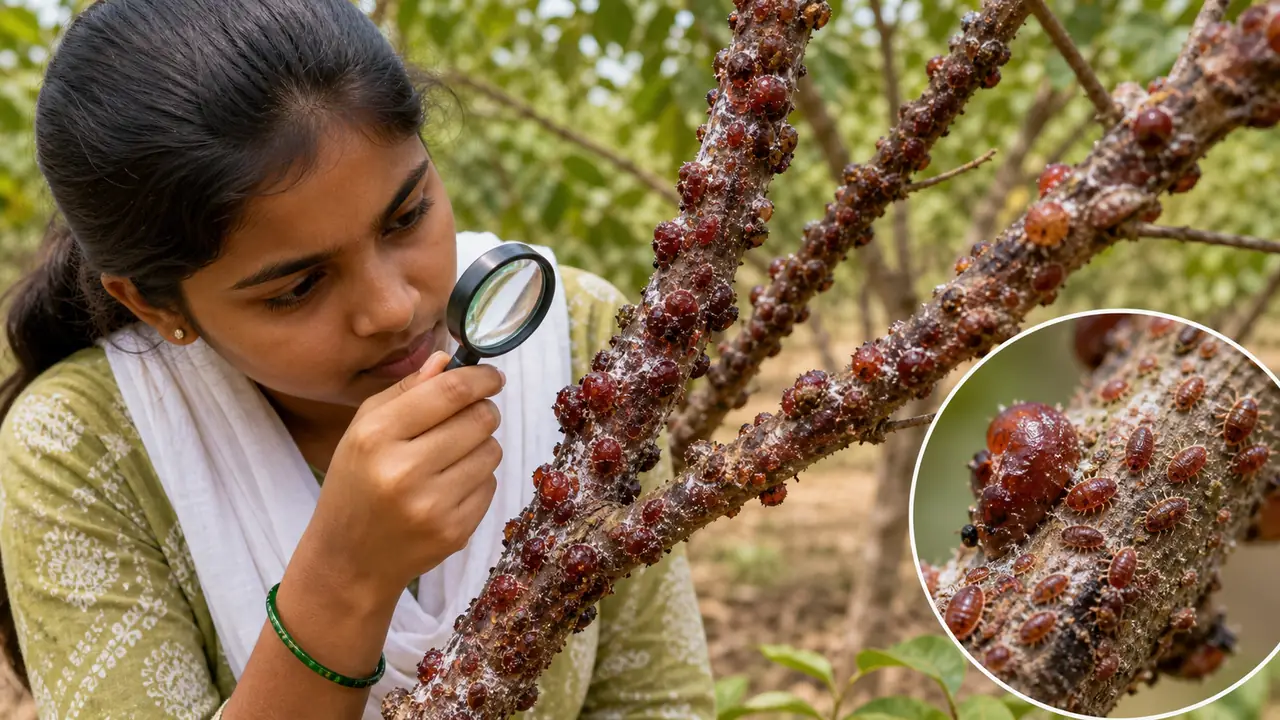
Lac is not a plant gum collected directly from bark. It is a resinous secretion produced by a tiny insect. The insect settles on young twigs, feeds from the plant tissue, and gradually surrounds itself with a protective resinous covering.
Historical and industrial background
Lac can be understood as an old Indian enterprise with long practical use. It is remembered not only for polishing, but also for sealing, insulation, and decorative work.
It also notes that shellac has historically been important in coatings and even in older industrial uses such as record-making before synthetic substitutes became common.
The textbook even connects lac with ancient Indian memory by recalling the famous lac palace episode from the Mahabharata. This is a useful reminder that lac is not a modern industrial invention; it has been known and used in the subcontinent for a very long time.
Pro Content Locked
Upgrade to Pro to access this lesson and all other premium content.
₹99 charged monthly · Cancel anytime
- All Agriculture & Banking Courses
- AI Lesson Questions (100/day)
- AI Doubt Solver (50/day)
- Glows & Grows Feedback (30/day)
- AI Section Quiz (20/day)
- 22-Language Translation (100/day)
- Recall Questions (20/day)
- AI Quiz (15/day)
- AI Quiz Paper Analysis (100/day)
- AI Step-by-Step Explanations (100/day)
- Spaced Repetition Recall (FSRS)
- AI Tutor
- Immersive Text Questions
- Audio Lessons — Hindi & English
- Mock Tests & Previous Year Papers
- Summary & Mind Maps
- XP, Levels, Leaderboard & Badges
- Generate New Classrooms
- Voice AI Teacher (AgriDots Live)
- AI Revision Assistant
- Knowledge Gap Analysis
- Interactive Revision (LangGraph)
🔒 Secure via Razorpay · Cancel anytime · No hidden fees
Lac Culture Basics
Lac culture is the rearing of lac insects on suitable host trees so that they produce a valuable resin called lac.
What lac actually is
Lac is not a plant gum collected directly from bark. It is a resinous secretion produced by a tiny insect. The insect settles on young twigs, feeds from the plant tissue, and gradually surrounds itself with a protective resinous covering.
Historical and industrial background
Lac can be understood as an old Indian enterprise with long practical use. It is remembered not only for polishing, but also for sealing, insulation, and decorative work.
It also notes that shellac has historically been important in coatings and even in older industrial uses such as record-making before synthetic substitutes became common.
The textbook even connects lac with ancient Indian memory by recalling the famous lac palace episode from the Mahabharata. This is a useful reminder that lac is not a modern industrial invention; it has been known and used in the subcontinent for a very long time.
Why lac culture matters
- creates income from tree-based farming systems
- suits small and rural enterprises
- gives commercial value to host trees
- produces industrial raw material for polishing and finishing work
Important host plants
The standard school-level examples associated with lac culture are:
- kusum
- palas
- ber
Healthy host plants are essential because the insect spends most of its useful life attached to the twig.
India has long been a major lac-producing region and that many livelihoods depend on this industry directly or indirectly.
Why host plants matter so much
Lac culture cannot be separated from host-plant management. Good host growth means better surface for settlement, feeding, and secretion. Poor host condition weakens the whole enterprise.
Lac culture is deeply tied to tree-based systems in India and nearby regions, so it fits naturally into agroforestry-linked livelihood systems.
Geographical memory point
The lesson notes that lac insects live on native trees in India, Myanmar, and Malaysia, but India is especially important from the agricultural-enterprise point of view because large numbers of people depend on lac either directly or indirectly.
Life cycle
- Tiny young insects called crawlers settle on a suitable branch.
- They insert their beak into plant tissue and start feeding.
- As they grow, they secrete resin around the body.
- The resin hardens when exposed to air.
- Many insects settle side by side and encrust the twig.
- Females remain inside the resinous covering and produce eggs.
- New crawlers emerge and move to fresh twigs, repeating the cycle.
Main biological points
- the young stage is the crawler
- females remain enclosed in the hardened resinous mass
- eggs develop inside the female body
- after hatching, fresh crawlers escape and settle on suitable nearby twigs
Many crawlers develop into female forms in roughly three months. This timing detail helps explain why lac culture depends on host-branch condition, observation, and stage-wise management.
This shows why the crawler stage is the critical mobile phase in the lac life cycle.
Why the female stage is so important
Once the female becomes enclosed in the resinous mass, she no longer behaves like a free-moving insect. She becomes the main biological centre for resin accumulation and egg production. That is why lac harvest and brood management are closely tied to the female-encrusted stage on the twig.
Forms of lac
| Form | Meaning |
|---|---|
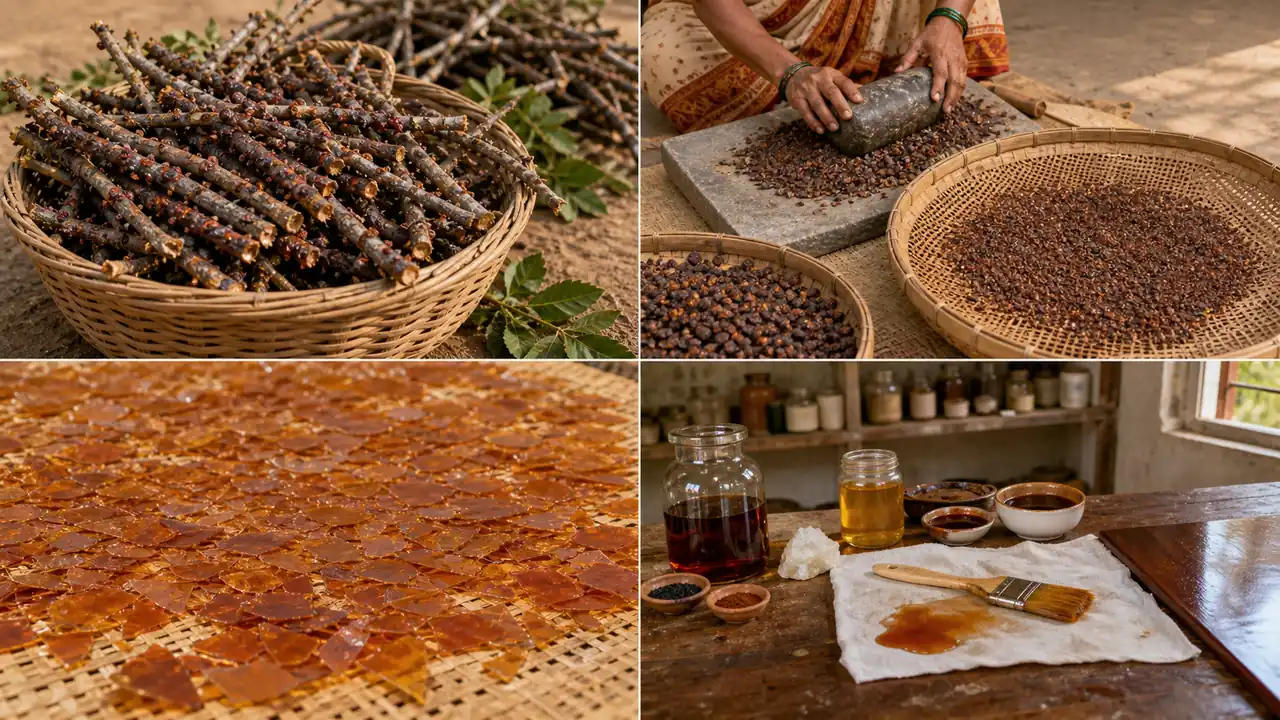
| Stick lac | lac-encrusted twigs harvested from host branches |
| Seed lac | granular lac obtained after crushing and cleaning |
| Shellac | purified commercial lac used in trade and industry |
Students should also understand that these are not three different materials produced independently. They are three stages of one processing chain.
By-products and secondary uses
Two small but useful processing points are:
- the fine dust separated during processing may be used in toys, bangles, and decorative products
- the woody portion left after removing lac can serve as fuel
These details show that traditional lac processing tried to use every component economically.
Uses of lac
- furniture polish
- preparation of varnishes and paints
- sealing of parcels and envelopes
- electrical insulation
- handicrafts
- toys and decorative items
- shoe polish and finishing applications
Important points include fine dust or particle use in toys and decorative products after processing.
Lac is also an old industrial material with value in finishing, coating, and specialty use. That is why lac culture survives even when synthetic substitutes exist.
Extraction sequence in fuller detail
The processing pathway is one of the most important areas:
- lac-encrusted twigs are harvested as stick lac
- stick lac is crushed or ground
- the granular cleaned product becomes seed lac
- seed lac is washed
- it is then melted and spread in a thin layer
- after drying, it becomes commercial shellac
This is the same biological product moving through cleaner and more marketable forms.
Enterprise value
Lac culture is an insect-based subsidiary enterprise. It supports livelihoods especially where tree resources already exist. It can be linked with agroforestry and farm-boundary plantation systems.
Scale and livelihood importance
- a very large number of insects are needed to produce a small commercial weight of lac
- finer residues can be used in small products such as bangles or toys
- the lac research institute at Ranchi is also mentioned
- synthetic substitutes exist, but shellac remains a classic biological industrial product
About 4,00,000 insects may be required to produce 1 kg of lac. Even when the figure is not quoted in an answer, it helps show the scale of biological production involved.
Why this figure matters
This single number teaches an important agriculture lesson: small-looking biological organisms can create valuable industrial output only when they are managed in enormous numbers and under proper ecological conditions.
Research and modern relevance
The textbook points to the Lac Research Institute at Ranchi as an important centre working on:
- lac-insect biology
- life-history understanding
- host and production improvement
- protection from enemies
Synthetic lacquers have replaced true shellac for some uses. That does not make lac unimportant; it shows why quality, niche use, and value addition matter in keeping this enterprise economically relevant.
Main points for a full answer
A full answer on lac culture usually mentions:
- lac is an insect secretion, not a tree gum
- host plants are essential
- crawler stage is important in the life cycle
- stick lac -> seed lac -> shellac is the processing chain
- lac has both livelihood and industrial importance
Common errors
- Lac is secreted by the insect, not by the tree.
- Stick lac and shellac are not the same stage.
- Host-plant management is as important as insect management.
Understanding the enterprise
Lac culture should not be seen as collecting gum from a tree. The tree provides the platform, the insect produces the resin, and the farmer manages the host twigs and timing.
Field analogy
Think of a lac twig like a rented shop line. Crawlers settle on it, feed there, and build resin around themselves. If the host branch is weak, crowded, or wrongly timed, the "shops" fail. If the host is healthy and brood lac is managed well, the twig becomes a valuable stick-lac harvest.
Small enterprise situation
A family with palas and ber trees may not be able to start a dairy or buy machines, but they can still earn from tree-based lac production if they learn timing, host pruning, and processing stages. That is why lac culture is important in areas where trees, family labour, and traditional knowledge are available.
Answer structure
A clear answer may follow this order:
- name the lac insect and host relationship
- explain crawler settlement and resin secretion
- mention host plants such as kusum, palas, and ber
- write the processing chain: stick lac -> seed lac -> shellac
- finish with uses and rural livelihood value
Summary Cheat Sheet
| Concept / Topic | Key Details / Explanation |
|---|---|
| Meaning of lac | Lac is a resinous secretion produced by a tiny insect on suitable host twigs. |
| Main processing sequence | The basic processing sequence is stick lac -> seed lac -> shellac. |
| Key production factors | Healthy host plants, correct brood-lac management, and proper timing of operations decide yield and quality. |
| Enterprise value | Lac culture creates value from tree-based biological production and supports rural livelihoods and diversification. |
| Best lesson takeaway | Lac should be understood as an insect-based enterprise linking host-tree care with commercial processing. |
Lesson Doubts
Ask questions, get expert answers