🧵 Sericulture Basics
A fuller lesson on silkworm rearing, mulberry linkage, cocoon formation, and reeling.
Sericulture Basics
Sericulture is the breeding and management of silkworms for commercial silk production.
Why sericulture is important
- combines agriculture with rural industry
- creates employment at multiple stages
- produces high-value textile raw material
- adds value beyond ordinary crop farming
Historical background
Sericulture can be understood as an old and celebrated enterprise:
- the best-known early story comes from China
- silk production remained guarded knowledge for centuries
- from East Asia it later spread to other regions
- in India it developed into an important agro-based rural industry
Sericulture not can be understood as a luxury craft but as a complete rural-production chain linked with host-plant care, insect rearing, cocoon handling, reeling, and textile value addition.
It also specifically presents sericulture as an important industry in countries such as China, Japan, India, Italy, France, and Spain, which helps students understand its global and historical significance.
Pro Content Locked
Upgrade to Pro to access this lesson and all other premium content.
₹99 charged monthly · Cancel anytime
- All Agriculture & Banking Courses
- AI Lesson Questions (100/day)
- AI Doubt Solver (50/day)
- Glows & Grows Feedback (30/day)
- AI Section Quiz (20/day)
- 22-Language Translation (100/day)
- Recall Questions (20/day)
- AI Quiz (15/day)
- AI Quiz Paper Analysis (100/day)
- AI Step-by-Step Explanations (100/day)
- Spaced Repetition Recall (FSRS)
- AI Tutor
- Immersive Text Questions
- Audio Lessons — Hindi & English
- Mock Tests & Previous Year Papers
- Summary & Mind Maps
- XP, Levels, Leaderboard & Badges
- Generate New Classrooms
- Voice AI Teacher (AgriDots Live)
- AI Revision Assistant
- Knowledge Gap Analysis
- Interactive Revision (LangGraph)
🔒 Secure via Razorpay · Cancel anytime · No hidden fees
Sericulture Basics
Sericulture is the breeding and management of silkworms for commercial silk production.
Why sericulture is important
- combines agriculture with rural industry
- creates employment at multiple stages
- produces high-value textile raw material
- adds value beyond ordinary crop farming
Historical background
Sericulture can be understood as an old and celebrated enterprise:
- the best-known early story comes from China
- silk production remained guarded knowledge for centuries
- from East Asia it later spread to other regions
- in India it developed into an important agro-based rural industry
Sericulture not can be understood as a luxury craft but as a complete rural-production chain linked with host-plant care, insect rearing, cocoon handling, reeling, and textile value addition.
It also specifically presents sericulture as an important industry in countries such as China, Japan, India, Italy, France, and Spain, which helps students understand its global and historical significance.
Main silk-producing source
The best-known silkworm is Bombyx mori, which feeds on mulberry leaves. This close relationship between insect and host plant is central to sericulture.
The larval stage is the real silk-producing stage. Sericulture therefore depends on healthy mulberry leaves, disease-free eggs, careful rearing, and proper cocoon handling.
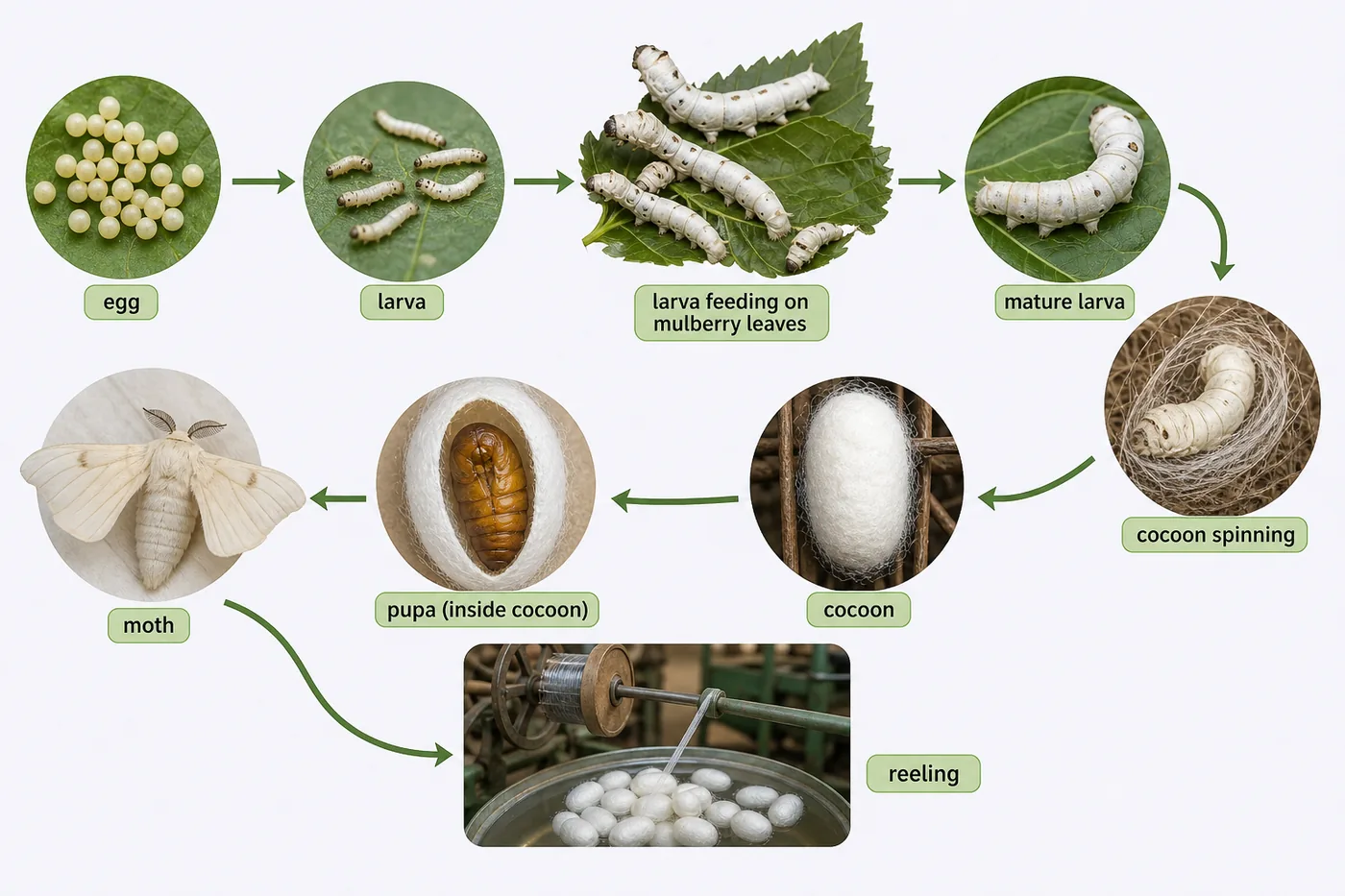
Life cycle of the silkworm
| Stage | Main event |
|---|---|
| Egg | healthy disease-free eggs are selected |
| Larva | caterpillar feeds actively on mulberry leaves |
| Cocoon | larva spins a silk filament around itself |
| Pupa/Moth | adult forms inside and later emerges if not processed |
Approximate timing
- Egg stage: about 10 days
- Larval period: about 30 days
- Pupal/cocoon stage: about 10 days
The full cycle from egg to adult is often remembered as roughly 50 days.
Adult, egg, larva, and pupa
Adult moth
- creamy white
- flat-bodied
- short-lived
- weak flyer
- female may lay roughly 300-500 eggs
- adult usually does not feed
The adult moth may live only about 2-3 days, which reinforces how short the reproductive adult stage is compared with the feeding larval phase.
Eggs
- round
- yellowish-white at first
- become grey near hatching
Larva
- newly hatched larva is small and dark
- moults four times during growth
- feeds heavily on mulberry leaves
- mature larva stops feeding before spinning the cocoon
- full-grown larva may reach about 7 cm
- the last larval stage shows a hump behind the head and a spine-like horn near the tail
Pupa
- develops inside the cocoon
- later changes into the adult moth
How the cocoon is formed
The larva secretes silk from special glands and moves its head repeatedly while spinning. This forms a continuous filament around the body, creating the cocoon.
Silk glands and cocoon value
- silk is secreted from a pair of enlarged silk glands
- the liquid hardens in air into a fine filament
- a single cocoon filament may be several hundred metres long
- pierced cocoons, from which the moth has emerged, are less valuable because the continuous filament is broken
A broader school-level range of about 700-1100 metres is given here for the continuous cocoon filament.
An important behavioural detail is that the larva may move its head rapidly many times per minute while laying down the silk filament. This shows that cocoon formation is an active biological process, not just passive secretion.
Main stages of sericulture
- arrange a reliable mulberry leaf supply
- hatch healthy eggs
- rear larvae in clean trays under suitable temperature
- feed regularly and maintain hygiene
- allow mature larvae to spin cocoons
- process cocoons for reeling
Rearing management sequence
A practical rearing workflow is:
- select healthy moths
- allow mating for a controlled period
- collect eggs from the female
- examine parent stock for disease
- keep only certified disease-free eggs
- hatch eggs in suitable controlled conditions
- rear larvae in trays at about 20-25°C
- begin with chopped mulberry leaves and later provide fresh leaves
- transfer growing larvae onto clean trays
- allow full-grown larvae to spin cocoons
This is important because sericulture is a hygiene-sensitive enterprise. Small neglect at the early stage can damage the whole silk chain.
Important points in the rearing sequence include:
- healthy moths are selected first
- mating is allowed for a limited period
- the female is later examined for disease after egg laying
- only certified disease-free eggs are retained for rearing
This shows that sericulture begins with stock selection and disease screening, not just feeding larvae.
What reeling means
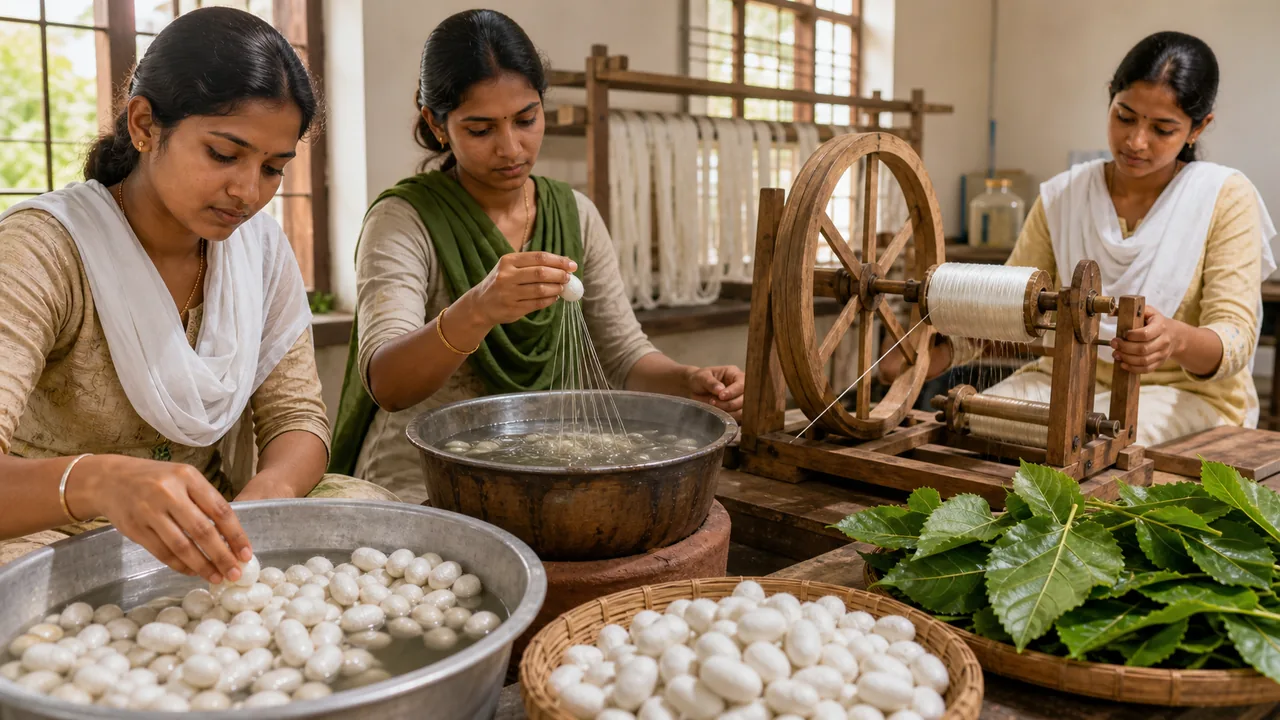
Reeling is the process of obtaining silk filament from cocoons. At school level, the key idea is:
- cocoons are collected
- the insect inside is prevented from emerging
- cocoons are softened in hot water
- filaments are unwound and combined
If the moth emerges naturally, the cocoon becomes pierced and the continuous filament is broken. That lowers value.
Reeling sequence
- gather cocoons at the suitable stage
- kill the insect inside by heat treatment
- soften the binding material in hot water
- find the loose filament ends
- reel together filaments from several cocoons
- use non-reelable leftovers as silk waste for spun silk
Some additional details worth retaining are:
- cocoons are often gathered about 8 days after spinning begins
- steam or dry heat is used before moth emergence
- soaking in water around 95-97°C softens the gummy binding material
- several filaments are reeled together on wheels or reeling devices
It is also useful to note:
- cocoons are kept in hot water while loose filament ends are caught by hand
- only about half of the silk of each cocoon may be reelable
- the remaining portion becomes silk waste used for spun silk
Important silk facts
- silk is lustrous, soft, and strong
- it is associated with fibroin and sericin
- cocoon quality strongly affects silk quality
- it can be dyed into many colours
- Bombyx mori is now fully domesticated and depends on human care
It is also emphasized that:
- fibroin forms the inner structural protein
- sericin forms the outer gummy covering
- raw silk must still pass through further treatment after reeling
This is useful because it explains why raw silk is not the final finished textile material. Reeling is important, but later treatment still shapes the final usable silk.
Types of silk often mentioned
| Type | Broad association |
|---|---|
| Mulberry silk | from Bombyx mori |
| Tasar silk | from other silk moth species |
| Muga silk | regionally important silk, especially Assam |
| Eri silk | linked with castor-fed silkworms |
These non-mulberry silks show that silk production is not limited to only one insect-host combination.
Important silk regions
The following Indian states are highlighted for mulberry silk:
- Karnataka
- West Bengal
- Jammu and Kashmir
This topic also links:
- Tasar with Bihar, Madhya Pradesh, and West Bengal
- Muga with the Brahmaputra Valley
- Eri with Assam
The text gives the non-mulberry associations in more biological detail:
- Tasar from Antheraea royeli on host trees like arjun
- Muga from Antheraea assama in the Brahmaputra Valley
- Eri from Philosamia ricini feeding on castor
These details make non-mulberry silk easier to remember in descriptive answers.
Management points
- only healthy eggs should be used
- rearing house hygiene is essential
- feeding must be regular and clean
- both the insect and the host plant need proper care
The mulberry-silkworm pair cannot be separated. Good sericulture depends on:
- leaf quality
- tray hygiene
- temperature care
- disease avoidance
- correct harvest stage of cocoons
Sericulture as a full production chain
Sericulture should not be studied only as a silkworm life cycle. It is better understood as a chain with five linked stages:
| Chain room | What happens there | What can go wrong |
|---|---|---|
| Mulberry field | healthy leaves are produced | leaf shortage, pest damage, poor nutrition |
| Egg room | disease-free eggs are selected and hatched | diseased eggs reduce the whole crop |
| Rearing house | larvae are fed and protected | crowding, temperature stress, unclean trays |
| Mounting/cocooning area | mature larvae spin cocoons | poor mounting causes weak or dirty cocoons |
| Reeling unit | filament is softened, found, and unwound | pierced or badly cooked cocoons give broken silk |
This chain view is useful because the topic moves from history to biology to rearing and then to reeling. Each stage depends on the previous one.
Egg production and disease screening
The egg stage looks simple, but it decides the health of the whole batch. The teaching logic is:
- selected healthy moths are paired for mating
- the female lays eggs after mating
- the parent moth is checked for disease
- only safe egg batches are used for commercial rearing
This is why students should connect seed quality in crop production with disease-free layings in sericulture. In both cases, the starting material determines later success.
Why disease-free eggs matter
Larvae are reared in close groups and feed continuously. If infection enters at the egg stage, it spreads through the batch and damages cocoon yield, cocoon quality, and farmer income.
Larval feeding rhythm
The larval stage is the main eating stage. A newly hatched larva is small and dark, but it grows rapidly because it feeds repeatedly on mulberry leaves.
Practical feeding ideas
- young larvae need tender chopped leaves
- older larvae can handle larger fresh leaves
- stale, wet, dusty, or diseased leaves should be avoided
- trays should be cleaned as larvae grow
- larvae should not be overcrowded, because crowding raises disease and heat stress
Important examples include:
feeding phase -> moult -> bigger larva -> heavier feeding -> mature larva -> cocoon
Cocoon formation as a biological engineering process
The cocoon is not a random covering. It is a protective shell made from a continuous protein filament. The larva secretes silk as a liquid and the filament hardens when exposed to air. The fast head movement distributes the thread around the body.
Why the filament is valuable
The filament is valuable because it is:
- long
- fine
- continuous
- strong
- capable of being reeled
That is why an intact cocoon is better than a pierced cocoon. Once the moth cuts its way out, the single long filament is broken into shorter pieces. Such cocoons may still be used, but they lose the advantage of long continuous reeling.
Cooking, reeling, and raw silk
Reeling is easier to remember if you imagine the cocoon as a ball of gum-bound thread. The thread is present, but it cannot be pulled smoothly until the gummy binding softens.
Reeling logic table
| Step | Purpose |
|---|---|
| Collect cocoons at correct time | prevents moth emergence and filament breakage |
| Heat treatment | kills the pupa before it pierces the cocoon |
| Hot-water cooking | softens sericin-rich gum around the thread |
| Finding filament ends | starts unwinding |
| Combining filaments | creates a stronger raw silk strand |
| Further processing | converts raw silk into usable textile material |
Important points include that only part of each cocoon is practically reelable. The leftover portion is not wasted; it becomes silk waste and can be spun into yarn. This shows that sericulture uses both high-grade continuous filament and lower-grade residual fibre.
Fibroin and sericin made simple
Silk contains two important protein parts:
| Protein | Simple role |
|---|---|
| Fibroin | the strong inner fibre core |
| Sericin | the outer gummy coating that binds the filament |
During cooking and later processing, the sericin relation becomes important because it affects reeling, softness, and final fabric feel.
Mulberry and non-mulberry silk comparison
| Silk type | Insect idea | Host-plant idea | Region/lesson memory |
|---|---|---|---|
| Mulberry | Bombyx mori | mulberry leaves | Karnataka, West Bengal, Jammu and Kashmir |
| Tasar | Antheraea group | arjun and forest trees | Bihar, Madhya Pradesh, West Bengal |
| Muga | Antheraea assama | som-type host plants | Brahmaputra Valley |
| Eri | Philosamia ricini | castor leaves | Assam |
Mulberry silk is the standard example, but non-mulberry silks show regional biodiversity and traditional knowledge. Even one correct insect-host-region relationship helps make the topic concrete.
Common errors
- Do not write that the adult moth produces silk; the larva produces the cocoon.
- Do not confuse cocoon with egg; cocoon is linked with pupa.
- Do not say pierced cocoons are best for reeling; intact cocoons are better for continuous filament.
- Do not forget that Bombyx mori is domesticated and depends strongly on human care.
- Do not separate sericulture from mulberry cultivation; leaf quality is the foundation of cocoon quality.
Sericulture flowchart for revision
healthy moths -> disease-free eggs -> larval rearing on mulberry -> moulting and growth -> mature larva -> cocoon spinning -> heat treatment -> cooking -> reeling -> raw silk -> final processing
Why sericulture helps rural economy
Sericulture can be framed as a multi-stage enterprise:
- mulberry cultivation
- egg production
- larval rearing
- cocoon production
- reeling
- further silk processing
That is why sericulture is taught as a subsidiary agricultural enterprise rather than as only an insect chapter.
Silk properties
Silk has several valuable properties:
- lustrous
- soft
- strong
- hard wearing
- capable of taking many dyes
These help students explain why silk has remained economically important for so long.
Summary Cheat Sheet
| Concept / Topic | Key Details / Explanation |
|---|---|
| Meaning of sericulture | Sericulture is the rearing of silkworms for cocoon and silk production, usually linked with Bombyx mori and mulberry-based systems. |
| Historical background | Silk is linked with old Chinese records, names such as Si-lung-Chi and Huang-ti, and long early secrecy before spreading to other countries. |
| Adult moth and egg facts | The adult moth is creamy white, lives only briefly, and a female may lay about 300-500 eggs. |
| Life cycle | A simple school-level timing line is egg -> larva -> pupa/cocoon -> adult, with larval feeding on mulberry leaves as the major rearing stage. |
| Disease-free eggs | Only certified disease-free eggs should be used for industrial rearing, making egg quality a key enterprise step. |
| Rearing sequence | Eggs hatch in incubator conditions, larvae are reared in trays, fed mulberry leaves, and kept clean until cocoon spinning. |
| Cocoon and filament value | Intact cocoons are valuable because they provide a long continuous filament, while pierced cocoons lose filament continuity and value. |
| Silk proteins | The main silk proteins are fibroin as the inner structural protein and sericin as the outer gummy protein. |
| Best lesson takeaway | Sericulture is a full chain from egg quality to cocoon handling and reeling, not just worm feeding. |
Reeling reference table
| Reeling step | Exact teaching point |
|---|---|
| Cocoon collection | gathered about 8 days after spinning begins |
| Stifling | steam or dry heat kills the pupa to protect the continuous filament |
| Cooking | cocoons are soaked in 95-97°C hot water for 10-15 minutes |
| End finding | loose thread ends are caught by hand |
| Reeling | threads from several cocoons are wound together on charakhas or reels |
| Yield logic | only about one-half of each cocoon’s silk is reelable |
| Waste use | remaining silk is spun as silk waste |
The cocoon thread has a fibroin core and sericin gum cover. Pierced cocoons are low-value because the emerging moth breaks the continuous filament.
Sericulture as leaf-to-fabric biology
Sericulture is a chain in which mulberry leaves become larval growth, larval growth becomes cocoon, cocoon becomes filament, and filament becomes silk.
Simple analogy
| Stage | Like in everyday life | Key student idea |
|---|---|---|
| Mulberry leaf | raw material in a workshop | quality feed decides larval growth |
| Larva | production worker | eats continuously and builds body reserves |
| Cocoon | packed finished unit | protects pupa and stores silk filament |
| Reeling | opening the packed unit carefully | continuous filament gives value |
| Raw silk | marketable output | quality depends on rearing and reeling |
Small household situation
If a household has mulberry leaves, clean trays, and disciplined feeding, sericulture can fit family labour very well. But if feeding is irregular or disease screening is ignored, cocoon quality falls. This makes sericulture a good example of how biology rewards careful daily management.
Lesson Doubts
Ask questions, get expert answers