🍄 Mushroom Cultivation Basics
A deeper lesson on mushroom biology, spawn preparation, composting, cultivation stages, and common issues.
Mushroom Cultivation Basics
Mushroom cultivation is the production of edible fungi on prepared organic substrates under controlled conditions.
Why mushroom cultivation is important
- needs comparatively little land
- gives quick returns
- uses agricultural residues effectively
- can be started at small, medium, or commercial scale
Basic biological idea
Mushrooms are saprophytic. They do not prepare food like green plants because they lack chlorophyll. Instead, they grow on dead and decaying organic matter.
Historical and production background
Mushroom cultivation is connected with older European work and then brings the discussion into Indian production. The main takeaways are:
- prepared organic substrate became the basis of scientific cultivation
- mushroom farming moved from a niche skill to a viable enterprise
- Indian production rose sharply once small and commercial units adopted controlled methods
- button mushroom dominates production in India
The production picture becomes more concrete when it is noted that organized and small-scale mushroom cultivation expanded rapidly in India, with button mushroom contributing the overwhelming majority of total cultivated production.
Pro Content Locked
Upgrade to Pro to access this lesson and all other premium content.
₹99 charged monthly · Cancel anytime
- All Agriculture & Banking Courses
- AI Lesson Questions (100/day)
- AI Doubt Solver (50/day)
- Glows & Grows Feedback (30/day)
- AI Section Quiz (20/day)
- 22-Language Translation (100/day)
- Recall Questions (20/day)
- AI Quiz (15/day)
- AI Quiz Paper Analysis (100/day)
- AI Step-by-Step Explanations (100/day)
- Spaced Repetition Recall (FSRS)
- AI Tutor
- Immersive Text Questions
- Audio Lessons — Hindi & English
- Mock Tests & Previous Year Papers
- Summary & Mind Maps
- XP, Levels, Leaderboard & Badges
- Generate New Classrooms
- Voice AI Teacher (AgriDots Live)
- AI Revision Assistant
- Knowledge Gap Analysis
- Interactive Revision (LangGraph)
🔒 Secure via Razorpay · Cancel anytime · No hidden fees
Mushroom Cultivation Basics
Mushroom cultivation is the production of edible fungi on prepared organic substrates under controlled conditions.
Why mushroom cultivation is important
- needs comparatively little land
- gives quick returns
- uses agricultural residues effectively
- can be started at small, medium, or commercial scale
Basic biological idea
Mushrooms are saprophytic. They do not prepare food like green plants because they lack chlorophyll. Instead, they grow on dead and decaying organic matter.
Historical and production background
Mushroom cultivation is connected with older European work and then brings the discussion into Indian production. The main takeaways are:
- prepared organic substrate became the basis of scientific cultivation
- mushroom farming moved from a niche skill to a viable enterprise
- Indian production rose sharply once small and commercial units adopted controlled methods
- button mushroom dominates production in India
The production picture becomes more concrete when it is noted that organized and small-scale mushroom cultivation expanded rapidly in India, with button mushroom contributing the overwhelming majority of total cultivated production.
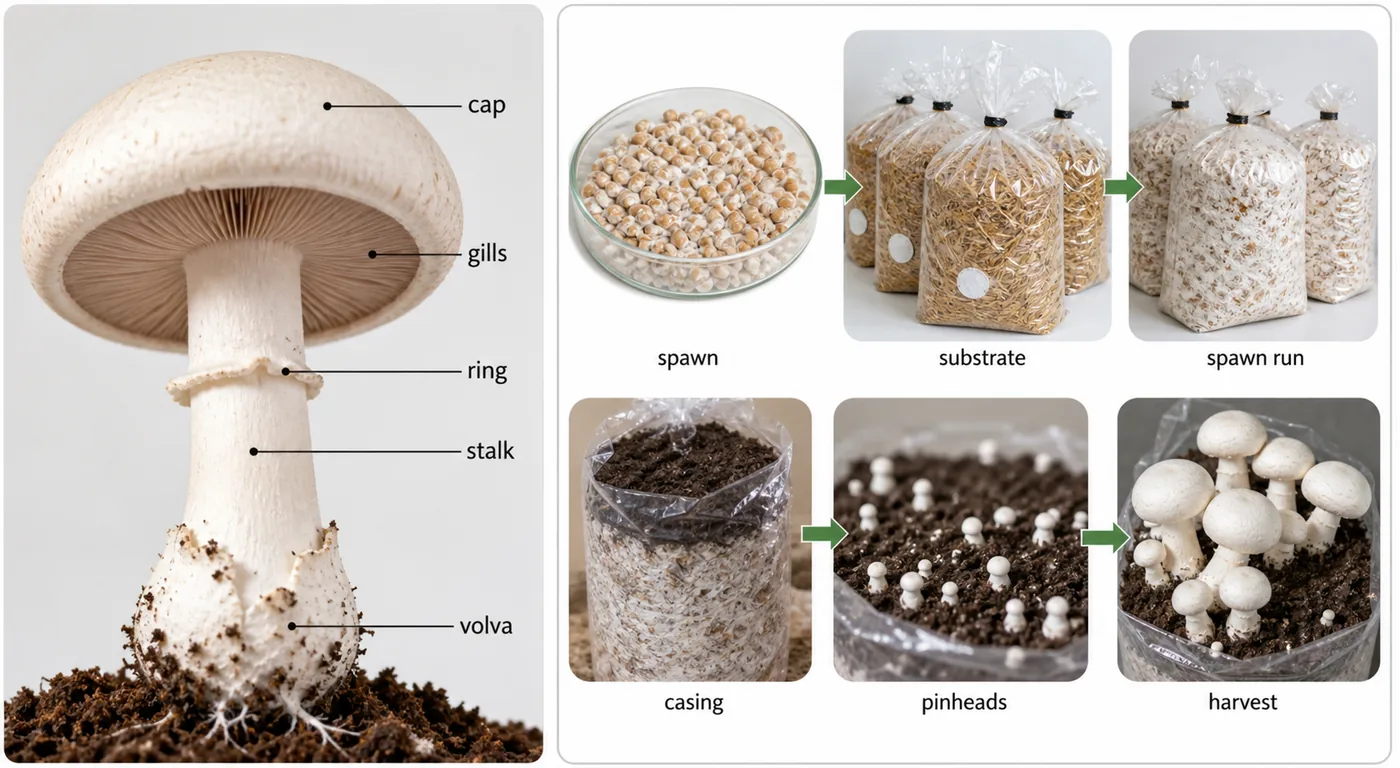
Morphology of the mushroom
The mushroom fruit body can be explained through visible structures:
- pileus or cap
- stipe or stalk
- gills
- in some mushrooms, annulus or volva
The gills bear spores, and their attachment helps in identification.
Types of gill attachment
Common forms of gill attachment are:
- free gill
- adnate gill
- decurrent gill
- adnexed gill
- sinuate gill
This reminds students that morphology helps identify mushroom forms correctly.
Important terms
| Term | Meaning |
|---|---|
| Spawn | planting material of mushroom; living mycelium on a carrier medium |
| Compost/Substrate | prepared organic medium for growth |
| Casing | covering placed over spawned compost in some systems |
| Cropping | stage when mushrooms appear and are harvested |
Major cultivated types
Strong emphasis is given to:
- button mushroom
- oyster mushroom
- milky mushroom
- paddy-straw mushroom
This is important because the unit is not only about one species; it introduces a small enterprise family of mushroom systems.
Two linked lessons emerge here:
- know the dominant commercial species
- understand that climate and substrate decide which mushroom enterprise is suitable
What spawn means
Spawn is not a seed in the ordinary sense. It is the active vegetative mycelium of a selected mushroom strain grown on grains or another suitable medium.
Qualities of good spawn
- fast growth in compost
- early cropping
- high yield
- good-quality mushrooms
Master spawn and commercial spawn are also distinguished, showing that spawn production itself is a technical stage.
This is important because weak or contaminated spawn can ruin the entire crop even before compost and casing are managed properly.
Main stages of button mushroom cultivation
- prepare compost
- inoculate with spawn
- maintain suitable temperature and humidity
- allow mycelial spread
- apply casing
- manage ventilation and watering
- harvest before quality declines
Two major composting approaches
- long method: slower outdoor composting with repeated turnings
- short method: phase-based composting followed by indoor pasteurization
Long method in simple logic
The long method relies on:
- outdoor piling
- repeated turnings
- moisture management
- progressive fermentation
- readiness judged partly by ammonia reduction and compost quality
The long method depends on a sequence of additions and turnings rather than a single pile-and-wait approach. Supplements, gypsum, protectants, and moisture are adjusted in stages.
Long-method compost recipe
A school-level formula is given using wheat straw as the base and supplements such as wheat bran, nitrogen sources, phosphate, potash, urea, gypsum, and protective materials. This should not be treated like kitchen cooking; the important thing is the purpose:
| Material group | Purpose |
|---|---|
| straw | carbon-rich structure and bulk |
| bran/manure/supplements | nutrients for microbial fermentation |
| nitrogen source | supports decomposition and later mycelial nutrition |
| gypsum | improves compost structure and condition |
| turnings | aeration and uniform fermentation |
| moisture | keeps microbial activity active |
The repeated turning schedule prevents anaerobic pockets. If the pile is not turned, some parts overheat or ferment badly while other parts remain raw.
Short method in simple logic
The short method uses:
- an outdoor phase for initial composting
- an indoor phase for pasteurization and conditioning
- controlled temperature stages
- cleaner finishing of the compost
The short method can be understood as superior in production quality and lower in disease risk when properly managed.
The two phases are:
- Phase I = outdoor composting and initial fermentation
- Phase II = indoor pasteurization and conditioning
Pasteurization is important because it helps destroy many pests and pathogens, ends uncontrolled fermentation, and prepares compost for button-mushroom mycelium.
Phase II composting stages
| Stage | What happens |
|---|---|
| Pre-peak heat | compost temperature rises and conditioning begins |
| Peak heat | pasteurization destroys many pests, flies, nematodes, and pathogens |
| Post-peak heat | ammonia is reduced and compost becomes selective for mushroom mycelium |
Good compost is ready for spawning only when it is cool enough, has suitable moisture, and is free from strong ammonia smell.
Why compost is so important
Unlike ordinary crops, mushrooms do not grow in open field soil. They need a specially prepared compost or substrate that supports the mushroom but suppresses competitors as much as possible.
What good compost should achieve
- provide nutrients and structure
- support mushroom mycelium
- discourage many competing moulds
- remain biologically and physically suitable for fruiting
Good compost should also be:
- adequately moist
- low in free ammonia
- physically friable enough for spawning
- biologically suitable for mycelial growth
A practical ready-for-spawning sign is that ammonia should be reduced to a very low level and the compost should show strong but suitable actinomycete development rather than raw foul fermentation.
Casing
Casing is the protective layer placed over fully colonized compost. It helps:
- maintain moisture
- support gas exchange
- create conditions for fruit-body emergence
Casing management details
Casing deserves extra importance because its quality affects:
- moisture regulation
- surface aeration
- pin-head initiation
- disease risk
It also refers to treatment or pasteurization of casing material before use.
One key point is that casing is not a substitute for compost nutrition. It is a management layer that helps moisture control and fruit-body initiation.
Broad environmental needs
- suitable moisture
- proper humidity
- correct temperature
- ventilation
- cleanliness
Button mushroom conditions
Button mushroom with cool-season cultivation in many Indian plains and with:
- moderate cool temperatures
- high humidity
- careful ventilation after casing
In the plains, button mushroom is strongly linked with the cool-season window roughly from October to March.
Button mushroom cultivation sequence
| Step | Key management point |
|---|---|
| Compost preparation | substrate must be selective and pasteurized/conditioned |
| Spawning | spawn is mixed at the correct rate in cooled compost |
| Spawn run | white mycelium spreads through compost under warm humid conditions |
| Casing | treated casing layer supports moisture and fruiting |
| Pinning | small pin heads appear after casing conditions are correct |
| Harvesting | mushrooms are picked before gills open widely |
Quality is linked with harvest timing. Open gills reduce market value, so harvesting is not delayed simply to increase size.
Why hygiene matters
Mushroom cultivation is highly sensitive to contamination. Dirty rooms, poor water, or badly prepared substrate can encourage competitor moulds, insects, and diseases that reduce yield heavily.
Other cultivated mushrooms
Oyster mushroom
The lesson notes that oyster mushrooms can grow on several agricultural residues such as straw and similar wastes. They are known for relatively high biological efficiency under suitable conditions.
It also connects oyster cultivation with bag-based production and comparatively quick cropping after spawn run under suitable humidity and temperature.
Oyster mushroom process
soak/sterilize straw -> drain excess water -> mix spawn -> fill perforated bags -> spawn run -> open bags -> primordia -> harvest clusters by twisting
The lesson notes chemical or hot-water treatment logic for substrate sanitation and emphasizes high humidity during spawn run and fruiting.
Milky mushroom
Milky mushroom is important because it performs well in warmer conditions and can fit tropical or higher-temperature production windows.
This gives it enterprise value where cool-season button mushroom cultivation is not practical.
Milky mushroom process
Milky mushroom can be understood as a warm-season option. A practical sequence is:
- soak wheat or paddy straw
- treat with hot water
- drain extra water
- mix a supplement such as wheat bran where required
- spawn at a higher rate than button mushroom systems
- apply casing after spawn run
- harvest when white fruit bodies mature
Paddy-straw mushroom
This type is associated with warm conditions and straw-based cultivation systems.
It is linked with tropical cultivation conditions and bundled or boxed substrate systems.
Paddy-straw mushroom process
It is associated with warm, humid conditions and substrates such as rice straw, banana leaves, water hyacinth, or similar material. Spawn is placed in layers, and beds or boxes are incubated under high temperature and humidity until fruiting begins.
These crop examples matter because mushroom enterprise selection depends on local climate as much as on market choice.
Spawn production in concept form
Grain spawn preparation is described in technical detail. The concept version is:
- grains are boiled and drained
- materials like gypsum and lime help grain condition and pH
- the medium is sterilized
- pure culture is introduced
- mycelium spreads through the grain
- master spawn is multiplied into commercial spawn
This is why spawn quality directly affects later yield and contamination risk.
This is why spawn must be pure, vigorous, and contamination-free.
Grain-spawn preparation is connected with the use of materials such as gypsum and lime to improve grain condition, reduce clumping, and support a suitable reaction.
Scale of growing systems
Mushroom houses can be divided into:
- marginal scale
- small scale
- industrial scale
This teaches that mushroom cultivation can be practiced in huts, converted rooms, or controlled insulated structures depending on investment.
That is why mushroom cultivation is often described as knowledge-intensive rather than land-intensive.
Common disease and pest problems
Mushroom production is not only about growth but also about protection from:
- mould problems
- flies
- springtails
- contamination in compost or casing
Named problems
Several disease and enemy problems are specifically named:
- green mould
- brown plaster mould
- white plaster mould
- inky caps
- yellow mould
- false truffle
- dry bubble disease
- sciarid flies
- phorid flies
- springtails
So a good mushroom grower manages both production and sanitation.
Nutritional and medicinal value
Mushrooms are valued for:
- protein
- minerals and vitamins
- dietary fibre
- low-calorie health value
Further emphasis is given to:
- useful protein content
- vitamins such as thiamine, riboflavin, and niacin
- medicinal interest in mushrooms like Ganoderma, Lentinula, and Pleurotus
Enterprise angle
Mushroom cultivation is often called knowledge-intensive rather than land-intensive. That means skill, timing, hygiene, compost quality, and environmental control matter more than simply having a large area of land.
Common disorders and enemies
Important examples include:
- green mould
- brown plaster mould
- white plaster mould
- dry bubble disease
- sciarid flies
- phorid flies
- springtails
Other named problems include inky caps, yellow mould, and false truffle, which shows that sanitation and compost quality are central to disease prevention.
Disease clue table
| Problem | Classroom clue | Management logic |
|---|---|---|
| Green mould | blue-green/green patches on compost or casing | sanitation, balanced compost, avoid excess humidity and contamination |
| Brown plaster mould | whitish patches turning brown | avoid moisture condensation and poor casing hygiene |
| Dry bubble | deformed or diseased fruit bodies | clean casing, hygiene, disease-free inputs |
| Sciarid/phorid flies | fly activity in crop room | screening, sanitation, compost treatment |
| Springtails | small jumping pests | clean rooms and avoid excess wetness |
Mushroom protection is mostly preventive. Once contamination spreads through compost, it is difficult to recover full yield.
Main conditions for success
Successful mushroom cultivation depends on:
- suitable species choice
- good spawn
- properly prepared compost or substrate
- pasteurization or sanitation
- casing where required
- correct temperature and humidity
- protection from moulds, flies, and contamination
Additional notes
History, production and species facts
| Source detail | Exam memory |
|---|---|
| First cultivation record | reign of Louis XIV, 1637-1715 |
| Early technical record | French scientists documented cultivation methods; Paris article in 1707 |
| Early substrate | horse dung in French foothill cultivation |
| India production growth | about 1,000 tonnes in 1981 to about 80,000 tonnes in 2006 |
| Unit structure | about half from marginal/small units and half from industrial establishments |
| Major producers | Punjab 35,000 MT, Tamil Nadu 15,000 MT, Andhra Pradesh 5,000 MT |
| Uttarakhand growth | 2,640 MT in 2000 to 5,340 MT in 2006 |
| Uttarakhand centres | Dehradun, Nainital, Haridwar, Udham Singh Nagar |
| Dominant mushroom | button mushroom, Agaricus bisporus, about 90% of Indian production |
Methodology for compost preparation
Use the exact heading methodology for compost preparation in revision. The lesson-style sequence is: select straw and supplements, wet the material, mix nitrogen and mineral supplements, stack the compost, turn at scheduled intervals, maintain moisture and aeration, complete phase-I fermentation, pasteurize or condition in phase II, remove excess ammonia, cool the compost, then spawn only when the compost is selective and safe for mushroom mycelium. | Other cultivated types | Pleurotus, Lentinula, Auricularia, Calocybe |
Medicinal mushroom memory table
| Medicinal mushroom | Common memory name |
|---|---|
| Ganoderma lucidum | Reishi mushroom |
| Coriolus versicolor | turkey-tail type medicinal fungus |
| Grifola frondosa | Maitake |
| Lentinula edodes | Shiitake |
| Cordyceps species | Keera ghas |
| Tremella fuciformis | jelly medicinal mushroom |
| Poria cocos | medicinal polypore |
| Pleurotus species | oyster or dhingri mushroom |
More than 270 mushroom species are believed to have medicinal properties in China, with about 25% thought to have antitumour capability.
Master spawn protocol
| Step | Lesson-aligned detail |
|---|---|
| Grain base | boil 10 kg wheat or sorghum grain in 15 L water |
| Drying | drain on wire netting until surface moisture is reduced |
| Additives | mix 120 g gypsum and 30 g lime with 10 kg boiled grain |
| Filling | fill half-litre milk/glucose bottles to about three-fourths capacity |
| Sterilization | sterilize at 20-22 lb psi, about 126°C, for 1.5-2 hours |
| Cooling | shake hot bottles to avoid clumps, then cool overnight in inoculation room |
| Inoculation | add two pure-culture agar bits opposite each other inside the bottle |
| Shaking | shake after 7-10 days to distribute mycelium |
| Readiness | stock culture ready after about 3 weeks |
| Multiplication | one stock bottle can multiply about 30-40 bottles or polypropylene bags |
Commercial spawn follows the same logic, but polypropylene bags may replace glass bottles. It is generally ready for compost seeding in 2-3 weeks.
Button mushroom compost formula and turning schedule
| Long-method ingredient | Quantity |
|---|---|
| Wheat straw | 300 kg |
| Wheat bran | 15 kg |
| Ammonium sulphate or calcium ammonium nitrate | 9 kg |
| Super phosphate | 3 kg |
| Muriate of potash | 3 kg |
| Urea | 3 kg |
| Gypsum | 30 kg |
| Furadan | 150 g |
| BHC | 150 g |
| Turning | Day | Important addition or check |
|---|---|---|
| Initial stack | 0 | straw moisture about 75%, pile about 1.5 m thick and 1.25 m high |
| 1st turning | 6 | aerate and mix outer and inner zones |
| 2nd turning | 10 | reverse top and inner material |
| 3rd turning | 13 | add gypsum and Furadan |
| 4th turning | 16 | repeat turning |
| 5th turning | 19 | add BHC |
| 6th turning | 22 | repeat turning |
| 7th turning | 25 | spawn if ammonia is absent |
Short composting and cropping facts
| Short-method ingredient | Quantity |
|---|---|
| Wheat straw | 1000 kg |
| Chicken manure | 600 kg |
| Urea | 15 kg |
| Wheat bran | 60 kg |
| Gypsum | 50 kg |
Phase I is outdoor composting. Phase II is pasteurization in a tunnel with recirculated air at about 150-250 m³ / 1000 kg compost / hour. Compost should cool to about 25°C before spawning. Ready compost memories: moisture about 68%, ammonia below 0.006%, pH 7.2-7.5, nitrogen around 2.5%, and good actinomycete growth.
Spawning is done at 600-750 g spawn per 100 kg compost. After 12-14 days, white mycelium covers the compost and casing is applied. Casing soil pH should be 7.5-7.8, casing thickness about 3-4 cm, and crop-room conditions after casing about 14-18°C and 80-85% humidity. Pinheads appear after about 10-12 days; harvesting continues for about 50-60 days.
| Compost method | Yield from 100 kg compost |
|---|---|
| Long method | 14-18 kg mushroom |
| Short / pasteurized method | 18-20 kg mushroom |
Paddy-straw mushroom is Volvariella volvacea. The lesson notes that it is popular in Southeast Asia, began in China about three hundred years ago, and includes white V. diplasia and blackish V. volvacea types.
Make mushroom cultivation feel practical
Mushroom cultivation is one of the easiest Unit 5 topics to visualize. A farmer takes a low-value material such as straw, prepares it carefully, adds spawn, controls moisture and temperature, and harvests a high-value food. The magic is not magic at all; it is clean biological management.
Kitchen-to-farm analogy
| Mushroom step | Everyday analogy | What can go wrong |
|---|---|---|
| Compost/substrate preparation | preparing the right batter | poor substrate gives weak growth |
| Spawning | adding the starter culture | contaminated spawn spreads failure |
| Spawn run | letting the culture spread | disturbance or dryness slows mycelium |
| Casing | giving a protective, moist top layer | wrong moisture reduces pinning |
| Fruiting | final crop formation | temperature and humidity decide success |
Small enterprise situation
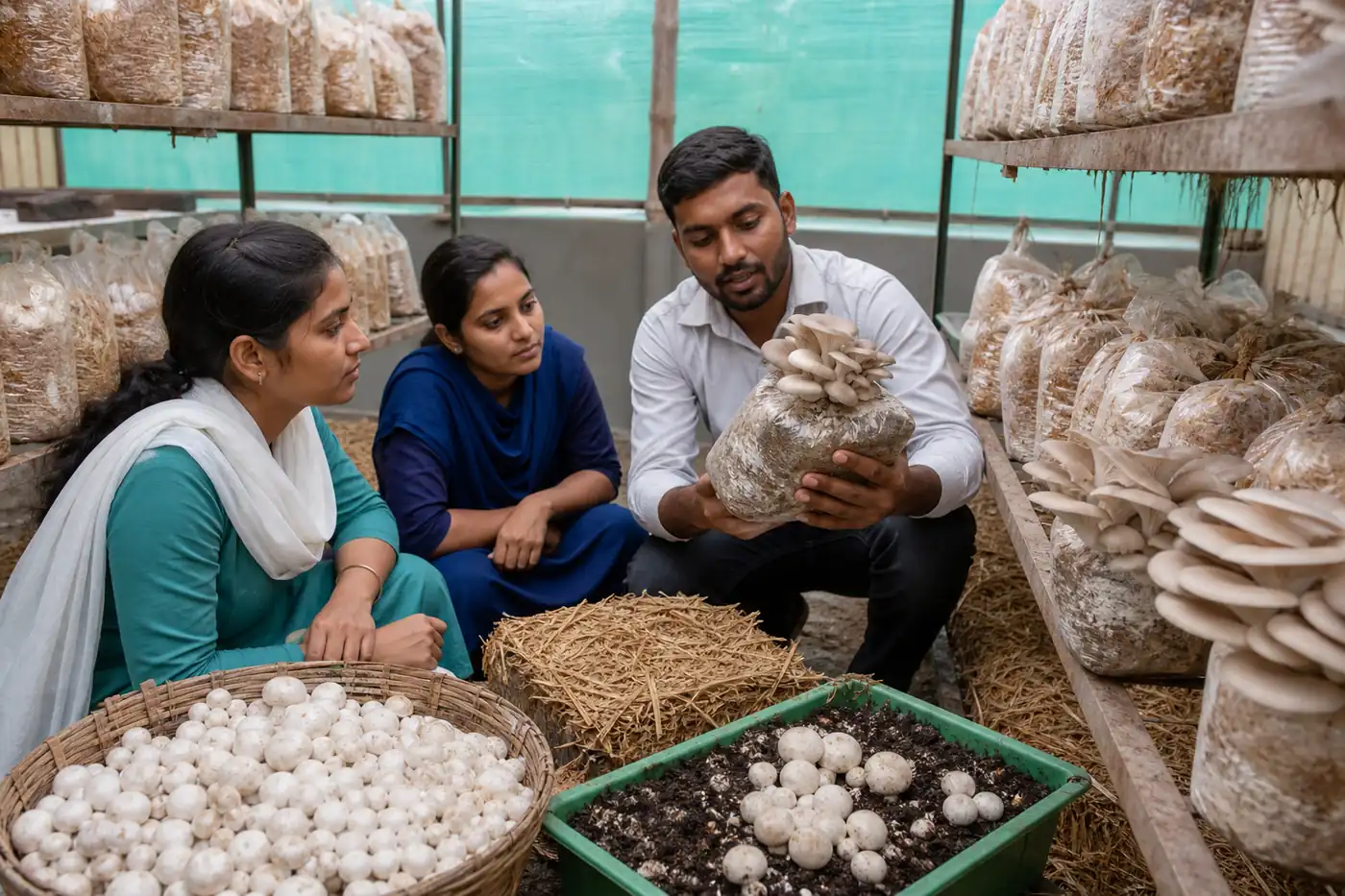
A student group in a village collects paddy straw after harvest. Instead of burning or wasting it, they use it for oyster mushroom production. The same activity teaches waste recycling, hygiene, marketing, and nutrition. This is why mushroom cultivation is a strong example of skill-based agriculture.
Summary Cheat Sheet
| Concept / Topic | Key Details / Explanation |
|---|---|
| Basic biology | Mushrooms are saprophytic fungi that grow on prepared organic substrates, not on ordinary farm soil. |
| Morphology | The key visible morphology words are pileus (cap), stipe (stalk), and gills, with gills bearing spores. |
| Spawn | Spawn is the planting material, meaning active mushroom mycelium on a suitable carrier medium. |
| Main cultivation sequence | The easiest sequence to remember is compost/substrate -> spawning -> casing -> cropping/harvest. |
| Major success factors | Hygiene, temperature, humidity, ventilation, and good substrate management decide success. |
| Best lesson takeaway | Mushroom cultivation is a controlled biological enterprise where sanitation and environmental management are as important as raw material. |
Lesson Doubts
Ask questions, get expert answers