🏡 Principles of Landscape Design
A fuller lesson on the meaning of landscape design, its elements, principles, and lawn-and-avenue basics.
Principles of Landscape Design
Landscape design is the planned arrangement of land, plants, paths, structures, and open space to create both utility and beauty.
Meaning of landscape gardening
Landscape gardening can be understood as the application of garden forms, methods, and materials to improve the surrounding landscape.
A landscape may be large or small, but in each case its appearance can be shaped or improved through design.
Landscape and landscape gardening
An important distinction is:
- landscape is any area where a view or design can be shaped
- landscape gardening is the planned use of garden forms, methods, and materials to improve that area
Important considerations before design
- the garden should suit the local environment
- overcrowding of plants should be avoided
- natural topography should be used intelligently
- harmony among different components is essential
- the designer should be clear whether the aim is utility, beauty, or both
A good garden plan should therefore be:
Pro Content Locked
Upgrade to Pro to access this lesson and all other premium content.
₹99 charged monthly · Cancel anytime
- All Agriculture & Banking Courses
- AI Lesson Questions (100/day)
- AI Doubt Solver (50/day)
- Glows & Grows Feedback (30/day)
- AI Section Quiz (20/day)
- 22-Language Translation (100/day)
- Recall Questions (20/day)
- AI Quiz (15/day)
- AI Quiz Paper Analysis (100/day)
- AI Step-by-Step Explanations (100/day)
- Spaced Repetition Recall (FSRS)
- AI Tutor
- Immersive Text Questions
- Audio Lessons — Hindi & English
- Mock Tests & Previous Year Papers
- Summary & Mind Maps
- XP, Levels, Leaderboard & Badges
- Generate New Classrooms
- Voice AI Teacher (AgriDots Live)
- AI Revision Assistant
- Knowledge Gap Analysis
- Interactive Revision (LangGraph)
🔒 Secure via Razorpay · Cancel anytime · No hidden fees
Principles of Landscape Design
Landscape design is the planned arrangement of land, plants, paths, structures, and open space to create both utility and beauty.
Meaning of landscape gardening
Landscape gardening can be understood as the application of garden forms, methods, and materials to improve the surrounding landscape.
A landscape may be large or small, but in each case its appearance can be shaped or improved through design.
Landscape and landscape gardening
An important distinction is:
- landscape is any area where a view or design can be shaped
- landscape gardening is the planned use of garden forms, methods, and materials to improve that area
Important considerations before design
- the garden should suit the local environment
- overcrowding of plants should be avoided
- natural topography should be used intelligently
- harmony among different components is essential
- the designer should be clear whether the aim is utility, beauty, or both
A good garden plan should therefore be:
- locally suitable
- purposeful
- harmonious
- non-crowded
- respectful of the existing site
Elements of landscape design
| Element | Simple meaning |
|---|---|
| Line | outlines of paths, borders, edges, fences |
| Form | three-dimensional character of objects |
| Mass | visual heaviness or solidity |
| Space | open or enclosed volume around objects |
| Texture | coarse, fine, rough, smooth character |
| Colour | harmony or contrast through colour use |
| Tone | relation of colour, light, and texture |
How to use these elements in a real garden
- Line controls movement through paths, boundaries, and bed edges.
- Form decides whether the scene feels upright, spreading, rounded, formal, or free.
- Mass helps one plant group dominate or recede visually.
- Space avoids crowding and gives breathing room.
- Texture changes the feeling of the site from bold to delicate.
- Colour affects emotional response and focal attention.
- Tone helps balance visual brightness and depth.
Principles of landscape design
Balance
Creates psychological equilibrium. It may be formal or informal.
Balance may also be horizontal, vertical, or radial, which helps show that it can be organized around axes or around a centre.
Proportion
Refers to the relative size and scale of different parts.
Perspective
Helps create depth and realism in arrangement.
Perspective is strengthened by:
- relative size
- overlapping objects
- sharper or blurred appearance
- foreground and background positioning
Emphasis
Draws attention to a focal point or dominant feature.
A focal point may be created by:
- a contrasting plant form
- a specimen tree
- a statue or water feature
- a bright flower group
- a strong change in colour or texture
Movement and rhythm
Guide the eye through the composition in an orderly and pleasant way.
Pattern and repetition
Repeated forms or arrangements create order and visual continuity.
Pattern, repetition, and rhythm are closely related:
- pattern = repeated motif
- repetition = repeated use of design elements
- rhythm = the sense of flow created by that repetition
Variety and contrast
Prevent monotony and make the garden more interesting.
Contrast is useful, but too much contrast breaks harmony. A good answer should therefore say that contrast must be used sparingly and purposefully.
Harmony and unity
Bring all parts together so the design feels like one whole composition.
Harmony among different components can be understood as the real essence of landscape gardening. So unity is not an extra principle; it is the final design goal.
A simple design line
Variety creates interest, but harmony keeps the garden beautiful.
Lawn establishment basics
Lawn making involves much more than a simple definition. The practical logic is:
- choose a turf species suited to the site
- prepare the soil properly
- plant by seeding, sodding, plugging, sprigging, or stolonizing
- maintain irrigation, mowing, and aftercare until the lawn establishes
Soil preparation for lawns
Soil preparation before lawn establishment is very important. A practical answer should mention:
- cleaning and levelling
- removal of debris and unwanted roots
- suitable soil tilth
- drainage planning
- correction of soil condition where necessary
Further practical details include:
- remove stones, bottles, old roots, and debris
- if rough grading is done, preserve topsoil and replace it later
- break compacted layers by tillage
- avoid damaging major tree roots while preparing the area
- restore enough good topsoil for turf rooting
- improve sandy or clay soils with organic matter
This lawn-establishment logic includes:
- choosing turf adapted to the area
- protecting existing roots where possible
- restoring good topsoil after rough grading when needed
- watering with fine spray after seeding
- giving close care during the first months of establishment
Some important turf-establishment words
| Word | Meaning |
|---|---|
| Seeding | establishing turf from seed |
| Sodding | laying ready-made turf pieces for quick cover |
| Sprigging | planting stems or runners without soil |
| Plugging | planting small sod pieces at intervals |
| Stolonizing | broadcasting stolons and covering them lightly |
Different establishment methods are used according to species, budget, and speed requirement. Sodding gives quick visual cover, while seeding, plugging, and sprigging help establish turf more gradually.
Sodding is the fastest way to create an almost instant lawn, especially where quick cover is needed for beauty or erosion control.
Why early lawn care matters
Many lawn failures occur not because the grass species was wrong, but because the new lawn was not managed carefully during establishment. Early-stage success depends on:
- fine watering after seeding
- protecting the young surface from drying
- preventing compaction
- allowing rooting before rough use
- continuing maintenance until full establishment
Lawn basics
A lawn is one of the most important visual and functional components of many landscapes.
Good lawn establishment depends on
- selecting suitable turf grass
- preparing the soil properly
- using the correct planting method
- maintaining water, mowing, and care after establishment
Young lawns need careful early watering and protection from drying. Lawn failure is largely an establishment and aftercare problem.
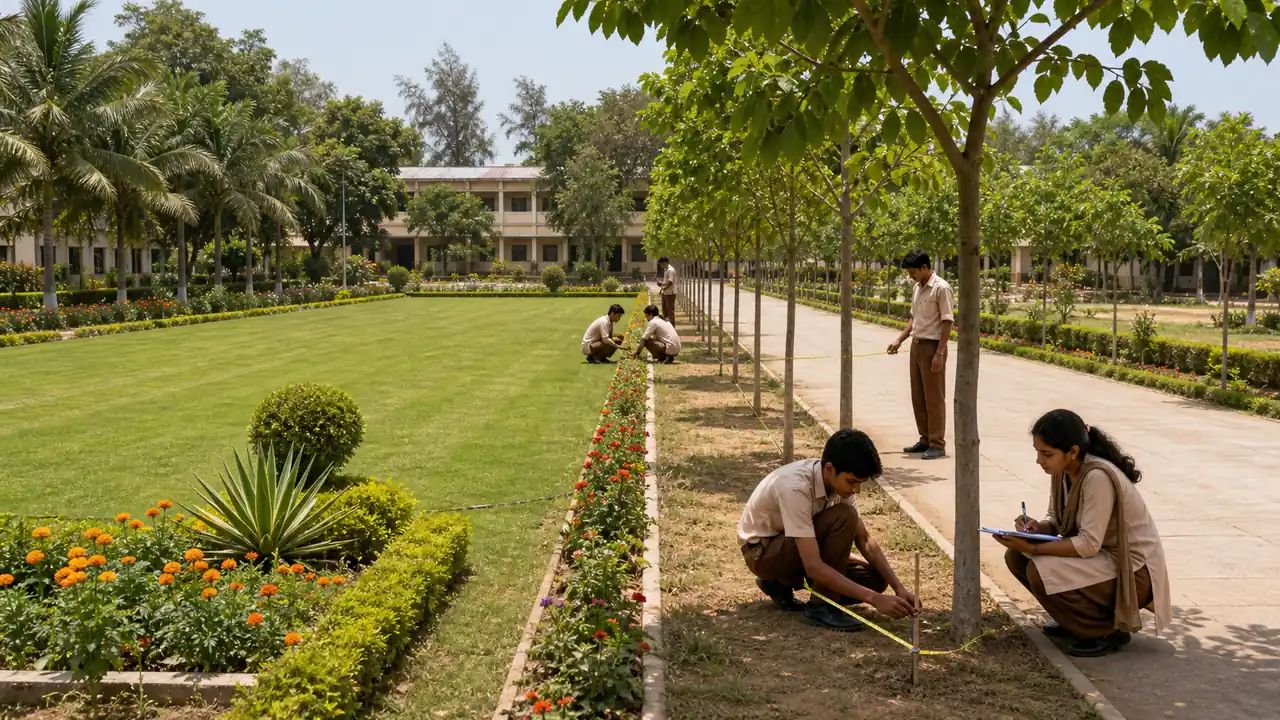
Avenue gardening
An avenue is a road or path lined with trees or large shrubs, often on both sides, to create a strong visual approach and shade effect.
Why avenue planting is important
- improves visual beauty
- creates identity for roads and campuses
- provides shade
- strengthens the formal design of entrances and approaches
Avenue gardening also has a historical role:
- avenues are among the oldest ideas in garden history
- they emphasize approach and arrival
- uniform species create order and continuity
- they direct the eye toward an important feature or structure
Avenue gardening also has historical and design value: avenues frame movement, direct the eye, and create a strong formal approach to buildings, roads, estates, and campuses.
Avenue planting usually uses a uniform species or cultivar so the entire approach looks ordered and continuous.
Garden styles
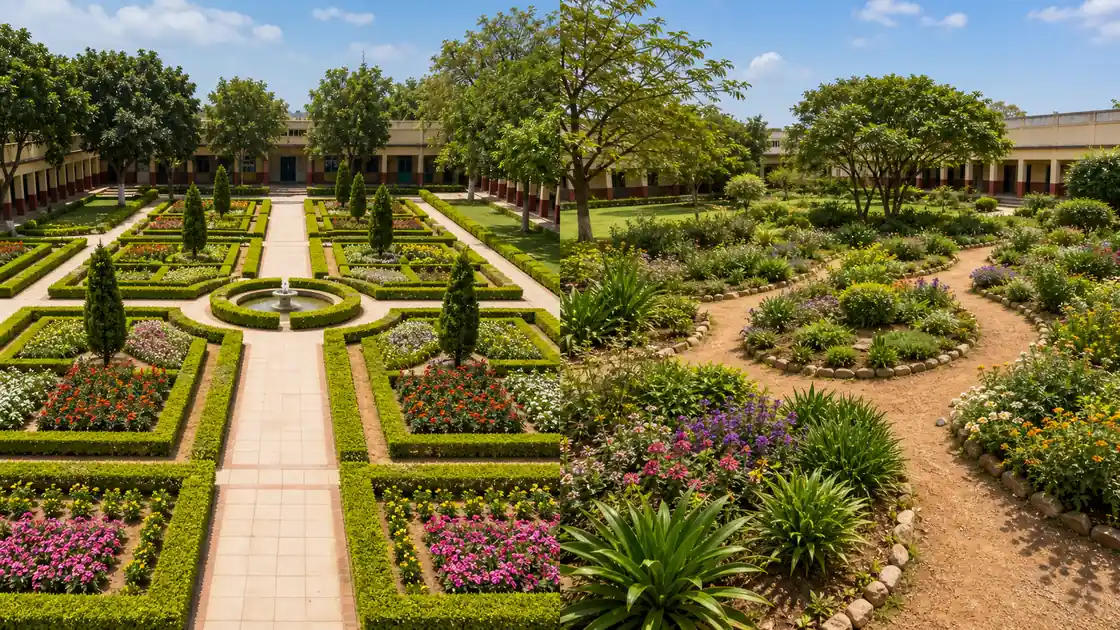
Formal style
Formal gardens are:
- symmetrical
- geometric
- often enclosed or bounded
- dependent on trimmed trees, shaped shrubs, and defined flower beds
Formal style depends on control, symmetry, and geometric order.
Formal gardens can be understood as highly ordered compositions where straight lines, regular spacing, and controlled features create dignity and discipline.
Informal style
Informal gardens are:
- asymmetrical
- more naturalistic
- based on flowing curves
- richer in irregular water bodies, grouped plants, and natural effects
Informal style aims at a more natural effect rather than rigid geometry.
Informal style can be understood as designed naturalness, not wild disorder.
It is still planned, but the planning is hidden inside curved lines, irregular grouping, and softer transitions.
Free style
Free style combines useful features of both formal and informal design.
This mixed style is often practical because it balances order with naturalness.
That is why free style is often useful in real homes, campuses, and public spaces where strict geometry alone may feel too rigid.
Why landscape gardening belongs in agriculture
This topic may look separate from agriculture at first, but it connects closely with:
- nursery management
- planting-material selection
- aesthetic use of horticultural plants
- environmental improvement
- public spaces, campuses, and home gardens
So landscape gardening is both an art and a practical horticultural enterprise.
Additional notes
Lawn grass species table
| Lawn grass | Texture | Best situation |
|---|---|---|
| Hariyali / Arugu / Doob grass | medium fine | open sunny location; drought resistant |
| St. Augustine / Buffalo grass | coarse | shady situation; needs frequent watering |
| Chain grass / Upparugu | fine | saline soils and open sunny locations |
| Annual blue grass, Poa annua | medium fine | acid soils and higher elevations |
| Kikuyu grass, Pennisetum clandestinum | rough | acid soils and higher elevations |
| Japan grass, Zoysia japonica | coarse | poor sandy soil, open sun, slow growth |
| Manila grass, Zoysia matrella | medium | open sunny situation |
| Korean / velvet / carpet grass, Zoysia tenuifolia | fine | open sunny situation |
| Bermuda / Hyderabad grass, Cynodon sp. | fine | open sunny situation; needs mowing |
| Dwarf Bermuda, Cynodon sp. | medium | open sunny situation |
| Fescue grass, Festuca sp. | coarse | shade tolerant; survives on inferior soils |
| Paspalum grass, Paspalum vaginatum | medium | open sunny situation |
Avenue-tree species list
Avenue gardening can be understood as an old formal landscape idea where uniform rows guide the eye toward an approach, road, mansion, campus, or architectural feature.
| Avenue tree group | Examples |
|---|---|
| Maples | Acer saccharum sugar maple, Acer platanoides Norway maple |
| Oaks | Quercus alba, Q. coccinea, Q. rubra, Q. velutina, Q. palustris |
| Lindens | Tilia euchlora, Tilia tomentosa, Tilia vulgaris |
| Elms | Ulmus americana, U. glabra, U. campestris |
| Other avenue trees | Ailanthus glandulosa, Celtis occidentalis, Fraxinus spp., Ginkgo biloba, Liquidambar styraciflua, Liriodendron tulipifera, Platanus orientalis, Phellodendron amurense |
Garden style examples from source
| Style idea | Example memory |
|---|---|
| Formal / highly ordered avenue design | Gardens of Versailles, Het Loo, French and Dutch baroque landscapes |
| Avenue as historical approach | sphinx avenue to Hatshepsut’s tomb; guardian-lion avenues to Ming tombs |
| Avenue as visual direction | Meindert Hobbema’s The Avenue at Middelharnis |
| Free style | Rose Garden, Ludhiana; remember the exact phrase Rose Garden Ludhiana for lesson-style recall |
Use these examples only as memory anchors. The exam answer should still explain the principle: formal gardens use symmetry and control, informal gardens use designed naturalness, and free style combines both.
Understanding landscape design in practice
Landscape design is agriculture plus visual thinking. The plants are still living material, but the question changes from "How much yield?" to "How should space feel, move, guide, cool, shade, and beautify?"
Campus example
Imagine redesigning your school entrance. Tall avenue trees can guide movement, lawn can create rest space, shrubs can hide rough corners, and a bright flowering bed can become the focal point. Balance, proportion, perspective, emphasis, rhythm, variety, and harmony are not art words only; they are decisions you can see while walking.
| Principle | Simple student test |
|---|---|
| Balance | Does one side feel too heavy or empty? |
| Proportion | Are plant sizes suitable for the building and path? |
| Perspective | Does the path or planting create depth? |
| Emphasis | Where does the eye naturally stop? |
| Rhythm | Is there a repeated pattern that guides movement? |
| Harmony | Do the parts feel like one garden? |
Small enterprise situation
A nursery student can earn by selling plants, but a landscape student can earn by planning how those plants are used in homes, schools, offices, and public parks. This turns plant knowledge into a service enterprise.
Exam framing
When asked about landscape principles, do not write one-word definitions only. For each principle, add a plant example: avenue trees for rhythm, lawn for open space, flower bed for emphasis, and mixed shrubs for variety.
Summary Cheat Sheet
| Concept / Topic | Key Details / Explanation |
|---|---|
| Meaning of landscape design | Landscape design combines utility and beauty through planned use of outdoor space. |
| Key design elements | Important design elements are line, form, space, texture, and colour. |
| Key design principles | High-value design principles are balance, proportion, harmony, unity, and contrast. |
| Lawn establishment | A good lawn depends on species choice, soil preparation, establishment method, and early care. |
| Best lesson takeaway | Landscape design is not random decoration; it is planned outdoor composition using principles and elements together. |
Lesson Doubts
Ask questions, get expert answers