📝 Subsidiary Enterprises Practice and Revision
A recap lesson bringing together the main subsidiary-enterprise concepts of Unit 5.
Subsidiary Enterprises Practice and Revision
This revision lesson brings together the enterprise-based side of agriculture. Unit 5 shows how farms become more resilient when production, processing, and ecology are connected through allied enterprises.
One-line map of the unit
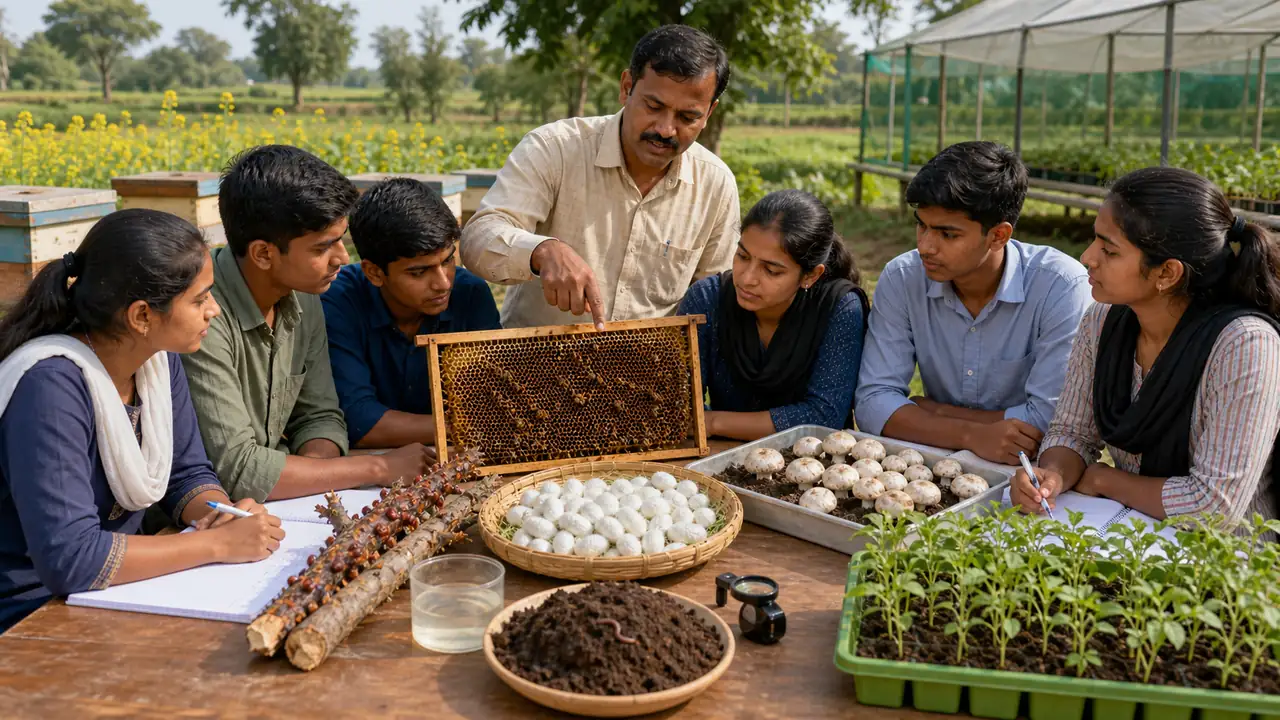
apiculture + lac + sericulture + mushroom + landscape + biopesticides + vermicompost + nursery = diversification with income, ecology, and skill
Unit sequence
Treat Unit 5 like a set of small rural enterprises, not as eleven isolated lessons. For every topic, ask three questions:
- What living organism, plant material, or biological process is being used?
- What management step does the farmer or student entrepreneur control?
- What product, service, or ecological benefit comes out?
One village example for the whole unit
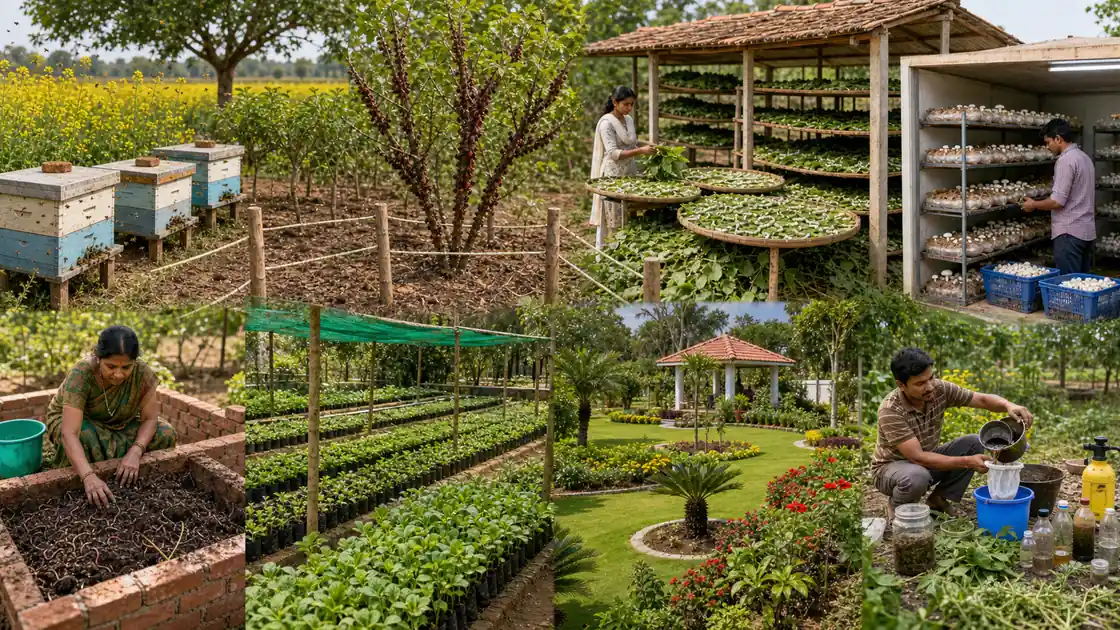
Imagine one village cluster:
- a mustard grower keeps bees for honey and pollination
- a family with palas and ber trees manages lac
- a mulberry-growing household sells cocoons
- a youth group grows oyster mushrooms from straw
- a nursery supplies seedlings and ornamental plants
- farmers use vermicompost and biopesticides to reduce input pressure
- a trained student designs a school garden using landscape principles
This turns the unit into a living map of diversification.
Pro Content Locked
Upgrade to Pro to access this lesson and all other premium content.
₹99 charged monthly · Cancel anytime
- All Agriculture & Banking Courses
- AI Lesson Questions (100/day)
- AI Doubt Solver (50/day)
- Glows & Grows Feedback (30/day)
- AI Section Quiz (20/day)
- 22-Language Translation (100/day)
- Recall Questions (20/day)
- AI Quiz (15/day)
- AI Quiz Paper Analysis (100/day)
- AI Step-by-Step Explanations (100/day)
- Spaced Repetition Recall (FSRS)
- AI Tutor
- Immersive Text Questions
- Audio Lessons — Hindi & English
- Mock Tests & Previous Year Papers
- Summary & Mind Maps
- XP, Levels, Leaderboard & Badges
- Generate New Classrooms
- Voice AI Teacher (AgriDots Live)
- AI Revision Assistant
- Knowledge Gap Analysis
- Interactive Revision (LangGraph)
🔒 Secure via Razorpay · Cancel anytime · No hidden fees
Subsidiary Enterprises Practice and Revision
This revision lesson brings together the enterprise-based side of agriculture. Unit 5 shows how farms become more resilient when production, processing, and ecology are connected through allied enterprises.
One-line map of the unit
apiculture + lac + sericulture + mushroom + landscape + biopesticides + vermicompost + nursery = diversification with income, ecology, and skill
Unit sequence
Treat Unit 5 like a set of small rural enterprises, not as eleven isolated lessons. For every topic, ask three questions:
- What living organism, plant material, or biological process is being used?
- What management step does the farmer or student entrepreneur control?
- What product, service, or ecological benefit comes out?
One village example for the whole unit
Imagine one village cluster:
- a mustard grower keeps bees for honey and pollination
- a family with palas and ber trees manages lac
- a mulberry-growing household sells cocoons
- a youth group grows oyster mushrooms from straw
- a nursery supplies seedlings and ornamental plants
- farmers use vermicompost and biopesticides to reduce input pressure
- a trained student designs a school garden using landscape principles
This turns the unit into a living map of diversification.
Objective check
- The biggest agricultural advantage of apiculture is often:
- pollination support to crops
- Queen excluder is associated with:
- modern movable-frame beehives
- Lac is produced by:
- a tiny insect growing on suitable host twigs
- Sericulture is linked with:
- silkworm rearing for silk production
- Spawn in mushroom cultivation means:
- mycelium-containing planting material
- Biopesticides are obtained mainly from:
- biological sources
- Vermicompost is produced with the help of:
- earthworms
- A nursery is mainly used to:
- raise healthy young planting material
- Worker bees are especially important because they:
- perform nearly all routine colony work
- Stick lac means:
- lac still attached to the twigs
- Shellac is:
- a purified processed commercial form of lac
- Button mushroom in India is mainly:
- Agaricus bisporus
- The hive section mainly used for honey storage is called:
- super
- The dance that gives direction for distant food is:
- waggle dance
- Pierced cocoons are low in value because:
- the continuous filament is broken
- The most common nursery bed for poorly drained conditions is:
- raised bed
- A plant-incorporated protectant is best understood as:
- a pesticidal substance produced by the plant itself
- The inner structural protein of silk is:
- fibroin
- The outer gummy protein of silk is:
- sericin
- The most suitable broad biopesticide term for pheromone-based mating disruption is:
- biochemical pesticide / semiochemical
- The nursery block used to maintain true-to-type mother plants is:
- progeny tree block
- Mushroom casing mainly helps in:
- moisture regulation, gas exchange, and fruiting support
- Eisenia fetida is important in:
- vermicomposting
- Bombyx mori feeds mainly on:
- mulberry leaves
- A parasitoid differs from a predator because:
- it develops on or in a host and eventually kills it
Fill in the blanks
- The plants that provide nectar and pollen for bees are called __________.
- The purified commercial form of lac is called __________.
- The common mulberry silkworm is __________.
- Mushroom planting material is called __________.
- The protective covering over colonized compost in some mushroom systems is called __________ soil / layer.
- The granular manure produced by earthworms is called __________.
- In a bee colony, sterile females that perform most duties are called __________.
- When the old queen leaves an overcrowded hive with many workers, the event is called __________.
- The boxes placed above the brood chamber for honey storage are called __________.
- The common lac insect is __________.
- The common mulberry silkworm feeds mainly on __________ leaves.
- The protective top layer after full mycelial growth in button mushroom is called __________.
- Surface-dwelling compost worms belong mainly to the __________ group.
- A nursery bed prepared above ground level to improve drainage is called a __________ bed.
- The plants that provide nectar and pollen to bees are collectively called __________.
- The granular commercial stage obtained after crushing and cleaning stick lac is called __________ lac.
- The silk proteins are mainly __________ and __________.
- Tree-lined approach planting in landscape design is called __________ gardening.
- The common button mushroom is __________.
- The process of mixing mushroom spawn into compost is called __________.
- The microbial biopesticide Trichoderma is mainly used against __________ diseases.
- The insecticidal bacterium abbreviated as Bt is __________.
- The most popular nursery bed in high-rainfall or poorly drained areas is __________ bed.
- The nursery structure used for high humidity rooting is called __________ house.
- Tasar silk is associated with __________ type host trees such as arjun.
- Muga silk is regionally associated with the __________ Valley.
- Eri silkworm commonly feeds on __________ leaves.
- A nursery mixture memory ratio is red earth:FYM:sand = __________.
Important point recall
These statements capture the main ideas that connect the unit:
- Beekeeping helps in three major ways: honey production, wax production, and pollination.
- A bee colony has three castes: queen, workers, and drones.
- Workers change duties with age and are the operational force of the colony.
- Bees communicate food-source information through dances.
- Lac is an insect secretion that hardens as an encrustation on twigs.
- Silk is strong, lustrous, and protein-based.
- Mushroom cultivation depends on substrate, sanitation, and environmental control.
- Biopesticides and vermicompost support sustainable farming by reducing chemical pressure and improving biological health.
- Nursery management determines the quality of later plantation material.
Unit 5 concept checklist
Use this as a side-by-side verification list while revising.
| Topic | Must-cover concepts |
|---|---|
| Apiculture | bee species, castes, queen, worker duties, drones, dance, swarming, hives, bee pasturage, honey, beeswax |
| Lac culture | lac insect, host twig encrustation, stick lac, seed lac, shellac, uses, livelihood value |
| Sericulture | history, Bombyx mori, egg-larva-pupa-adult cycle, mulberry, cocoon, rearing, reeling, fibroin, sericin, non-mulberry silk |
| Mushroom | morphology, nutrition, medicinal value, spawn, compost, casing, button/oyster/milky/paddy-straw mushrooms, diseases and pests |
| Landscape | elements, principles, lawn establishment, avenue gardening, formal/informal/free styles |
| Biopesticides | microbial, PIP, botanical, biochemical, semiochemical, IGR, predators, parasitoids, formulation |
| Vermicompost | nutrients, earthworm groups, Eisenia fetida, bed preparation, harvesting, precautions |
| Nursery | importance, site factors, components, bed types, soil mixture, fruit nursery, vegetable nursery, hi-tech nursery |
Very short answer drill
- What is apiculture?
- What is bee pasturage?
- What is lac culture?
- What is stick lac?
- What is shellac?
- What is seed lac?
- What is sericulture?
- What is spawn?
- What is casing?
- What is a biopesticide?
- What is vermicompost?
- What is a nursery?
- What is a raised nursery bed?
- What is bee pasturage?
- What is an avenue?
- What is fibroin?
- What is sericin?
- What is a PIP?
- What is a semiochemical?
- What is a parasitoid?
- What is hardening off?
- What is a progeny tree block?
- What is a mist house?
- What is Eisenia fetida?
- What is a pierced cocoon?
Short-answer practice
- Why are workers considered the functional backbone of a bee colony?
- Differentiate between stick lac, seed lac, and shellac.
- Explain the role of mulberry in sericulture.
- Why are pierced cocoons less valuable than intact cocoons?
- Why is hygiene critical in mushroom cultivation?
- What are the basic conditions needed for a successful vermicompost bed?
- Why is nursery layout important for healthy planting material?
- How do biopesticides fit into sustainable agriculture?
- Why are subsidiary enterprises especially useful for small and diversified farms?
- Why is bee pasturage important in apiculture?
- Why is harmony called the essence of landscape gardening?
- Differentiate between predators and parasitoids.
- Explain why Trichoderma is useful in disease management.
- Why are disease-free eggs essential in sericulture?
- Why is a raised bed preferred in high-rainfall nursery areas?
- Why should evergreen fruit seedlings be moved with an earth ball?
- Explain how biopesticide formulation affects field success.
- Why are pierced cocoons lower in value?
- Why does mushroom cultivation require compost instead of ordinary soil?
Long-answer style prompts
- Describe the importance of apiculture in agriculture and rural livelihoods.
- Explain the structure and functioning of a bee colony.
- Write a note on lac culture and its commercial products.
- Explain the main steps of sericulture from egg to silk.
- Describe mushroom cultivation as a skill-based agricultural enterprise.
- Explain the principles and elements of landscape design with examples.
- Explain the role of biopesticides and vermicompost in sustainable agriculture.
- Write a note on nursery establishment and the principles of good nursery layout.
- Explain the importance of subsidiary enterprises in diversifying agricultural income.
- Explain sericulture as a chain from egg production to raw silk.
- Describe biopesticides with types, examples, and mode of action.
- Explain nursery components and layout with special reference to bed types and propagation structures.
- Describe mushroom composting, spawning, casing, and harvesting in sequence.
- Explain vermicompost production including earthworm type, bed preparation, harvesting, and precautions.
Applied questions
- A farmer values bees only for honey. Explain the larger agricultural importance that the farmer is missing.
- In a mushroom unit, the compost is good but contamination is high. Which management point is weak?
- Why can vermicompost not be treated as "just decomposed waste"?
- If nursery plants are weak and non-uniform, what later farm-level problems may appear?
- Why do allied enterprises often stabilize income better than dependence on a single crop alone?
- A sericulture farmer allows moths to emerge from most cocoons before processing. Predict the effect on silk value.
- A nursery is located in a low-lying field with no drainage. Which nursery-bed design is most suitable and why?
- A farmer applies a Bt product after caterpillars have stopped feeding. Why may the result be poor?
- A mushroom grower cuts oyster mushrooms with a dirty knife and leaves stumps. What disease-risk logic is involved?
- A mulberry garden has whitefly pressure but the farmer also rears silkworms. Why are selective or biological tools preferred?
Match the following
| Column A | Column B |
|---|---|
| Bombyx mori | mulberry silk |
| Laccifer lacca | lac |
| Agaricus bisporus | button mushroom |
| Eisenia fetida | vermicompost |
| Trichoderma | soil-borne disease suppression |
| Bt | lepidopteran larvae |
| Raised nursery bed | poor drainage/high rainfall |
| Queen excluder | modern beehive |
| Casing soil | button mushroom fruiting support |
| Progeny block | true-to-type mother plants |
Difference table practice
| Pair | Difference line |
|---|---|
| Queen and worker | queen is fertile egg-layer; workers are sterile females doing colony work |
| Worker and drone | worker is female labour caste; drone is male mating caste |
| Stick lac and shellac | stick lac is crude twig-attached lac; shellac is refined commercial lac |
| Intact cocoon and pierced cocoon | intact cocoon gives continuous filament; pierced cocoon has broken filament |
| Predator and parasitoid | predator eats many prey; parasitoid develops on/in host and kills it |
| Flat bed and raised bed | flat bed suits good drainage; raised bed suits poor drainage/high rainfall |
| Spawn and compost | spawn is mushroom planting material; compost is the growth substrate |
| Fibroin and sericin | fibroin is inner fibre protein; sericin is gummy outer protein |
Five-mark answer outlines
Sericulture
Define sericulture, name Bombyx mori, mention mulberry leaves, describe egg-larva-cocoon stages, then explain reeling and silk proteins.
Biopesticides
Define biopesticide, list microbial/botanical/biochemical/PIP/biotic agents, give examples such as Bt, Trichoderma, neem, pheromones, and predators, then connect with IPM.
Nursery
Define nursery, write importance, site factors, components, bed types, soil mixture, and hardening. Add one fruit nursery and one vegetable nursery example.
Vermicompost
Define vermicompost, mention earthworms and Eisenia fetida, explain vermibed, waste layering, moisture care, harvesting, and precautions.
Memory clusters
Apiculture cluster
- Apiculture = honey + wax + pollination.
- Workers = cleaners, nurses, guards, foragers, builders.
- Queen = main egg-layer.
- Drones = male bees mainly for mating.
- Swarming = colony division with old queen leaving overcrowded hive.
Lac and silk cluster
- Lac = insect secretion on twigs.
- Stick lac = crude lac on twigs.
- Seed lac = processed grains after cleaning and crushing.
- Shellac = refined commercial product.
- Sericulture = silkworm + cocoon + reeling + silk.
- Pierced cocoon = low-value cocoon after moth emergence.
- Fibroin = inner protein; sericin = gummy outer protein.
- Tasar, muga, and eri = non-mulberry silk memory set.
Mushroom, compost, and nursery cluster
- Spawn = mushroom planting material.
- Master spawn = source material for further multiplication.
- Casing = protective top layer in suitable systems.
- Vermicompost = worm-processed organic manure.
- Nursery = starting point of quality planting material.
- Raised bed = nursery bed for poorly drained or high-rainfall situations.
- Flat bed = nursery bed where drainage is already good.
- Deep bed = cold-protection bed in temperate conditions.
- Mist house = controlled humidity structure for rooting.
- Progeny block = true-to-type mother-plant area.
Landscape cluster
- Landscape = any area whose view can be shaped through design.
- Harmony = the essence of good composition.
- Avenue = tree-lined path or road emphasizing approach.
- Formal, informal, and free style = major garden-design labels.
Biopesticide cluster
- Microbial = bacteria, fungi, viruses, nematodes, or microbial products.
- Botanical = neem, pyrethrum, rotenone-type, plant oils, and extracts.
- Semiochemical = behaviour signal used for monitoring, trapping, or mating disruption.
- IGR = growth regulator that disturbs moulting, metamorphosis, or reproduction.
- Predator = eats many prey.
- Parasitoid = develops on/in host and kills it.
Oral recall
Speak these aloud without notes:
- why a bee colony is a social production unit
- how lac changes from secretion on twig to commercial product
- how silk is obtained from cocoon
- why mushroom cultivation demands hygiene and environmental control
- why nurseries matter in horticulture and plantation systems
Answer key
Fill in the blanks answers
- bee pasturage
- shellac
- Bombyx mori
- spawn
- casing
- vermicompost / worm cast
- workers
- swarming
- supers
- Laccifer lacca
- mulberry
- casing
- epigeic
- raised
- bee pasturage
- seed
- fibroin, sericin
- avenue
- Agaricus bisporus
- spawning
- soil-borne
- Bacillus thuringiensis
- raised
- mist
- arjun
- Brahmaputra
- castor
- 2:1:1
Summary Cheat Sheet
| Concept / Topic | Key Details / Explanation |
|---|---|
| Unit 5 core idea | Unit 5 is about diversification beyond field crops through subsidiary enterprises. |
| Shared enterprise logic | Each enterprise combines biology, management skill, and market or livelihood awareness. |
| Recurring themes | Pollination, recycling, biological protection, and planting-material quality are recurring themes across the unit. |
| Sustainable-agriculture link | Sustainable agriculture appears here especially through apiculture, biopesticides, vermicompost, and nursery production. |
| Best unit takeaway | The whole unit teaches how small allied enterprises can improve farm resilience, ecology, and income together. |
Lesson Doubts
Ask questions, get expert answers