🌿 Nursery and Layout of Nursery
A deeper lesson on nursery importance, site selection, and layout logic for raising healthy planting material.
Nursery and Layout of Nursery
A nursery is a place where seedlings, saplings, and other planting materials are raised, propagated, multiplied, hardened, and often sold for field planting.
Why nurseries are important
- provide healthy planting material
- improve establishment success
- support horticulture and landscaping
- create income opportunities through seedling production
Why nurseries are especially useful
Young seedlings need special care during early growth. It is far easier and more economical to protect them in a small nursery area than in a large permanent field.
Nurseries are also important because:
- vegetative propagules need skilled care before field planting
- grafts and cuttings need controlled aftercare
- seedlings can be hardened before transplanting
- field preparation can continue while nursery plants are still growing
- orchard replacement plants can be maintained for casualty gaps
Hardening against natural stress is one of the strongest reasons why a nursery exists in the first place.
Pro Content Locked
Upgrade to Pro to access this lesson and all other premium content.
₹99 charged monthly · Cancel anytime
- All Agriculture & Banking Courses
- AI Lesson Questions (100/day)
- AI Doubt Solver (50/day)
- Glows & Grows Feedback (30/day)
- AI Section Quiz (20/day)
- 22-Language Translation (100/day)
- Recall Questions (20/day)
- AI Quiz (15/day)
- AI Quiz Paper Analysis (100/day)
- AI Step-by-Step Explanations (100/day)
- Spaced Repetition Recall (FSRS)
- AI Tutor
- Immersive Text Questions
- Audio Lessons — Hindi & English
- Mock Tests & Previous Year Papers
- Summary & Mind Maps
- XP, Levels, Leaderboard & Badges
- Generate New Classrooms
- Voice AI Teacher (AgriDots Live)
- AI Revision Assistant
- Knowledge Gap Analysis
- Interactive Revision (LangGraph)
🔒 Secure via Razorpay · Cancel anytime · No hidden fees
Nursery and Layout of Nursery
A nursery is a place where seedlings, saplings, and other planting materials are raised, propagated, multiplied, hardened, and often sold for field planting.
Why nurseries are important
- provide healthy planting material
- improve establishment success
- support horticulture and landscaping
- create income opportunities through seedling production
Why nurseries are especially useful
Young seedlings need special care during early growth. It is far easier and more economical to protect them in a small nursery area than in a large permanent field.
Nurseries are also important because:
- vegetative propagules need skilled care before field planting
- grafts and cuttings need controlled aftercare
- seedlings can be hardened before transplanting
- field preparation can continue while nursery plants are still growing
- orchard replacement plants can be maintained for casualty gaps
Hardening against natural stress is one of the strongest reasons why a nursery exists in the first place.
Basic layout needs
| Need | Why it matters |
|---|---|
| Good site | accessibility and suitability |
| Water source | regular irrigation |
| Drainage | prevents waterlogging |
| Beds and paths | better organization |
| Shade or protection | helps delicate young plants |
Nursery definition expanded
A nursery is not just a fenced patch of seedlings. It is a planned production unit where planting material is:
- raised from seed
- multiplied vegetatively
- rooted or grafted
- hardened
- graded
- sold or shifted for field planting
That is why both ordinary seedling beds and advanced structures such as mist houses, polyhouses, and greenhouses are included here.
Important factors affecting nursery establishment
A key point is practical factors such as:
- location and transport access
- topography
- local climate
- water availability
- labour and market convenience
These matter because a nursery is not only a plant-growing place; it is also a management and business unit.
Important examples include:
- location and site
- topography and climate
- local business reputation
- transport facility
- suitable soil
- water facility
- manure availability
- labour availability
Site factor decision table
| Factor | Good choice | Problem if ignored |
|---|---|---|
| Topography | gentle, workable, well-drained site | erosion or water stagnation |
| Climate | suitable for target crops | poor germination or stress |
| Soil | fertile, friable, disease-free | weak roots and poor seedling vigour |
| Water | reliable and clean | irregular growth and mortality |
| Labour | skilled and available | poor grafting, delayed watering, bad grading |
| Transport | near road and market | high breakage and sale difficulty |
| Business reputation | locality trusted for planting material | low buyer confidence |
What a nursery should achieve
- orderly production
- easy watering and management
- proper separation of plant lots
- easy lifting, grading, and sale
- better survival after transplanting
Important nursery sections
| Section | Purpose |
|---|---|
| Propagation area | seed sowing or rooting of cuttings |
| Potting area | media preparation and filling |
| Hardening area | gradual exposure before transplanting |
| Mother block | source of propagation material where needed |
| Paths and service space | movement and sanitation |
Several structural and service components are also named:
- office and sale counter
- packing and potting sheds
- store and implement shed
- propagation structures such as greenhouse, polyhouse, shade house, lath house, mist house, hot bed, and cold frame
One more source detail is important:
- the progeny tree block maintains true-to-type mother plants
- it is assigned roughly 10% of the total nursery area
- this matters because nursery reputation depends on genetic and varietal reliability
Components of a complete nursery
Nursery components can be divided into functional groups. In simple student language:
| Component | Examples | Why it is needed |
|---|---|---|
| Administration and sale | office, sale counter, records | ordering, billing, customer trust |
| Work sheds | potting shed, packing shed, implement shed | media mixing, packing, tool storage |
| Storage | seed, manure, pots, labels, chemicals where permitted | prevents confusion and wastage |
| Mother/progeny block | true-to-type mother plants | reliable scion, cutting, and budwood source |
| Propagation structures | mist house, greenhouse, polyhouse, shade house, hot bed, cold frame | controlled rooting, grafting, seedling care |
| Production beds | flat, raised, deep beds | seedling and sapling production |
| Hardening area | partial shade/open exposure transition zone | prepares plants for field conditions |
The key line is: a nursery layout should reduce loss, maintain varietal purity, and make daily operations easy.
Site selection principles
- choose well-drained land
- ensure regular water supply
- keep the area accessible for labour and transport
- avoid low-lying waterlogged spots
- provide fencing or protection where needed
Site choice is specifically linked with topography, climate, transport access, labour, and the practical reputation of the location for nursery business.
Nursery layout logic
An efficient nursery layout should allow a plant to move in one direction:
input storage -> media preparation -> sowing/propagation -> early care -> potting or transplanting -> hardening -> sale/field dispatch
If this flow is broken, workers waste time carrying plants backwards and forwards, labels get mixed, and disease can move from old stock to young stock.
Practical layout rules
- keep water source close enough for irrigation but not so close that beds become waterlogged
- keep mother plants separate from sale stock
- keep diseased or doubtful plants away from healthy lots
- maintain paths wide enough for workers, trays, and wheelbarrows
- label beds by crop, variety, sowing date, and expected transplanting date
- keep compost and manure in a separate organized area
- place the hardening area near the dispatch side
Propagation structures explained
| Structure | Student-friendly purpose |
|---|---|
| Greenhouse | protects and controls the growing environment |
| Polyhouse | protected cultivation using plastic covering |
| Glass house | protected structure with glass covering |
| Shade house | reduces harsh sunlight for delicate plants |
| Lath house | gives filtered shade and airflow |
| Mist house | supports rooting by maintaining humidity |
| Hot bed | gives warmth for germination or rooting |
| Cold frame | protects plants while gradually exposing them |
These structures create the right microclimate for propagation, rooting, graft union healing, and hardening.
Why layout matters
A poor nursery layout causes:
- crowding
- disease spread
- difficult irrigation
- mixing of seedling batches
- inefficient labour use
Practical planning ideas
- keep beds aligned and manageable
- maintain path space between units
- store compost, tools, and containers in an organized way
- separate delicate seedlings from hardier stock when management differs
- ensure hardening space before field transfer
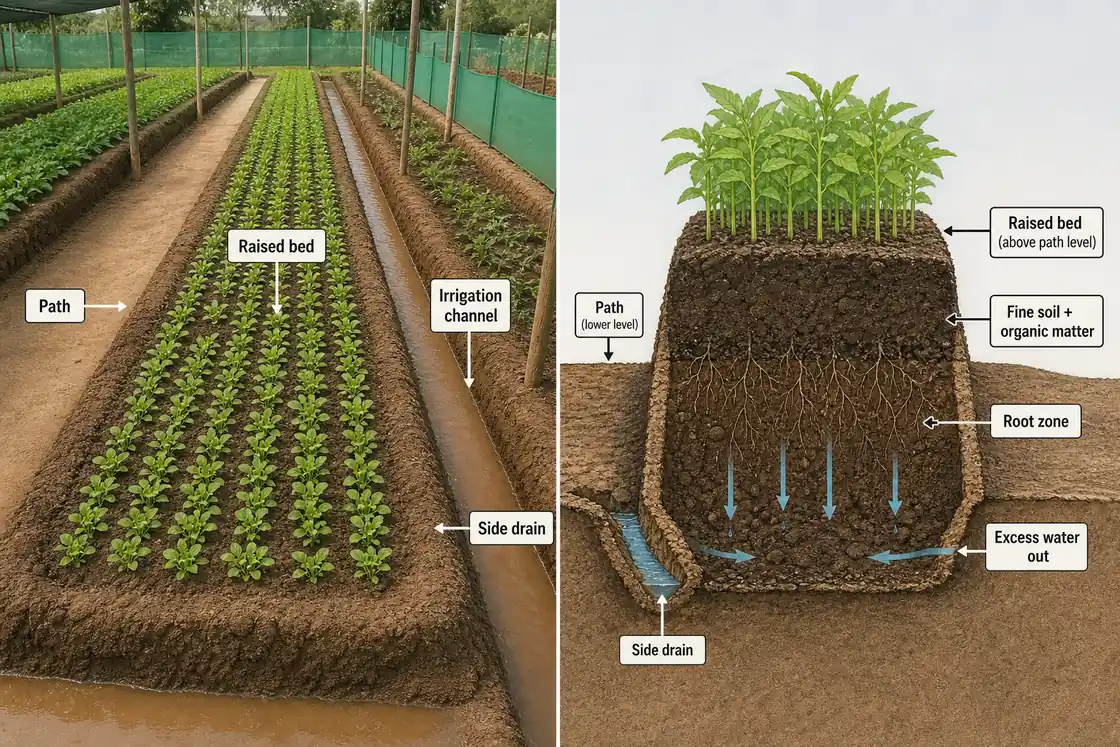
Nursery beds
Three basic nursery-bed types are described:
| Bed type | Best use idea |
|---|---|
| Flat bed | where rainfall is low or drainage is already good |
| Raised bed | where rainfall is high or drainage is poor |
| Deep bed | where protection from cold is needed |
Raised beds are especially common because they improve drainage and management.
More exact bed logic
- flat bed suits low-rainfall conditions or already good drainage
- raised bed is the most popular type where rainfall is high or drainage is poor
- raised beds are commonly shown about 15 cm above ground level
- deep bed is useful in colder or temperate conditions and may be about 25-30 cm below ground level
Bed selection examples
- In a high-rainfall district, choose raised beds so excess water drains away.
- In an arid area with good drainage, a flat bed may be practical and economical.
- In a cold temperate area, a deep bed can reduce cold-wind exposure.
The bed type is therefore a response to climate and drainage, not a random shape.
Soil mixture
For propagation and pot culture, a mixture commonly used here is based on:
- red earth
- FYM
- sand
This reminds students that nursery media must balance drainage, fertility, and root support.
The standard source ratio is:
| Component | Usual share |
|---|---|
| Red earth | 2 parts |
| FYM | 1 part |
| Sand | 1 part |
In some systems, leaf mould or charcoal may also be added depending on crop and nursery practice.
Hardening off
Hardening off means gradually preparing nursery plants for open field conditions. A seedling raised in a protected environment may be soft and tender. If it is suddenly planted in direct sun, dry wind, or cold night conditions, it may wilt or die.
How hardening works
- reduce excessive watering gradually
- expose plants to outside conditions for part of the day
- avoid sudden shock
- keep plants healthy but not overly succulent
- shift only when roots and shoots are strong enough
This explains why nursery-raised plants often survive better than weak direct-sown seedlings.
Fruit nursery points
Several orchard-oriented practical ideas are also added:
- many fruit nursery plants are shifted to the orchard at about 1-2 years age
- papaya is shifted much earlier
- deciduous fruits are often transplanted in late winter without earth ball
- evergreen fruit plants are usually shifted in the rainy season with earth ball
- planting in evening hours improves survival
- some extra plants are kept for replacement
Students should also retain these operational clues:
- most fruit seedlings are shifted from nursery to orchard at about 1-2 years age
- papaya is shifted much earlier, often around 2 months
- deciduous fruits are commonly shifted in February-March without earth ball
- evergreen fruits are commonly shifted in June-July with earth ball
- around 15% extra plants may be kept or purchased for casualty replacement
Fruit nursery transplanting logic
| Fruit group | Transplanting idea | Reason |
|---|---|---|
| Deciduous fruits | move during dormancy/late winter without earth ball | less active growth reduces shock |
| Evergreen fruits | move with earth ball during rainy season | active leaves need root protection and moisture |
| Papaya | move young, around two months | older seedlings transplant poorly |
Evening planting is advised because temperature and sunlight stress are lower, so seedlings get the night period to recover.
Vegetable nursery idea
Nursery planning is also connected to vegetables such as tomato, brinjal, chilli, cole crops, and onion. The key principle is that nursery area and transplanting age differ crop by crop, so planning must be crop-specific.
Vegetable nursery reference table
| Crop | Nursery area for 1 hectare planting | Approximate seedling age for transplanting |
|---|---|---|
| Tomato | 100-125 m² | 3-4 weeks |
| Brinjal | 125-150 m² | 3-4 weeks |
| Chilli | 150-200 m² | 3-4 weeks |
| Cole crops | 250 m² | 6-8 weeks |
| Onion | 500 m² | 6-8 weeks |
Why vegetable nursery area differs
Nursery area depends on seedling size, spacing, number of plants required, and how long the crop remains in the nursery. Onion and cole crops remain longer, so they need more planned nursery area and careful management.
Quality standards in nursery stock
Good planting material should be:
- true-to-type
- disease-free
- pest-free
- well-rooted
- not root-bound
- properly labelled
- hardened before dispatch
- uniform in size
Poor nursery stock creates losses after planting. The farmer may face gaps, uneven growth, delayed flowering, poor orchard establishment, and extra cost for replacement.
Hi-tech nursery
Hi-tech nurseries are used for commercial planting material such as tissue-cultured or protected high-value plants. These nurseries use structures like greenhouses or plastic tunnels and may automate:
- temperature control
- ventilation
- watering
- feeding
- hardening support
The final teaching point is that ordinary nursery methods may not meet sudden demand for elite or tissue-cultured planting material. That is why hi-tech nurseries are linked with crops such as tissue-cultured banana, gerbera, and carnation.
Hi-tech nursery workflow
In a hi-tech nursery, the same nursery principles are applied with better control:
- elite or tissue-cultured plants arrive
- plants are acclimatized in protected structures
- humidity, temperature, light, and ventilation are managed
- feeding and irrigation may be automated
- plants are graded and hardened
- uniform planting material is supplied to farmers
This makes hi-tech nurseries important for crops where demand rises suddenly and uniformity is essential.
Main points for a full answer
A full answer on nursery establishment may be written under these heads:
- definition
- importance
- site selection factors
- nursery components
- bed types
- soil mixture
- fruit and vegetable nursery examples
- hardening and hi-tech nursery
Additional notes
Nursery source-detail checklist
| Nursery component | Source detail |
|---|---|
| Building structures | office, sale counter, packing shed, potting shed, store, implement shed, residential quarter |
| Progeny tree block | true-to-type mother plants; about 10% of total nursery area |
| Propagation structures | greenhouse, glass house, polyhouse, hot bed, cold frame, lath house, shade house, mist house |
| Flat bed | used where rainfall is low or drainage is good |
| Raised bed | most popular; useful in high rainfall or poor drainage; about 15 cm above ground |
| Deep bed | temperate-zone protection from cold wind; about 25-30 cm deep |
| Soil mixture | red earth 2 parts, FYM 1 part, sand 1 part |
Fruit nursery transplanting facts
| Plant group | Lesson-aligned nursery rule |
|---|---|
| Fruit seedlings | usually shifted to orchard at 1-2 years |
| Papaya | transplant at about 2 months; sow in Feb-March and transplant in May |
| Deciduous fruits | transplant in Feb-March, usually without earth ball |
| Evergreen fruits | transplant in June-July with earth ball |
| Extra plants | purchase about 15% extra seedlings |
| Planting time | evening hours reduce transplanting stress |
Ordinary nursery versus hi-tech nursery
| Feature | Ordinary nursery | Hi-tech nursery |
|---|---|---|
| Demand type | routine local planting material | sudden demand for commercial elite plants |
| Crop examples | common fruit and vegetable seedlings | tissue-cultured banana, gerbera, carnation |
| Protection | open beds, shade, simple structures | greenhouse, glass building, plastic tunnel, protected structures |
| Climate control | limited | automated or semi-automated temperature, ventilation, light, watering, feeding |
| Roof / structure | fixed or simple | may include fold-back roofs for hardening-off |
| Hardening | manual shifting to outdoor conditions | possible without manual transfer by opening roofs or controlled exposure |
| Plant uniformity | variable | higher uniformity and survival |
| Cost | lower | higher investment, higher precision |
The core comparison is simple: ordinary nursery practices are economical and useful for routine propagation, but hi-tech nurseries are needed where uniform, protected, high-value planting material must be produced quickly and reliably.
Nursery layout in practice
A nursery is the school of plants. Seeds, cuttings, grafts, and young seedlings are not sent directly into the main field. They first grow in a protected learning space where water, shade, spacing, nutrition, and hardening can be controlled.
A simple analogy
| Nursery component | School analogy | Plant purpose |
|---|---|---|
| Mother block | library of trusted source material | true-to-type propagation |
| Seed bed | first training area | germination and early growth |
| Mist chamber | intensive care room | rooting delicate cuttings |
| Hardening area | practice ground | prepares plants for field stress |
| Sales/dispatch area | dispatch point | healthy plants leave for planting |
Small enterprise situation
A village nursery can supply tomato seedlings before the season, grafted mango plants for orchards, ornamental plants for homes, and avenue saplings for roadsides. The same nursery may therefore serve farmers, gardeners, schools, and local government planting drives.
Summary Cheat Sheet
| Concept / Topic | Key Details / Explanation |
|---|---|
| Meaning of nursery | A nursery is the starting point of many horticultural systems because it raises healthy young planting material. |
| Why nursery care matters | Young plants need more careful management than field-established plants, so nursery quality strongly affects later crop performance. |
| Importance of layout | Good layout makes management easy, efficient, and hygienic. |
| Core planning formula | The best quick formula is site + water + drainage + protection + organization. |
| Bed types | Flat bed, raised bed, and deep bed are important nursery-design terms, with raised beds especially useful where drainage is poor. |
| Soil-mixture memory line | A classic school-level nursery-mixture line is red earth 2 + FYM 1 + sand 1. |
| Best lesson takeaway | Nursery design is a quality-control step for future planting, not just a place to keep seedlings. |
Lesson Doubts
Ask questions, get expert answers