♻️ Vermicompost Enterprise
A deeper lesson on vermicompost production, nutritive value, advantages, and enterprise management.
Vermicompost Enterprise
Vermicompost is a fine, stable organic manure produced when selected earthworms convert decomposed organic waste into nutrient-rich castings.
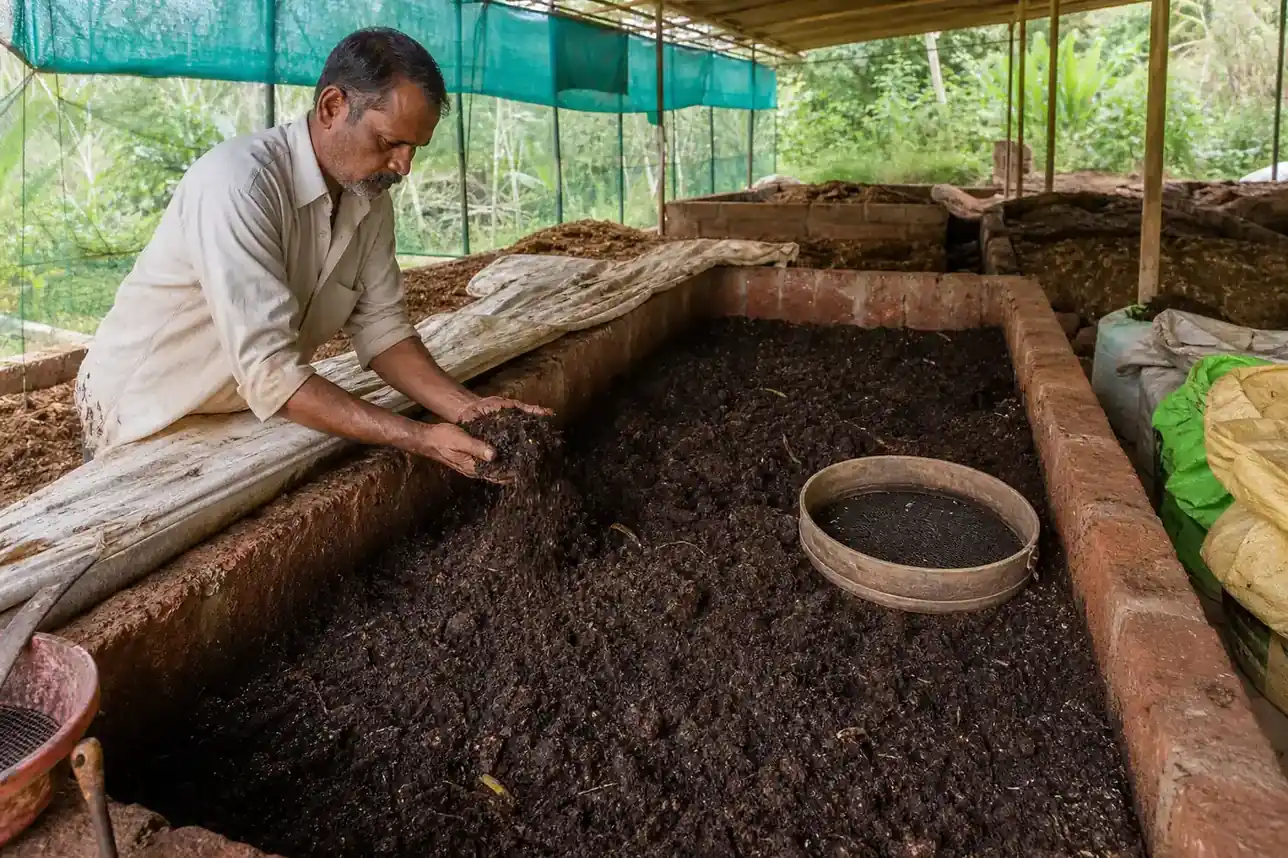
What vermicomposting means
Vermicomposting is the biological process in which organic residues are turned into worm castings or vermicast, which function as a valuable bio-fertilizer-like organic input.
Vermicompost is an organic manure produced when earthworms feed on biological waste materials and plant residues. It is closely linked with both waste conversion and soil enrichment.
Why vermicompost is valuable
- improves soil structure
- enhances microbial activity
- adds organic matter and plant nutrients
- converts waste into a useful farm input
- supports a small enterprise model
Basic process
Earthworms feed on biodegradable organic material and release castings that become vermicompost. The feed material should be moist and partially decomposed, not fresh and heating strongly.
The text highlights an important point here: earthworm activity does not merely break waste into smaller pieces. It improves:
Pro Content Locked
Upgrade to Pro to access this lesson and all other premium content.
₹99 charged monthly · Cancel anytime
- All Agriculture & Banking Courses
- AI Lesson Questions (100/day)
- AI Doubt Solver (50/day)
- Glows & Grows Feedback (30/day)
- AI Section Quiz (20/day)
- 22-Language Translation (100/day)
- Recall Questions (20/day)
- AI Quiz (15/day)
- AI Quiz Paper Analysis (100/day)
- AI Step-by-Step Explanations (100/day)
- Spaced Repetition Recall (FSRS)
- AI Tutor
- Immersive Text Questions
- Audio Lessons — Hindi & English
- Mock Tests & Previous Year Papers
- Summary & Mind Maps
- XP, Levels, Leaderboard & Badges
- Generate New Classrooms
- Voice AI Teacher (AgriDots Live)
- AI Revision Assistant
- Knowledge Gap Analysis
- Interactive Revision (LangGraph)
🔒 Secure via Razorpay · Cancel anytime · No hidden fees
Vermicompost Enterprise
Vermicompost is a fine, stable organic manure produced when selected earthworms convert decomposed organic waste into nutrient-rich castings.
What vermicomposting means
Vermicomposting is the biological process in which organic residues are turned into worm castings or vermicast, which function as a valuable bio-fertilizer-like organic input.
Vermicompost is an organic manure produced when earthworms feed on biological waste materials and plant residues. It is closely linked with both waste conversion and soil enrichment.
Why vermicompost is valuable
- improves soil structure
- enhances microbial activity
- adds organic matter and plant nutrients
- converts waste into a useful farm input
- supports a small enterprise model
Basic process
Earthworms feed on biodegradable organic material and release castings that become vermicompost. The feed material should be moist and partially decomposed, not fresh and heating strongly.
The text highlights an important point here: earthworm activity does not merely break waste into smaller pieces. It improves:
- aeration
- porosity
- structure
- drainage
- moisture-holding capacity
Worm castings may hold water up to many times their own weight, which is why vermicompost is valued not only for nutrients but also for soil physical improvement.
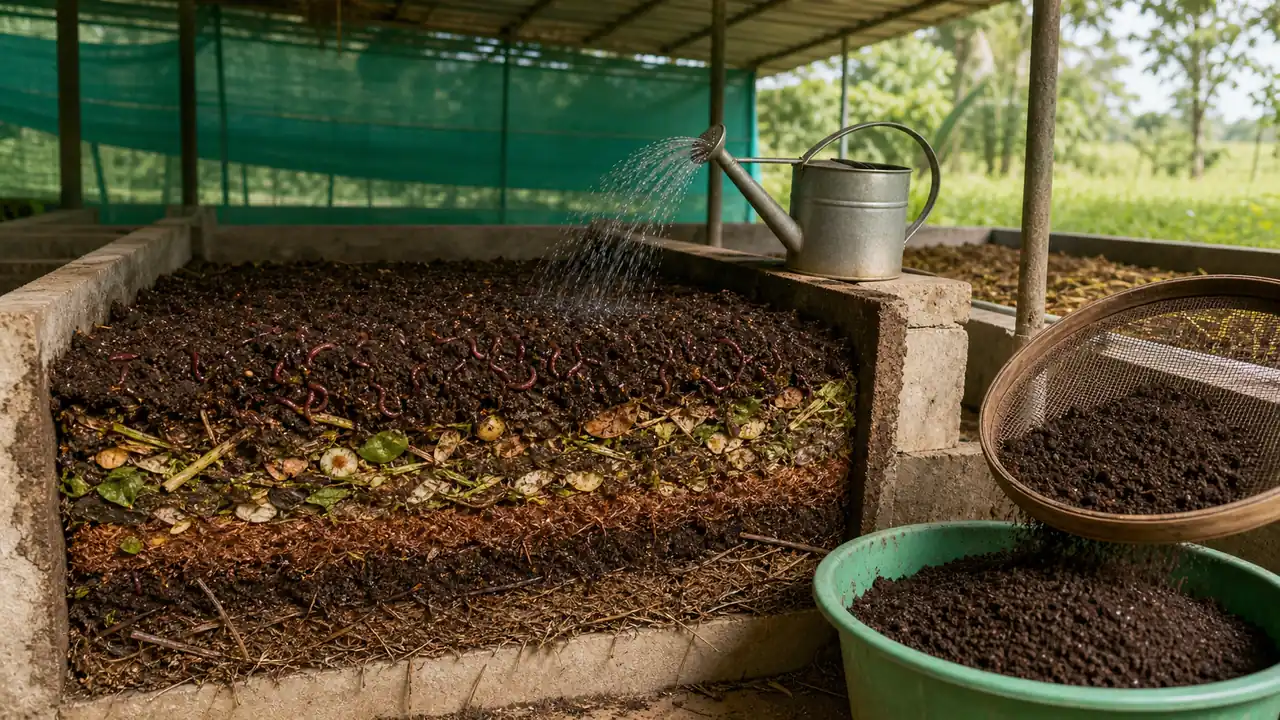
Materials and conditions needed
- organic waste
- suitable earthworms
- shade
- moisture
- aeration
- drainage
Good bed conditions
| Condition | Why it matters |
|---|---|
| Moisture | worms need a moist environment |
| Shade | direct sun and heat can harm worms |
| Aeration | prevents foul smell and poor decomposition |
| Drainage | avoids waterlogging |
Nutritive and biological value
Vermicompost is important not only because it is organic, but because it is:
- rich in essential plant nutrients
- rich in beneficial microflora
- easier to handle and apply than bulky undecomposed waste
- supportive of soil biological activity
It also points out that vermicompost helps improve the soil environment rather than acting only as a one-time nutrient dose.
Approximate nutritive profile in source terms
The nutrient-style summary here is more useful than a single fixed formula. Vermicompost commonly contains:
- useful organic carbon
- a favourable C:N ratio
- appreciable nitrogen
- appreciable phosphorus
- appreciable potassium
- calcium, magnesium, sulphur, and trace elements such as copper, iron, and zinc
An approximate nutrient-style profile includes:
- organic carbon
- a favourable C:N ratio
- about 1.5-2.5% nitrogen in some source descriptions
- appreciable phosphorus and potassium
The exact numbers can vary, but the main point is that vermicompost is much richer and more biologically active than raw waste.
Nutrient values
A textbook-style range is given for several components:
| Component | Approximate source range |
|---|---|
| Organic carbon | 9.5-17.98% |
| C:N ratio | about 11.64 |
| Nitrogen | 1.5-2.5% |
| Phosphorus | 1.6-1.8% |
| Potassium | 1.0-1.5% |
| Sodium | 0.06-0.30% |
| Calcium + Magnesium | 22.67-47.60 meq/100g |
| Copper | 2-9.50 mg/kg |
| Iron | 2-9.30 mg/kg |
| Zinc | 5.70-11.50 mg/kg |
| Sulphur | 128-548 mg/kg |
These values are best used to show that vermicompost is nutrient-rich and biologically active, not to suggest that every batch is chemically identical.
Important advantages
- free-flowing and easy to apply
- improves soil physical condition
- supports beneficial microbial life
- can reduce pest and disease incidence in a healthier soil system
- may carry cocoons and help biological activity continue in suitable environments
Further emphasis is given to:
- more useful actinomycetes than ordinary FYM
- less odour and easier handling
- reduced nutrient losses
- freedom from many weed seeds and pathogens when prepared properly
- presence of vitamins, enzymes, and plant-growth-related substances
Vermicompost may contain several times more available nutrients than ordinary topsoil in some respects, and it is repeatedly presented as richer and more active than raw undecomposed farm waste.
A few memorable source claims
- castings may contain about 5 times more available nitrogen than good topsoil
- about 7 times more available potash than good topsoil
- about 1.5 times more calcium than good topsoil
Students do not need to over-argue these figures in every answer, but they are strong memory anchors for the superiority of worm castings over unprocessed waste.
Enterprise value
Vermicompost can function as:
- a farm nutrient-management activity
- a small saleable manure unit
- a support enterprise for organic farming, nurseries, and kitchen gardens
A practical application clue is also given through a recommended use level of about 15-20% in certain growing media or mixtures. This helps show vermicompost as both a field input and a nursery-enterprise material.
Preparation process
At a simple level, preparation involves:
- collecting organic biodegradable waste
- pre-decomposing or softening the material
- filling beds or pits under suitable conditions
- introducing earthworms
- maintaining moisture and shade
- allowing conversion into castings
- harvesting mature vermicompost
Selection of site and bed preparation
More operational detail than a simple definition is given here. Important points include:
- shade is essential
- the bed should remain moist but not waterlogged
- the unit should be protected from predators and direct harsh conditions
A broad bed-size memory line is also given, such as about 40-50 ft x 3-4 ft x 3-4 ft for larger traditional layouts, though actual farm practice may vary with scale.
Vermibed structure
The vermibed can be described as a layered unit:
- a thin base layer of broken bricks and coarse sand
- above that, about 15-20 cm of good moist loamy soil
- earthworms introduced into this home layer
- fresh cattle-dung lumps and dry leaves, chopped hay, straw, or biomass placed above
- later addition of pre-digested organic waste in thin layers
This gives a practical picture of the composting bed rather than an abstract definition.
Types of earthworms in concept form
Earthworms can be classified into three broad ecological groups:
| Group | Where they mainly live |
|---|---|
| Epigeic | near the surface in organic matter |
| Endogeic | in the topsoil zone |
| Anecic | in deeper permanent burrows |
For vermicomposting, surface-feeding forms are especially useful.
This can be expanded by describing:
- epigeic worms as surface dwellers associated with organic matter
- endogeic worms as topsoil dwellers
- anecic worms as deeper-burrowing forms
This classification helps explain why not every earthworm behaves the same way in a composting unit.
Eisenia fetida
Eisenia fetida is especially important as a suitable worm for managed vermicomposting systems:
- a red compost worm
- active on organic residues
- suitable for rapid organic-waste conversion
Simple practical traits also include:
- red colour
- active feeding on organic matter
- regular cocoon production under good conditions
Several memory facts are also added:
- it is considered suitable for Rajasthan conditions in the lesson context
- it may be around 3-4 inches long
- it is red in colour
- it may lay 2-3 cocoons per week under favourable conditions
- each cocoon may contain 3-4 eggs
These are helpful in descriptive answers because they make the enterprise feel biologically real.
When compost is ready
Mature vermicompost is generally indicated by:
- dark granular appearance
- earthy smell
- absence of strong heating
- visible castings on the surface or upper layer
It is also described as loose, crumbly, humus-rich, and dark brown to black.
A useful time clue is that, depending on pit or bed size, compost may be ready in about 60-90 days.
Harvesting and worm separation
Several practical ideas are suggested:
- stop watering before harvesting so many worms move downward
- separate worms and coarse residues by sieving
- heap material in light so worms move to the cooler lower part
- in multi-pit systems, allow worms to migrate toward the next active chamber
The textbook also makes an important quality point:
- mature compost should smell earthy
- a foul smell suggests incomplete conversion or anaerobic conditions
- a musty smell may suggest mold, overheating, or nitrogen loss
This is valuable because it teaches students to judge maturity by observation, not only by waiting for a fixed number of days.
Common mistakes
- using fresh hot waste directly
- letting the bed dry too much
- allowing water stagnation
- exposing the unit to direct harsh sunlight
Precautions
- keep moisture moderate, not excessive
- maintain suitable bed temperature
- avoid injury to worms during handling
- protect the bed from ants, termites, centipedes, rats, birds, and other predators
- do not use wastes contaminated with plastics, chemicals, pesticides, or metals
One specific warning is that:
- waterlogging creates anaerobic conditions
- excess moisture disturbs worm activity and biomass
- shading is essential
- direct plastic covering on active beds may trap too much heat in some situations
It also gives a strong moisture guideline: bed moisture should usually stay around 40-50%, because excess water leads to anaerobic conditions, pH change, reduced worm activity, weight loss, and decline in worm population.
Additional notes
Vermicompost nutrient-value table
| Component | Source range or value |
|---|---|
| Organic carbon | 9.5-17.98% |
| C/N ratio | 11.64 |
| Nitrogen | 1.5-2.50% |
| Phosphorus | 1.6-1.8% |
| Potassium | 1.0-1.5% |
| Sodium | 0.06-0.30% |
| Calcium and magnesium | 22.67-47.60 meq/100 g |
| Copper | 2-9.50 mg kg⁻¹ |
| Iron | 2-9.30 mg kg⁻¹ |
| Zinc | 5.70-11.50 mg kg⁻¹ |
| Sulphur | 128-548 mg kg⁻¹ |
Recommended vermicompost application can be remembered as 15-20% in the lesson context.
Earthworm ecological groups and species
| Group | Where they live | Size / behaviour | Examples |
|---|---|---|---|
| Epigeic | surface litter, dung, compost | dark, active, usually 1-18 cm; do not form permanent burrows | Eisenia fetida, Dendrobaena octaedra, Dendrodrilus rubidus, Lumbricus rubellus, Eiseniella tetraedra |
| Endogeic | top 20 cm of soil | soil feeders, shallow semi-permanent burrows, about 2.5-30 cm | Aporrectodea caliginosa, Aporrectodea rosea, Octolasion cyaneum, Octolasion lacteum |
| Anecic | deep permanent burrows up to about 3 m | surface-feeding but deep-burrowing, burrows up to about 2 cm diameter | Lumbricus terrestris, Aporrectodea longa |
Eisenia fetida source facts
| Trait | Source memory |
|---|---|
| Climate suitability | most suitable for Rajasthan context in this topic |
| Length and weight | about 3-4 inches, about 0.5 g |
| Colour | red |
| Feeding | about 90% organic matter and 10% soil |
| Cocoon production | 2-3 cocoons per week |
| Eggs per cocoon | 3-4 eggs |
| Six-month memory | adult earthworm may lay about 250 eggs in six months |
Bed and harvesting numeric facts
| Operation | Exact memory |
|---|---|
| Bed size | 40-50 ft × 3-4 ft × 3-4 ft |
| Vermibed | 15-20 cm moist loamy soil over 5 cm broken bricks and coarse sand |
| Starter worms | about 150 earthworms in a 2 m × 1 m × 0.75 m pit |
| First moist phase | keep bed moist for about 30 days before repeated wet-waste layers |
| Waste layer | about 5 cm wet organic waste, repeat about twice weekly |
| Harvest readiness | 60-90 days, dark, granular, lightweight, humus-rich, earthy smell |
| Worm separation | stop watering 2-3 days; about 80% worms move downward |
Vermiconversion means conversion of organic waste into useful compost through earthworm activity. Two-pit and four-pit systems help create a harvesting cycle instead of stopping production after one batch.
Vermicompost as a living factory
Vermicompost is not just "put waste and worms together." It is a managed biological factory. The raw material is organic waste, the workers are earthworms and microbes, the factory conditions are shade and moisture, and the finished product is stable compost.
A simple analogy
| Factory part | Vermicompost equivalent | Why it matters |
|---|---|---|
| Raw material | partially decomposed organic waste | fresh hot waste can hurt worms |
| Workers | earthworms and microbes | convert waste into castings |
| Factory climate | shade, moisture, aeration | keeps worms active |
| Quality control | smell, texture, colour, maturity | tells whether compost is ready |
| Final product | vermicast/vermicompost | improves soil and crop growth |
Small enterprise situation
A dairy family has cow dung, crop residues, and shade near the cattle shed. Instead of letting waste pile up, they can pre-decompose it and run vermicompost beds. The family saves on manure cost, sells surplus compost, and improves soil health in its own fields.
Summary Cheat Sheet
| Concept / Topic | Key Details / Explanation |
|---|---|
| Meaning of vermicompost | Vermicompost is produced through the action of earthworms on organic waste. |
| Main benefit | It improves soil health as well as nutrient supply by biological recycling. |
| Core management words | The easiest management words to remember are moisture + shade + aeration. |
| Enterprise value | Vermicompost is both a soil-health practice and a small enterprise opportunity. |
| High-value terms | Important terms are epigeic worms, Eisenia fetida, and vermicast. |
| Maturity clue | A mature vermicompost unit should smell earthy, not rotten. |
Lesson Doubts
Ask questions, get expert answers