📊 Union Budget 2026-27: Complete Highlights for IBPS AFO, Banking & Agriculture Exams
Union Budget 2026-27 highlights for IBPS AFO, NABARD, RRB SO, FCI AGT & banking exams: fiscal deficit 4.3%, agriculture and allied allocation ₹1.63 lakh crore, PM-KISAN ₹63,500 crore, fertilizer subsidy ₹1.71 lakh crore, Viksit Bharat rural employment mission allocation ₹95,692 crore, Bharat-VISTAAR, high-value agriculture and exam cheat sheet.
Budget 2026-27 Highlights
Union Budget 2026-27: Direct Answer for Exams
For banking and agriculture exams, the Union Budget 2026-27 is best remembered through four numbers: fiscal deficit at 4.3% of GDP, total expenditure of ₹53.47 lakh crore, agriculture and allied activities allocation of ₹1,62,671 crore, and fertilizer subsidy of ₹1,70,781 crore. In agriculture schemes, the highest-recall figures are PM-KISAN ₹63,500 crore, MISS ₹22,600 crore, PMFBY ₹12,200 crore, PM-AASHA ₹7,200 crore, Bharat-VISTAAR ₹150 crore, and High-Value Agriculture ₹350 crore.
30-Second Search Snippet
Union Budget 2026-27 highlights: fiscal deficit is budgeted at 4.3% of GDP; revenue deficit at 1.5% of GDP; total expenditure at ₹53.47 lakh crore; capital expenditure at ₹12.22 lakh crore; agriculture and allied activities at ₹1.63 lakh crore; fertilizer subsidy at ₹1.71 lakh crore; PM-KISAN at ₹63,500 crore; and Viksit Bharat Guarantee for Rozgar and Ajeevika Mission (Gramin), abbreviated as VB-G RAM G, at ₹95,692 crore. For IBPS AFO, NABARD, FCI AGT and banking exams, connect these figures with fiscal consolidation, rural demand, agricultural credit, subsidy burden, and farmer income support.
What Examiners Usually Ask
| Query Intent | Answer to Mark |
|---|---|
| Fiscal deficit in Budget 2026-27 | 4.3% of GDP |
| Revenue deficit in Budget 2026-27 | 1.5% of GDP |
| Agriculture and allied activities allocation | ₹1,62,671 crore |
| Fertilizer subsidy allocation | ₹1,70,781 crore |
| PM-KISAN allocation | ₹63,500 crore |
| PM-KISAN benefit | ₹6,000 per year in three DBT instalments |
| MISS allocation | ₹22,600 crore |
| Crop Insurance Scheme / PMFBY allocation | ₹12,200 crore |
| PM-AASHA allocation | ₹7,200 crore |
| Bharat-VISTAAR | Digital agriculture knowledge/advisory support, ₹150 crore |
| Support for High Value Agriculture | Crop diversification support, ₹350 crore |
| Viksit Bharat Guarantee for Rozgar and Ajeevika Mission (Gramin) | VB-G RAM G rural employment/livelihood mission, ₹95,692 crore |
TIP
Exam memory line: Budget 2026-27 = 4.3 FD + 1.63L Agri + 1.71L Fertilizer + 63,500 PM-KISAN.
Key Features of Budget 2026-2027
Government of India Ministry of Finance Budget Division February, 2026
India's Economic Trajectory
AIM:
- Transform aspiration into achievement
- Potential into performance
Principles:
- Viksit Bharat, balancing ambition with inclusion
- Action Over Ambivalence
- Reform Over Rhetoric
- People Over Populism
Key Pillars:
- Stability
- Sustained Growth
- Fiscal Discipline
- Moderate Inflation
Strategic Goals:
- Energy security
- Domestic manufacturing capacity
- Reduced critical import dependencies
- Citizens benefit from government actions
Economic Outlook:
- High growth rate of around 7%
- Far-reaching structural reforms
- Strong thrust on public investment
- Fiscal prudence
- Monetary stability
Yuva Shakti-driven Budget: Government’s ‘Sankalp’
This is the first Budget prepared in Kartavya Bhawan, inspired by 3 Kartavyas (Duties). The government's 'Sankalp' focuses on the poor, underprivileged, and disadvantaged.
The New Income Tax Act, 2025 is set to come into effect from April 2026, promising simplified rules and forms (to be notified shortly).
The Three Primary Kartavyas:
- Accelerate and sustain economic growth.
- Fulfill aspirations of our people.
- Vision of Sabka Sath, Sabka Vikas.
This will be achieved by:
- Enhancing productivity and competitiveness.
- Building resilience to volatile global dynamics.
- Building people’s capacity.
- Making them strong partners in India’s path to prosperity.
- Ensuring that every family, community, region, and sector has access to resources, amenities, and opportunities for meaningful participation.
The approach will be continuous, adaptive, and forward-looking.
Robust & Resilient Financial Sector
The financial sector will be strengthened by:
- Mobilising savings, allocating capital efficiently, and managing risks.
- Utilizing cutting-edge technologies, including AI applications.
- Force multipliers for better governance.
- Sustaining the momentum of structural reforms.
India’s Reform Express
The government has undertaken comprehensive economic reforms towards creating employment, boosting productivity, and accelerating growth.
- Over 350 reforms have been rolled out, including GST (Goods and Services Tax) simplification, notification of Labour Codes, and rationalisation of mandatory Quality Control Orders.
- High Level Committees have been formed.
- Central Government is working with the State Governments on deregulation and reducing compliance requirements.
Pillars of Growth and Development
The budget focuses on the following pillars:
- Sustaining Economic Growth
- Strengthening the Foundations of Growth
- People-Centric Development
- Trust-based Governance
- Ease of Doing Business and Ease of Living
- Fiscal matters
Sustaining Economic Growth
Manufacturing - Strategic and Frontier Sectors
The Budget includes several schemes to boost manufacturing in strategic and frontier sectors:
- ISM (India Semiconductor Mission) 2.0
- Biopharma SHAKTI: Launched with an outlay of ₹10,000 crores to build the ecosystem for domestic production of biologics and biosimilars.
- Hi-Tech Tool Rooms in CPSEs (Central Public Sector Enterprises)
- Scheme for Rare Earth Permanent Magnets (research, mining, processing and manufacturing)
- Scheme for Container Manufacturing
- 3 Dedicated Chemical Parks, enhancing domestic production
- Integrated Programme for Textiles
- Dedicated initiative for manufacturing of affordable Sports Goods
- Electronics Components Manufacturing Scheme
- Scheme to revive 200 legacy industrial clusters
- Strengthening domestic manufacturing of high-value and technologically-advanced Construction and Infrastructure Equipment
Tax Reforms to Boost Manufacturing Sector
- Exemption from income tax for five years to non-residents providing capital goods, equipment or tooling, to any toll manufacturer in a bonded zone.
- Provision of safe harbour to non-residents for component warehousing in a bonded warehouse.
- Deferred duty payment window to trusted manufacturers.
- Increase the limit for duty-free imports of specified inputs used for processing seafood products for export, from the current 1 per cent to 3 per cent of the FOB (Free on Board) value of the previous year’s export turnover.
- Duty-free imports of specified inputs extended to export of shoe uppers in addition to leather or synthetic footwear.
- Extension of time for the export of final product from the existing 6 months to 1 year for exporters of leather or textile garments, leather and synthetic footwear.
- Exemption from basic customs duty on specified parts used in the manufacture of microwave ovens.
- Exemption from basic customs duty on components and parts used in aircraft manufacturing.
- Exemption from basic customs duty on raw materials imported for manufacture of aircraft parts used in maintenance, repair, or overhaul requirements defense units.
- Regular importers with trusted longstanding supply chains to be recognized in the risk system.
- Export cargo using electronic sealing to be provided through clearance from the factory premises to the ship.
- A special one-time measure to facilitate sale in domestic tariff area at concessional rate of duty by eligible manufacturing units of SEZs (Special Economic Zones).
Three-pronged Approach to Help MSMEs (Micro, Small and Medium Enterprises) Grow as ‘Champions’
Equity Support
- Dedicated ₹10,000 crore SME (Small and Medium Enterprise) Growth Fund.
- Top up the Self-Reliant India Fund (2021) with ₹2,000 crore.
Professional Support
Government to facilitate Professional Institutions to develop 'Corporate Mitras' especially in Tier-II and Tier-III towns, to help MSMEs meet compliance requirements at affordable costs.
Liquidity Support through TReDS (Trade Receivables Discounting System)
- Mandate TReDS as the transaction settlement platform for all purchases from MSMEs by CPSUs (Central Public Sector Undertakings), serving as a benchmark for other corporates.
- Introduce a credit guarantee support mechanism through CGTMSE (Credit Guarantee Fund Trust for Micro and Small Enterprises) for invoice discounting on the TReDS platform.
- Linking GeM (Government e-Marketplace) with TReDS to encourage cheaper and quicker financing.
- TReDS receivables as asset-backed securities, to develop a secondary market and enhance liquidity and settlement of transactions.
Tax Proposal
- Removal of the current value cap of ₹10 lakh per consignment on courier exports.
Renewing the Emphasis on Services Sector
Service Sector
High-Powered 'Education to Employment and Enterprise' Standing Committee to focus on the Services Sector as a core driver of Viksit Bharat.
Upgrade and establishing new institutions for Allied Health Professionals (AHPs) in ten selected disciplines.
Health
Care Ecosystem
Developing a variety of NSQF (National Skills Qualifications Framework)-aligned programmes to train 1.5 lakh multiskilled caregivers.
Schemes to support States in establishing Five Hubs for Medical Value Tourism in partnership with the private sector.
Medical Tourism
AYUSH (Ayurveda, Yoga & Naturopathy, Unani, Siddha, and Homeopathy)
3 new All India Institutes of Ayurveda, upgrading AYUSH pharmacies and Drug Testing Labs for higher standards of certification ecosystem, & upgrading the WHO (World Health Organization) Global Traditional Medicine Centre.
Orange Economy
Setting up Animation, Visual Effects, Gaming, and Comics (AVGC) Content Creator Labs in 15,000 secondary schools and 500 colleges.
Design
Setting up of a new National Institute of Design through the Challenge route in eastern region of India.
Sports
Khelo India Mission - Integrated talent development pathway, systematic coaching development, integration of science & technology and development of sports infrastructure.
Education
- Establish 5 University Townships near major industrial and logistic corridors.
- Establish a girls' hostel in Higher Education STEM (Science, Technology, Engineering, and Mathematics) institutions in every district.
- Set up or upgrade four Telescope Infrastructure facilities.
- Set up a National Institute of Hospitality to bridge academia, industry, and the Government.
Tourism
- Pilot scheme to upskill 10,000 guides in 20 iconic tourist sites.
- National Destination Digital Knowledge Grid to digitally document all places of significance.
- Develop ecologically sustainable Mountain trails, Turtle Trails, and Bird watching trails in select states.
- India to host the first-ever Global Big Cat Summit.
- Develop 15 archeological sites into vibrant, experiential cultural destinations.
- Develop Buddhist Circuits in the North East Region.
Tax Reforms to Boost Services Sector
- Clubbing of services under a single category of information technology services with a common safe harbor margin of ±5.5%.
- Continuation of safe harbor for a period of five years at the company's choice.
- Provision of tax holidays until 2047 to foreign companies providing cloud service to global customers through Indian-based data centers services. Related Entities providing data center services from India to get a safe-harbour of 15% on cost. (means there will be no tax on Operating Cost + 15% Profit Margin)
- Safe harbor threshold for IT services increasing from ₹ 500 crore to ₹2,000 crore.
- Fasttracking unilateral Advance Pricing Agreement (APA) process for IT services with an aim to conclude it within a period of two years, can be extended by a further period of six months on the taxpayer’s request.
- Approval of safe harbor for IT services by an automated rule-driven process.
- Extension of facility of modified returns for APA-availing entities to its associated entities.
- Exemption to global income of non-resident expert for a stay period of 5 years under notified schemes.
Financial Sector Reforms
High-Level Committee on Banking for Viksit Bharat This proposed committee acts as a strategic think-tank to prepare the Indian banking system for the "Viksit Bharat 2047" vision. Its mandate includes:
- Capacity Building: Ensuring banks have the size and capital to fund massive infrastructure needs.
- Tech Alignment: integrating AI and digital public infrastructure deeper into banking operations.
- Global Competitiveness: Preparing Indian banks to compete with global giants.
Municipal Bonds Incentive (₹100 Cr for ₹1000 Cr Issuance)
- The Issue: Municipal corporations often face high fixed costs (legal, rating, compliance) when issuing bonds, deterring them from tapping the market.
- The Incentive: Government offers a flat ₹100 Crore incentive for cities that issue a single bond of over ₹1000 Crore.
- Goal: To create liquid, large-sized bond issuances that attract institutional investors (like pension funds) and reduce reliance on state grants for urban infrastructure.
Restructuring PFC & REC
- Context: Power Finance Corporation (PFC) and Rural Electrification Corporation (REC) are the two biggest lenders to the power sector.
- The Plan: The proposal aims to merge or restructure them to create a single, massive Non-Banking Financial Company (NBFC).
- Objective: A combined entity would have a stronger balance sheet, allowing it to borrow cheaper from global markets and fund larger renewable energy projects without hitting "single borrower exposure limits".
FEMA (Foreign Exchange Management Act) — Non-debt Instruments Rules Review
- Current State: Foreign investment rules are often complex, differing by sector (Automatic vs Govt route).
- The Review: Aims to simplify the Non-debt Instruments rules (Equity, Preference Shares, etc.) to make India a more attractive destination for FDI (Foreign Direct Investment).
- Focus: Removing procedural bottlenecks and creating a "single-window" feel for foreign investors.
Total Return Swaps (TRS) on Corporate Bonds
-
Concept: TRS is a financial contract where an investor receives the total return (interest + capital appreciation) of a bond without actually owning it.
-
Benefit: This allows foreign investors or hedge funds to take exposure to Indian corporate bonds without facing the logistical hurdles of custody and settlement.
-
Impact: It massively increases liquidity in the corporate bond market, as risk can be traded easily.
🎓 Practical Example: The Foreign Investor & The Indian Bank
- Scenario: A US Hedge Fund wants to invest in Reliance Bonds but doesn't want the hassle of registering as an owner in India.
- The Deal (TRS): Experiences a "Swap" with an Indian Bank.
- Bank buys/holds the Reliance Bond.
- Bank pays the Hedge Fund all interest (Coupon) + any increase in Bond Price.
- Hedge Fund pays the Bank a fee (e.g., LIBOR (London Interbank Offered Rate) + 1%) + pays the Bank if the Bond Price falls.
- Result: The Hedge Fund makes profit/loss exactly like a bond owner, but the Bank keeps the actual bond.
Tax Proposals for Financial Sector
- Raising the STT (Securities Transaction Tax) on Futures from 0.02% to 0.05%. (150% increase)
- STT on Options premium and exercise of options to be raised to 0.15% from a rate of 0.1% and 0.125%, respectively.
Increasing Farmer's Income & High Technology
The Budget places a massive focus on modernizing agriculture through technology and diversification.
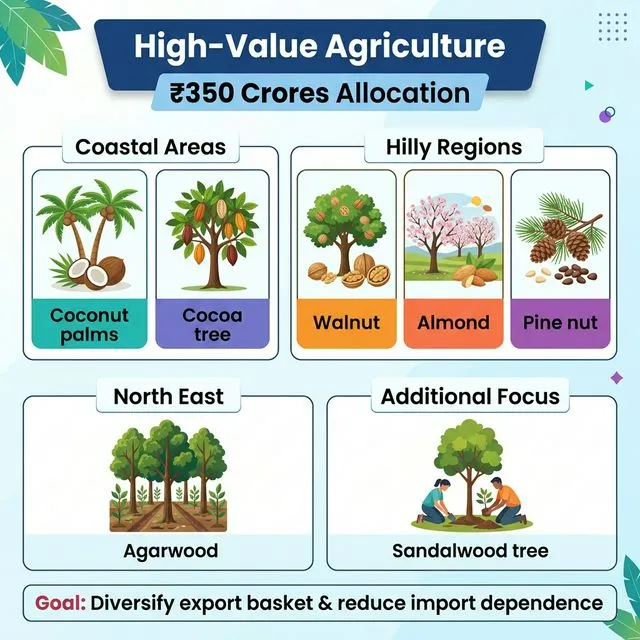
High-Value Agriculture
- Allocation: ₹350 Cr
- Mission: Shift from traditional crops to high-value alternatives to boost income.
- Target Crops:
- Coastal Areas: Dedicated Coconut Promotion Scheme to replace old trees with high-yielding varieties. Also, dedicated Indian Cashew & Cocoa Programmes to create premium global brands by 2030.
- Hilly Regions: Focus on walnuts, almonds, and pine nuts.
- North East: Cultivation of Agarwood.
- Goal: Diversify export basket and reduce import dependence.
- Sandalwood: Focused cultivation and value-added processing.
Digital Agriculture: Bharat-VISTAAR
- Allocation: ₹150 Cr
- Launch: Bharat-VISTAAR (Virtually Integrated System to Access Agricultural Resources)
- Function: A multilingual AI tool designed to integrate AgriStack portals and the ICAR (Indian Council of Agricultural Research) package on agricultural practices with AI systems, making knowledge accessible to farmers in their native languages.
- Benefit: Provides farmers with real-time, data-driven advisory services in their native language.
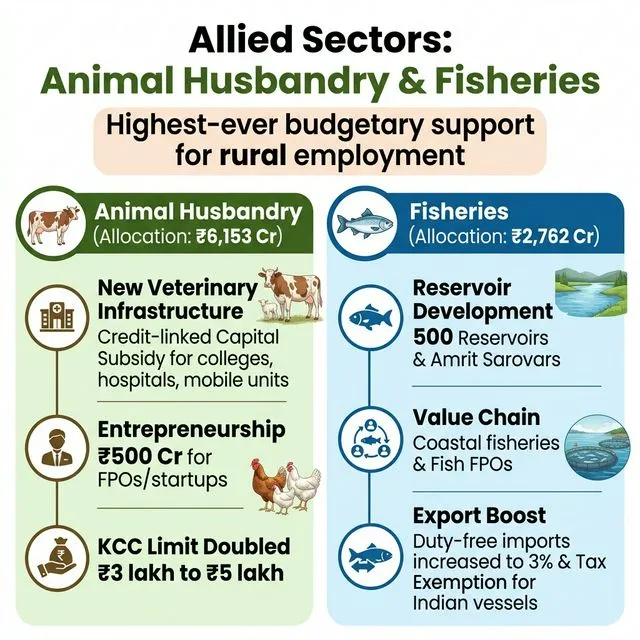
Allied Sectors: Animal Husbandry & Fisheries
The allied sectors have received their highest-ever budgetary support to drive rural employment.
🏗️ Animal Husbandry
- Allocation: ₹6,153 Cr
- New Veterinary Infrastructure: A Credit-linked Capital Subsidy Scheme for private players to set up:
- Veterinary & Para-vet colleges.
- Veterinary Hospitals & Diagnostic Labs.
- Mobile Veterinary Units.
- Entrepreneurship: ₹500 Crore allocated for the "Integrated Scheme for Entrepreneurship Development" to support FPOs (Farmer Producer Organizations) and startups in livestock.
- KCC (Kisan Credit Card) Limit Doubled: Loan limit for Animal Husbandry farmers under KCC increased from ₹3 lakh to ₹5 lakh.
🐟 Fisheries
- Allocation: ₹2,762 Cr
- Reservoir Development: Integrated development of 500 Reservoirs and Amrit Sarovars to create fisheries hubs.
- Value Chain: Strengthening coastal fisheries value chains and market linkages for Fish FPOs and women-led groups.
- Export Boost:
- Duty-free imports for inputs used in seafood processing increased to 3% of export turnover.
- Tax Exemption: Fish caught by Indian vessels in international waters are now exempt from customs duties.
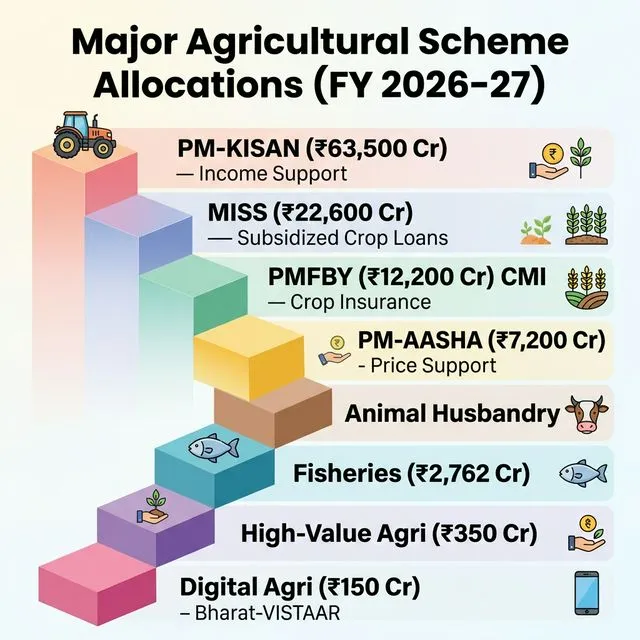
Major Agricultural Scheme Allocations (FY 2026-27)
- PM-KISAN (Pradhan Mantri Kisan Samman Nidhi): ₹63,500 Crore (Income support of ₹6,000/year to farmers).
- Modified Interest Subvention Scheme (MISS): ₹22,600 Crore (Subsidized short-term crop loans).
- Pradhan Mantri Fasal Bima Yojana (PMFBY): ₹12,200 Crore (Crop Insurance).
- PM-AASHA (Pradhan Mantri Annadata Aay SanraksHan Abhiyan): ₹7,200 Crore (Price support & deficiency payments).
- High-Value Agriculture: ₹350 Crore (Diversification to high-value crops).
- Digital Agriculture: ₹150 Crore (Bharat-VISTAAR).
- Animal Husbandry: ₹6,153 Crore (Veterinary infrastructure & entrepreneurship).
- Fisheries: ₹2,762 Crore (Reservoir development & value chain strengthening). Out of which for just one scheme 2,500 Crore for Pradhan Mantri Matsya Sampada Yojana (PMMSY).
TAX PROPOSALS
- Fish catch by an Indian fishing vessel in EEZ (Exclusive Economic Zone) or on the High Seas to be made free of duty. Treating the landing of such fish on a foreign port as export of goods.
- Deduction allowed to primary cooperative society engaged to include supply of cattle feed and cotton seed produced by members.
- Allowing inter-cooperative society dividend income as deduction under the new tax regime to the extent distributed to members.
- Exemption from tax dividend income received by a notified national co-operative federation from investments made in companies up to 31.3.2026 from tax for a period of three years. Exemption to be allowed only for dividends distributed to its member co-operatives.
Strengthening the Foundations of Growth
Infrastructure
- Several initiatives for large-scale enhancement of public infrastructure: InVITs (Infrastructure Investment Trusts), REITs (Real Estate Investment Trusts), NHIF (National Highways Infrastructure Fund) and NABFID (National Bank for Financing Infrastructure and Development).
- Continued focus on developing infrastructure in cities with over 5 lakh population (Tier II and Tier III).
- Enhanced Public Capex: Public capital expenditure has been enhanced from ₹11.2 lakh crore in BE (Budget Estimates) 2025-26 to ₹12.2 lakh crore in FY 2026-27.
| Fiscal Year | Amount (₹ in lakh crore) |
|---|---|
| FY15 | 12.2 |
| FY27 | 2 |
- Setting up Infrastructure Risk Guarantee Fund to provide prudently calibrated partial credit guarantees to lenders.
- Recycling of real estate assets of CPSEs through the setting up of dedicated REITs.
- Establishment of new Dedicated Freight Corridors connecting Dankuni in the East to Surat in the West.
- Operationalising 20 new National Waterways connecting mineral rich areas, industrial centres and ports.
- Setting up of ship repair ecosystem catering to inland waterways.
- Launch a Coastal Cargo Promotion Scheme to increase the share of inland waterways and coastal shipping from 6% to 12% by 2047.
- Launching a Seaplane VGF (Viability Gap Funding) Scheme to indigenise manufacturing.
- ₹2 lakh crore support to states under SASCI (Special Assistance Scheme for Capital Investment) Scheme.
- Purvodaya: Development of Integrated East Coast Industrial Corridor.
Ensuring Long-Term Energy Security and Stability
- Scheme to adopt Carbon Capture Utilization and Storage (CCUS) with an outlay of ₹3,20,000 crore.
- Exemption of BCD (Basic Customs Duty) on import of sodium antimonate for use in manufacture of solar glass.
- Exemption of BCD on import of capital goods required for the processing of critical minerals in India.
- Extending exemption of BCD to capital goods used for the manufacture of Lithium-Ion Cells for batteries to be used in battery energy storage systems.
- Extension of the existing basic customs duty exemption on imports of goods required for Nuclear Power Projects till the year 2035 and expand it for all nuclear plants irrespective of their capacity.
- Exclusion of entire value of biogas in Central Excise duty payable on biogas blended CNG (Compressed Natural Gas).
Urbanisation: City Economic Regions
-
Amplifying the potential of cities to deliver the economic power of agglomerations.
-
Focus on Tier II, Tier III cities, and temple-towns.
-
'Growth Connectors' - 7 High-Speed Rail corridors between cities:
- Mumbai-Pune
- Pune-Hyderabad
- Hyderabad-Bengaluru
- Hyderabad-Chennai
- Chennai-Bengaluru
- Delhi-Varanasi
- Varanasi-Siliguri
Environmentally sustainable passenger systems.
People Centric Development
- Building a strong Care Ecosystem, covering geriatric and allied care services. Training of 1.5 lakh multiskilled caregivers.
- Self-Help Entrepreneur (SHE) Marts to be set up as community-owned retail outlets within the cluster level federations.
- Divyangjan Kaushal Yojana: providing dignified livelihood opportunities through industry-relevant and customized training specific to disability groups.
- Divyang Sahara Yojana: Timely access to high-quality assistive devices for all eligible.
- Supporting Artificial Limbs Manufacturing Corporation of India (ALIMCO) to scale up production of assistive devices, invest in R&D and AI integration.
- Strengthen PM Divyasha Kendras as modern retail-style centres.
- Setting up of a NIMHANS (National Institute of Mental Health and Neuro-Sciences)-style institute & upgrading National Mental Health Institutes in Ranchi and Tezpur.
- Establishing Emergency and Trauma Care Centres in district hospitals.
Trust Based Governance
- Enhancement of duty-deferral period for Tier 2 and Tier 3 Authorised Economic Operators (AEO) from 15 to 30 days. Eligible manufacturer-importers to get the same duty deferral facility. Government agencies will be encouraged to leverage AEO accreditation.
- Transformation of Customs warehousing framework into a warehouse operator-centric system with self-declarations etc.
- Extension of validity period of advance ruling, binding on Customs, from 3 years to 5 years.
- The filing of Bill of entry by a trusted importer; and arrival of goods to automatically notify Customs.
- Regular importers with trusted longstanding supply chains will be recognized in the risk system, so that the need for verification of their cargo every time can be minimized.
Ease of Doing Business and Ease of Living
- Individual Persons Resident Outside India (PROIs) will be permitted to invest in equity instruments of listed Indian companies through the Portfolio Investment Scheme (PIS).
- Interest awarded by the motor accident claim tribunal to a natural person will be exempt from Income Tax and any TDS (Tax Deducted at Source) on this account will be done away with.
- Reduced TCS (Tax Collected at Source) on Overseas Tours: TCS rate on sale of overseas tour program packages reduced from the current 5% (and 20% in some cases) to 2% without any stipulation of amount.
- Reduced TCS for Education/Medical: TCS for nursing education and medical purposes under LRS (Liberalised Remittance Scheme) reduced from 5% to 2%.
- TDS on Supply of manpower services to be at the rate of either 1% or 2%.
- Obtaining a lower or nil deduction certificate through a rule-based automated process for small taxpayers.
- Enable depositories to accept Form 15G or Form 15H from taxpayers holding securities in multiple companies.
- Time available for revising returns extended from 31st December to up to 31st March with the payment of a nominal fee.
- Individuals with ITR (Income Tax Return) 1 and ITR 2 returns will continue to file till 31st July and non-audit business cases or trusts are proposed to be allowed time till 31st August.
- TDS on the sale of immovable property by a non-resident to be deducted and deposited through resident buyer's PAN (Permanent Account Number) instead of TAN (Tax Deduction and Collection Account Number).
- Introducing a one-time 6-month foreign asset disclosure scheme below a certain size for small taxpayers.
- Allow taxpayers to update their returns even after reassessment proceedings have been initiated at an additional 10 percent tax rate over and above the rate applicable for the relevant year.
- Framework for immunity from penalty and prosecution in the cases of underreporting extended to misreporting.
- Non-production of books of account and documents and requirement of TDS payment is decriminalised.
- Immunity from prosecution with retrospective effect from 1.10.2024 for non-disclosure of non-immovable foreign assets with aggregate value less than ₹ 20 lakh.
- Exemption from Minimum Alternate Tax (MAT) to all non-residents who pay tax on presumptive basis.
- Constitute a Joint Committee of Ministry of Corporate Affairs and Central Board of Direct Taxes for incorporating the requirements of Income Computation and Disclosure Standards (ICDS) in the Indian Accounting Standards (IndAS).
- Tax buyback for all types of shareholders as Capital Gains. However, promoters will pay an additional buyback tax.
- Set-off using available MAT credit to be allowed to an extent of 1/4th of the tax liability in the new regime.
- MAT is proposed to be made final tax.
- Exempt BCD on 17 drugs or medicines for cancer patients.
- Single and interconnected digital window for cargo clearance approvals.
- Customs Integrated System (CIS) to be rolled out in 2 years.
- Honest taxpayers willing to settle disputes will now be able to close cases by paying an additional amount in lieu of penalty.
Fiscal Matters
16th Finance Commission
- The Government has accepted the recommendation of the Commission to retain the vertical share of devolution at 41%.
- Provision ₹1.4 lakh crore to the States for the FY 27 as Finance Commission Grants. These include Rural and Urban Local Body and Disaster Management Grants.
Fiscal Consolidation
- Central Government will target reaching a debt-to-GDP (Gross Domestic Product) ratio of 50±1 percent by 2030.
- The debt-to-GDP ratio is estimated to be 55.6 percent of GDP in BE 2026-27, compared to 56.1 percent of GDP in RE 2025-26.
- In RE 2025-26, the fiscal deficit has been estimated at par with BE of 2025-26 at 4.4 percent of GDP. In line with the new fiscal prudence path of debt consolidation, the fiscal deficit in BE 2026-27 is estimated to be 4.3 percent of GDP.
- Revenue deficit is budgeted at 1.5% of GDP in BE 2026-27, while the effective revenue deficit is 0.3% of GDP. Do not confuse these two figures in MCQs.
Deficit Trends
The following deficit trends are observed:
| Indicator | 2022-23 | 2023-24 | 2024-25 | 2025-26 RE | 2026-27 BE |
|---|---|---|---|---|---|
| Fiscal Deficit (%) | 6.50 | 5.00 | 4.30 | 4.4 | 4.30 |
| Revenue Deficit (%) | N/A | N/A | 1.70 | 1.5 | 1.50 |
| Primary Deficit (%) | 3.00 | N/A | 4.00 | N/A | N/A |
| Effective Revenue Deficit | N/A | N/A | N/A | N/A | N/A |
Note: Some data points were missing from the source and are marked as N/A
The chart shows a decreasing trend in fiscal consolidation from 2022-23 to 2026-27 (BE). The fiscal deficit is projected to decrease to 4.30% in 2026-27 (BE). For revenue-side questions, remember the distinction: revenue deficit = 1.5% of GDP, while effective revenue deficit = 0.3% of GDP in BE 2026-27.
Rupee Allocation
Rupee Comes From (Sources of Revenue)
- Corporation Tax: 18%
- Borrowings and Liabilities: 24%
- Income Tax: 21%
- Non-Debt Capital Receipts: 5%
- Customs: 4%
- Non-Tax Revenues: 10%
- Union Excise Duties: 6%
- GST and other taxes: 15%
Rupee Goes To (Expenditure)
- States Share of Taxes: 22%
- Other Expenditures: 7%
- Civil Pension: 2%
- Finance Commission & other transfers: 7%
- Central Sector Scheme: 17%
- Centrally Sponsored Scheme: 8%
- Major Subsidies: 6%
- Interest Payment: 20%
- Defence: 11%
Budget Estimates & Financials
Receipts (₹ lakh crore)
| Category | 2024-25 (Actuals) | 2025-26 (BE) | 2025-26 (RE) | 2026-27 (BE) |
|---|---|---|---|---|
| Capital Receipts | 18.1 | 16.4 | 16.2 | 16.2 |
| Revenue Receipts | 35.3 | 33.4 | 30.4 | 34.2 |
Expenditures (₹ lakh crore)
| Category | 2024-25 (Actuals) | 2025-26 (BE) | 2025-26 (RE) | 2026-27 (BE) |
|---|---|---|---|---|
| Effective Capital Expenditure | 17.1 | 13.2 | 14.0 | 15.5 |
| Revenue Expenditure | 41.3 | 39.4 | 38.7 | 36.0 |
Robust Economic Foundations
-
Trend in Net Receipt of Centre: The following data points show the trend of the Centre's net receipts.
- Centre’s net Tax Revenue (₹ lakh crore): Increases from 28.7 (2022-23) to 35 (2026-27 BE).
- Non-Tax Revenues (₹ lakh crore): Decreases from 1.4 (2022-23) to 0.6 (2026-27 BE).
- Non-Debt Capital Receipts (₹ lakh crore): Decreases from 1.2 (2022-23) to 0.2 (2026-27 BE).
Total Transfer to States and UTs (₹ lakh crore)
| Year | Amount |
|---|---|
| 2022-23 | 23.4 |
| 2023-24 | 20.7 |
| 2024-25 | 18.7 |
| 2025-26 (RE) | 22.3 |
| 2026-27 (BE) | 26.2 |
The transfer amounts show a decrease from 2022-23 to 2024-25, followed by an increase in 2025-26(RE) and 2026-27(BE).
Expenditure of Major Items (₹ crore)
| Sector | Allocation |
|---|---|
| Transport | 5,98,520 |
| Defence | 5,94,585 |
| Rural Development | 2,73,108 |
| Home Affairs | 2,55,234 |
| Agriculture and Allied Activities | 1,62,671 |
| Education | 1,39,289 |
| Energy | 1,09,029 |
| Health | 1,04,599 |
| Urban Development | 85,522 |
| IT and Telecom | 74,560 |
| Commerce and Industry | 70,296 |
| Social Welfare | 62,362 |
| Scientific Departments | 55,756 |
| Tax Administration | 45,500 |
| External Affairs | 22,119 |
| Finance | 20,649 |
| Development of North East | 6,812 |
Summary Cheat Sheet
| Topic | Key Detail | Value / Target |
|---|---|---|
| GDP Growth | Estimated growth rate | ~7% |
| Fiscal Deficit | BE 2026-27 | 4.3% of GDP |
| Revenue Deficit | BE 2026-27 | 1.5% of GDP |
| Effective Revenue Deficit | BE 2026-27 | 0.3% of GDP |
| Debt-to-GDP Target | By 2030 | 50±1% |
| Public Capex | BE 2026-27 | ₹12.2 lakh crore |
| New Income Tax Act | Effective from | April 2026 |
| PM-KISAN | Annual allocation | ₹63,500 Cr |
| MISS (Crop Loans) | Allocation | ₹22,600 Cr |
| PMFBY (Crop Insurance) | Allocation | ₹12,200 Cr |
| PM-AASHA | Price support | ₹7,200 Cr |
| Animal Husbandry | Total allocation | ₹6,153 Cr |
| Fisheries | Total allocation | ₹2,762 Cr |
| PMMSY | Within fisheries | ₹2,500 Cr |
| Bharat-VISTAAR | Digital agriculture AI tool | ₹150 Cr |
| High-Value Agriculture | Crop diversification | ₹350 Cr |
| Biopharma SHAKTI | Biologics manufacturing | ₹10,000 Cr |
| SME Growth Fund | Equity support for MSMEs | ₹10,000 Cr |
| Self-Reliant India Fund | Top-up | ₹2,000 Cr |
| KCC Limit (Animal Husbandry) | Increased from ₹3L | ₹5 lakh |
| CCUS Scheme | Carbon capture outlay | ₹3,20,000 Cr |
| SASCI | State support | ₹2 lakh Cr |
| High-Speed Rail | City corridors planned | 7 corridors |
| National Waterways | New waterways | 20 |
| Coastal Shipping Target | By 2047 | 12% (from 6%) |
| AVGC Labs | Schools + Colleges | 15,000 + 500 |
| Caregivers Training | Multiskilled caregivers | 1.5 lakh |
| Medical Value Tourism | Partnership hubs | 5 hubs |
| STT on Futures | Increased from 0.02% | 0.05% |
| STT on Options | Increased to | 0.15% |
| TCS Overseas Tours | Reduced from 5/20% | 2% |
| TCS Education/Medical | Reduced from 5% | 2% |
| Municipal Bonds | Incentive for ₹1000 Cr issuance | ₹100 Cr |
| Finance Commission | Vertical devolution share | 41% |
| State Transfers | BE 2026-27 | ₹26.2 lakh Cr |
| Borrowings | Share of revenue | 24% |
| Interest Payments | Share of expenditure | 20% |
| Defence | Allocation | ₹5,94,585 Cr |
| Transport | Allocation | ₹5,98,520 Cr |
| Cancer Drugs | BCD exempted drugs | 17 drugs |
Lesson Doubts
Ask questions, get expert answers