🏦 Basic Saving Bank Deposit Account (BSBDA)
Detailed guide on BSBDA features, mandatory free facilities, and revised RBI guidelines (2026).
Basic Saving Bank Deposit Account (BSBDA)
What is BSBDA?
A Basic Savings Bank Deposit Account (BSBDA) is a special type of savings account designed to provide affordable banking facilities to every person, including those from economically weaker sections. ⭐
The idea is simple — no one should be denied access to basic banking just because they cannot maintain a minimum balance. BSBDA ensures that even a person with zero balance can hold a bank account and use essential banking services free of charge.
Why was BSBDA introduced?
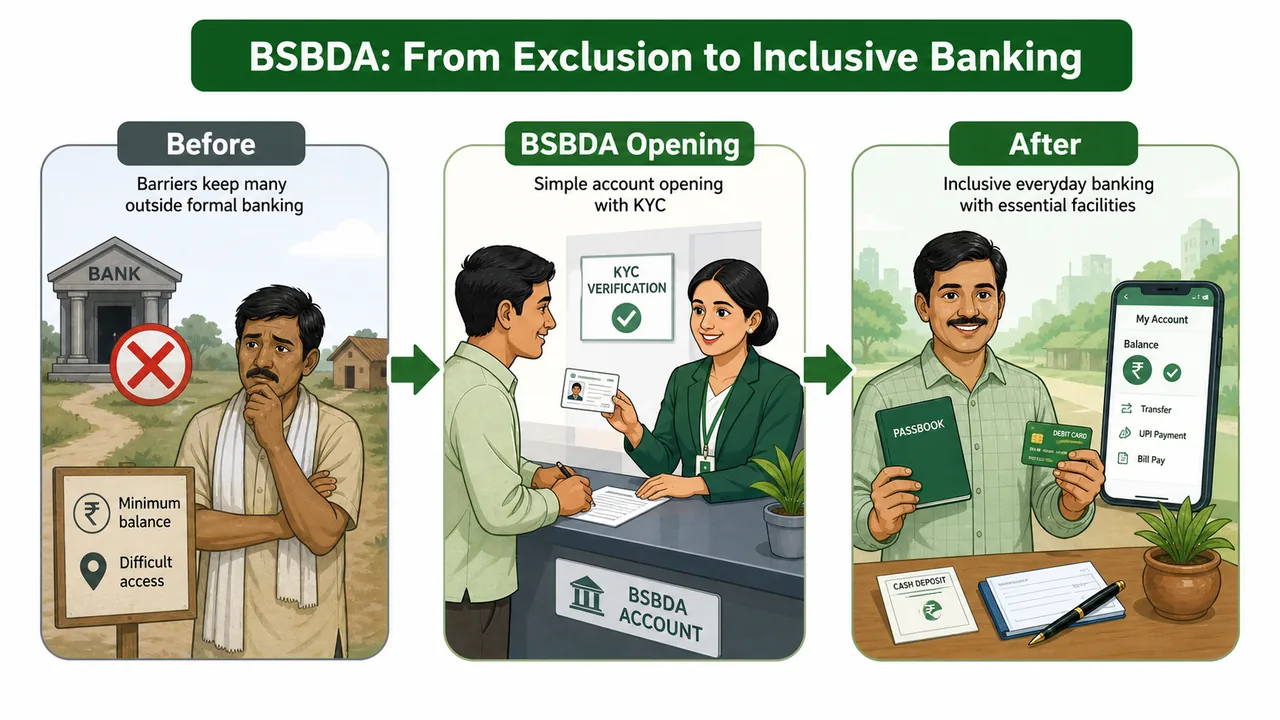
Before BSBDA, banks charged penalties for not maintaining minimum balance, discouraged small depositors, and millions of Indians remained unbanked. RBI introduced BSBDA to support financial inclusion — bringing every citizen into the formal banking system. ⭐
Legal basis: RBI mandates that every bank in India must offer BSBDA as a normal banking service available to all. It is not optional for banks — they are required to provide it. ⭐
Pro Content Locked
Upgrade to Pro to access this lesson and all other premium content.
₹99 charged monthly · Cancel anytime
- All Agriculture & Banking Courses
- AI Lesson Questions (100/day)
- AI Doubt Solver (50/day)
- Glows & Grows Feedback (30/day)
- AI Section Quiz (20/day)
- 22-Language Translation (100/day)
- Recall Questions (20/day)
- AI Quiz (15/day)
- AI Quiz Paper Analysis (100/day)
- AI Step-by-Step Explanations (100/day)
- Spaced Repetition Recall (FSRS)
- AI Tutor
- Immersive Text Questions
- Audio Lessons — Hindi & English
- Mock Tests & Previous Year Papers
- Summary & Mind Maps
- XP, Levels, Leaderboard & Badges
- Generate New Classrooms
- Voice AI Teacher (AgriDots Live)
- AI Revision Assistant
- Knowledge Gap Analysis
- Interactive Revision (LangGraph)
🔒 Secure via Razorpay · Cancel anytime · No hidden fees
Basic Saving Bank Deposit Account (BSBDA)
What is BSBDA?
A Basic Savings Bank Deposit Account (BSBDA) is a special type of savings account designed to provide affordable banking facilities to every person, including those from economically weaker sections. ⭐
The idea is simple — no one should be denied access to basic banking just because they cannot maintain a minimum balance. BSBDA ensures that even a person with zero balance can hold a bank account and use essential banking services free of charge.
Why was BSBDA introduced?
Before BSBDA, banks charged penalties for not maintaining minimum balance, discouraged small depositors, and millions of Indians remained unbanked. RBI introduced BSBDA to support financial inclusion — bringing every citizen into the formal banking system. ⭐
Legal basis: RBI mandates that every bank in India must offer BSBDA as a normal banking service available to all. It is not optional for banks — they are required to provide it. ⭐
KYC requirement: BSBDA must be opened with proper KYC (Know Your Customer) due diligence, same as any regular savings account.
Revised Guidelines (December 2025) ⭐
RBI issued revised guidelines on BSBDA on 4th December, 2025. These amendments are effective from 1st April, 2026 and expand the minimum free facilities that banks must offer.
Mandatory Free Facilities
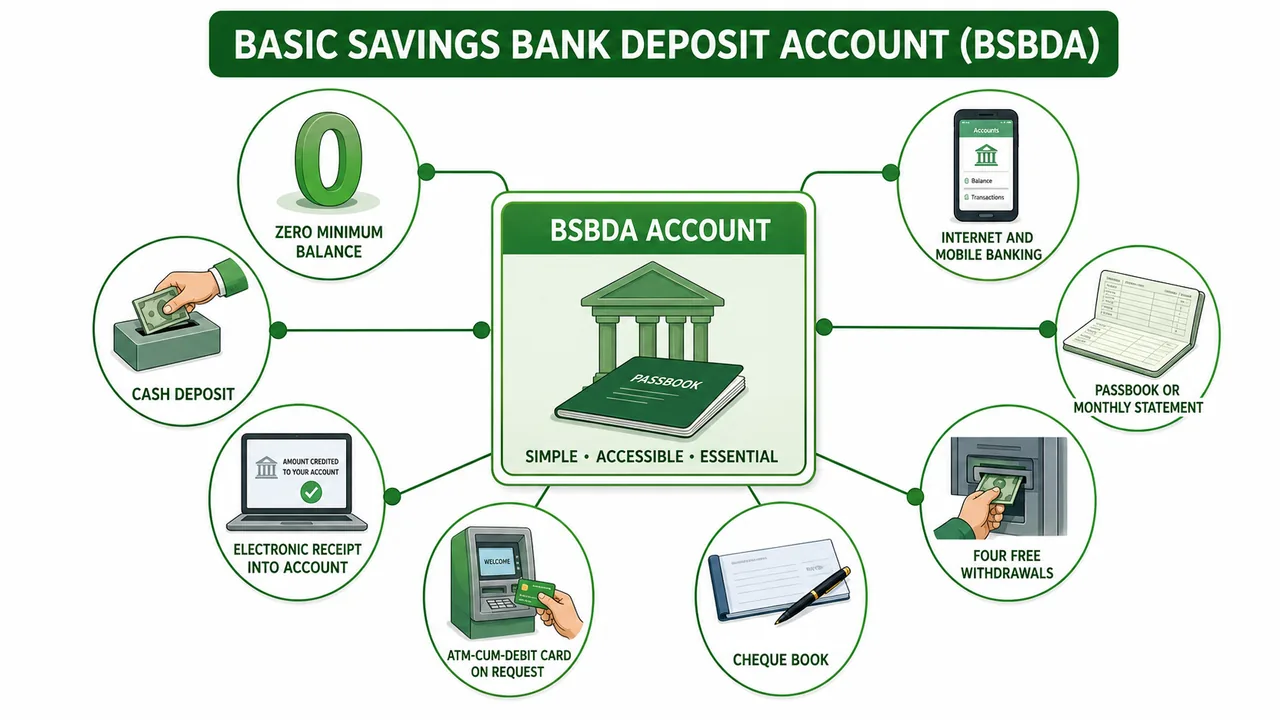
Every BSBDA must provide the following eight facilities completely free of charge:
1. No Minimum Balance
No requirement of minimum balance to be maintained, and no initial deposit needed to open the account. A person can open a BSBDA with literally ₹0.
2. Unlimited Cash Deposits
Deposit of cash without any limit on the number and value of deposits that can be made in a month. Banks cannot restrict how often or how much you deposit. ⭐
3. Electronic Receipts
Receipt of money through any electronic channel or deposit/collection of cheques. This includes NEFT, RTGS, IMPS, UPI credits — all free.
4. Free ATM-cum-Debit Card ⭐
An ATM-cum-Debit Card must be provided without any annual fee — neither at the time of issuance nor at renewal. However, the card is issued only on request of the customer; banks cannot force it.
5. Free Cheque Book
A cheque book with a minimum of 25 cheque leaves per year, provided free of charge.
6. Internet & Mobile Banking
Internet and mobile banking facility must be provided free. This was added in the 2025 revised guidelines to ensure digital access for all BSBDA holders. ⭐
7. Passbook or Statement
A passbook or monthly statement of account — in print or by email — must be provided free.
8. Four Free Withdrawals Per Month ⭐
A minimum of four free withdrawals per month, which includes:
- Cash withdrawals at the bank's own ATM
- Cash withdrawals at another bank's ATM
- Fund transfers
IMPORTANT
Digital payments are NOT counted as withdrawals. Point of Sale (PoS) transfers, NEFT, RTGS, UPI, IMPS, and other digital payment transactions are excluded from the four-withdrawal limit. This means a BSBDA holder can make unlimited UPI/NEFT payments without it eating into their four free withdrawals. ⭐
Other Important Guidelines
A) Additional Facilities
Banks may provide additional facilities beyond the eight mandatory ones, with or without charges. However:
- Banks cannot insist that customers avail optional facilities (like cheque book or internet banking) at the time of account opening ⭐
- Banks cannot require the customer to maintain a minimum balance under any circumstance
B) Applicability to Existing Accounts
Existing BSBDA holders must also be offered the free facilities listed in points 6 to 8 above (internet/mobile banking, passbook, four free withdrawals). Banks cannot deny these to old account holders. ⭐
C) Conversion of Accounts
If a customer requests conversion of an existing savings account to a BSBDA, the bank must complete the conversion within seven days of receiving the request. ⭐
D) One BSBDA Rule ⭐
This is a strict restriction:
- A BSBDA holder cannot hold any other savings account in the same bank or in any other bank
- Before opening a new BSBDA or converting an existing account, the bank must obtain a written declaration from the customer confirming they do not hold another BSBDA elsewhere
- If a customer already holds a BSBDA in Bank A and approaches Bank B to open a new BSBDA, Bank B cannot open the account
Why this rule exists: Since BSBDA offers free facilities with no minimum balance, allowing multiple BSBDAs would let people exploit the system and increase costs for banks. One person, one BSBDA — this keeps the scheme sustainable.
BSBDA vs Regular Savings Account
| Feature | BSBDA | Regular Savings Account |
|---|---|---|
| Minimum Balance | NIL | ₹500–₹10,000 (varies by bank) |
| Penalty for low balance | No | Yes |
| Free withdrawals | 4 per month | Varies (usually more) |
| ATM Card fee | Free (on request) | May have annual charges |
| Cheque book | 25 leaves/year free | Usually free but varies |
| Internet/Mobile banking | Free (mandatory) | Free (usually) |
| Multiple accounts | Only one BSBDA allowed | Can hold multiple |
| Additional services | Limited unless paid | Full range |
⭐ Key takeaway for exams: BSBDA is the minimum guarantee — every Indian has the right to hold a basic bank account with these free facilities, regardless of their income level.
References
4 sources • [1] [2] [3] [4]
References
Summary Cheat Sheet
| Concept / Topic | Key Details / Explanation |
|---|---|
| BSBDA full form | Basic Savings Bank Deposit Account — a zero-balance savings account for financial inclusion |
| Purpose | Ensure every person, including economically weaker sections, has access to affordable banking |
| Legal mandate | Every bank in India must offer BSBDA; it is not optional for banks |
| KYC requirement | Must be opened with proper KYC (same as regular savings account) |
| Revised guidelines date | RBI issued revised guidelines on 4th December 2025, effective from 1st April 2026 |
| Mandatory free facilities (count) | Eight (8) facilities must be provided completely free of charge |
| 1. Minimum balance | NIL — no minimum balance and no initial deposit required |
| 2. Cash deposits | Unlimited — no restriction on number or value of deposits per month |
| 3. Electronic receipts | Receipt of money through any electronic channel (NEFT, RTGS, IMPS, UPI) — free |
| 4. ATM-cum-Debit Card | Provided free (no annual fee), but only on request of the customer |
| 5. Cheque book | Minimum 25 cheque leaves per year, free of charge |
| 6. Internet & Mobile banking | Free — added in the 2025 revised guidelines |
| 7. Passbook / Statement | Free passbook or monthly statement (print or email) |
| 8. Free withdrawals | Minimum 4 free withdrawals per month (own ATM, other ATM, fund transfers) |
| Digital payments & withdrawals | PoS, NEFT, RTGS, UPI, IMPS are NOT counted as withdrawals — unlimited digital payments allowed |
| Additional facilities | Banks may offer extra services with or without charges, but cannot insist customer avail them at account opening |
| Existing BSBDA holders | Must also be offered facilities 6–8 (internet/mobile banking, passbook, 4 free withdrawals) |
| Account conversion timeline | Bank must convert existing savings account to BSBDA within 7 days of request |
| One BSBDA rule | A person cannot hold any other savings account in the same or any other bank alongside a BSBDA |
| Written declaration | Bank must obtain written declaration confirming customer does not hold another BSBDA elsewhere |
| Why one BSBDA only | Prevents exploitation of free facilities; keeps the scheme sustainable for banks |
Lesson Doubts
Ask questions, get expert answers