💱 Forward Exposure & Unhedged Foreign Currency Exposure (UFCE)
Unhedged Foreign Currency Exposures, UFCE computation, provisioning & capital requirements, forward contracts, AD general/specific directions, user classification, permissible FX derivatives, and pre-settlement risk.
Forward Exposure & Unhedged Foreign Currency Exposure (UFCE)
Introduction — Unhedged Foreign Currency Exposures
- Entities with Foreign Currency (FCY) Exposures are exposed to currency risk.
- If these exposures are not hedged, adverse movements in exchange rates can affect the entity's capacity to service its debt.
- This in turn impacts the credit risk borne by banks lending to such entities.
- RBI requires banks to factor in the risks arising from Unhedged Foreign Currency Exposures (UFCE) of their borrowers.
- Banks must put in place a proper mechanism to:
- Estimate UFCE of borrowers
- Assess the riskiness of such exposures
- Factor this in their credit appraisal, loan pricing, and provisioning
Computation of UFCE
Definition
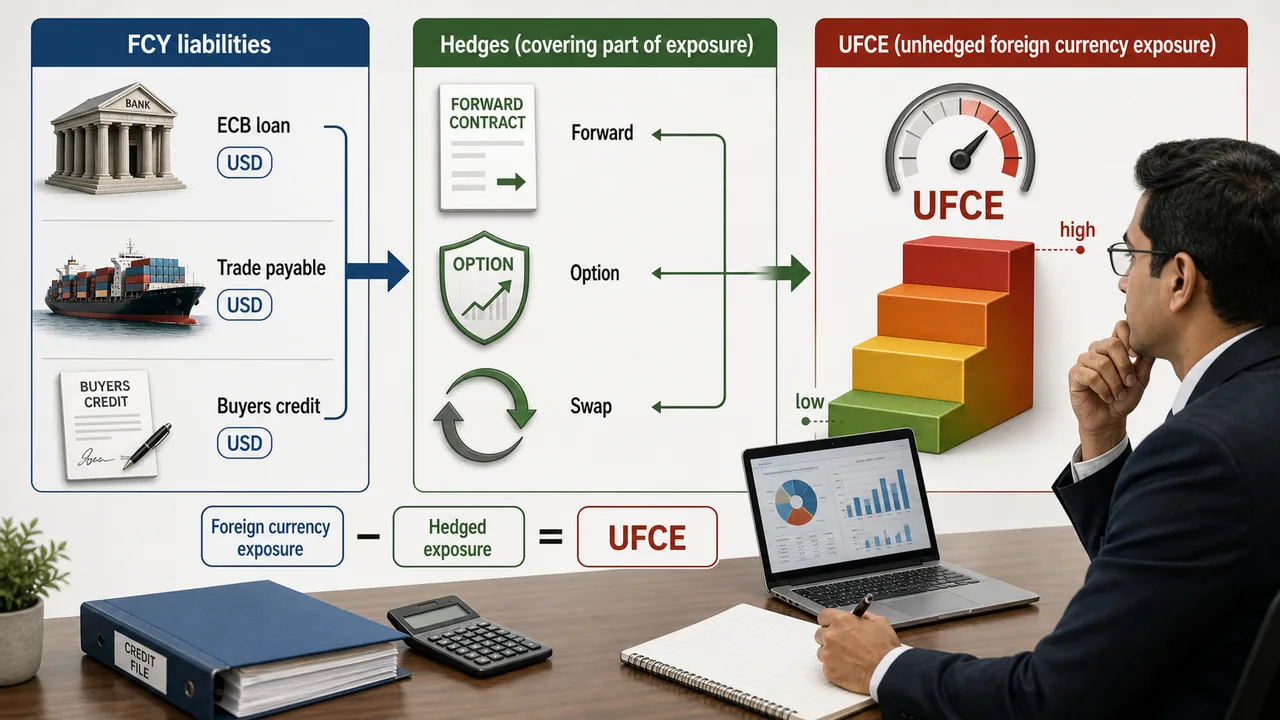
- UFCE = Total FCY Exposure − FCY Hedged Exposure
- Only financial hedges (forward contracts, options, swaps) are considered, not natural hedges for this computation.
Natural Hedge
- A natural hedge exists when a borrower has FCY earnings that can offset FCY liabilities.
- Example: An exporter with dollar receivables and dollar loans — the receivables naturally offset the loan exposure.
- RBI's guidelines focus on financial hedges (derivatives) for UFCE computation, but banks may consider natural hedges in their internal credit assessment.
Steps in UFCE Estimation
- Identify all FCY liabilities (ECB, FCNR loans, buyer's credit, trade payables, etc.)
- Identify all FCY hedges (forward contracts, options, swaps)
- Compute UFCE = FCY Liabilities − FCY Hedges
- Express UFCE as a percentage of the entity's total equity or EBID (Earnings Before Interest & Depreciation)
UFCE Ratio
- UFCE as % of EBID is the key ratio used for provisioning and capital adequacy computation.
- Higher UFCE/EBID ratio → higher risk → higher provisioning and capital charge.
Provisioning and Capital Requirements for UFCE
Incremental Provisioning
Banks must maintain incremental provisioning for borrowers with UFCE:
🔐
Pro Content Locked
Upgrade to Pro to access this lesson and all other premium content.
Pro
Popular Save ₹100/mo
₹ 99 /mo
₹99 charged monthly · Cancel anytime
- All Agriculture & Banking Courses
- AI Lesson Questions (100/day)
- AI Doubt Solver (50/day)
- Glows & Grows Feedback (30/day)
- AI Section Quiz (20/day)
- 22-Language Translation (100/day)
- Recall Questions (20/day)
- AI Quiz (15/day)
- AI Quiz Paper Analysis (100/day)
- AI Step-by-Step Explanations (100/day)
- Spaced Repetition Recall (FSRS)
- AI Tutor
- Immersive Text Questions
- Audio Lessons — Hindi & English
- Mock Tests & Previous Year Papers
- Summary & Mind Maps
- XP, Levels, Leaderboard & Badges
- Generate New Classrooms
- Voice AI Teacher (AgriDots Live)
- AI Revision Assistant
- Knowledge Gap Analysis
- Interactive Revision (LangGraph)
🔒 Secure via Razorpay · Cancel anytime · No hidden fees
Forward Exposure & Unhedged Foreign Currency Exposure (UFCE)
Introduction — Unhedged Foreign Currency Exposures
- Entities with Foreign Currency (FCY) Exposures are exposed to currency risk.
- If these exposures are not hedged, adverse movements in exchange rates can affect the entity's capacity to service its debt.
- This in turn impacts the credit risk borne by banks lending to such entities.
- RBI requires banks to factor in the risks arising from Unhedged Foreign Currency Exposures (UFCE) of their borrowers.
- Banks must put in place a proper mechanism to:
- Estimate UFCE of borrowers
- Assess the riskiness of such exposures
- Factor this in their credit appraisal, loan pricing, and provisioning
Computation of UFCE
Definition
- UFCE = Total FCY Exposure − FCY Hedged Exposure
- Only financial hedges (forward contracts, options, swaps) are considered, not natural hedges for this computation.
Natural Hedge
- A natural hedge exists when a borrower has FCY earnings that can offset FCY liabilities.
- Example: An exporter with dollar receivables and dollar loans — the receivables naturally offset the loan exposure.
- RBI's guidelines focus on financial hedges (derivatives) for UFCE computation, but banks may consider natural hedges in their internal credit assessment.
Steps in UFCE Estimation
- Identify all FCY liabilities (ECB, FCNR loans, buyer's credit, trade payables, etc.)
- Identify all FCY hedges (forward contracts, options, swaps)
- Compute UFCE = FCY Liabilities − FCY Hedges
- Express UFCE as a percentage of the entity's total equity or EBID (Earnings Before Interest & Depreciation)
UFCE Ratio
- UFCE as % of EBID is the key ratio used for provisioning and capital adequacy computation.
- Higher UFCE/EBID ratio → higher risk → higher provisioning and capital charge.
Provisioning and Capital Requirements for UFCE
Incremental Provisioning
Banks must maintain incremental provisioning for borrowers with UFCE:
| UFCE as % of EBID | Incremental Provisioning |
|---|---|
| Up to 15% | Nil |
| More than 15% and up to 30% | 20 bps (0.20%) |
| More than 30% and up to 50% | 40 bps (0.40%) |
| More than 50% and up to 75% | 60 bps (0.60%) |
| More than 75% | 80 bps (0.80%) |
Incremental Capital Requirement
Banks must hold incremental capital on exposure to borrowers with UFCE:
| UFCE as % of EBID | Incremental Capital (Risk Weight) |
|---|---|
| Up to 15% | Nil |
| More than 15% and up to 30% | 25% |
| More than 30% and up to 50% | 40% |
| More than 50% and up to 75% | 60% |
| More than 75% | 80% |
Key Points
- These are incremental provisions/capital — they are in addition to regular provisioning and risk weighting norms.
- Banks should review UFCE of borrowers at least on a quarterly basis.
- Information on UFCE should be obtained as part of regular credit appraisal and review.
Concepts of Forward Exposure
Forward Contract
- A forward contract is an agreement to buy or sell a specified quantity of foreign currency at a predetermined exchange rate on a specified future date.
- It is a binding obligation on both parties — the buyer and the seller.
- Used for hedging foreign currency risk arising from trade or capital account transactions.
Forward Rate
- The forward rate is determined by the spot rate adjusted for the interest rate differential between the two currencies.
- Forward Rate = Spot Rate × (1 + Interest Rate of Quote Currency) / (1 + Interest Rate of Base Currency)
- If the domestic interest rate is higher than the foreign interest rate, the forward rate will be at a premium (higher than spot).
- If the domestic interest rate is lower, it will be at a discount (lower than spot).
Forward Premium and Discount
- Forward Premium: When the forward rate is higher than the spot rate.
- Forward Discount: When the forward rate is lower than the spot rate.
- In India, since INR interest rates are typically higher than USD rates, USD is generally quoted at a forward premium against INR.
Types of Forward Contracts
- Fixed Date Forward: Delivery on a specific date.
- Option Forward: Delivery during a specified period (not a specific date) — the customer has the option to choose any date within the period.
- The option period should not exceed one month.
Cancellation and Extension
- Forward contracts can be cancelled or extended (rolled over) on or before the maturity date.
- Cancellation charges apply based on the difference between the contracted rate and the prevailing market rate.
- Automatic cancellation occurs if the contract is not utilized within 15 days after maturity.
Regulatory Guidelines — General Directions for Authorised Dealers (ADs)
Authorised Dealers
- Authorised Dealers (ADs) are entities licensed by RBI under FEMA, 1999 to deal in foreign exchange.
- Categories:
- AD Category-I: Banks (can undertake all current and capital account transactions)
- AD Category-II: Select financial institutions, authorized money changers
- AD Category-III: Select financial institutions for specific purposes
General Directions
- ADs must ensure that foreign exchange transactions are undertaken for bona fide purposes.
- They must comply with FEMA provisions and RBI directions.
- ADs should have a Board-approved policy for foreign exchange risk management.
- Know Your Customer (KYC) and Anti-Money Laundering (AML) norms must be followed.
- ADs must report transactions to RBI through prescribed returns and statements.
Specific Directions for ADs
Proprietary Trading
- ADs can undertake proprietary trading in foreign exchange for their own account.
- Must maintain open position limits as prescribed by RBI:
- Net Open Position (NOP) limits — daylight and overnight
- Aggregate Gap Limits (AGL)
- Proprietary positions must be within Board-approved limits.
Client Transactions
- ADs can offer foreign exchange products to clients for hedging genuine exposures.
- Must ensure suitability and appropriateness of products offered.
- Must provide fair pricing and transparent terms.
Risk Management
- ADs must have robust risk management systems including:
- Market risk management
- Credit risk management (counterparty risk)
- Operational risk management
- Regular stress testing and scenario analysis must be conducted.
- Mid-office (risk monitoring) must be independent of front office (dealing) and back office (settlement).
Directions for Exchanges
- Currency futures and currency options are permitted on recognized stock exchanges.
- Permitted currency pairs: USD-INR, EUR-INR, GBP-INR, JPY-INR, and cross-currency pairs (EUR-USD, GBP-USD, USD-JPY).
- Participants can take positions up to USD 100 million equivalent across all exchanges for USD-INR without underlying exposure documentation.
- For positions beyond the limit, participants must have underlying exposure.
- Exchanges must have robust risk management, margining, and settlement systems.
- Clearing Corporation acts as the Central Counterparty (CCP).
User Classification
Retail Users
- Entities that are not market-makers.
- Include individuals, corporates, firms, partnership firms, trusts, etc.
- They access FX derivatives to hedge their underlying exposure.
- Banks must ensure retail users understand the risks of derivative products.
Non-Retail Users
- Entities classified as non-retail include:
- AD Category-I banks
- Other entities with net worth of Rs. 500 crore or more
- Entities that have turnover of Rs. 1,000 crore or more
- Non-retail users are deemed to have the expertise to understand and manage risks of derivative products.
- They have access to a wider range of derivative products.
Suitability and Appropriateness
For Retail Users
- ADs must follow a Suitability and Appropriateness Policy when offering derivatives to retail users.
- Must assess whether the product is suitable for the user's needs and risk profile.
- Must explain the risks, costs, and payoffs of the product clearly.
- Provide a Product Suitability Statement to the user.
- Exotic products or complex structures cannot be offered to retail users unless they meet specific criteria.
For Non-Retail Users
- Deemed to have the expertise; suitability assessment is not mandatory.
- However, ADs must still ensure fair dealing and transparency.
- Non-retail users can access all permissible derivative products.
Permissible Foreign Exchange Derivative Contracts
OTC Derivatives (via ADs)
- Forward Contracts — most common hedging tool
- Foreign Currency Options — European/American style
- Foreign Currency Swaps — exchange of cash flows in different currencies
- Interest Rate Swaps (IRS) — in foreign currency
- Forward Rate Agreements (FRAs)
- Cross-Currency Swaps
- Cost Reduction Structures — combinations of options (for non-retail users)
- Seagull Structures — combination of call spread + selling a put (for non-retail users)
Exchange-Traded Derivatives
- Currency Futures — standardized contracts on exchanges
- Currency Options — standardized options on exchanges
- Available on: NSE, BSE, MCX-SX (MSEI)
Restrictions
- Leveraged products are not permitted for retail users.
- Derivatives must be for hedging purposes (retail users) — not speculation.
- Non-retail users can take positions based on their risk appetite.
Remittance Related to FX Derivative Contracts
- All premiums, margins, and settlement amounts related to FX derivative contracts can be remitted through ADs.
- No prior RBI approval is required for remittances under derivative contracts booked with ADs.
- For exchange-traded derivatives, margins and settlement are handled through the clearing mechanism.
- Net settlement in INR is permitted for certain derivative contracts.
- ADs must ensure that remittances are for genuine derivative transactions and not for circumventing FEMA provisions.
Pre-Settlement Risk
Definition
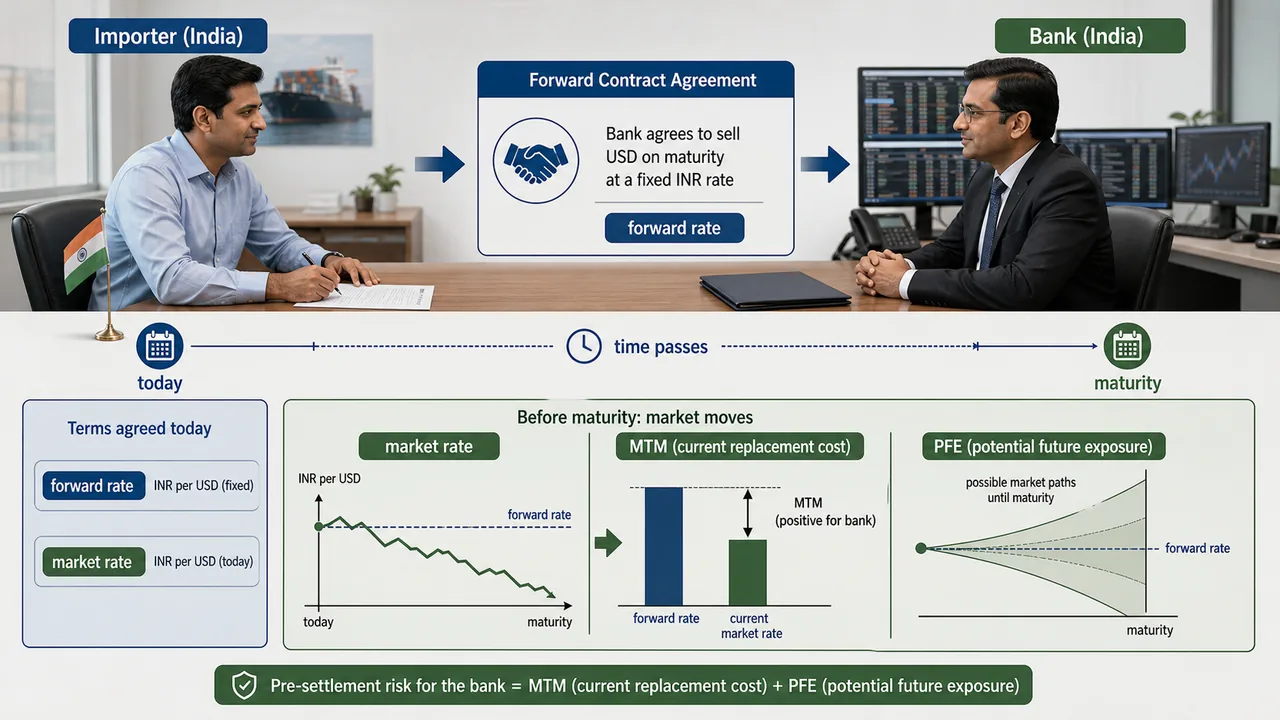
- Pre-Settlement Risk (PSR) is the risk that a counterparty will default before the final settlement of the transaction.
- Also known as counterparty credit risk in derivative transactions.
- Arises from the time a transaction is entered into until it is finally settled.
Components of PSR
-
Replacement Cost (Current Exposure):
- The mark-to-market (MTM) value of the contract.
- If the MTM is positive, the bank faces a loss if the counterparty defaults.
- If the MTM is negative, there is no current exposure (but potential future exposure exists).
-
Potential Future Exposure (PFE):
- The estimated increase in exposure over the remaining life of the contract.
- Accounts for potential future changes in market rates.
- Calculated using add-on factors based on the type and residual maturity of the contract.
Example
- Bank enters a forward contract to buy USD 1 million at ₹83.
- On the date of potential default, the market rate is ₹85.
- Replacement cost = (85 − 83) × 1,000,000 = ₹20,00,000
- If the counterparty defaults, the bank loses ₹20 lakh because it must now buy USD at ₹85 instead of ₹83.
- Additionally, PFE would be computed based on add-on factors.
Estimation of PSR
- PSR = Max(0, MTM) + PFE
- MTM is the current replacement cost (only positive values considered).
- PFE is computed using add-on percentages prescribed by RBI/Basel norms:
| Residual Maturity | Interest Rate | FX & Gold | Equity | Precious Metals | Other Commodities |
|---|---|---|---|---|---|
| Up to 1 year | 0.0% | 1.0% | 6.0% | 7.0% | 10.0% |
| 1–5 years | 0.5% | 5.0% | 8.0% | 7.0% | 12.0% |
| Over 5 years | 1.5% | 7.5% | 10.0% | 8.0% | 15.0% |
Countering Pre-Settlement Risk
- Credit Limits: Set counterparty-wise credit limits for derivative exposures.
- Netting Agreements: Legally enforceable netting reduces exposure (net positive vs gross exposure).
- Collateral (CSA): Credit Support Annex under ISDA — counterparties post collateral (margin) against MTM.
- Central Clearing (CCP): Exchange-traded derivatives cleared through CCP reduce bilateral PSR.
- Credit Value Adjustment (CVA): Pricing adjustment for counterparty credit risk.
- Close-out Netting: On default, all transactions with the counterparty are netted and closed.
- Regular MTM Monitoring: Daily mark-to-market and margin calls.
Summary Cheat Sheet
| Parameter | Detail |
|---|---|
| UFCE | Total FCY Exposure − Hedged Exposure |
| UFCE Ratio | UFCE as % of EBID |
| UFCE ≤ 15% | Nil incremental provisioning & capital |
| UFCE 15–30% | 20 bps provisioning, 25% add'l risk weight |
| UFCE 30–50% | 40 bps provisioning, 40% add'l risk weight |
| UFCE 50–75% | 60 bps provisioning, 60% add'l risk weight |
| UFCE > 75% | 80 bps provisioning, 80% add'l risk weight |
| UFCE Review | At least quarterly |
| Forward Contract | Agreement to buy/sell FCY at predetermined rate on future date |
| Forward Rate | Spot Rate × (1 + Quote CCY rate) / (1 + Base CCY rate) |
| Forward Premium | Forward rate > Spot rate (higher domestic interest) |
| Forward Discount | Forward rate < Spot rate (lower domestic interest) |
| Option Forward | Delivery within a period (max 1 month) |
| Auto Cancellation | If not utilized within 15 days after maturity |
| AD Category-I | Banks — all current & capital account transactions |
| AD Category-II | Select FIs, authorized money changers |
| AD Category-III | Select FIs for specific purposes |
| Open Position Limits | NOP (daylight & overnight) + AGL |
| Exchange Pairs | USD-INR, EUR-INR, GBP-INR, JPY-INR + cross pairs |
| No-Doc Limit | Up to USD 100 million equivalent on exchanges |
| Non-Retail Threshold | Net worth ≥ Rs. 500 crore or turnover ≥ Rs. 1,000 crore |
| Retail Users | Must have underlying exposure; suitability assessment mandatory |
| Non-Retail Users | Wider product access; suitability not mandatory |
| OTC Derivatives | Forwards, Options, Swaps, IRS, FRA, Cross-Currency Swaps |
| Exchange Derivatives | Currency Futures & Options on NSE, BSE, MSEI |
| PSR | Pre-Settlement Risk = Max(0, MTM) + PFE |
| Replacement Cost | Positive MTM of contract |
| PFE (FX ≤ 1yr) | 1.0% of notional |
| PFE (FX 1–5yr) | 5.0% of notional |
| PFE (FX > 5yr) | 7.5% of notional |
| Countering PSR | Credit limits, Netting, Collateral (CSA), CCP, CVA, Close-out |
| Netting | ISDA close-out netting reduces bilateral exposure |
| CSA | Credit Support Annex — collateral against MTM |
| CVA | Credit Value Adjustment for counterparty risk pricing |
| Mid-Office | Must be independent of front office & back office |
Lesson Doubts
Ask questions, get expert answers