🗺️ Lead Bank Scheme - Credit Planning & District-Level Banking Coordination
Complete guide to the Lead Bank Scheme - Gadgil Study Group, Nariman Committee, credit plan preparation (PLP to SLCP), BLBC, DCC, SLBC forums with exam-focused facts and tables
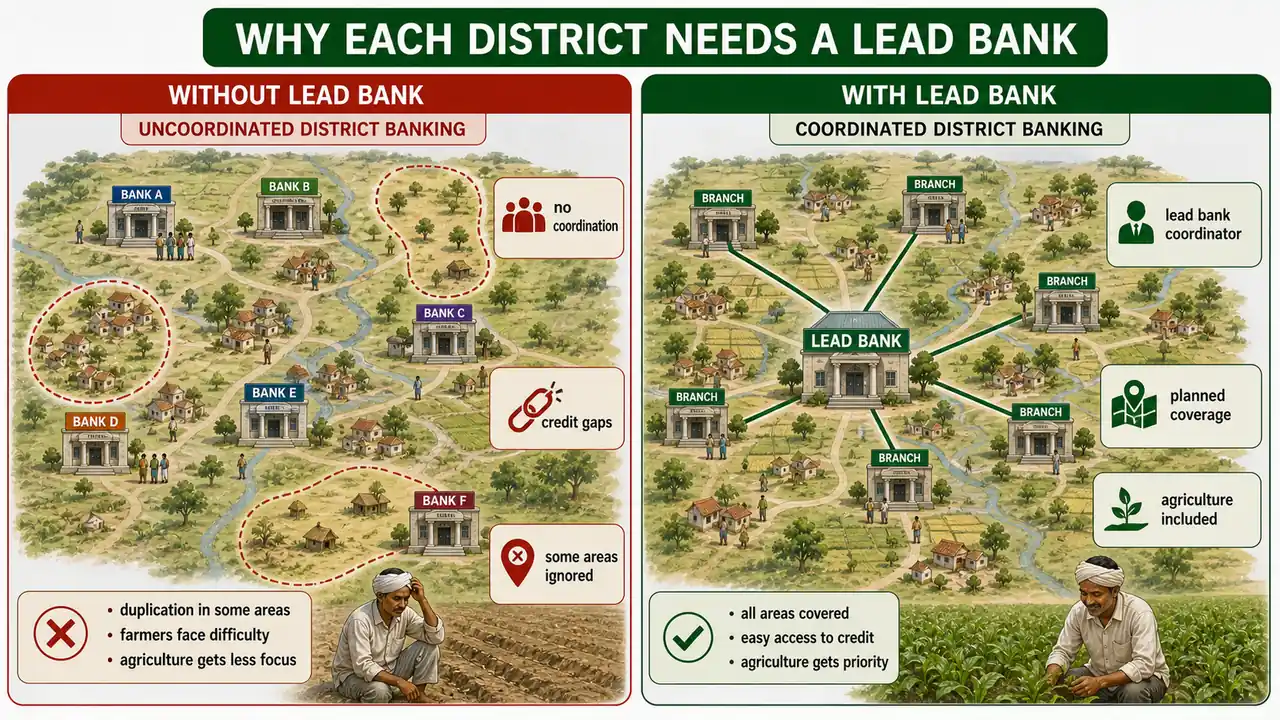
Why Does Each District Need a Lead Bank?
Consider a drought-prone district in Rajasthan with 15 different bank branches -- SBI, PNB, a regional rural bank, a cooperative bank, and others. Each bank has its own lending priorities. Without coordination, some villages get multiple bank branches while others have none. Some sectors receive excess credit while agriculture is ignored. The Lead Bank Scheme solves this by assigning one bank as the coordinator for each district, ensuring that credit reaches every block, every sector, and every farmer in a planned manner.
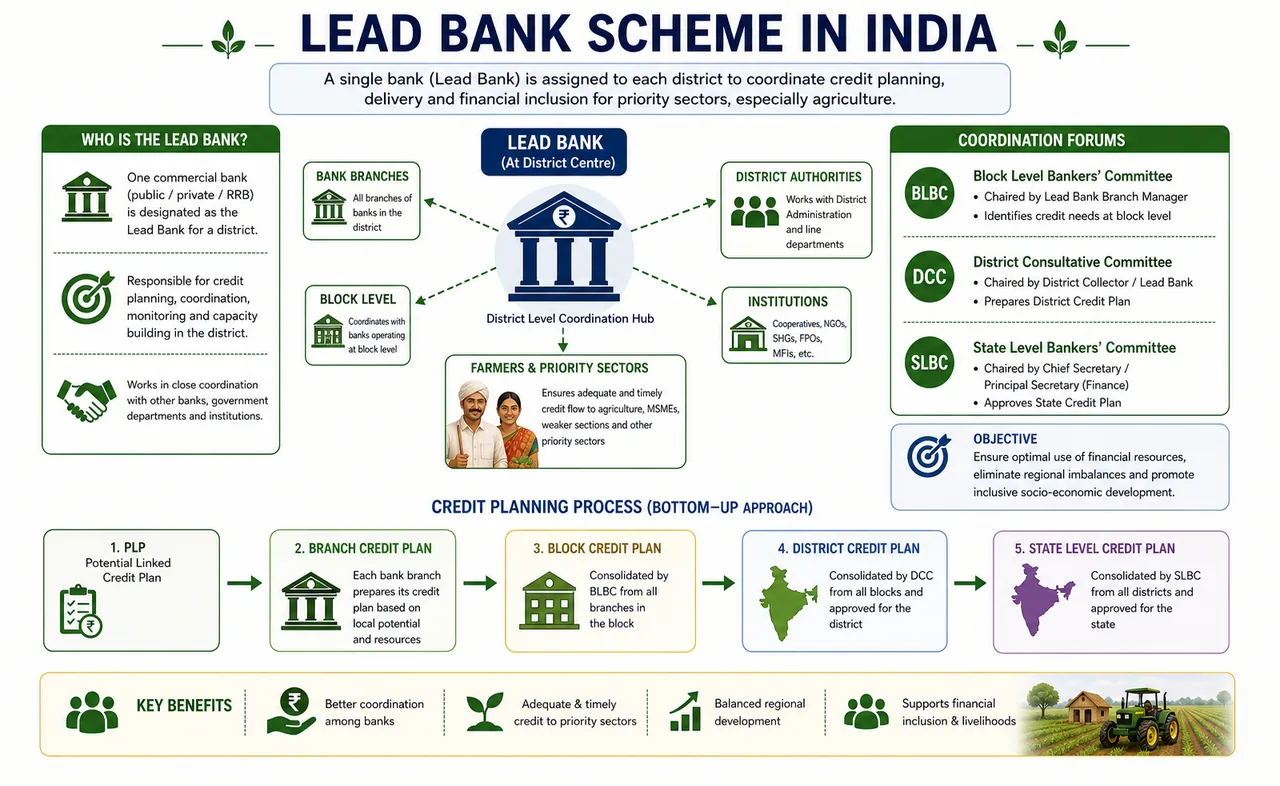
What is the Lead Bank Scheme?
IMPORTANT
Lead Bank Scheme (1969): Recommended by Gadgil Study Group (Service Area Approach) and endorsed by F.K.F. Nariman Committee. Administered by RBI. SBI has the most lead bank districts. Uttar Pradesh has the highest number of lead bank districts.
Pro Content Locked
Upgrade to Pro to access this lesson and all other premium content.
₹99 charged monthly · Cancel anytime
- All Agriculture & Banking Courses
- AI Lesson Questions (100/day)
- AI Doubt Solver (50/day)
- Glows & Grows Feedback (30/day)
- AI Section Quiz (20/day)
- 22-Language Translation (100/day)
- Recall Questions (20/day)
- AI Quiz (15/day)
- AI Quiz Paper Analysis (100/day)
- AI Step-by-Step Explanations (100/day)
- Spaced Repetition Recall (FSRS)
- AI Tutor
- Immersive Text Questions
- Audio Lessons — Hindi & English
- Mock Tests & Previous Year Papers
- Summary & Mind Maps
- XP, Levels, Leaderboard & Badges
- Generate New Classrooms
- Voice AI Teacher (AgriDots Live)
- AI Revision Assistant
- Knowledge Gap Analysis
- Interactive Revision (LangGraph)
🔒 Secure via Razorpay · Cancel anytime · No hidden fees
Why Does Each District Need a Lead Bank?
Consider a drought-prone district in Rajasthan with 15 different bank branches -- SBI, PNB, a regional rural bank, a cooperative bank, and others. Each bank has its own lending priorities. Without coordination, some villages get multiple bank branches while others have none. Some sectors receive excess credit while agriculture is ignored. The Lead Bank Scheme solves this by assigning one bank as the coordinator for each district, ensuring that credit reaches every block, every sector, and every farmer in a planned manner.
What is the Lead Bank Scheme?
IMPORTANT
Lead Bank Scheme (1969): Recommended by Gadgil Study Group (Service Area Approach) and endorsed by F.K.F. Nariman Committee. Administered by RBI. SBI has the most lead bank districts. Uttar Pradesh has the highest number of lead bank districts.
Origin and Recommendations
| Event | Year | Detail |
|---|---|---|
| National Credit Council (NCC) appoints study group | 1969 | Under chairmanship of Prof. D.R. Gadgil |
| Gadgil Study Group recommends | 1969 | "Service Area Approach" -- each bank branch is assigned a specific geographic area and is responsible for its credit needs |
| RBI appoints Nariman Committee | 1969 | Under Sri F.K.F. Nariman to examine Gadgil's recommendations |
| Nariman Committee endorses and recommends | 1969 | Formulation of "Lead Bank Scheme" |
| Scheme launched | 1969 | Alongside bank nationalization -- both aimed at directing banking resources toward rural development |
How It Works
- Specific districts are allotted to each bank
- The lead bank in a district is the one with the maximum number of branches in that district
- The lead bank does not monopolize banking -- it acts as a consortium leader coordinating all credit institutions
- Its role: identify potential areas for banking, expand credit facilities, and coordinate development efforts
| Key Fact | Detail |
|---|---|
| Administered by | Reserve Bank of India (since 1969) |
| Districts covered | 717 districts (as on June 2019) |
| Banks with lead responsibility | 18 public sector banks + 1 private sector bank |
| Bank with most lead districts | State Bank of India (largest branch network) |
| State with most lead districts | Uttar Pradesh (most populous state, largest number of districts) |
TIP
Exam Tip: Lead Bank Scheme and Bank Nationalization both happened in 1969. Both aimed at directing credit to rural areas. Remember: "1969 = Two banking revolutions."
Implementation -- Credit Plan Preparation
The Lead Bank Scheme uses a bottom-up approach to credit planning. Planning starts at the block level and aggregates upward to the state level.
The Credit Planning Hierarchy
Branch Credit Plan (BCP)
    --> Block Credit Plan
        --> District Credit Plan (DCP)
            --> State Level Credit Plan (SLCP)
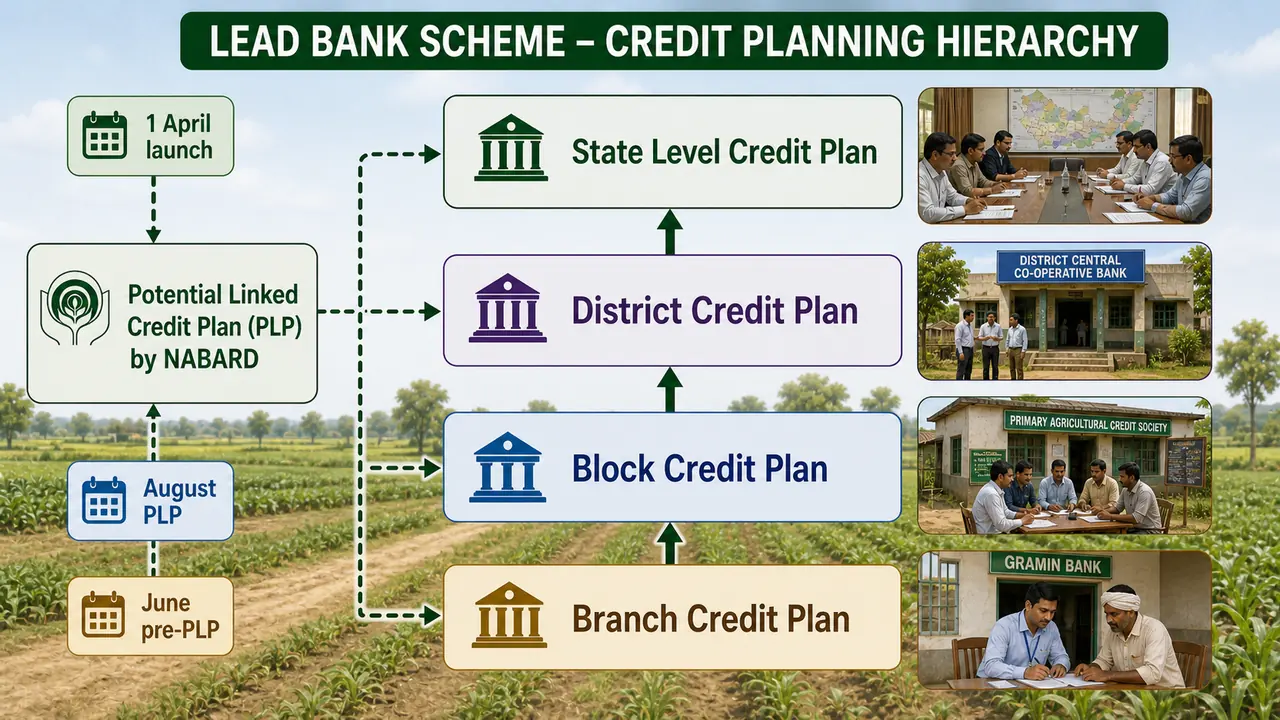
Step 1: Potential Linked Credit Plans (PLPs)
| Feature | Detail |
|---|---|
| Prepared by | NABARD (at district level) |
| Purpose | Map existing potential for development through bank credit |
| Factors considered | Long-term physical potential, infrastructure support, marketing facilities, government policies/programmes |
| Nature | Decentralized credit planning -- foundation for all district-level credit plans |
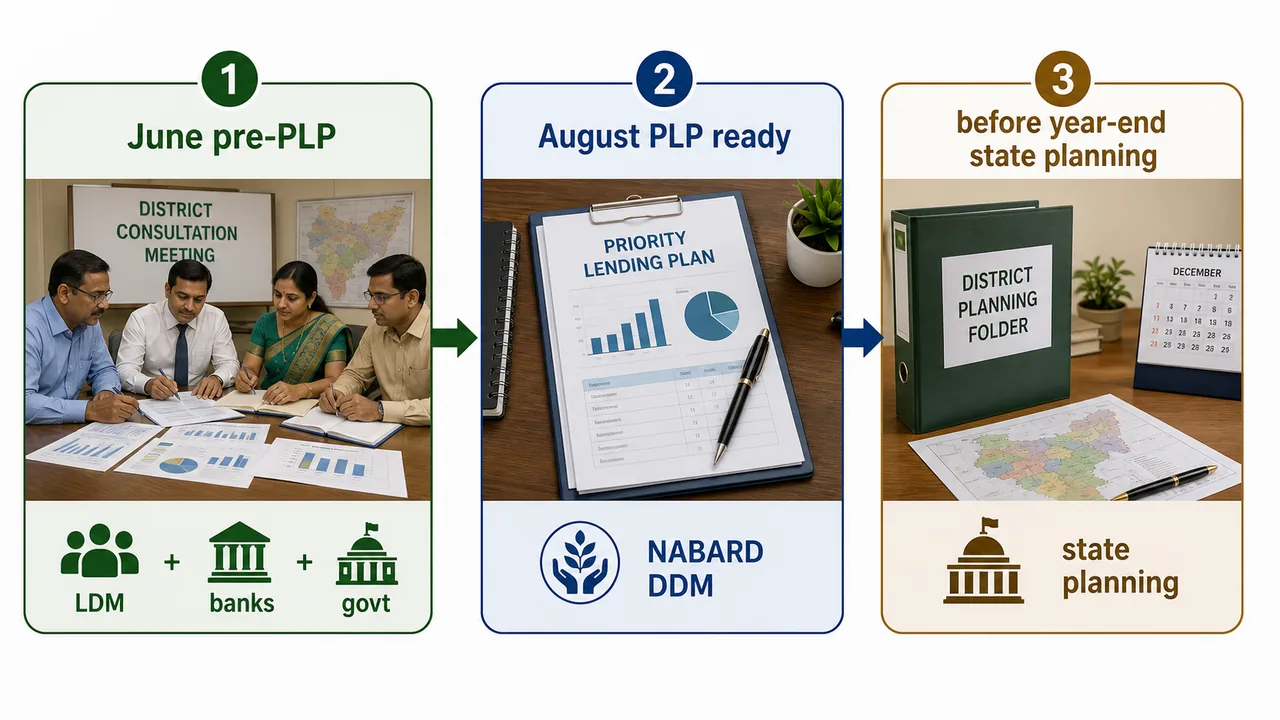
Annual PLP Preparation Timeline:
| Month | Activity | Convened By |
|---|---|---|
| June | Pre-PLP meeting -- banks and government agencies share views on sector/activity-wise credit potential | Lead District Manager (LDM) |
| -- | DDM of NABARD presents major information requirements | -- |
| August | PLP preparation completed for the following year | NABARD's DDM |
| Before year-end | PLP projections factored into State Government planning | -- |
Example: In a district of Andhra Pradesh, NABARD's PLP identifies potential for Rs 200 crore in agriculture credit -- Rs 80 crore for paddy, Rs 40 crore for cotton, Rs 30 crore for horticulture, Rs 20 crore for dairy, Rs 15 crore for fisheries, and Rs 15 crore for farm mechanization. This becomes the blueprint for all bank lending in the district.
Step 2: From PLP to District Credit Plan
The PLP feeds into the actual credit plan preparation through this sequence:
| Step | Plan | Prepared By | How |
|---|---|---|---|
| 1 | Branch Credit Plan (BCP) | Individual branch managers | Based on block-wise, activity-wise potential circulated by controlling offices |
| 2 | Block Credit Plan | BLBC meeting | BCPs discussed and aggregated; DDM and LDM guide the process |
| 3 | District Credit Plan (DCP) | Lead District Manager (LDM) | All Block Credit Plans aggregated |
| 4 | Approval | District Consultative Committee (DCC) | DCP placed before DCC for final acceptance |
| 5 | State Level Credit Plan (SLCP) | SLBC convenor bank | All DCPs aggregated; launched by 1st April every year |
TIP
Mnemonic -- "B-B-D-S": Branch --> Block --> District --> State. Credit planning flows bottom-up while fund flow moves top-down.
Monitoring Credit Plan Performance
Three forums at different levels monitor implementation, identify gaps, and take corrective action.
Forums Under Lead Bank Scheme
1. Block Level Bankers' Committee (BLBC)
The grassroots level forum for coordination between credit institutions and field-level development agencies.
| Feature | Detail |
|---|---|
| Chairman | Lead District Manager (LDM) |
| Meetings | Quarterly |
| Functions | Prepare and review Block Credit Plan; resolve operational problems in credit programmes |
Members of BLBC:
| Member | Role |
|---|---|
| All banks operating in the block | Lenders |
| District Central Cooperative Bank | Cooperative credit |
| Regional Rural Bank | Rural credit |
| Block Development Officer | Government development |
| Extension officers (agriculture, industries, cooperatives) | Technical guidance |
| LDO of RBI and DDM of NABARD | Selective attendance |
| Panchayat Samiti representatives | Invited at half-yearly intervals for rural development inputs |
TIP
Exam Key (NABARD 2020): BLBC = Quarterly meetings | Chairman = LDM (Lead District Manager)
2. District Consultative Committee (DCC)
The primary coordinating body for all banking and development activities in a district.
| Feature | Detail |
|---|---|
| Constituted | Early 1970s |
| Chairman | District Collector (DC) |
| Meetings | Quarterly (convened by Lead Bank) |
| Purpose | Common forum for bankers and government agencies to coordinate developmental activities |
Members of DCC:
| Member |
|---|
| Reserve Bank of India |
| NABARD |
| All commercial banks in the district |
| Cooperative banks including DCCB |
| Regional Rural Banks |
| Various State Government departments and allied agencies |
DCC Meeting Agenda:
| Item | Focus Area |
|---|---|
| Review of Financial Inclusion Plan (FIP) | Are all households covered by banking? |
| Doubling of Farmers' Income | Progress toward the 2022 target |
| District Credit Plan (DCP) performance | Are banks meeting their lending commitments? |
| SHG-bank linkage progress | Are self-help groups being financed adequately? |
TIP
Exam Key: DCC = Quarterly meetings | Chairman = District Collector | Convened by Lead Bank
3. State Level Bankers' Committee (SLBC)
The apex inter-institutional forum for banking coordination at the state level.
| Feature | Detail |
|---|---|
| Constituted | April 1977 |
| Chairman | CMD / Executive Director of the Convener Bank |
| Function | Coordination machinery for development of the state; aggregates all DCPs into State Level Credit Plan |
Additional topics at SLBC:
- Discussion on implementation of Model Land Leasing Act, 2016
- State-level policy coordination for financial inclusion
Comparison of Forums
| Feature | BLBC | DCC | SLBC |
|---|---|---|---|
| Level | Block | District | State |
| Chairman | Lead District Manager (LDM) | District Collector (DC) | CMD of Convener Bank |
| Frequency | Quarterly | Quarterly | As needed |
| Constituted | Under LBS | Early 1970s | April 1977 |
| Key function | Block Credit Plan review | DCP review and approval | State Level Credit Plan |
| Plan prepared | Block Credit Plan | District Credit Plan | State Level Credit Plan |
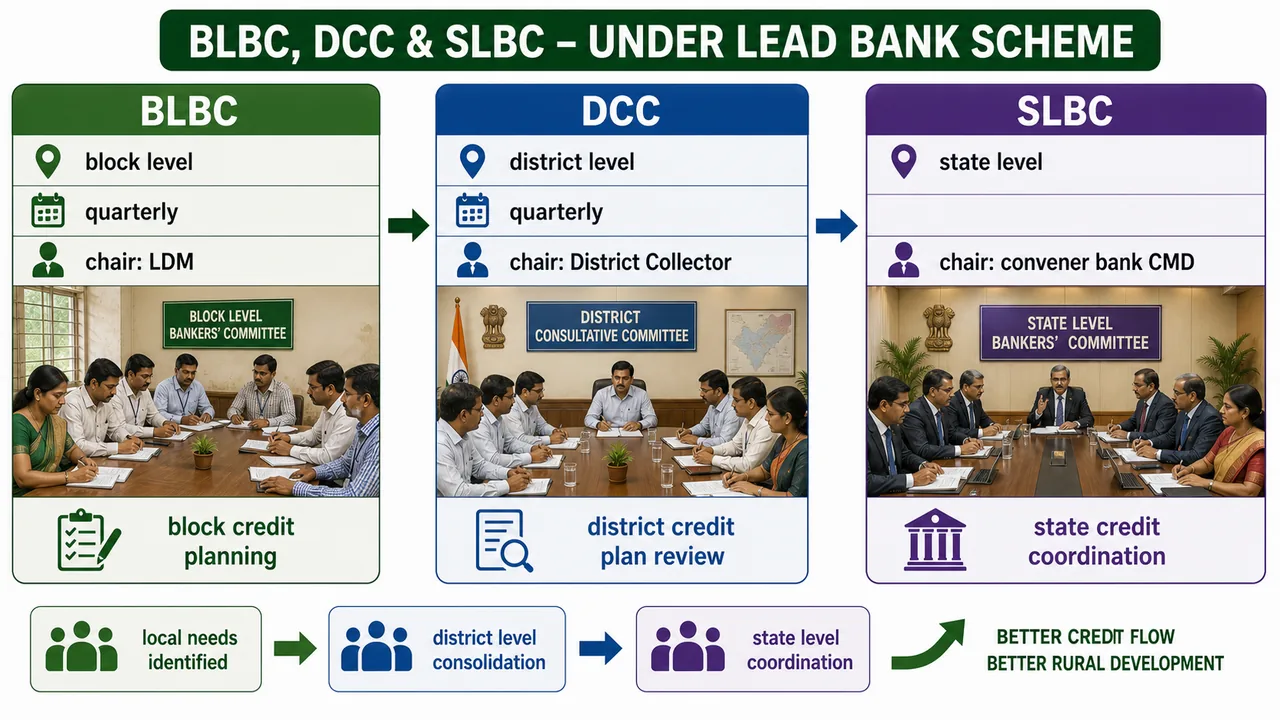
Credit Plan Flow -- Complete Picture
The following table summarizes the entire credit planning process under the Lead Bank Scheme:
| Stage | Plan | Prepared By | Reviewed/Approved By | Timeline |
|---|---|---|---|---|
| 1 | PLP (Potential Linked Credit Plan) | NABARD's DDM | Pre-PLP meeting (June); completed by August | Annual |
| 2 | Branch Credit Plan (BCP) | Branch managers | Internal | After PLP |
| 3 | Block Credit Plan | Aggregated at BLBC meeting | BLBC (quarterly) | After BCPs |
| 4 | District Credit Plan (DCP) | LDM (aggregates block plans) | DCC (quarterly) | Before budget finalization |
| 5 | State Level Credit Plan (SLCP) | SLBC convenor bank | SLBC | Launched by 1st April |
Summary Cheat Sheet
| Topic | Key Facts |
|---|---|
| Lead Bank Scheme | 1969; recommended by Gadgil Study Group; endorsed by Nariman Committee |
| Service Area Approach | Each bank branch responsible for credit needs of its assigned area |
| Administered by | RBI |
| Lead bank criteria | Bank with maximum branches in the district |
| Districts covered | 717 districts; 18 PSBs + 1 private bank |
| Most lead districts (bank) | State Bank of India |
| Most lead districts (state) | Uttar Pradesh |
| Credit planning approach | Bottom-up: Branch --> Block --> District --> State |
| PLP | Prepared by NABARD; pre-PLP meeting in June; completed by August |
| DCP | Prepared by LDM; approved by DCC |
| SLCP | Launched by 1st April every year |
| BLBC | Block level; quarterly; chaired by LDM |
| DCC | District level; quarterly; chaired by District Collector; convened by Lead Bank |
| SLBC | State level; constituted April 1977; chaired by CMD of Convener Bank |
| Key committees | Gadgil (Service Area Approach, 1969), Nariman (Lead Bank Scheme, 1969) |