🙅🏼♂️ Returns to Scale in Agriculture
Understand how proportional changes in all farm inputs affect output — with agricultural examples, isoquant analysis, and comparison with the Law of Variable Proportions.
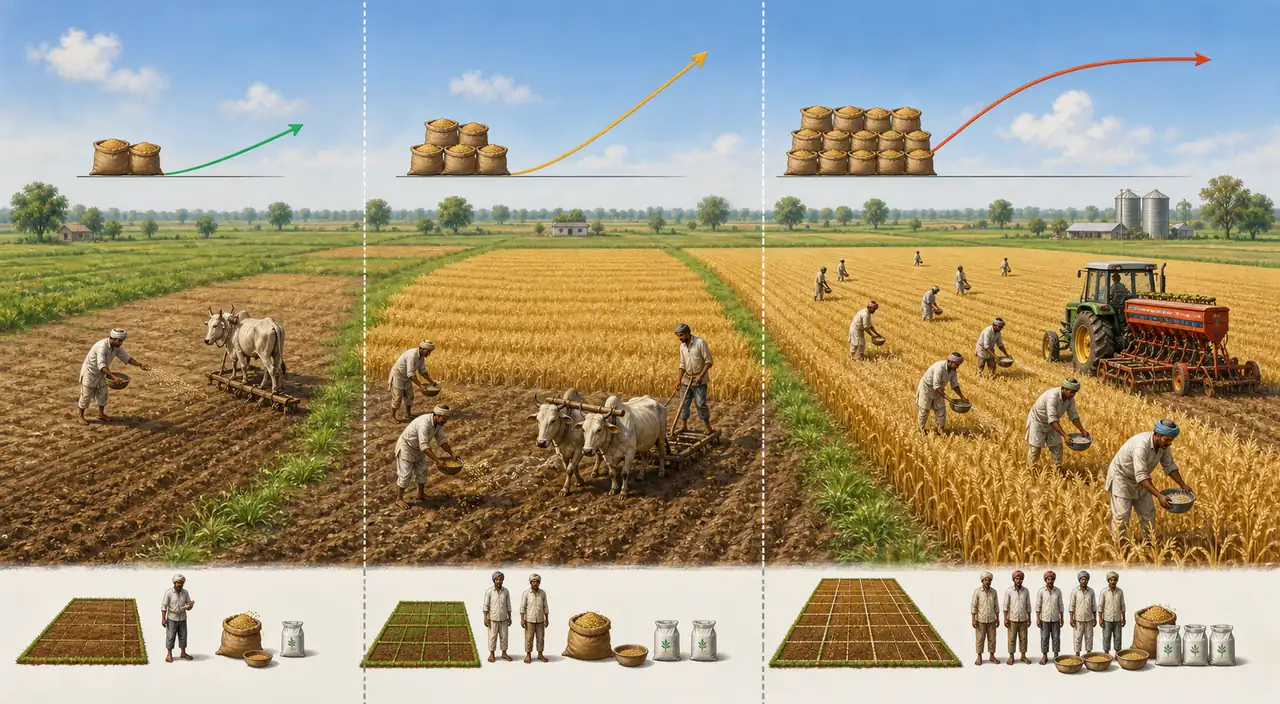
Imagine a farmer cultivates 2 hectares of wheat using 1 worker, 50 kg seed, and 25 kg fertilizer and harvests 20 quintals. Now suppose he doubles everything — 4 hectares, 2 workers, 100 kg seed, 50 kg fertilizer. If his harvest jumps to 50 quintals (more than double), he is experiencing increasing returns to scale. This concept of changing all inputs together in the same proportion and observing the effect on output is what Returns to Scale is all about.
The important question is not just whether the farm gets bigger, but whether the bigger farm becomes more efficient, equally efficient, or harder to manage. Returns to scale gives that answer by comparing proportional increases in all inputs with the resulting change in output.
What Are Returns to Scale?
Returns to scale describe the behaviour of output when all inputs are increased or decreased simultaneously in the same proportion. The proportion among inputs remains unchanged — only the scale of operation changes.
Pro Content Locked
Upgrade to Pro to access this lesson and all other premium content.
₹99 charged monthly · Cancel anytime
- All Agriculture & Banking Courses
- AI Lesson Questions (100/day)
- AI Doubt Solver (50/day)
- Glows & Grows Feedback (30/day)
- AI Section Quiz (20/day)
- 22-Language Translation (100/day)
- Recall Questions (20/day)
- AI Quiz (15/day)
- AI Quiz Paper Analysis (100/day)
- AI Step-by-Step Explanations (100/day)
- Spaced Repetition Recall (FSRS)
- AI Tutor
- Immersive Text Questions
- Audio Lessons — Hindi & English
- Mock Tests & Previous Year Papers
- Summary & Mind Maps
- XP, Levels, Leaderboard & Badges
- Generate New Classrooms
- Voice AI Teacher (AgriDots Live)
- AI Revision Assistant
- Knowledge Gap Analysis
- Interactive Revision (LangGraph)
🔒 Secure via Razorpay · Cancel anytime · No hidden fees
Imagine a farmer cultivates 2 hectares of wheat using 1 worker, 50 kg seed, and 25 kg fertilizer and harvests 20 quintals. Now suppose he doubles everything — 4 hectares, 2 workers, 100 kg seed, 50 kg fertilizer. If his harvest jumps to 50 quintals (more than double), he is experiencing increasing returns to scale. This concept of changing all inputs together in the same proportion and observing the effect on output is what Returns to Scale is all about.
The important question is not just whether the farm gets bigger, but whether the bigger farm becomes more efficient, equally efficient, or harder to manage. Returns to scale gives that answer by comparing proportional increases in all inputs with the resulting change in output.
What Are Returns to Scale?
Returns to scale describe the behaviour of output when all inputs are increased or decreased simultaneously in the same proportion. The proportion among inputs remains unchanged — only the scale of operation changes.
Unlike the Law of Variable Proportions (where only one input varies and others stay fixed), returns to scale examines what happens when the entire scale of the farm changes.
Three Stages of Returns to Scale
When all inputs are increased in the same proportion, output passes through three distinct stages:
| Stage | Name | Output Behaviour | Agricultural Reason |
|---|---|---|---|
| I | Increasing Returns to Scale | Output rises more than proportionally | Better division of labour, efficient use of machinery, bulk purchase of seeds and fertilizers |
| II | Constant Returns to Scale | Output rises exactly in proportion | Farm operates at its most balanced and optimal scale |
| III | Diminishing Returns to Scale | Output rises less than proportionally | Management difficulties, coordination problems, supervision lapses over large areas |
Numerical Example
Consider a wheat farm where land and labour are increased together:
| Scale | Land (acres) | Workers | Total Product (quintals) | Marginal Product (quintals) | Stage |
|---|---|---|---|---|---|
| 1x | 3 | 1 | 2 | — | — |
| 2x | 6 | 2 | 5 | 3 | Increasing |
| 3x | 9 | 3 | 9 | 4 | Increasing |
| 4x | 12 | 4 | 12 | 3 | Constant |
| 5x | 15 | 5 | 14 | 2 | Diminishing |
- From scale 1x to 2x, output more than doubles (2 to 5) — increasing returns.
- From scale 3x to 4x, output increases by exactly 3 — constant returns.
- Beyond 4x, each additional unit of scale adds less output — diminishing returns set in because managing 15+ acres with proportionally more workers becomes harder.
| Scale of Inputs | Total Physical Product in Quintals | Marginal Physical Product in Quintals | Remarks |
|---|---|---|---|
| 1 acres + 3 workers | 2 | 2 | Increasing Return |
| 2 acres + 6 workers | 5 | 3 | Increasing Return |
| 3 acres + 9 workers | 9 | 4 | Increasing Return |
| 4 acres + 12 workers | 14 | 5 | Increasing Return |
| 5 acres + 15 workers | 19 | 5 | Constant Return |
| 6 acres + 18 workers | 24 | 5 | Constant Return |
| 7 acres + 21 workers | 28 | 4 | Decreasing Return |
| 8 acres + 24 workers | 31 | 3 | Decreasing Return |
| 9 acres + 27 workers | 33 | 2 | Decreasing Return |
Exam Tip: In practice, the Law of Variable Proportions is more commonly applicable than returns to scale because it is nearly impossible to increase all inputs in exactly the same proportion on a real farm.
Summary of Basic Production Relationships
Isoquant Analysis of Returns to Scale
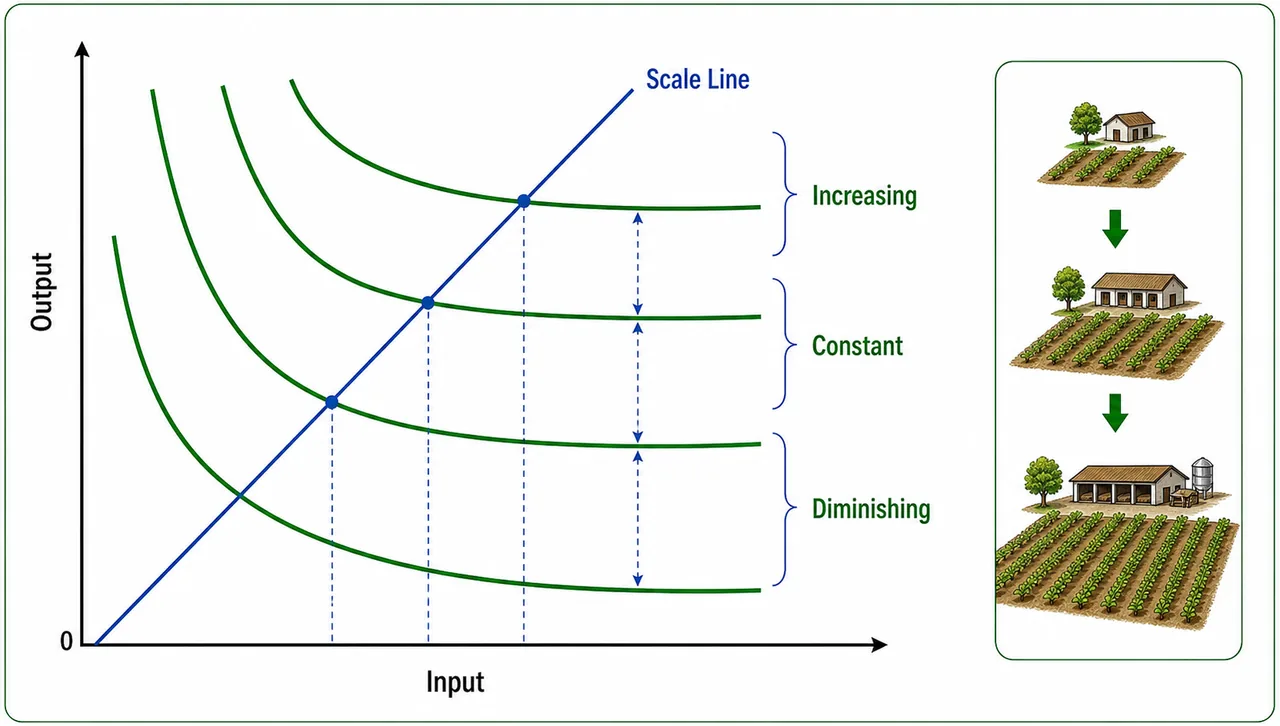
Returns to scale can also be understood using the scale line (a ray from the origin) on an isoquant map. The distance between successive isoquants along the scale line reveals the type of returns:
| Type | Distance Between Isoquants (AB, BC, CD) | Meaning |
|---|---|---|
| Increasing returns | AB > BC > CD (distances shrink) | Less additional input needed for each successive output increase |
| Constant returns | AB = BC = CD (distances equal) | Same additional input yields same additional output |
| Diminishing returns | AB < BC < CD (distances widen) | More additional input needed for same output increment |
Agricultural example: A mango orchard doubles all inputs (land, saplings, labour, water). Initially, the orchard benefits from better pollination and efficient irrigation layout (increasing returns). At optimal scale, returns are constant. Beyond that, pest management and supervision become difficult (diminishing returns).
Law of Variable Proportions vs. Returns to Scale
| Feature | Law of Variable Proportions | Returns to Scale |
|---|---|---|
| Inputs changed | Only one input varies; others fixed | All inputs change simultaneously |
| Proportion | Input proportions change | Input proportions remain same |
| Time period | Short-run concept | Long-run concept |
| Practical relevance | Highly relevant to everyday farming | More of theoretical interest |
| Example | Adding more fertilizer to a fixed plot of paddy | Doubling the entire paddy farm — land, seed, fertilizer, labour |
| Stages | Increasing, Diminishing, Negative MPP | Increasing, Constant, Diminishing |
| Law of Variable Proportion | Returns to Scale |
|---|---|
| Describes the change in output when a single input is varied. | Returns to the change in output when all inputs are varied in equal proportion. |
| At least one factor is kept constant or fixed. | All factors are varied. |
| Input proportions among factors remains the same. | Input proportions among factors remains the same. |
| Short run production function. | Long run production function. |
| Output includes stages: increasing, decreasing returns. | Output includes stages: increasing, constant, decreasing. |
| Increasing returns are due to better use of fixed factor. | Increasing returns are due to economies of scale. |
| Maximum output is due to optimum use of fixed factors. | Maximum output is due to optimum combination of all factors. |
| Diminishing returns are due to inefficiency arising out of over utilization of fixed factor. | Diminishing returns are due to diseconomies of scale. |
| Internal dis economies of scale. | Internal dis economies of scale. |
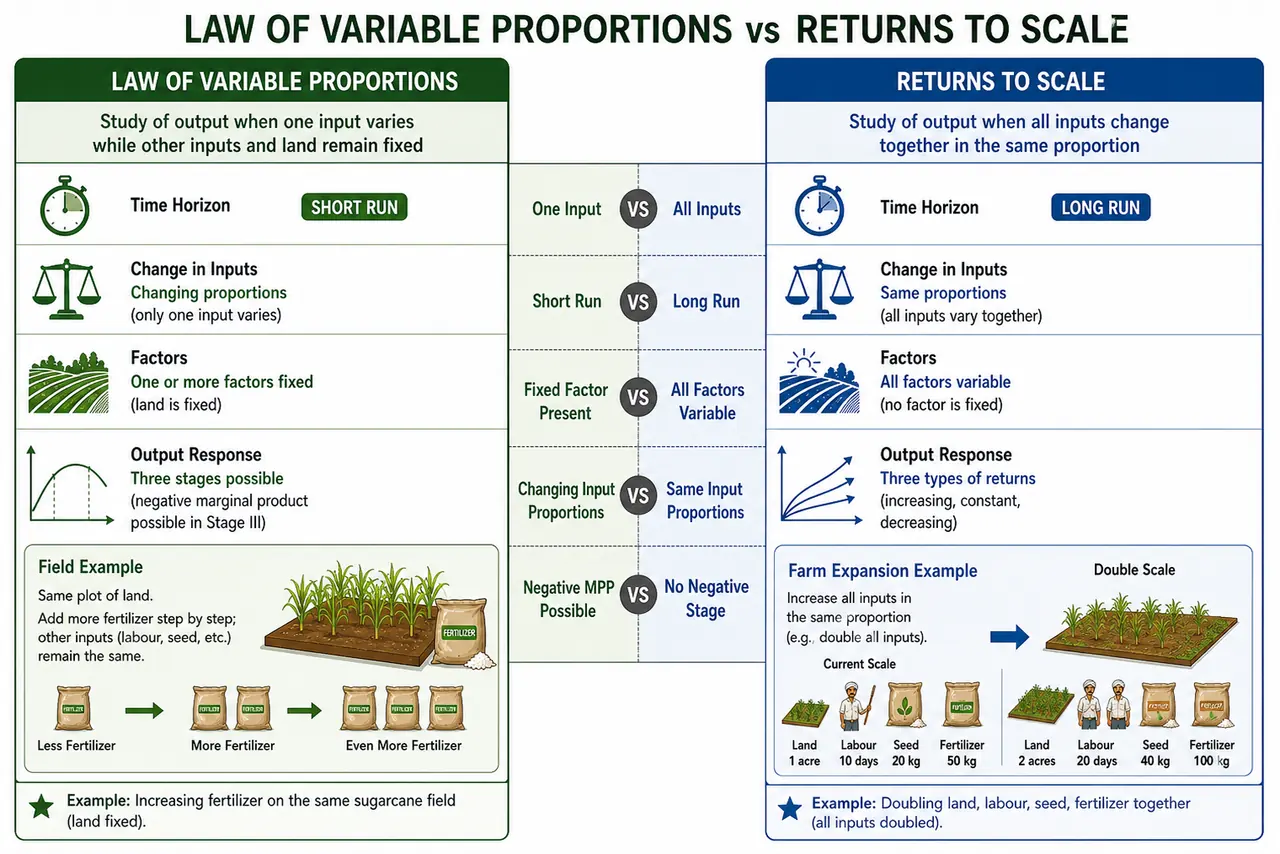
Mnemonic — "VO-SL":
- Variable proportions = One input changes (short-run)
- Scale = aLl inputs change (long-run)
Summary Cheat Sheet
| Concept / Topic | Key Details / Explanation |
|---|---|
| Returns to Scale | Effect on output when all inputs are changed simultaneously in the same proportion |
| Key Difference from Variable Proportions | Returns to scale: all inputs change (long-run). Variable Proportions: one input changes (short-run) |
| Increasing Returns to Scale | Output rises more than proportionally; better division of labour, bulk purchase benefits |
| Constant Returns to Scale | Output rises exactly in proportion; farm at most balanced, optimal scale |
| Diminishing Returns to Scale | Output rises less than proportionally; management difficulties, supervision lapses over large areas |
| Isoquant Test: Increasing | Distances between isoquants shrink along scale line (AB > BC > CD) |
| Isoquant Test: Constant | Distances between isoquants are equal (AB = BC = CD) |
| Isoquant Test: Diminishing | Distances between isoquants widen (AB < BC < CD) |
| Scale Line | A ray from the origin on an isoquant map; measures returns to scale |
| Law of Variable Proportions | Only one input varies, others fixed; input proportions change; short-run concept |
| Returns to Scale | All inputs change simultaneously; proportions remain same; long-run concept |
| Practical Relevance | Law of Variable Proportions is more relevant in real farming (nearly impossible to change all inputs proportionally) |
| Variable Proportions Stages | Increasing, Diminishing, Negative MPP |
| Returns to Scale Stages | Increasing, Constant, Diminishing (no negative stage) |
| VO-SL Mnemonic | Variable proportions = One input changes; Scale = aLl inputs change |