⚠️ Risk and Uncertainty in Farm Management — Sources, Differences and Mitigation Strategies
Understand risk vs uncertainty in agriculture — definitions, sources (production, price, financial, technological), and 9 methods to reduce risk including diversification, insurance, hedging, MSP, and contract farming. With agricultural examples, comparison tables, and exam tips.
A paddy farmer in Odisha sows his crop in June, expecting harvest in November. Between sowing and harvest, he faces unpredictable monsoon rains, possible pest attacks, fluctuating market prices, and uncertain government procurement. He must commit resources today based on outcomes he will not know for five months. This time lag between decision and outcome — and the inability to predict the future perfectly — is why risk and uncertainty are central to every farm management decision.
Why Risk Matters in Agriculture
Farmers make critical decisions (which crop to plant, how much fertilizer to apply, how much to borrow) early in the season, but results depend on weather, pests, prices, and policies that unfold months later. Because of this time lag:
Pro Content Locked
Upgrade to Pro to access this lesson and all other premium content.
₹99 charged monthly · Cancel anytime
- All Agriculture & Banking Courses
- AI Lesson Questions (100/day)
- AI Doubt Solver (50/day)
- Glows & Grows Feedback (30/day)
- AI Section Quiz (20/day)
- 22-Language Translation (100/day)
- Recall Questions (20/day)
- AI Quiz (15/day)
- AI Quiz Paper Analysis (100/day)
- AI Step-by-Step Explanations (100/day)
- Spaced Repetition Recall (FSRS)
- AI Tutor
- Immersive Text Questions
- Audio Lessons — Hindi & English
- Mock Tests & Previous Year Papers
- Summary & Mind Maps
- XP, Levels, Leaderboard & Badges
- Generate New Classrooms
- Voice AI Teacher (AgriDots Live)
- AI Revision Assistant
- Knowledge Gap Analysis
- Interactive Revision (LangGraph)
🔒 Secure via Razorpay · Cancel anytime · No hidden fees
A paddy farmer in Odisha sows his crop in June, expecting harvest in November. Between sowing and harvest, he faces unpredictable monsoon rains, possible pest attacks, fluctuating market prices, and uncertain government procurement. He must commit resources today based on outcomes he will not know for five months. This time lag between decision and outcome — and the inability to predict the future perfectly — is why risk and uncertainty are central to every farm management decision.
Why Risk Matters in Agriculture
Farmers make critical decisions (which crop to plant, how much fertilizer to apply, how much to borrow) early in the season, but results depend on weather, pests, prices, and policies that unfold months later. Because of this time lag:
- Good decisions can produce bad outcomes (drought destroys a well-planned crop).
- The most successful farmers are those who make the best possible decisions while surrounded by risk and uncertainty.
- Effective risk management is therefore a critical skill — not an optional extra.
If everything were known with certainty, farming decisions would be easy. The real world demands courage and skill to decide under incomplete information.
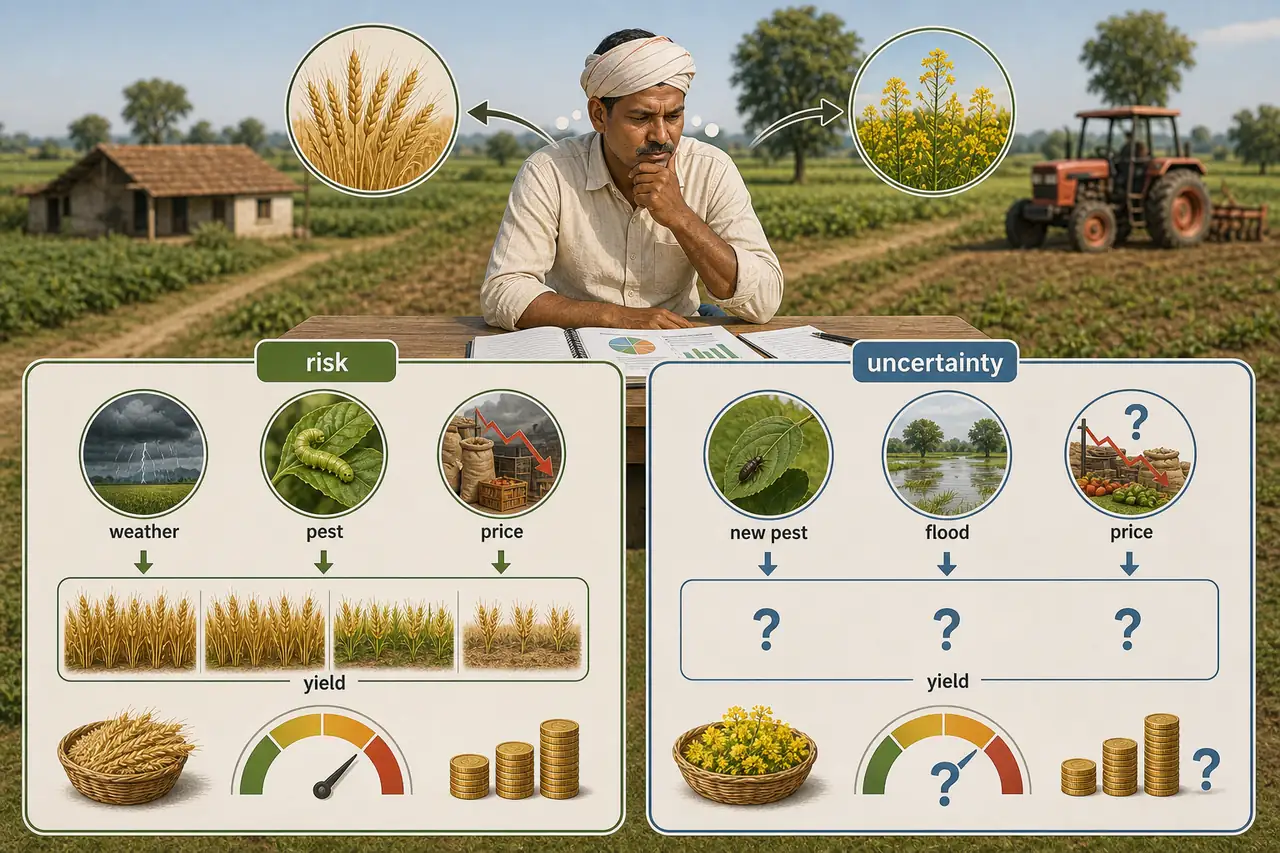
Risk vs Uncertainty — The Core Distinction
Understanding the difference between risk and uncertainty is fundamental and frequently tested in exams.
Risk
- All possible outcomes of a decision are known.
- The probability of each outcome is also known (from historical data, experiments, or statistical analysis).
- Risk is measurable — it can be quantified using probability distributions.
- Risk is insurable — because probabilities are known, insurance companies can calculate premiums.
Agricultural example: Historical records show that wheat crop in a region fails once in every 10 years. The probability of failure is 10% — this is a risk situation.
Uncertainty
- Either the possible outcomes are unknown, or their probabilities are unknown, or both are unknown.
- Uncertainty is not measurable — the parameters of the probability distribution (mean, variance, skewness) cannot be determined empirically.
- Uncertainty is not insurable — since probabilities cannot be calculated, insurance companies cannot price the coverage.
Agricultural example: A completely new pest (like fall armyworm appearing in India for the first time in 2018) causes damage of unknown magnitude — this is uncertainty because there is no historical data to estimate probabilities.
| Feature | Risk | Uncertainty |
|---|---|---|
| Possible outcomes | Known | Partly or fully unknown |
| Probabilities | Known and measurable | Unknown or unmeasurable |
| Quantification | Can be measured statistically | Cannot be measured reliably |
| Insurability | Insurable | Not insurable |
| Agricultural example | Crop failure with known historical frequency | Impact of an unprecedented weather event or new pest |
| Decision tool | Expected value, probability analysis | Judgement, experience, precautionary strategies |
Exam Tip — Mnemonic: "Risk = Rates known" (probabilities are known rates). "Uncertainty = Unknown" (probabilities are unknown). If you can assign a number to the chance, it is risk. If you cannot, it is uncertainty.
Sources of Risk and Uncertainty in Agriculture
Farm risk comes from four main sources. Understanding each helps in choosing the right mitigation strategy.
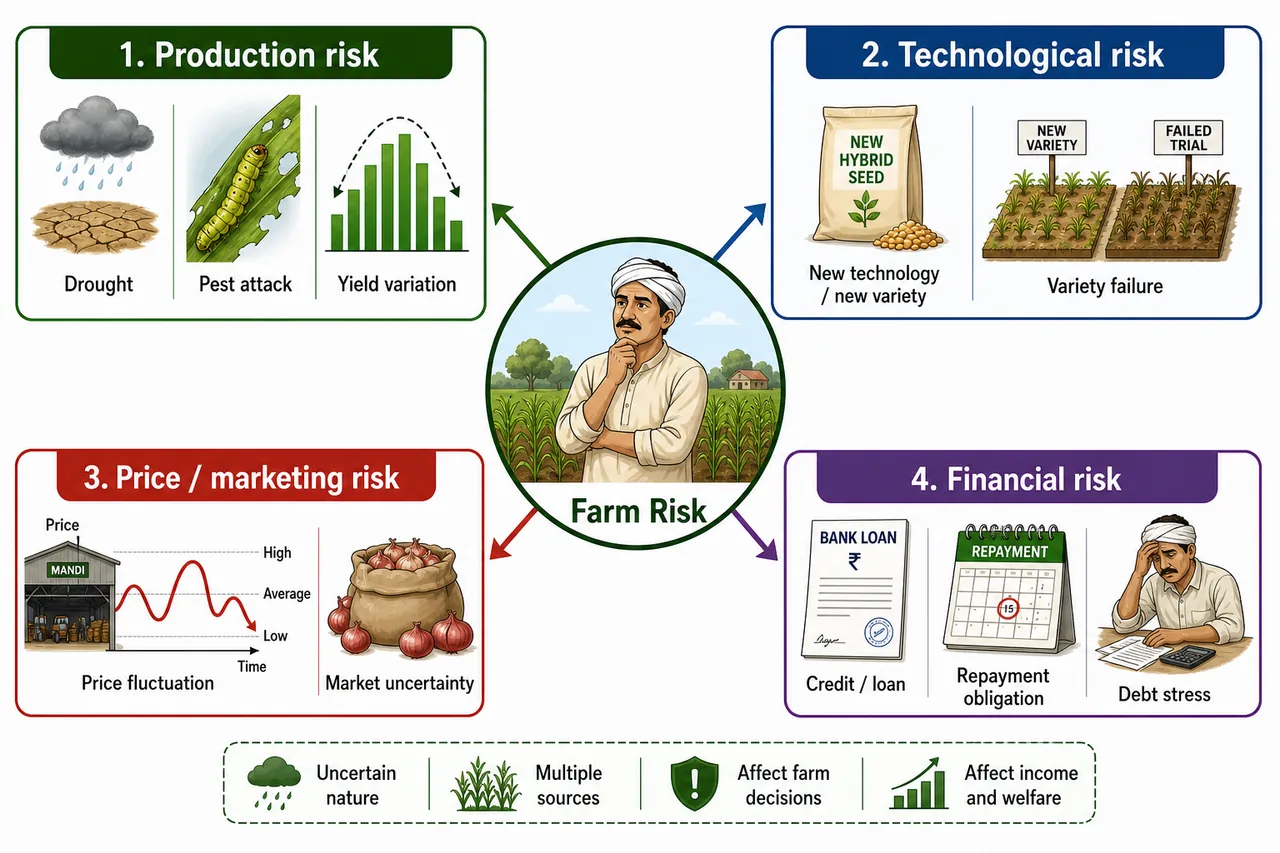
1. Production Risk (Yield Risk)
The most fundamental source of agricultural risk. Crop and livestock yields are never known with certainty before harvest.
Causes: Weather variability (drought, floods, hail), pest and disease outbreaks, weed pressure, soil quality variations.
Agricultural example: A farmer uses the same quantity of seed, fertilizer, and water every year on the same land, yet rice yields vary from 35 q/ha to 50 q/ha across years — entirely due to weather and pest differences beyond the farmer's control.
Key point: The cost of production per unit depends on both input costs and yield. Since both vary, the cost per quintal is highly unpredictable.
2. Technological Risk
A specific form of production risk related to new technology adoption.
Key questions: Will the new technology perform as promised? Will it reduce costs and increase yields in local conditions?
Agricultural example: A farmer adopts a new Bt cotton variety expecting 20 q/ha yield. In practice, the variety performs poorly in local soil conditions and yields only 12 q/ha. The new technology did not deliver the expected results — this is technological risk.
3. Price or Marketing Risk
Variability in output prices is a major source of income instability.
Causes: Global commodity markets, government policy changes, supply gluts after bumper harvests, demand shifts, seasonal price fluctuations.
Agricultural example: Onion prices in India can swing from Rs. 10/kg to Rs. 80/kg within a single year. A farmer who planted onions expecting Rs. 40/kg may receive only Rs. 12/kg at harvest — a devastating price collapse entirely beyond the farmer's control.
4. Financial Risk
Arises when money is borrowed to finance farm operations.
Key concern: Future income may not be sufficient to repay the debt. Interest rates may change, scale of operations may shrink, or the farm may fail to generate expected revenue.
Agricultural example: A farmer borrows Rs. 5,00,000 at 12% interest to set up a polyhouse for vegetable cultivation. A hailstorm destroys the crop, but the loan repayment obligation remains unchanged. A highly leveraged farm (one with heavy borrowing) faces greater financial risk because loan repayments are fixed regardless of farm performance.
| Source of Risk | What Varies | Farmer's Control | Agricultural Example |
|---|---|---|---|
| Production risk | Yields | Very limited | Drought reducing wheat yield |
| Technological risk | Performance of new inputs/methods | Moderate (can test first) | New variety failing in local conditions |
| Price/Marketing risk | Output prices | Almost none | Onion price crash after bumper harvest |
| Financial risk | Ability to repay debt | Partial (can limit borrowing) | Crop failure when heavy loans are outstanding |
Methods of Reducing Risk and Uncertainty
Farmers and farm managers use nine key strategies to manage risk. These move from the simplest (diversification) to the most institutional (government support prices).
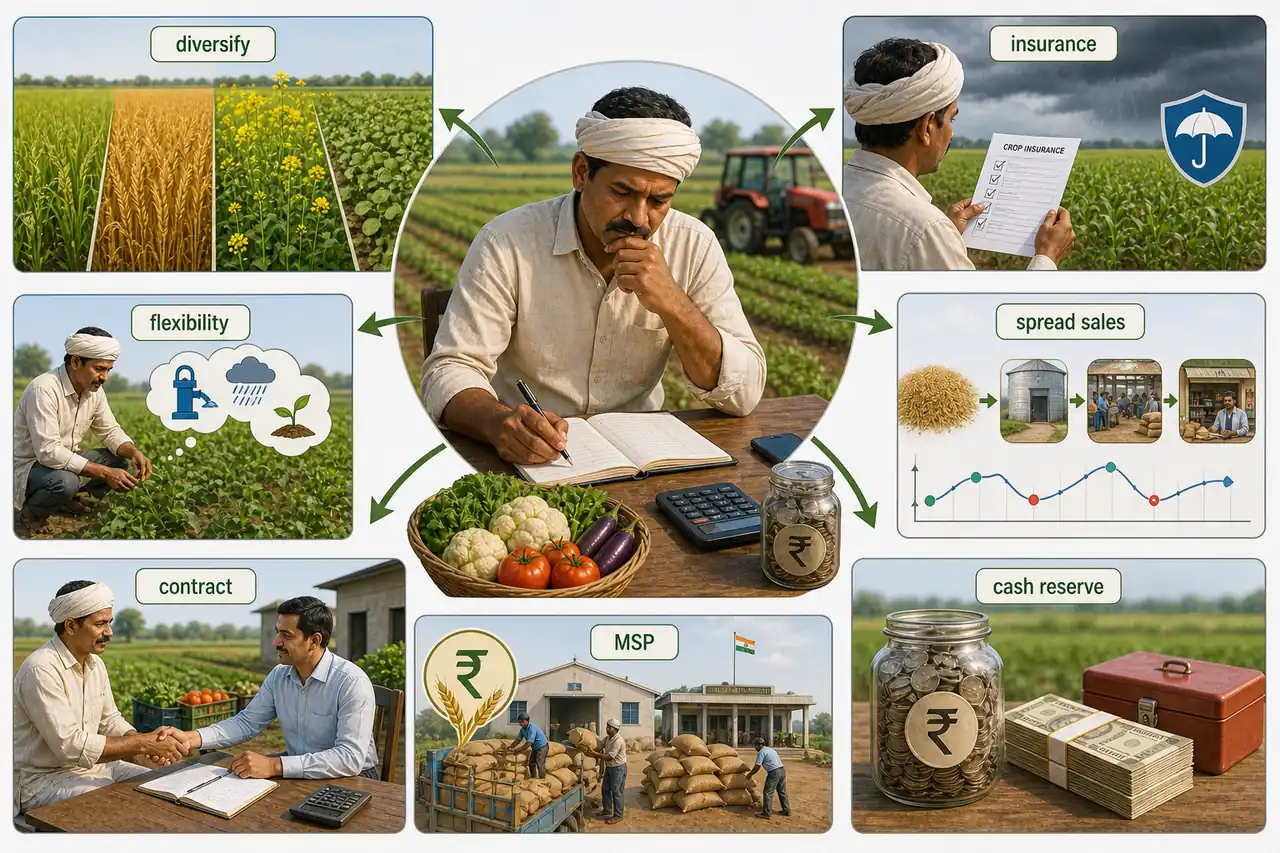
1. Diversification
Grow two or more crops or combine crops with livestock so that income does not depend on a single enterprise. If all prices and yields do not move in the same direction at the same time, total farm income becomes more stable.
Agricultural example: A farmer in Rajasthan grows mustard, wheat, and cumin, and also rears goats. Even if mustard prices fall, wheat and cumin may compensate, and goat sales provide a steady income stream.
2. Selection of Stable Enterprises
Choose enterprises with low yield variability — those less affected by weather and market swings.
Agricultural example: Irrigated paddy gives more stable yields than rainfed jowar. Dairy farming provides regular monthly income compared to seasonal crop income. Drought-resistant millet varieties offer more stability than water-intensive sugarcane in low-rainfall areas.
3. Crop and Livestock Insurance
For risks that can be insured, insurance converts the chance of a large loss into a certain small premium payment.
Agricultural example: Under Pradhan Mantri Fasal Bima Yojana (PMFBY), a paddy farmer pays a premium of 2% of the sum insured. If floods destroy the crop, the insurance company compensates the loss. The farmer exchanges a small certain cost (premium) for protection against a large uncertain loss.
4. Flexibility
While diversification prevents large losses, flexibility prevents the sacrifice of large gains. A flexible farm plan uses resources that can be easily shifted from one enterprise to another as new information becomes available.
Agricultural example: A farmer with a bore well and sprinkler system can switch between vegetables, pulses, or oilseeds depending on early-season price signals — the irrigation infrastructure is flexible across crops.
5. Spreading Sales
Instead of selling the entire crop at one time, sell portions at different times throughout the year. This averages out price fluctuations — you avoid selling everything at the lowest price, though you also miss selling everything at the peak.
Agricultural example: A soybean farmer stores part of the harvest in a warehouse and sells in three batches — October, December, and February — getting an average price rather than depending on a single market day.
6. Hedging
A technical procedure involving trading in commodity futures contracts through a commodity exchange. The farmer locks in a price before harvest, transferring price risk to the futures market.
Agricultural example: A cotton farmer sells futures contracts on NCDEX at Rs. 6,500/quintal in July for October delivery. Even if spot prices fall to Rs. 5,800/quintal at harvest, the farmer receives the hedged price.
7. Contract Farming (Contract Sales)
Producers sign a contract with a buyer or processor before planting. The contract specifies the price, quantity, and quality, removing price risk at planting time.
Agricultural example: Gherkin farmers in Karnataka sign contracts with export companies before sowing. The company guarantees a fixed price per kg, and the farmer knows the revenue in advance — allowing better planning of input use.
8. Minimum Support Price (MSP)
The government announces a minimum price at which it will purchase the commodity if market prices fall below it. This acts as a safety net for farmers.
Agricultural example: The government announces MSP for paddy at Rs. 2,300/quintal. If market price falls to Rs. 1,800/quintal, the farmer can sell to government procurement agencies at Rs. 2,300/quintal.
9. Building Net Worth
A strong net worth (total assets minus total liabilities) provides solvency, liquidity, and credit access. It serves as a financial buffer, allowing the farm to absorb losses in bad years and continue operating.
Agricultural example: A farmer who has saved money, owns land debt-free, and has grain reserves can survive a bad season without selling assets or taking distress loans.
| Risk Reduction Method | Type of Risk Addressed | How It Works | Agricultural Example |
|---|---|---|---|
| Diversification | Production + Price | Spread income across multiple enterprises | Wheat + mustard + dairy |
| Stable enterprises | Production | Choose low-variability crops/livestock | Irrigated paddy over rainfed jowar |
| Insurance | Production | Convert large uncertain loss into small certain premium | PMFBY for kharif crops |
| Flexibility | Production + Price | Keep resources shiftable across enterprises | Multi-purpose irrigation system |
| Spreading sales | Price | Sell in batches over time | Soybean sold in 3 lots over 5 months |
| Hedging | Price | Lock in price via futures contracts | Cotton futures on NCDEX |
| Contract farming | Price | Pre-agreed price with buyer before planting | Gherkin export contracts in Karnataka |
| MSP | Price | Government buys if market price falls below MSP | Paddy at Rs. 2,300/quintal |
| Building net worth | Financial | Maintain strong asset base as buffer | Debt-free land, grain reserves, savings |
Exam Tip: For essay questions, group the methods by the type of risk they address — production risk (diversification, stable enterprises, insurance, flexibility), price risk (spreading sales, hedging, contracts, MSP), and financial risk (net worth, limiting leverage). This shows structured thinking and earns better marks.
Summary Cheat Sheet
| Concept / Topic | Key Details / Explanation |
|---|---|
| Risk | All outcomes and probabilities are known; measurable; insurable |
| Uncertainty | Outcomes or probabilities (or both) are unknown; not measurable; not insurable |
| Risk Mnemonic | "Risk = Rates known" (probabilities are known). "Uncertainty = Unknown" |
| Production Risk | Yield variability due to weather, pests, diseases; most fundamental source |
| Technological Risk | New technology may not perform as expected in local conditions |
| Price/Marketing Risk | Output price fluctuations beyond farmer's control (e.g., onion price swings Rs 10-80/kg) |
| Financial Risk | Borrowed capital creates fixed repayment obligations regardless of farm performance |
| Highly Leveraged Farm | Heavy borrowing = greater financial risk; loan repayments fixed even if crop fails |
| 1. Diversification | Multiple enterprises to reduce income variability; "don't put all eggs in one basket" |
| 2. Stable Enterprises | Choose crops/livestock with low yield variability; prefer irrigated over rainfed |
| 3. Crop Insurance | Converts uncertain large loss into certain small premium (e.g., PMFBY — 2% premium for kharif) |
| 4. Flexibility | Resources that can be shifted across enterprises as conditions change; prevents sacrifice of large gains |
| 5. Spreading Sales | Sell in batches over time to average out price fluctuations |
| 6. Hedging | Lock in price via commodity futures contracts (e.g., NCDEX cotton futures) |
| 7. Contract Farming | Pre-harvest price agreement with buyer removes price risk at planting time |
| 8. MSP | Government minimum support price; safety net if market price falls below MSP |
| 9. Building Net Worth | Strong asset base (Total Assets - Total Liabilities) provides buffer for bad years |
| Production Risk Methods | Diversification, stable enterprises, insurance, flexibility |
| Price Risk Methods | Spreading sales, hedging, contract farming, MSP |
| Financial Risk Methods | Building net worth, limiting leverage |
| Time Lag Problem | Decisions made early in season; outcomes depend on weather/pests/prices months later |