🧶 Systems of Farming — Farm Organisation and Ownership Models
Understand the six systems of farming — Peasant, Joint, Capitalistic, State, Collective, and Cooperative — with ownership patterns, agricultural examples, and exam-ready comparison tables.
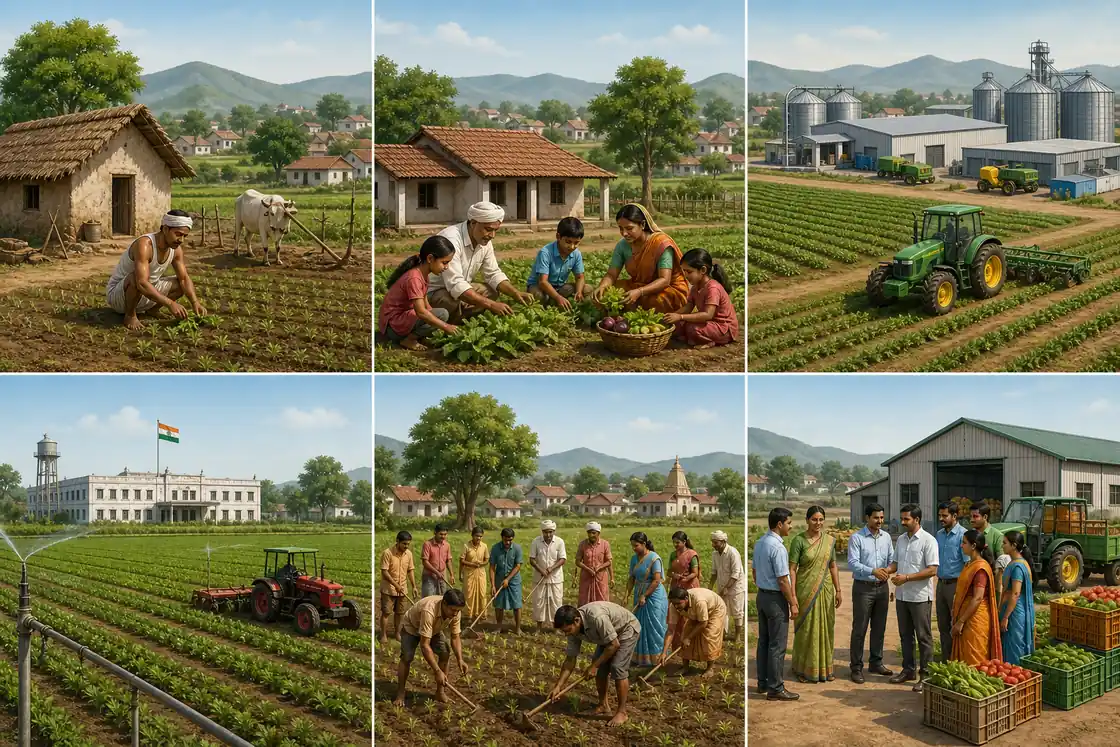
In a village in Madhya Pradesh, three farmers work side by side yet operate under completely different systems. Farmer A owns 2 acres and manages everything himself — a peasant farmer. Farmer B pools his land with two neighbours to cultivate jointly — joint farming. Down the road, a government-run seed multiplication farm produces certified wheat seed — state farming. The way a farm is owned, organised, and managed defines its system of farming.
This is why systems of farming matter so much in exams and in real agriculture: the same crop may be grown under very different ownership, control, labour, and profit-sharing arrangements. Once the organisational pattern changes, the incentives, efficiency, and social outcomes of farming also change.
Definition
According to Johnson:
Pro Content Locked
Upgrade to Pro to access this lesson and all other premium content.
₹99 charged monthly · Cancel anytime
- All Agriculture & Banking Courses
- AI Lesson Questions (100/day)
- AI Doubt Solver (50/day)
- Glows & Grows Feedback (30/day)
- AI Section Quiz (20/day)
- 22-Language Translation (100/day)
- Recall Questions (20/day)
- AI Quiz (15/day)
- AI Quiz Paper Analysis (100/day)
- AI Step-by-Step Explanations (100/day)
- Spaced Repetition Recall (FSRS)
- AI Tutor
- Immersive Text Questions
- Audio Lessons — Hindi & English
- Mock Tests & Previous Year Papers
- Summary & Mind Maps
- XP, Levels, Leaderboard & Badges
- Generate New Classrooms
- Voice AI Teacher (AgriDots Live)
- AI Revision Assistant
- Knowledge Gap Analysis
- Interactive Revision (LangGraph)
🔒 Secure via Razorpay · Cancel anytime · No hidden fees
In a village in Madhya Pradesh, three farmers work side by side yet operate under completely different systems. Farmer A owns 2 acres and manages everything himself — a peasant farmer. Farmer B pools his land with two neighbours to cultivate jointly — joint farming. Down the road, a government-run seed multiplication farm produces certified wheat seed — state farming. The way a farm is owned, organised, and managed defines its system of farming.
This is why systems of farming matter so much in exams and in real agriculture: the same crop may be grown under very different ownership, control, labour, and profit-sharing arrangements. Once the organisational pattern changes, the incentives, efficiency, and social outcomes of farming also change.
Definition
According to Johnson:
"The combination of products on a given farm and the method or practices that are used in the production of the products is known as the system of farming."
While type of farming asks what is produced, system of farming asks how the farm is organised — who owns the land, who makes decisions, and whether resources are used individually or jointly.
Classification of Systems
Systems of farming are classified into six categories based on organisational set-up:
| # | System | Ownership | Management |
|---|---|---|---|
| 1 | Peasant / Individual | Individual | Individual |
| 2 | Joint | Multiple individuals | Joint / shared |
| 3 | Capitalistic / Corporate | Private capitalists / corporations | Hired managers + labour |
| 4 | State | Government | Government officials |
| 5 | Collective | Collective / society | Elected committee |
| 6 | Cooperative | Voluntary pooling | Democratic / elected body |
Mnemonic — "PJ-CSCC": Peasant, Joint, Capitalistic, State, Collective, Cooperative. Think: "People Join Country's Six Cultivation Clubs."
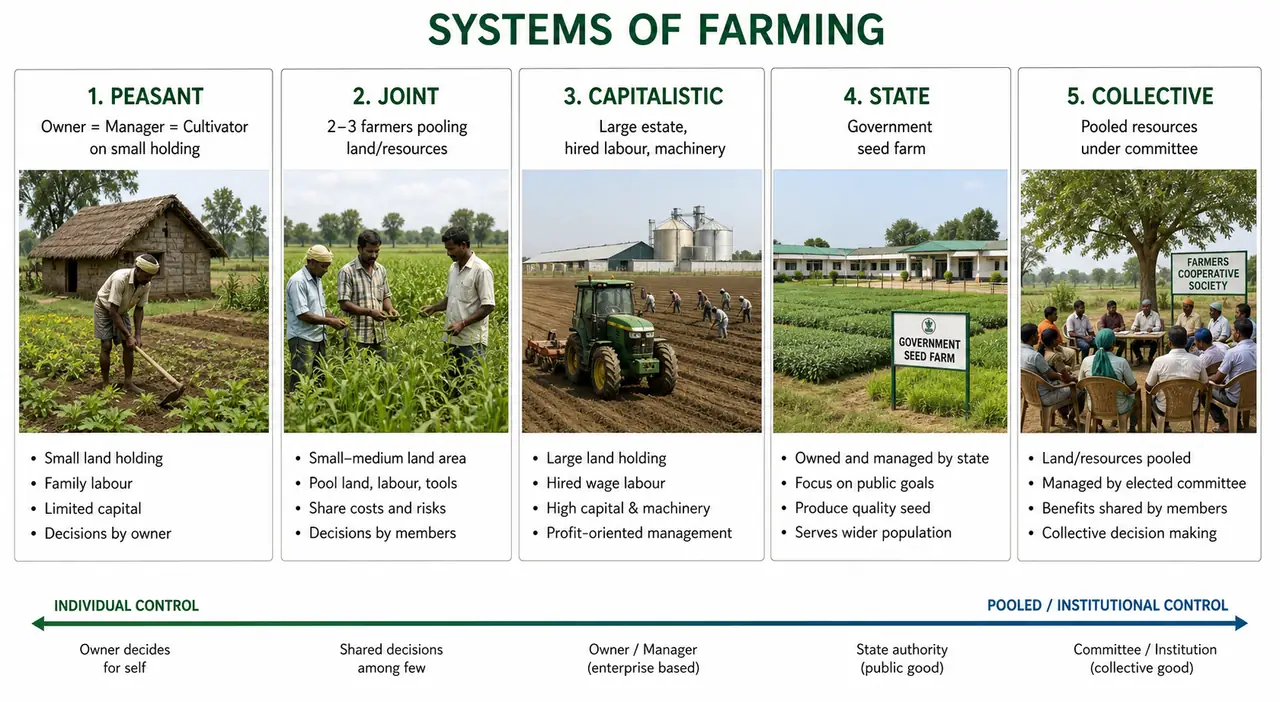
1. Peasant / Individual Farming
The farmer is simultaneously the owner, manager, and organiser of the farm. This is the most common system in India.
Agricultural example: A marginal farmer in West Bengal owns 1.5 acres, grows paddy in kharif and potato in rabi, makes all decisions himself, and sells produce at the local mandi.
| Advantages | Disadvantages |
|---|---|
| Full freedom in decision-making | Resources are generally meagre |
| Personal ownership motivates better land care | Law of inheritance fragments holdings over generations |
| No dependence on outside management | Limited access to capital, technology, and markets |
Exam Tip: Peasant farming + law of inheritance = land fragmentation, a major challenge in Indian agriculture.
2. Joint Farming
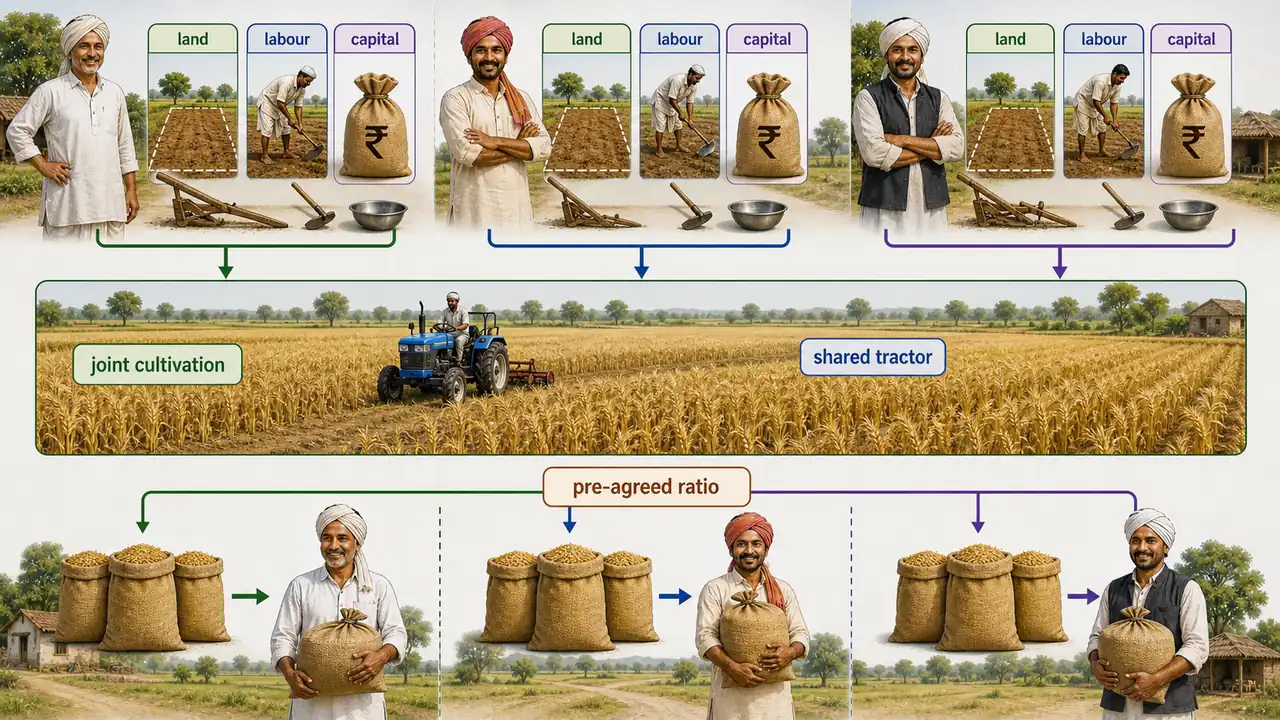
Two or more farmers pool their resources (land, labour, capital) and carry out agricultural operations together. Produce is divided according to a pre-agreed ratio.
Agricultural example: Three brothers in Punjab with 2 acres each pool their 6 acres to cultivate wheat together, share a tractor, and divide the harvest equally.
| Advantages | Disadvantages |
|---|---|
| Overcomes limitations of small holdings | Disputes may arise over profit sharing |
| Shared cost of machinery and inputs | Decision-making can be slow with multiple owners |
| Better bargaining power in markets | Exit of one member can disrupt operations |
3. Capitalistic / Corporate Farming
Land is held in large areas by private capitalists, corporations, or syndicates. Capital comes from one or a few investors, or from many (like a joint stock company). Work is done by hired labour using modern technology and extensive mechanisation.
Agricultural example: Tea plantations in Assam and coffee estates in Karnataka owned by large companies like Tata Coffee, employing hundreds of hired workers.
| Advantages | Disadvantages |
|---|---|
| Good supervision and strong organisation | Creates socio-economic imbalances |
| Sufficient capital and resources | Actual cultivator is not the owner |
| Latest technology and machinery used | Benefits may not reach labourers |
| High efficiency due to scale | Concentration of land in few hands |
Where found: USA, Australia, Canada. In India — tea, coffee, rubber, and sugarcane plantations in former Bombay, Madras, and Mysore states.
4. State Farming
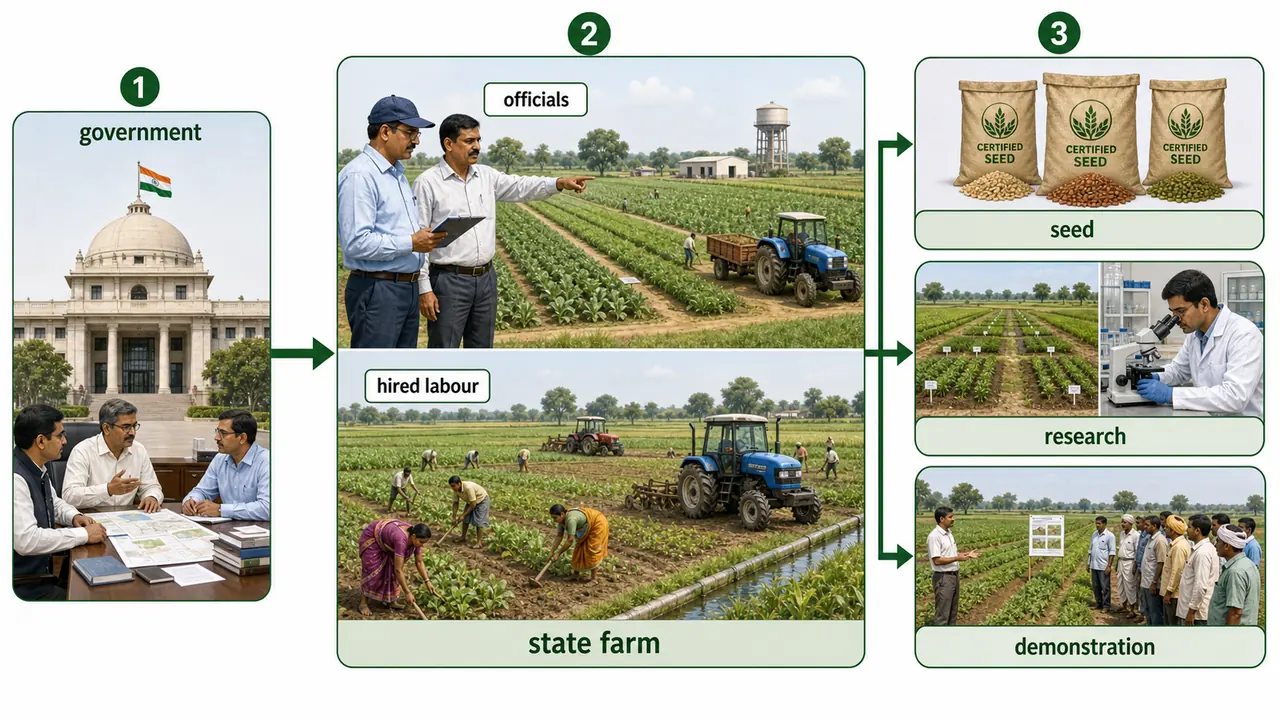
Farms owned and managed by the government. Government officials handle operations, and labourers are hired on daily or monthly wages with no say in farm policy.
Agricultural example: The Central State Farm at Suratgarh (Rajasthan) — one of Asia's largest state farms — produces certified seeds of wheat, mustard, and gram for distribution to farmers.
| Advantages | Disadvantages |
|---|---|
| No shortage of resources | Resources may not be available on time due to bureaucratic delays |
| Serves research, demonstration, and seed production | Profit maximisation is not the primary objective |
| Tests and showcases new agricultural technologies | Workers have no ownership stake or decision-making power |
Common types: Research farms, Seed multiplication farms, Demonstration farms.
5. Collective Farming
A large number of families or villagers pool all their resources — land, livestock, machinery — under collective management. An elected committee or general body holds supreme power. Resources belong to the society, not to any individual.
Agricultural example: Soviet-era kolkhoz farms where entire villages pooled land and equipment; similar models were adopted in China during the commune period.
| Advantages | Disadvantages |
|---|---|
| Large-scale mechanised farming | Individual has no voice in decisions |
| Pooled resources eliminate duplication | Personal initiative is suppressed |
| Economies of scale achieved | Not prevalent in India |
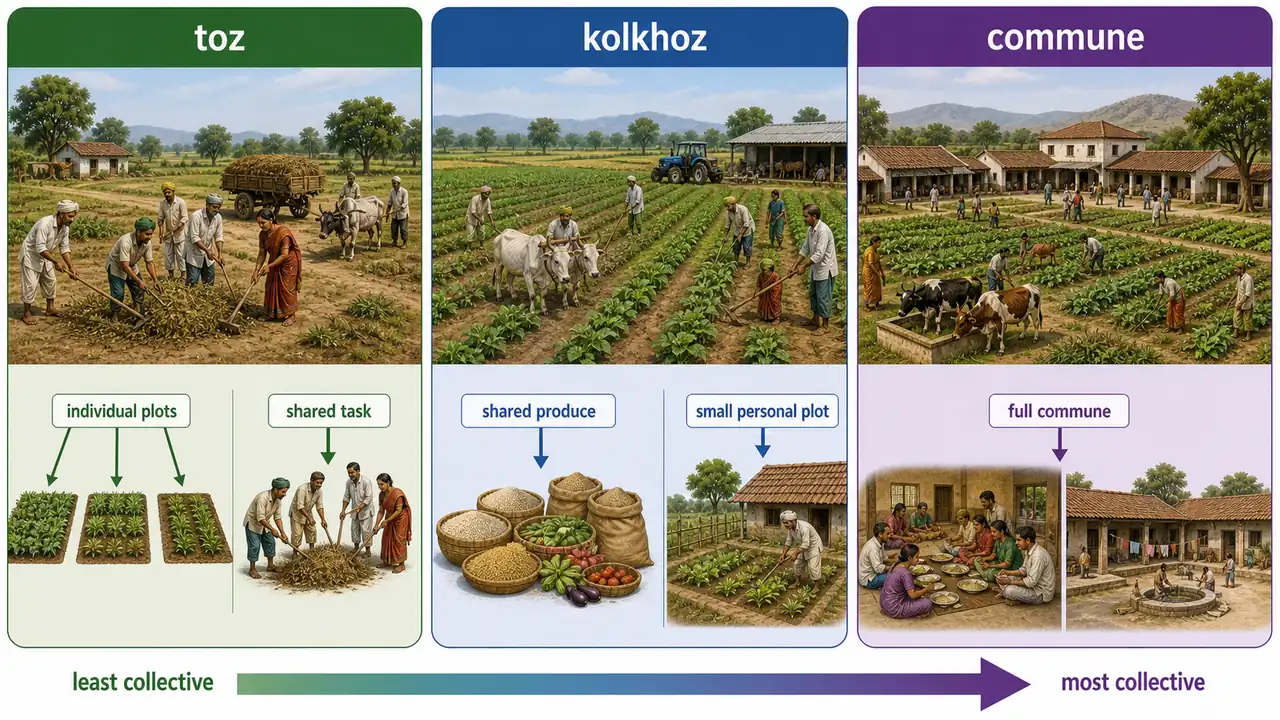
Three Forms of Collective Farming
| Form | Key Feature |
|---|---|
| Toz | Simplest form; members cooperate for specific tasks but retain individual holdings |
| Kolkhoz | Full collective management; produce shared; members retain small personal plots |
| Commune | Most extreme; all aspects of life and farming are communal |
Exam Tip: Collective farming was prominent in Russia and China. It is not practised in India. Remember: Collective = Compulsory pooling.
6. Cooperative Farming
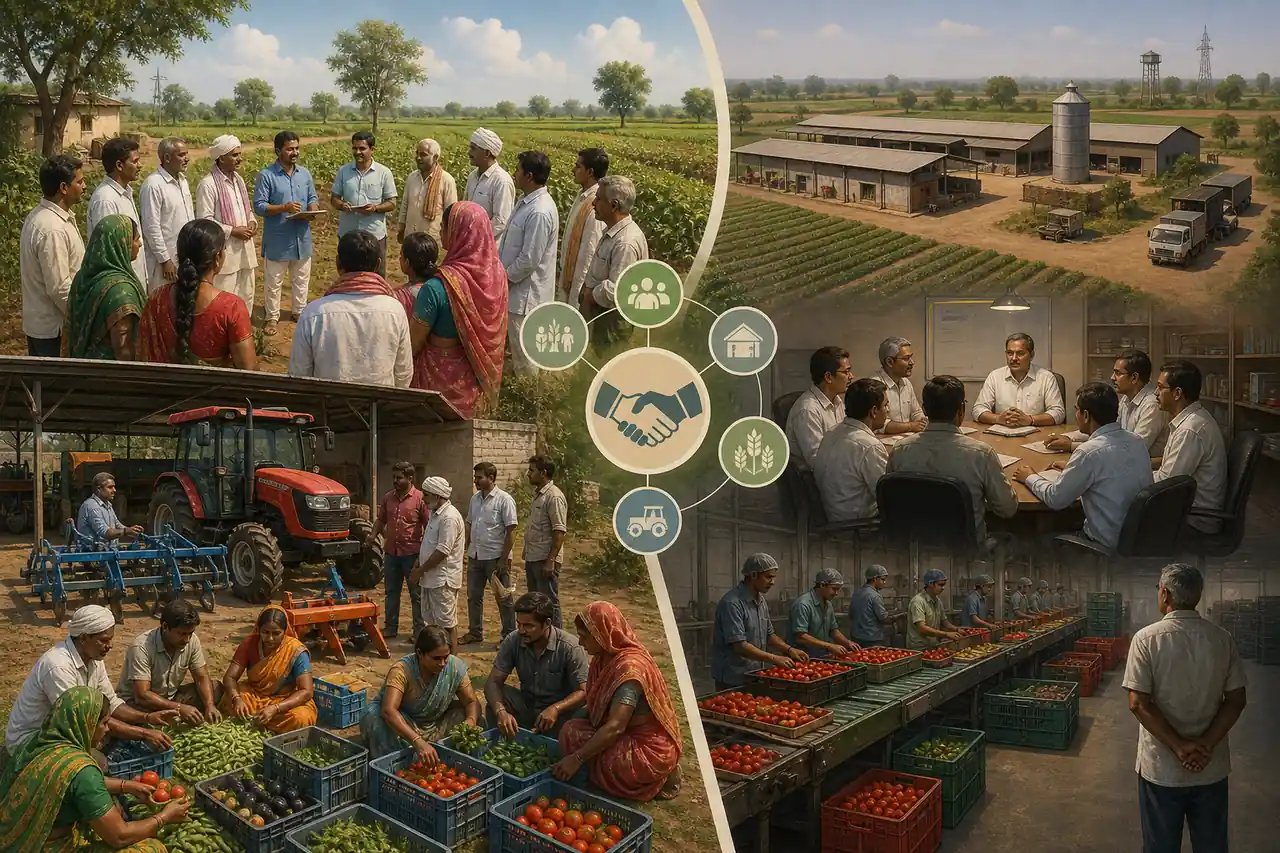
A voluntary organisation where small farmers and landless labourers pool land and resources to increase income. The key distinction from collective farming is the word "voluntary" — nobody is forced to join.
Agricultural example: Amul (Gujarat) started as a cooperative model where dairy farmers pooled milk for collective processing and marketing, transforming rural incomes.
According to the Planning Commission, cooperative farming implies pooling of land and joint management.
The Working Group on Cooperative Farming defines it as: "A voluntary association of cultivators for better utilisation of resources including manpower and pooled land, in which majority of the members participate in farm operations with a view to increasing agricultural production, employment, and income."
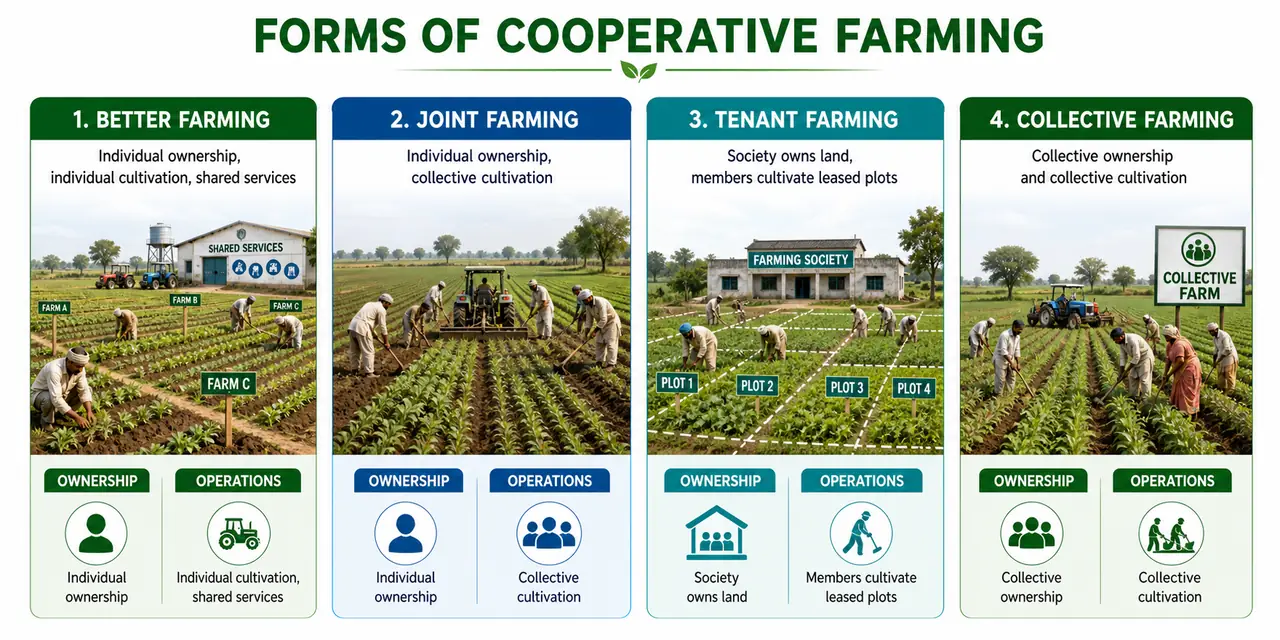
Four Forms of Cooperative Farming
| Form | Ownership | Operations | Profit Distribution | Example |
|---|---|---|---|---|
| Cooperative Better Farming | Individual | Individual | Each farmer keeps own profit after paying for shared services | Farmers share a combine harvester for wheat harvesting |
| Cooperative Joint Farming | Individual | Collective | Daily wages + profit by land share | Small rice farmers pool plots for joint cultivation; profit split by area contributed |
| Cooperative Tenant Farming | Society | Individual (on leased plots) | Each member pays rent; keeps remaining produce | Landless labourers get plots from a land-owning society for cultivation |
| Cooperative Collective Farming | Collective | Collective | By labour and capital invested | Members pool all resources; a general body manages everything |
Mnemonic for four forms — "BJTC": Better, Joint, Tenant, Collective. Think: "Bring Joint Teamwork for Cooperation."
Key Differences Among Forms
| Feature | Better Farming | Joint Farming | Tenant Farming | Collective Farming |
|---|---|---|---|---|
| Land ownership | Individual | Individual | Society | Collective |
| Who cultivates | Individual | Joint | Individual (lessee) | Joint |
| Decision-making | Individual | Democratic body | Individual (within rules) | General body |
| Target group | Small farmers wanting shared services | Small farmers wanting scale | Landless labourers | Those wanting full collectivisation |
Exam Tips
- Peasant farming is the most common in India — always link it to land fragmentation due to inheritance laws.
- Cooperative vs. Collective: Cooperative = voluntary; Collective = compulsory. This is the most frequently tested distinction.
- State farming in India = primarily for seed production and research, not commercial profit.
- Capitalistic farming in India = plantation crops (tea, coffee, rubber, sugarcane).
- The four forms of cooperative farming are listed from least collective (Better Farming) to most collective (Collective Farming).
Summary Cheat Sheet
| Concept / Topic | Key Details / Explanation |
|---|---|
| System of Farming | How a farm is owned, organised, and managed — who owns land, who makes decisions, individual vs joint |
| Type vs System | Type = what is produced. System = how the farm is organised |
| 1. Peasant/Individual Farming | Owner = Manager = Cultivator; most common in India; full freedom but meagre resources |
| Peasant + Inheritance | Law of inheritance causes land fragmentation — a major challenge in Indian agriculture |
| 2. Joint Farming | Two or more farmers pool resources; produce divided by pre-agreed ratio |
| 3. Capitalistic/Corporate | Large areas held by private capitalists/corporations; hired labour + modern technology; e.g., tea/coffee plantations |
| Capitalistic in India | Tea (Assam), Coffee (Karnataka), Rubber, Sugarcane plantations |
| 4. State Farming | Owned and managed by government; primarily for seed production, research, demonstration |
| State Farm Example | Central State Farm, Suratgarh (Rajasthan) — one of Asia's largest; produces certified seeds |
| 5. Collective Farming | All resources pooled under collective management; elected committee holds power; compulsory pooling |
| Collective Forms | Toz (simplest), Kolkhoz (full collective), Commune (most extreme) |
| Collective Where | Prominent in Russia and China; not practised in India |
| 6. Cooperative Farming | Voluntary pooling of land and resources; democratic management; key distinction = voluntary |
| Cooperative vs Collective | Cooperative = voluntary; Collective = compulsory (most frequently tested distinction) |
| 4 Cooperative Forms | Better (individual ownership + operations), Joint (individual ownership, collective operations), Tenant (society owns, individual cultivates), Collective (collective ownership + operations) |
| Cooperative Better Farming | Individual ownership + individual operations; share only services (e.g., combine harvester) |
| Cooperative Joint Farming | Individual ownership but collective operations; profit by land share |
| Cooperative Tenant Farming | Society owns land; members lease plots; target group: landless labourers |
| PJ-CSCC Mnemonic | Peasant, Joint, Capitalistic, State, Collective, Cooperative |
| BJTC Mnemonic | Better, Joint, Tenant, Collective (four forms of cooperative farming, least to most collective) |