⏳ Compounding & Discounting in Farm Economics
Time value of money — compounding (future value) and discounting (present value) with agricultural examples for project appraisal
Why Time Matters in Agriculture
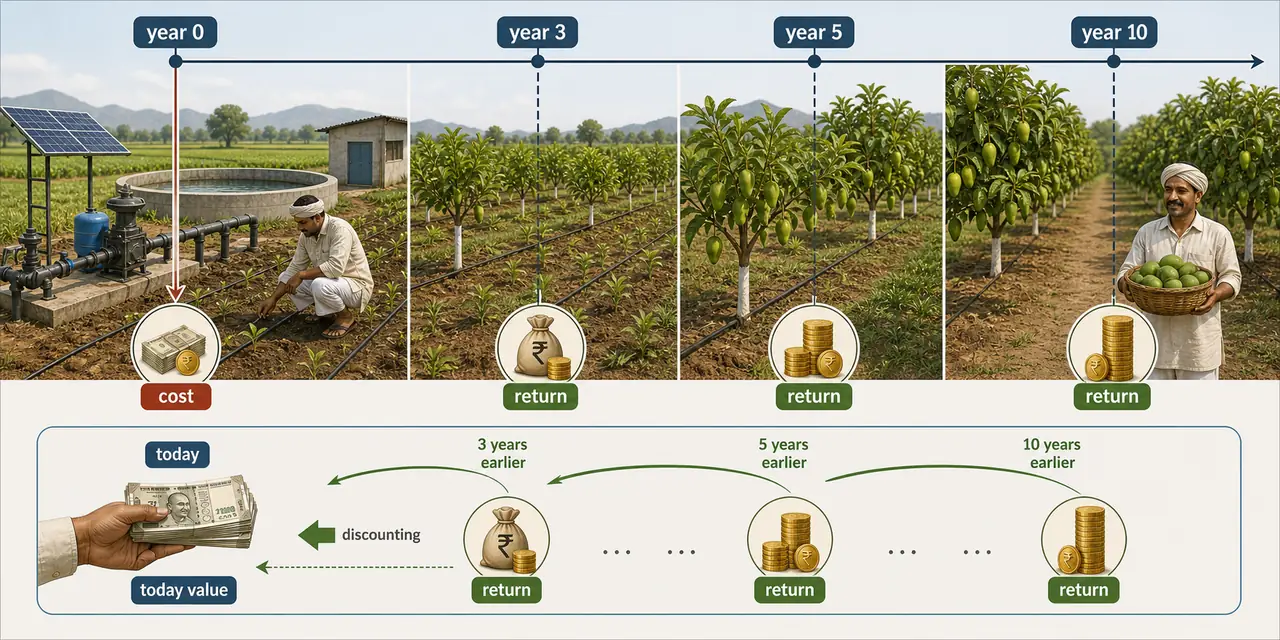
A farmer plants a mango orchard today. The trees will not bear fruit for 5-7 years, but the investment (land preparation, saplings, fencing, irrigation) must be made right now. Is it worth spending Rs 3,00,000 today to earn Rs 80,000 per year starting seven years later?
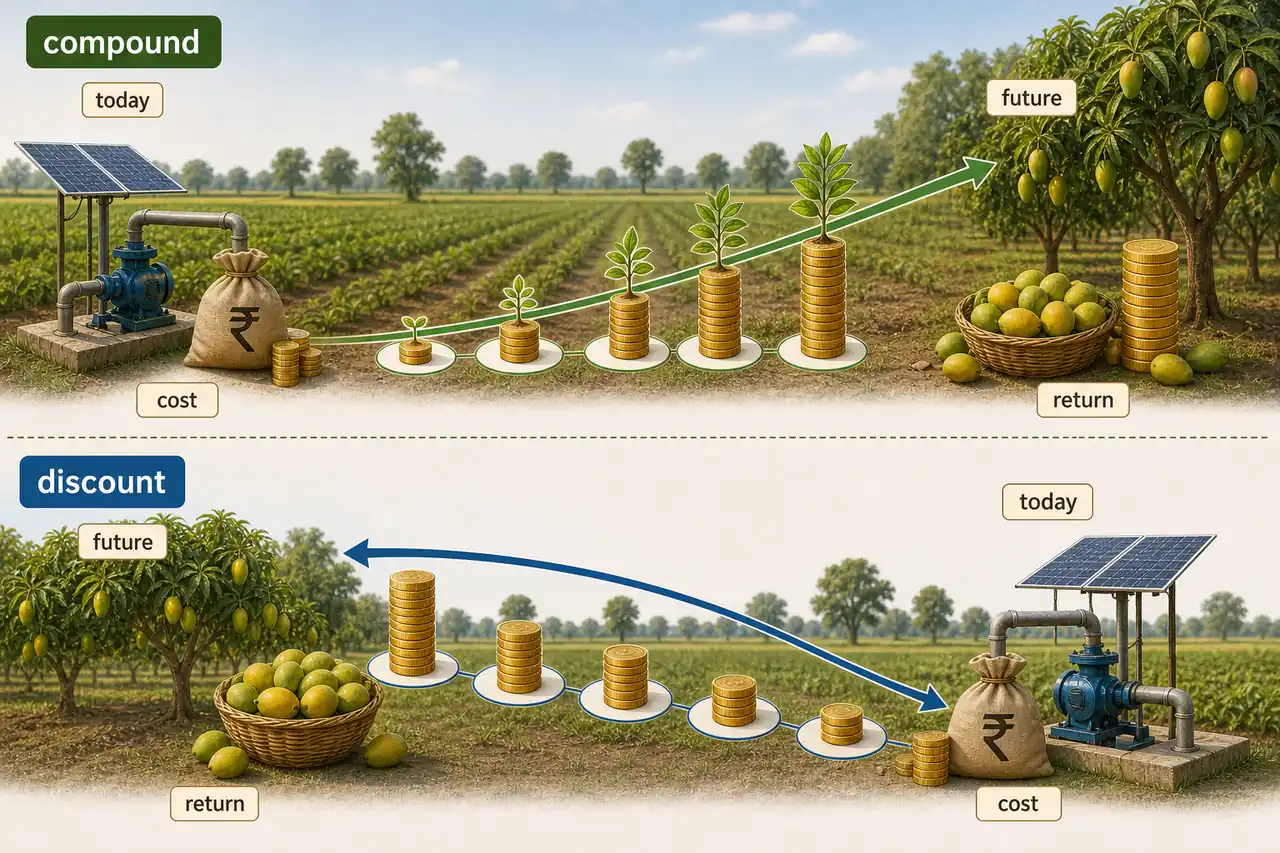
To answer such questions, we need to compare money at different points in time. This is the Time Comparison Principle — the foundation of all project appraisal in farm management.
IMPORTANT
Core idea: Rs 1,000 received today is worth MORE than Rs 1,000 received five years from now. Why? Because today's Rs 1,000 can be deposited in a bank and earn interest. This is called the time value of money.
Compounding (Present to Future)
Compounding answers the question: "If I invest a sum today, how much will it grow to in the future?"
Pro Content Locked
Upgrade to Pro to access this lesson and all other premium content.
₹99 charged monthly · Cancel anytime
- All Agriculture & Banking Courses
- AI Lesson Questions (100/day)
- AI Doubt Solver (50/day)
- Glows & Grows Feedback (30/day)
- AI Section Quiz (20/day)
- 22-Language Translation (100/day)
- Recall Questions (20/day)
- AI Quiz (15/day)
- AI Quiz Paper Analysis (100/day)
- AI Step-by-Step Explanations (100/day)
- Spaced Repetition Recall (FSRS)
- AI Tutor
- Immersive Text Questions
- Audio Lessons — Hindi & English
- Mock Tests & Previous Year Papers
- Summary & Mind Maps
- XP, Levels, Leaderboard & Badges
- Generate New Classrooms
- Voice AI Teacher (AgriDots Live)
- AI Revision Assistant
- Knowledge Gap Analysis
- Interactive Revision (LangGraph)
🔒 Secure via Razorpay · Cancel anytime · No hidden fees
Why Time Matters in Agriculture
A farmer plants a mango orchard today. The trees will not bear fruit for 5-7 years, but the investment (land preparation, saplings, fencing, irrigation) must be made right now. Is it worth spending Rs 3,00,000 today to earn Rs 80,000 per year starting seven years later?
To answer such questions, we need to compare money at different points in time. This is the Time Comparison Principle — the foundation of all project appraisal in farm management.
IMPORTANT
Core idea: Rs 1,000 received today is worth MORE than Rs 1,000 received five years from now. Why? Because today's Rs 1,000 can be deposited in a bank and earn interest. This is called the time value of money.
Compounding (Present to Future)
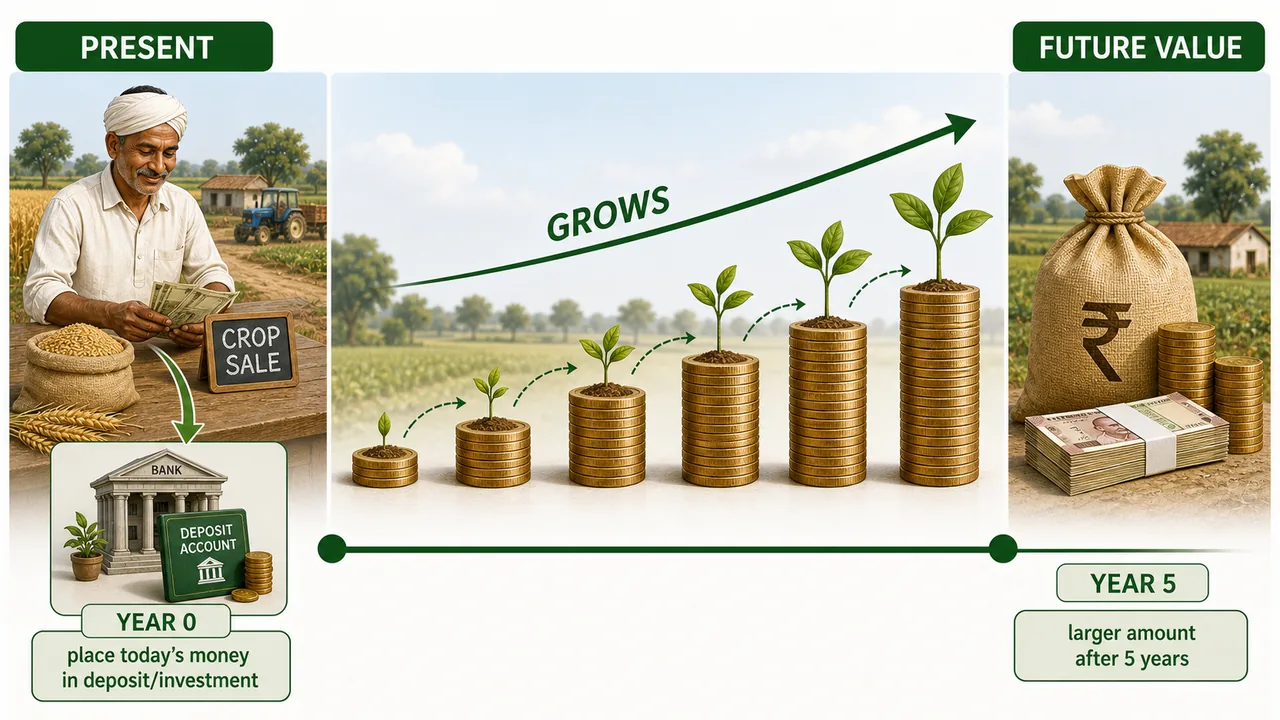
Compounding answers the question: "If I invest a sum today, how much will it grow to in the future?"
FV = P (1 + i)n
| Symbol | Meaning | Example |
|---|---|---|
| FV | Future Value | What the investment grows to |
| P | Present sum (principal) | Rs 50,000 invested today |
| i | Interest rate per period | 8% per year (0.08) |
| n | Number of periods | 5 years |
Agricultural Example
A farmer deposits Rs 50,000 from wheat sales into a fixed deposit at 8% annual interest for 5 years.
FV = 50,000 x (1 + 0.08)5 = 50,000 x 1.469 = Rs 73,466
After 5 years, the farmer's Rs 50,000 grows to Rs 73,466.
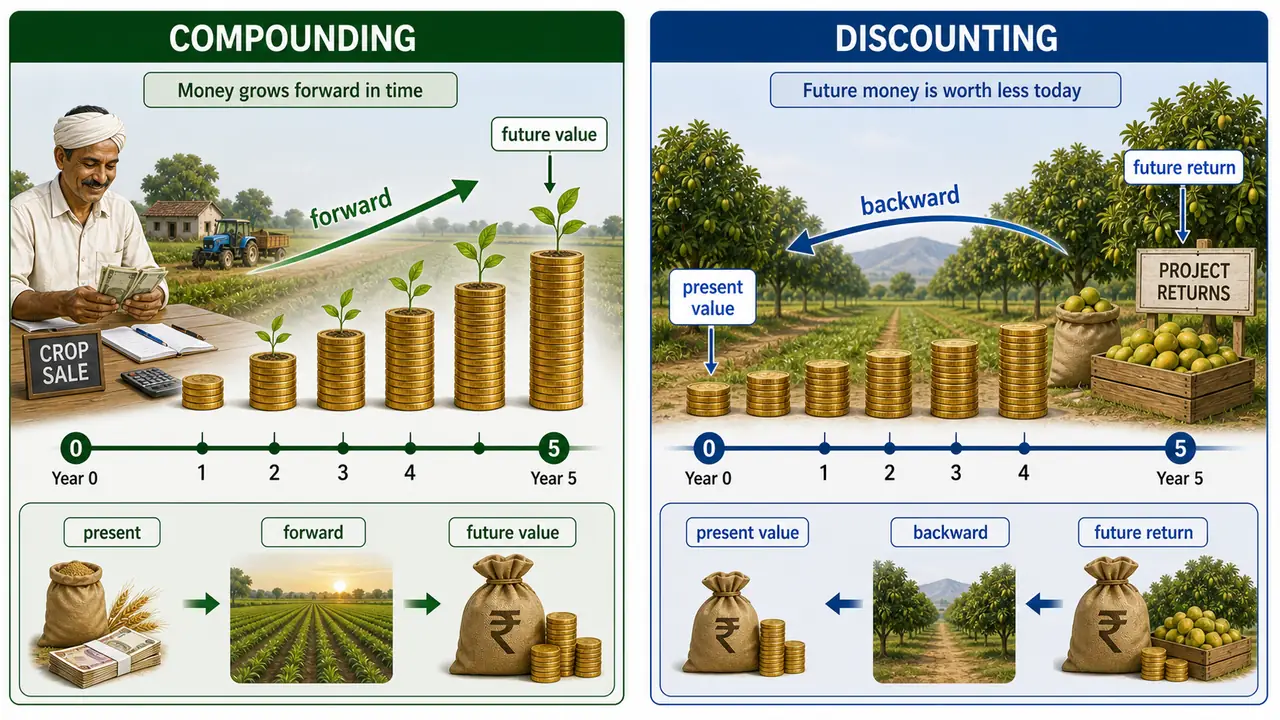
Compounding = Moving FORWARD in time (present to future)
Discounting (Future to Present)
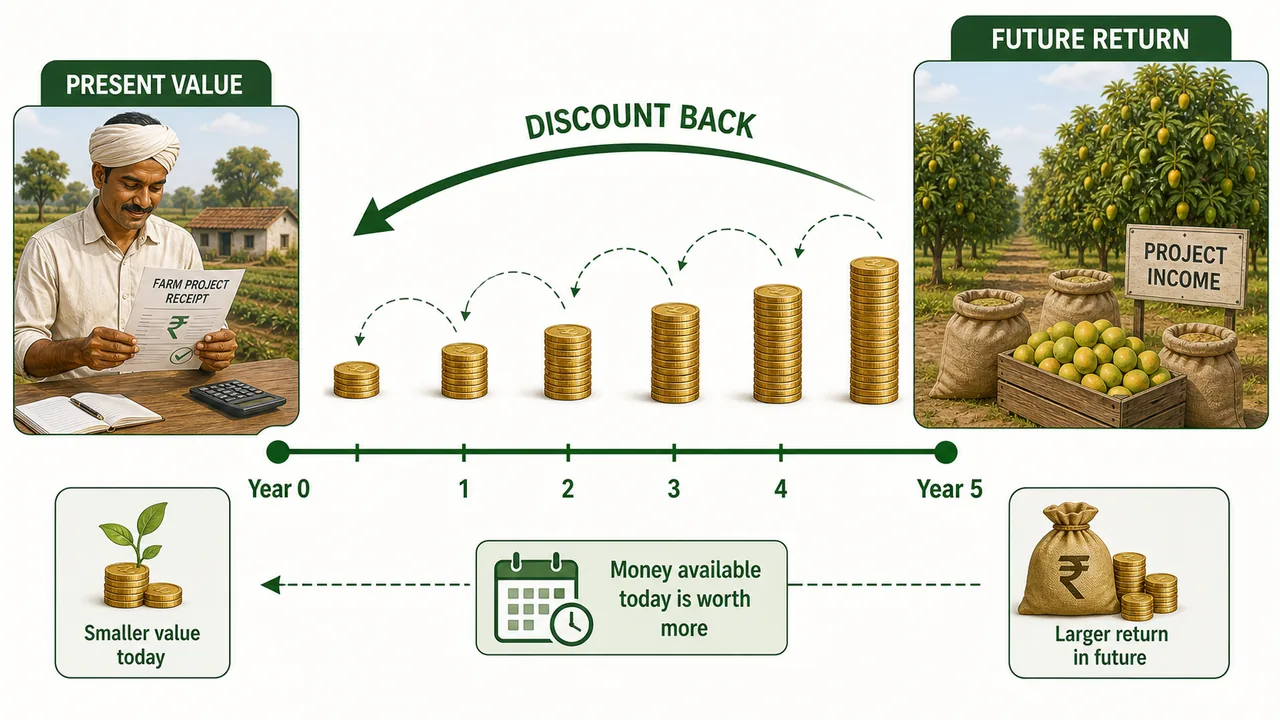
Discounting answers the reverse question: "What is a future sum worth in today's terms?"
PV = P / (1 + i)n
| Symbol | Meaning | Example |
|---|---|---|
| PV | Present Value | Today's equivalent of the future sum |
| P | Future sum | Rs 1,00,000 expected after 5 years |
| i | Discount rate (interest rate) | 10% per year (0.10) |
| n | Number of periods | 5 years |
Agricultural Example
A sericulture project promises to generate Rs 1,00,000 profit in Year 5. If the opportunity cost of capital is 10%, what is that future profit worth today?
PV = 1,00,000 / (1 + 0.10)5 = 1,00,000 / 1.6105 = Rs 62,092
That Rs 1,00,000 five years from now is worth only Rs 62,092 today.
Discounting = Moving BACKWARD in time (future to present)
Compounding vs Discounting: Side-by-Side
| Feature | Compounding | Discounting |
|---|---|---|
| Direction | Present to Future | Future to Present |
| Question answered | "How much will my money grow to?" | "What is future money worth today?" |
| Formula | FV = P (1 + i)n | PV = P / (1 + i)n |
| Used for | Savings, loan growth, deposit maturity | Project appraisal (NPW, BCR, IRR) |
| Agricultural use | Calculating maturity value of crop insurance premium | Evaluating whether a 10-year orchard investment is worthwhile |
| Effect of higher rate | Future value increases | Present value decreases |
| Effect of longer period | Future value increases | Present value decreases |
Why Discounting Matters for Farm Projects
Most agricultural projects have costs early and benefits late:
| Year | Drip Irrigation Project |
|---|---|
| Year 0 | Rs 4,00,000 investment (cost) |
| Year 1 | Rs 20,000 maintenance (cost) |
| Year 2 | Rs 80,000 net benefit |
| Year 3 | Rs 1,20,000 net benefit |
| Year 4 onwards | Rs 1,50,000 net benefit per year |
Without discounting, you would simply add up all benefits and compare with costs. But this ignores the fact that money spent today (Year 0) is more valuable than money earned in Year 4. Discounting corrects this by converting all future values to present worth before comparison.
This is exactly what project appraisal techniques like NPW (Net Present Worth), BCR (Benefit-Cost Ratio), and IRR (Internal Rate of Return) do.
Summary Cheat Sheet
| Concept / Topic | Key Details / Explanation |
|---|---|
| Time Value of Money | Rs 1,000 today is worth more than Rs 1,000 in the future because today's money can earn interest |
| Time Comparison Principle | Foundation of all project appraisal — compare money at different points in time |
| Compounding | Moving present to future: "How much will my money grow to?" |
| Compounding Formula | FV = P (1 + i)n where P = principal, i = interest rate, n = periods |
| Discounting | Moving future to present: "What is future money worth today?" |
| Discounting Formula | PV = P / (1 + i)n where P = future sum, i = discount rate, n = periods |
| Discount Factor | 1/(1+i)n — multiplier to convert any future value to present worth |
| Effect of Higher Rate | Compounding: FV increases. Discounting: PV decreases |
| Effect of Longer Period | Compounding: FV increases. Discounting: PV decreases |
| Compounding Use | Savings growth, loan repayment calculation, FD maturity value |
| Discounting Use | Project appraisal — NPW, BCR, IRR calculations |
| Why Discounting Matters | Most agri projects have costs early and benefits late; discounting corrects for time difference |
| NPW | Net Present Worth — PV of benefits minus PV of costs |
| BCR | Benefit-Cost Ratio — PV of benefits divided by PV of costs |
| IRR | Internal Rate of Return — discount rate where NPW = 0 |
| Mnemonic | "Come Forward, Discount Backward" — Compounding = Forward, Discounting = Backward |
Lesson Doubts
Ask questions, get expert answers