🏢 Forms of Business Organisation in Agriculture — From Sole Proprietorship to Cooperatives
Learn the five forms of business organisation relevant to Indian agriculture — sole proprietorship, Joint Hindu Family firm, partnership, joint-stock company, and cooperative society. Includes comparison tables, agricultural examples, legal details, and exam tips.
Most farms in India are run by a single farmer who owns the land, makes all decisions, and bears all profits and losses alone. This is a sole proprietorship — the simplest and most common form of business organisation in Indian agriculture. But as farming operations grow larger or require more capital, other forms of organisation become necessary. Understanding these forms is essential for farm management and frequently tested in competitive exams.
Why Business Organisation Matters in Agriculture
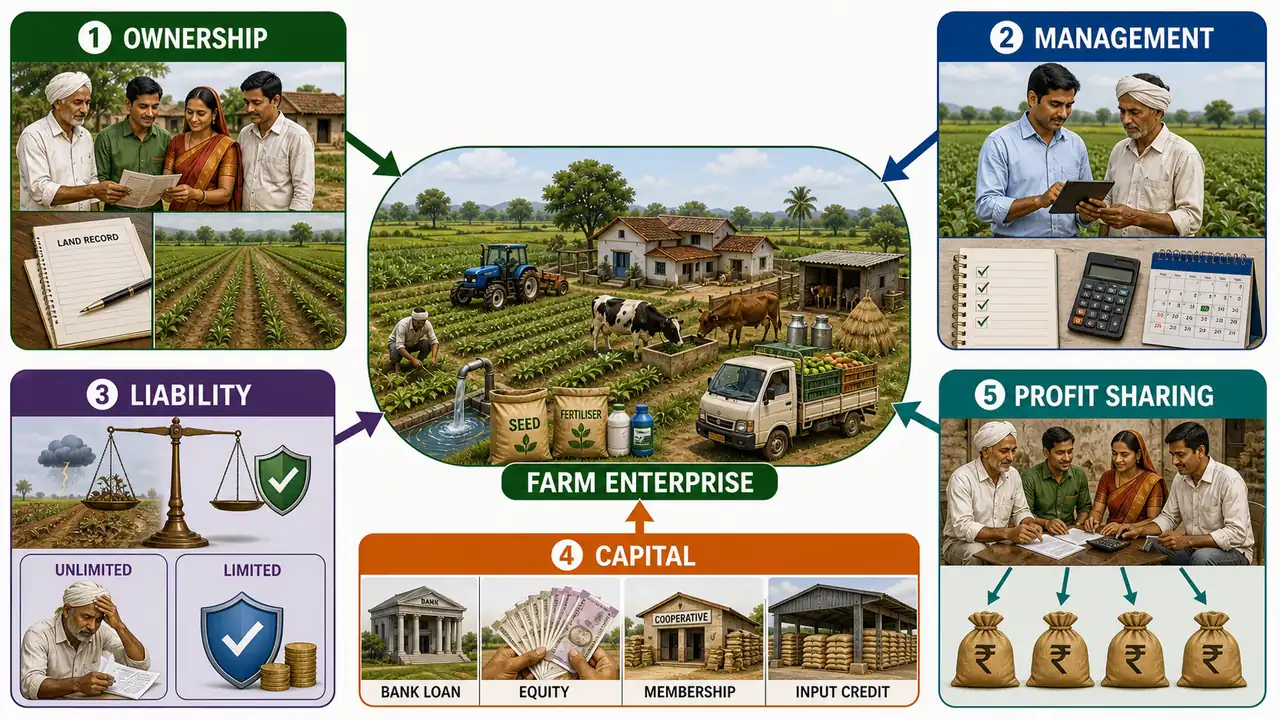
The form of business organisation determines:
- Who owns the farm or agri-business
- Who manages day-to-day operations
- Who bears the risk (liability)
- How capital is raised
- How profits are shared
Choosing the right form depends on the scale of operations, capital requirement, risk tolerance, and the number of people involved.
Pro Content Locked
Upgrade to Pro to access this lesson and all other premium content.
₹99 charged monthly · Cancel anytime
- All Agriculture & Banking Courses
- AI Lesson Questions (100/day)
- AI Doubt Solver (50/day)
- Glows & Grows Feedback (30/day)
- AI Section Quiz (20/day)
- 22-Language Translation (100/day)
- Recall Questions (20/day)
- AI Quiz (15/day)
- AI Quiz Paper Analysis (100/day)
- AI Step-by-Step Explanations (100/day)
- Spaced Repetition Recall (FSRS)
- AI Tutor
- Immersive Text Questions
- Audio Lessons — Hindi & English
- Mock Tests & Previous Year Papers
- Summary & Mind Maps
- XP, Levels, Leaderboard & Badges
- Generate New Classrooms
- Voice AI Teacher (AgriDots Live)
- AI Revision Assistant
- Knowledge Gap Analysis
- Interactive Revision (LangGraph)
🔒 Secure via Razorpay · Cancel anytime · No hidden fees
Most farms in India are run by a single farmer who owns the land, makes all decisions, and bears all profits and losses alone. This is a sole proprietorship — the simplest and most common form of business organisation in Indian agriculture. But as farming operations grow larger or require more capital, other forms of organisation become necessary. Understanding these forms is essential for farm management and frequently tested in competitive exams.
Why Business Organisation Matters in Agriculture
The form of business organisation determines:
- Who owns the farm or agri-business
- Who manages day-to-day operations
- Who bears the risk (liability)
- How capital is raised
- How profits are shared
Choosing the right form depends on the scale of operations, capital requirement, risk tolerance, and the number of people involved.
The Five Forms of Business Organisation
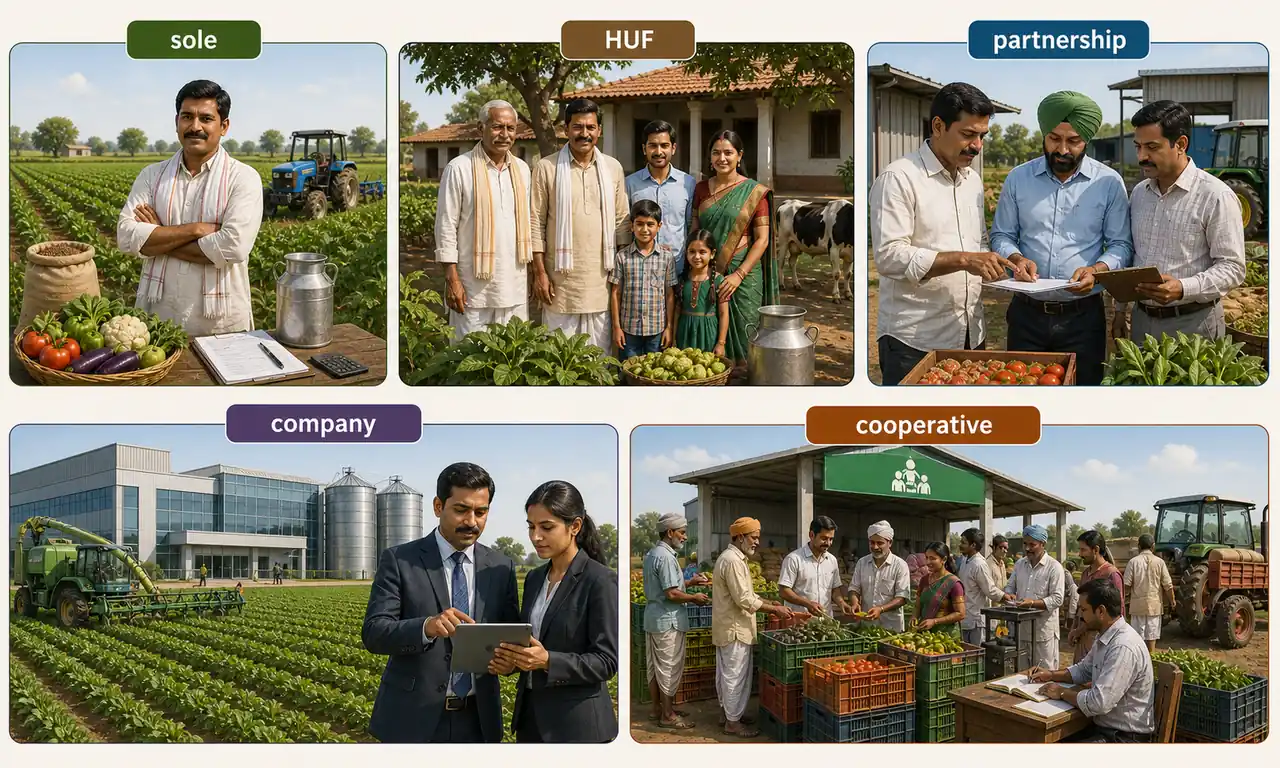
1. Sole Proprietorship (Individual Entrepreneur)
The simplest form — one person owns, manages, and controls the entire business.
Key features:
- Single owner who is also the manager
- Unlimited liability — the owner's personal assets can be used to settle business debts
- Easiest to start — no registration required in most cases
- All profits belong to the owner; all losses are borne by the owner alone
- Business ceases to exist on the death of the owner
Agricultural example: A marginal farmer in Bihar cultivating 1.5 hectares of paddy and wheat on his own land. He decides what to grow, arranges inputs, hires casual labour, sells the produce, and keeps all the profit. If the crop fails, he alone bears the loss.
Best suited for: Small and marginal farms, roadside nurseries, individual dairy units.
2. Joint Hindu Family Firm (HUF)
A unique form under Indian law where the business is owned by members of an undivided Hindu family.
Key features:
- Governed by Hindu Law (Mitakshara or Dayabhaga school)
- The eldest male member (or any senior member) acts as Karta (manager)
- Membership is by birth — every person born into the family automatically becomes a co-parcener
- Karta has unlimited liability; other members have liability limited to their share
- No registration required
- Continues even after the death of the Karta (next senior member takes over)
Agricultural example: A joint family in Haryana owns 20 hectares of agricultural land. The eldest brother (Karta) manages the farming operations — deciding crop rotation, purchasing inputs, marketing produce. All family members share in the income according to their ancestral share.
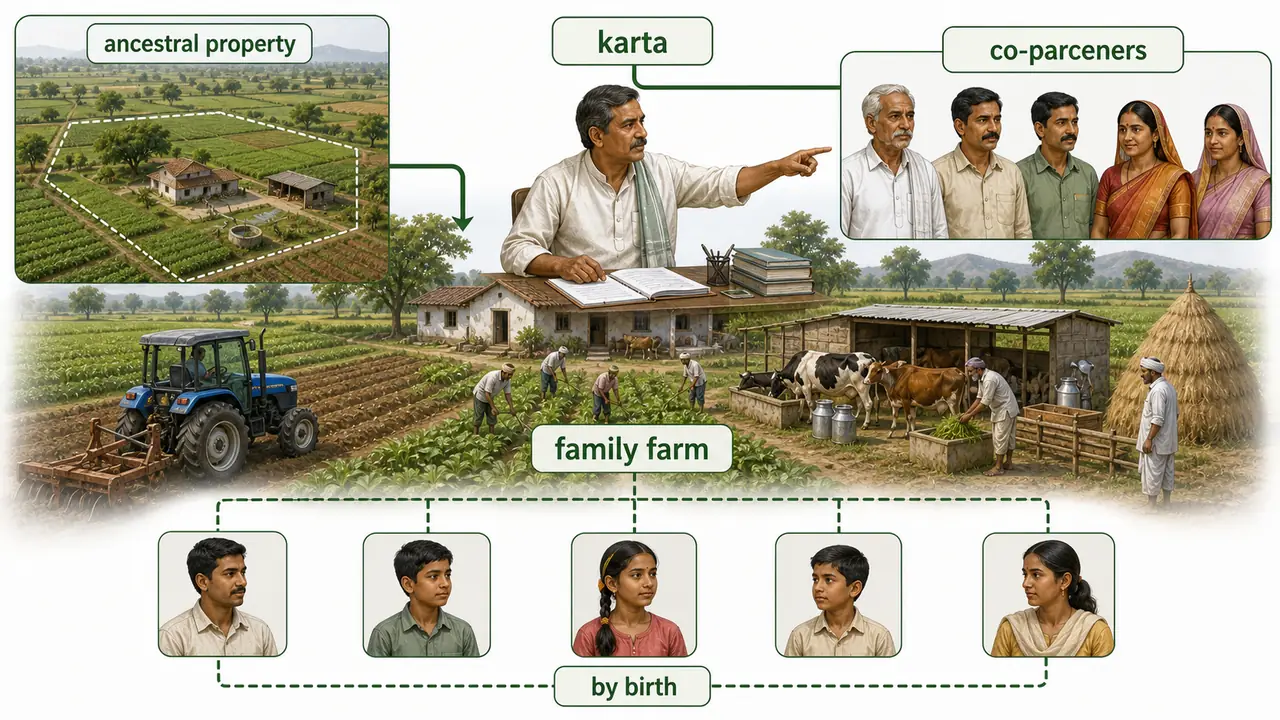
Best suited for: Traditional family farms where land is jointly held across generations.
3. Partnership Firm
Two or more persons agree to share profits and losses of a business carried on by all or any of them acting for all.
Key features:
- Governed by the Indian Partnership Act, 1932
- Minimum 2 members, maximum 50 members
- Partners share profits/losses as per the partnership deed (agreement)
- Each partner can act as an agent of the firm
- Unlimited liability for all partners (unless specifically limited in the deed)
- Registration is optional but advisable for legal protection
Agricultural example: Three progressive farmers in Maharashtra pool their resources to set up a grape cold storage and export unit. One contributes land, another contributes capital, and the third manages daily operations. Profits are shared in the ratio agreed upon (e.g., 40:30:30).
Best suited for: Medium-scale agri-businesses — cold storages, processing units, custom hiring centres, seed production units.
4. Joint-Stock Company
A company with separate legal identity from its members (shareholders). The word 'Limited' (Ltd.) or 'Private Limited (Pvt. Ltd.)' appears after the company name.
Key features:
- Governed by the Companies Act, 2013
- Separate legal entity — can own property, sue, and be sued in its own name
- Limited liability — shareholders' liability is limited to the face value of shares held
- Ownership and management are separated — shareholders own, Board of Directors manages
- Perpetual existence — not affected by death or exit of any member
- Two types:
| Type | Minimum Members | Maximum Members | Share Transfer |
|---|---|---|---|
| Private Limited (Pvt. Ltd.) | 2 | 200 | Restricted (cannot sell to public) |
| Public Limited (Ltd.) | 7 | No maximum limit | Free (can be listed on stock exchange) |
Agricultural examples:
- Private Limited: A family-owned rice mill registered as "XYZ Agro Pvt. Ltd." with 5 family members as shareholders.
- Public Limited: IFFCO (Indian Farmers Fertiliser Cooperative — though structured as a cooperative, companies like Rallis India Ltd. or UPL Ltd. are public limited companies in the agri-input sector).
Best suited for: Large-scale agri-businesses — food processing companies, fertilizer manufacturers, seed companies, agri-tech startups seeking investor funding.
5. Cooperative Society
A voluntary association of individuals who come together to achieve common economic objectives through a jointly owned and democratically managed enterprise.
Key features:
- Governed by the Cooperative Societies Act (state-level) or Multi-State Cooperative Societies Act, 2002 (central)
- Established on principles of cooperation — self-help, mutual aid, democratic control
- One member, one vote — irrespective of the number of shares held (unlike companies where voting power depends on shareholding)
- Limited liability for members
- Minimum 10 members required for registration
- Profits are distributed as dividends proportional to shares, or used for common benefit
Agricultural examples:
- Primary Agricultural Credit Societies (PACS) — village-level cooperative providing crop loans
- District Central Cooperative Banks (DCCBs) — provide refinance to PACS
- NAFED (National Agricultural Cooperative Marketing Federation) — marketing of agricultural produce
- IFFCO (Indian Farmers Fertiliser Cooperative) — fertilizer production and distribution
- KRIBHCO (Krishak Bharati Cooperative) — fertilizer cooperative
- Amul (GCMMF) — dairy cooperative (Gujarat Cooperative Milk Marketing Federation)
- Village-level dairy cooperatives under Operation Flood
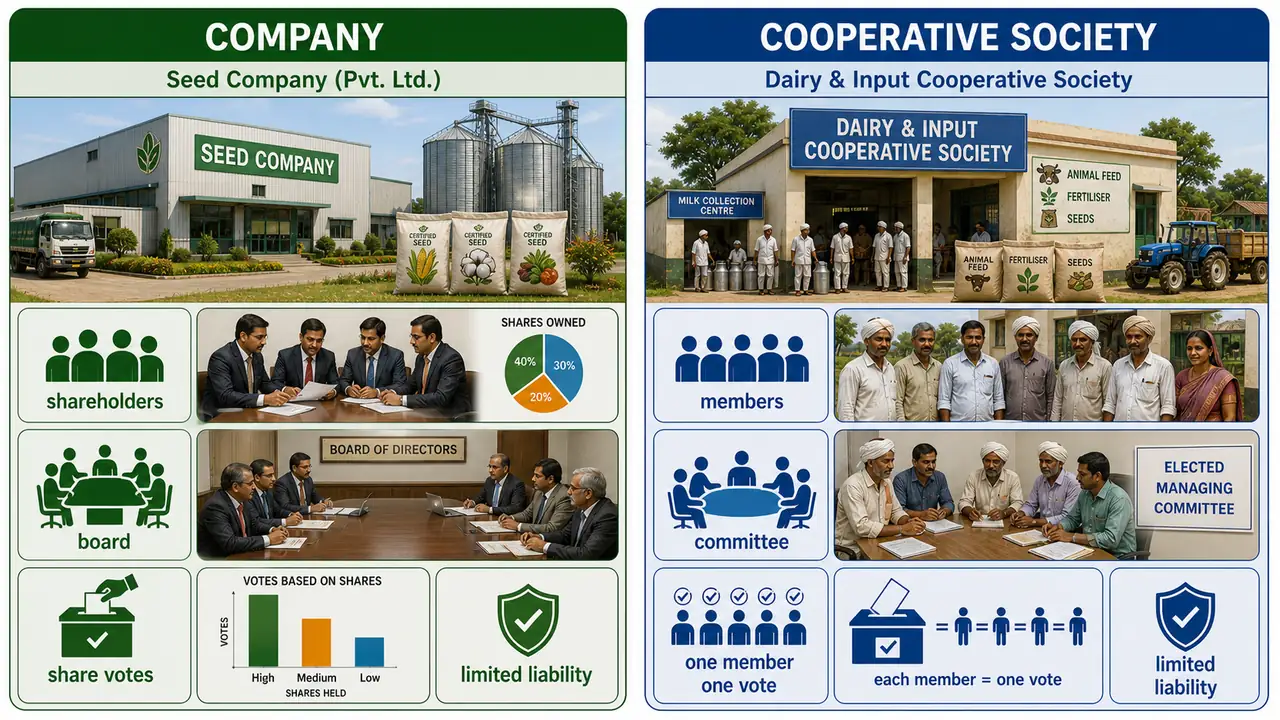
Best suited for: Agricultural marketing, credit, dairy, input supply, and processing — especially for small and marginal farmers who individually lack bargaining power.
NOTE
For agricultural competitive exams, cooperative societies are the most important form. PACS, DCCBs, NAFED, IFFCO, KRIBHCO, and Amul are all cooperative organisations that appear repeatedly in exam questions.
Comparison of All Five Forms
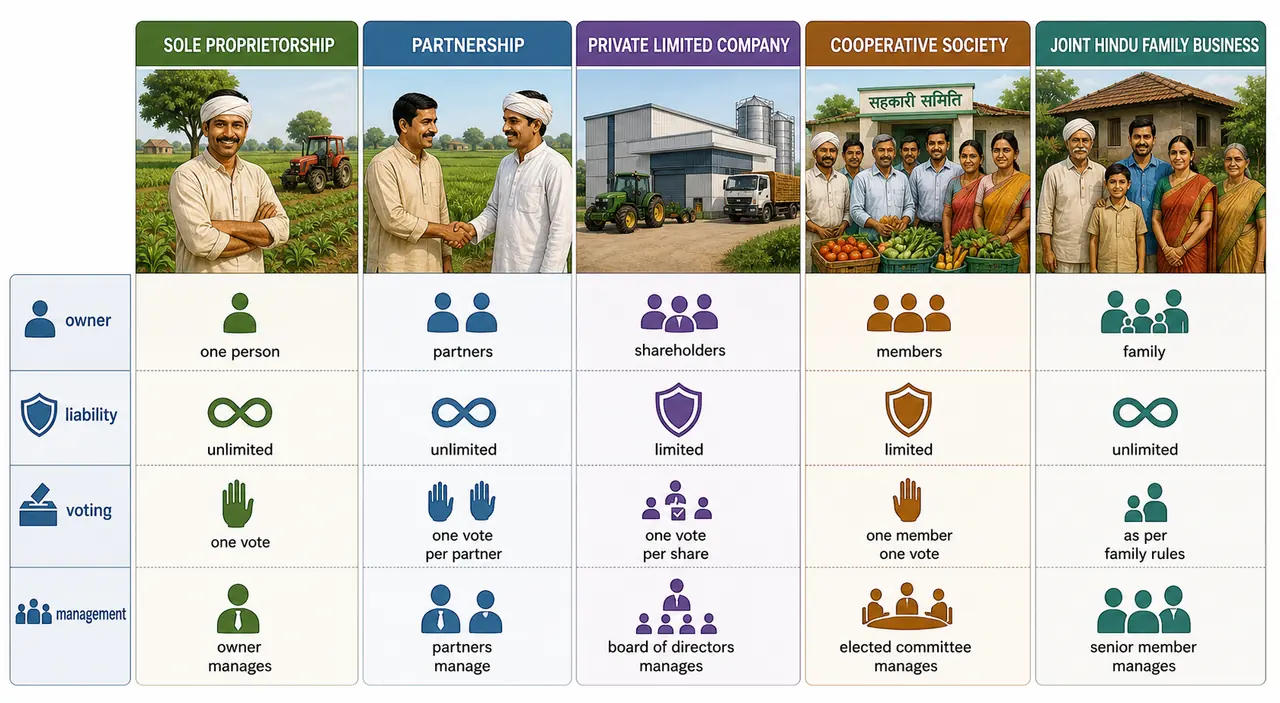
| Feature | Sole Proprietorship | Joint Hindu Family | Partnership | Joint-Stock Company | Cooperative Society |
|---|---|---|---|---|---|
| Governing law | None specific | Hindu Law | Partnership Act, 1932 | Companies Act, 2013 | Cooperative Societies Act |
| Minimum members | 1 | 2 (family members) | 2 | 2 (Pvt.) / 7 (Public) | 10 |
| Maximum members | 1 | No limit (family) | 50 | 200 (Pvt.) / No limit (Public) | No limit |
| Liability | Unlimited | Unlimited for Karta; limited for others | Unlimited | Limited to share value | Limited |
| Management | Owner | Karta | All partners or designated partners | Board of Directors | Elected managing committee |
| Voting | Owner decides | Karta decides | As per deed | Proportional to shares | One member, one vote |
| Registration | Not required | Not required | Optional | Mandatory | Mandatory |
| Continuity | Ends with owner | Continues (next Karta) | Ends on death/exit of partner (unless agreed otherwise) | Perpetual | Perpetual |
| Capital raising | Limited (personal funds) | Family resources | Partners' contributions | Shares sold to public/investors | Member shares + government aid |
| Agri example | Small family farm | Joint family farm | Cold storage by 3 farmers | Seed company (Pvt. Ltd.) | PACS, Amul, IFFCO |
Exam Tip — Mnemonic: Remember the five forms in order of increasing complexity: "S-J-P-C-Co" — Sole, Joint Hindu Family, Partnership, Company, Cooperative. Think: "Simple Joints Produce Company Cooperation."
Summary Cheat Sheet
| Concept / Topic | Key Details / Explanation |
|---|---|
| Sole Proprietorship | One owner, unlimited liability, simplest form, most common in Indian farming; no registration required |
| Joint Hindu Family (HUF) | Governed by Hindu Law; Karta (eldest member) manages; membership by birth; Karta has unlimited liability |
| Partnership Firm | 2-50 members; governed by Indian Partnership Act, 1932; unlimited liability; profit sharing by deed |
| Private Limited Company | 2-200 members; governed by Companies Act, 2013; limited liability; restricted share transfer |
| Public Limited Company | Minimum 7 members, no maximum; shares freely transferable; can list on stock exchange |
| Cooperative Society | Voluntary association; one member, one vote; governed by Cooperative Societies Act; minimum 10 members |
| Unlimited Liability | Owner's personal assets can be used to settle business debts (Sole Proprietorship, Partnership, Karta in HUF) |
| Limited Liability | Liability limited to face value of shares held (Companies, Cooperatives) |
| Separate Legal Entity | Company can own property, sue, be sued in its own name; exists independent of members |
| Perpetual Existence | Not affected by death/exit of any member (Companies and Cooperatives) |
| PACS | Primary Agricultural Credit Societies — village-level cooperative providing crop loans |
| NAFED | National Agricultural Cooperative Marketing Federation — marketing of agricultural produce |
| IFFCO | Indian Farmers Fertiliser Cooperative — fertilizer production and distribution |
| KRIBHCO | Krishak Bharati Cooperative — fertilizer cooperative |
| Amul (GCMMF) | Gujarat Cooperative Milk Marketing Federation — dairy cooperative under Operation Flood |
| Registration | Not required: Sole Proprietorship, HUF. Optional: Partnership. Mandatory: Company, Cooperative |
| Voting Rights | Companies: proportional to shares. Cooperatives: one member, one vote regardless of shares |
| Order of Complexity | S-J-P-C-Co: Sole, Joint Hindu Family, Partnership, Company, Cooperative |
| Capital Raising | Sole: personal funds. HUF: family. Partnership: partners. Company: shares/investors. Cooperative: member shares + govt aid |
| Most Exam-Important | Cooperative societies — PACS, DCCBs, NAFED, IFFCO, KRIBHCO, Amul appear repeatedly |
Lesson Doubts
Ask questions, get expert answers