💧 Hydroponic Fodder Production for Mini Dairy Units — NABARD
NABARD model for a 40-kg/day hydroponic fodder unit costing ₹55,000 with 0% margin money (full bank loan), 5-year repayment, BCR 1.06, and IRR 54.51%. Covers soilless cultivation technology, maize fodder economics, and incremental milk yield benefits for exams.
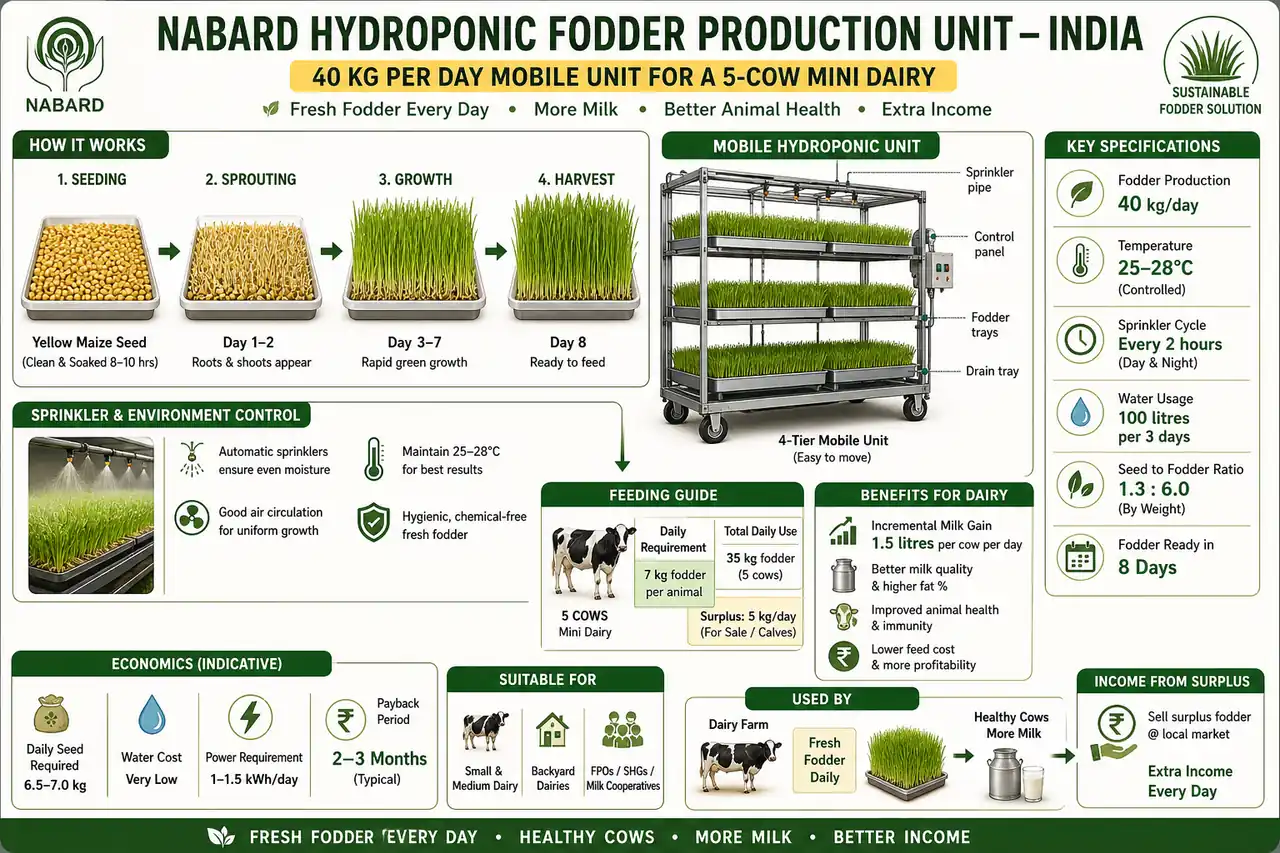
India faces a severe fodder deficit — 23.40% shortage of dry fodder, 11.24% green fodder, and 28.90% concentrates (ICAR-IGFRI, 2019). Hydroponics produces green fodder without soil, in just 8 days for maize, using only 100 litres of water per 3 days — a technology that directly addresses both land scarcity and water shortage.
- Green fodder cost is 30–35% of total milk production cost
- Seed-to-fodder ratio for maize: 1.3:6.0 (1.3 kg seed → 6 kg fodder)
- Incremental milk yield from hydroponic fodder: 1.5 litres/day/cow
Project Overview
The TANUVAS-designed unit produces 40 kg fodder/day for a 5-cow mini dairy unit. The semi-automatic device operates at 25–28°C with air cooler, exhaust fan, and LED lights. Sprinklers run every 2 hours. The unit requires only 25 sq ft and is mounted on wheels for portability.
Pro Content Locked
Upgrade to Pro to access this lesson and all other premium content.
₹99 charged monthly · Cancel anytime
- All Agriculture & Banking Courses
- AI Lesson Questions (100/day)
- AI Doubt Solver (50/day)
- Glows & Grows Feedback (30/day)
- AI Section Quiz (20/day)
- 22-Language Translation (100/day)
- Recall Questions (20/day)
- AI Quiz (15/day)
- AI Quiz Paper Analysis (100/day)
- AI Step-by-Step Explanations (100/day)
- Spaced Repetition Recall (FSRS)
- AI Tutor
- Immersive Text Questions
- Audio Lessons — Hindi & English
- Mock Tests & Previous Year Papers
- Summary & Mind Maps
- XP, Levels, Leaderboard & Badges
- Generate New Classrooms
- Voice AI Teacher (AgriDots Live)
- AI Revision Assistant
- Knowledge Gap Analysis
- Interactive Revision (LangGraph)
🔒 Secure via Razorpay · Cancel anytime · No hidden fees
India faces a severe fodder deficit — 23.40% shortage of dry fodder, 11.24% green fodder, and 28.90% concentrates (ICAR-IGFRI, 2019). Hydroponics produces green fodder without soil, in just 8 days for maize, using only 100 litres of water per 3 days — a technology that directly addresses both land scarcity and water shortage.
- Green fodder cost is 30–35% of total milk production cost
- Seed-to-fodder ratio for maize: 1.3:6.0 (1.3 kg seed → 6 kg fodder)
- Incremental milk yield from hydroponic fodder: 1.5 litres/day/cow
Project Overview
The TANUVAS-designed unit produces 40 kg fodder/day for a 5-cow mini dairy unit. The semi-automatic device operates at 25–28°C with air cooler, exhaust fan, and LED lights. Sprinklers run every 2 hours. The unit requires only 25 sq ft and is mounted on wheels for portability.
A key feature: hydroponics is added to an existing mini dairy in its second year, so the model assumes the lactation income is the incremental benefit from the additional fodder feeding.
Financial Structure
| Component | Amount (Rs.) |
|---|---|
| Hydroponic unit (40 kg/day capacity) | 48,000 |
| GST @ 12% | 5,760 |
| Transportation & installation | 1,000 |
| Miscellaneous | 240 |
| Total Cost | 55,000 |
| Margin Money | 0 (NIL) |
| Bank Loan (100%) | 55,000 |
NOTE
This is the only NABARD model with 0% margin money. As per RBI guidelines, projects below ₹1 lakh do not require margin money. This makes hydroponics uniquely accessible to the poorest farmers.
Technical Parameters
| Parameter | Value |
|---|---|
| Fodder production | 40 kg/day |
| Primary seed | Yellow Maize |
| Seed requirement/day | 8.66 kg |
| Seed-to-fodder ratio | 1.3:6.0 |
| Growth period | 8 days |
| Water requirement | 100 litres per 3 days |
| Maize seed cost | ₹18/kg |
| Fodder per animal/day | 7 kg (for 5 animals) + 5 kg sold |
| Sale price of surplus fodder | ₹6/kg |
| Incremental milk yield | 1.5 litres/cow/day |
| Milk price | ₹42/litre |
| Depreciation | 20% per annum (straight line) |
| Repayment period | 5 years |
| Interest rate | 12% per annum |
Other seeds used: Bajra, Horse gram, Jowar, Minor Millets, Moth bean, Ragi, Sun Hemp. Yellow Maize is preferred because it has the lowest cost of production (₹3.00/kg) and highest seed-to-fodder ratio.
NOTE
Exam trap: The hydroponics model is added in the 2nd year of the mini dairy operation. Year 1 of the hydroponics cashflow corresponds to Year 2 of the dairy unit. Income calculations must reflect this staggered start.
Income & Repayment
| Year | Total Income (Rs.) | Total Cost (Rs.) | Gross Surplus (Rs.) |
|---|---|---|---|
| 1 | 1,04,060 | 1,33,376 | 25,684 |
| 2 | 1,04,060 | 80,876 | 23,184 |
| 3 | 98,390 | 80,876 | 17,514 |
Annual income = Incremental milk income (₹89,460) + Surplus fodder sales (₹14,600) = ₹1,04,060
- BCR: 1.064:1 at 15% discount factor
- NPW: ₹20,254
- IRR: 54.51%
The 54.51% IRR, despite a BCR of only 1.06, reflects the very low initial investment. The government is encouraged to provide subsidy to accelerate adoption — some state governments already supply hydroponic units at subsidised rates.
Sources & References
Primary source for this lesson is NABARD's official Model Bankable Projects portal.[1] Lesson-specific report copy used for this topic.[2]
References
2 sources • [1] [2]
References
Used for: Official NABARD portal for model bankable project documents and updates.
Used for: Reference copy used in this lesson for project parameters and worked figures.
The figures in this lesson reflect the cost norms and technical parameters as published in the NABARD document. Actual costs may vary by state, season, and year of implementation. Always refer to the latest NABARD circular for current norms.
Summary Cheat Sheet
| Concept / Topic | Key Details / Explanation |
|---|---|
| Unit size | 40 kg fodder/day for a 5-cow mini dairy |
| Total Cost | ₹55,000 |
| Margin Money | 0% (NIL) — only NABARD model with zero margin; RBI norm: no margin below ₹1 lakh |
| Bank Loan | 100% = ₹55,000 |
| Primary seed | Yellow Maize (lowest production cost ₹3/kg, highest seed-to-fodder ratio) |
| Seed-to-fodder ratio | 1.3:6.0 (1.3 kg seed → 6 kg fodder) |
| Seed requirement/day | 8.66 kg |
| Growth period | 8 days (maize) |
| Water requirement | 100 litres per 3 days |
| Maize seed cost | ₹18/kg |
| Unit space | 25 sq ft (mounted on wheels, portable) |
| Operating temperature | 25–28°C (air cooler + exhaust fan + LED lights) |
| Sprinkler cycle | Every 2 hours |
| Fodder per animal/day | 7 kg for 5 animals; 5 kg surplus sold at ₹6/kg |
| Incremental milk yield | 1.5 litres/cow/day |
| Milk price | ₹42/litre |
| Annual income | Incremental milk ₹89,460 + surplus fodder ₹14,600 = ₹1,04,060 |
| Depreciation | 20% per annum (straight line) |
| Interest rate | 12% per annum |
| Repayment period | 5 years |
| BCR | 1.064:1 at 15% discount factor |
| NPW | ₹20,254 |
| IRR | 54.51% |
| India fodder deficit | Dry: 23.40%; Green: 11.24%; Concentrates: 28.90% (ICAR-IGFRI, 2019) |
| Model timing | Added in 2nd year of existing mini dairy — Year 1 cashflow = Year 2 of dairy |
| Other seeds usable | Bajra, Horse gram, Jowar, Minor Millets, Moth bean, Ragi, Sun Hemp |
| Designed by | TANUVAS (Tamil Nadu Veterinary and Animal Sciences University) |
Lesson Doubts
Ask questions, get expert answers