🌿 Moringa Cultivation for Goat Feed — NABARD Model
NABARD model for 1 hectare moringa cultivation with total cost of ₹9.15 lakh, 10% margin money, 5-year repayment (1-year grace), BCR 1.48, and IRR 127%. Covers PKM-1 variety, 650 MT/ha biomass, pellet production, and integration with stall-fed goat rearing for exams.
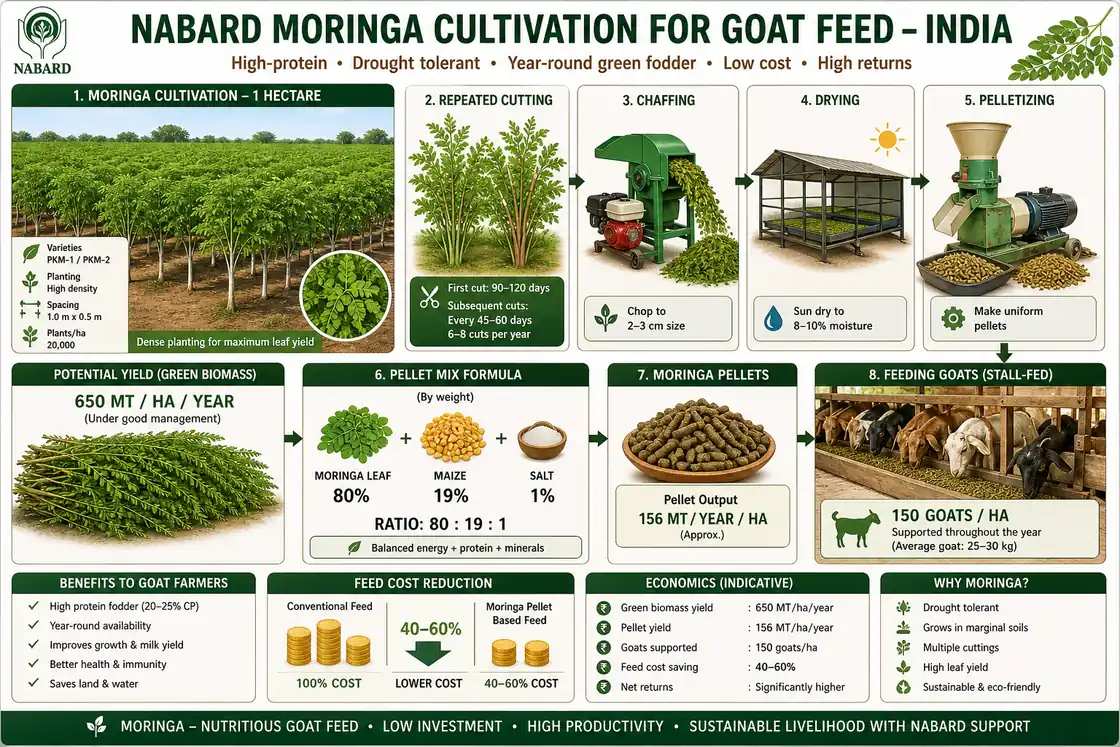
Moringa (drumstick tree) produces the highest biomass of any fodder crop — 650 MT/ha/year versus 350 MT for Napier grass and just 55 MT for Sorghum. With 28.9% crude protein in leaves and 92% digestibility, it is the ideal high-protein, low-cost feed for stall-fed goats. Feed cost is the single biggest determinant of goat farm viability.
- Country faces: 35.6% green fodder deficit, 10.95% dry fodder, 44% concentrate deficit
- Moringa vs conventional protein supplements: outperforms coconut meal, cotton seed cake, groundnut cake
- One planting lasts 8–10 years
Project Overview
The model covers 1 hectare of Moringa cultivation using PKM-1/PKM-2 variety (Tamil Nadu Agricultural University) at 30 cm × 30 cm spacing — accommodating 1.11 lakh plants per ha. Green biomass is harvested, chaffed, sun-dried, and mixed with maize and salt (ratio 80:19:1) to produce pellets.
Pro Content Locked
Upgrade to Pro to access this lesson and all other premium content.
₹99 charged monthly · Cancel anytime
- All Agriculture & Banking Courses
- AI Lesson Questions (100/day)
- AI Doubt Solver (50/day)
- Glows & Grows Feedback (30/day)
- AI Section Quiz (20/day)
- 22-Language Translation (100/day)
- Recall Questions (20/day)
- AI Quiz (15/day)
- AI Quiz Paper Analysis (100/day)
- AI Step-by-Step Explanations (100/day)
- Spaced Repetition Recall (FSRS)
- AI Tutor
- Immersive Text Questions
- Audio Lessons — Hindi & English
- Mock Tests & Previous Year Papers
- Summary & Mind Maps
- XP, Levels, Leaderboard & Badges
- Generate New Classrooms
- Voice AI Teacher (AgriDots Live)
- AI Revision Assistant
- Knowledge Gap Analysis
- Interactive Revision (LangGraph)
🔒 Secure via Razorpay · Cancel anytime · No hidden fees
Moringa (drumstick tree) produces the highest biomass of any fodder crop — 650 MT/ha/year versus 350 MT for Napier grass and just 55 MT for Sorghum. With 28.9% crude protein in leaves and 92% digestibility, it is the ideal high-protein, low-cost feed for stall-fed goats. Feed cost is the single biggest determinant of goat farm viability.
- Country faces: 35.6% green fodder deficit, 10.95% dry fodder, 44% concentrate deficit
- Moringa vs conventional protein supplements: outperforms coconut meal, cotton seed cake, groundnut cake
- One planting lasts 8–10 years
Project Overview
The model covers 1 hectare of Moringa cultivation using PKM-1/PKM-2 variety (Tamil Nadu Agricultural University) at 30 cm × 30 cm spacing — accommodating 1.11 lakh plants per ha. Green biomass is harvested, chaffed, sun-dried, and mixed with maize and salt (ratio 80:19:1) to produce pellets.
With 1 ha of Moringa, a farmer can support: 150 Sirohi/Jamnapari goats or 200 Barbari goats. FCR with Moringa pellets is 8.76:1 vs 11.1:1 with conventional feed.
Financial Structure
| Component | Amount (Rs.) |
|---|---|
| Land prep, layout, live fencing | 16,000 |
| Planting material (40 kg seeds @ ₹3,000/kg) | 1,20,000 |
| Drip irrigation system | 1,00,000 |
| Chaff cutter | 20,000 |
| Pelletizer | 3,00,000 |
| Annual maintenance (manures, fertilizers, harvesting, processing) | 3,56,225 |
| Total First Year Cost | 9,14,725 |
| Margin Money (10%) | 91,473 |
| Bank Loan (90%) | 8,23,253 |
NOTE
The pelletizer cost alone is ₹3,00,000 — the single biggest capital item. Drip irrigation is replaced in Year 5 (₹1,00,000), which temporarily reduces surplus in that year. Both items are exam traps.
Technical Parameters
| Parameter | Value |
|---|---|
| Unit | 1 hectare |
| Variety | PKM-1, PKM-2 (TNAU) |
| Spacing | 30 cm × 30 cm |
| Plant population | 1.11 lakh/ha |
| Seed requirement | 40 kg/ha |
| Seed cost | ₹3,000/kg (PKM-1 from TNAU) |
| Cuttings/year | 6 (North India); 8 in South India |
| Green biomass | 650 MT/ha/year |
| Dry biomass | 130 MT/ha/year |
| Feed pellets | 156 MT/ha/year |
| Sale price of pellets | ₹4,500/MT |
| Pellet composition | Moringa:Maize:Salt = 80:19:1 |
| Shelf life of pellets | >6 months |
| Economic life | 8 years |
| Interest rate | 13% per annum |
NOTE
First harvest is at 90 days after sowing, then every 45 days. In North India, no cutting from Dec 15 to Mar 15 (leaf shedding in winter). South India allows continuous cutting — 8 cuttings/year vs 6 in North India.
Income & Repayment
Annual income (all years): 156 MT pellets × ₹4,500/MT = ₹7,02,000
| Year | Surplus (Rs.) | Principal Repayment | Net Surplus |
|---|---|---|---|
| 1 | -2,12,725 | 0 (grace) | -3,19,748 |
| 2 | 3,45,775 | 2,00,000 | 38,752 |
| 3 | 3,45,775 | 2,00,000 | 64,752 |
| 4 | 3,45,775 | 2,20,000 | 70,752 |
| 5 | 2,45,775 | 2,03,253 | 16,100 |
- Repayment period: 5 years including 1-year grace period
- BCR: 1.48:1
- NPW: ₹10,16,234
- IRR: 127% — extraordinarily high due to very low annual recurring costs after Year 1 investment
Moringa reduces goat feed cost by 25% and increases milk yield by 20% (field studies). This combination of fodder production + stall-fed goat integration is NABARD's model for converting degraded/low-fertility land into highly productive enterprise.
Sources & References
Primary source for this lesson is NABARD's official Model Bankable Projects portal.[1] Lesson-specific report copy used for this topic.[2]
References
2 sources • [1] [2]
References
Used for: Official NABARD portal for model bankable project documents and updates.
Used for: Reference copy used in this lesson for project parameters and worked figures.
The figures in this lesson reflect the cost norms and technical parameters as published in the NABARD document. Actual costs may vary by state, season, and year of implementation. Always refer to the latest NABARD circular for current norms.
Summary Cheat Sheet
| Concept / Topic | Key Details / Explanation |
|---|---|
| Unit size | 1 hectare moringa cultivation |
| Variety | PKM-1, PKM-2 (Tamil Nadu Agricultural University) |
| Spacing | 30 cm × 30 cm |
| Plant population | 1.11 lakh plants/ha |
| Seed requirement | 40 kg/ha |
| Seed cost | ₹3,000/kg (PKM-1 from TNAU) |
| Total First Year Cost | ₹9,14,725 |
| Margin Money | 10% = ₹91,473 |
| Bank Loan | 90% = ₹8,23,253 |
| Biggest capital item | Pelletizer: ₹3,00,000 |
| Green biomass | 650 MT/ha/year (highest of any fodder crop — Napier: 350 MT, Sorghum: 55 MT) |
| Dry biomass | 130 MT/ha/year |
| Feed pellets produced | 156 MT/ha/year |
| Pellet composition | Moringa:Maize:Salt = 80:19:1 |
| Pellet sale price | ₹4,500/MT |
| Annual income | 156 MT × ₹4,500 = ₹7,02,000 |
| Shelf life of pellets | >6 months |
| Cuttings per year | 6 (North India); 8 (South India) — no cutting Dec 15 to Mar 15 in North |
| First harvest | 90 days after sowing, then every 45 days |
| Economic life | 8 years (one planting lasts 8–10 years) |
| Interest rate | 13% per annum |
| Repayment period | 5 years including 1-year grace period |
| BCR | 1.48:1 |
| NPW | ₹10,16,234 |
| IRR | 127% — highest among all NABARD MBPs |
| Crude protein content | 28.9% in leaves, 92% digestibility |
| FCR improvement | Moringa pellets: 8.76:1 vs conventional feed: 11.1:1 |
| Goat carrying capacity | 1 ha supports 150 Sirohi/Jamnapari goats or 200 Barbari goats |
| Feed cost reduction | 25% lower goat feed cost; 20% increase in milk yield |
| India fodder deficit | Green: 35.6%; Dry: 10.95%; Concentrate: 44% |
Lesson Doubts
Ask questions, get expert answers