🐟 Rainbow Trout Farming — Raceway System
NABARD model bankable project for Rainbow Trout (Oncorhynchus mykiss) farming in 2 raceways in Himalayan states. Covers cold-water requirements, raceway design, capital cost of ₹9.58 lakh, and financial indicators for exams.
Rainbow Trout (Oncorhynchus mykiss) is the primary cold-water aquaculture species in India's Himalayan regions. Production grew from 147 tonnes (2004) to 842 tonnes (2016) — a growth rate of 31% per annum. Major producing states: Himachal Pradesh, Jammu & Kashmir, Sikkim, and Uttarakhand.
- Brown trout (Salmo trutta) and Rainbow trout are the two species found in India
- Introduced by the British for sport fishing; first brown trout eggs from Scotland hatched at Harwan, Kashmir in 1905
- Farm gate price: ₹500–600/kg — a high-value low-volume fish
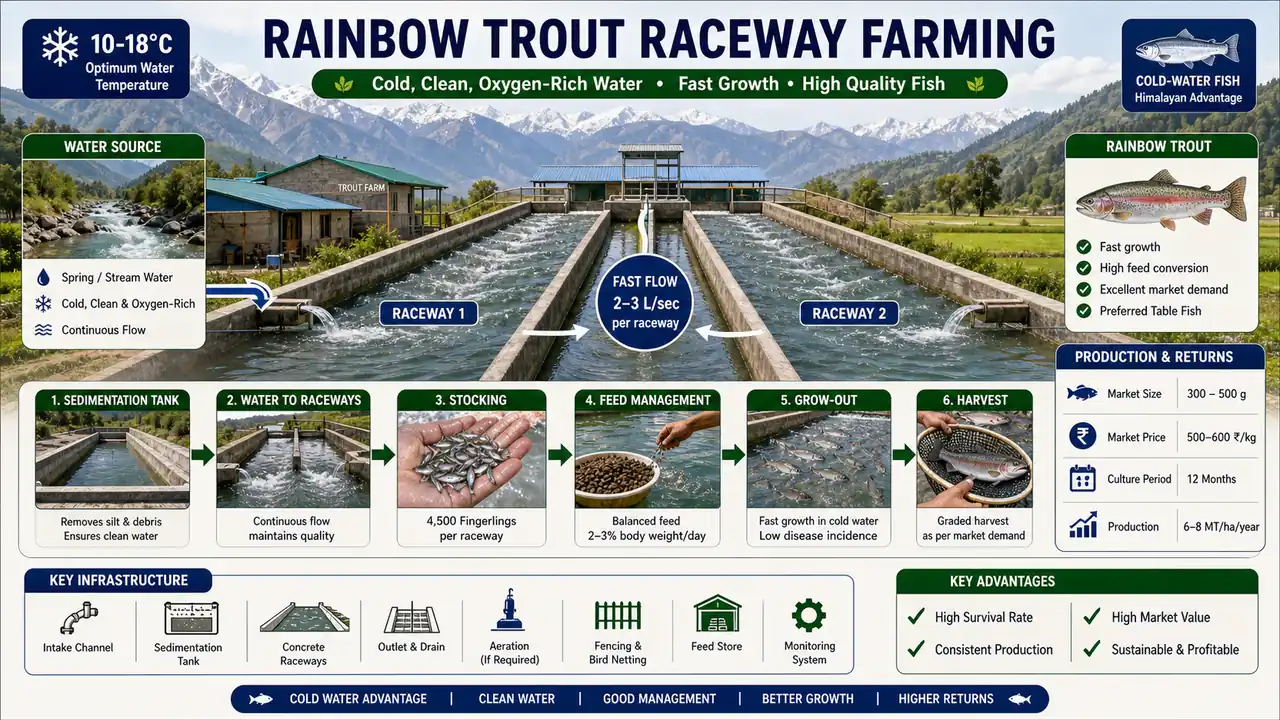
Water & Site Requirements
Trout requires cold, highly oxygenated, crystal-clear water — the most critical production constraint.
| Parameter | Ideal Range |
|---|---|
| Water temperature | 10–18°C (optimal); stops feeding above 18°C |
| Dissolved oxygen | 5.8–9.5 mg/l |
| pH | 7–8 (tolerates 4.5–9.2) |
| Turbidity | Secchi disc visibility > 25 cm |
| Water flow (raceway) | 2–3 litres/second |
| Water source | Spring or snow-melt/glacier-fed streams |
NOTE
Pro Content Locked
Upgrade to Pro to access this lesson and all other premium content.
₹99 charged monthly · Cancel anytime
- All Agriculture & Banking Courses
- AI Lesson Questions (100/day)
- AI Doubt Solver (50/day)
- Glows & Grows Feedback (30/day)
- AI Section Quiz (20/day)
- 22-Language Translation (100/day)
- Recall Questions (20/day)
- AI Quiz (15/day)
- AI Quiz Paper Analysis (100/day)
- AI Step-by-Step Explanations (100/day)
- Spaced Repetition Recall (FSRS)
- AI Tutor
- Immersive Text Questions
- Audio Lessons — Hindi & English
- Mock Tests & Previous Year Papers
- Summary & Mind Maps
- XP, Levels, Leaderboard & Badges
- Generate New Classrooms
- Voice AI Teacher (AgriDots Live)
- AI Revision Assistant
- Knowledge Gap Analysis
- Interactive Revision (LangGraph)
🔒 Secure via Razorpay · Cancel anytime · No hidden fees
Rainbow Trout (Oncorhynchus mykiss) is the primary cold-water aquaculture species in India's Himalayan regions. Production grew from 147 tonnes (2004) to 842 tonnes (2016) — a growth rate of 31% per annum. Major producing states: Himachal Pradesh, Jammu & Kashmir, Sikkim, and Uttarakhand.
- Brown trout (Salmo trutta) and Rainbow trout are the two species found in India
- Introduced by the British for sport fishing; first brown trout eggs from Scotland hatched at Harwan, Kashmir in 1905
- Farm gate price: ₹500–600/kg — a high-value low-volume fish
Water & Site Requirements
Trout requires cold, highly oxygenated, crystal-clear water — the most critical production constraint.
| Parameter | Ideal Range |
|---|---|
| Water temperature | 10–18°C (optimal); stops feeding above 18°C |
| Dissolved oxygen | 5.8–9.5 mg/l |
| pH | 7–8 (tolerates 4.5–9.2) |
| Turbidity | Secchi disc visibility > 25 cm |
| Water flow (raceway) | 2–3 litres/second |
| Water source | Spring or snow-melt/glacier-fed streams |
NOTE
Exam trap: Trout STOPS feeding above 18°C (optimal range 10–18°C). Below 5°C, fish lose appetite. This temperature sensitivity is why trout farming is restricted to Himalayan states — a key exam MCQ point.
Raceway Design
A raceway is a rectangular flow-through channel. Key specifications:
| Parameter | Value |
|---|---|
| Raceway dimensions | 17 m × 2 m × 1.5 m (51 m³ volume each) |
| Number of raceways | 2 (minimum for continuity/cleaning) |
| Length:width ratio | ≥ 8:1 (prevents circular swimming, debris at centre) |
| Slope | ~2% (gravity flow-through system) |
| Sedimentation tank | 8 m × 8 m × 1.5 m = 96 m³ (arrests silt before entry) |
| Stocking density | 4,500 fingerlings (5–10 g) per raceway (85–90 nos./m³) |
| Water channel from source | 20 m × 0.35 m × 0.35 m cemented nala |
Feed Management
- Diet: minimum 40% crude protein at 2–3% body weight/day
- Feed types: Starter I (fry to 50 g) → Starter II (50–150 g) → Production feed (150 g to harvest)
- Frequency: fry (1–2 g) fed 8 times/day; reduced to 3 times/day for 5 g+
- Feed halved above 19°C; suspended on cloudy/turbid days
Capital Cost (2 Raceways)
| Component | Cost (₹) |
|---|---|
| 2 raceways (17 m × 2 m × 1.5 m each) | 3,00,000 |
| Water head channel + parallel channel (20 m each) | 26,750 |
| Sedimentation tank (8 m × 8 m × 1.5 m) | 1,74,300 |
| Bird protection net | 10,000 |
| Equipment (dragnet, hand net, tubs, etc.) | 10,000 |
| Wire/chain link fencing (45 RMT) | 25,200 |
| Total Capital Cost (A) | ₹5,49,235 |
Operational cost (Year 1 — 9 months feed):
| Item | Cost (₹) |
|---|---|
| Seed — 9,000 fingerlings @ ₹8/piece | 72,000 |
| Feed — 2,531 kg @ ₹110/kg | 2,78,300 |
| Labour — 1 person @ ₹4,000/month | 48,000 |
| Miscellaneous | 10,000 |
| Total Operational Cost (B) | ₹4,08,410 |
Total project cost: ₹9,57,645
NOTE
Feed cost (₹110/kg) is the largest recurring expense in trout farming — higher than all other NABARD fish models. Feed availability and cost remain the primary constraint for trout farmers across Himalayan states.
Production Economics
| Parameter | Value |
|---|---|
| Survival rate | 75% |
| Production per raceway per year | 843.75 kg |
| Total production (2 raceways) | ~1,688 kg/year |
| Average harvest weight | 250–300 g in 12 months |
| Farm gate price | ₹500/kg |
| Annual gross income | ₹8,43,750 |
Financial Analysis
| Indicator | Value |
|---|---|
| Total Financial Outlay | ₹9.58 lakh |
| Margin (15%) | ₹1.44 lakh |
| Bank Loan | ₹8.14 lakh |
| Rate of Interest | 12% |
| Repayment Period | 6 years (1 year grace) |
| NPW @ 15% | ₹6.598 lakh |
| BCR | 1.31 : 1 |
| IRR | 43% |
Subsidy: Available under Neel Kranti Mission (Blue Revolution) for raceway construction and first-year inputs — implemented by State Fisheries Departments.
Sources & References
Primary source for this lesson is NABARD's official Model Bankable Projects portal.[1] Lesson-specific report copy used for this topic.[2]
References
2 sources • [1] [2]
References
Used for: Official NABARD portal for model bankable project documents and updates.
Used for: Reference copy used in this lesson for project parameters and worked figures.
The figures in this lesson reflect the cost norms and technical parameters as published in the NABARD document. Actual costs may vary by state, season, and year of implementation. Always refer to the latest NABARD circular for current norms.
Summary Cheat Sheet
| Concept / Topic | Key Details / Explanation |
|---|---|
| Species | Rainbow Trout (Oncorhynchus mykiss) — primary cold-water aquaculture species in India |
| Production growth | 147 tonnes (2004) → 842 tonnes (2016) = 31% per annum |
| Major producing states | Himachal Pradesh, Jammu & Kashmir, Sikkim, Uttarakhand |
| Historical introduction | Brown trout eggs from Scotland hatched at Harwan, Kashmir in 1905 |
| Water temperature | Optimal: 10–18°C; stops feeding above 18°C; appetite lost below 5°C |
| Dissolved oxygen | 5.8–9.5 mg/l |
| pH | 7–8 (tolerates 4.5–9.2) |
| Water flow (raceway) | 2–3 litres/second |
| Raceway dimensions | 17 m × 2 m × 1.5 m (51 m³ volume each) |
| Number of raceways | 2 |
| Length:width ratio | ≥ 8:1 |
| Sedimentation tank | 8 m × 8 m × 1.5 m = 96 m³ |
| Stocking density | 4,500 fingerlings (5–10 g)/raceway (~85–90 nos./m³) |
| Fingerling cost | 9,000 @ ₹8/piece = ₹72,000 |
| Feed protein requirement | Minimum 40% crude protein |
| Feed cost | ₹110/kg — highest feed cost of all NABARD fish models |
| Feed frequency (fry 1–2 g) | 8 times/day; reduced to 3 times/day for 5 g+ |
| Feed rate | 2–3% of body weight/day |
| Survival rate | 75% |
| Average harvest weight | 250–300 g in 12 months |
| Total production (2 raceways) | ~1,688 kg/year |
| Farm gate price | ₹500/kg |
| Annual gross income | ₹8,43,750 |
| Total Capital Cost (A) | ₹5,49,235 |
| Total Operational Cost (B) | ₹4,08,410 |
| Total Project Cost | ₹9,57,645 |
| Margin Money | 15% = ₹1.44 lakh |
| Bank Loan | ₹8.14 lakh |
| Interest rate | 12% |
| Repayment period | 6 years with 1-year grace |
| NPW @ 15% | ₹6.598 lakh |
| BCR | 1.31:1 |
| IRR | 43% |
| Linked scheme | Neel Kranti Mission (Blue Revolution) — subsidy for raceway + first-year inputs |
Lesson Doubts
Ask questions, get expert answers