♻️ Low-Cost RAS with Vegetable Farming (Aquaponics)
NABARD model bankable project for low-cost Recirculatory Aquaculture System (RAS) with integrated vegetable farming. Covers 90 m³ tank design, 3 cycles/year, total cost of ₹15 lakh, IRR of 36%, and BCR of 1.58 for exams.
A Recirculatory Aquaculture System (RAS) is an intensive, indoor fish production system that reuses water through biological and mechanical filtration. Traditional open ponds use >20 litres/kg fish; high-cost RAS uses only 5 litres/kg and produces up to 40 tonnes/year from 1/10th of a hectare.
- Low-cost RAS is designed for small farmers — requires only 2,400 sq. ft. land
- Government of India identified 10 states for RAS promotion: Bihar, Chhattisgarh, Haryana, MP, Maharashtra, Odisha, Punjab, Rajasthan, Telangana, UP
- In India, farmers primarily grow Pangassius and GIFT Tilapia in RAS
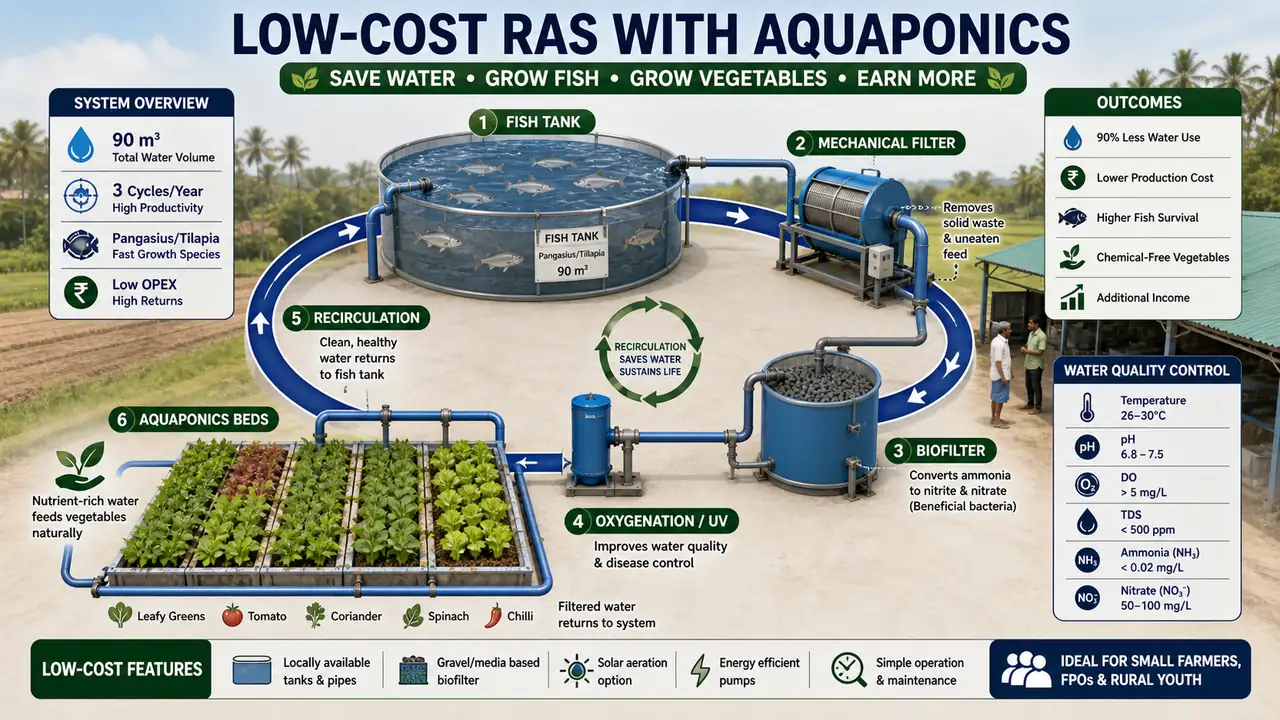
System Design — Low Cost Model
The low-cost RAS uses a 90 m³ cement tank (6.7 m × 6.7 m × 2 m) with a conical bottom and a central slurry pit (30 cm × 30 cm × 30 cm) for waste collection.
Pro Content Locked
Upgrade to Pro to access this lesson and all other premium content.
₹99 charged monthly · Cancel anytime
- All Agriculture & Banking Courses
- AI Lesson Questions (100/day)
- AI Doubt Solver (50/day)
- Glows & Grows Feedback (30/day)
- AI Section Quiz (20/day)
- 22-Language Translation (100/day)
- Recall Questions (20/day)
- AI Quiz (15/day)
- AI Quiz Paper Analysis (100/day)
- AI Step-by-Step Explanations (100/day)
- Spaced Repetition Recall (FSRS)
- AI Tutor
- Immersive Text Questions
- Audio Lessons — Hindi & English
- Mock Tests & Previous Year Papers
- Summary & Mind Maps
- XP, Levels, Leaderboard & Badges
- Generate New Classrooms
- Voice AI Teacher (AgriDots Live)
- AI Revision Assistant
- Knowledge Gap Analysis
- Interactive Revision (LangGraph)
🔒 Secure via Razorpay · Cancel anytime · No hidden fees
A Recirculatory Aquaculture System (RAS) is an intensive, indoor fish production system that reuses water through biological and mechanical filtration. Traditional open ponds use >20 litres/kg fish; high-cost RAS uses only 5 litres/kg and produces up to 40 tonnes/year from 1/10th of a hectare.
- Low-cost RAS is designed for small farmers — requires only 2,400 sq. ft. land
- Government of India identified 10 states for RAS promotion: Bihar, Chhattisgarh, Haryana, MP, Maharashtra, Odisha, Punjab, Rajasthan, Telangana, UP
- In India, farmers primarily grow Pangassius and GIFT Tilapia in RAS
System Design — Low Cost Model
The low-cost RAS uses a 90 m³ cement tank (6.7 m × 6.7 m × 2 m) with a conical bottom and a central slurry pit (30 cm × 30 cm × 30 cm) for waste collection.
3 floating cages (30 m³ each) are housed inside the tank. Fish are grown in the cages; the tank water is continuously filtered.
| Component | Purpose |
|---|---|
| Venturi aeration (0.5 HP pump) | Oxygenates bottom, creates circular water flow, moves sludge to centre |
| Trickling nitrifying bio-reactor (3 units) | Converts harmful ammonia to nitrates via Nitrosomonas and Nitrobacter |
| Mechanical filter | Removes suspended solids |
| Overhead tank (1,000 litres) | Slurry separation and water distribution |
| Bore well (3" delivery pipe) | Fresh water top-up for evaporation losses |
| 5 KVA diesel generator | Backup power (critical — fish die without aeration) |
NOTE
Exam trap: The nitrification process is the most critical component. Ammonia (from fish waste/uneaten feed) must be kept below 0.5 ppm. Nitrosomonas converts NH₃ → NO₂; Nitrobacter converts NO₂ → NO₃.
Critical Water Quality Parameters
| Parameter | Ideal Range |
|---|---|
| pH | 7.5–8.0 |
| Dissolved oxygen | 5–8 mg/l |
| Ammonia | 0–0.5 mg/l |
| Nitrite | 0–1 mg/l |
| Nitrate | 0–10 mg/l |
| Hydrogen sulphide | 0–0.1 mg/l |
Production Parameters (Pangassius — per cycle)
| Parameter | Value |
|---|---|
| Stocking density | 80 fish/m³ × 90 m³ = 7,200 seeds |
| Survival rate | 90% → 6,480 fish |
| Average growth per cycle | 400 g per fish (600 g at harvest from 200 g seed) |
| Culture period per cycle | 4 months |
| Cycles per year | 3 |
| Production per cycle | 6,480 × 0.6 kg = 3,888 kg |
| Farm gate price | ₹110/kg |
| Income per cycle | ₹4,27,680 |
| Annual net income (3 cycles) | ₹4,08,540 |
Capital Cost
| Component | Cost (₹) |
|---|---|
| 90 m³ cement culture tank | 1,58,500 |
| 3 floating cages (30 m³ each) | 45,000 + 15,000 installation |
| 3 Trickling bio-reactors + platform | 1,74,000 |
| 4 air injector assemblies | 1,00,000 |
| 2 pumps (0.5 HP self-priming) | 50,000 |
| Emergency aeration + inverter | 1,50,000 |
| Bore well (3" pipe) | 1,25,000 |
| 5 KVA diesel generator | 1,25,000 |
| Electrical connections & wiring | 50,000 |
| Plumbing, shed, miscellaneous | 80,000 + 25,000 + 36,000 |
| Water chemistry kits + colorimeter | 30,000 |
| Total Capital Cost | ₹12,08,500 |
Operational cost per cycle: ₹2,91,500
- Seeds: ₹54,000 | Feed (4,860 kg @ ₹35): ₹1,70,100 | Electricity: ₹25,000 | Generator diesel: ₹5,000 | Salaries + misc: ₹37,400
Total project cost (capital + 1 operating cycle): ₹15,00,000
Aquaponics Add-On: Vegetable Farming
Slurry from the central pit is nutrient-rich organic manure. It is sufficient for vegetable cultivation on ½ acre adjacent to the RAS — providing additional income with zero additional input cost.
Financial Analysis
| Indicator | Value |
|---|---|
| Total Project Cost | ₹15.00 lakh |
| IRR | 36% |
| BCR | 1.58 : 1 |
| NPW | ₹7.62 lakh |
| Repayment Period | 9 years (1 year grace) |
Blue Revolution subsidy: 50% of unit cost (ceiling ₹7.50 lakh) for general states; 80% (ceiling ₹12 lakh) for NE/Himalayan states. Innovative large-scale RAS (≥500 tonnes/year): 50% up to ₹50 lakh.
Sources & References
Primary source for this lesson is NABARD's official Model Bankable Projects portal.[1] Lesson-specific report copy used for this topic.[2]
References
2 sources • [1] [2]
References
Used for: Official NABARD portal for model bankable project documents and updates.
Used for: Reference copy used in this lesson for project parameters and worked figures.
The figures in this lesson reflect the cost norms and technical parameters as published in the NABARD document. Actual costs may vary by state, season, and year of implementation. Always refer to the latest NABARD circular for current norms.
Summary Cheat Sheet
| Concept / Topic | Key Details / Explanation |
|---|---|
| System type | Low-cost RAS — 90 m³ cement tank with 3 floating cages (30 m³ each) |
| Land required | 2,400 sq ft only |
| Primary species | Pangassius and GIFT Tilapia |
| 10 promoted states | Bihar, Chhattisgarh, Haryana, MP, Maharashtra, Odisha, Punjab, Rajasthan, Telangana, UP |
| Tank dimensions | 6.7 m × 6.7 m × 2 m with conical bottom and central slurry pit |
| Stocking density | 80 fish/m³ × 90 m³ = 7,200 seeds/cycle |
| Survival rate | 90% → 6,480 fish |
| Culture period per cycle | 4 months |
| Cycles per year | 3 |
| Average growth per cycle | 400 g (600 g harvest from 200 g seed) |
| Production per cycle | 3,888 kg |
| Farm gate price | ₹110/kg |
| Income per cycle | ₹4,27,680 |
| Annual net income | ₹4,08,540 |
| Total Capital Cost | ₹12,08,500 |
| Operational cost per cycle | ₹2,91,500 (feed ₹1,70,100 + seeds ₹54,000 + electricity ₹25,000 + others) |
| Total Project Cost | ₹15,00,000 |
| IRR | 36% |
| BCR | 1.58:1 |
| NPW | ₹7.62 lakh |
| Repayment period | 9 years with 1-year grace |
| Nitrification process | Nitrosomonas: NH₃ → NO₂; Nitrobacter: NO₂ → NO₃; Ammonia must be <0.5 ppm |
| Aeration system | Venturi aeration (0.5 HP pump); emergency backup: 5 KVA diesel generator (critical — fish die without aeration) |
| Water reuse | 95–99% recirculation via biofilters + mechanical filter + UV steriliser |
| Aquaponics add-on | Slurry → vegetable cultivation on ½ acre at zero additional input cost |
| Blue Revolution subsidy | 50% (ceiling ₹7.50 lakh) general states; 80% (ceiling ₹12 lakh) NE/Himalayan; innovative large RAS (≥500 t/yr): 50% up to ₹50 lakh |
| Water use advantage | Traditional ponds: >20 L/kg; high-cost RAS: only 5 L/kg |
Lesson Doubts
Ask questions, get expert answers