🌿 Fish Farming in Wetlands (Chaurs) — Bihar
NABARD model scheme for fish farming in Bihar's wetlands (Chaurs). Covers 9.41 lakh ha wetland potential, composite fish culture, capital cost of ₹2.70 lakh/ha, BCR of 1.65, and Blue Revolution subsidy for exams.
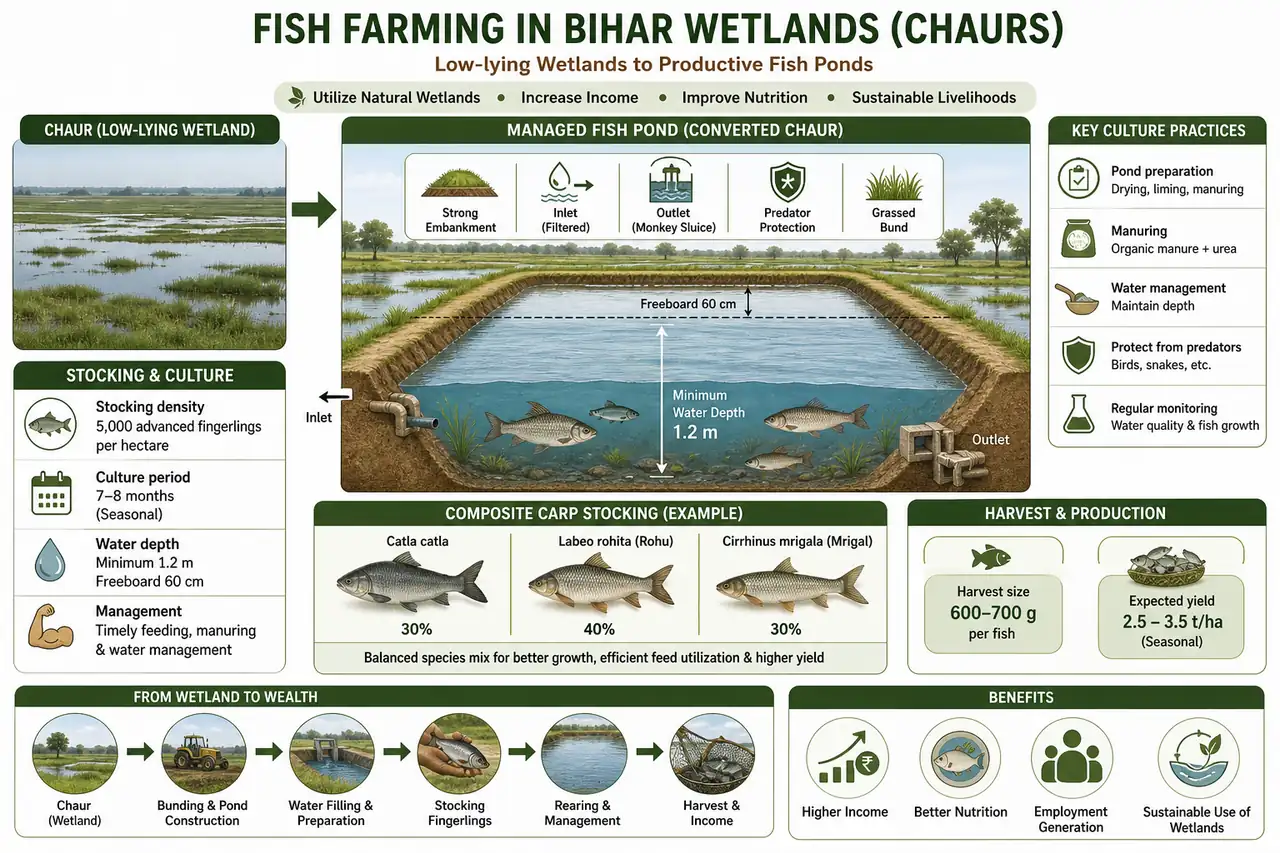
Bihar has 9.41 lakh hectares of wetlands (locally called Chaurs) across 19 districts — predominantly in Patna, Lakhisarai, and Nalanda. These low-lying areas currently yield only one rabi crop per year with very low returns, but are ideal for fish pond development.
- Bihar ranks 4th in inland fish production in India
- Annual demand: 6.42 lakh tonnes; deficit met by importing 1.42 lakh tonnes from Andhra Pradesh and West Bengal
- Current pond productivity: 2,800 kg/ha vs. potential of 4,000–5,000 kg/ha
Why Chaurs for Fish Farming?
- Wetlands retain water for parts of the year — lower pond construction cost
- IMC (Indian Major Carps) — Catla, Rohu, Mrigal — are highly preferred by Bihar consumers
- Locally produced fresh fish fetches premium price over ice-preserved imported fish
- Blue Revolution subsidy of 50% of unit cost available for waterlogged area development
Technical Parameters
| Parameter | Value |
|---|---|
| Culture type | Composite (IMC + exotic carps, 3–6 species) |
| Pond size | 0.4–1.5 ha (rectangular, east-west orientation) |
| Water depth | Minimum 1.2 m throughout culture period |
| Pond depth | Min 1 m, max 1.5 m; free board ≥ 60 cm |
| Dyke slope | 1.5:1 (outside); 2.1:1 (inside) |
| Stocking density | 5,000 fingerlings/ha |
| Stocking size | 50 g advanced fingerlings |
| Culture period | 7–8 months (wetland seasonal constraint) |
| Average growth | 600–700 g at harvest |
| Survival rate | 90% |
NOTE
Pro Content Locked
Upgrade to Pro to access this lesson and all other premium content.
₹99 charged monthly · Cancel anytime
- All Agriculture & Banking Courses
- AI Lesson Questions (100/day)
- AI Doubt Solver (50/day)
- Glows & Grows Feedback (30/day)
- AI Section Quiz (20/day)
- 22-Language Translation (100/day)
- Recall Questions (20/day)
- AI Quiz (15/day)
- AI Quiz Paper Analysis (100/day)
- AI Step-by-Step Explanations (100/day)
- Spaced Repetition Recall (FSRS)
- AI Tutor
- Immersive Text Questions
- Audio Lessons — Hindi & English
- Mock Tests & Previous Year Papers
- Summary & Mind Maps
- XP, Levels, Leaderboard & Badges
- Generate New Classrooms
- Voice AI Teacher (AgriDots Live)
- AI Revision Assistant
- Knowledge Gap Analysis
- Interactive Revision (LangGraph)
🔒 Secure via Razorpay · Cancel anytime · No hidden fees
Bihar has 9.41 lakh hectares of wetlands (locally called Chaurs) across 19 districts — predominantly in Patna, Lakhisarai, and Nalanda. These low-lying areas currently yield only one rabi crop per year with very low returns, but are ideal for fish pond development.
- Bihar ranks 4th in inland fish production in India
- Annual demand: 6.42 lakh tonnes; deficit met by importing 1.42 lakh tonnes from Andhra Pradesh and West Bengal
- Current pond productivity: 2,800 kg/ha vs. potential of 4,000–5,000 kg/ha
Why Chaurs for Fish Farming?
- Wetlands retain water for parts of the year — lower pond construction cost
- IMC (Indian Major Carps) — Catla, Rohu, Mrigal — are highly preferred by Bihar consumers
- Locally produced fresh fish fetches premium price over ice-preserved imported fish
- Blue Revolution subsidy of 50% of unit cost available for waterlogged area development
Technical Parameters
| Parameter | Value |
|---|---|
| Culture type | Composite (IMC + exotic carps, 3–6 species) |
| Pond size | 0.4–1.5 ha (rectangular, east-west orientation) |
| Water depth | Minimum 1.2 m throughout culture period |
| Pond depth | Min 1 m, max 1.5 m; free board ≥ 60 cm |
| Dyke slope | 1.5:1 (outside); 2.1:1 (inside) |
| Stocking density | 5,000 fingerlings/ha |
| Stocking size | 50 g advanced fingerlings |
| Culture period | 7–8 months (wetland seasonal constraint) |
| Average growth | 600–700 g at harvest |
| Survival rate | 90% |
NOTE
Exam trap: Wetland (Chaur) fish culture period is 7–8 months — shorter than standard 11-month pond culture. This is because chaurs fill with water seasonally. First-year expected production is only 2,500 kg/ha; second year onwards 3,000 kg/ha.
Water Quality Optimum (IMC + Exotic Carps)
| Parameter | Optimal Range |
|---|---|
| Temperature | 25–32°C |
| Dissolved oxygen | 5–7 ppm |
| pH | 7–7.5 |
| Salinity | 0–5 ppt |
| Total alkalinity | 50–100 ppm |
| Ammonia | < 0.1 ppm |
| Visibility | 40 cm (Secchi disc) |
Capital & Operational Cost (1 Ha)
Capital cost for 1 ha wetland development: ₹2.70 lakh
Operational cost (first crop — capitalised): ₹1.235 lakh
Key items: fingerlings (5,000 @ market rate), lime, fertilisers, supplementary feed (oil cake + rice bran in perforated sacks), shallow tube well and pump set.
Financial Analysis
| Indicator | Value |
|---|---|
| Capital Cost | ₹2.70 lakh/ha |
| Operational Cost (capitalised) | ₹1.235 lakh |
| Margin (25%) | Per RBI guidelines |
| Farm gate price | ₹100/kg |
| Production Year 1 | 2,500 kg |
| Production Year 2+ | 3,000 kg |
| BCR | 1.65 |
| NPW | ₹5,13,751 |
| IRR | > 15% |
| Repayment Period | 7 years (1 year grace) |
Subsidies & Schemes
| Scheme | Benefit |
|---|---|
| Blue Revolution (GoI) | 50% of unit cost for waterlogged area development |
| Long Term Rural Credit Fund (LTRCF) | Concessional refinance from NABARD to cooperative banks & RRBs |
| CIFA / NFDB / KVK | Training for fish farmers |
NOTE
The soil type for carp ponds must be clay/clay-loam/silty-clay with soil pH 6.5–7.5. Acidic soils need lime before stocking. This soil requirement is a common MCQ trap — not all wetland soil is suitable without preparation.
Sources & References
Primary source for this lesson is NABARD's official Model Bankable Projects portal.[1] Lesson-specific report copy used for this topic.[2]
References
2 sources • [1] [2]
References
Used for: Official NABARD portal for model bankable project documents and updates.
Used for: Reference copy used in this lesson for project parameters and worked figures.
The figures in this lesson reflect the cost norms and technical parameters as published in the NABARD document. Actual costs may vary by state, season, and year of implementation. Always refer to the latest NABARD circular for current norms.
Summary Cheat Sheet
| Concept / Topic | Key Details / Explanation |
|---|---|
| State focus | Bihar — wetlands called Chaurs across 19 districts |
| Wetland area potential | 9.41 lakh hectares |
| Bihar inland fish rank | 4th in India |
| Annual demand/deficit | Demand: 6.42 lakh tonnes; deficit: 1.42 lakh tonnes imported from AP and WB |
| Current productivity | 2,800 kg/ha vs potential 4,000–5,000 kg/ha |
| Culture type | Composite — IMC (Catla, Rohu, Mrigal) + exotic carps (3–6 species) |
| Pond size | 0.4–1.5 ha, rectangular, east-west orientation |
| Minimum water depth | 1.2 m throughout culture period |
| Dyke slope | Outside: 1.5:1; Inside: 2.1:1 |
| Free board | ≥ 60 cm |
| Stocking density | 5,000 fingerlings/ha at 50 g (advanced fingerlings) |
| Culture period | 7–8 months (shorter than standard — chaurs fill seasonally) |
| Survival rate | 90% |
| Average harvest weight | 600–700 g |
| Production Year 1 | 2,500 kg/ha |
| Production Year 2+ | 3,000 kg/ha |
| Farm gate price | ₹100/kg |
| Capital Cost | ₹2.70 lakh/ha |
| Operational Cost (capitalised) | ₹1.235 lakh |
| Margin Money | 25% (per RBI guidelines) |
| Repayment period | 7 years with 1-year grace |
| BCR | 1.65 |
| NPW | ₹5,13,751 |
| IRR | >15% |
| Blue Revolution subsidy | 50% of unit cost for waterlogged area development |
| Soil requirement | Clay/clay-loam/silty-clay; soil pH 6.5–7.5 |
| Optimal DO | 5–7 ppm; pH: 7–7.5; Ammonia: <0.1 ppm |
Lesson Doubts
Ask questions, get expert answers