🤑 Agricultural Economics — Foundations & Key Concepts
Master the fundamentals of Agricultural Economics — definitions, importance, sub-disciplines, and exam-ready revision with examples and mnemonics.
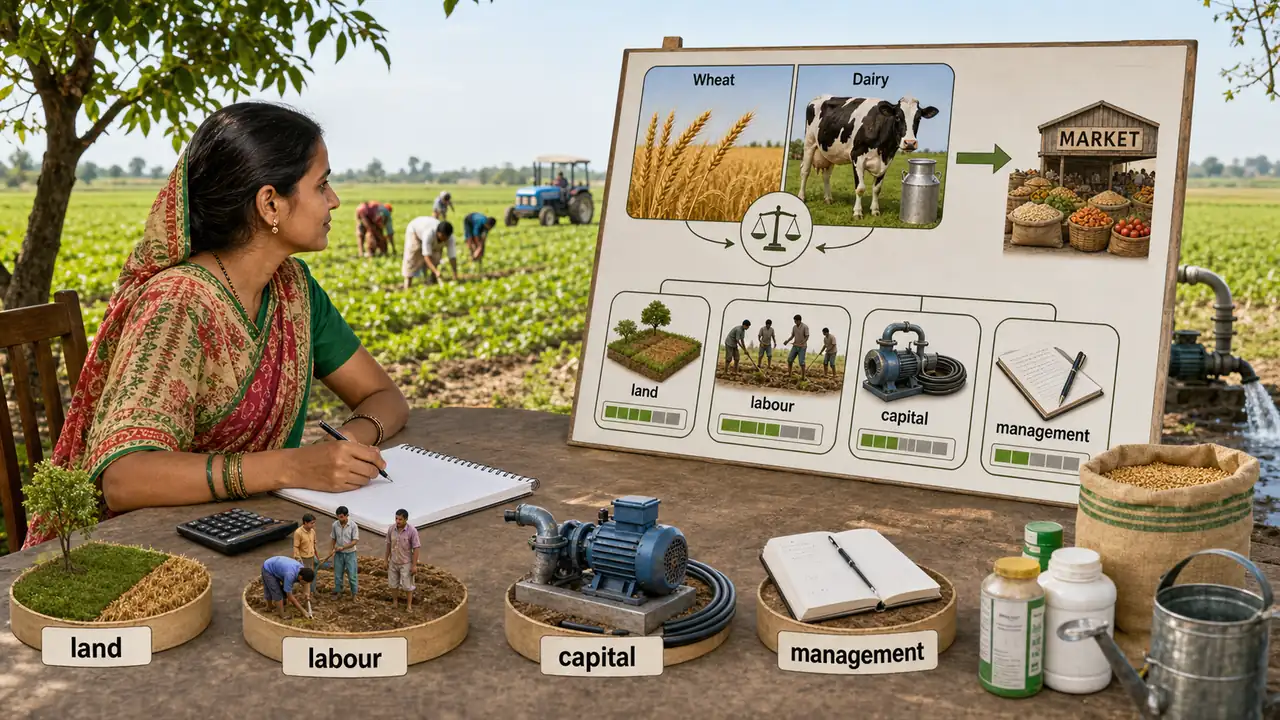

Why Should a Farmer Study Economics?
Imagine a wheat farmer in Punjab with 5 acres of land. She must decide: How much seed to buy? Should she hire labour or use family workers? Is it worth investing in a new irrigation pump? Should she sell at the local mandi today or store grain and wait for better prices?
Every one of these decisions involves scarce resources — land, labour, capital, and time. Agricultural Economics gives her (and you) the tools to make these decisions wisely and maximize income from limited resources.
What Is Agricultural Economics?
Agricultural Economics is an applied branch of economics that uses economic principles to solve problems related to farming, agribusiness, and rural development.
Pro Content Locked
Upgrade to Pro to access this lesson and all other premium content.
Charged once for one year · ₹1188 total
Save ₹100/month vs ₹2388/year launch price
- All Agriculture & Banking Courses
- AI Lesson Questions (100/day)
- AI Doubt Solver (50/day)
- Glows & Grows Feedback (30/day)
- AI Section Quiz (20/day)
- 22-Language Translation (100/day)
- Recall Questions (20/day)
- AI Quiz (15/day)
- AI Quiz Paper Analysis (100/day)
- AI Step-by-Step Explanations (100/day)
- Spaced Repetition Recall (FSRS)
- AI Tutor
- Immersive Text Questions
- Audio Lessons — Hindi & English
- Mock Tests & Previous Year Papers
- Summary & Mind Maps
- XP, Levels, Leaderboard & Badges
- Generate New Classrooms
- Voice AI Teacher (AgriDots Live)
- AI Revision Assistant
- Knowledge Gap Analysis
- Interactive Revision (LangGraph)
🔒 Secure one-time yearly payment via Razorpay · No hidden fees
Why Should a Farmer Study Economics?
Imagine a wheat farmer in Punjab with 5 acres of land. She must decide: How much seed to buy? Should she hire labour or use family workers? Is it worth investing in a new irrigation pump? Should she sell at the local mandi today or store grain and wait for better prices?
Every one of these decisions involves scarce resources — land, labour, capital, and time. Agricultural Economics gives her (and you) the tools to make these decisions wisely and maximize income from limited resources.
What Is Agricultural Economics?
Agricultural Economics is an applied branch of economics that uses economic principles to solve problems related to farming, agribusiness, and rural development.
Think of it as a bridge between textbook economic theory and the muddy realities of the field — literally.
| Component | Meaning |
|---|---|
| Agriculture | From Latin ager (soil) + cultura (cultivation) — the production of crops and livestock |
| Economics | The science of how people use scarce resources to produce and distribute goods |
| Agricultural Economics | Applying economic principles to optimize agricultural production, marketing, and policy |
Exam Tip: The Latin roots Ager + Cultura = Agriculture is a frequently tested fact. Remember: "The AGEd farmer CULTivates the soil."
Key Definitions (Exam Essentials)
Three classic definitions appear repeatedly in competitive exams. Understand each one's emphasis:
| Scholar | Definition | Key Emphasis |
|---|---|---|
| Prof. Gray | "The science in which the principles and methods of economics are applied to the special conditions of agricultural industry." | Application of economic methods to agriculture |
| Prof. Hibbard | "The study of relationships arising from the wealth-getting and wealth-using activity of man in agriculture." | Wealth creation (production) and wealth use (consumption & investment) |
| Snodgras & Wallace | "An applied phase of social science of economics in which attention is given to all aspects of problems related to agriculture." | All dimensions — production, marketing, policy, rural development |
Mnemonic — GHS: Gray = General application, Hibbard = How wealth flows, Snodgras = Scope is wide (all aspects).
Practical Example
When a dairy farmer in Gujarat decides how many buffaloes to maintain (production), how to price milk (marketing), and whether to take a Kisan Credit Card loan (finance) — she is dealing with issues that all three definitions cover.
Origin and Evolution
| Period | Development |
|---|---|
| Classical era | Adam Smith and other economists laid the theoretical foundations of economics |
| 19th century | Agricultural economics emerged as a distinct discipline — applying economic methods to crop production and livestock management |
| Late 19th century | Agricultural depression in Europe and America pushed economists to study farm-level problems seriously |
| Mid-20th century | Another wave of agricultural depression led to deeper research into causes and solutions for farm crises |
| Modern era | The field now covers food security, climate change adaptation, supply chains, precision agriculture economics, and more |
Agricultural economics was born out of necessity — when farms failed, economists realized that general theory alone could not fix agriculture's unique problems.
Why Agricultural Economics Matters
1. Optimizes Scarce Resources
A marginal farmer in Bihar with 1 hectare must decide: grow rice or maize? Agricultural economics uses production functions to calculate which crop gives the highest return per rupee spent.
2. Bridges Theory and Practice
Economic theory says "equalize marginal cost and marginal revenue." Agricultural economics translates this into: "Stop applying fertilizer when the cost of the next bag exceeds the value of extra yield it produces."
3. Uses Quantitative Tools
The discipline relies on mathematics and statistics — regression analysis, linear programming, cost-benefit analysis — to make farming decisions data-driven rather than guesswork.
4. Addresses Both Micro and Macro Issues
| Level | Focus | Example |
|---|---|---|
| Micro | Individual farm decisions | Should a farmer in Haryana switch from wheat to mustard? |
| Macro | National/global agricultural policy | How does the MSP (Minimum Support Price) affect food inflation? |
5. Solves Real-World Agricultural Problems
- Production problems: What is the optimal input combination for maximum output?
- Marketing problems: Why do onion prices crash during glut seasons?
- Finance problems: How can small farmers access affordable credit?
- Policy problems: What impact does PM-KISAN have on farm investment?
Core Sub-Disciplines
Agricultural economics is not a single subject — it is a family of interconnected fields:
| Sub-Discipline | What It Studies | Farm Example |
|---|---|---|
| Microeconomics | Individual decision-making, supply & demand | A farmer choosing between two crop varieties based on cost and expected price |
| Macroeconomics | Economy-wide agricultural trends, GDP contribution | India's agriculture contributing ~18% to GDP but employing ~42% of the workforce |
| Agricultural Production Economics | Input-output relationships, efficiency | How much additional wheat does one extra kg of urea produce? (diminishing returns) |
| Farm Management | Planning, organizing, and controlling farm operations | Preparing a seasonal crop plan and budget for a 10-acre mixed farm |
| Agricultural Marketing | Price discovery, supply chains, market structure | Why a tomato farmer gets Rs 5/kg while the consumer pays Rs 40/kg |
Exam Tip: Remember the sub-disciplines with the mnemonic "My Mom Always Finds Markets" — Microeconomics, Macroeconomics, Agricultural Production Economics, Farm Management, Marketing.
The Four Scarce Resources in Agriculture
Every agricultural economics problem revolves around the optimal use of four key resources:
| Resource | Description | Scarcity Example |
|---|---|---|
| Land | Fixed in supply; varies in fertility | A farmer cannot create more land — she must maximize yield per hectare |
| Labour | Human effort — family or hired | During harvest season, labour shortage drives up daily wages from Rs 300 to Rs 500 |
| Capital | Money, machinery, inputs (seeds, fertilizers) | A small farmer may only afford one bag of DAP — she must apply it where it matters most |
| Management | Decision-making and entrepreneurial ability | Two farmers with identical land and inputs can have very different profits based on management skill |
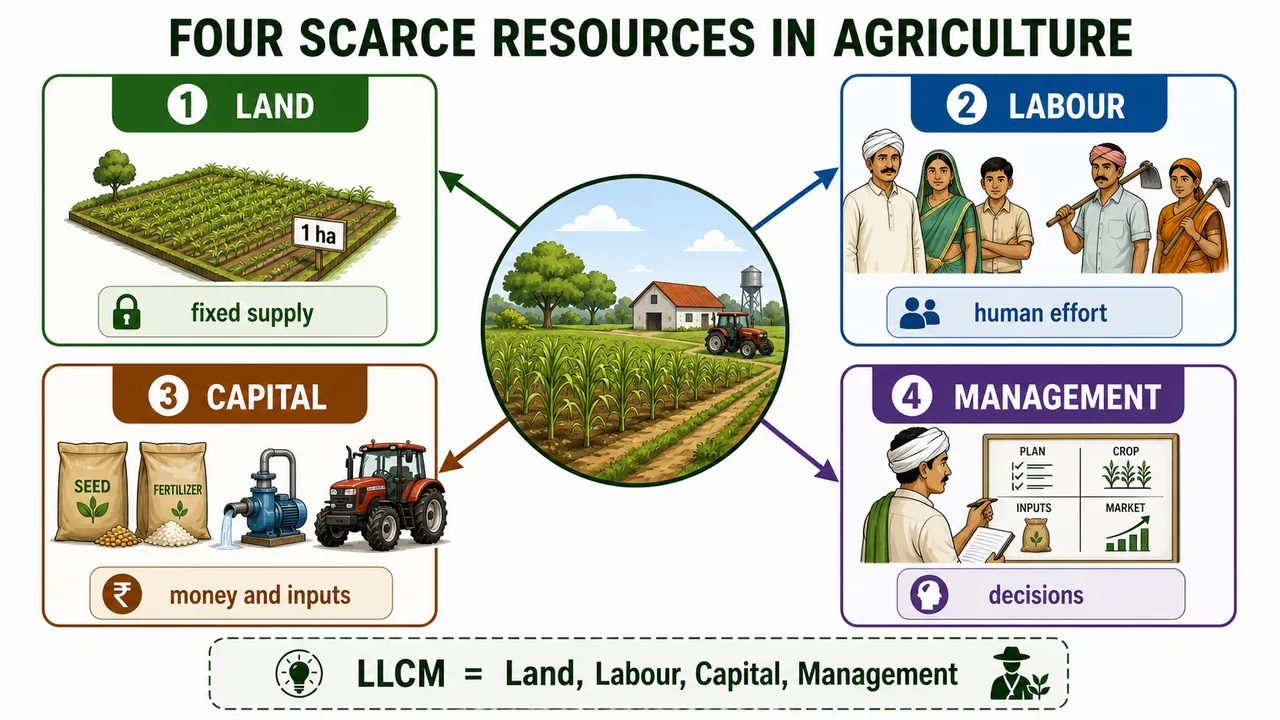
Mnemonic — LLCM: "Land, Labour, Capital, Management" — or think "LLC of a Manager" (the farmer is the CEO of her farm).
Summary Cheat Sheet
| Topic | Key Point |
|---|---|
| What is it? | Applied economics for agriculture — optimizing scarce resources (land, labour, capital, management) |
| Etymology | Ager (soil) + Cultura (cultivation) = Agriculture |
| Origin | 19th century; driven by agricultural depressions |
| Focus | Primarily microeconomics, but also macro-level policy |
| Prof. Gray | Principles of economics applied to agricultural industry |
| Prof. Hibbard | Wealth-getting and wealth-using in agriculture |
| Snodgras & Wallace | All aspects of agricultural problems |
| Tools used | Production functions, programming models, statistics |
| Sub-disciplines | Micro, Macro, Production Economics, Farm Management, Marketing |
| Why it matters | Bridges theory and practice; maximizes farm income; informs policy |
Final Exam Tip: In MCQs, if you see "applied field of economics related to agriculture," the answer is always Agricultural Economics — not rural economics or farm science. The word "applied" is the distinguishing marker.