🪁 Principles of Economics for Agriculture
Master core economic principles — goods, utility, consumer behaviour, and indifference curves — with agricultural examples, exam tips, and mnemonics
Why Economics Matters to a Farmer
A wheat farmer in Punjab has 10 acres of land. Should he grow wheat or mustard this season? How many bags of fertilizer should he buy? Should he sell at harvest or store and sell later?
Every one of these decisions is an economic decision — it involves scarce resources, alternative uses, and the goal of maximum satisfaction. Economics gives us the tools to answer such questions systematically.
All economic activity revolves around producing, exchanging, and consuming goods and services.
Goods and Services
Goods
Goods are tangible products that satisfy human wants or needs.
- They can be seen, touched, and measured.
- They are the material outcome of combining inputs (raw materials, labour, capital).
- Agricultural examples: Wheat grain, tractor, seeds, fertilizers, pesticides.
Services
Services are intangible activities performed by one party for the benefit of another.
| Feature | Meaning | Agricultural Example |
|---|---|---|
| Intangible | Cannot be touched or stored | Crop insurance advisory |
| Non-materialistic | No physical ownership results | Veterinary consultation |
| Inseparable | Produced and consumed at the same time | Soil testing at the lab |
| Variable | Quality differs by provider, time, place | Two different extension officers giving advice |
| Perishable | Cannot be stored for later | An empty seat on the Kisan Rail, once departed, is lost forever |
Classification of Goods
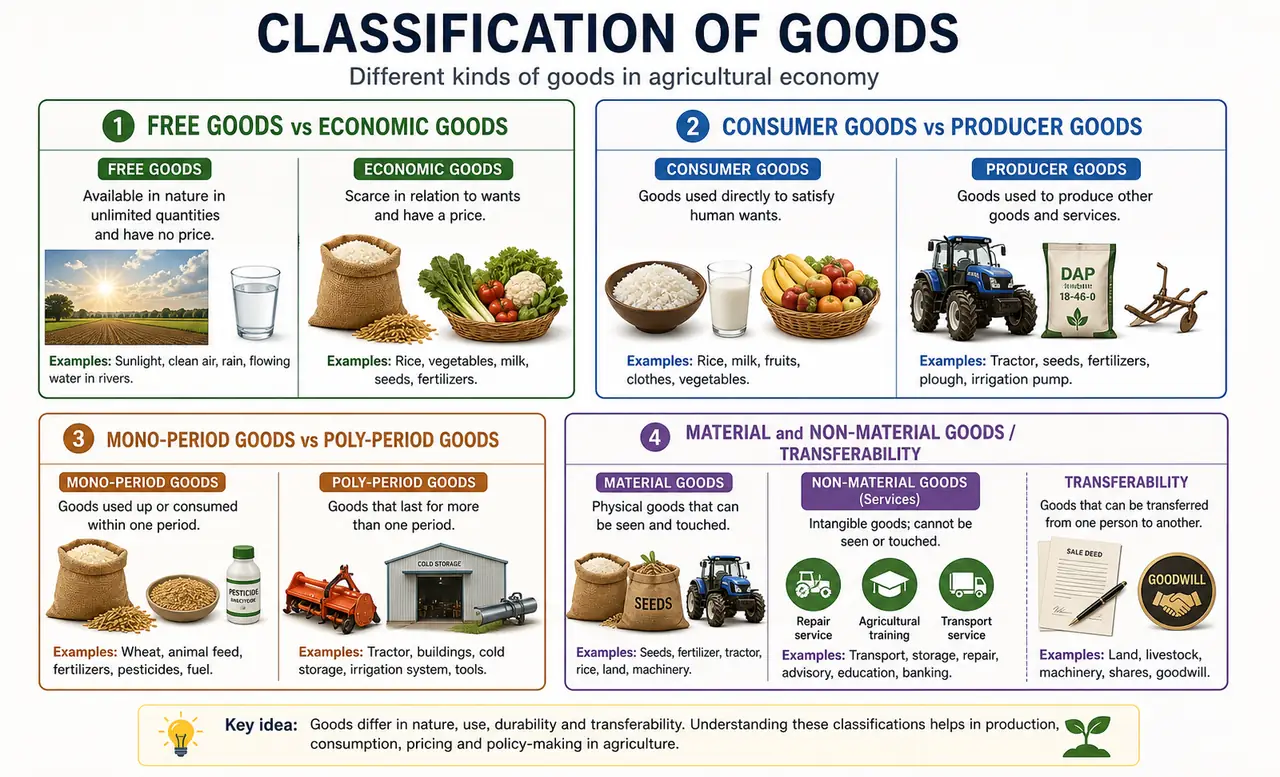
1. Based on Supply — Free Goods vs Economic Goods
| Feature | Free Goods | Economic Goods |
|---|---|---|
| Availability | Abundant (gift of nature) | Scarce (man-made or limited) |
| Price | No payment needed | Available only on payment |
| Value | Value-in-use only | Value-in-use AND value-in-exchange |
| Example | Sunshine, air, river water | Seeds, diesel, tractor |
Key insight: Economics exists because resources are scarce. If all goods were free, there would be no need for economics.
Pro Content Locked
Upgrade to Pro to access this lesson and all other premium content.
Charged once for one year · ₹1188 total
Save ₹100/month vs ₹2388/year launch price
- All Agriculture & Banking Courses
- AI Lesson Questions (100/day)
- AI Doubt Solver (50/day)
- Glows & Grows Feedback (30/day)
- AI Section Quiz (20/day)
- 22-Language Translation (100/day)
- Recall Questions (20/day)
- AI Quiz (15/day)
- AI Quiz Paper Analysis (100/day)
- AI Step-by-Step Explanations (100/day)
- Spaced Repetition Recall (FSRS)
- AI Tutor
- Immersive Text Questions
- Audio Lessons — Hindi & English
- Mock Tests & Previous Year Papers
- Summary & Mind Maps
- XP, Levels, Leaderboard & Badges
- Generate New Classrooms
- Voice AI Teacher (AgriDots Live)
- AI Revision Assistant
- Knowledge Gap Analysis
- Interactive Revision (LangGraph)
🔒 Secure one-time yearly payment via Razorpay · No hidden fees
Why Economics Matters to a Farmer
A wheat farmer in Punjab has 10 acres of land. Should he grow wheat or mustard this season? How many bags of fertilizer should he buy? Should he sell at harvest or store and sell later?
Every one of these decisions is an economic decision — it involves scarce resources, alternative uses, and the goal of maximum satisfaction. Economics gives us the tools to answer such questions systematically.
All economic activity revolves around producing, exchanging, and consuming goods and services.
Goods and Services
Goods
Goods are tangible products that satisfy human wants or needs.
- They can be seen, touched, and measured.
- They are the material outcome of combining inputs (raw materials, labour, capital).
- Agricultural examples: Wheat grain, tractor, seeds, fertilizers, pesticides.
Services
Services are intangible activities performed by one party for the benefit of another.
| Feature | Meaning | Agricultural Example |
|---|---|---|
| Intangible | Cannot be touched or stored | Crop insurance advisory |
| Non-materialistic | No physical ownership results | Veterinary consultation |
| Inseparable | Produced and consumed at the same time | Soil testing at the lab |
| Variable | Quality differs by provider, time, place | Two different extension officers giving advice |
| Perishable | Cannot be stored for later | An empty seat on the Kisan Rail, once departed, is lost forever |
Classification of Goods
1. Based on Supply — Free Goods vs Economic Goods
| Feature | Free Goods | Economic Goods |
|---|---|---|
| Availability | Abundant (gift of nature) | Scarce (man-made or limited) |
| Price | No payment needed | Available only on payment |
| Value | Value-in-use only | Value-in-use AND value-in-exchange |
| Example | Sunshine, air, river water | Seeds, diesel, tractor |
Key insight: Economics exists because resources are scarce. If all goods were free, there would be no need for economics.
Context matters: Air is a free good outdoors, but the same air delivered by a fan or AC becomes an economic good.
Exam Tip: Economic goods = Wealth. Free goods have only value-in-use, never value-in-exchange.
2. Based on Consumption
| Type | Satisfaction | Order | Agricultural Example |
|---|---|---|---|
| Consumer goods | Direct (used by end consumer) | First order | Rice, vegetables, milk |
| Producer goods | Indirect (used to produce other goods) | Second order | Tractor, plough, seed drill |
| Inferior goods | Negative income effect | — | Coarse grain (jowar/bajra) — demand falls as income rises |
Inferior goods explained: When a farmer's income rises, he switches from coarse grain to basmati rice. The coarse grain is the inferior good — its demand falls when income rises.
3. Based on Durability
| Type | Also Called | Usage | Agricultural Example |
|---|---|---|---|
| Mono-period goods | Single-use goods | Used once in production/consumption | Seeds, fertilizers, pesticides |
| Poly-period goods | Durable goods | Used repeatedly over many periods | Tractor, tube well, cold storage unit |
4. Based on Transferability
| Material? | Transferable? | Example |
|---|---|---|
| External Material | Yes | Land, farm buildings, tractor |
| External Material | No | Kisan Credit Card, PAN Card |
| External Non-material | Yes | Goodwill of an agri-business |
| External Non-material | No | Friendship, sunlight |
| Internal Non-material | No | Farming skill, intelligence |
Mnemonic — EMEIN: External Material, External Non-material, Internal Non-material (the three rows to remember).
Utility
What is Utility?
Utility is the power of a good or service to satisfy a human want. It is not the same as "usefulness" in everyday language — even harmful goods (like tobacco) have utility in economics if they satisfy a want.
Characteristics of Utility
| Characteristic | Meaning | Agricultural Example |
|---|---|---|
| Subjective | Varies person to person | HYV seed: high utility for a farmer, zero for a cloth merchant |
| Varies with purpose | Same good, different uses | Coconut oil — cooking, hair care, or machine lubricant |
| Varies with time | Depends on when it is consumed | Labour is most valuable during transplanting and harvesting, not in between |
| Varies with ownership | Owning gives more utility than hiring | Owning a tractor vs hiring one — ownership adds security and flexibility |
| Not synonymous with pleasure | Want satisfaction, not enjoyment | A farmer sprays bitter pesticide — no pleasure, but the want (crop protection) is satisfied |
| Utility is not satisfaction | Utility is the potential; satisfaction is the result | Utility is the cause, satisfaction is the effect |
Types of Utility — The Four Forms
Mnemonic — FPTP: Form, Place, Time, Possession
| Type | How Value is Added | Agricultural Example |
|---|---|---|
| Form Utility | Changing the form of a good | Paddy processed into rice fetches a higher price |
| Place Utility | Moving goods to where they are needed | Shimla apples transported to Chennai markets |
| Time Utility | Storing goods and releasing when scarce | Wheat stored in a warehouse and sold when off-season prices rise |
| Possession Utility | Transferring ownership to someone who values it more | Farm land sold for commercial use — same land, higher utility to new owner |
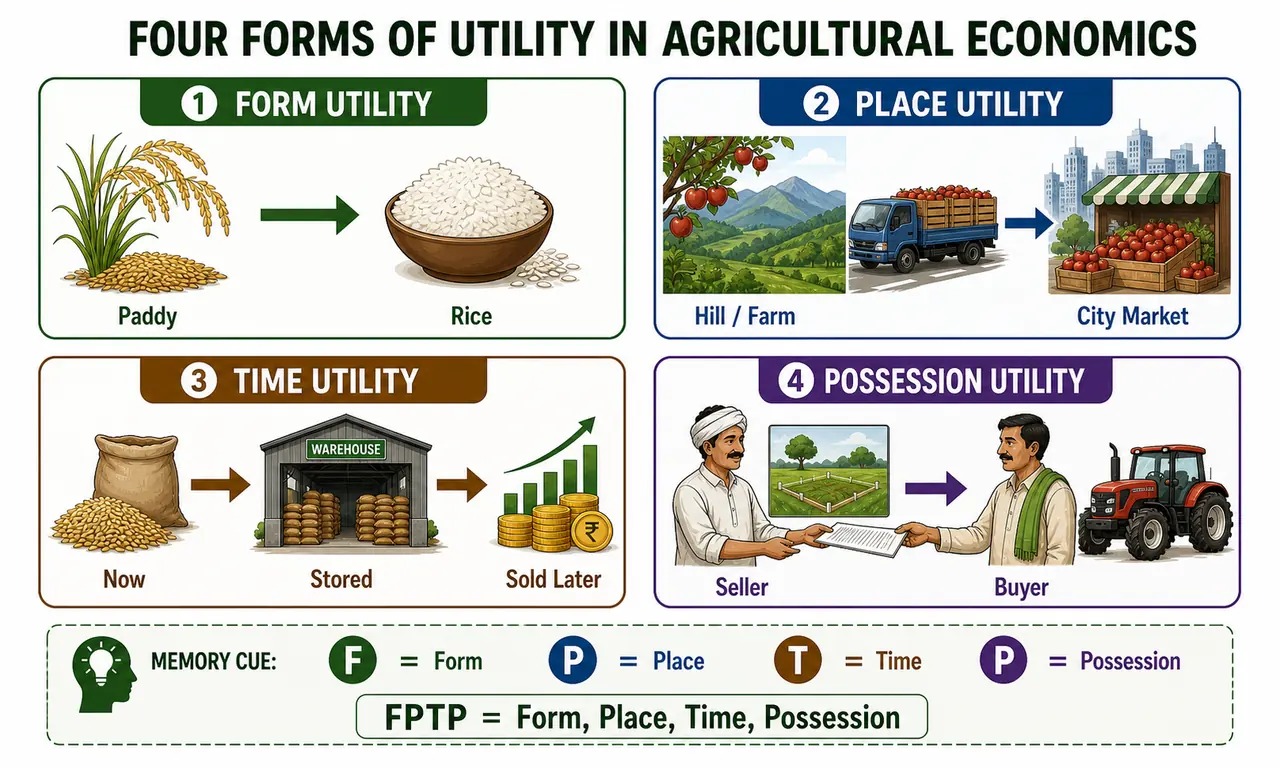
Exam Tip: Questions often ask "Which type of utility does transportation create?" — Answer: Place utility.
Cardinal vs Ordinal Utility
| Feature | Cardinal Utility | Ordinal Utility |
|---|---|---|
| Can utility be measured? | Yes, in numerical units ("utils") | No, only ranked (1st, 2nd, 3rd preference) |
| Example | Coffee = 100 utils, Tea = 50 utils (coffee is twice as desirable) | Coffee is preferred over tea (no magnitude) |
| Limitation | Highly subjective — hard to assign exact numbers | Cannot compare intensity of preference |
| Considered | Less realistic | More realistic |
| Associated laws | LDMU, Equi-Marginal Utility, Consumer Surplus | Indifference Curve Analysis |
Value, Price, and Wealth
Value
Value in economics means value-in-exchange — the capacity of a good to command other goods in exchange.
Three conditions for a good to have value:
- It must possess utility (satisfy some want)
- It must be scarce (limited availability)
- It must be transferable (capable of being exchanged)
Price
- In ancient barter systems, goods were exchanged for goods — value and price were the same thing.
- Today, value expressed in monetary terms is price.
- Barter failed because it required a double coincidence of wants — both parties needed what the other offered. Money solved this as a universal medium of exchange.
Agricultural example: A farmer values his 1 quintal of wheat at 3 kg of jaggery (barter value). In monetary terms, 1 quintal of wheat = Rs 2,275 (MSP price).
Wealth
In economics, wealth is not just money — it means anything that has value.
"Wealth consists of all potentially exchangeable means of satisfying human wants." — J.M. Keynes
Four characteristics of wealth:
- Possesses utility
- Is scarce
- Is transferable
- Is external to the person (personal qualities like intelligence are NOT wealth)
Key Relationships
| Relationship | Rule | Example |
|---|---|---|
| Money and Wealth | All money is wealth, but all wealth is not money | Land is wealth but not money |
| Income and Wealth | Wealth is a stock (fund); Income is a flow | Agricultural land (wealth) generates crop revenue (income) each season |
Analogy: Think of wealth as a reservoir and income as the stream flowing from it.
Types of Wealth
| Type | Meaning | Example |
|---|---|---|
| Individual Wealth | Personal tangible and intangible possessions | Farm land, bonds, patents |
| Social Wealth | Collectively used by all citizens | Irrigation canals, public mandis, government agricultural universities |
| Representative Wealth | Title deeds representing real assets | Share certificates, warehouse receipts |
| National Wealth | Individual + Social wealth minus national debts | Rivers, forests, mineral resources |
| Cosmopolitan Wealth | Sum total of all nations' wealth | Global agricultural output |
| Negative Wealth | Debts owed by individuals or the nation | Farm loans, national debt |
Exam Tip: National Wealth = Individual Wealth + Social Wealth - National Debts. Do not forget the deduction.
Wealth vs Welfare
| Wealth | Welfare |
|---|---|
| It is the means to an end. | It is the end itself |
| It is objective. | It is subjective. |
| It includes harmful goods. | It does not include harmful goods. |
| It does not include free goods. | Free and economic goods lead to welfare. |
Human Wants
Wants are the starting point of all economic activity. Without wants, there is no need for production, exchange, or consumption.
Economic activity: Wants --> Production --> Exchange --> Consumption (the end point)
Characteristics of Human Wants
| Characteristic | Meaning | Agricultural Example |
|---|---|---|
| Unlimited | We always desire more | A farmer buys a tractor, then wants a harvester, then a cold storage |
| Recurring | Satisfied wants reappear | Hunger returns daily; fertilizer is needed every season |
| Satiable (individually) | Any single want can be fully satisfied at a given time | Thirst is quenched after drinking enough water |
| Complementary | Some wants go together | Tractor and diesel; pen and paper |
| Competitive | Satisfying one may mean sacrificing another | Limited budget: buy fertilizer OR pesticide? |
| Alternative means | One want, multiple solutions | Hunger can be satisfied by rice, roti, or fruit |
Classification of Wants
Necessaries
Goods that must be consumed. Three sub-types:
| Sub-type | Meaning | Example |
|---|---|---|
| Necessaries of Existence | Bare minimum for survival | Food, water, shelter |
| Necessaries of Efficiency | Improve performance | Nutritious diet for a farm labourer, good classroom ventilation |
| Conventional Necessaries | Arise from custom or habit | Festival celebrations, tea/coffee habit |
Comforts
Goods that fall between necessaries and luxuries — not essential but increase efficiency and pleasure.
Example: Cushioned chair, ceiling fan, a motorcycle for commuting to the field.
Luxuries
Goods that satisfy superfluous wants — neither essential nor efficiency-boosting.
| Sub-type | Meaning | Example |
|---|---|---|
| Harmless Luxuries | No negative effects | Furnished bungalow, expensive food |
| Harmful Luxuries | Detrimental to health | Alcohol, tobacco |
| Defense Luxuries | Store of value for emergencies | Gold ornaments, jewellery |
Mnemonic for Wants Classification — NCL: Necessaries (existence, efficiency, conventional), Comforts, Luxuries (harmless, harmful, defense).
Law of Diminishing Marginal Utility (LDMU)
Two Approaches to Consumer Behaviour
| Approach | Also Called | Can Utility Be Measured? | Key Laws |
|---|---|---|---|
| Utility Analysis | Cardinal / Marshallian | Yes | LDMU, Equi-Marginal Utility, Consumer Surplus |
| Indifference Curve | Ordinal | No (only ranked) | Indifference Curve Analysis |
The Law
Given by German economist H.H. Gossen (also called Gossen's First Law).
Statement: As a consumer consumes more and more units of a commodity, the additional (marginal) utility from each successive unit decreases.
Marshall's definition:
"The additional benefit a person derives from a given increase of his stock of anything diminishes with the growth of the stock he has."
Agricultural example: A thirsty farmer drinks glasses of water after working in the field:
- 1st glass: Immense satisfaction (MU = 10)
- 2nd glass: Good, still thirsty (MU = 7)
- 3rd glass: Okay (MU = 4)
- 4th glass: Barely needed (MU = 1)
- 5th glass: Does not want it (MU = 0 — point of saturation)
- 6th glass: Feels sick (MU = -2 — negative utility)
Key Definitions
- Marginal Utility (MU): The additional satisfaction from consuming one more unit.
- Total Utility (TU): The cumulative satisfaction from all units consumed.
Formula: MUa = TUa - TU(a-1)
Assumptions of LDMU
- Single commodity with homogeneous (identical) units
- No change in consumer's taste, habit, income, or fashion
- Continuous consumption — units consumed in quick succession
- Units must be of suitable size (not too small, not too large)
- Prices of the commodity and its substitutes remain constant
- Commodity must be divisible
- Consumer is rational (seeks to maximize satisfaction)
- Goods must be normal goods
Mnemonic — HCTSPRDN: Homogeneous, Continuous, Taste unchanged, Suitable size, Price constant, Rational consumer, Divisible, Normal goods.
Graphical Representation
| Units of Apple Consumed | Total utility | Marginal utility |
|---|---|---|
| 0 | 0 | - |
| 1 | 70 | 70 |
| 2 | 110 | 40 |
| 3 | 130 | 20 |
| 4 | 140 | 10 |
| 5 | 145 | 0 |
| 6 | 140 | -5 |
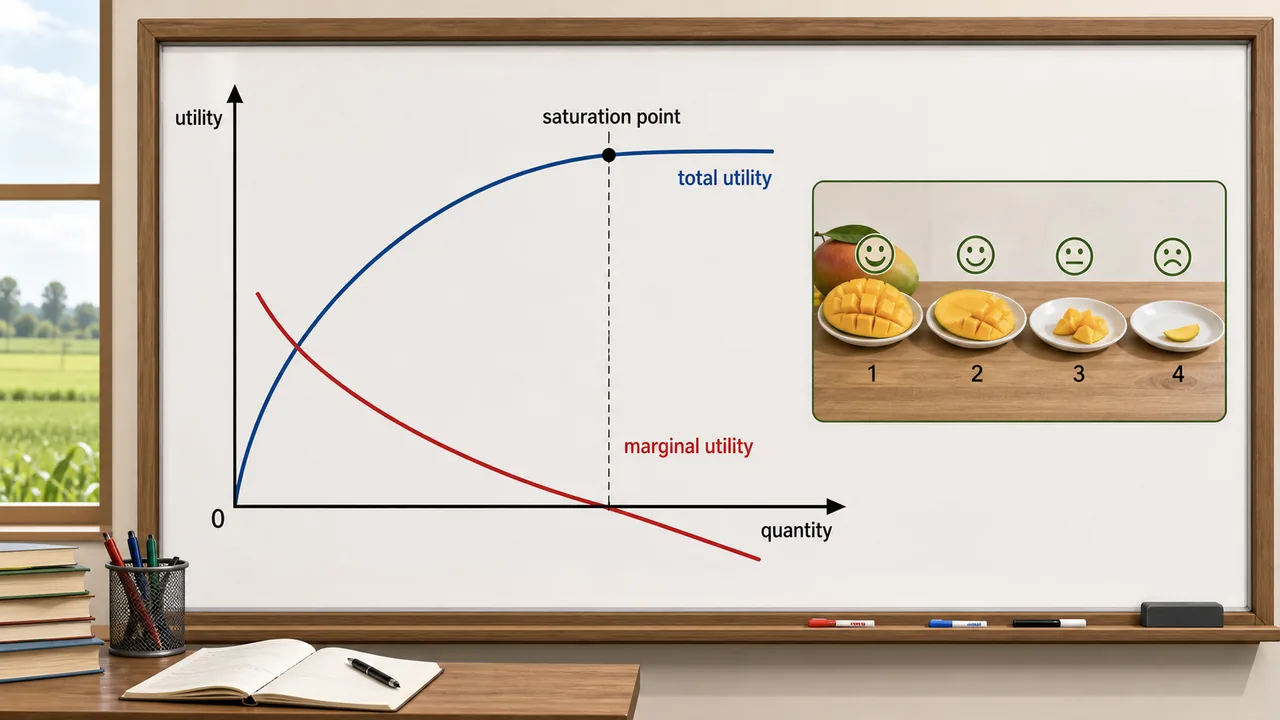
Key observations from the graph:
- TU curve starts at origin (zero consumption = zero utility)
- TU reaches its maximum at point M, where MU = 0 (point of saturation)
- MU curve falls throughout and becomes negative after the saturation point
- After saturation, consuming more actually reduces total utility
Importance of LDMU
| Application | How LDMU Applies |
|---|---|
| Foundation of consumer theory | Law of Demand, Equi-Marginal Utility, and Consumer Surplus are all built on LDMU |
| Variety in consumption | Diminishing MU drives consumers to seek variety rather than consuming only one good |
| Price-supply relationship | When supply of a good increases, its MU falls, so its price falls |
| Diamond-Water Paradox | Water: high TU but low MU (abundant) = low price. Diamonds: low TU but high MU (scarce) = high price |
| Progressive taxation | As income rises, MU of money falls — so higher income can be taxed at higher rates without proportional hardship |
| Wealth redistribution | Rs 100 gives more utility to a poor farmer than to a wealthy landlord — supports equitable distribution |
Exam Tip: The Diamond-Water Paradox (Adam Smith) is a favourite exam question. Remember: price depends on marginal utility, not total utility.
Exceptions to LDMU
| Exception | Why LDMU Fails | Example |
|---|---|---|
| Hobbies | Passion and emotional attachment override the law | Stamp collecting — each new stamp adds more joy |
| Addiction | Craving increases with each dose | Alcohol — each drink increases desire for the next |
| Misers | Greed increases with each additional unit of money | Accumulating wealth gives increasing satisfaction |
| Reading | Cumulative knowledge makes each new book more rewarding | A student's 10th book on agriculture is more useful than the 1st |
Marginal utility of money is always positive. (UPPSC 2021)
Law of Equi-Marginal Utility (LEMU)
Also called Gossen's Second Law.
A consumer reaches equilibrium (maximum satisfaction) when he distributes his limited income across goods such that the marginal utility from the last rupee spent on each good is equal.
Agricultural example: A farmer has Rs 10,000 to spend. He should allocate between seeds, fertilizer, and pesticide such that the last rupee spent on each input gives him the same additional output. If the last Rs 100 on fertilizer gives more output than the last Rs 100 on pesticide, he should shift spending toward fertilizer.
Practical Applications of LEMU
| Field | Application | Example |
|---|---|---|
| Consumption | Consumer equalizes MU per rupee across all goods | Household budget allocation |
| Production | Producer finds the least-cost combination of inputs | Substituting labour for machinery until marginal returns equalize |
| Exchange | Trade occurs because both parties increase utility | Farmer trades surplus wheat for oil |
| Distribution | Each factor of production is paid according to its marginal contribution | Wages = marginal productivity of labour |
| Public Finance | Government allocates budget so the last rupee on education = last rupee on healthcare | Union Budget allocation across ministries |
Consumer Surplus
Consumer Surplus = What you are willing to pay - What you actually pay
Marshall's definition:
"The excess of the price which he would be willing to pay rather than go without the thing, over that which he actually does pay, is the economic measure of this surplus satisfaction."
Agricultural example: A farmer is willing to pay Rs 50/kg for quality seeds but the market price is Rs 35/kg. His consumer surplus = Rs 15/kg.
Importance of Consumer Surplus
| Application | Explanation |
|---|---|
| Index of economic well-being | Higher consumer surplus suggests consumers are better off |
| Monopolist pricing | A monopolist can raise prices on goods with high consumer surplus without losing many sales |
| Taxation policy | Government can impose higher taxes on goods with high consumer surplus (demand stays strong) |
| International trade | Cheaper imports increase consumer surplus — consumers get goods below what they would have paid domestically |
Indifference Curve
An indifference curve shows different combinations of two goods (X and Y) that give the consumer equal satisfaction. The consumer is "indifferent" between any two points on the same curve.
- Based on the ordinal concept of utility — no numerical measurement needed, only ranking of preferences.
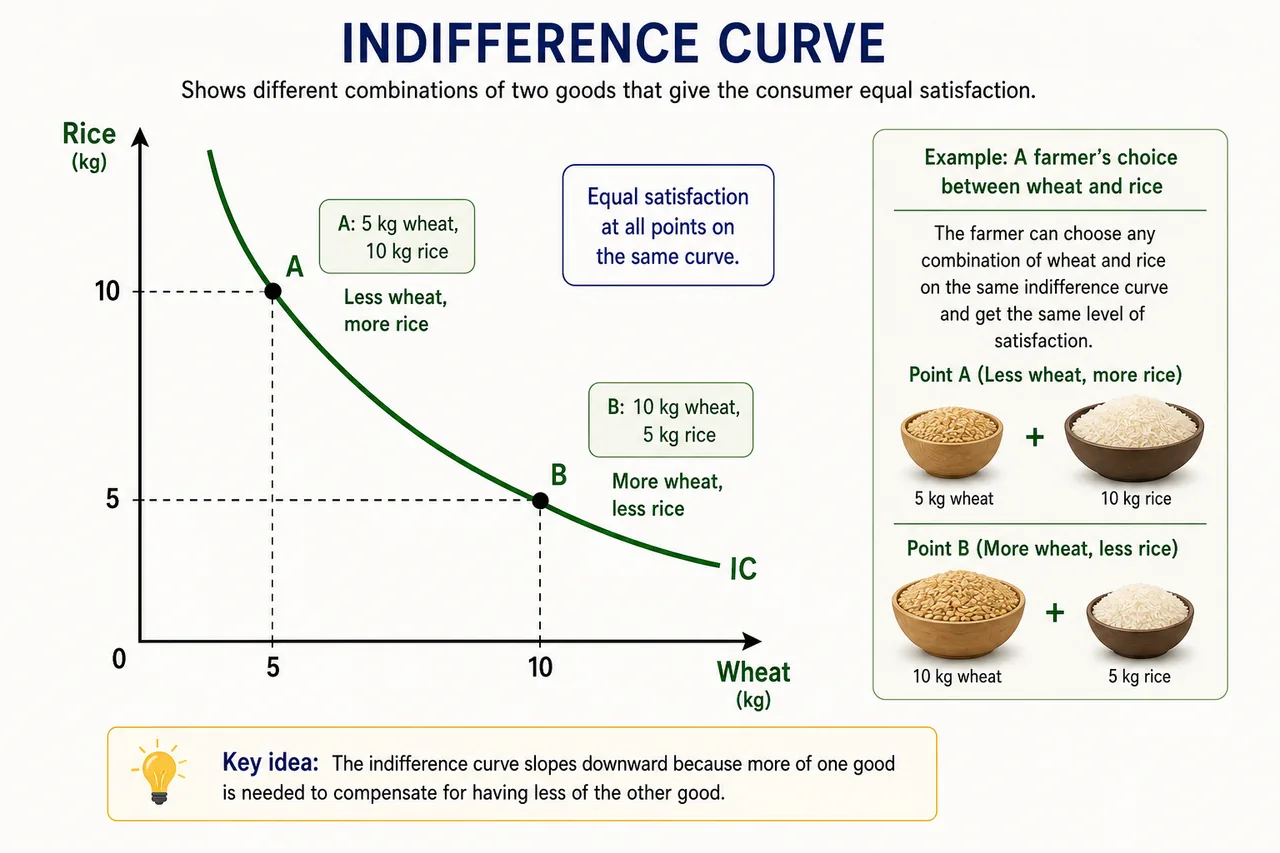
Agricultural example: A farmer may be equally happy with:
- 5 kg of wheat + 2 kg of rice, OR
- 3 kg of wheat + 4 kg of rice
Both combinations lie on the same indifference curve because they provide equal satisfaction.
Summary Cheat Sheet
| Concept | Core Idea | Key Person / Law | Exam Keyword |
|---|---|---|---|
| Goods | Tangible, satisfy wants | — | Tangible, material outcome |
| Services | Intangible, inseparable, perishable | — | INVP (Intangible, Non-materialistic, Variable, Perishable) |
| Free vs Economic Goods | Scarcity determines value | — | Free = value-in-use only; Economic = both |
| Utility | Power to satisfy a want | — | Subjective, not equal to satisfaction |
| Form / Place / Time / Possession Utility | FPTP — four ways value is added | — | Processing, Transport, Storage, Ownership |
| Cardinal vs Ordinal | Measurable vs Rankable | Marshall vs Hicks | Cardinal = numbers; Ordinal = order |
| Value | Value-in-exchange | — | Utility + Scarcity + Transferability |
| Wealth | Anything that has value | J.M. Keynes | External to person |
| Money vs Wealth | All money is wealth, not vice versa | — | Stock vs Flow |
| LDMU | Each extra unit gives less MU | H.H. Gossen (First Law) | MU falls, TU max when MU = 0 |
| Diamond-Water Paradox | Price depends on MU, not TU | Adam Smith | Scarcity drives MU |
| LEMU | Equalize MU per rupee across goods | Gossen (Second Law) | Consumer equilibrium |
| Consumer Surplus | Willingness to pay minus actual price | Alfred Marshall | Taxation, monopoly pricing |
| Indifference Curve | Equal satisfaction combinations | Ordinal approach | Ranking, not measuring |
Quick Revision Mnemonics
| Mnemonic | Stands For |
|---|---|
| FPTP | Form, Place, Time, Possession (types of utility) |
| NCL | Necessaries, Comforts, Luxuries (classification of wants) |
| INVP | Intangible, Non-materialistic, Variable, Perishable (features of services) |
| HCTSPRDN | Homogeneous, Continuous, Taste unchanged, Suitable size, Price constant, Rational, Divisible, Normal goods (LDMU assumptions) |