🙋🏼Demand and Supply — Core Concepts for Agricultural Economics
Master demand, supply, elasticity, and their agricultural applications. Covers law of demand, types of demand, elasticity measures, supply determinants, and exam-ready mnemonics for banking and agriculture competitive exams.
Introduction: Why Demand and Supply Matter in Agriculture
Imagine a wheat farmer in Punjab. After a bumper harvest, wheat floods the local mandi. Prices drop. Consumers buy more rotis and less rice. Meanwhile, a drought in Maharashtra reduces onion supply, and onion prices skyrocket across India. These everyday agricultural realities are governed by two fundamental forces: demand and supply.
Understanding these concepts is essential not only for economics exams but also for grasping how agricultural markets, government procurement, MSP decisions, and food security policies actually work.
Part 1: Demand
What Is Demand?
Demand is not merely a desire or wish. In economics, demand means the quantity of a good that a buyer is willing and able to purchase at a given price during a specific time period.
Agricultural example: A farmer wants a new tractor (desire). But desire alone is not demand. Only when the farmer has both the willingness and the money (purchasing power) to buy the tractor does it become demand.
Three Essential Characteristics of Demand
| Characteristic | Meaning | Agricultural Example |
|---|---|---|
| Willingness + Ability to pay | The buyer must want the good AND have the money | A dairy farmer wants cattle feed and can afford it |
| At a price | Demand is always stated at a specific price | ”50 kg of urea at Rs 270/bag” — not just “urea” |
| Per unit of time | Demand refers to a specific time period | ”200 quintals of rice per month” — not just “rice” |
Exam Tip: Remember the mnemonic WAP — Willingness, Ability to pay, Price and time period. All three must be present for valid demand.
Individual Demand vs Market Demand
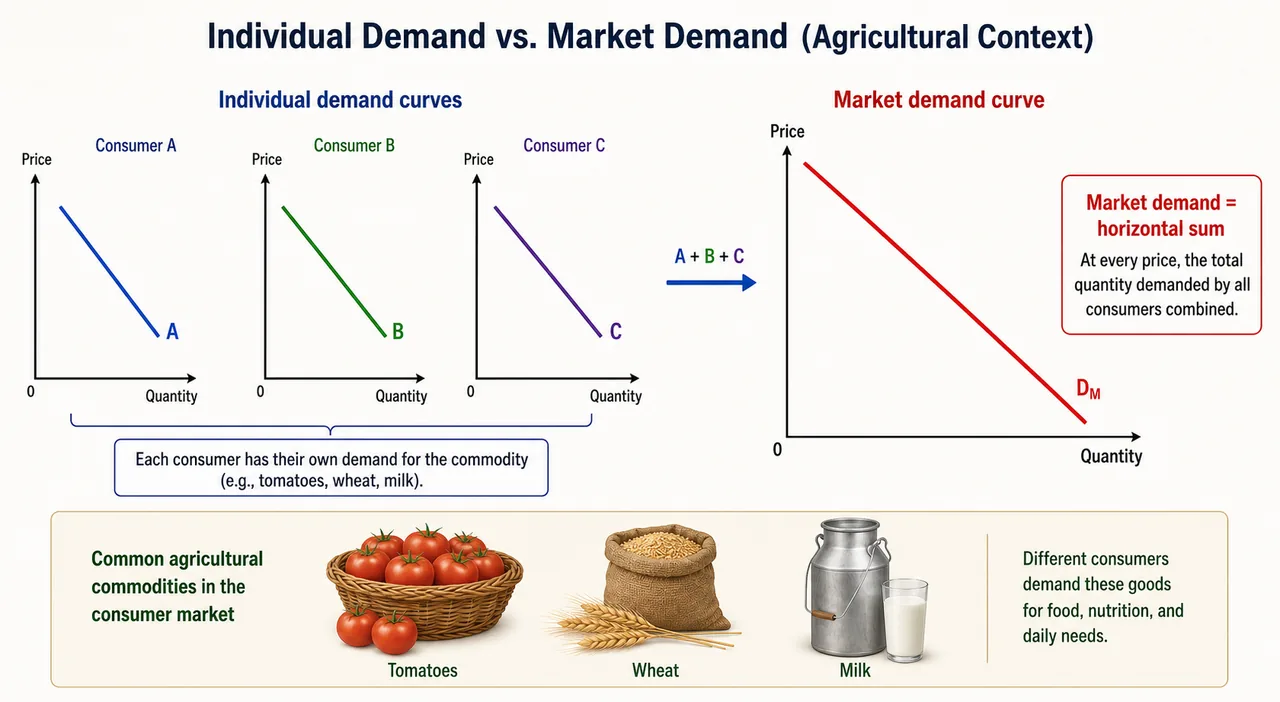
Individual demand is the quantity one buyer is willing to purchase at each price level.
Market demand is the horizontal summation of all individual demands at each price level.
Agricultural example: At Rs 40/kg for tomatoes:
- Household A demands 3 kg
- Household B demands 5 kg
- Household C demands 2 kg
- Market demand = 3 + 5 + 2 = 10 kg
At each price, we sum up quantities demanded by every buyer to get market demand.
Demand Schedule and Demand Curve
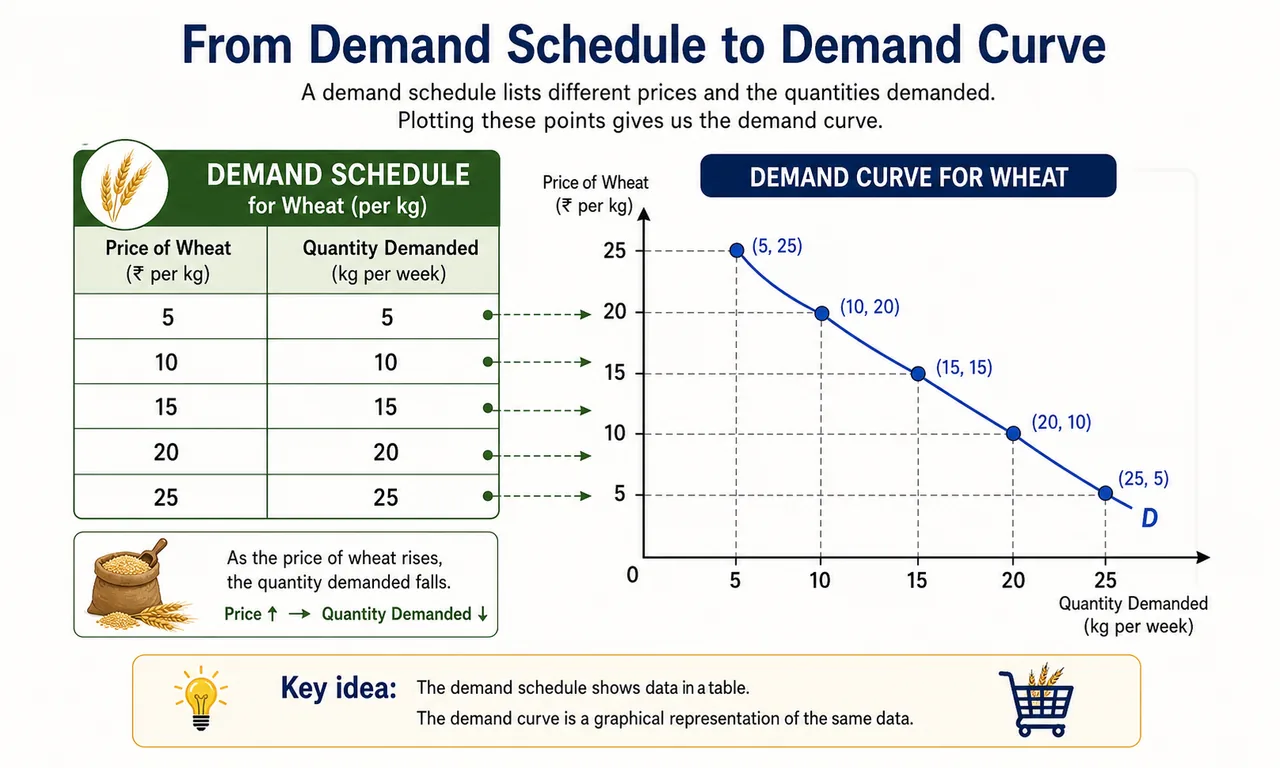
A demand schedule is a table showing quantities demanded at various prices.
| Price of Wheat (Rs/kg) | Quantity Demanded (kg/week) |
|---|---|
| 30 | 100 |
| 25 | 150 |
| 20 | 220 |
| 15 | 300 |
A demand curve is the graphical representation of a demand schedule. It plots price on the vertical axis and quantity on the horizontal axis. Each point on the curve shows the maximum quantity buyers will purchase at that price.
Types of Demand
1. Price Demand
The quantities of a good a consumer is willing to buy at all possible prices, other things remaining constant. This is the most commonly studied form and forms the basis of the demand curve.
Example: How much rice will consumers buy at Rs 40/kg vs Rs 50/kg vs Rs 60/kg?
2. Income Demand
The quantities a consumer is willing to buy at different levels of income, other things remaining constant.
- Normal goods: Demand rises with income (e.g., fruits, dairy products)
- Inferior goods: Demand falls as income rises (e.g., coarse grains like bajra replaced by wheat/rice as income grows)
3. Cross Demand
Demand for a good changes not because of its own price but because of a change in the price of a related good.
Example: When the price of mustard oil rises, consumers switch to sunflower oil. Demand for sunflower oil increases — this is cross demand.
4. Derived Demand
Demand that arises not for the good itself but because it is needed to produce a final product.
Agricultural example: Demand for fertilizers is derived from the demand for food grains. Demand for jute is derived from the demand for jute bags and sacking.
5. Autonomous Demand
Demand that exists independently, for direct consumption, not linked to any other product.
Example: Demand for food grains, vegetables, and milk — these are consumed for their own sake.
| Type | Depends On | Agricultural Example |
|---|---|---|
| Price demand | Price of the good itself | Rice at different price levels |
| Income demand | Consumer’s income level | Shift from millets to wheat as income rises |
| Cross demand | Price of related goods | Mustard oil price rise increases sunflower oil demand |
| Derived demand | Demand for the final product | Fertilizer demand derived from crop demand |
| Autonomous demand | Direct consumer need | Demand for vegetables |
Law of Demand
The law of demand states: as price increases, quantity demanded decreases, and vice versa (other things remaining constant).
In short: price and quantity demanded move in opposite directions.
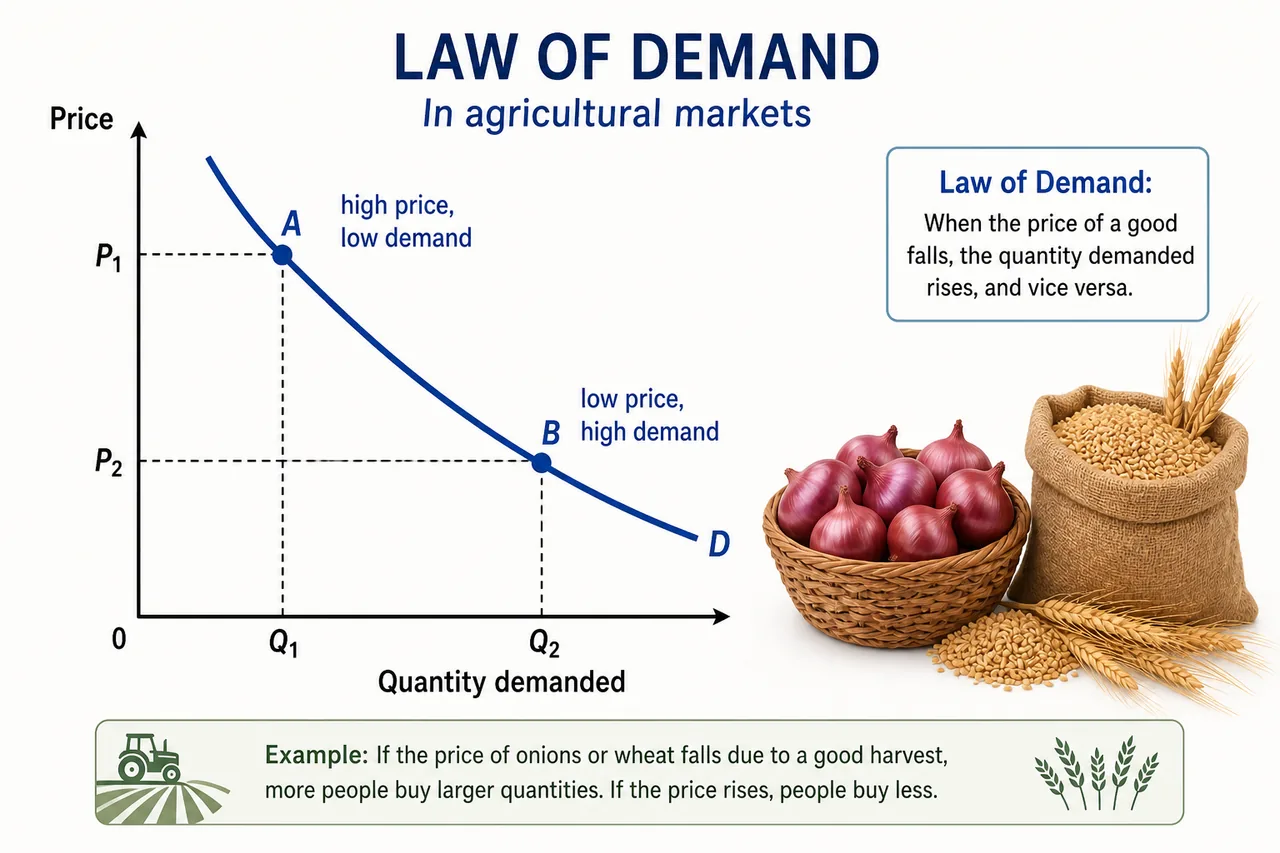
As price falls from PA to PB, quantity demanded increases from QA to QB. The demand curve slopes downward from left to right (negative slope).
Exam Tip: The demand curve slopes downward because of three effects — ISL: Income effect, Substitution effect, Law of diminishing marginal utility.
Why Does the Demand Curve Slope Downward?
1. Income Effect
When the price of wheat falls from Rs 30/kg to Rs 20/kg, a consumer’s purchasing power effectively increases. With the same budget, they can now buy more wheat or spend the savings elsewhere. A price drop makes the consumer “effectively richer.”
2. Substitution Effect
When the price of pulses falls while the price of chicken remains the same, pulses become relatively cheaper. Consumers substitute pulses for chicken, increasing the quantity of pulses demanded. Consumers naturally shift towards the relatively cheaper option.
3. Law of Diminishing Marginal Utility
Each additional unit of a good gives less satisfaction than the previous one. A consumer will buy more units only if the price falls to match the declining marginal utility. This is the fundamental reason behind the law of demand.
Changes in Demand: Movement vs Shift
This distinction is critical for exams.
| Feature | Movement Along the Curve | Shift of the Curve |
|---|---|---|
| Cause | Change in the good’s own price | Change in any factor OTHER than price |
| Curve position | Stays the same | Moves left or right |
| Terminology | Extension (price falls) / Contraction (price rises) | Increase (rightward) / Decrease (leftward) |
| Example | Potato price drops from Rs 30 to Rs 20, quantity demanded rises | Government launches “Eat Millets” campaign, millet demand increases at every price |
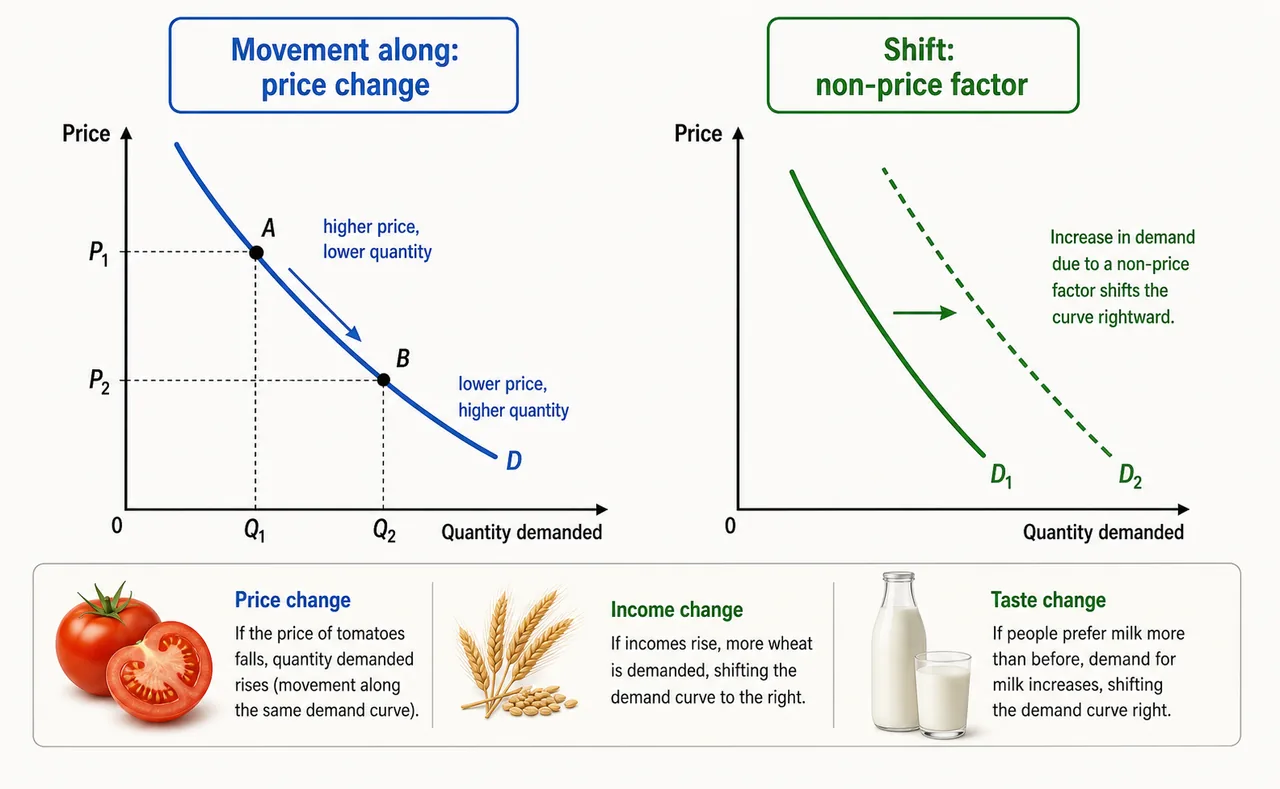
Key Rule: Movement along = price change only. Shift = everything else (income, tastes, related goods’ prices, expectations).
Determinants of Demand
| Determinant | Effect on Demand | Agricultural Example |
|---|---|---|
| Price of the good | Inverse relationship (law of demand) | Higher rice price reduces rice demand |
| Price of substitutes | Direct relationship | Tur dal price rises, consumers buy more moong dal |
| Price of complements | Inverse relationship | Tractor price rises, demand for diesel (used with tractors) falls |
| Income | Direct for normal goods; inverse for inferior goods | Rising rural income increases demand for fruits; decreases demand for coarse grains |
| Tastes and preferences | Shifts demand curve | Growing health awareness increases demand for organic produce |
| Future price expectations | Speculative buying or postponement | Farmers hoard onions expecting future price rise |
Exceptions to the Law of Demand
In these cases, demand does NOT follow the inverse price-quantity relationship:
| Exception | Explanation | Example |
|---|---|---|
| Giffen Goods | Inferior goods where a strong negative income effect overpowers the substitution effect; demand rises as price rises | Poor families buy more bajra when its price rises because they can no longer afford wheat |
| Veblen Goods (status symbols) | Higher price increases the good’s prestige value | Expensive Basmati rice varieties seen as status symbols |
| Speculative buying | Expectation of future price increase causes hoarding | Traders stock up on pulses when prices begin rising, expecting further increases |
Exam Tip — Giffen’s Paradox: Named after Sir Robert Giffen, who observed that poor English families bought MORE bread when its price rose (they could no longer afford meat). In Indian agriculture, the same logic applies to coarse cereals for poor households.
Part 2: Elasticity of Demand
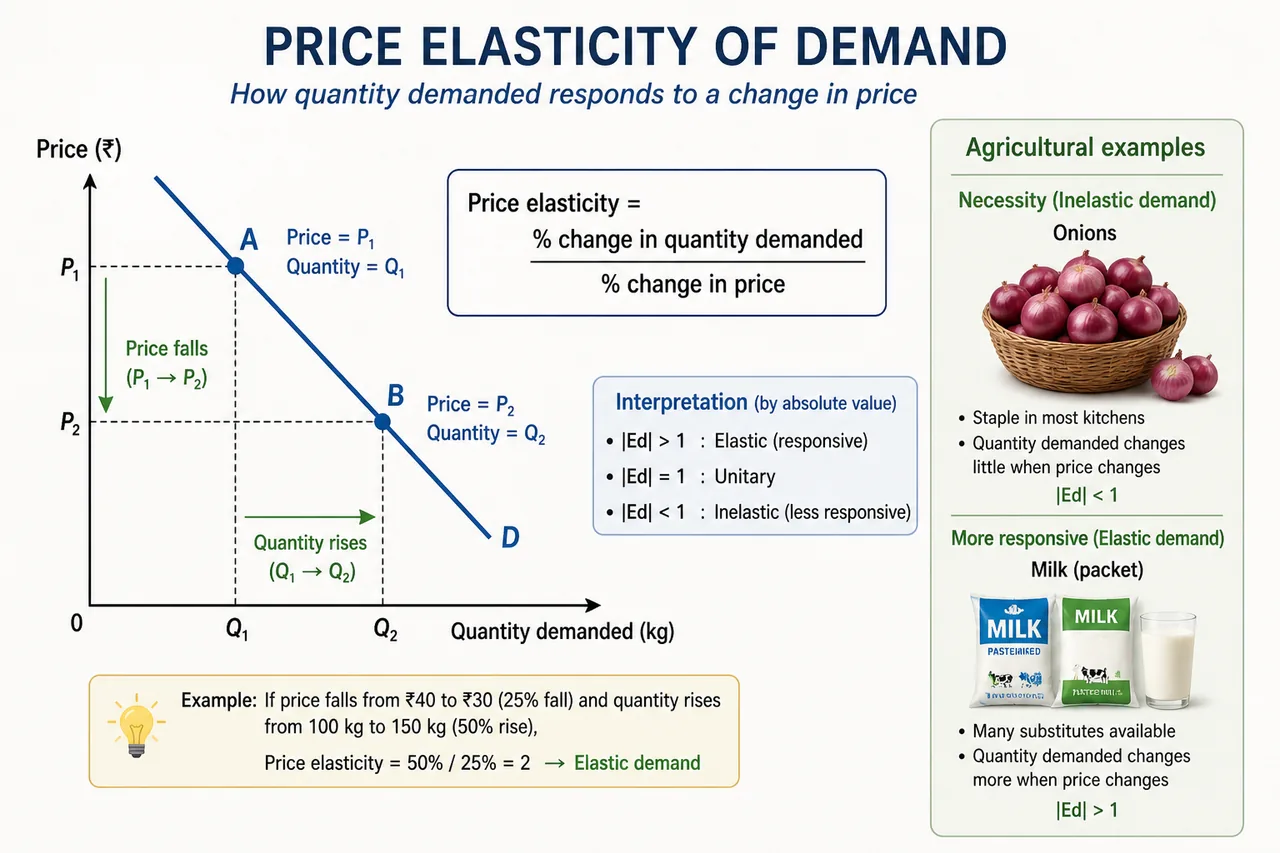
Elasticity measures how responsive quantity demanded is to a change in a particular factor. It goes beyond direction (up or down) to quantify the magnitude of response.
Price Elasticity of Demand
Price elasticity = Percentage change in quantity demanded / Percentage change in price
It answers: “If price changes by 1%, by what percentage does quantity demanded change?”
Income Elasticity of Demand
Income elasticity = Percentage change in quantity demanded / Percentage change in income
- Positive for normal goods (demand rises with income)
- Negative for inferior goods (demand falls as income rises)
- High for luxuries (demand grows faster than income)
- Low for necessities (demand grows slower than income)
Example: As rural income rises, demand for milk (normal good, moderate income elasticity) increases steadily, while demand for coarse millets (inferior good, negative income elasticity) falls.
Cross Elasticity of Demand
Cross elasticity = Percentage change in demand of Good A / Percentage change in price of Good B
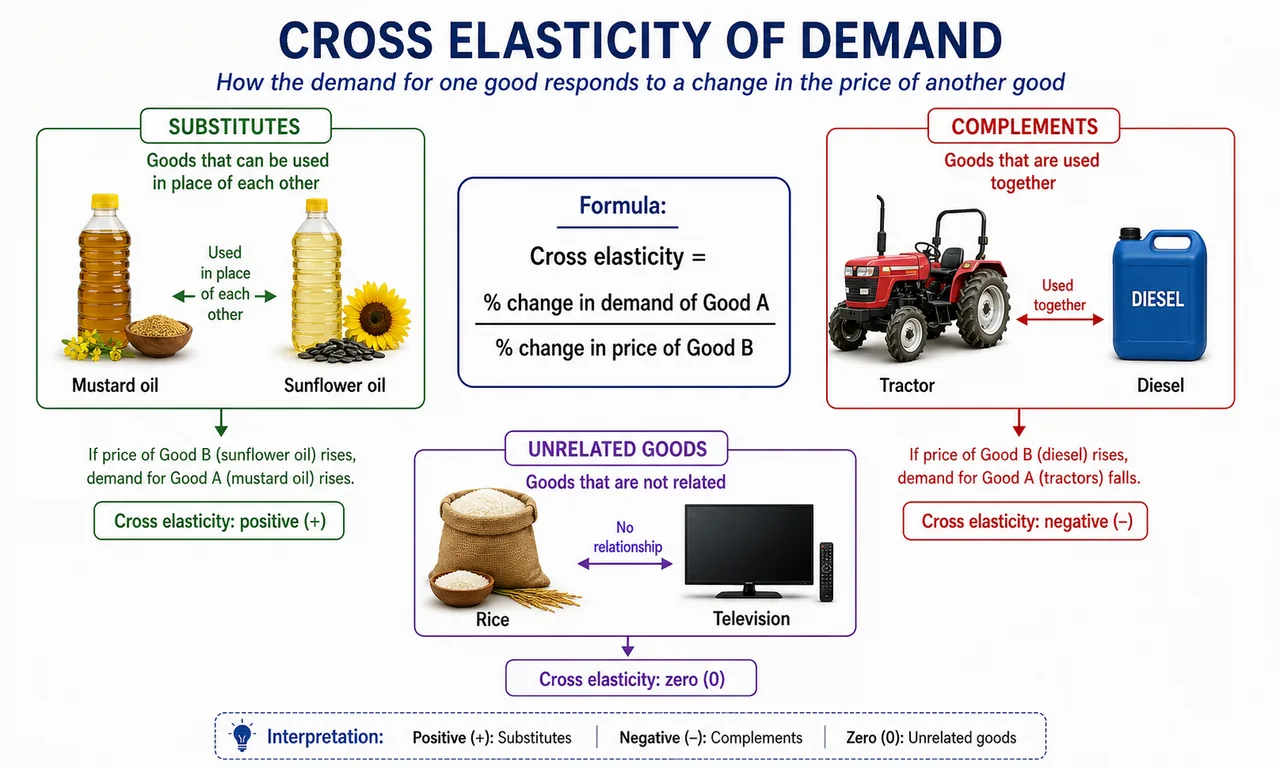
| Relationship | Cross Elasticity | Example |
|---|---|---|
| Substitutes | Positive (+) | Mustard oil and sunflower oil |
| Complements | Negative (−) | Tractors and diesel |
| Unrelated goods | Zero (0) | Rice and televisions |
Methods of Measuring Elasticity
| Method | Description | When to Use |
|---|---|---|
| Point elasticity | Measured at a single point on the demand curve | Small/precise price changes |
| Arc elasticity | Measured between two points on the demand curve (average elasticity over a range) | Large price changes |
Degrees of Price Elasticity of Demand
| Degree | Value | Demand Curve Shape | Example |
|---|---|---|---|
| Perfectly inelastic | E = 0 | Vertical line | Essential seeds during sowing season (no substitute) |
| Perfectly elastic | E = infinity | Horizontal line | Wheat sold in a perfectly competitive mandi (identical quality) |
| Unitary elastic | E = 1 | Rectangular hyperbola | Total expenditure stays constant as price changes |
| Relatively elastic | E > 1 | Flatter curve | Exotic fruits, luxury agricultural products |
| Relatively inelastic | 0 < E < 1 | Steeper curve | Food grains, salt, essential vegetables |
Exam Mnemonic — PURRE (degrees of elasticity): Perfectly inelastic, Unitary, Relatively elastic, Relatively inelastic, Perfectly Elastic.
Factors Determining Price Elasticity of Demand
| Factor | Effect | Agricultural Example |
|---|---|---|
| Degree of necessity | Necessities have inelastic demand | Wheat, rice, salt — bought regardless of price |
| Availability of substitutes | More substitutes = more elastic | Groundnut oil (many cooking oil substitutes) is more elastic than salt (no substitute) |
| Proportion of income spent | Larger share = more elastic | A tractor (large % of income) has more elastic demand than matchboxes |
| Time period | Long run = more elastic | Farmers can switch crops in the next season if input prices stay high |
| Number of uses | More uses = more elastic | Sugarcane (sugar, jaggery, ethanol, bagasse) has elastic demand |
Practical Importance of Elasticity of Demand
| Application | How Elasticity Helps | Example |
|---|---|---|
| Taxation policy | Taxing inelastic goods generates more revenue with less reduction in sales | Government taxes on tobacco, liquor |
| Price discrimination by monopolists | Charge higher price where demand is inelastic | APMC mandis charging different fees for essential vs luxury produce |
| Business pricing | Lower price if demand is elastic; raise price if inelastic | Organic food brands lower prices to expand market share |
| Trade unions and wages | Workers in inelastic-demand industries have more bargaining power | Dairy workers can push for higher wages since milk demand is inelastic |
| International trade | Terms of trade depend on elasticity of imports/exports | Marshall-Lerner condition: devaluation improves trade balance only if sum of import and export elasticities exceeds 1 |
| Government agricultural policy | MSP and procurement decisions consider elasticity | Government procures wheat/rice (inelastic demand) to stabilize prices |
| Advertising decisions | More spending on ads when demand is elastic | Organic food companies invest heavily in marketing |
| Factor pricing | Factors with inelastic demand command higher prices | Scarce agricultural land near cities earns premium rent |
Part 3: Supply
What Is Supply?
Supply is the quantity of a good that sellers are willing and able to offer for sale at different prices during a specific time period.
Agricultural example: A rice miller is willing to supply 500 quintals of rice per month at Rs 35/kg but only 300 quintals at Rs 28/kg.
Supply vs Stock
| Feature | Supply | Stock |
|---|---|---|
| Definition | Quantity actually brought to market for sale at a given price | Total quantity available (whether offered for sale or not) |
| Relationship to market | Active portion offered for sale | Total inventory held by producers |
| For perishable goods | Supply = Stock (must sell quickly) | Vegetables, fruits, fish — cannot be stored long |
| For durable goods | Supply may be less than stock | A wheat trader may hold back stock expecting higher prices later |
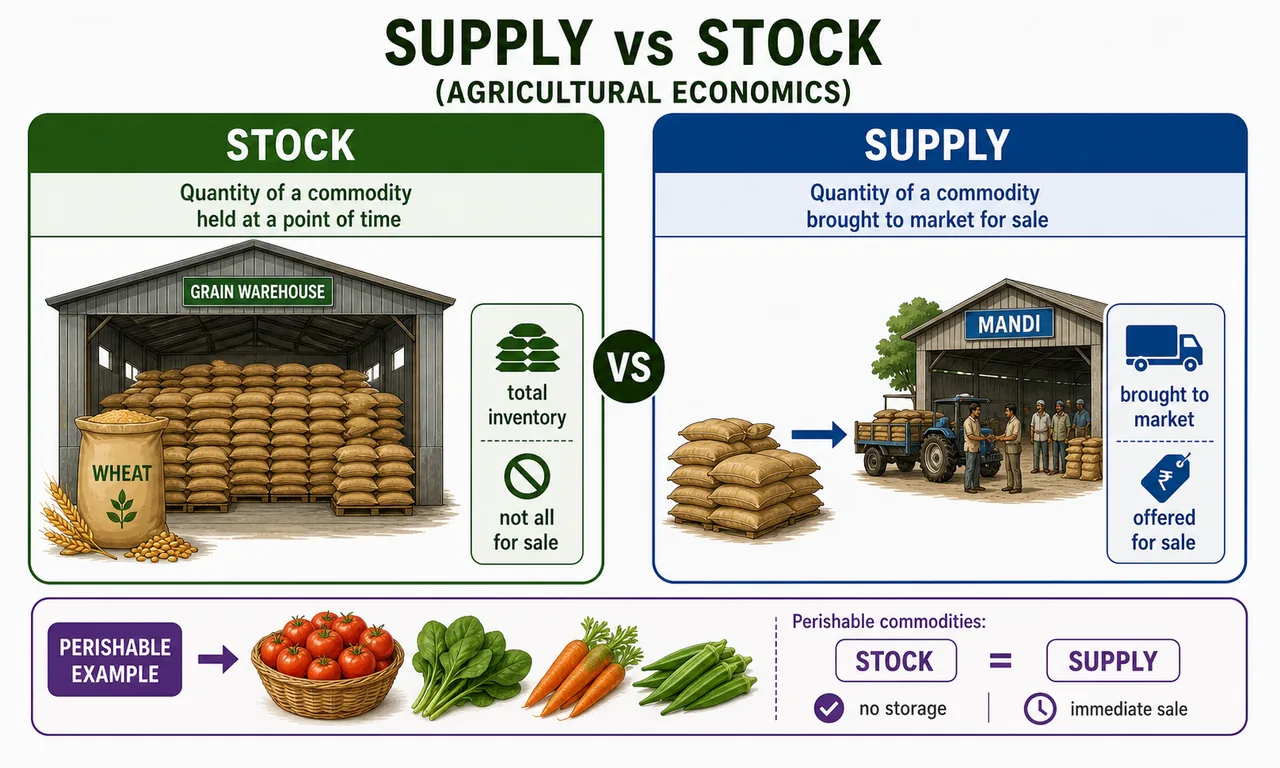
Agricultural insight: During harvest season, farmers often hold back grain stock if current mandi prices are below MSP, waiting for government procurement. Here, stock is large but supply is deliberately restricted.
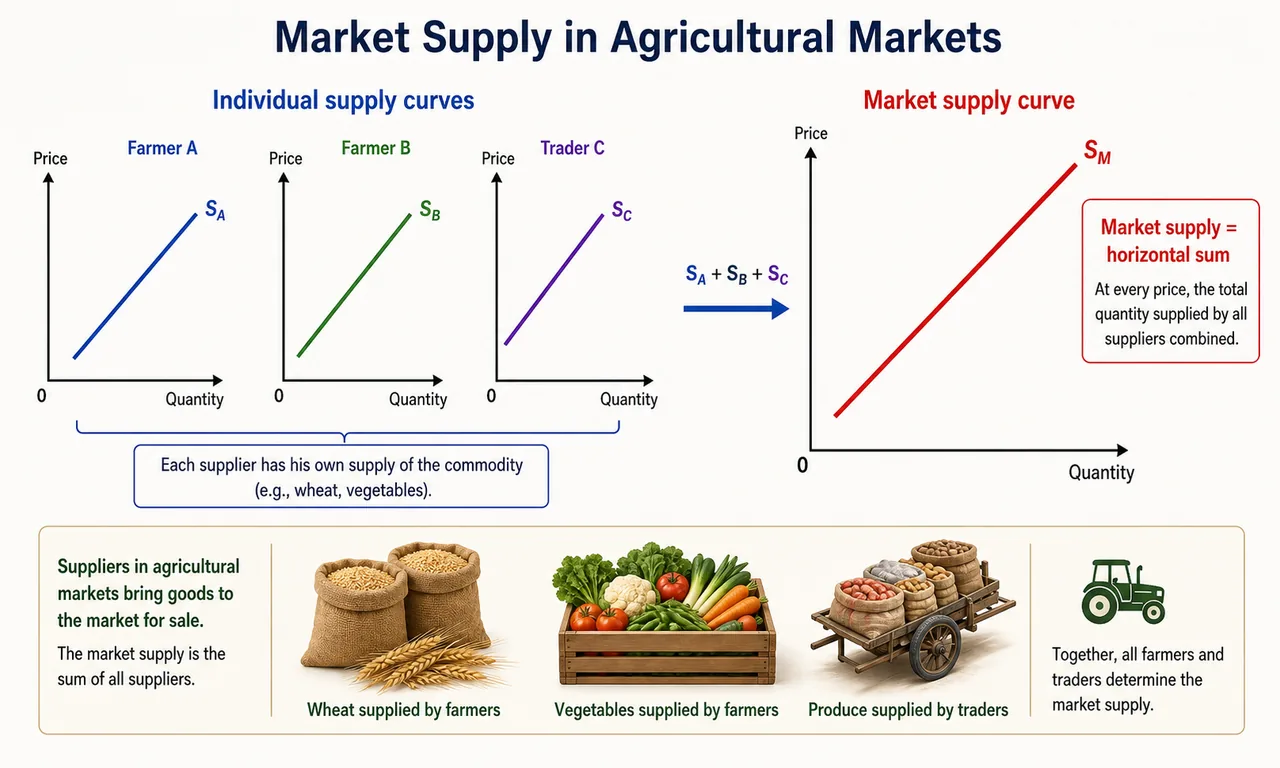
Market Supply
Market supply is the horizontal summation of all individual producers’ supply at each price level — the same concept as market demand but on the supply side.
Law of Supply
The law of supply states: as price increases, quantity supplied increases, and vice versa (other things remaining constant).
Supply and price move in the same direction — the opposite of demand. The supply curve slopes upward from left to right.
Why? Higher prices make production more profitable, encouraging producers to supply more.
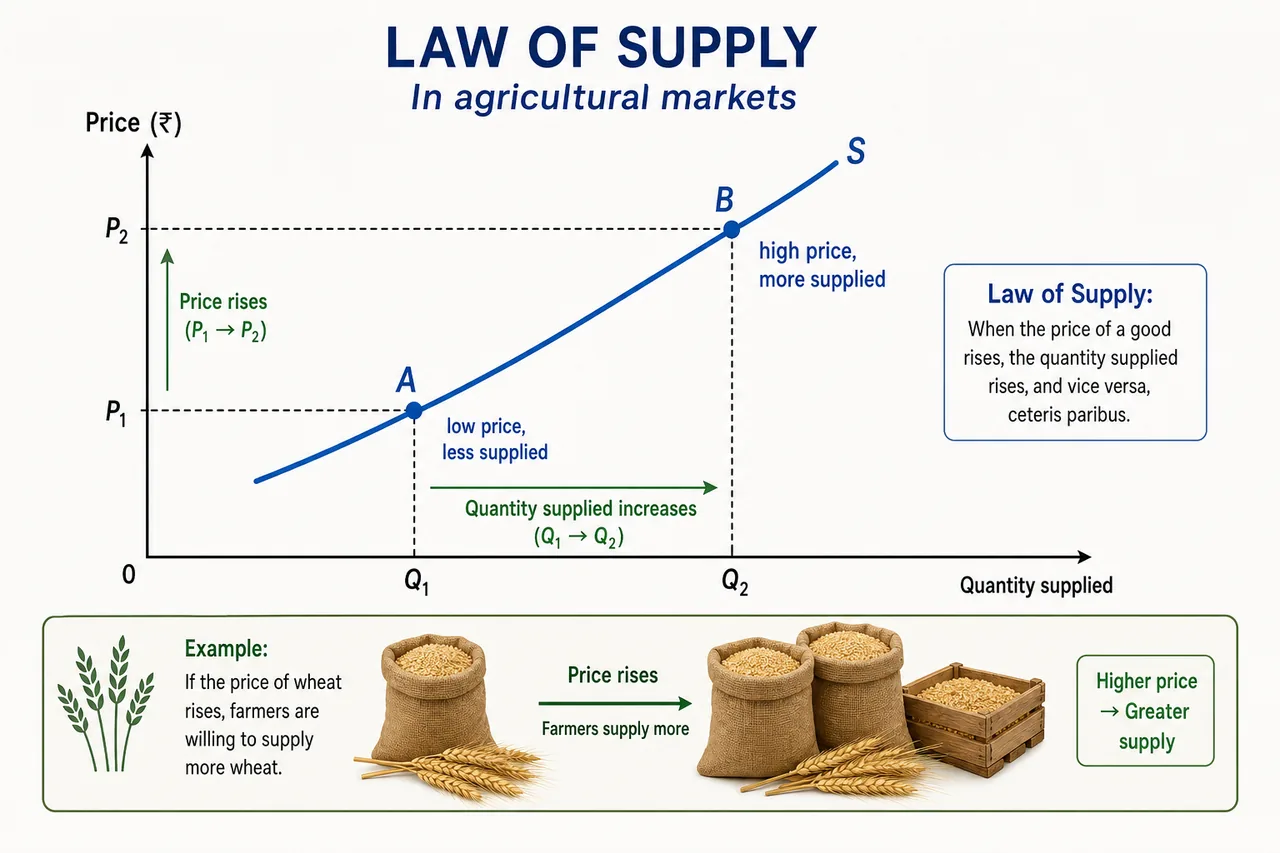
Exam Tip: Demand curve = downward slope (inverse). Supply curve = upward slope (direct). Remember: D for Down, S for Slope-up.
Determinants of Supply
| Determinant | Effect on Supply | Agricultural Example |
|---|---|---|
| Price of the product | Direct — higher price, more supply | Higher MSP for paddy encourages farmers to grow more paddy |
| Technology | Better tech shifts supply right | Drip irrigation increases crop yield, increasing supply |
| Input/production costs | Higher costs reduce supply | Rise in fertilizer or diesel prices reduces crop supply |
| Tax | Increases cost, reduces supply | Higher export tax on onions reduces onion supply to foreign markets |
| Subsidy | Reduces cost, increases supply | Fertilizer subsidy increases fertilizer supply |
| Future price expectations | Expected price rise may reduce current supply (hoarding) | Traders hoard pulses expecting price rise after poor monsoon forecast |
| Price of other goods | Producers shift to more profitable goods | If cotton prices surge, farmers switch from soybean to cotton |
| Number of producers | More producers = more supply | Entry of new poultry farms increases chicken supply |
Changes in Supply: Movement vs Shift
| Feature | Movement Along Supply Curve | Shift of Supply Curve |
|---|---|---|
| Cause | Change in the good’s own price | Change in any factor OTHER than price |
| Curve position | Stays the same | Moves left or right |
| Terminology | Extension (price rises) / Contraction (price falls) | Increase (rightward) / Decrease (leftward) |
| Example | Wheat price rises from Rs 20 to Rs 30, quantity supplied increases | Introduction of HYV seeds increases wheat supply at every price |
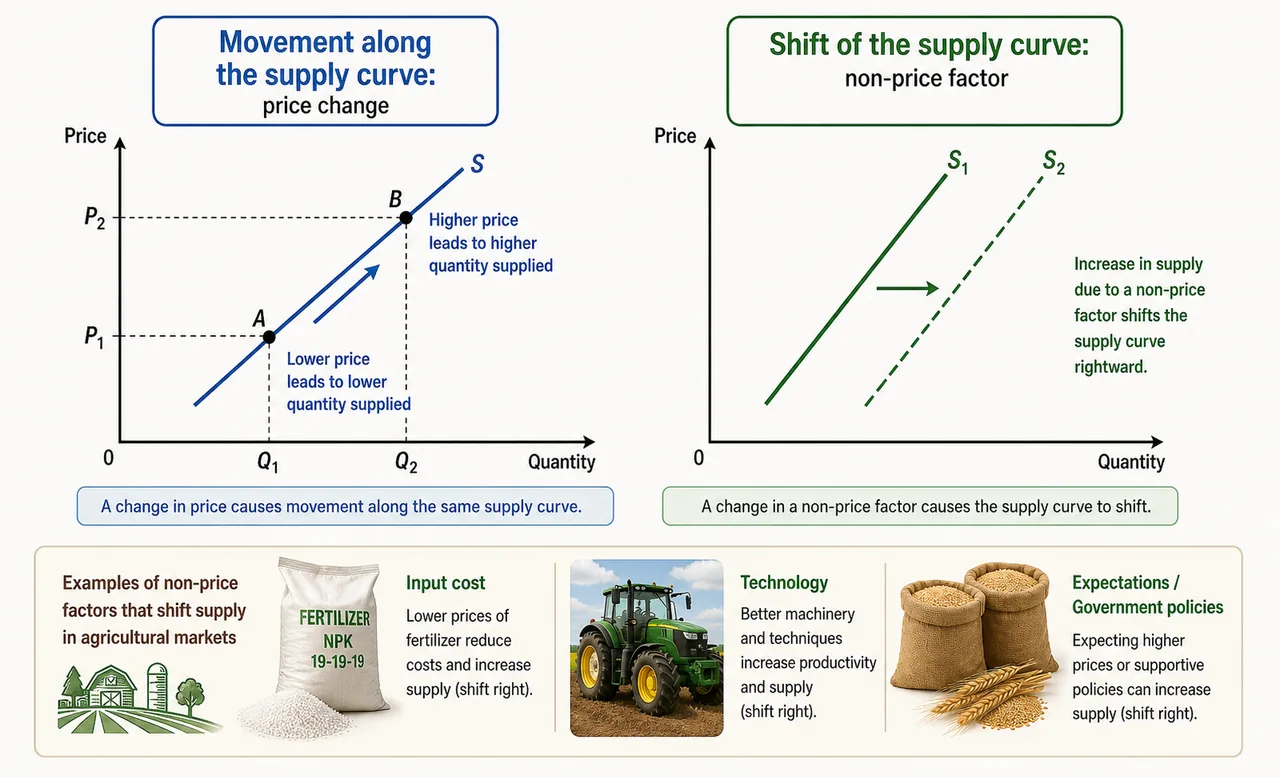
Factors Causing Supply Shifts
| Factor | Direction of Shift | Agricultural Example |
|---|---|---|
| Fall in input prices | Rightward (increase) | Cheaper fertilizers lower cost, increase crop supply |
| Technological improvement | Rightward (increase) | Combine harvesters reduce harvesting cost, increase grain supply |
| Better transport | Rightward (increase) | Cold chain logistics enable supply of perishables to distant markets |
| Favorable climate | Rightward (increase) | Good monsoon leads to bumper crop, increased supply |
| Political stability | Rightward (increase) | Stable governance ensures uninterrupted agricultural production |
| Lower taxes / higher subsidies | Rightward (increase) | Subsidy on drip irrigation increases horticultural supply |
| Higher taxes / unfavorable policy | Leftward (decrease) | Export ban reduces supply to international markets |
| Natural disaster | Leftward (decrease) | Floods destroy crops, reducing vegetable supply |
Determinants of Price Elasticity of Supply
| Factor | Effect | Agricultural Example |
|---|---|---|
| Time period | Longer time = more elastic | Farmers can switch crops next season; in current season, supply is fixed |
| Ability to store | Storable goods = more elastic | Wheat (storable) has more elastic supply than tomatoes (perishable) |
| Factor mobility | Higher mobility = more elastic | If labour can move easily between crops, supply adjusts faster |
| Marginal cost changes | Rapidly rising costs = less elastic | Expanding irrigation-dependent crops in water-scarce areas faces rising costs |
| Excess capacity | Spare capacity = more elastic | A flour mill running at 60% capacity can quickly increase output |
| Infrastructure | Better infrastructure = more elastic | Good roads, cold storage, and irrigation make agricultural supply more responsive |
| Agriculture vs Industry | Agricultural supply is generally more inelastic | Crops take a full season to grow; factories can adjust output in weeks |
Exam Tip: Agricultural supply is inherently more inelastic than industrial supply because crops depend on seasons, weather, and biological growth cycles that cannot be accelerated.
Summary Table: Demand vs Supply at a Glance
| Concept | Demand | Supply |
|---|---|---|
| Definition | Quantity buyers are willing and able to buy | Quantity sellers are willing and able to sell |
| Law | Price up, quantity down (inverse) | Price up, quantity up (direct) |
| Curve slope | Downward (left to right) | Upward (left to right) |
| Movement along curve | Due to change in own price | Due to change in own price |
| Shift of curve | Due to non-price factors (income, tastes, related prices) | Due to non-price factors (technology, costs, policy) |
| Elasticity measures | Price, income, cross elasticity | Price elasticity of supply |
| Agricultural peculiarity | Food demand is generally inelastic | Agricultural supply is generally inelastic (seasonal) |
Key Formulas for Quick Revision
| Formula | Expression |
|---|---|
| Price Elasticity of Demand | (% change in Qd) / (% change in P) |
| Income Elasticity of Demand | (% change in Qd) / (% change in Income) |
| Cross Elasticity of Demand | (% change in Qd of A) / (% change in Price of B) |
| Marshall-Lerner Condition | Trade balance improves if (Elasticity of exports + Elasticity of imports) > 1 |
Exam-Ready Mnemonics
| Mnemonic | Stands For | Concept |
|---|---|---|
| WAP | Willingness, Ability to pay, Price and time | Three characteristics of demand |
| ISL | Income effect, Substitution effect, Law of diminishing marginal utility | Three reasons for downward-sloping demand curve |
| TIPNS | Tastes, Income, Prices of related goods, Number of buyers, Speculative expectations | Determinants of demand (non-price) |
| D-Down, S-Slope-up | Demand slopes down, Supply slopes up | Curve directions |
| PURRE | Perfectly inelastic, Unitary, Relatively elastic, Relatively inelastic, Perfectly Elastic | Five degrees of elasticity |
Demand and Supply — Video Explanation
Summary Cheat Sheet
| Concept / Topic | Key Details / Explanation |
|---|---|
| Definition of Demand | Quantity a buyer is willing and able to purchase at a given price during a specific time period (mnemonic: WAP — Willingness, Ability, Price & time) |
| Individual vs Market Demand | Market demand = horizontal summation of all individual demands at each price |
| Demand Schedule & Curve | Schedule is a table; curve plots price (Y-axis) vs quantity (X-axis); slopes downward left to right |
| Price Demand | Quantities demanded at all possible prices, ceteris paribus — basis of the demand curve |
| Income Demand | Demand at different income levels; normal goods (direct), inferior goods (inverse) |
| Cross Demand | Demand changes due to price change of a related good (substitutes or complements) |
| Derived Demand | Demand arising because the good is needed to produce a final product (e.g., fertiliser demand derived from crop demand) |
| Autonomous Demand | Demand for direct consumption, independent of other products |
| Law of Demand | Price up → quantity demanded down (inverse relationship); curve slopes downward due to ISL (Income effect, Substitution effect, LDMU) |
| Movement vs Shift | Movement along curve = own price change; Shift of curve = non-price factors (income, tastes, related goods, expectations) |
| Determinants of Demand | Price of good, price of substitutes (direct), price of complements (inverse), income, tastes, future price expectations |
| Giffen Goods | Inferior goods where income effect > substitution effect; demand rises as price rises (Sir Robert Giffen) |
| Veblen Goods | Status/prestige goods; higher price increases demand |
| Price Elasticity of Demand | (% change in Qd) / (% change in P); measures responsiveness of demand to price |
| Income Elasticity | Positive for normal goods, negative for inferior goods, high for luxuries, low for necessities |
| Cross Elasticity | Positive for substitutes, negative for complements, zero for unrelated goods |
| Degrees of Elasticity (PURRE) | Perfectly inelastic (E=0, vertical), Unitary (E=1, rectangular hyperbola), Relatively elastic (E>1), Relatively inelastic (0<E<1), Perfectly elastic (E=∞, horizontal) |
| Factors Affecting Elasticity | Degree of necessity, availability of substitutes, proportion of income spent, time period, number of uses |
| Marshall-Lerner Condition | Devaluation improves trade balance only if sum of export and import elasticities > 1 |
| Law of Supply | Price up → quantity supplied up (direct relationship); supply curve slopes upward |
| Supply vs Stock | Supply = quantity brought to market; Stock = total inventory; for perishable goods, supply = stock |
| Determinants of Supply | Price, technology, input costs, tax, subsidy, future price expectations, price of other goods, number of producers |
| Movement vs Shift (Supply) | Movement = own price change (extension/contraction); Shift = non-price factors (technology, costs, policy) |
| Agricultural Supply | Inherently more inelastic than industrial supply due to seasonal, weather, and biological constraints |
| Key Formulas | Price Ed = %ΔQd / %ΔP; Income Ed = %ΔQd / %ΔIncome; Cross Ed = %ΔQd(A) / %ΔP(B) |
Pro Content Locked
Upgrade to Pro to access this lesson and all other premium content.
₹2388 billed yearly
- All Agriculture & Banking Courses
- AI Lesson Questions (100/day)
- AI Doubt Solver (50/day)
- Glows & Grows Feedback (30/day)
- AI Section Quiz (20/day)
- 22-Language Translation (30/day)
- Recall Questions (20/day)
- AI Quiz (15/day)
- AI Quiz Paper Analysis
- AI Step-by-Step Explanations
- Spaced Repetition Recall (FSRS)
- AI Tutor
- Immersive Text Questions
- Audio Lessons — Hindi & English
- Mock Tests & Previous Year Papers
- Summary & Mind Maps
- XP, Levels, Leaderboard & Badges
- Generate New Classrooms
- Voice AI Teacher (AgriDots Live)
- AI Revision Assistant
- Knowledge Gap Analysis
- Interactive Revision (LangGraph)
🔒 Secure via Razorpay · Cancel anytime · No hidden fees
Introduction: Why Demand and Supply Matter in Agriculture
Imagine a wheat farmer in Punjab. After a bumper harvest, wheat floods the local mandi. Prices drop. Consumers buy more rotis and less rice. Meanwhile, a drought in Maharashtra reduces onion supply, and onion prices skyrocket across India. These everyday agricultural realities are governed by two fundamental forces: demand and supply.
Understanding these concepts is essential not only for economics exams but also for grasping how agricultural markets, government procurement, MSP decisions, and food security policies actually work.
Part 1: Demand
What Is Demand?
Demand is not merely a desire or wish. In economics, demand means the quantity of a good that a buyer is willing and able to purchase at a given price during a specific time period.
Agricultural example: A farmer wants a new tractor (desire). But desire alone is not demand. Only when the farmer has both the willingness and the money (purchasing power) to buy the tractor does it become demand.
Three Essential Characteristics of Demand
| Characteristic | Meaning | Agricultural Example |
|---|---|---|
| Willingness + Ability to pay | The buyer must want the good AND have the money | A dairy farmer wants cattle feed and can afford it |
| At a price | Demand is always stated at a specific price | ”50 kg of urea at Rs 270/bag” — not just “urea” |
| Per unit of time | Demand refers to a specific time period | ”200 quintals of rice per month” — not just “rice” |
Exam Tip: Remember the mnemonic WAP — Willingness, Ability to pay, Price and time period. All three must be present for valid demand.
Individual Demand vs Market Demand
Individual demand is the quantity one buyer is willing to purchase at each price level.
Market demand is the horizontal summation of all individual demands at each price level.
Agricultural example: At Rs 40/kg for tomatoes:
- Household A demands 3 kg
- Household B demands 5 kg
- Household C demands 2 kg
- Market demand = 3 + 5 + 2 = 10 kg
At each price, we sum up quantities demanded by every buyer to get market demand.
Demand Schedule and Demand Curve
A demand schedule is a table showing quantities demanded at various prices.
| Price of Wheat (Rs/kg) | Quantity Demanded (kg/week) |
|---|---|
| 30 | 100 |
| 25 | 150 |
| 20 | 220 |
| 15 | 300 |
A demand curve is the graphical representation of a demand schedule. It plots price on the vertical axis and quantity on the horizontal axis. Each point on the curve shows the maximum quantity buyers will purchase at that price.
Types of Demand
1. Price Demand
The quantities of a good a consumer is willing to buy at all possible prices, other things remaining constant. This is the most commonly studied form and forms the basis of the demand curve.
Example: How much rice will consumers buy at Rs 40/kg vs Rs 50/kg vs Rs 60/kg?
2. Income Demand
The quantities a consumer is willing to buy at different levels of income, other things remaining constant.
- Normal goods: Demand rises with income (e.g., fruits, dairy products)
- Inferior goods: Demand falls as income rises (e.g., coarse grains like bajra replaced by wheat/rice as income grows)
3. Cross Demand
Demand for a good changes not because of its own price but because of a change in the price of a related good.
Example: When the price of mustard oil rises, consumers switch to sunflower oil. Demand for sunflower oil increases — this is cross demand.
4. Derived Demand
Demand that arises not for the good itself but because it is needed to produce a final product.
Agricultural example: Demand for fertilizers is derived from the demand for food grains. Demand for jute is derived from the demand for jute bags and sacking.
5. Autonomous Demand
Demand that exists independently, for direct consumption, not linked to any other product.
Example: Demand for food grains, vegetables, and milk — these are consumed for their own sake.
| Type | Depends On | Agricultural Example |
|---|---|---|
| Price demand | Price of the good itself | Rice at different price levels |
| Income demand | Consumer’s income level | Shift from millets to wheat as income rises |
| Cross demand | Price of related goods | Mustard oil price rise increases sunflower oil demand |
| Derived demand | Demand for the final product | Fertilizer demand derived from crop demand |
| Autonomous demand | Direct consumer need | Demand for vegetables |
Law of Demand
The law of demand states: as price increases, quantity demanded decreases, and vice versa (other things remaining constant).
In short: price and quantity demanded move in opposite directions.
As price falls from PA to PB, quantity demanded increases from QA to QB. The demand curve slopes downward from left to right (negative slope).
Exam Tip: The demand curve slopes downward because of three effects — ISL: Income effect, Substitution effect, Law of diminishing marginal utility.
Why Does the Demand Curve Slope Downward?
1. Income Effect
When the price of wheat falls from Rs 30/kg to Rs 20/kg, a consumer’s purchasing power effectively increases. With the same budget, they can now buy more wheat or spend the savings elsewhere. A price drop makes the consumer “effectively richer.”
2. Substitution Effect
When the price of pulses falls while the price of chicken remains the same, pulses become relatively cheaper. Consumers substitute pulses for chicken, increasing the quantity of pulses demanded. Consumers naturally shift towards the relatively cheaper option.
3. Law of Diminishing Marginal Utility
Each additional unit of a good gives less satisfaction than the previous one. A consumer will buy more units only if the price falls to match the declining marginal utility. This is the fundamental reason behind the law of demand.
Changes in Demand: Movement vs Shift
This distinction is critical for exams.
| Feature | Movement Along the Curve | Shift of the Curve |
|---|---|---|
| Cause | Change in the good’s own price | Change in any factor OTHER than price |
| Curve position | Stays the same | Moves left or right |
| Terminology | Extension (price falls) / Contraction (price rises) | Increase (rightward) / Decrease (leftward) |
| Example | Potato price drops from Rs 30 to Rs 20, quantity demanded rises | Government launches “Eat Millets” campaign, millet demand increases at every price |
Key Rule: Movement along = price change only. Shift = everything else (income, tastes, related goods’ prices, expectations).
Determinants of Demand
| Determinant | Effect on Demand | Agricultural Example |
|---|---|---|
| Price of the good | Inverse relationship (law of demand) | Higher rice price reduces rice demand |
| Price of substitutes | Direct relationship | Tur dal price rises, consumers buy more moong dal |
| Price of complements | Inverse relationship | Tractor price rises, demand for diesel (used with tractors) falls |
| Income | Direct for normal goods; inverse for inferior goods | Rising rural income increases demand for fruits; decreases demand for coarse grains |
| Tastes and preferences | Shifts demand curve | Growing health awareness increases demand for organic produce |
| Future price expectations | Speculative buying or postponement | Farmers hoard onions expecting future price rise |
Exceptions to the Law of Demand
In these cases, demand does NOT follow the inverse price-quantity relationship:
| Exception | Explanation | Example |
|---|---|---|
| Giffen Goods | Inferior goods where a strong negative income effect overpowers the substitution effect; demand rises as price rises | Poor families buy more bajra when its price rises because they can no longer afford wheat |
| Veblen Goods (status symbols) | Higher price increases the good’s prestige value | Expensive Basmati rice varieties seen as status symbols |
| Speculative buying | Expectation of future price increase causes hoarding | Traders stock up on pulses when prices begin rising, expecting further increases |
Exam Tip — Giffen’s Paradox: Named after Sir Robert Giffen, who observed that poor English families bought MORE bread when its price rose (they could no longer afford meat). In Indian agriculture, the same logic applies to coarse cereals for poor households.
Part 2: Elasticity of Demand
Elasticity measures how responsive quantity demanded is to a change in a particular factor. It goes beyond direction (up or down) to quantify the magnitude of response.
Price Elasticity of Demand
Price elasticity = Percentage change in quantity demanded / Percentage change in price
It answers: “If price changes by 1%, by what percentage does quantity demanded change?”
Income Elasticity of Demand
Income elasticity = Percentage change in quantity demanded / Percentage change in income
- Positive for normal goods (demand rises with income)
- Negative for inferior goods (demand falls as income rises)
- High for luxuries (demand grows faster than income)
- Low for necessities (demand grows slower than income)
Example: As rural income rises, demand for milk (normal good, moderate income elasticity) increases steadily, while demand for coarse millets (inferior good, negative income elasticity) falls.
Cross Elasticity of Demand
Cross elasticity = Percentage change in demand of Good A / Percentage change in price of Good B
| Relationship | Cross Elasticity | Example |
|---|---|---|
| Substitutes | Positive (+) | Mustard oil and sunflower oil |
| Complements | Negative (−) | Tractors and diesel |
| Unrelated goods | Zero (0) | Rice and televisions |
Methods of Measuring Elasticity
| Method | Description | When to Use |
|---|---|---|
| Point elasticity | Measured at a single point on the demand curve | Small/precise price changes |
| Arc elasticity | Measured between two points on the demand curve (average elasticity over a range) | Large price changes |
Degrees of Price Elasticity of Demand
| Degree | Value | Demand Curve Shape | Example |
|---|---|---|---|
| Perfectly inelastic | E = 0 | Vertical line | Essential seeds during sowing season (no substitute) |
| Perfectly elastic | E = infinity | Horizontal line | Wheat sold in a perfectly competitive mandi (identical quality) |
| Unitary elastic | E = 1 | Rectangular hyperbola | Total expenditure stays constant as price changes |
| Relatively elastic | E > 1 | Flatter curve | Exotic fruits, luxury agricultural products |
| Relatively inelastic | 0 < E < 1 | Steeper curve | Food grains, salt, essential vegetables |
Exam Mnemonic — PURRE (degrees of elasticity): Perfectly inelastic, Unitary, Relatively elastic, Relatively inelastic, Perfectly Elastic.
Factors Determining Price Elasticity of Demand
| Factor | Effect | Agricultural Example |
|---|---|---|
| Degree of necessity | Necessities have inelastic demand | Wheat, rice, salt — bought regardless of price |
| Availability of substitutes | More substitutes = more elastic | Groundnut oil (many cooking oil substitutes) is more elastic than salt (no substitute) |
| Proportion of income spent | Larger share = more elastic | A tractor (large % of income) has more elastic demand than matchboxes |
| Time period | Long run = more elastic | Farmers can switch crops in the next season if input prices stay high |
| Number of uses | More uses = more elastic | Sugarcane (sugar, jaggery, ethanol, bagasse) has elastic demand |
Practical Importance of Elasticity of Demand
| Application | How Elasticity Helps | Example |
|---|---|---|
| Taxation policy | Taxing inelastic goods generates more revenue with less reduction in sales | Government taxes on tobacco, liquor |
| Price discrimination by monopolists | Charge higher price where demand is inelastic | APMC mandis charging different fees for essential vs luxury produce |
| Business pricing | Lower price if demand is elastic; raise price if inelastic | Organic food brands lower prices to expand market share |
| Trade unions and wages | Workers in inelastic-demand industries have more bargaining power | Dairy workers can push for higher wages since milk demand is inelastic |
| International trade | Terms of trade depend on elasticity of imports/exports | Marshall-Lerner condition: devaluation improves trade balance only if sum of import and export elasticities exceeds 1 |
| Government agricultural policy | MSP and procurement decisions consider elasticity | Government procures wheat/rice (inelastic demand) to stabilize prices |
| Advertising decisions | More spending on ads when demand is elastic | Organic food companies invest heavily in marketing |
| Factor pricing | Factors with inelastic demand command higher prices | Scarce agricultural land near cities earns premium rent |
Part 3: Supply
What Is Supply?
Supply is the quantity of a good that sellers are willing and able to offer for sale at different prices during a specific time period.
Agricultural example: A rice miller is willing to supply 500 quintals of rice per month at Rs 35/kg but only 300 quintals at Rs 28/kg.
Supply vs Stock
| Feature | Supply | Stock |
|---|---|---|
| Definition | Quantity actually brought to market for sale at a given price | Total quantity available (whether offered for sale or not) |
| Relationship to market | Active portion offered for sale | Total inventory held by producers |
| For perishable goods | Supply = Stock (must sell quickly) | Vegetables, fruits, fish — cannot be stored long |
| For durable goods | Supply may be less than stock | A wheat trader may hold back stock expecting higher prices later |
Agricultural insight: During harvest season, farmers often hold back grain stock if current mandi prices are below MSP, waiting for government procurement. Here, stock is large but supply is deliberately restricted.
Market Supply
Market supply is the horizontal summation of all individual producers’ supply at each price level — the same concept as market demand but on the supply side.
Law of Supply
The law of supply states: as price increases, quantity supplied increases, and vice versa (other things remaining constant).
Supply and price move in the same direction — the opposite of demand. The supply curve slopes upward from left to right.
Why? Higher prices make production more profitable, encouraging producers to supply more.
Exam Tip: Demand curve = downward slope (inverse). Supply curve = upward slope (direct). Remember: D for Down, S for Slope-up.
Determinants of Supply
| Determinant | Effect on Supply | Agricultural Example |
|---|---|---|
| Price of the product | Direct — higher price, more supply | Higher MSP for paddy encourages farmers to grow more paddy |
| Technology | Better tech shifts supply right | Drip irrigation increases crop yield, increasing supply |
| Input/production costs | Higher costs reduce supply | Rise in fertilizer or diesel prices reduces crop supply |
| Tax | Increases cost, reduces supply | Higher export tax on onions reduces onion supply to foreign markets |
| Subsidy | Reduces cost, increases supply | Fertilizer subsidy increases fertilizer supply |
| Future price expectations | Expected price rise may reduce current supply (hoarding) | Traders hoard pulses expecting price rise after poor monsoon forecast |
| Price of other goods | Producers shift to more profitable goods | If cotton prices surge, farmers switch from soybean to cotton |
| Number of producers | More producers = more supply | Entry of new poultry farms increases chicken supply |
Changes in Supply: Movement vs Shift
| Feature | Movement Along Supply Curve | Shift of Supply Curve |
|---|---|---|
| Cause | Change in the good’s own price | Change in any factor OTHER than price |
| Curve position | Stays the same | Moves left or right |
| Terminology | Extension (price rises) / Contraction (price falls) | Increase (rightward) / Decrease (leftward) |
| Example | Wheat price rises from Rs 20 to Rs 30, quantity supplied increases | Introduction of HYV seeds increases wheat supply at every price |
Factors Causing Supply Shifts
| Factor | Direction of Shift | Agricultural Example |
|---|---|---|
| Fall in input prices | Rightward (increase) | Cheaper fertilizers lower cost, increase crop supply |
| Technological improvement | Rightward (increase) | Combine harvesters reduce harvesting cost, increase grain supply |
| Better transport | Rightward (increase) | Cold chain logistics enable supply of perishables to distant markets |
| Favorable climate | Rightward (increase) | Good monsoon leads to bumper crop, increased supply |
| Political stability | Rightward (increase) | Stable governance ensures uninterrupted agricultural production |
| Lower taxes / higher subsidies | Rightward (increase) | Subsidy on drip irrigation increases horticultural supply |
| Higher taxes / unfavorable policy | Leftward (decrease) | Export ban reduces supply to international markets |
| Natural disaster | Leftward (decrease) | Floods destroy crops, reducing vegetable supply |
Determinants of Price Elasticity of Supply
| Factor | Effect | Agricultural Example |
|---|---|---|
| Time period | Longer time = more elastic | Farmers can switch crops next season; in current season, supply is fixed |
| Ability to store | Storable goods = more elastic | Wheat (storable) has more elastic supply than tomatoes (perishable) |
| Factor mobility | Higher mobility = more elastic | If labour can move easily between crops, supply adjusts faster |
| Marginal cost changes | Rapidly rising costs = less elastic | Expanding irrigation-dependent crops in water-scarce areas faces rising costs |
| Excess capacity | Spare capacity = more elastic | A flour mill running at 60% capacity can quickly increase output |
| Infrastructure | Better infrastructure = more elastic | Good roads, cold storage, and irrigation make agricultural supply more responsive |
| Agriculture vs Industry | Agricultural supply is generally more inelastic | Crops take a full season to grow; factories can adjust output in weeks |
Exam Tip: Agricultural supply is inherently more inelastic than industrial supply because crops depend on seasons, weather, and biological growth cycles that cannot be accelerated.
Summary Table: Demand vs Supply at a Glance
| Concept | Demand | Supply |
|---|---|---|
| Definition | Quantity buyers are willing and able to buy | Quantity sellers are willing and able to sell |
| Law | Price up, quantity down (inverse) | Price up, quantity up (direct) |
| Curve slope | Downward (left to right) | Upward (left to right) |
| Movement along curve | Due to change in own price | Due to change in own price |
| Shift of curve | Due to non-price factors (income, tastes, related prices) | Due to non-price factors (technology, costs, policy) |
| Elasticity measures | Price, income, cross elasticity | Price elasticity of supply |
| Agricultural peculiarity | Food demand is generally inelastic | Agricultural supply is generally inelastic (seasonal) |
Key Formulas for Quick Revision
| Formula | Expression |
|---|---|
| Price Elasticity of Demand | (% change in Qd) / (% change in P) |
| Income Elasticity of Demand | (% change in Qd) / (% change in Income) |
| Cross Elasticity of Demand | (% change in Qd of A) / (% change in Price of B) |
| Marshall-Lerner Condition | Trade balance improves if (Elasticity of exports + Elasticity of imports) > 1 |
Exam-Ready Mnemonics
| Mnemonic | Stands For | Concept |
|---|---|---|
| WAP | Willingness, Ability to pay, Price and time | Three characteristics of demand |
| ISL | Income effect, Substitution effect, Law of diminishing marginal utility | Three reasons for downward-sloping demand curve |
| TIPNS | Tastes, Income, Prices of related goods, Number of buyers, Speculative expectations | Determinants of demand (non-price) |
| D-Down, S-Slope-up | Demand slopes down, Supply slopes up | Curve directions |
| PURRE | Perfectly inelastic, Unitary, Relatively elastic, Relatively inelastic, Perfectly Elastic | Five degrees of elasticity |
Demand and Supply — Video Explanation
Summary Cheat Sheet
| Concept / Topic | Key Details / Explanation |
|---|---|
| Definition of Demand | Quantity a buyer is willing and able to purchase at a given price during a specific time period (mnemonic: WAP — Willingness, Ability, Price & time) |
| Individual vs Market Demand | Market demand = horizontal summation of all individual demands at each price |
| Demand Schedule & Curve | Schedule is a table; curve plots price (Y-axis) vs quantity (X-axis); slopes downward left to right |
| Price Demand | Quantities demanded at all possible prices, ceteris paribus — basis of the demand curve |
| Income Demand | Demand at different income levels; normal goods (direct), inferior goods (inverse) |
| Cross Demand | Demand changes due to price change of a related good (substitutes or complements) |
| Derived Demand | Demand arising because the good is needed to produce a final product (e.g., fertiliser demand derived from crop demand) |
| Autonomous Demand | Demand for direct consumption, independent of other products |
| Law of Demand | Price up → quantity demanded down (inverse relationship); curve slopes downward due to ISL (Income effect, Substitution effect, LDMU) |
| Movement vs Shift | Movement along curve = own price change; Shift of curve = non-price factors (income, tastes, related goods, expectations) |
| Determinants of Demand | Price of good, price of substitutes (direct), price of complements (inverse), income, tastes, future price expectations |
| Giffen Goods | Inferior goods where income effect > substitution effect; demand rises as price rises (Sir Robert Giffen) |
| Veblen Goods | Status/prestige goods; higher price increases demand |
| Price Elasticity of Demand | (% change in Qd) / (% change in P); measures responsiveness of demand to price |
| Income Elasticity | Positive for normal goods, negative for inferior goods, high for luxuries, low for necessities |
| Cross Elasticity | Positive for substitutes, negative for complements, zero for unrelated goods |
| Degrees of Elasticity (PURRE) | Perfectly inelastic (E=0, vertical), Unitary (E=1, rectangular hyperbola), Relatively elastic (E>1), Relatively inelastic (0<E<1), Perfectly elastic (E=∞, horizontal) |
| Factors Affecting Elasticity | Degree of necessity, availability of substitutes, proportion of income spent, time period, number of uses |
| Marshall-Lerner Condition | Devaluation improves trade balance only if sum of export and import elasticities > 1 |
| Law of Supply | Price up → quantity supplied up (direct relationship); supply curve slopes upward |
| Supply vs Stock | Supply = quantity brought to market; Stock = total inventory; for perishable goods, supply = stock |
| Determinants of Supply | Price, technology, input costs, tax, subsidy, future price expectations, price of other goods, number of producers |
| Movement vs Shift (Supply) | Movement = own price change (extension/contraction); Shift = non-price factors (technology, costs, policy) |
| Agricultural Supply | Inherently more inelastic than industrial supply due to seasonal, weather, and biological constraints |
| Key Formulas | Price Ed = %ΔQd / %ΔP; Income Ed = %ΔQd / %ΔIncome; Cross Ed = %ΔQd(A) / %ΔP(B) |
Knowledge Check
Take a dynamically generated quiz based on the material you just read to test your understanding and get personalized feedback.
Lesson Doubts
Ask questions, get expert answers