⛏ Factors of Production: Land, Labour, Capital & Enterprise in Agriculture
Understand the four factors of production -- Land, Labour, Capital, and Enterprise -- with agricultural examples, types of rent, wages, interest, and profit for competitive exam preparation.
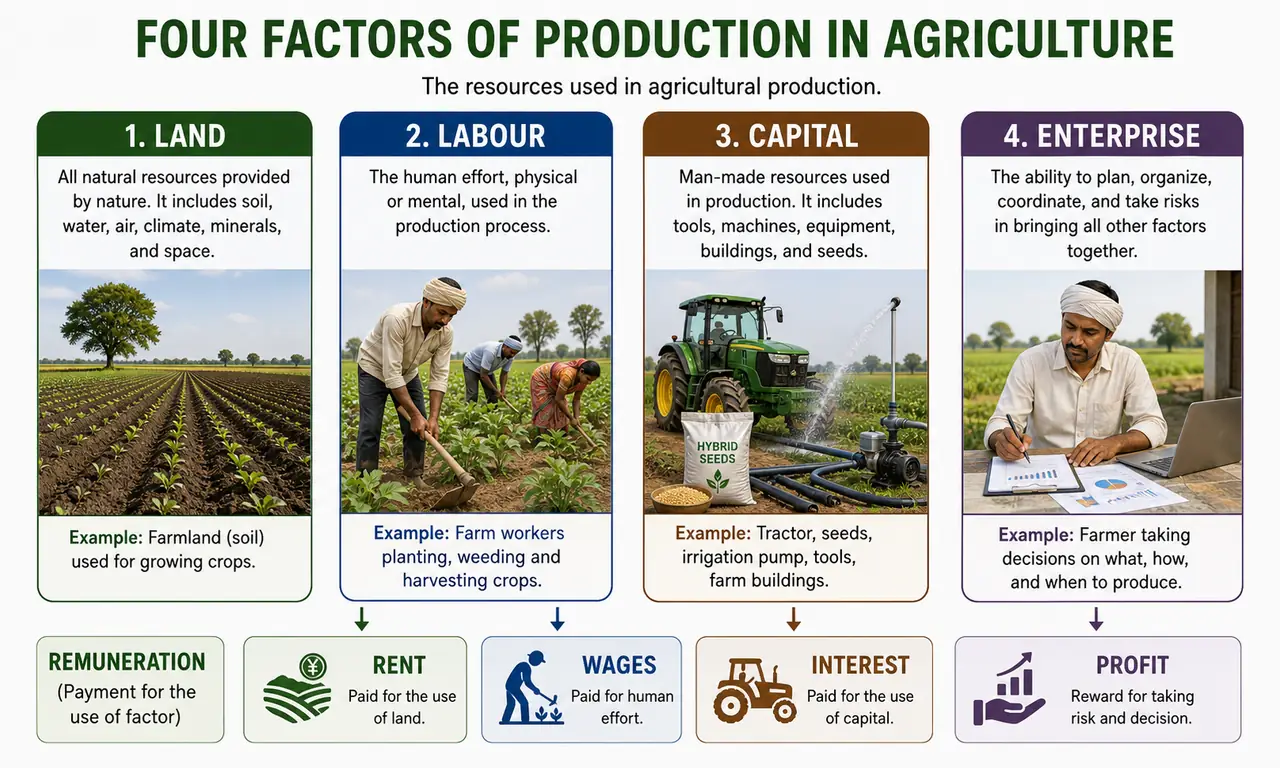
Factors of Production
Think about what a farmer needs to grow wheat. She needs land to sow, labourers to plough and harvest, capital like seeds, fertilisers and a tractor, and her own decision-making ability to choose the right crop at the right time. These four inputs are exactly what economists call the factors of production -- the resources used to produce any good or service.
They are classified into four categories:
| Factor | What It Means | Agricultural Example | Remuneration |
|---|---|---|---|
| Land | All natural resources | Farmland, water, soil fertility | Rent |
| Labour | Human effort (physical + mental) | Farm workers, agronomists | Wages |
| Capital | Man-made aids to production | Tractors, seeds, fertilisers, irrigation wells | Interest |
| Enterprise | Organisation + risk-bearing | The farmer who decides what to grow and bears market risk | Profit |
Distribution and Factor Pricing
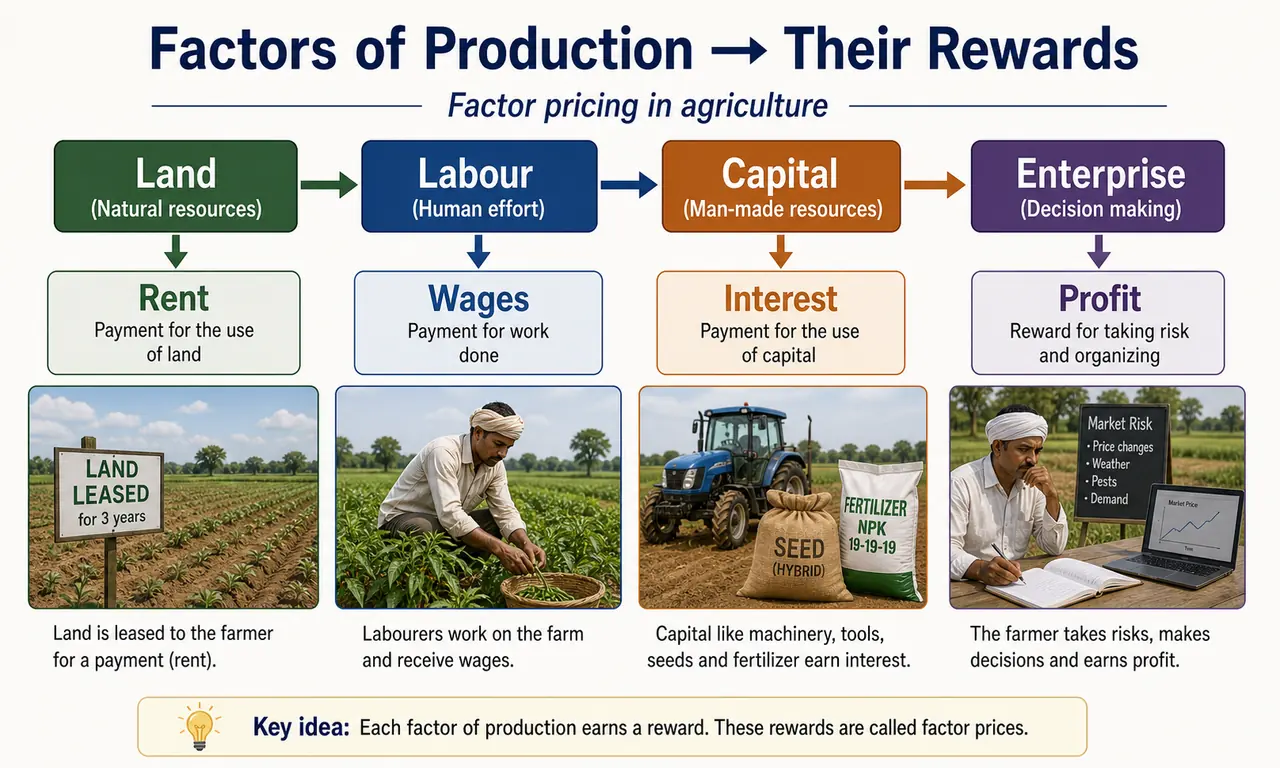
- The way total farm income is divided among land, labour, capital, and enterprise is called distribution.
- Each factor has a "price" set by demand and supply in the factor market. This process is called factor pricing.
Exam Tip -- Mnemonic "LLCE-RWIP": Land = Rent, Labour = Wages, Capital = Interest, Enterprise = Profit
Pro Content Locked
Upgrade to Pro to access this lesson and all other premium content.
Charged once for one year · ₹1188 total
Save ₹100/month vs ₹2388/year launch price
- All Agriculture & Banking Courses
- AI Lesson Questions (100/day)
- AI Doubt Solver (50/day)
- Glows & Grows Feedback (30/day)
- AI Section Quiz (20/day)
- 22-Language Translation (100/day)
- Recall Questions (20/day)
- AI Quiz (15/day)
- AI Quiz Paper Analysis (100/day)
- AI Step-by-Step Explanations (100/day)
- Spaced Repetition Recall (FSRS)
- AI Tutor
- Immersive Text Questions
- Audio Lessons — Hindi & English
- Mock Tests & Previous Year Papers
- Summary & Mind Maps
- XP, Levels, Leaderboard & Badges
- Generate New Classrooms
- Voice AI Teacher (AgriDots Live)
- AI Revision Assistant
- Knowledge Gap Analysis
- Interactive Revision (LangGraph)
🔒 Secure one-time yearly payment via Razorpay · No hidden fees
Factors of Production
Think about what a farmer needs to grow wheat. She needs land to sow, labourers to plough and harvest, capital like seeds, fertilisers and a tractor, and her own decision-making ability to choose the right crop at the right time. These four inputs are exactly what economists call the factors of production -- the resources used to produce any good or service.
They are classified into four categories:
| Factor | What It Means | Agricultural Example | Remuneration |
|---|---|---|---|
| Land | All natural resources | Farmland, water, soil fertility | Rent |
| Labour | Human effort (physical + mental) | Farm workers, agronomists | Wages |
| Capital | Man-made aids to production | Tractors, seeds, fertilisers, irrigation wells | Interest |
| Enterprise | Organisation + risk-bearing | The farmer who decides what to grow and bears market risk | Profit |
Distribution and Factor Pricing
- The way total farm income is divided among land, labour, capital, and enterprise is called distribution.
- Each factor has a "price" set by demand and supply in the factor market. This process is called factor pricing.
Exam Tip -- Mnemonic "LLCE-RWIP": Land = Rent, Labour = Wages, Capital = Interest, Enterprise = Profit
1. Rent (Return to Land)
Rent is the payment made for using land -- a naturally occurring resource whose total supply is fixed. A farmer who leases 5 acres of paddy land pays rent to the landowner.
Rent for publicly owned land (grazing commons, government wasteland) is almost zero because it is meant for public welfare, not private profit.
Types of Rent
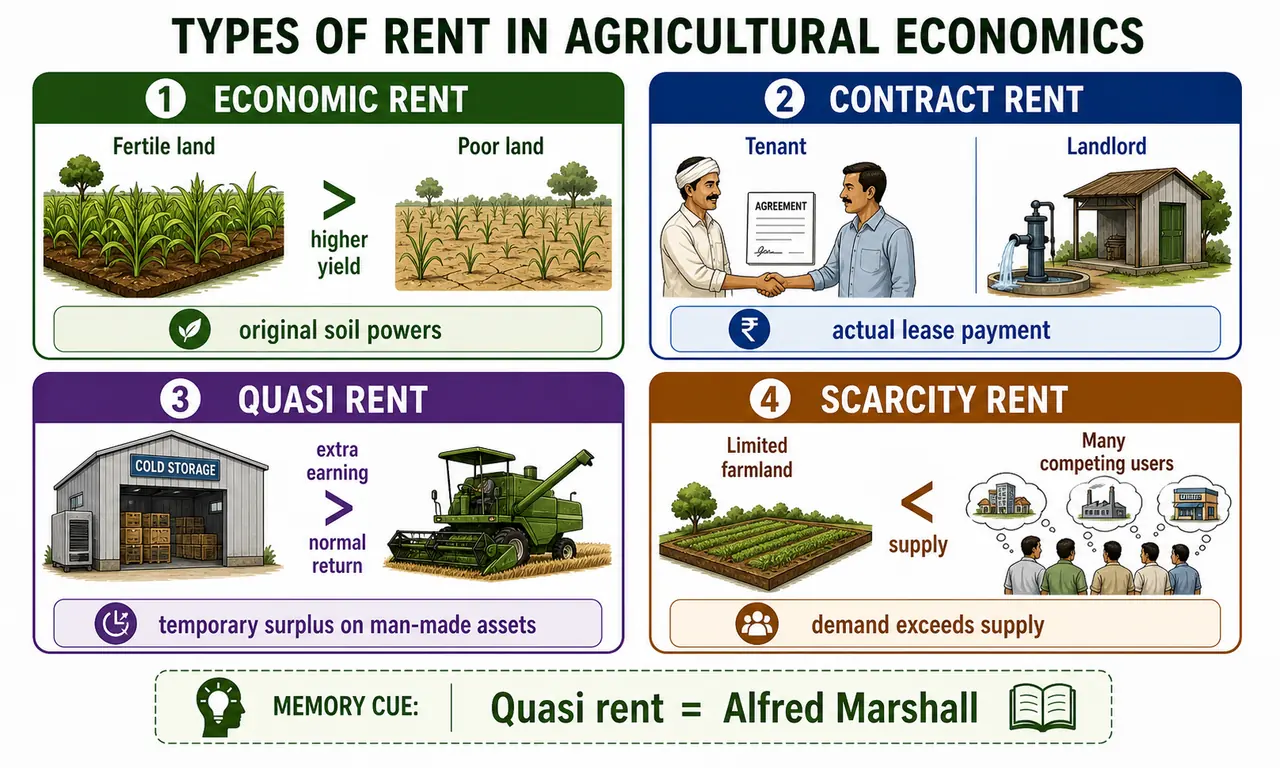
Economic Rent
Economic rent is the payment made exclusively for the original and indestructible powers of the soil -- its natural fertility, location, and mineral content -- with no human improvement involved.
Agricultural example: Two plots of equal size sit side by side. Plot A has rich alluvial soil; Plot B has poor sandy soil. The extra rent that Plot A commands purely because of its natural fertility is economic rent.
In farming, the rent a tenant pays to a landlord is not pure economic rent -- it is part of contract rent (explained below).
Contract Rent
Contract rent is the actual agreed payment between a tenant farmer and a landowner, specified in a lease.
A landlord usually provides not just bare land but also infrastructure -- tube-wells, farm buildings, fencing, levelled fields. The landlord expects a return on these investments too. Therefore:
Contract Rent = Economic Rent + Interest on Capital Invested in Land Improvements + Depreciation on Farm Structures
Agricultural example: A tenant pays Rs 15,000/acre/year. Of this, Rs 8,000 is for the land itself (economic rent) and Rs 7,000 covers the tube-well, storage shed, and boundary fencing the landlord built.
Quasi Rent
Quasi rent is the temporary surplus income earned by man-made assets (machines, buildings, cold-storage units) when their demand rises in the short run but supply cannot adjust immediately.
- Short run: Supply of these assets is fixed, so extra demand pushes up their earnings -- this surplus is quasi rent.
- Long run: More machines/buildings are produced, supply catches up with demand, and the surplus disappears.
- Quasi rent does not apply to land because land supply is permanently inelastic -- the surplus on land is permanent rent, not quasi rent.
Agricultural example: After a bumper harvest, demand for cold-storage facilities spikes. Existing cold-storage owners earn extra income (quasi rent). Over time, new cold-storage units are built, and the extra earnings vanish.
Key fact: The concept of quasi rent was introduced by Alfred Marshall.
| Feature | Economic Rent | Quasi Rent |
|---|---|---|
| Applies to | Land (natural resource) | Man-made assets (machines, buildings) |
| Supply | Permanently inelastic | Temporarily fixed, elastic in long run |
| Duration | Permanent | Temporary (disappears in long run) |
| Coined by | David Ricardo (concept) | Alfred Marshall |
Scarcity Rent
Scarcity rent arises when the demand for land exceeds its available supply. Because land supply is inelastic, competition among users drives up the price.
Agricultural example: In the fertile Indo-Gangetic plain, population pressure and urbanisation have shrunk available farmland. Farmers competing for the remaining plots push rents well above normal levels -- this extra premium is scarcity rent.
2. Wages (Return to Labour)
"A wage is a sum of money paid under contract by an employer to a worker for services rendered." -- Benham
Wages are the return to labour -- the only factor inseparable from the person providing it. A farm labourer cannot "send" his labour to the field; he must go himself.
- Wages -- paid to casual/daily farm workers
- Salaries -- paid to permanent staff (farm manager, agronomist)
- Fees -- paid to consultants (soil-testing expert, veterinary doctor)
All three are payments for human effort and skill.
Methods of Wage Payment
| Method | Basis of Payment | Agricultural Example |
|---|---|---|
| Cash Wages | Money | Rs 400/day to a harvest labourer |
| Kind Wages | Goods/services | 5 kg of grain per day of work; free meals + housing on the farm |
| Time Wages | Duration (hourly, daily, monthly) | Rs 350/day for 8 hours of weeding, regardless of area covered |
| Piece Wages | Quantity of output | Rs 2 per kg of cotton picked |
| Task Wages | Completion of a specific task | Rs 3,000 for transplanting one acre of paddy (contract wages) |
Exam Tip: Time wages guarantee steady income but do not reward productivity. Piece wages reward productivity but may lead to quality issues. Task wages combine a defined scope with a fixed price.
Nominal Wages vs Real Wages
| Nominal (Money) Wage | Real Wage | |
|---|---|---|
| Definition | Amount of money received | Purchasing power of that money |
| Formula | W | R = W / P (P = price index) |
| Accounts for inflation? | No | Yes |
Agricultural example: A farm labourer earns Rs 300/day (nominal wage). If the consumer price index is 150 (base year = 100):
Real Wage = 300 / 1.50 = Rs 200 in base-year terms.
Even though money wages rose, the labourer's actual purchasing power may not have improved if prices rose equally.
3. Interest (Return to Capital)
"Interest is the payment made by a borrower for the use of a loan, expressed as the ratio which that payment bears to the loan." -- Marshall
Interest is the price paid for using loanable funds. The rate of interest is determined by the demand for and supply of these funds.
Why interest matters in agriculture: Farmers routinely borrow for seeds, fertilisers, pesticides, machinery, and land improvement. The cost of borrowing (interest) directly affects their profitability and cropping decisions.
Agricultural example: A farmer takes a Kisan Credit Card (KCC) loan of Rs 3,00,000 at 7% per annum. The Rs 21,000 paid annually is the interest -- the return to the capital lent by the bank.
4. Profit (Return to Enterprise)
Profit is the reward for the entrepreneurial functions of decision-making and uncertainty-bearing.
Unlike rent, wages, and interest -- which are contractual payments settled before the outcome is known -- profit is a residual income: what remains after all other factors have been paid.
Profit = Total Revenue - Total Costs (rent + wages + interest + other expenses)
- If revenue exceeds costs: positive profit
- If costs exceed revenue: loss (negative profit)
This residual nature makes entrepreneurship inherently risky.
Agricultural example: A farmer grows watermelons. She pays Rs 20,000 as land rent, Rs 30,000 as labour wages, Rs 15,000 as interest on her loan, and Rs 10,000 on seeds and inputs. Her total cost is Rs 75,000. If she sells the crop for Rs 1,20,000, her profit is Rs 45,000. If unseasonal rain destroys half the crop and she sells for only Rs 50,000, she incurs a loss of Rs 25,000. The farmer bears this uncertainty -- that is the entrepreneurial function.
Summary Cheat Sheet
| Factor | Return | Key Characteristic | Agricultural Example | Exam Keyword |
|---|---|---|---|---|
| Land | Rent | Fixed supply, naturally occurring | Farmland, water bodies, forests | Inelastic supply |
| Labour | Wages | Inseparable from the person | Farm workers, agronomists | Human effort |
| Capital | Interest | Man-made, can be accumulated | Tractors, seeds, irrigation | Loanable funds |
| Enterprise | Profit | Residual income, risk-bearing | Farmer deciding crop mix | Uncertainty |
Quick Revision: Types of Rent
| Type | Meaning | Applies To | Duration |
|---|---|---|---|
| Economic Rent | Return for original powers of soil | Land only | Permanent |
| Contract Rent | Actual payment under lease agreement | Land + improvements | As per lease |
| Quasi Rent | Temporary surplus on fixed man-made assets | Machines, buildings | Short run only |
| Scarcity Rent | Premium due to excess demand over supply | Land | As long as scarcity persists |
Quick Revision: Types of Wages
| Type | Basis |
|---|---|
| Cash / Kind | Medium of payment |
| Time Wages | Duration of work |
| Piece Wages | Quantity of output |
| Task Wages | Completion of assigned task |
| Nominal vs Real | Money amount vs purchasing power (R = W/P) |
Final Mnemonic -- "LLCE gives RWIP": Land-Rent, Labour-Wages, Capital-Interest, Enterprise-Profit. Quasi rent is by Marshall, applies to man-made assets only, and is temporary.