🙇♂️ Randomised Block Design (RBD)
Layout, mathematical model, ANOVA, blocking principle, fertility gradient, advantages — the most frequently used design in agricultural field experiments
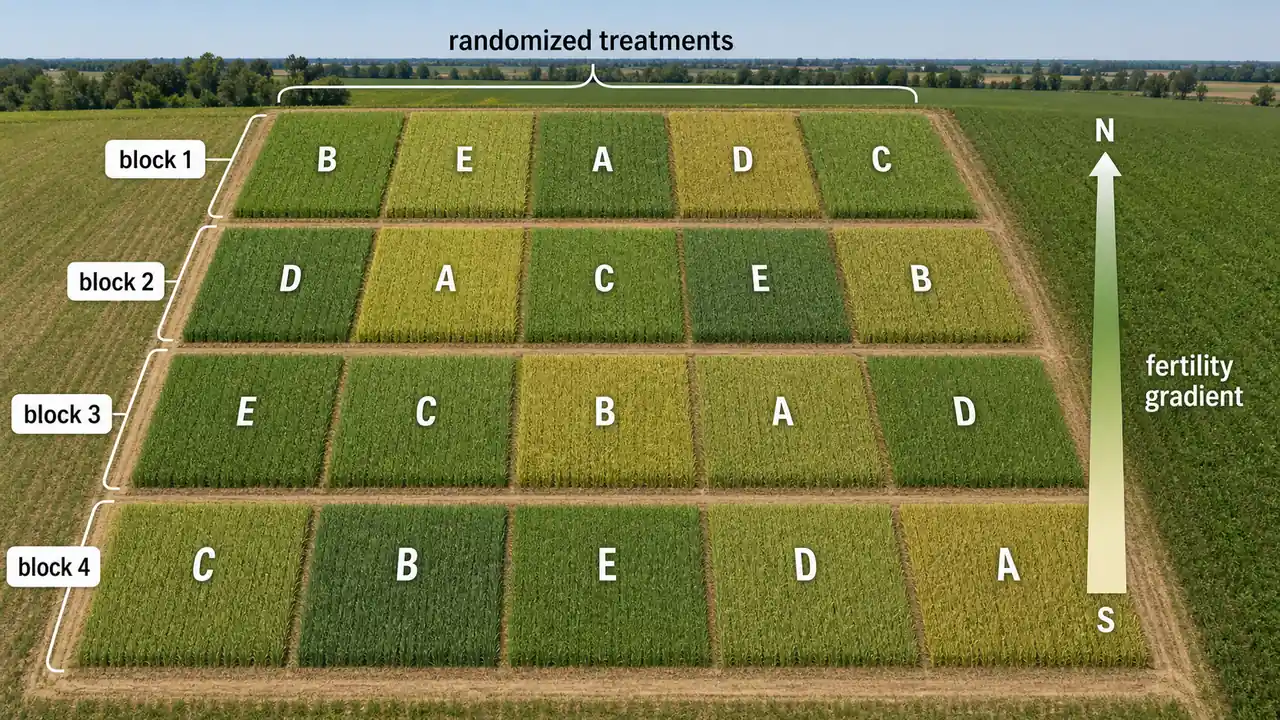
A field trial comparing eight rice varieties faces a problem: soil fertility decreases steadily from the north to the south of the plot. CRD would mix this fertility gradient into the error term, obscuring real varietal differences. By dividing the field into blocks perpendicular to the gradient — each block containing all eight varieties — the Randomised Block Design separates soil variation from treatment effects, giving far more precise results.
-
We have seen that in a completely randomized design no local control measure was adopted excepting that the experimental units should be homogeneous.
-
Usually, when experiments require a large number of experimental units, completely randomized designs cannot ensure precision of the estimates of treatment effects.
-
In agricultural field experiments, usually the experimental materials are not homogeneous. Soil fertility, moisture content, slope, and other field conditions naturally vary across the experimental area. In such situations the principle of local control is adopted and the experimental material is grouped into homogeneous sub groups. The subgroup is commonly termed as block. Since each block will consist the entire set of treatments a block is equivalent to a replication. This is a critical concept -- in RBD, each block contains one replicate of every treatment, so the number of blocks equals the number of replications.
Pro Content Locked
Upgrade to Pro to access this lesson and all other premium content.
Charged once for one year · ₹1188 total
Save ₹100/month vs ₹2388/year launch price
- All Agriculture & Banking Courses
- AI Lesson Questions (100/day)
- AI Doubt Solver (50/day)
- Glows & Grows Feedback (30/day)
- AI Section Quiz (20/day)
- 22-Language Translation (100/day)
- Recall Questions (20/day)
- AI Quiz (15/day)
- AI Quiz Paper Analysis (100/day)
- AI Step-by-Step Explanations (100/day)
- Spaced Repetition Recall (FSRS)
- AI Tutor
- Immersive Text Questions
- Audio Lessons — Hindi & English
- Mock Tests & Previous Year Papers
- Summary & Mind Maps
- XP, Levels, Leaderboard & Badges
- Generate New Classrooms
- Voice AI Teacher (AgriDots Live)
- AI Revision Assistant
- Knowledge Gap Analysis
- Interactive Revision (LangGraph)
🔒 Secure one-time yearly payment via Razorpay · No hidden fees
A field trial comparing eight rice varieties faces a problem: soil fertility decreases steadily from the north to the south of the plot. CRD would mix this fertility gradient into the error term, obscuring real varietal differences. By dividing the field into blocks perpendicular to the gradient — each block containing all eight varieties — the Randomised Block Design separates soil variation from treatment effects, giving far more precise results.
-
We have seen that in a completely randomized design no local control measure was adopted excepting that the experimental units should be homogeneous.
-
Usually, when experiments require a large number of experimental units, completely randomized designs cannot ensure precision of the estimates of treatment effects.
-
In agricultural field experiments, usually the experimental materials are not homogeneous. Soil fertility, moisture content, slope, and other field conditions naturally vary across the experimental area. In such situations the principle of local control is adopted and the experimental material is grouped into homogeneous sub groups. The subgroup is commonly termed as block. Since each block will consist the entire set of treatments a block is equivalent to a replication. This is a critical concept -- in RBD, each block contains one replicate of every treatment, so the number of blocks equals the number of replications.
Simple idea:
RBD means: first make similar blocks, then compare treatments within each block. This removes much of the field-to-field variation from the error term.
- The blocks are formed with units having common characteristics which may influence the response under study.
- In agricultural field experiments the soil fertility is an important character that influences the crop responses. The uniformity trial is used to identify the soil fertility of a field. A uniformity trial involves growing a single crop uniformly across the entire field and then mapping the yield variation to understand the fertility gradient -- the direction in which soil fertility changes.
- If the fertility gradient is found to run in one direction (say from north to south) then the blocks are formed in the opposite direction (from east to west). By arranging blocks perpendicular to the fertility gradient, each block captures similar levels of fertility, making plots within a block more uniform.
- If the number of experimental units within each group is same as the number of treatments and if every treatment appears precisely once in each group, then such an arrangement is called a randomized block design.
Easy memory rule:
In RBD:
- each block contains all treatments
- each treatment appears once per block
- so number of blocks = number of replications
Layout
- Let us consider 5 treatments A, B, C, D and E each replicated 4 times. We divide the whole experimental area into 4 relatively homogeneous blocks and each block into 5 plots. Treatments are then allocated at random to the plots of a block, fresh randomization being done for each block. Fresh randomization for each block means we generate a new random arrangement for every block independently, not using the same order throughout.
- A particular layout as follows:
| Block | Plot 1 | Plot 2 | Plot 3 | Plot 4 | Plot 5 |
|---|---|---|---|---|---|
| Block 1 | A | E | B | D | C |
| Block 2 | E | D | C | B | A |
| Block 3 | C | B | A | E | D |
| Block 4 | A | D | E | C | B |
Statistical Analysis
- The results from RBD can be arranged in two way table according to the replications (blocks) and treatments, there will be 'rk' observations in total. The two-way table structure is what makes RBD a two-way classification -- data is organized both by treatments and by blocks. The data can be arranged in the following table.
Mathematical Model
| Treatments | Blocks | Treatment totals | Means |
|---|---|---|---|
| t_1 | y_11, y_12, ..., y_1r | T_1 | \bar{T}_1 |
| t_2 | y_21, y_22, ..., y_2r | T_2 | \bar{T}_2 |
| \vdots | \vdots | \vdots | \vdots |
| t_i | y_i1, y_i2, ..., y_ir | T_i | \bar{T}_i |
| \vdots | \vdots | \vdots | \vdots |
| t_k | y_k1, y_k2, ..., y_kr | T_k | \bar{T}_k |
| Block totals | B_1, B_2, ..., B_r | G.T. | - |
| Block means | \bar{B}_1, \bar{B}_2, ..., \bar{B}_r | - | - |
yij = μ + αi + βj + ξij
-
i = 1, 2,... k
-
j = 1, 2,... r
-
Where,
- yij is the jth replication of the ith treatment
- μ = general mean effect -- the overall average across all treatments and blocks.
- αi = the effect due to ith treatment -- the deviation of the i-th treatment mean from the overall mean.
- βi = the effect due to jth block -- the deviation of the j-th block mean from the overall mean. By including this term, the block-to-block variation is separated from the error, thereby reducing it.
- ξij = error effect -- the remaining random variation after accounting for treatments and blocks.
-
Source of Variability:
- Due to treatment
- Block
- Error
In RBD, the total variation is partitioned into these three components. The key advantage over CRD is that the block variation is identified and removed from the error, making treatment comparisons more precise.
So compared with CRD, RBD is better whenever the field has a one-direction fertility gradient.
Null hypothesis:
- H01: There is no significant difference between the treatment effects.
i.e. α1 = α2 = ......... = αk
- H02: There is no significant difference between the block effects
i.e. β1 = β2= ......... = βr
Note that while we test both hypotheses, the primary interest is usually in H01 (treatment effects). The block hypothesis H02 is of secondary interest -- a significant block effect simply confirms that the blocking was effective and worthwhile.
Meaning of block significance:
If block effect is significant, it usually means the field really did vary from block to block, so blocking was a sensible decision.
- The null hypothesis can be verified by applying the ANOVA procedure. The different steps are in the analysis of data are:
| Sources of variation | D.F. | S.S. | M.S. | F-cal. value | F-table value at 5% LOS |
|---|---|---|---|---|---|
| Treatments | k - 1 | Tr.S.S. | TMS = Tr.S.S. / (k - 1) | F_t = TMS / EMS | F[k - 1, (r - 1)(k - 1)] |
| Blocks (Replications) | r - 1 | BSS | BMS = BSS / (r - 1) | F_b = BMS / EMS | F[r - 1, (r - 1)(k - 1)] |
| Error | (r - 1)(k - 1) | ESS | EMS = ESS / ((r - 1)(k - 1)) | - | - |
| Total | rk - 1 | TSS | - | - | - |
Advantages and disadvantages of RBD
-
Two-way classification (treatment wise and replication/block wise) and one-way control (local control). This means the data is organized in two dimensions (treatments and blocks), and error is controlled in one direction through blocking.
-
The principle advantage of RBD is that it increases the precision of the experiment. This is due to the reduction of experimental error by adoption of local control.
-
The amount of information obtained in RBD is more as compared to CRD. Hence, RBD is more efficient than CRD.
-
Flexibility is another advantage of RBD. Any number of replications can be included in RBD. If large number of homogeneous units are available, large number of treatments can be included in this design.
-
Since the layout of RBD involves equal replication of treatments, statistical analysis is simple. Even when some observations are missing of certain treatments, the data can be analysed by the use of missing plot technique. This technique, also developed by R.A. Fisher, allows the researcher to estimate missing values and proceed with the analysis, although with a slight loss of precision.
- When the number of treatments is increased, the block size will increase. If the block size is large it may be difficult to maintain homogeneity within blocks. Consequently, the experimental error will be increased. Hence, RBD may not be suitable for large number of treatments. But for this disadvantage, the RBD is a versatile design. It is the most frequently used design in agricultural experiments. This makes RBD the workhorse of agricultural research -- used more often than any other design.
-
The optimum block size in field experiments is 21 plots. i.e. we cannot compare treatments which are > 21 in RBD to preserve homogeneity of plots within a block. It is used up to 20 treatments without appreciable loss of efficiency. Beyond 20 treatments, researchers should consider incomplete block designs like Balanced Incomplete Block Design (BIBD) or lattice designs.
-
This design appropriate when the fertility gradient in the field is in one direction only. If the fertility varies in two directions simultaneously, Latin Square Design (LSD) would be more appropriate.
-
In RBD the most number of blocks must be equal to the number of replications fixed for coach treatment.
-
The number of plots in each block should be equal to the number of treatments.
-
It provides more accurate results than CRD due to formation of homogenous blocks.
-
This design utilizes all the three basic principles of field experimentation. Unlike CRD (which uses only randomization and replication), RBD employs replication, randomization, and local control together.
-
Error degree of freedom in RBD: (r-1) x (k-1). Where r = number of replications (blocks) and k = number of treatments. For example, with 4 blocks and 5 treatments, error d.f. = (4-1) x (5-1) = 3 x 4 = 12.
NOTE
RBD Summary: Two-way classification, one-way control, most frequently used design in agricultural experiments, suitable for up to 20 treatments, fertility gradient in one direction, error d.f. = (r-1)(k-1).
Summary Cheat Sheet
| Concept / Topic | Key Details |
|---|---|
| RBD | Randomised Block Design — most frequently used in agriculture |
| Classification | Two-way (treatment + block), one-way control |
| Principles used | All three — replication, randomisation, local control |
| Best for | Field experiments with fertility gradient in one direction |
| Block | Homogeneous sub-group; one block = one replication |
| Uniformity trial | Identifies fertility gradient direction in a field |
| Block arrangement | Perpendicular to the fertility gradient |
| Mathematical model | y_ij = μ + α_i + β_j + ξ_ij |
| β_j | Effect of j-th block (separates block variation from error) |
| Error d.f. | (r-1) x (k-1) (r = blocks/replications, k = treatments) |
| Treatments | Up to 20 without appreciable loss of efficiency |
| Optimum block size | 21 plots maximum for homogeneity within blocks |
| More efficient than | CRD — due to reduction of error by local control |
| ANOVA sources | Treatment SS + Block SS + Error SS = Total SS |
| Fresh randomisation | Done independently for each block |
| Missing plot technique | Developed by R.A. Fisher; estimates missing values |
| Number of blocks | = Number of replications |
| Plots per block | = Number of treatments |
| Limitation | Large number of treatments → large block → heterogeneity |
| Beyond 20 treatments | Use incomplete block designs (BIBD, lattice) |
| Two-direction gradient | Use LSD instead of RBD |