📖 Forestry -- Definition, Classification, and Branches
Forestry definition, classification by management intensity (intensive, extensive, protection, production), and eight branches of forestry
From Growing Trees to Managing Ecosystems
The previous lesson explored how forests are classified by age, composition, ownership, and ecological type. Now we shift focus from the forests themselves to the discipline that manages them -- forestry.
When a farmer in Himachal Pradesh plants apple trees, it is horticulture. When the Forest Department plants Chir Pine on degraded hillsides, it is forestry. But what exactly is forestry? It is far more than just planting trees -- it encompasses the entire cycle of creating, conserving, managing, and harvesting forest resources.
This lesson covers:
- Definition of Forestry -- what it encompasses
- Classification by management intensity -- intensive, extensive, protection, production
- Eight branches of Forestry -- from silviculture to wildlife management
What is Forestry?
Forestry is the theory and practice of all that constitutes the creation, conservation, and scientific management of forests and the utilization of their resources.
-
It includes raising tree crops, their growth and care, and final harvesting
-
It covers not only management of existing forests but also creation of new forests
-
It encompasses harvesting, marketing, and utilization of all forest products and services
-
Two classic one-liners are frequently asked in forestry MCQs: the father of Indian forestry / tropical forestry is Dr. Dietrich Brandis, and the father of modern agroforestry is P. K. R. Nair.
-
Another direct recall line is that Dietrich Brandis is classically remembered as the first Inspector General of Forests in India.
NOTE
Forestry has a dual focus: managing what exists and creating what is needed. This makes it a dynamic, forward-looking discipline -- not merely preserving old forests but actively building new ones.
Classification of Forestry
Based on Intensity of Management
| Type | Goal | Input Level | Key Feature |
|---|---|---|---|
| Intensive Forestry | Maximum production per unit area (usually timber) | High (improved stock, fertilizers, pest control) | Like intensive agriculture -- maximize yield |
| Extensive Forestry (Multiple-use) | Balanced range of products (fuel, fodder, timber, wildlife) | Moderate | Cannot utilize full site potential; serves many functions |
| Protection Forestry | Protect natural resources (soil, water, climate) | Low (minimal harvesting) | Ecology over economics |
| Production Forestry | Maximum economic output | High | Further divided into Commercial and Industrial |
Intensive vs Extensive Forestry
| Parameter | Intensive Forestry | Extensive Forestry |
|---|---|---|
| Also called | -- | Multiple-use forestry |
| Primary output | Single product (usually timber) | Multiple products (fuel, fodder, timber, etc.) |
| Site potential used | Maximum | Partial |
| Management effort | Very high | Moderate |
| Example | Eucalyptus plantation for pulp | Mixed forest managed for fuel + fodder + timber |
Production Forestry Sub-types
| Sub-type | Focus | Example |
|---|---|---|
| Commercial Forestry | Maximum timber and forest products as a business enterprise | Teak plantation for high-value timber |
| Industrial Forestry | Raw material for industries | Wood for paper mills, plywood factories, matchstick manufacturing |
TIP
Exam distinction: Commercial = selling forest products. Industrial = supplying raw material to factories. Both fall under Production Forestry, but the end-use differs.
- Older exam books often quote forestry's contribution to India's economy at around 1.2%. Current official national-account treatment may vary by year and method, but this older one-liner still appears in competitive-exam question banks, so students may encounter both the textbook figure and broader modern environmental-account discussions.
Eight Branches of Forestry
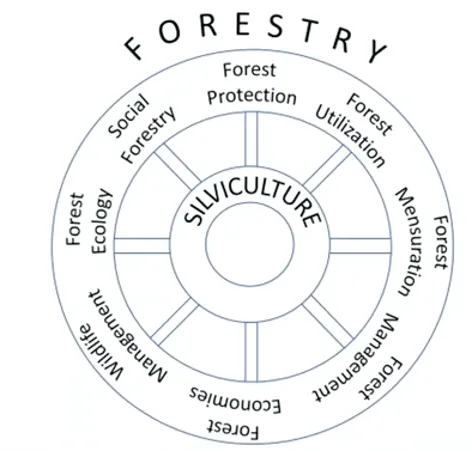
Silviculture is the core branch of forestry. The other seven branches support and complement it.
| Branch | Focus | Key Concept |
|---|---|---|
| Silviculture | Growing and maintaining forest crops | Core branch; Silva = woody patches |
| Forest Mensuration (Dendrometry) | Measuring tree dimensions, volume, age, growth | Latin mensura = measure |
| Social Forestry | Trees in/outside forests with people's participation | Forestry of the people, by the people, for the people |
| Forest Management | Planning, organizing, controlling forestry operations | Backbone: Maximum Sustained Yield |
| Forest Utilization | Harvesting, marketing, and applying forest produce | Bridge between forest and market |
| Forest Ecology | Study of organisms and their environment in forest ecosystems | Basis for conservation and sustainable management |
| Wildlife Management | Conservation of wild animals, birds, plants in natural habitats | Example: Tiger census |
| Forest Protection | Prevention and control of damage from humans, animals, insects, diseases, climate | Includes forest entomology and forest pathology |
Detailed Branch Descriptions
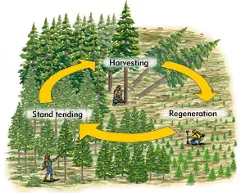
Silviculture: The study and practice of raising forest crops -- methods of planting, growth management, and care up to final harvesting. Silvics (the study of life history and characteristics of forest trees in relation to environment) is a prerequisite for silviculture.
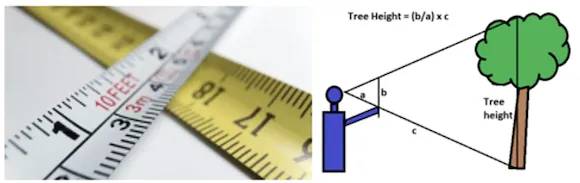
Forest Mensuration / Dendrometry: Determination of dimensions (diameter, height, volume), form, age, and increment of trees -- individually, in stands, or across entire forests. Foundation of forest inventory and valuation.
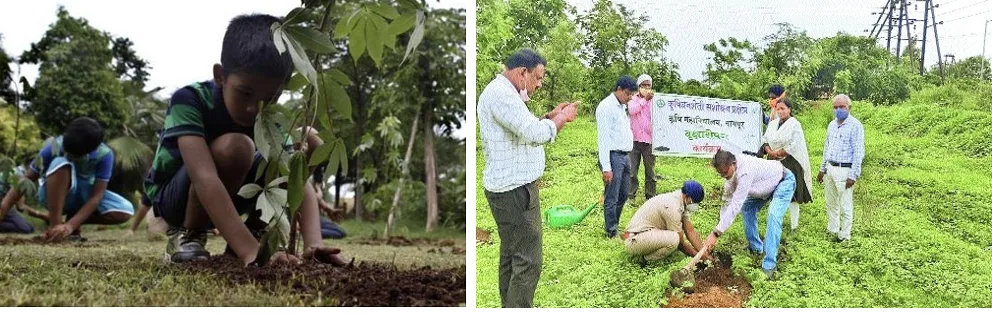
Social Forestry: Growing trees with intimate involvement of people -- community forestry, farm forestry. Term coined by J.C. Westoby (1976).
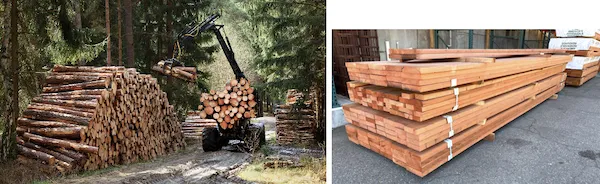
Forest Utilization: Covers everything from felling trees to processing and selling products -- timber, fuel, charcoal, pulpwood, plywood.
Forest Ecology: Study of how trees interact with other organisms and with physical factors (soil, water, light, climate) in forest ecosystems.

Wildlife Management: Population monitoring, habitat conservation, anti-poaching, species recovery programs.
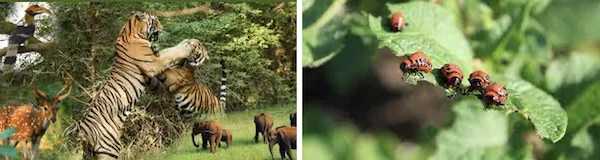
Forest Protection: Deals with biotic threats (grazing, fire, encroachment, pests) and abiotic threats (drought, storms, frost). Includes forest entomology (insect pests) and forest pathology (diseases).
Agricultural Connection
Forestry and agriculture are deeply interconnected:
| Forestry Concept | Agricultural Relevance |
|---|---|
| Silviculture | Agroforestry tree management on farms |
| Social Forestry | Farm forestry, trees on boundaries |
| Forest Protection | Same principles apply to pest/disease management in crops |
| Forest Mensuration | Measuring tree growth in agroforestry systems |
| Multiple-use Forestry | Similar to integrated farming -- multiple outputs from one system |
| Maximum Sustained Yield | Analogous to sustainable crop yield management |
Biosphere Reserves and Conservation Approaches
Some forestry exam questions shift from management branches to conservation frameworks, so these one-liners are worth keeping close to the core lesson.
| Topic | Key Fact |
|---|---|
| Biosphere Reserve Programme | Initiated by UNESCO in 1971 under the Man and Biosphere (MAB) Programme |
| Biosphere Reserve scheme in India | Launched in 1986 |
| First biosphere reserve in India | Nilgiri Biosphere Reserve |
| Core zone | Central protected zone where human activity is not allowed |
| In-situ conservation | Conservation in natural habitat — e.g. National Parks, Wildlife Sanctuaries, Biosphere Reserves, biodiversity hotspots |
| Ex-situ conservation | Conservation outside natural habitat — e.g. botanical gardens, zoos, seed banks, gene banks |
TIP
Quick distinction: In-situ = conserve species where they naturally occur. Ex-situ = conserve them outside their natural habitat under managed conditions.
Quick Forestry Dates and Institutes
Some forestry questions are pure recall. These two tables gather the exam-grade dates and institute-location pairs that do not need a full standalone revision lesson.
Important Days
| Date | Day |
|---|---|
| 2nd February | World Wetland Day |
| 3rd March | World Wildlife Day |
| 21st March | World Forestry Day |
| 22nd March | World Water Day |
| 22nd April | Earth Day |
| 5th June | World Environment Day |
| 16th September | World Ozone Day |
| 18th September | World Bamboo Day |
| 16th October | World Food Day |
Forestry Institutes and Locations
| Institute | Location |
|---|---|
| Tropical Forest Research Institute | Jabalpur, Madhya Pradesh |
| Central Arid Zone Forestry Research Institute | Jodhpur |
| Centre for Forest Based Livelihood and Extension | Agartala |
| Centre for Forestry Research and Human Resource Development | Chhindwara |
| Centre for Social Forestry and Eco-Rehabilitation | Prayagraj (Allahabad) |
| Forest Research Institute | Dehradun, Uttarakhand |
| Himalayan Forest Research Institute | Shimla, Himachal Pradesh |
| Institute of Forest Biodiversity | Hyderabad, Telangana |
| Institute of Forest Genetics and Tree Breeding | Coimbatore, Tamil Nadu |
| Institute of Wood Science and Technology | Bengaluru, Karnataka |
| Wildlife Institute of India | Dehradun, Uttarakhand |
TIP
Dehradun pair: both FRI and WII are in Dehradun. Jabalpur is the key match for TFRI.
Additional Forestry Institutions and Conservation Bodies
| Institution / Body | Key Fact |
|---|---|
| ICFRE | Indian Council of Forestry Research and Education, Dehradun |
| ICFRE establishment | 1986 |
| ICFRE network | Older exam books commonly recall 9 institutes under ICFRE |
| WWF | World Wide Fund for Nature, Gland, Switzerland |
| WWF symbol | Red Panda |
| CITES | Convention on International Trade in Endangered Species of Wild Fauna and Flora |
| CITES recall | Signed in 1973 at Washington, D.C.; came into force in 1975 |
| UNEP | United Nations Environment Programme, Nairobi, Kenya |
| UNEP establishment | 1972 |
| BNHS | Bombay Natural History Society |
| BNHS establishment | 1883 |
| IUCN | Founded in 1948 at Gland, Switzerland; later known as the World Conservation Union |
| IUCN Red List categories | 9 |
| First Red Data Book | 1964 |
NOTE
These body-and-location pairs are mostly recall-based exam facts. In forestry exams, ICFRE = Dehradun + 1986 + 9 institutes, WWF = Gland, CITES = wildlife-trade convention, and IUCN = red-list authority are the most useful memory anchors.
Exam Tips
TIP
Frequently tested facts:
- Core branch of forestry -- Silviculture
- Silva means -- woody patches
- Forest Mensuration also called -- Dendrometry (Greek: dendron = tree, metron = measure)
- Backbone of Forest Management -- Maximum Sustained Yield
- Social Forestry coined by -- J.C. Westoby (1976)
- Extensive Forestry also called -- Multiple-use Forestry
- Forest Protection includes -- Entomology (insects) + Pathology (diseases)
- Production Forestry types -- Commercial (business) + Industrial (factory raw material)
- World Forestry Day -- 21st March
- World Environment Day -- 5th June
- World Bamboo Day -- 18th September
- TFRI location -- Jabalpur
- FRI and WII location -- Dehradun
Summary Table
| Topic | Key Fact |
|---|---|
| Definition | Creation, conservation, management, and utilization of forests |
| Core branch | Silviculture (Silva = woody patches) |
| Total branches | 8 |
| Intensive forestry | Maximum production per unit area |
| Extensive forestry | Multiple-use forestry (balanced outputs) |
| Protection forestry | Ecological services (soil, water, climate) |
| Production forestry | Commercial (business) + Industrial (factory supply) |
| Forest Mensuration | Dendrometry -- measuring trees |
| Forest Management backbone | Maximum Sustained Yield |
| Social Forestry | People's participation; coined by Westoby (1976) |
| Forest Protection | Entomology + Pathology |
Summary Cheat Sheet
| Concept / Topic | Key Details |
|---|---|
| Forestry definition | Science, art, and practice of managing forests and related resources |
| Silviculture | Core branch of forestry; growing & tending forest crops |
| Silviculture analogy | Agronomy : Agriculture :: Silviculture : Forestry |
| Forest Management | Planning & administration; backbone: Maximum Sustained Yield |
| Forest Mensuration | Measurement of trees (diameter, height, volume, growth) |
| Forest Protection | Entomology (insects) + Pathology (diseases) |
| Forest Utilisation | Harvesting, processing, marketing of forest products |
| Forest Economics | Financial analysis of forestry operations |
| Social Forestry | Forestry with people's participation; coined by Westoby (1976) |
| Dendrology | Study of trees — identification, classification, nomenclature |
| Forest Ecology | Study of forest ecosystems and their interactions |
| First biosphere reserve in India | Nilgiri Biosphere Reserve |
| ICFRE | Dehradun; established in 1986; often recalled with 9 institutes |
| WWF | Gland, Switzerland; symbol = Red Panda |
| IUCN | Founded in 1948 at Gland, Switzerland; 9 Red List categories; first Red Data Book = 1964 |
| Classification of forests | By function, composition, age, ownership, growing stock |
| Branches of forestry | Silviculture, Management, Mensuration, Protection, Utilisation, Economics |
TIP
Next lesson: We now dive into Silviculture -- the core branch of forestry -- covering tree growth stages, regeneration methods, tending operations, and silvicultural systems.