🌾 Silvipasture Systems -- Trees with Pasture and Animals
Protein banks, live fences of fodder trees, and trees on pasture land -- species, design, and benefits for livestock integration
When Trees Feed the Cattle
In the previous lesson, we explored agrisilviculture -- the combination of trees with crops through systems like Taungya, alley cropping, and shelterbelts. Now we turn to the second major system type: silvipasture -- where trees are combined with pasture and livestock instead of crops.
In the arid districts of Rajasthan, a livestock farmer faces a critical problem every winter -- grass dries up and there is no green fodder for months. But the farmer who planted Grewia optiva and Morus alba trees along field boundaries can harvest protein-rich leaves all winter, keeping cattle healthy and milk flowing. This is the silvipasture system -- trees deliberately integrated with pasture and livestock.
This lesson covers:
- Protein banks -- dedicated high-protein fodder tree plantings
- Live fences -- biological barriers that also produce fodder
- Trees on pasture land -- shade, microclimate, and additional products
These sub-systems are particularly important for dryland agriculture questions in exams.
Pro Content Locked
Upgrade to Pro to access this lesson and all other premium content.
₹99 charged monthly · Cancel anytime
- All Agriculture & Banking Courses
- AI Lesson Questions (100/day)
- AI Doubt Solver (50/day)
- Glows & Grows Feedback (30/day)
- AI Section Quiz (20/day)
- 22-Language Translation (100/day)
- Recall Questions (20/day)
- AI Quiz (15/day)
- AI Quiz Paper Analysis (100/day)
- AI Step-by-Step Explanations (100/day)
- Spaced Repetition Recall (FSRS)
- AI Tutor
- Immersive Text Questions
- Audio Lessons — Hindi & English
- Mock Tests & Previous Year Papers
- Summary & Mind Maps
- XP, Levels, Leaderboard & Badges
- Generate New Classrooms
- Voice AI Teacher (AgriDots Live)
- AI Revision Assistant
- Knowledge Gap Analysis
- Interactive Revision (LangGraph)
🔒 Secure via Razorpay · Cancel anytime · No hidden fees
When Trees Feed the Cattle
In the previous lesson, we explored agrisilviculture -- the combination of trees with crops through systems like Taungya, alley cropping, and shelterbelts. Now we turn to the second major system type: silvipasture -- where trees are combined with pasture and livestock instead of crops.
In the arid districts of Rajasthan, a livestock farmer faces a critical problem every winter -- grass dries up and there is no green fodder for months. But the farmer who planted Grewia optiva and Morus alba trees along field boundaries can harvest protein-rich leaves all winter, keeping cattle healthy and milk flowing. This is the silvipasture system -- trees deliberately integrated with pasture and livestock.
This lesson covers:
- Protein banks -- dedicated high-protein fodder tree plantings
- Live fences -- biological barriers that also produce fodder
- Trees on pasture land -- shade, microclimate, and additional products
These sub-systems are particularly important for dryland agriculture questions in exams.
What is a Silvipasture System?
While agrisilviculture focuses on tree-crop interactions, silvipasture shifts the focus to the tree-animal relationship. The core challenge it addresses is keeping livestock fed and healthy in regions where natural pasture alone is insufficient year-round.
A silvipasture system combines trees with pasture and/or animals on the same unit of land.
| Component | Role |
|---|---|
| Trees/shrubs | Provide fodder, timber, fuelwood, shade, and soil improvement |
| Pasture/grasses | Primary grazing feed for livestock |
| Animals | Produce milk, meat, wool; recycle nutrients through manure |
- Most needed in dry areas where natural pastures alone cannot provide year-round feed
- Trees serve as a buffer during lean periods when grasses are scarce
- Three main sub-types: Protein banks, Live fences, Trees on pasture land
IMPORTANT
Silvipasture is distinct from agrisilviculture (trees + crops) and agrisilvipasture (trees + crops + animals). In silvipasture, the focus is on the tree-animal interaction, not crop production.
1. Protein Banks
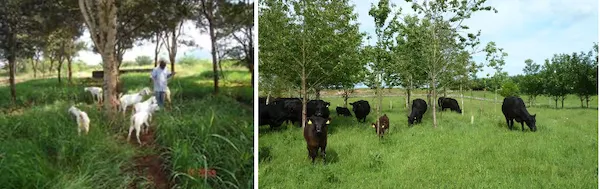
A protein bank is a dedicated block or strip of land planted with high-protein tree species to supplement livestock nutrition during fodder scarcity.
| Feature | Detail |
|---|---|
| Purpose | Cut and carry fodder for stall-fed animals during winter deficit |
| Protein content of tree leaves | 12-25% crude protein (vs grass: 3-8%) |
| Feeding method | Periodic harvesting of foliage, carried to animals |
| Best for | Supplementing low-protein crop residues and dry grass |
Protein Bank Species
| Species | Common Name | Key Advantage |
|---|---|---|
| Grewia optiva | Beul | Backbone of hill fodder supply |
| Bauhinia variegata | Kachnar | Highly palatable leaves |
| Morus alba | Mulberry | Rich in protein; also feeds silkworms |
| Artocarpus spp. | Jackfruit | Large leaf biomass |
| Anogeissus latifolia | Dhawra | Tolerates dry conditions |
| Dalbergia sissoo | Shisham | N-fixing; improves soil |
| Zizyphus jujuba | Ber | Thorny; also provides fruit |
TIP
Why "protein bank"? Just as a financial bank stores money for lean times, a protein bank stores protein-rich fodder (in the form of tree leaves) for the winter fodder deficit period when green grass is unavailable.
Tree Fodder vs Grass Fodder -- Why Trees Matter
| Parameter | Grass/Crop Residue | Tree Leaves (Protein Bank) |
|---|---|---|
| Crude protein | 3-8% | 12-25% |
| Availability in winter | Scarce (dry) | Available (evergreen/late deciduous) |
| Mineral content | Low | Generally higher (Ca, P) |
| Digestibility | Variable | Moderate to good |
| Labour | Low (grazing) | Higher (cut and carry) |
Tree fodder supplements -- not replaces -- grass. The combination ensures balanced nutrition year-round.
2. Live Fences of Fodder Trees
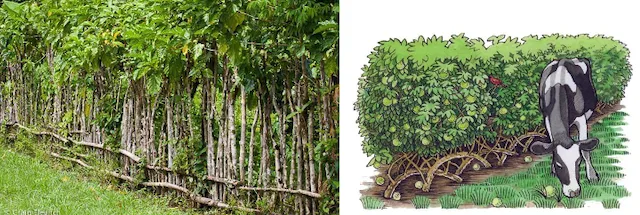
A live fence is a row of closely planted trees or shrubs that serves as a biological barrier while also producing fodder.
| Feature | Detail |
|---|---|
| Primary purpose | Protect farm property from stray animals and encroachment |
| Secondary purpose | Fodder production from periodic pruning |
| Advantage over wire fencing | Self-sustaining, provides additional products, improves soil |
Live Fence Species
| Species | Key Feature |
|---|---|
| Sesbania grandiflora | Fast growth, N-fixing, excellent green manure |
| Gliricidia sepium | N-fixing, tolerates frequent pruning |
| Erythrina abyssinica | Produces nutritious fodder |
| Euphorbia spp. | Thorny barrier; discourages animal entry |
| Acacia spp. | Thorny; effective barrier; fuel and fodder |
NOTE
Many live fence species are nitrogen-fixing legumes (Gliricidia, Sesbania), so they also improve the fertility of adjacent soil. This makes live fences a triple-purpose system: protection + fodder + soil improvement.
3. Trees and Shrubs on Pasture Land
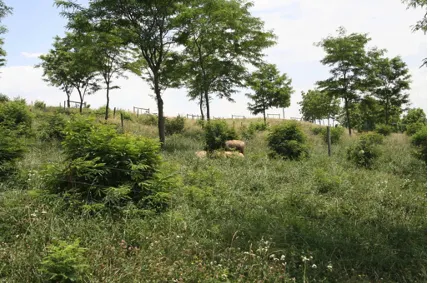
The most widespread form of silvipasture -- trees scattered across or systematically arranged on grazing land.
| Arrangement | Description | Advantage |
|---|---|---|
| Irregular/scattered | Trees occupy naturally favourable microsites | Minimal planning required |
| Systematic/regular | Trees planted at regular intervals | Optimizes light penetration for grass growth |
Benefits of trees on pasture:
- Shade for livestock -- reduces heat stress (critical in tropical regions)
- Additional fodder from tree foliage
- Improved microclimate -- lower temperature, higher humidity
- Nitrogen fixation by leguminous trees benefits grass growth
- Timber and fuelwood as long-term products
Comparison of Three Silvipasture Sub-systems
The three sub-systems serve different niches on a livestock farm. Understanding their differences is key for exam questions that ask you to match a system to a farmer's specific need.
| Feature | Protein Bank | Live Fence | Trees on Pasture |
|---|---|---|---|
| Layout | Block or strip | Linear (boundary) | Scattered or systematic |
| Primary output | Cut-and-carry fodder | Fencing + fodder | Shade + mixed products |
| Scale | Small dedicated area | Farm boundary | Entire pasture area |
| Labour | Higher (harvesting) | Low (self-sustaining) | Lowest (animals graze) |
| Best species | Grewia, Morus, Bauhinia | Gliricidia, Sesbania, Acacia | Mixed shade + fodder trees |
Related Pasture Term: Lay Farming
Lay farming means rotation of arable crops with two or more years of sown pasture. It is not a full silvipasture system by itself, but it is a related exam term because the pasture phase helps restore soil fertility through organic matter addition and legume-based nitrogen fixation.
Agricultural Connection: Why Livestock Farmers Need Trees
In arid and semi-arid India, livestock farming faces multiple simultaneous challenges -- fodder scarcity, heat stress, soil degradation, and single-income risk. Silvipasture addresses all of these through one integrated system.
| Problem in Dry Areas | How Silvipasture Solves It |
|---|---|
| Winter fodder scarcity | Protein banks provide 12-25% crude protein leaves |
| Stray animal damage to crops | Live fences act as biological barriers |
| Heat stress in livestock | Trees on pasture provide shade and reduce temperature |
| Soil degradation in pastures | N-fixing trees improve soil fertility for better grass growth |
| Single income source | Trees add timber and fuelwood income to livestock farming |
Exam Tips
TIP
Key facts for exams:
- Silvipasture = Trees + Pasture/Animals (no crops)
- Three sub-types: Protein bank, Live fence, Trees on pasture
- Protein bank tree leaves: 12-25% crude protein
- Cut and carry method used in protein banks
- Live fence species: Gliricidia, Sesbania, Erythrina (N-fixing)
- Most needed in dry/arid areas
- Key fodder tree in hills: Grewia optiva
- Silvipasture provides: fodder + shade + fuelwood + soil improvement
Summary Table
| Topic | Key Fact |
|---|---|
| Definition | Trees + Pasture + Animals on same land |
| Three sub-types | Protein bank, Live fence, Trees on pasture |
| Most needed in | Dry/arid areas (year-round fodder challenge) |
| Protein bank purpose | Cut-and-carry fodder during winter deficit |
| Tree leaf protein | 12-25% crude protein |
| Key protein bank species | Grewia optiva, Morus alba, Bauhinia, Dalbergia |
| Live fence purpose | Protection + fodder + soil improvement |
| Live fence species | Gliricidia, Sesbania, Erythrina, Acacia |
| Trees on pasture benefit | Shade for livestock, improved microclimate |
Summary Cheat Sheet
| Concept / Topic | Key Details |
|---|---|
| Silvipasture | Trees + Pasture/Grazing land + Animals (2-component system) |
| Primary purpose | Integrate livestock grazing with tree growing |
| Protein bank | Planting high-protein fodder trees/shrubs on grazing land |
| Protein bank species | Leucaena, Gliricidia, Sesbania, Hardwickia |
| Live fence | Row of trees/shrubs as protective boundary |
| Live fence species | Gliricidia, Sesbania, Erythrina, Acacia |
| Live fence purpose | Protection + fodder + soil improvement |
| Trees on pasture benefit | Shade for livestock, improved microclimate, N-fixation |
| Shade-tolerant grasses | Brachiaria, Paspalum (grow well under tree canopy) |
| Silvipasture advantage | Year-round fodder supply; reduces grazing pressure on forests |
| Animal component | Cattle, goats, sheep graze under tree canopy |
| Arid zone silvipasture | Prosopis cineraria (Khejri) + native grasses + goats/sheep |
| Humid zone silvipasture | Coconut/arecanut palms + improved grasses + cattle |
| Tree density | Must be managed to allow sufficient light for grass growth |
TIP
Next: Lesson 04 covers Agrisilvipastoral systems -- the most complete form of agroforestry that integrates all three components (trees + crops + animals), including Kerala home gardens, silviapiary, and aquaforestry.