🧑🏻🌾 Silviculture -- The Science of Growing Forest Crops
Definition, dendrology, phenology, tree characteristics, growth stages, regeneration (natural and artificial), tending operations, silvicultural systems, and forest succession
From Seed to Timber -- Managing a Forest's Lifecycle
The previous lesson introduced forestry as a discipline and identified silviculture as its core branch. Now we explore silviculture in depth -- the science of growing and managing forest crops from seed to harvest.
Just as a farmer manages the lifecycle of a wheat crop -- from seed selection to sowing, weeding, irrigation, and harvesting -- a forester manages the lifecycle of a forest crop through silviculture. But while a wheat crop takes 4 months, a Teak forest may take 60 years.
This lesson covers:
- Definition and related sciences -- dendrology, phenology
- Tree characteristics and growth stages -- from recruit to mature tree
- Regeneration -- natural and artificial methods
- Tending operations -- weeding, thinning, pruning, lopping
- Silvicultural systems -- high forest vs coppice
- Forest succession -- pioneer to climax communities
What is Silviculture?
| Feature | Detail |
|---|---|
| Word origin | Latin Silva = woodland |
| Definition | Art and science of cultivating forest crops (Champion and Seth, 1968) |
| Covers | Establishment, development, care, and reproduction of timber stands |
| Analogy | Just as agronomy is to agriculture, silviculture is to forestry |
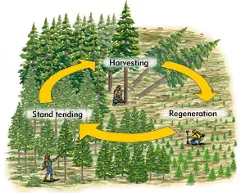
Silviculture is the branch of forestry concerned with the establishment, development, care, and reproduction of forest crops / timber stands.
Pro Content Locked
Upgrade to Pro to access this lesson and all other premium content.
₹99 charged monthly · Cancel anytime
- All Agriculture & Banking Courses
- AI Lesson Questions (100/day)
- AI Doubt Solver (50/day)
- Glows & Grows Feedback (30/day)
- AI Section Quiz (20/day)
- 22-Language Translation (100/day)
- Recall Questions (20/day)
- AI Quiz (15/day)
- AI Quiz Paper Analysis (100/day)
- AI Step-by-Step Explanations (100/day)
- Spaced Repetition Recall (FSRS)
- AI Tutor
- Immersive Text Questions
- Audio Lessons — Hindi & English
- Mock Tests & Previous Year Papers
- Summary & Mind Maps
- XP, Levels, Leaderboard & Badges
- Generate New Classrooms
- Voice AI Teacher (AgriDots Live)
- AI Revision Assistant
- Knowledge Gap Analysis
- Interactive Revision (LangGraph)
🔒 Secure via Razorpay · Cancel anytime · No hidden fees
From Seed to Timber -- Managing a Forest's Lifecycle
The previous lesson introduced forestry as a discipline and identified silviculture as its core branch. Now we explore silviculture in depth -- the science of growing and managing forest crops from seed to harvest.
Just as a farmer manages the lifecycle of a wheat crop -- from seed selection to sowing, weeding, irrigation, and harvesting -- a forester manages the lifecycle of a forest crop through silviculture. But while a wheat crop takes 4 months, a Teak forest may take 60 years.
This lesson covers:
- Definition and related sciences -- dendrology, phenology
- Tree characteristics and growth stages -- from recruit to mature tree
- Regeneration -- natural and artificial methods
- Tending operations -- weeding, thinning, pruning, lopping
- Silvicultural systems -- high forest vs coppice
- Forest succession -- pioneer to climax communities
What is Silviculture?
| Feature | Detail |
|---|---|
| Word origin | Latin Silva = woodland |
| Definition | Art and science of cultivating forest crops (Champion and Seth, 1968) |
| Covers | Establishment, development, care, and reproduction of timber stands |
| Analogy | Just as agronomy is to agriculture, silviculture is to forestry |
Silviculture is the branch of forestry concerned with the establishment, development, care, and reproduction of forest crops / timber stands.
The book also separates silvics from silviculture. Silvics is the study of the life history and characteristics of forest crops in relation to their environment, while silviculture is the practical application of that knowledge in raising and managing forest stands.
Why study silviculture?
- Produce more volume and higher quality wood per unit area
- Reduce rotation period (harvest sooner)
- Enable afforestation and reforestation
- Introduce exotics (Poplar, Eucalyptus)
- Create man-made forests in place of natural forests
TIP
Exam parallel: Agronomy = growing field crops. Silviculture = growing forest crops. Silviculture is the core branch of forestry.
Related Sciences
| Term | Definition | Importance |
|---|---|---|
| Dendrology | Science of classifying and identifying woody plants (trees, shrubs, lianas); also called xylology in many exam-oriented texts | First step in any silvicultural operation |
| Phenology | Study of timing of periodic events (flowering, fruiting, leaf shedding) | Determines best times for seed collection, planting, harvesting |
| Dendrochronology | Study of tree rings to estimate age and growth history | Helps infer tree age and past growth pattern |
| Dendroclimatology | Use of tree-ring records to reconstruct past climate | Links annual growth pattern with climatic variation |
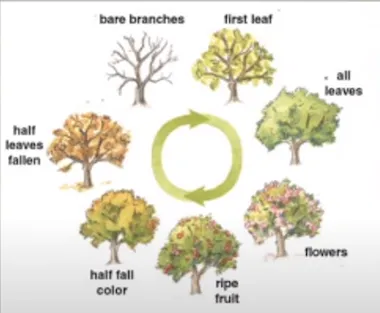
Key identification features for dendrology: bark, fruit, leaves, twigs.
The Stand -- Unit of Silviculture
The unit of silviculture is the stand.
| Concept | Definition |
|---|---|
| Stand | An aggregation of trees occupying a specific area, sufficiently uniform in composition, age, arrangement, and condition to be distinguishable from adjoining areas |
| Forest | A collection of stands (like a farm is a collection of fields) |
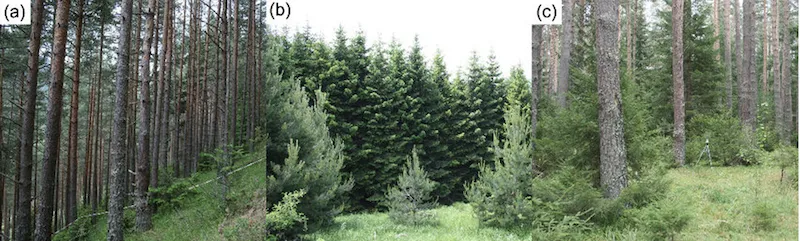
All forest management operations are planned and executed at the stand level.
Composition of a Stand
Forest stands are also classified by the proportion contributed by a single dominant species.
| Share of one species in the stand | Classification |
|---|---|
| More than 75% | Pure crop |
| 50-75% | Main crop |
| 25-50% | Mixed crop |
| Less than 25% | Miscellaneous crop |
TIP
Threshold to remember: if one species contributes more than 75%, the stand is treated as a pure crop.
Tree Characteristics
Evergreen vs Deciduous
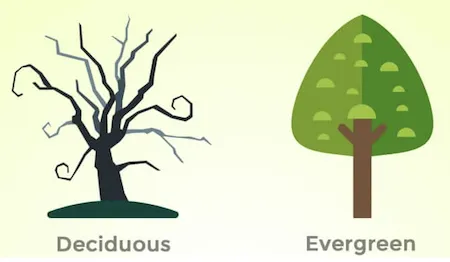
| Feature | Evergreen | Deciduous |
|---|---|---|
| Leaf retention | Never entirely leafless | Distinct leafless period for part of year |
| Leaf replacement | Gradual -- new leaves emerge before old fall | Abrupt -- leaves shed together |
| Adaptation | Humid tropical climates | Water-conserving adaptation for dry/cold seasons |
| Example | Tropical evergreen forests | Teak, Sal forests Exams |
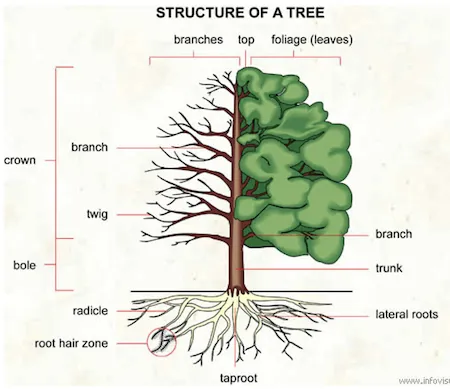
Tree Anatomy
| Part | Description |
|---|---|
| Stem (= Bole = Trunk) | Principal axis; transport pathway for water and nutrients |
| Bole | Lower part of stem up to where main branches diverge -- commercially most valuable part |
| Crown | Upper branchy part above bole; contains leaves (photosynthesis factories) |
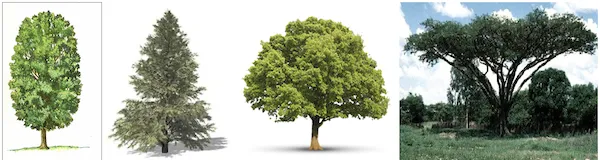
Basic Growth Forms
| Form | Meaning |
|---|---|
| Tree | Woody perennial plant with a well-defined erect trunk and a more or less distinct crown |
| Shrub | Smaller perennial woody plant, usually with several stems arising from the base |
| Herb | Plant with a soft, non-woody stem, whether annual or perennial |
| Vine | Woody or herbaceous plant with weak stems that depend on other plants or supports |
Stages of Tree Growth
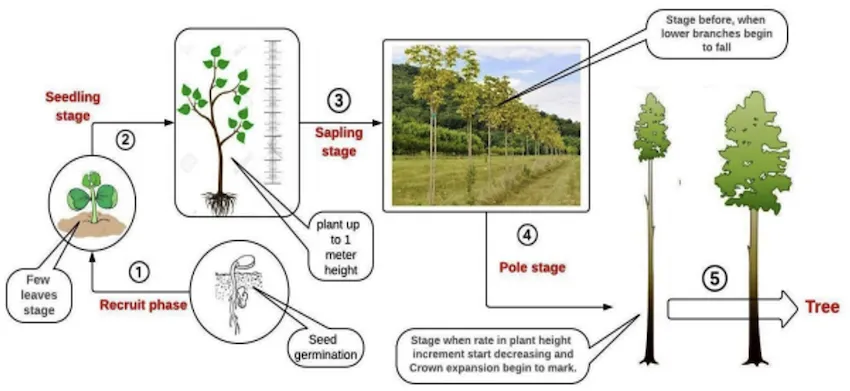
| Stage | Description | Key Characteristic |
|---|---|---|
| Recruit/Juvenile | Seed germination to few leaves | Most vulnerable; needs maximum protection |
| Seedling | Up to ~1 m height with few leaves | Establishing root system |
| Sapling | From 1 m until lower branches begin to fall | More established, better stress tolerance |
| Pole | Lower branches falling; height growth slowing; crown expanding | Active height and girth growth |
| Tree | Well-defined single bole, >6 m height | Mature; contributes to canopy |
TIP
Growth stages in order: Recruit --> Seedling --> Sapling --> Pole --> Tree (>6 m).
Forest Regeneration
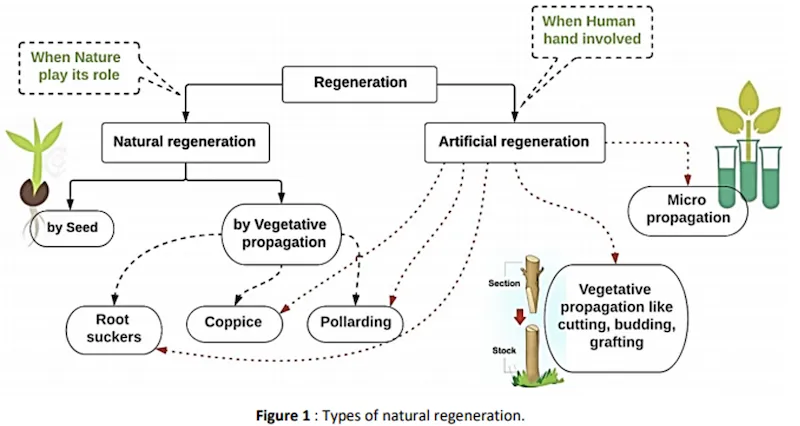
Regeneration is replacing the old crop with a younger one -- the cornerstone of sustainable forestry.
Regeneration Types:
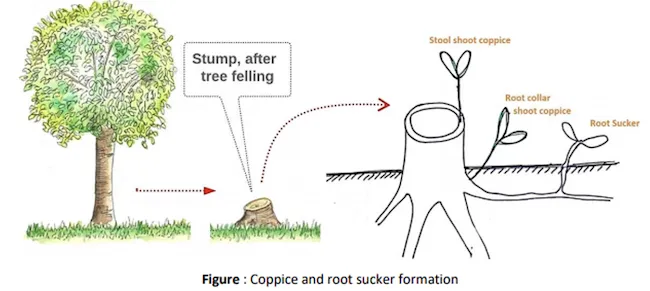
- Natural Regeneration: 1. By Seeds, 2. By Coppices, 3. By Root suckers
- Artificial Regeneration: 1. By sowing, 2. By planting
- Natural regeneration supplemented by artificial regeneration
| Type | Method | Result |
|---|---|---|
| Natural regeneration | By nature (seed or vegetative) | Seed --> High forest; Coppice --> Coppice forest |
| Artificial regeneration | Human-assisted (sowing, planting) | Plantation |
| Combined | Natural + artificial supplement | When natural alone is insufficient |
- In classical silviculture wording, natural regeneration means renewal of the forest crop through self-sown seed or through vegetative means such as coppice and root suckers, without establishing the new crop primarily by planting.
Natural Regeneration Methods
| Method | Height of Cut | Purpose |
|---|---|---|
| Coppicing | 30-45 cm from ground | Rapid regeneration from existing root system |
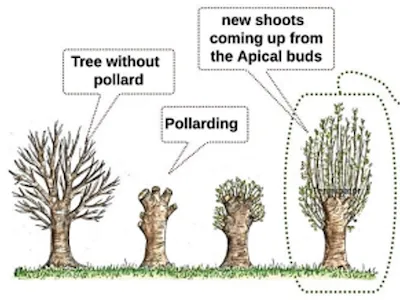
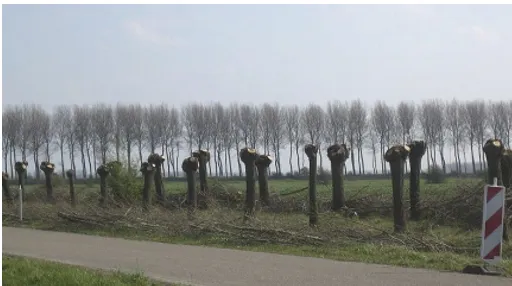
| Pollarding | 1-1.25 m from ground | New shoots above browsing height of livestock |
Artificial Regeneration
| Term | Definition | Key Distinction |
|---|---|---|
| Afforestation | Planting trees on land that was never forest | Creating new forest (e.g., on barren wasteland) |
| Reforestation | Replanting on land that was previously forest | Restoring lost forest |
| Deforestation | Removal of forest and conversion to non-forest use | Greatest threat to global forests |
IMPORTANT
Afforestation = planting where there was never forest. Reforestation = replanting where forest existed before. This is a commonly tested distinction.
- Older forestry objective books also distinguish forest degradation from deforestation:
- Forest degradation = qualitative deterioration of forest condition
- Deforestation = quantitative loss of forest area / cover through conversion to non-forest use
- In the same exam-book framing, depletion of forest tree cover by less than 90% is treated as degradation, while depletion by more than 90% is treated as deforestation.
- A classic MCQ-style example is that logging is usually treated as forest degradation, not full deforestation, unless the land is permanently converted out of forest use.
Seed Orchards
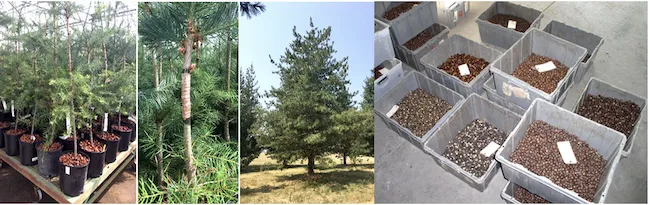
Plantations established exclusively to produce genetically superior seed.
| Type | Method | Advantage |
|---|---|---|
| Clonal | Grafting clones of superior trees on 2-3 year old seedlings | Known genetic parentage; consistent quality |
| Seedling | Raised from seeds of superior trees | Genetic diversity maintained |
Forest Nursery
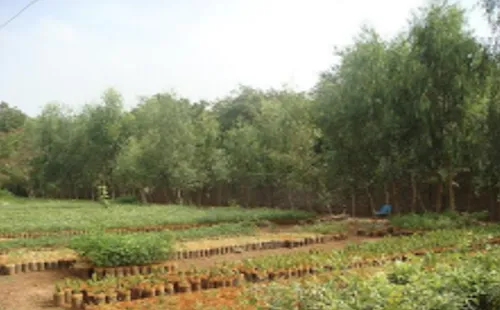
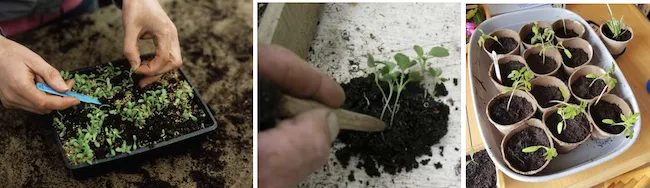
An area where seedlings are raised for eventual planting out. A well-managed nursery is the foundation of successful plantation forestry.
| Practice | Description |
|---|---|
| Pricking out | Transplanting seedlings from germination bed into larger containers when they have 2+ leaves |
| Hardening | Gradually removing shade and reducing water to acclimatize seedlings to field conditions |
NOTE
Hardened seedlings have higher survival rates after field transplanting because they have adapted to full sunlight and reduced moisture -- simulating real field conditions.
Tending Operations
Tending = any operation carried out for the benefit of a forest crop between the seedling and mature stages.
| Operation | Purpose |
|---|---|
| Weeding | Remove competing vegetation |
| Cleaning | Remove unwanted species from young stands |
| Thinning | Remove weaker trees to give remaining trees more resources |
| Improvement felling | Remove poor-quality trees in mature stands |
| Climber cutting | Remove woody climbers that damage trees |
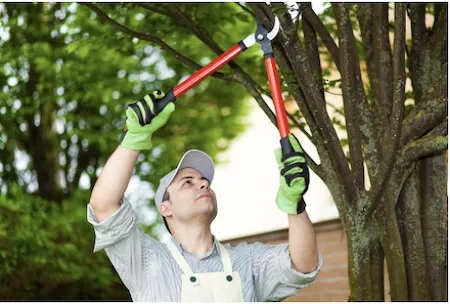
| Pruning | Remove branches to produce knot-free timber (improves quality and value) |
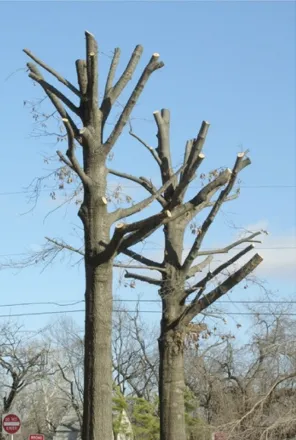
| Lopping | Cut branches to obtain fodder, fuel, or raw material (e.g., Diospyros for bidi leaves) |
| Girdling | Ring-bark unwanted trees to kill them slowly |
TIP
Lopping vs Pruning: Lopping = cutting branches for products (fodder, fuel). Pruning = cutting branches for timber quality and tree health. Both remove branches, but the purpose differs.
Common Thinning Types Asked in Exams
| Thinning type | Other name | Core idea |
|---|---|---|
| Mechanical thinning | Geometric thinning | Trees removed by fixed spacing or row rule, not by detailed crown judgment |
| Crown thinning | French thinning | Removal mainly from upper crown classes to favour the best dominant trees |
| Ordinary thinning | German thinning / Low thinning | Inferior suppressed trees removed first from lower crown classes |
| Advance thinning | Craib's thinning | Thinning started before strong competition is fully established |
| Free thinning | Elite thinning / Alpha thinning | Selection made flexibly around the best crop trees |
In practical stand treatment, ordinary thinning is directed mainly at the inferior and suppressed individuals of the crop, while the more promising dominant trees are generally retained unless they are clearly dead, diseased, or otherwise defective.
Not included in tending: Planting / regeneration, felling, soil working, drainage, irrigation, controlled burning.
Silvicultural Systems
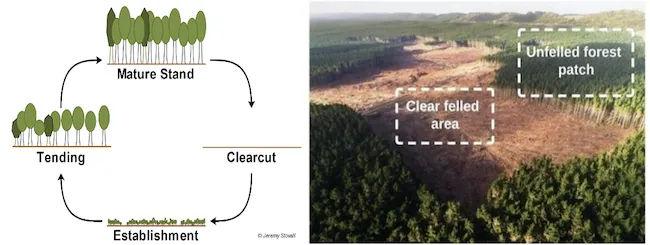
A silvicultural system is a planned set of treatments applied to a forest crop throughout its life -- from regeneration to final harvest.
| Basis of Classification | In India |
|---|---|
| Mode of regeneration | Primary classification basis |
Two Main Systems
| System | Regeneration | Rotation | Root System |
|---|---|---|---|
| High Forest System | From seed (natural or artificial) | Long | Strong tap root |
| Coppice Forest System | From vegetative methods (coppice, pollarding) | Short | Uses existing root system |
High Forest -- Felling Concepts
| Term | Definition |
|---|---|
| Clear felling | Removal of ALL trees from a harvesting area |
| Annual coupe | Area felled each year = Total area (A) / Rotation (r) |
| AAC | Annual Allowable Cut -- maximum harvestable volume per year for sustained yield |
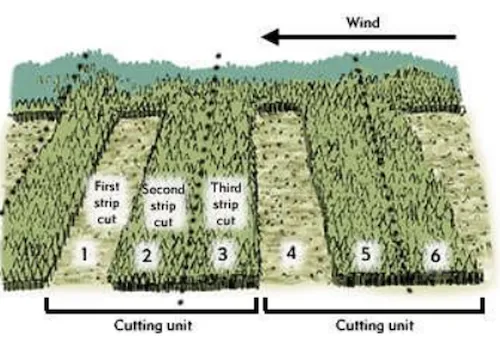
Coppice Systems (7 Types)
| System | Key Feature |
|---|---|
| Simple coppice | Clear-fell completely; new crop from stool coppice |
| Coppice of two rotations | Two different rotation periods |
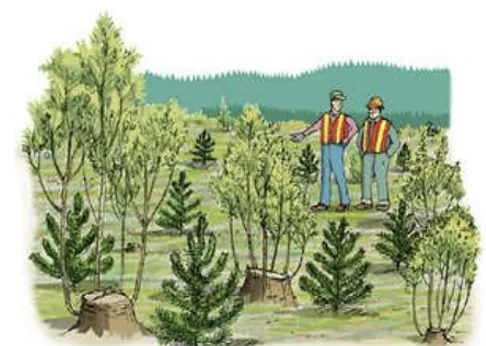
| Shelterwood coppice | Shelter trees retained during regeneration |
| Coppice selection | Selective felling of mature coppice |
| Coppice-with-standards | Standards (seed trees) retained among coppice |
| Coppice-with-reserves | Reserve trees retained for longer rotation |
| Pollard system | Cut above browsing height for fodder shoots |
NOTE
Salix (Willow) is pollarded in Kashmir valley to produce shoots for the cricket bat industry -- an excellent example of silviculture adapted to local economic needs.
Forest Succession
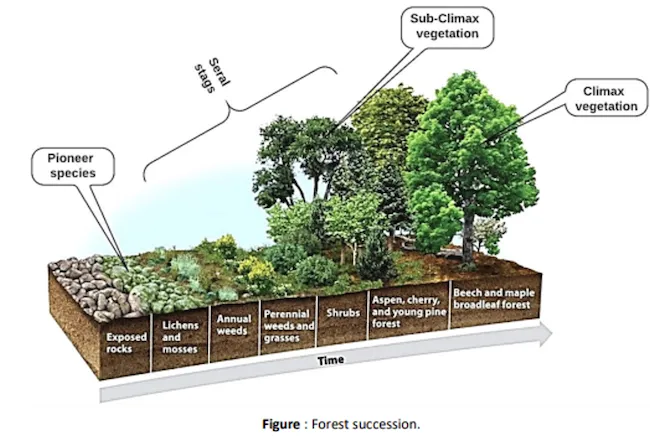
Succession is the natural, orderly replacement of one biotic community by another more advanced community over time.
| Stage | Community | Example |
|---|---|---|
| 1. Pioneer | Grasses, herbs | Colonize bare land |
| 2. Intermediate | Shrubs, small trees | Replace grasses |
| 3. Climax | Mature forest | Stable, self-perpetuating community |
Understanding succession is vital for forest restoration -- knowing which stage a degraded area is in helps foresters choose the right intervention.
Exam Tips
TIP
High-frequency exam facts:
- Silva = woodland (Latin)
- Unit of silviculture = Stand
- Tree height to be called "tree" = >6 m
- Coppicing height = 30-45 cm
- Pollarding height = 1-1.25 m (above browsing)
- Afforestation = planting where never forest
- Reforestation = replanting where forest existed before
- Annual coupe = A/r (area/rotation)
- Lopping = for products (fodder, fuel)
- Pruning = for timber quality
- Dendrology = tree identification and classification
- Phenology = timing of seasonal events
Summary Table
| Topic | Key Fact |
|---|---|
| Definition | Art and science of cultivating forest crops |
| Latin origin | Silva = woodland |
| Analogy | Agronomy : Agriculture :: Silviculture : Forestry |
| Unit | Stand |
| Tree height threshold | >6 m |
| Two regeneration types | Natural (seed/coppice) and Artificial (plantation) |
| Afforestation | Planting on non-forest land |
| Reforestation | Replanting on former forest land |
| Coppicing height | 30-45 cm |
| Pollarding height | 1-1.25 m |
| Two silvicultural systems | High forest (seed, long rotation) and Coppice (vegetative, short rotation) |
| Tending operations | Weeding, cleaning, thinning, pruning, lopping, girdling |
| Succession stages | Pioneer --> Intermediate --> Climax |
| Seed orchards | Clonal (grafted) or Seedling (from superior seeds) |
Summary Cheat Sheet
| Concept / Topic | Key Details |
|---|---|
| Silviculture | Latin Silva = woodland; art & science of growing forest crops |
| Definition by | Champion and Seth (1968) |
| Analogy | Agronomy : Agriculture :: Silviculture : Forestry |
| Purpose | Produce more wood, reduce rotation, enable afforestation/reforestation |
| Tending operations | Weeding, cleaning, thinning, pruning, lopping, girdling |
| Weeding | Removing unwanted plants competing with desired crop |
| Thinning | Removing some trees to improve growth of remaining |
| Pruning | Removing lower branches for knot-free timber |
| Girdling (Ring-barking) | Removing bark ring to kill unwanted trees |
| Succession | Pioneer → Intermediate → Climax community |
| Pioneer species | First colonisers; light-demanding; fast growing |
| Climax species | Final stable community; shade-tolerant |
| Seed orchards | Clonal (grafted) or Seedling (from superior seeds) |
| Afforestation | Planting trees on land that was never forested |
| Reforestation | Replanting on land that was previously forested |
| Regeneration methods | Natural (seed fall, coppice) vs Artificial (planting, direct seeding) |
TIP
Next lesson: Now that you understand silvicultural principles, the next lesson covers Silviculture of Important Tree Species -- Teak, Eucalyptus, Poplar, Neem, Bamboo, and other key species with their families, uses, and exam-critical facts.