🎹 Agrisilviculture Systems -- Trees with Crops
Nair's classification, shifting cultivation, Taungya system, alley cropping, shelterbelts, windbreaks, soil conservation hedges, and hortisilviculture
When a Forest Department Planted Teak -- and Got Rice Too
In the previous lesson, we defined agroforestry and explored its principles, benefits, constraints, and management practices. Now we move to the first major system type: agrisilviculture -- the combination of trees with agricultural crops.
In 1850s Burma, forest officers discovered that tribal labourers clearing land for teak plantations could grow rice between the young teak seedlings. The trees got weeded for free, the labourers got food, and the government got its plantation established at minimal cost. This Taungya system became one of the world's first formally recognized agroforestry practices -- and it all started because someone saw the logic in combining trees with crops.
This lesson covers:
- P.K. Nair's classification of agroforestry systems (1987)
- Shifting cultivation (Jhum) -- the oldest system
- Taungya system -- origin, types, and rainfall requirements
- Alley cropping -- hedgerow intercropping with nitrogen-fixing trees
- Shelterbelts and windbreaks -- protection zone calculations
- Hortisilviculture -- fruit trees with timber trees
All sub-systems are high-yield for IBPS AFO, NABARD Grade A, and FCI exams.
Pro Content Locked
Upgrade to Pro to access this lesson and all other premium content.
₹99 charged monthly · Cancel anytime
- All Agriculture & Banking Courses
- AI Lesson Questions (100/day)
- AI Doubt Solver (50/day)
- Glows & Grows Feedback (30/day)
- AI Section Quiz (20/day)
- 22-Language Translation (100/day)
- Recall Questions (20/day)
- AI Quiz (15/day)
- AI Quiz Paper Analysis (100/day)
- AI Step-by-Step Explanations (100/day)
- Spaced Repetition Recall (FSRS)
- AI Tutor
- Immersive Text Questions
- Audio Lessons — Hindi & English
- Mock Tests & Previous Year Papers
- Summary & Mind Maps
- XP, Levels, Leaderboard & Badges
- Generate New Classrooms
- Voice AI Teacher (AgriDots Live)
- AI Revision Assistant
- Knowledge Gap Analysis
- Interactive Revision (LangGraph)
🔒 Secure via Razorpay · Cancel anytime · No hidden fees
When a Forest Department Planted Teak -- and Got Rice Too
In the previous lesson, we defined agroforestry and explored its principles, benefits, constraints, and management practices. Now we move to the first major system type: agrisilviculture -- the combination of trees with agricultural crops.
In 1850s Burma, forest officers discovered that tribal labourers clearing land for teak plantations could grow rice between the young teak seedlings. The trees got weeded for free, the labourers got food, and the government got its plantation established at minimal cost. This Taungya system became one of the world's first formally recognized agroforestry practices -- and it all started because someone saw the logic in combining trees with crops.
This lesson covers:
- P.K. Nair's classification of agroforestry systems (1987)
- Shifting cultivation (Jhum) -- the oldest system
- Taungya system -- origin, types, and rainfall requirements
- Alley cropping -- hedgerow intercropping with nitrogen-fixing trees
- Shelterbelts and windbreaks -- protection zone calculations
- Hortisilviculture -- fruit trees with timber trees
All sub-systems are high-yield for IBPS AFO, NABARD Grade A, and FCI exams.
Classification of Agroforestry Systems
Before diving into individual agrisilviculture sub-systems, it is essential to understand how all agroforestry systems are classified. P.K. Nair's framework provides the standard taxonomy used across textbooks and exams.

P.K. Nair (1987), widely regarded as the father of modern agroforestry, classified agroforestry systems based on four criteria:
| Basis of Classification | What It Describes |
|---|---|
| Structural | Nature and arrangement of components (most commonly used) |
| Functional | Role of the system (productive, protective, or both) |
| Socioeconomic | Level of input and market orientation |
| Ecological | Suitability to agro-ecological zones |
- His book An Introduction to Agroforestry is the foundational text for the discipline.
| System | Components |
|---|---|
| Agri-Silviculture | Agricultural Crops + Forest Trees |
| Silvi-Pastoral | Forest trees + Grasses |
| Agri-Silvi-Pastoral | Agricultural Crops + Forest Trees + Grasses |
| Agri-Horti System | Agricultural Crops + Fruit Crops |
| Horti-Silviculture | Fruit Crops + Forest Trees |
| Horti-Pasture | Fruit Trees + Grasses |
| Agri-Horti-Silviculture | Agricultural Crops + Fruit Crops + Forest Trees |
| Aqua-Silviculture | Fish + Forest Trees |
| Agri-Silvi-Aquaculture | Agricultural crops + Forest Trees + Fish |
IMPORTANT
The structural classification is the most important and commonly used. It describes the physical composition and arrangement of the system in a clear, observable way.
Structural Classification -- Based on Nature of Components
The structural basis is the most commonly used classification in exams because it directly describes what you see on the ground -- which components are present and how they are arranged.
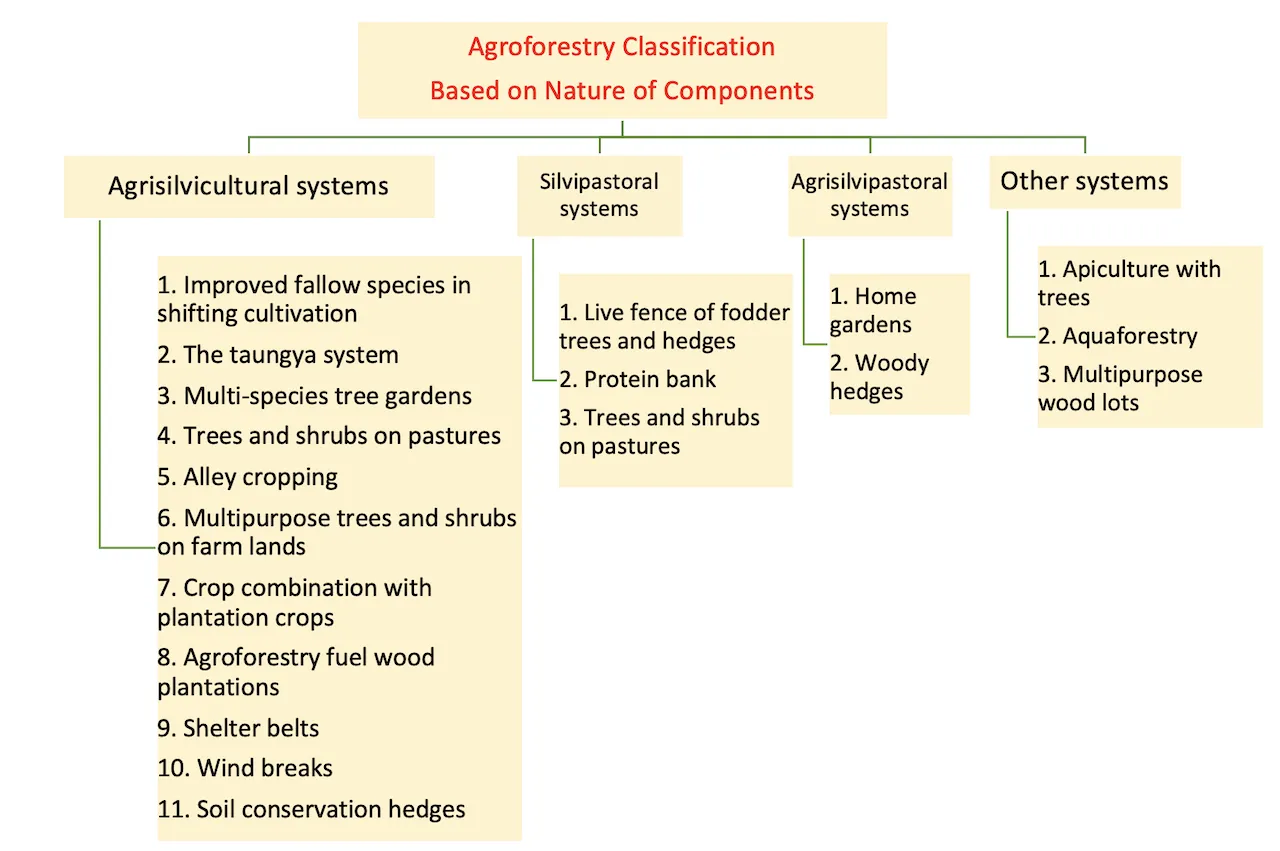
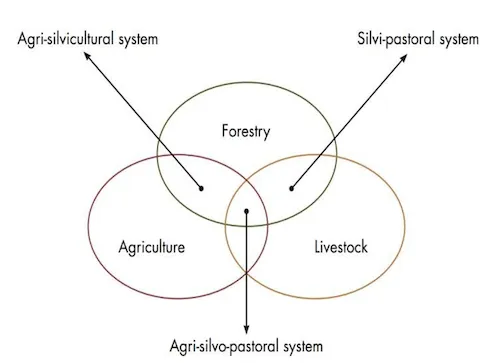
| System | Components | Example |
|---|---|---|
| Agrisilviculture (also silviagriculture / agrosilviculture) | Trees + Crops | Taungya, alley cropping |
| Silvopastoral (silvipastoral) | Trees + Pasture/Animals | Protein banks, live fences |
| Agrosilvopastoral (agrisilvipastoral) | Trees + Crops + Pasture/Animals | Home gardens, multi-tier systems |
| Other systems | Trees + other components | Apiculture with trees, aquaforestry |
TIP
Memory aid: Think of the components as building blocks -- Agri (crops), Silvi (trees), Pastoral (animals). Combine any two or all three to name the system.
Agrisilviculture Sub-systems
Having established the classification framework, we now examine each agrisilviculture sub-system in detail. Agrisilviculture (Trees + Crops) includes several important sub-systems:
| Sub-system | Key Feature |
|---|---|
| Improved fallow in shifting cultivation | Trees planted during fallow to restore soil |
| Taungya system | Crops grown alongside new forest plantations |
| Multi-species tree gardens | Mixed tree species for diverse products |
| Alley cropping (hedgerow intercropping) | Crops grown in alleys between tree hedgerows |
| Agroforestry for fuelwood | Fuelwood trees on farm boundaries |
| Shelterbelts | Wide tree belts protecting crops from wind |
| Windbreaks | Narrow tree strips for local wind protection |
| Soil conservation hedges | Trees on bunds and terraces to prevent erosion |
| Hortisilviculture | Fruit trees + timber trees together |
1. Shifting Cultivation (Jhum)
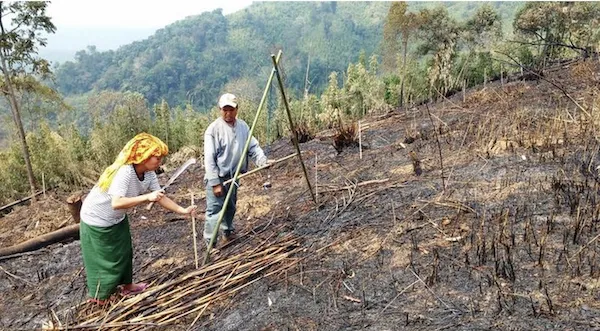
Shifting cultivation is the oldest known agroforestry system, dating back thousands of years.
The cycle:
- Select a forest patch and clear-fell it
- Burn the slashed vegetation (slash and burn)
- Cultivate crops for 2-3 years until soil fertility declines
- Abandon the site (fallow period) and move to a new patch
- Return after the fallow period when soil has recovered
The problem: Earlier, the fallow cycle was 20-30 years -- enough for full recovery. Due to population pressure, it has reduced to 2-3 years, causing ecological degradation, soil erosion, and conversion of forests to wasteland.
| Feature | Detail |
|---|---|
| Most prevalent in | North-Eastern India |
| Called Jhum in | North-Eastern hill region |
| Called Khallu/Kurwa in | Jharkhand |
| Called Dahiya/Podu in | Odisha, Andhra Pradesh |
| States practicing it | Assam, Meghalaya, Manipur, Nagaland, Arunachal Pradesh, Mizoram, Tripura, Jharkhand, West Bengal, Sikkim, Odisha, Chhattisgarh, Madhya Pradesh, Andhra Pradesh, Kerala |
Improved Fallow System: Planting nitrogen-fixing trees during the fallow period to restore soil fertility faster, allowing either shorter fallows or better yields.
NOTE
The reduction of fallow period from 25-30 years to 2-3 years is the core problem that makes modern shifting cultivation unsustainable. This is a frequently tested concept.
2. Taungya System
The Taungya system is a modified form of shifting cultivation used primarily to establish timber plantations at low cost.
| Feature | Detail |
|---|---|
| Word origin | Burmese -- taung = hill, ya = cultivation |
| First used | 1850s in Burma (Myanmar) for Teak plantations |
| In India introduced by | Dr. Brandis |
| First Indian adoption | Common exam framing: 1890 |
| In South India called | Kumri |
| Rainfall requirement | 1,200-1,500 mm |
| Crop duration | 1-3 years (until tree shade becomes too dense) |
| exams 2019 | Combined stand of woody and agricultural species during early plantation stage |
How it works: Labourers are given forest land to grow food crops (rice, millets, vegetables) alongside newly planted tree seedlings. They weed the plantation as part of crop cultivation. After 3-5 years, when the tree canopy closes, they move to a new area.
Types of Taungya
| Type | Who Manages | Key Feature |
|---|---|---|
| Departmental Taungya | Forest department (daily wage labour) | Most centralized; department bears all costs |
| Leased Taungya | Highest bidder gets lease | Market mechanism for plantation establishment |
| Village Taungya | Settled village families (0.8-1.7 ha each) | Most successful -- creates ownership and long-term commitment |
TIP
Exam favourite: Village Taungya is the most successful type because families live on the land and have a direct stake in both crops and plantations.
NOTE
Taungya is often described as a scientifically managed and organised form of shifting cultivation. The forestry objective remains plantation establishment, while temporary crop cultivation helps reduce weeding costs during the early years.
3. Multi-species Tree Gardens
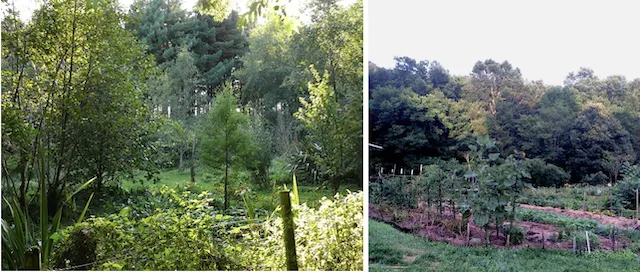
- Various tree species are grown in a mixed arrangement
- Provides ecological resilience and year-round supply of different products
- Main function: production of food, fodder, and wood for home consumption and sale
- Common in Kerala (home gardens with coconut, arecanut, pepper, jackfruit, mango)
4. Alley Cropping (Hedgerow Intercropping)
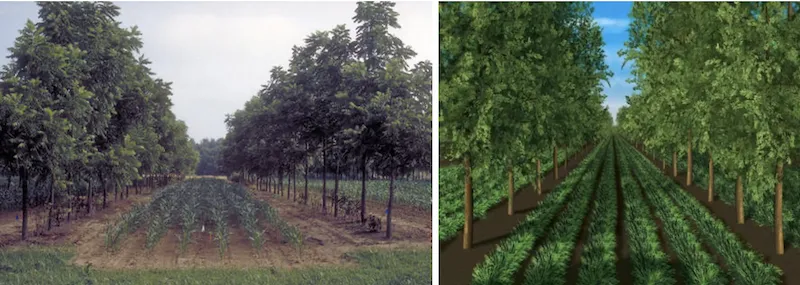
One of the most well-researched agroforestry systems in the tropics.
How it works:
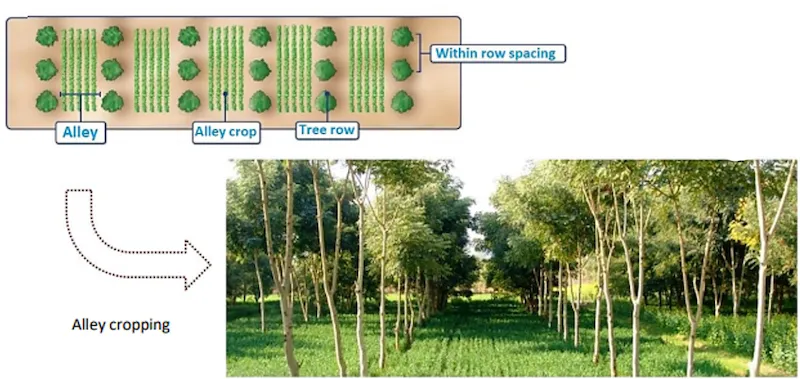
- Perennial, preferably leguminous trees/shrubs are grown as hedgerows in wide rows
- Agricultural crops are planted in the "alleys" between the hedgerows
- During cropping, trees are pruned and the biomass is used as mulch on the alleys -- this reduces evaporation, suppresses weeds, and adds nutrients
| Feature | Detail |
|---|---|
| Preferred tree type | Leguminous (Leucaena, Gliricidia) -- for nitrogen fixation |
| Row spacing | 4-8 m between hedgerows |
| Within-row spacing | 25 cm to 2 m |
| Hedgerow orientation | East to west (both sides get full sunlight) |
| Wider spacing used in | Semi-arid and sub-humid regions (reduce water competition) |
NOTE
The biomass transfer from pruned hedgerows to crop alleys is the central mechanism through which alley cropping improves yields -- it adds green manure while reducing competition.
5. Agroforestry for Fuelwood Production
- Multipurpose fuelwood species are planted on or around agricultural lands
- Over 70% of rural India depends on fuelwood for cooking
- Trees also serve as fencing, shelterbelts, and boundary markers
- Common species: Acacia nilotica, Albizia lebbek, Cassia siamea, Casuarina equisetifolia, Dalbergia sissoo, Prosopis juliflora, Eucalyptus tereticornis
6. Shelterbelts
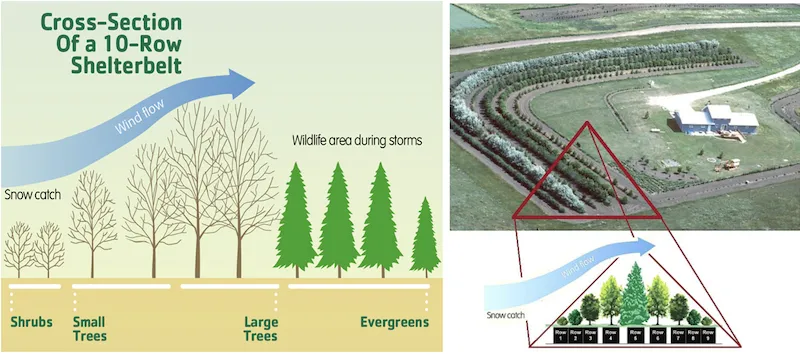
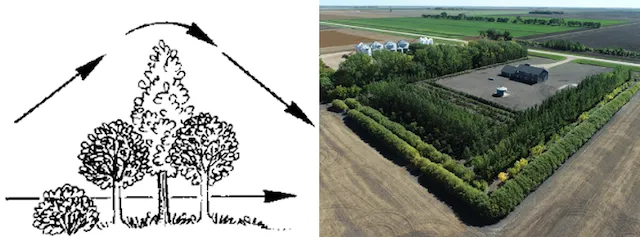
A wide belt of trees, shrubs, and grasses planted in rows at right angles to prevailing winds to protect crops from wind erosion and hot desiccating winds.
| Feature | Detail |
|---|---|
| Cross-section shape | Triangular -- tall trees in centre, shorter trees on sides, shrubs and grasses at edges |
| Ideal width | Up to 50 m |
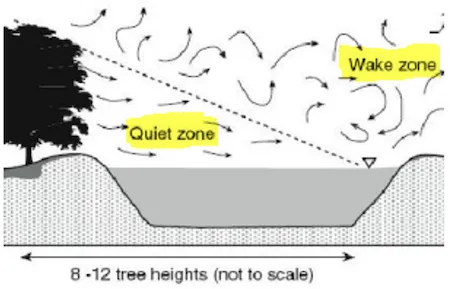
| Protection zone | 15-20 times the height of the belt (on leeward side) |
| Minimum length | 24 times its height (to avoid end eddies) |
| Spacing in Rajasthan | 10 times height (75 m for 7.5 m tall belt) |
| Wind velocity reduction | 20% reduction used as basis of usefulness |
| Permeability | Semi-permeable is better than solid (avoids leeward turbulence) |
TIP
Shelterbelt key numbers to remember: Width = 50 m, Protection = 15-20x height, Minimum length = 24x height. Roads should not cross shelterbelts (creates funnel effect).
7. Windbreaks
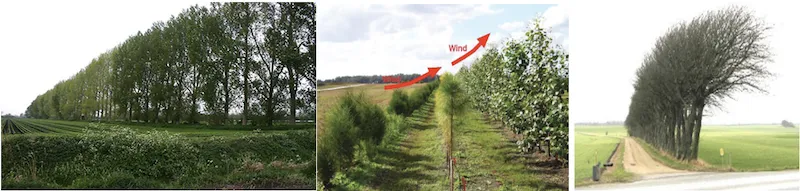
| Feature | Shelterbelt | Windbreak |
|---|---|---|
| Width | Wide (up to 50 m, many rows) | Narrow (2-3 rows, sometimes single row) |
| Scale | Regional protection | Local/farm-level protection |
| Land requirement | Large | Small -- practical for small farmers |
| Species | Mixed trees, shrubs, grasses | Often Eucalyptus, Casuarina (coastal) in 4-5 rows |
- Windbreaks protect livestock from cold winds; shelterbelts protect crops from hot drying winds
- An agroforestry system suitable for small orchards prone to wind damage is a windbreak
8. Soil Conservation Hedges
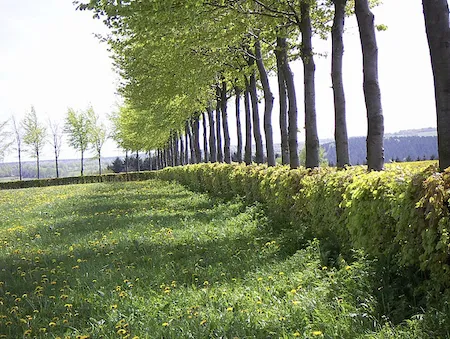
- Trees planted on bunds and terraces to stabilize soil and reinforce conservation structures
- Intercept rain and obstruct wind, reducing soil erosion
- Common species: Grevillea robusta, Acacia catechu, Pinus roxburghii, Prosopis juliflora, Leucaena leucocephala (often with grasses)
9. Hortisilviculture
- Integration of horticultural trees (fruit) with timber trees on the same land
- Combines short-term returns from fruits with long-term returns from timber
- Timber trees on orchard bunds act as windbreaks, protecting fruit trees from high winds
- Example: Mango orchard with Teak on boundaries
Comparison of Wind Protection Systems
Shelterbelts, windbreaks, and soil conservation hedges all use trees to protect land -- but they differ in scale, width, and primary purpose. This comparison is a common exam question.
| Feature | Shelterbelt | Windbreak | Soil Conservation Hedge |
|---|---|---|---|
| Primary purpose | Protect large crop areas from wind | Protect small farms/orchards | Prevent soil erosion |
| Width | Wide (up to 50 m) | Narrow (2-3 rows) | Single row on bunds |
| Scale | Regional | Farm-level | Field-level |
| Protection mechanism | Deflects and reduces wind | Blocks wind | Stabilizes soil + reduces runoff |
| Key species | Mixed (tall + medium + short) | Eucalyptus, Casuarina | Leucaena, Acacia, grasses |
Exam Tips
TIP
Frequently tested facts:
- Who classified AF systems? -- P.K. Nair (1987), 4 criteria
- Most common classification -- Structural basis
- Oldest AF system -- Shifting cultivation
- Jhum practiced in -- North-Eastern India
- Taungya word origin -- Burmese (1850s)
- Most successful Taungya -- Village Taungya
- Taungya rainfall -- 1,200-1,500 mm
- Alley cropping hedgerow direction -- East to west
- Shelterbelt protection zone -- 15-20x height
- Shelterbelt minimum length -- 24x height
Summary Table
| Topic | Key Fact |
|---|---|
| Nair's classification (1987) | Structural, Functional, Socioeconomic, Ecological |
| Agrisilviculture | Trees + Crops |
| Silvopastoral | Trees + Pasture/Animals |
| Agrosilvopastoral | Trees + Crops + Animals |
| Oldest AF system | Shifting cultivation (Jhum in NE India) |
| Taungya origin | Burma, 1850s |
| Most successful Taungya | Village Taungya |
| Alley cropping tree type | Leguminous (nitrogen-fixing) |
| Hedgerow orientation | East to west |
| Shelterbelt width | Up to 50 m |
| Protection zone | 15-20x height |
| Minimum shelterbelt length | 24x height |
| Windbreak rows | 2-3 rows (narrow) |
| Hortisilviculture | Fruit trees + timber trees |
Summary Cheat Sheet
| Concept / Topic | Key Details |
|---|---|
| Agrisilviculture | Trees + Crops on same land |
| Nair's classification (1987) | Structural, Functional, Socioeconomic, Ecological |
| Shifting cultivation | Oldest AF system; slash-and-burn; AKA Jhum (NE India) |
| Taungya system | Origin: Burma, 1850s; growing crops during tree establishment |
| Most successful Taungya | Village Taungya |
| Alley cropping | Crops between rows of leguminous trees (N-fixing hedgerows) |
| Hedgerow orientation | East to West |
| Alley cropping trees | Leucaena, Gliricidia, Sesbania (all N-fixing) |
| Shelterbelt | Wide strip (up to 50 m) of trees protecting crops from wind |
| Shelterbelt protection | 15–20× tree height downwind |
| Minimum shelterbelt length | 24× height |
| Windbreak | Narrow strip (2–3 rows) of trees; similar function to shelterbelt |
| Shelterbelt permeability | Semi-permeable (40–60% density) is most effective |
| Hortisilviculture | Fruit trees + timber trees combined |
| Soil conservation hedges | Contour hedgerows on slopes to reduce erosion |
| Taungya in South India | Called Kumri |
| Taungya rainfall | 1,200--1,500 mm |
| Wind velocity reduction | 20% used as basis of shelterbelt usefulness |
TIP
Next: Lesson 03 covers Silvipasture systems -- how trees are integrated with pasture and livestock through protein banks, live fences, and scattered trees on grazing land.