📐 Forest Mensuration -- Measuring Trees and Forests
Definition of mensuration (dendrometry), objectives, breast height measurement (DBH/GBH), basal area, and modern measurement technologies
The Farmer Who Needed to Know How Much Wood He Had
The previous lesson explored Social Forestry -- how trees are grown with community participation outside conventional forests. But whether trees grow in a government forest or on a farmer's boundary, someone eventually needs to measure them. That brings us to forest mensuration.
A farmer in Uttarakhand planted Poplar trees on his field boundaries 15 years ago. Now a timber dealer offers to buy them. But how does the farmer determine a fair price? He needs to know the diameter, height, and volume of each tree.
This lesson covers:
- Definition -- mensuration and dendrometry
- Objectives -- why we measure trees
- Breast height -- the standard measurement point (DBH, GBH)
- Basal area -- the key density indicator
- Modern measurement tools -- laser, GPS, LiDAR
What is Forest Mensuration?
The word mensuration comes from the Latin word mensura, meaning measure.
Pro Content Locked
Upgrade to Pro to access this lesson and all other premium content.
₹99 charged monthly · Cancel anytime
- All Agriculture & Banking Courses
- AI Lesson Questions (100/day)
- AI Doubt Solver (50/day)
- Glows & Grows Feedback (30/day)
- AI Section Quiz (20/day)
- 22-Language Translation (100/day)
- Recall Questions (20/day)
- AI Quiz (15/day)
- AI Quiz Paper Analysis (100/day)
- AI Step-by-Step Explanations (100/day)
- Spaced Repetition Recall (FSRS)
- AI Tutor
- Immersive Text Questions
- Audio Lessons — Hindi & English
- Mock Tests & Previous Year Papers
- Summary & Mind Maps
- XP, Levels, Leaderboard & Badges
- Generate New Classrooms
- Voice AI Teacher (AgriDots Live)
- AI Revision Assistant
- Knowledge Gap Analysis
- Interactive Revision (LangGraph)
🔒 Secure via Razorpay · Cancel anytime · No hidden fees
The Farmer Who Needed to Know How Much Wood He Had
The previous lesson explored Social Forestry -- how trees are grown with community participation outside conventional forests. But whether trees grow in a government forest or on a farmer's boundary, someone eventually needs to measure them. That brings us to forest mensuration.
A farmer in Uttarakhand planted Poplar trees on his field boundaries 15 years ago. Now a timber dealer offers to buy them. But how does the farmer determine a fair price? He needs to know the diameter, height, and volume of each tree.
This lesson covers:
- Definition -- mensuration and dendrometry
- Objectives -- why we measure trees
- Breast height -- the standard measurement point (DBH, GBH)
- Basal area -- the key density indicator
- Modern measurement tools -- laser, GPS, LiDAR
What is Forest Mensuration?
The word mensuration comes from the Latin word mensura, meaning measure.

| Term | Definition |
|---|---|
| Mensuration (general) | Branch of mathematics dealing with measurement of lengths, areas, and volumes |
| Forest Mensuration | Determination of dimensions, form, weight, growth, volume, health, and age of trees -- individually or collectively |
| Dendrometry | Synonym for forest mensuration (Greek: dendron = tree, metron = measure) |
| Age classification | Division of a forest crop by age classes for harvest planning |
TIP
Exam tip: Forest Mensuration and Dendrometry are synonymous. Remember the Greek roots: dendron (tree) + metron (measure).
Objectives of Forest Mensuration
| Objective | Why It Matters | Modern Application |
|---|---|---|
| Value estimation | Determines fair market value of forest products | Timber sale pricing |
| Basis of management | Provides data on standing timber and annual growth (increment) | Sustainable yield planning |
| Research measurement | Compares silvicultural treatments, species, and spacing | Scientific trials |
| Planning | Estimates future demand and supply of wood and forest products | National forest inventory |
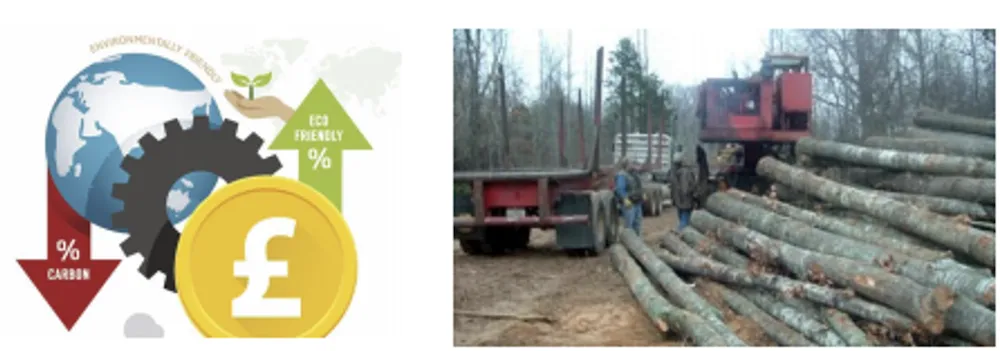
| Carbon estimation | Quantifies carbon stored in forest biomass | Carbon trading, REDD+, climate commitments |
| Forest certification | Verifies sustainable management practices | International timber markets |
IMPORTANT
In the modern context, carbon stock estimation through forest mensuration has become crucial for climate change mitigation and international carbon credit markets. This connects mensuration to India's NDC targets under the Paris Agreement.
- In older forestry objective books, forest inventory is defined as the description of the number of trees, their quality, diameters, and the important site characteristics of the land on which they are growing.
Breast Height -- The Standard Measurement Point
Why Measure at a Standard Height?
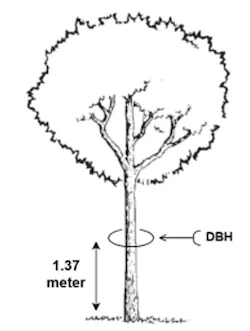
Measuring tree diameter or girth at a standardized height ensures consistency and comparability of measurements across different trees, locations, and time periods.
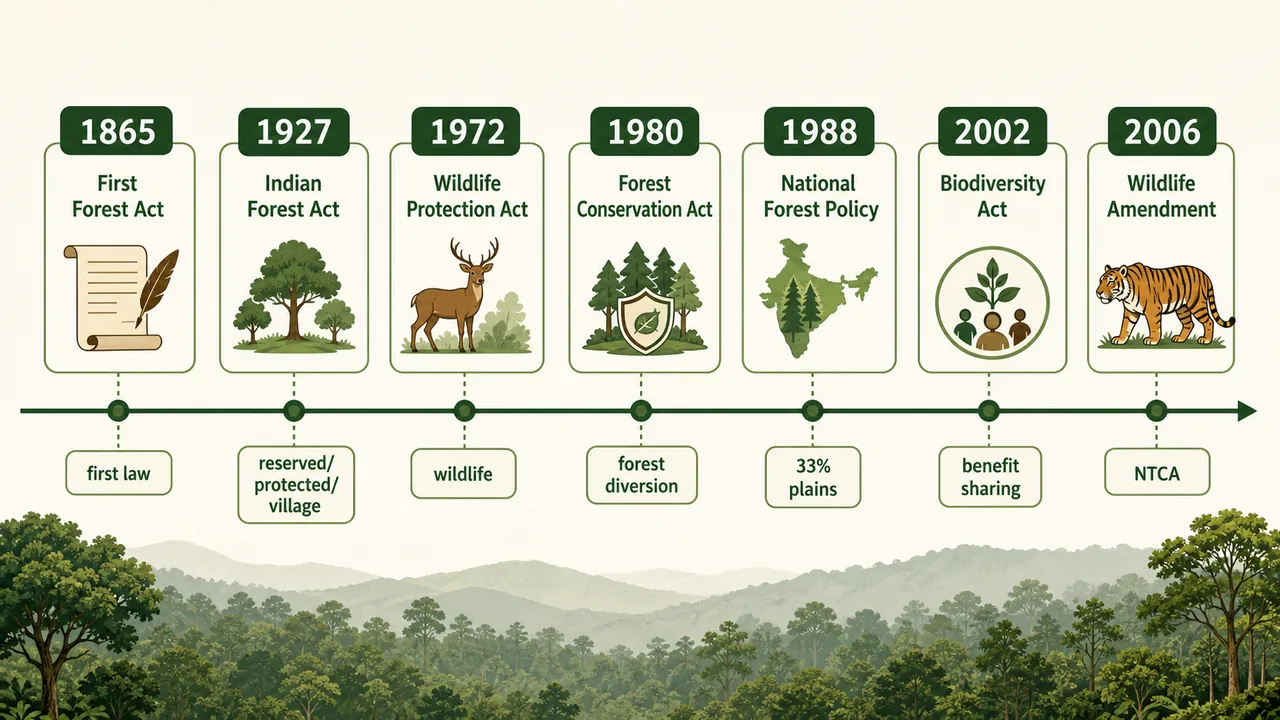
Breast Height (BH) Standards
Key Measurements at Breast Height
| Abbreviation | Full Form | What It Measures |
|---|---|---|
| DBH | Diameter at Breast Height | Diameter of tree trunk at BH |
| GBH | Girth at Breast Height | Circumference of tree trunk at BH |
| Basal area | Cross-sectional area at BH | Area of the trunk's cross-section |
| Region | Breast Height |
|---|---|
| In India, Burma, America, Union of South Africa and other British Colonies | 1.37 m (4 feet 6 inch) above ground level |
| Europe, United Kingdom, FAO and other Commonwealth countries | 1.3 m (4 feet 3 inch) |
TIP
DBH is the single most commonly measured tree parameter in forestry worldwide. If you remember one mensuration concept, remember this: DBH = diameter at 1.37 m in India.
Diameter Classes and Standard Colour Coding
In Indian forestry field records and inventories, trees are often grouped into standard diameter classes and tagged with a colour code.
| Diameter class | Colour |
|---|---|
| 0-20 cm | Blank |
| 20-30 cm | Green |
| 30-40 cm | Red |
| 40-50 cm | Yellow |
| 50-60 cm | Black |
| 60-70 cm | White |
| 70 cm and above | Blue |
TIP
Exam-style recall: a tree of 45 cm DBH falls in the yellow class.
Basal Area
Basal area is the cross-sectional area of a tree stem measured at breast height. When applied to a forest stand, it is the sum of basal areas of all stems per unit area.
| Feature | Detail |
|---|---|
| Unit | Square meters per hectare (m2/ha) |
| Formula | Basal area = pi/4 x (DBH)2 |
| Use | Key indicator of forest density and site productivity |
| Application | Forest inventory, management planning, yield estimation |
NOTE
A higher basal area indicates a denser forest with more wood volume. Basal area measurements help foresters decide when thinning is needed.
Density Scale Used in Working Plans
| Density | Canopy class |
|---|---|
| 1.0 | Closed |
| 0.8-0.99 | Dense |
| 0.6-0.79 | Fairly dense |
| 0.4-0.59 | Thin |
| 0.2-0.39 | Open |
| Less than 0.2 | Sparse |
Forest Working Plan Map Colours
| Forest type / land use | Standard colour |
|---|---|
| Sal | Blue |
| Teak | Burnt sienna |
| Mixed forest | Green |
| Barren land | Yellow |
| Cultivation area | Uncoloured |
Age-Class Symbols
| Age class | Symbol |
|---|---|
| Seedling crop | 0 |
| Thicket of seedlings | 00 |
| Pole crop | + |
| Mature high forest | - |
| Over-mature forest | = |
Modern Measurement Methods
| Technology | Application | Advantage |
|---|---|---|
| Laser rangefinders | Measure tree height and distance | Fast, accurate, non-contact |
| Electronic dendrometers | Measure diameter continuously | Track growth over time |
| Hypsometers | Measure tree height | Portable, easy to use |
| GPS (Global Positioning Systems) | Map tree locations, demarcate boundaries | Accurate spatial positioning |
| Remote sensing | Large-area forest inventory | Used in ISFR assessments |
| LiDAR | 3D forest structure mapping | Most advanced technology |
These modern tools have revolutionized forest measurement by making it faster, more accurate, and less labour-intensive compared to traditional manual methods.
Agricultural Connection
Forest mensuration concepts apply directly to agroforestry:
| Farming Scenario | Mensuration Application |
|---|---|
| Poplar trees on field boundaries | Measure DBH to estimate timber volume and sale price |
| Teak in farm woodlots | Track basal area growth for harvest timing |
| Fruit trees in orchards | Measure crown spread to plan spacing |
| Carbon credit programmes | Estimate biomass and carbon stock from tree measurements |
Exam Tips
TIP
Frequently tested facts:
- Mensuration from Latin -- mensura = measure
- Forest Mensuration synonym -- Dendrometry
- Dendron = tree, Metron = measure (Greek)
- Breast height in India -- 1.37 m (4 ft 6 in)
- DBH = Diameter at Breast Height
- GBH = Girth at Breast Height
- Basal area unit -- m2/ha
- Basal area = indicator of forest density
- Modern tools -- laser, GPS, LiDAR, electronic dendrometers
- Diameter class 40-50 cm = Yellow
- Sal map colour = Blue; Teak = Burnt sienna
- Density 1.0 = Closed canopy
Summary Table
| Topic | Key Fact |
|---|---|
| Definition | Measurement of tree dimensions, form, age, growth, and volume |
| Synonym | Dendrometry (Greek: dendron + metron) |
| Latin origin | Mensura = measure |
| Breast height (India) | 1.37 m (4 ft 6 in) |
| Key measurement | DBH (Diameter at Breast Height) |
| Basal area unit | m2/ha |
| Four objectives | Value estimation, Management, Research, Planning |
| Modern application | Carbon stock estimation for climate commitments |
| Modern tools | Laser, GPS, LiDAR, electronic dendrometers |
Summary Cheat Sheet
| Concept / Topic | Key Details |
|---|---|
| Forest Mensuration | Science of measuring trees and forests (diameter, height, volume, growth) |
| Four objectives | Value estimation, Management, Research, Planning |
| DBH | Diameter at Breast Height; most common measurement |
| BH in India | 1.37 m (4 ft 6 in) |
| BH in Europe/FAO | 1.3 m (4 ft 3 in) |
| Basal area | Cross-section area of stem at BH; indicator of forest density |
| Volume estimation | Uses DBH, height, and form factor |
| Form factor | Ratio of tree volume to volume of a cylinder of same DBH & height |
| Height measurement tools | Clinometer, Hypsometer, Abney level |
| Diameter tools | Caliper, diameter tape |
| Increment borer | Extracts core sample to count annual rings (age determination) |
| Site quality | Productivity of a site; measured by site index (height at reference age) |
| Modern tools | Laser, GPS, LiDAR, electronic dendrometers |
| Modern application | Carbon stock estimation for climate commitments |
| Growing stock | Total volume of standing trees in a forest |
Annual Rings and the Pressler Connection
- In classical forestry mensuration, the Pressler's increment borer is the standard tool used to remove a narrow wood core so that annual rings can be counted without felling the tree.
- Study of annual rings for age and past growth is called dendrochronology, while their use in interpreting past climatic variation is called dendroclimatology.
TIP
Quick recall: Pressler's increment borer -> annual rings -> dendrochronology (age/growth history) and dendroclimatology (climate history).
TIP
Next lesson: Measuring forests is one thing; protecting them through law is another. The next lesson covers Forest Legislation in India -- the Indian Forest Act 1927, National Forest Policy 1988, Wildlife Protection Act, and the Chipko Movement.