👨🔧 Diagnosis and Design (D&D) in Agroforestry
ICRAF's D&D methodology -- key features, design criteria (productivity, sustainability, adaptability), and macro vs micro D&D procedures
Solving the Right Problem First
In the previous lesson, we explored how agroforestry systems are designed using spatial, temporal, and functional arrangements. But how does a development team decide which system to implement in a specific location? That decision requires a structured methodology.
A development team arrives in a drought-prone village in Madhya Pradesh. The crops are failing, the soil is eroding, and fuelwood is scarce. Should they plant Eucalyptus for fuelwood? Introduce alley cropping for soil fertility? Or set up a silvipasture system for livestock? The answer depends on a systematic diagnosis of the land management problems before designing any intervention. This is exactly what ICRAF's Diagnosis and Design (D&D) methodology does -- it ensures that the solution matches the problem.
This lesson covers:
- What D&D is -- ICRAF's methodology and its three key features
- Design criteria -- Productivity, Sustainability, and Adaptability
- Two scales of D&D -- Macro (landscape) vs Micro (farm-level)
- The decision flow -- From diagnosis to on-farm trials
D&D is a high-yield topic for exams, often tested as direct recall questions.
Pro Content Locked
Upgrade to Pro to access this lesson and all other premium content.
₹99 charged monthly · Cancel anytime
- All Agriculture & Banking Courses
- AI Lesson Questions (100/day)
- AI Doubt Solver (50/day)
- Glows & Grows Feedback (30/day)
- AI Section Quiz (20/day)
- 22-Language Translation (100/day)
- Recall Questions (20/day)
- AI Quiz (15/day)
- AI Quiz Paper Analysis (100/day)
- AI Step-by-Step Explanations (100/day)
- Spaced Repetition Recall (FSRS)
- AI Tutor
- Immersive Text Questions
- Audio Lessons — Hindi & English
- Mock Tests & Previous Year Papers
- Summary & Mind Maps
- XP, Levels, Leaderboard & Badges
- Generate New Classrooms
- Voice AI Teacher (AgriDots Live)
- AI Revision Assistant
- Knowledge Gap Analysis
- Interactive Revision (LangGraph)
🔒 Secure via Razorpay · Cancel anytime · No hidden fees
Solving the Right Problem First
In the previous lesson, we explored how agroforestry systems are designed using spatial, temporal, and functional arrangements. But how does a development team decide which system to implement in a specific location? That decision requires a structured methodology.
A development team arrives in a drought-prone village in Madhya Pradesh. The crops are failing, the soil is eroding, and fuelwood is scarce. Should they plant Eucalyptus for fuelwood? Introduce alley cropping for soil fertility? Or set up a silvipasture system for livestock? The answer depends on a systematic diagnosis of the land management problems before designing any intervention. This is exactly what ICRAF's Diagnosis and Design (D&D) methodology does -- it ensures that the solution matches the problem.
This lesson covers:
- What D&D is -- ICRAF's methodology and its three key features
- Design criteria -- Productivity, Sustainability, and Adaptability
- Two scales of D&D -- Macro (landscape) vs Micro (farm-level)
- The decision flow -- From diagnosis to on-farm trials
D&D is a high-yield topic for exams, often tested as direct recall questions.
What is D&D?
D&D is a methodology developed by ICRAF (World Agroforestry Centre) for:
- Diagnosis -- Identifying land management problems and their root causes
- Design -- Creating agroforestry solutions that address those specific problems
It provides a structured, step-by-step framework for agroforestry researchers and development workers to plan effective projects.
IMPORTANT
D&D ensures that agroforestry is recommended only when it truly offers the best solution -- not simply because the team has an agroforestry mandate. All possible interventions (chemical fertilizers, manure, improved varieties, etc.) are considered before selecting agroforestry.
Three Key Features of D&D
| Feature | Description | Practical Benefit |
|---|---|---|
| Flexibility | Can be scaled up or down for different users and resources | Works for small NGO projects or large national programmes |
| Speed | Offers a rapid appraisal option at the planning stage | Quick but reliable assessment before committing resources |
| Repetition | An open-ended, iterative learning process | Each cycle improves upon the previous design |
TIP
Mnemonic: D&D features = FSR -- Flexibility, Speed, Repetition. Think of it as "Fast, Scalable, Repeatable."
Criteria of a Good Agroforestry Design
A well-designed agroforestry system must fulfill three criteria (note the parallel with the three attributes of agroforestry -- PSA):
| Criterion | What It Means | Key Question |
|---|---|---|
| Productivity | Increases total system output (tree products + crop yields + reduced inputs) | Does it produce more from the same land? |
| Sustainability | Maintains long-term soil health, nutrient cycling, and ecological stability | Will it keep working for the next generation? |
| Adaptability | Fits the social, economic, and cultural context of target farmers | Will the farmer actually adopt it? |
NOTE
A technically perfect design that ignores the farmer's socio-economic conditions, cultural preferences, labour availability, and risk tolerance will fail regardless of its scientific merit. Adaptability is often the deciding factor.
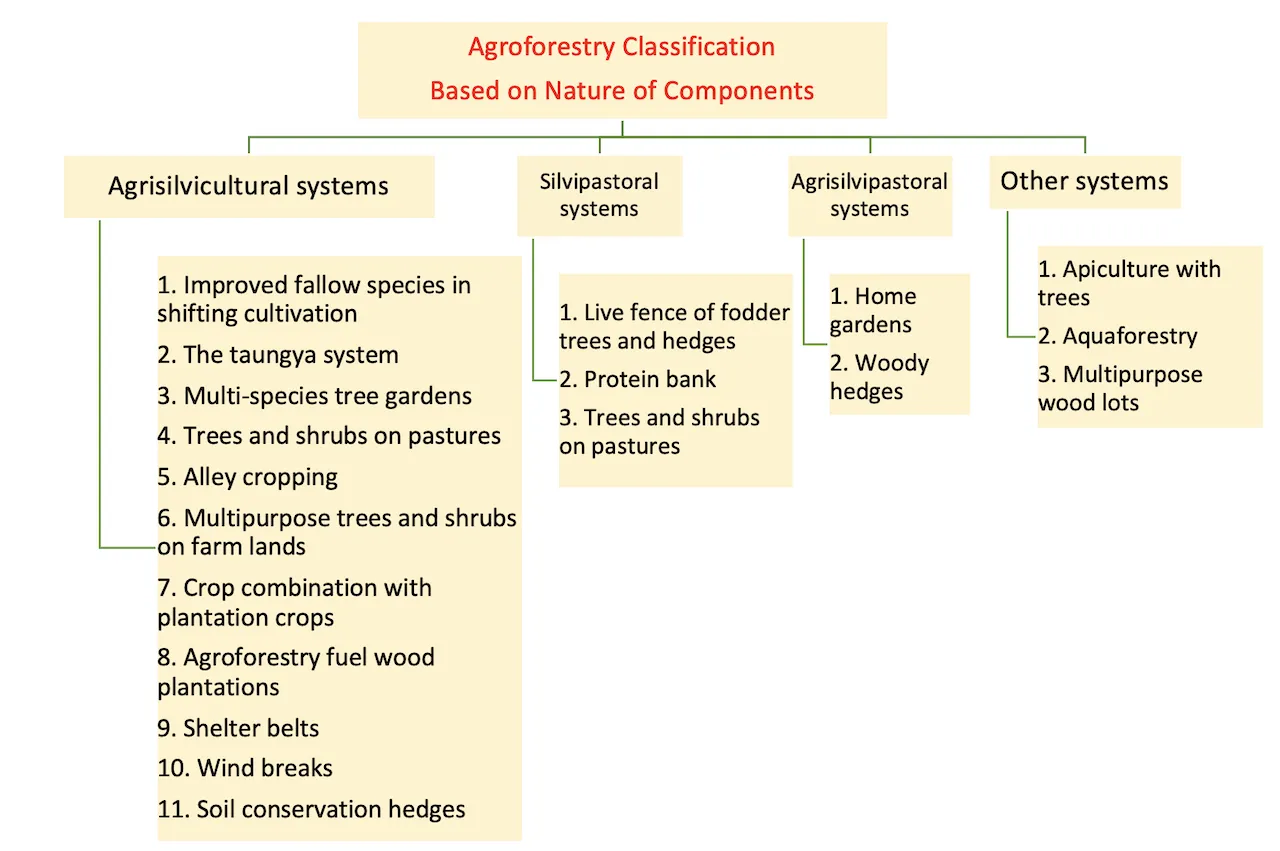
Productivity in D&D vs Monocropping
In agroforestry, productivity is measured by total system output, not just crop yield. This includes:
- Increased tree products (timber, fuelwood, fruit)
- Improved crop yields (through soil improvement, microclimate)
- Reduced inputs (less fertilizer needed due to nitrogen fixation)
- Increased labour efficiency
- Diversification of production (multiple products = reduced risk)
- Satisfaction of basic needs (food, fuel, fodder from one system)
D&D Procedure: Two Scales
The D&D process operates at two levels -- broad landscape analysis followed by detailed local investigation.
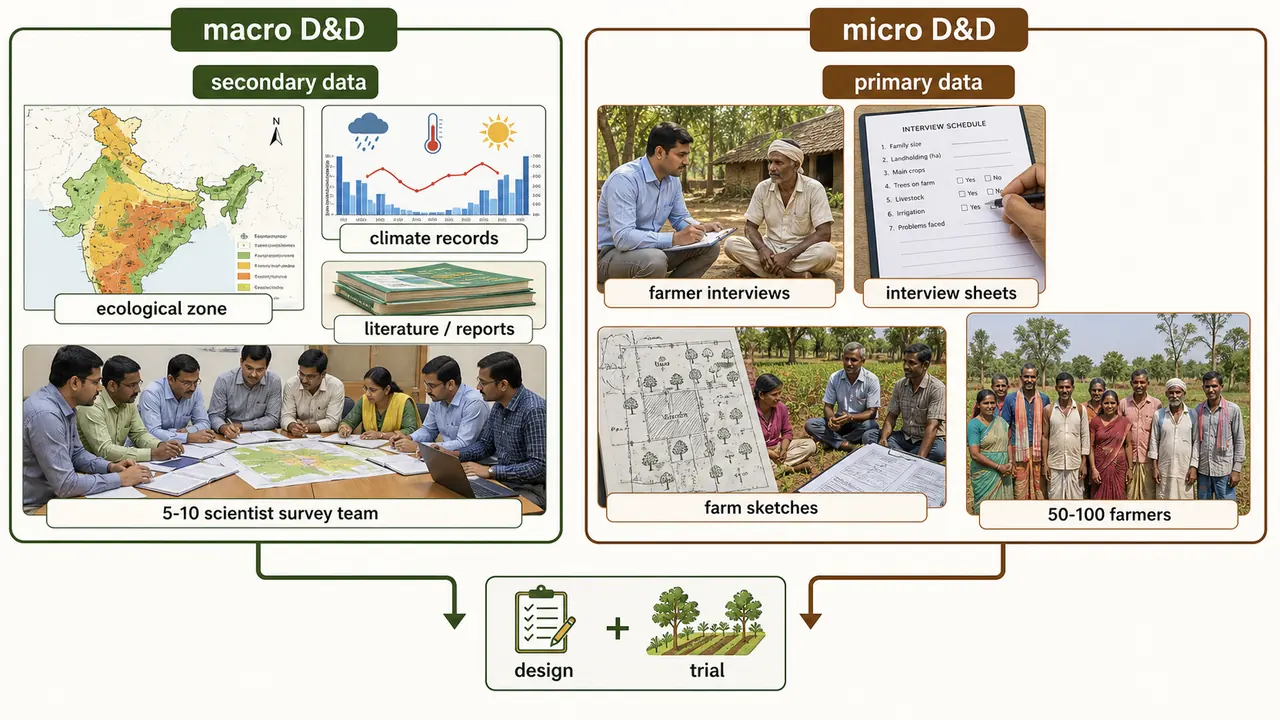
Macro D&D (Landscape Level)
| Feature | Detail |
|---|---|
| Scope | Covers an entire ecological zone within a country |
| Data source | Primarily secondary information (published data, maps, census, climate records) |
| Team size | 5-10 biophysical and social scientists |
| Duration | Approximately 3 months |
| Output | Identification of target land-use systems for detailed study |
What happens:
- The research team surveys an entire ecological zone using existing data
- Land-use systems within the zone are mapped and characterized
- Target systems with the greatest potential for agroforestry are selected
- These targets are passed to the micro D&D phase
Micro D&D (Farm/Community Level)
| Feature | Detail |
|---|---|
| Scope | Specific land-use systems identified during macro D&D |
| Data source | Primary data -- direct farmer engagement, field surveys |
| Survey size | 50-100 individuals with semi-structured questionnaire |
| Focus | Indigenous knowledge, local constraints, farmer preferences |
| Output | Preliminary agroforestry designs (sketches) for on-farm trials |
What happens:
- The team engages directly with farmers to understand real constraints
- Ongoing research and extension work in the area is reviewed
- All possible interventions are identified (not just agroforestry)
- Each alternative is evaluated for technical potential and farmer feasibility
- Promising agroforestry technologies are sketched as preliminary designs
TIP
Exam distinction: Macro D&D uses secondary data (published reports, maps) over 3 months for an entire zone. Micro D&D uses primary data (farmer surveys of 50-100 people) for specific target systems.
Macro vs Micro D&D -- Comparison
| Parameter | Macro D&D | Micro D&D |
|---|---|---|
| Scale | Entire ecological zone | Specific land-use system |
| Data type | Secondary (existing) | Primary (field surveys) |
| Team | 5-10 scientists | Smaller focused team |
| Duration | ~3 months | Variable (longer) |
| Farmer contact | Minimal | Extensive (50-100 surveys) |
| Output | Target systems selected | Preliminary designs created |
| Comes first? | Yes (precedes micro) | No (follows macro) |
The D&D Decision Flow
- Macro D&D identifies the broad problems and target areas
- Micro D&D diagnoses specific constraints at the farm level
- All interventions are considered (not just agroforestry)
- Feasibility is assessed (cost, labour, inputs, farmer capacity)
- Promising solutions are designed as preliminary sketches
- On-farm trials test the designs with actual farmers
- Iteration -- feedback from trials improves the design (D&D repeats)
Agricultural Example: D&D in Action
Problem: A village in Odisha faces soil erosion on sloping farmland, fuelwood scarcity, and low crop yields.
| D&D Step | Action |
|---|---|
| Macro D&D | Identify the agro-ecological zone (Eastern Ghats, sub-humid) |
| Micro D&D | Survey 80 farmers; find that soil loss and fuelwood collection consume most labour |
| All options considered | Chemical fertilizers (costly), terracing (labour-intensive), contour hedgerows (feasible) |
| Best AF design | Contour hedgerows of Leucaena (N-fixing, fuelwood, mulch) + crops in alleys |
| Feasibility check | Leucaena seed available locally, farmers willing, labour manageable |
| On-farm trial | 10 farmers test the system for 2 seasons |
| Iteration | Adjust spacing based on results; expand to 50 farmers |
Exam Tips
TIP
Key facts for exams:
- D&D developed by -- ICRAF
- Three features of D&D -- Flexibility, Speed, Repetition
- Three design criteria -- Productivity, Sustainability, Adaptability
- Macro D&D team -- 5-10 scientists, uses secondary data, ~3 months
- Micro D&D survey -- 50-100 farmers, uses primary data
- D&D considers all interventions, not just agroforestry
- D&D is iterative -- designs improve through repeated cycles
Summary Cheat Sheet
| Concept / Topic | Key Details |
|---|---|
| D&D | Diagnosis and Design methodology for agroforestry planning |
| Developed by | ICRAF (World Agroforestry Centre) |
| Purpose | Systematic identification of problems and design of AF solutions |
| Three features | Flexibility, Speed, Repetition (mnemonic: FSR) |
| Design criteria | Productivity, Sustainability, Adaptability (parallel to AF attributes) |
| Key principle | Consider all interventions, not just agroforestry |
| Nature of process | Iterative (open-ended learning; revisit and refine) |
| Macro D&D | Entire ecological zone; 5--10 scientists; secondary data; ~3 months |
| Micro D&D | Specific land-use system; 50--100 farmer surveys; primary data |
| D&D steps | Pre-diagnostic -> Diagnostic -> Design -> Planning -> Implementation |
| Key output | Land-use plan with recommended AF technologies |
TIP
Next: Lesson 07 covers Wasteland Development -- how degraded and unused lands are classified, their extent in India, and the role of agroforestry in reclaiming them.