👨🏻🌾 Agroforestry -- Definition, Principles, and Practices
Definition, attributes (PSA), benefits, constraints, allelopathy, management practices, species selection, and key research institutes (ICRAF, NRCAF)
Trees and Crops -- Better Together
In the semi-arid regions of Rajasthan, farmers have grown Khejari (Prosopis cineraria) trees alongside pearl millet for centuries. The Khejari fixes atmospheric nitrogen, enriches the soil, provides fodder for livestock, and yields nutritious pods -- all while the millet grows beneath its canopy. This ancient practice is the essence of agroforestry: combining trees with crops and/or animals on the same land for greater total benefit.
This lesson covers:
- Definition and origin of agroforestry (Bene et al., 1977)
- Three attributes -- Productivity, Sustainability, Adoptability (PSA)
- Benefits and constraints -- including allelopathy
- Species selection and management practices -- pollarding, coppicing, pruning
- Key research institutes -- ICRAF, NRCAF, IGFRI
Agroforestry is a high-frequency topic in IBPS AFO, NABARD Grade A, and FCI exams -- especially definitions, attributes, and management practice heights.
What is Agroforestry?
Agroforestry is a land-use system that deliberately integrates trees with crops and/or animals on the same unit of land.
Pro Content Locked
Upgrade to Pro to access this lesson and all other premium content.
₹99 charged monthly · Cancel anytime
- All Agriculture & Banking Courses
- AI Lesson Questions (100/day)
- AI Doubt Solver (50/day)
- Glows & Grows Feedback (30/day)
- AI Section Quiz (20/day)
- 22-Language Translation (100/day)
- Recall Questions (20/day)
- AI Quiz (15/day)
- AI Quiz Paper Analysis (100/day)
- AI Step-by-Step Explanations (100/day)
- Spaced Repetition Recall (FSRS)
- AI Tutor
- Immersive Text Questions
- Audio Lessons — Hindi & English
- Mock Tests & Previous Year Papers
- Summary & Mind Maps
- XP, Levels, Leaderboard & Badges
- Generate New Classrooms
- Voice AI Teacher (AgriDots Live)
- AI Revision Assistant
- Knowledge Gap Analysis
- Interactive Revision (LangGraph)
🔒 Secure via Razorpay · Cancel anytime · No hidden fees
Trees and Crops -- Better Together
In the semi-arid regions of Rajasthan, farmers have grown Khejari (Prosopis cineraria) trees alongside pearl millet for centuries. The Khejari fixes atmospheric nitrogen, enriches the soil, provides fodder for livestock, and yields nutritious pods -- all while the millet grows beneath its canopy. This ancient practice is the essence of agroforestry: combining trees with crops and/or animals on the same land for greater total benefit.
This lesson covers:
- Definition and origin of agroforestry (Bene et al., 1977)
- Three attributes -- Productivity, Sustainability, Adoptability (PSA)
- Benefits and constraints -- including allelopathy
- Species selection and management practices -- pollarding, coppicing, pruning
- Key research institutes -- ICRAF, NRCAF, IGFRI
Agroforestry is a high-frequency topic in IBPS AFO, NABARD Grade A, and FCI exams -- especially definitions, attributes, and management practice heights.
What is Agroforestry?
Agroforestry is a land-use system that deliberately integrates trees with crops and/or animals on the same unit of land.
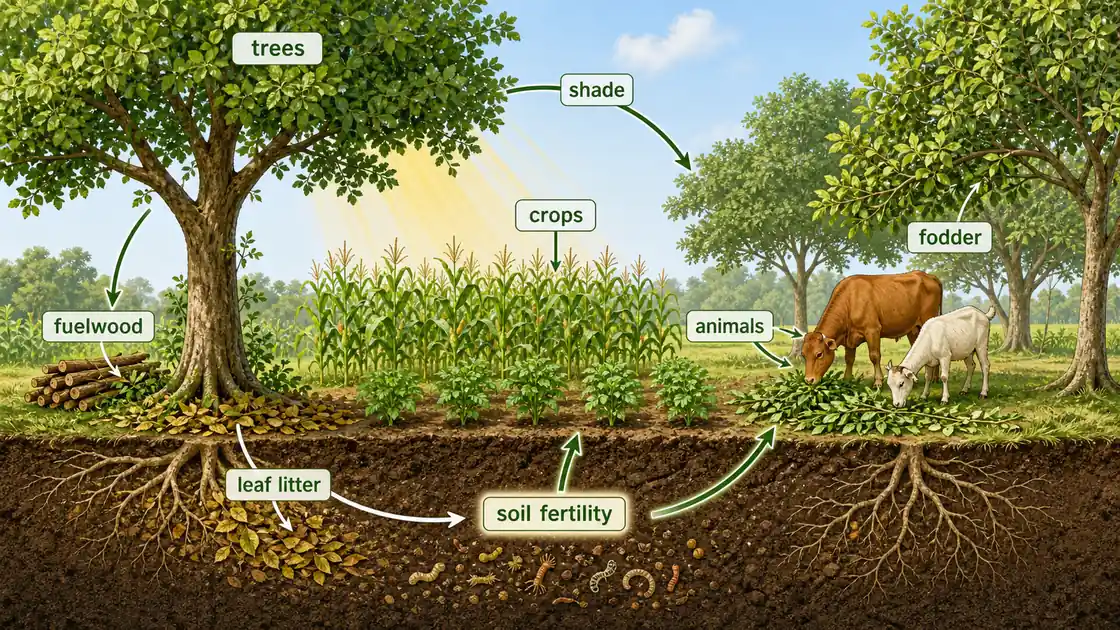
- It has developed as an interface between agriculture and forestry, combining the best of both disciplines.
- Bene et al. (1977) defined agroforestry as a sustainable management system for land that increases overall production, combines agricultural crops, forest plants, and tree crops and/or animals simultaneously or sequentially, and applies management practices compatible with local cultural patterns.
- Even the simplest agroforestry system is more complex ecologically and economically than monocropping -- but this complexity is a strength, providing multiple products, reducing risk, and enhancing ecosystem services.
IMPORTANT
Key words in the definition: simultaneously (growing together at the same time) and sequentially (growing one after the other on the same land). The system must also be culturally compatible with local farming practices.
Agroforestry vs Social Forestry
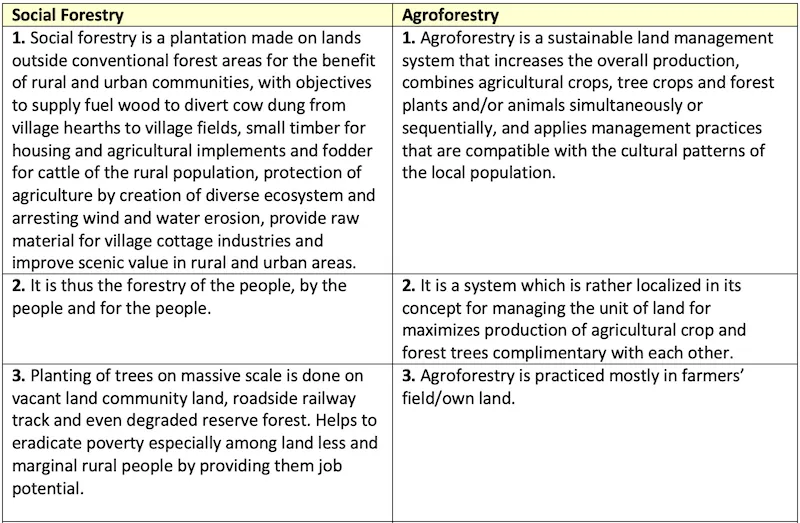
| Feature | Agroforestry | Social Forestry |
|---|---|---|
| Where | On agricultural/farm land | On public/community/wasteland |
| Who manages | Individual farmer | Community or government |
| Primary goal | Farm productivity + sustainability | Meet rural needs for fuel, fodder, timber |
| Integration | Trees + crops + animals together | Trees grown separately from farming |
| Coined by | Bene et al. (1977) | J.C. Westoby (1976) |
TIP
Exam shortcut: Agroforestry = trees ON farms. Social Forestry = trees FOR communities (usually OUTSIDE farms).
Three Attributes of Agroforestry (PSA)
Every agroforestry system should possess these three attributes:
| Attribute | Meaning | How It Works |
|---|---|---|
| Productivity | Maintain or increase output | Multiple outputs (food, fuel, fodder, timber) from the same land |
| Sustainability | Conserve the resource base | Trees improve soil through N-fixation, nutrient recycling, organic matter, erosion control |
| Adoptability | Fit local farming practices | Technologies must match socio-economic context, culture, and available resources |
TIP
Mnemonic: Remember PSA -- Productivity, Sustainability, Adoptability. Think of it as a "Public Service Announcement" for sustainable farming.
Benefits of Agroforestry
Environmental Benefits
- Reduces pressure on natural forests by producing fuelwood, fodder, and timber on farmlands
- Nutrient recycling -- deep tree roots access nutrients from lower soil layers and return them to the surface through leaf litter
- Erosion control -- tree roots and stems reduce surface run-off and soil loss
- Microclimate improvement -- canopy lowers soil temperature and reduces moisture evaporation
- Soil structure improvement -- constant addition of organic matter from decomposed litter
- Carbon sequestration -- trees store atmospheric carbon in their biomass
Economic Benefits
- Increased output of food, fuelwood, fodder, fertilizer, and timber
- Risk reduction -- diverse products provide a safety net against single-crop failure
- Higher and more sustained farm income
- Wasteland rehabilitation -- degraded lands unsuitable for crops can be restored through agroforestry
Social Benefits
- Improved rural living standards through sustained employment and higher income
- Better nutrition and health from increased quality and diversity of food
- Community stability -- productive land means farmers do not need to abandon degraded areas
| Benefit Category | Key Example |
|---|---|
| Environmental | Nitrogen-fixing trees (Leucaena, Khejari) enrich soil naturally |
| Economic | Teak + turmeric system yields timber income + annual crop income |
| Social | Year-round employment in tree management and crop cultivation |
Scope of Agroforestry in India
India has tremendous scope for agroforestry because:
- India has achieved food self-sufficiency but faces shortages of fuel, fodder, and timber
- An estimated 25.6 million hectares of wasteland could be brought under agroforestry
- Older exam-oriented forestry books also quote India's agroforestry area at around 28.42 million ha or roughly 8.65% of geographical area, so students may encounter both the policy-oriented scope figure and this older textbook estimate
- Large areas of farm boundaries, bunds, and wastelands are available for tree planting
- Multipurpose tree species can be grown alongside existing annual crops
- The system generates rural employment and provides raw material for cottage industries
- Helps maintain ecological balance through soil and water conservation
NOTE
India's National Agroforestry Policy (2014) was the first of its kind globally, recognizing agroforestry as a key strategy for food security, environmental protection, and rural development.
Constraints in Agroforestry
While the benefits of agroforestry are substantial, the system also introduces challenges that farmers must manage. Understanding these constraints is essential for designing systems that minimise negative interactions between trees and crops.
1. Interference Effects (Competition)
- Trees compete with crops for light, water, and nutrients -- this is called Allelospoly
- Tree canopy reduces photosynthetically active radiation (PAR) reaching understory crops
- Felling of trees can physically damage standing crops
2. Environmental Constraints
- Trees may serve as hosts to insect pests harmful to crops
- Trees attract birds that may feed on crop seeds and fruits
- Potential soil moisture depletion by deep-rooted trees in dry areas
3. Socioeconomic Constraints
- More labour inputs required, creating scarcity for other farm activities
- Longer gestation period for tree crops -- farmers wait years for timber returns while needing immediate income
- Farmers prefer field crops over trees, especially where land is scarce
- Complex management requirements
4. Allelopathy
- Allelopathy (Muller, 1969) is the release of chemical inhibitors (allelochemicals) by one plant that suppress the growth of another -- distinct from simple competition
- Toxic metabolites are mainly found in leaves but occur in other plant parts too
- Summer materials are more toxic than those in rainy or winter seasons
- Example: Eucalyptus is strongly allelopathic -- many crops grow poorly near Eucalyptus trees
| Constraint Type | Example | Impact |
|---|---|---|
| Light competition | Dense tree canopy | Reduced crop photosynthesis |
| Water competition | Deep-rooted trees in dry areas | Crop moisture stress |
| Allelopathy | Eucalyptus, Walnut | Chemical inhibition of crop growth |
| Long gestation | Teak (15-20 years to harvest) | Cash flow problems for small farmers |
| Pest hosting | Certain trees harbour crop pests | Increased pest damage to crops |
Minimizing Constraints
Successful agroforestry depends on reducing competition between trees and crops. The strategies below address light, water, and nutrient competition through species choice, arrangement, and active tree management.
| Strategy | How It Helps |
|---|---|
| Wider tree spacing | More light, water, and nutrients reach crops |
| Crown pruning | Reduces shade; pruned biomass adds green manure to soil |
| Root pruning/trenching | Reduces below-ground competition for moisture and nutrients |
| Shade-tolerant crops | Turmeric, ginger, black pepper, leafy vegetables thrive under partial shade |
| Nitrogen-fixing trees | Legume trees (Leucaena, Gliricidia) enhance rather than deplete soil fertility |
| Deep-rooted trees | Trees exploit deeper soil layers; crops use surface layers -- niche differentiation |
| Vertical training | Trees grow tall and narrow, minimizing shadow on companion crops |
| S.N. | Crop | Examples |
|---|---|---|
| 1. | Vegetables | Ginger, Turmeric, Potato, Cucurbit |
| 2. | Agricultural crops | Oats, Maize, Soybean, Groundnut |
| 3. | Grasses | Cenchrus spp., Panicum |
Choice of Species for Agroforestry
Selecting the right tree species is one of the most critical decisions in agroforestry design. The wrong species can suppress crops through excessive shading or allelopathy, while the right species enhances soil fertility and provides multiple products. The ideal agroforestry tree should have these characteristics:
| Desired Trait | Reason | Example Species |
|---|---|---|
| Fast growth | Quick returns | Eucalyptus, Leucaena |
| Nitrogen fixation | Improves soil fertility | Leucaena leucocephala, Khejari |
| Deep tap root | No competition with shallow crop roots | Dalbergia sissoo |
| Easy decomposition of litter | Rapid nutrient cycling | Gliricidia |
| Ability to coppice | Repeated harvesting possible | Acacia, Albizia |
| Multiple uses | Timber + fodder + fuelwood | Subabul (Leucaena) |
| No competition with field crops | Compatible growth habits | Narrow-crowned species |
| Easy regeneration | Low establishment cost | Self-seeding species |
Management Practices
Tree management in agroforestry controls canopy size, promotes regeneration, and maximises useful biomass. These practices are frequently tested in exams -- especially the height distinctions between pollarding and coppicing.
| Practice | Description | Height/Level | Purpose |
|---|---|---|---|
| Thinning | Removing weaker trees from immature stand | Throughout stand | Improves growth and form of remaining trees |
| Pruning | Removing live/dead branches | Various | Produces knot-free, high-value timber |
| Pollarding | Cutting stem at height above ground | 2-2.5 m | New shoots above livestock browsing reach |
| Lopping | Removing one-year shoots from crown | Crown level | Fodder production for livestock |
| Coppicing | Cutting main stem near ground | 20-30 cm | Multiple new shoots from established root system |
| Bending | Restricting bole development | Ground level | Produces foliage close to ground |
| Training | Directing vertical growth | Throughout | Minimizes shade on companion crops |
Coppicing Ability of Different Species
| Category | Species Examples |
|---|---|
| Strong coppicers | Acacia catechu, Albizia lebbek, Anogeissus latifolia |
| Good coppicers | Aesculus indica, Chloroxylon swietinia, Hardwickia binata |
| Bad coppicers | Adina cordifolia, Bombax ceiba |
| Non-coppicers | All conifers (pines, spruces, firs) -- they lack dormant basal buds |
TIP
Exam distinction: Pollarding = cut at 2-2.5 m (above browsing height). Coppicing = cut at 20-30 cm (near ground). Both produce new shoots, but from different heights.
Key Research Institutes
India's agroforestry research is supported by dedicated national and international institutions. Exam questions frequently test headquarters locations and establishment years.
| Institute | Full Name | Headquarters | Established | Focus |
|---|---|---|---|---|
| ICRAF | World Agroforestry Centre (formerly International Council for Research in Agroforestry) | Nairobi, Kenya | 1977 | Global agroforestry research |
| NRCAF | National Research Centre for Agroforestry | Jhansi, Uttar Pradesh | 1988 | Indian agroforestry research and technology |
| IGFRI | Indian Grassland and Fodder Research Institute | Jhansi, Uttar Pradesh | 1962 | Forage production and utilization |
NOTE
ICRAF was the first international organization dedicated exclusively to agroforestry research. It was renamed from "International Council" to "International Centre" in 1991, and is now known as the World Agroforestry Centre.
Exam Tips and Mnemonics
TIP
High-frequency exam facts:
- Definition year (Bene et al.) -- 1977
- Three attributes -- PSA (Productivity, Sustainability, Adoptability)
- ICRAF headquarters -- Nairobi, Kenya (established 1977)
- NRCAF headquarters -- Jhansi, Uttar Pradesh
- Allelopathic tree example -- Eucalyptus
- Pollarding height -- 2-2.5 m
- Coppicing height -- 20-30 cm
- Competition term -- Allelospoly
- India's wasteland potential for AF -- 25.6 million hectares
Summary Table
| Topic | Key Fact |
|---|---|
| Definition | Trees + crops + animals on same land (simultaneously or sequentially) |
| Coined by | Bene et al. (1977) |
| Three attributes | Productivity, Sustainability, Adoptability (PSA) |
| Key constraint | Light competition (allelospoly) |
| Allelopathy example | Eucalyptus releases allelochemicals |
| Pollarding height | 2-2.5 m above ground |
| Coppicing height | 20-30 cm from ground |
| Non-coppicers | All conifers |
| ICRAF | Nairobi, Kenya (1977) |
| NRCAF | Jhansi, Uttar Pradesh |
| IGFRI | Jhansi, Uttar Pradesh |
| India's AF potential | 25.6 million hectares of wasteland |
| National AF Policy | 2014 (first globally) |
Which Agroforestry System for Which Farmer?
Decision guide for IBPS AFO aspirants recommending agroforestry:
| Farmer's Situation | System | Components | Key Benefit |
|---|---|---|---|
| Dryland/rainfed, marginal land | Agrisilviculture (trees + crops) | Khejari/Neem + bajra/moth bean | N-fixation; fodder; soil improvement; traditional in Rajasthan |
| Dairy farmer needing fodder | Silvipasture (trees + grasses + animals) | Subabul/Leucaena + Napier grass + cattle | Year-round green fodder; tree leaves = protein-rich feed |
| Small farmer, all needs from one plot | Agrisilvipasture (trees + crops + animals) | Poplar + wheat + buffalo | Timber income after 6-8 years; crop income annual; dairy daily |
| Irrigated plains (Punjab, Haryana, UP) | Poplar-based agrisilviculture | Poplar + wheat/sugarcane | Timber worth ₹2-4 lakh/acre at harvest; crop income continues |
| Coastal/wetland areas | Aquaforestry (mangroves + fish) | Mangrove + shrimp/crab | Coastal protection + livelihood |
| Hilly terrain | Contour hedgerow system | Leucaena/Gliricidia on contour bunds + crops between | Soil conservation + N-fixation + fodder |
Tree species selection rule: Choose trees that are not allelopathic (avoid Eucalyptus near crops — it releases growth-inhibiting chemicals). Best multipurpose trees for Indian agroforestry: Khejari (arid), Subabul (semi-arid), Poplar (irrigated plains), Teak (humid tropics). All conifers are non-coppicers — avoid for coppice-based systems.
India's agroforestry milestone: India adopted the world's first National Agroforestry Policy in 2014 — a fact frequently tested in IBPS AFO, NABARD, and FCI exams.
Summary Cheat Sheet
| Concept / Topic | Key Details |
|---|---|
| Agroforestry definition | Land-use system combining trees with crops and/or animals on same land |
| Key attributes (PSA) | Productivity, Sustainability, Adoptability |
| ICRAF | World Agroforestry Centre; HQ: Nairobi, Kenya |
| NRCAF | National Research Centre for Agroforestry; Jhansi, Uttar Pradesh |
| IGFRI | Indian Grassland & Fodder Research Institute; Jhansi, Uttar Pradesh |
| National AF Policy | 2014 — India was first country globally to adopt agroforestry policy |
| India's AF potential | 25.6 million hectares of wasteland |
| Older textbook AF area figure | 28.42 million ha (~8.65%) |
| Allelopathy | Chemical inhibition of one plant by another via allelochemicals |
| AF components | Woody perennials (trees/shrubs) + crops and/or animals |
| AF benefits | Soil conservation, biodiversity, income diversification, microclimate improvement |
| AF constraints | Shade effect, root competition, allelopathy, complex management |
| Khejri (Prosopis cineraria) | Classic AF tree in Rajasthan; N-fixing; fodder + pods + fuel |
| Khejri-based AF system | Most associated with Western Rajasthan |
| Popular north Indian AF model | Poplar + wheat in Punjab / Haryana / western UP |
| Species selection criteria | Light requirement, root depth, N-fixation, growth rate, allelopathy |
| Two-component systems | Agrisilviculture (trees+crops), Silvipasture (trees+pasture) |
| Three-component systems | Agrisilvipasture (trees+crops+animals) |
TIP
Next: Lesson 02 covers Agrisilviculture systems -- the sub-types of tree-crop combinations including Taungya, alley cropping, shelterbelts, and windbreaks.