🐛 Rice Pests Part 2: Minor Pests and Integrated Pest Management
Complete guide to minor rice pests (WBPH, earhead bug, mealy bug, black bug, case worm, grasshopper, whorl maggot) and comprehensive rice IPM strategies with biological control agents, resistant varieties, and chemical management
A farmer in Odisha notices that his nearly-mature paddy has developed an unpleasant smell, and many grains have turned chaffy with black spots. On closer inspection, he finds long, slender green-brown bugs feeding on the milky grains — these are Gandhi bugs (rice earhead bugs), named for the obnoxious odour they release when disturbed. While the six major rice pests covered in Part 1 cause the bulk of the damage, these "minor" pests can cause serious localised losses. More importantly, this lesson covers the Integrated Pest Management (IPM) strategy for rice — a holistic approach that combines cultural, mechanical, biological, and chemical methods to manage all rice pests sustainably.
Minor and Other Pests of Rice
7. White Backed Plant Hopper (WBPH) — Sogatella furcifera
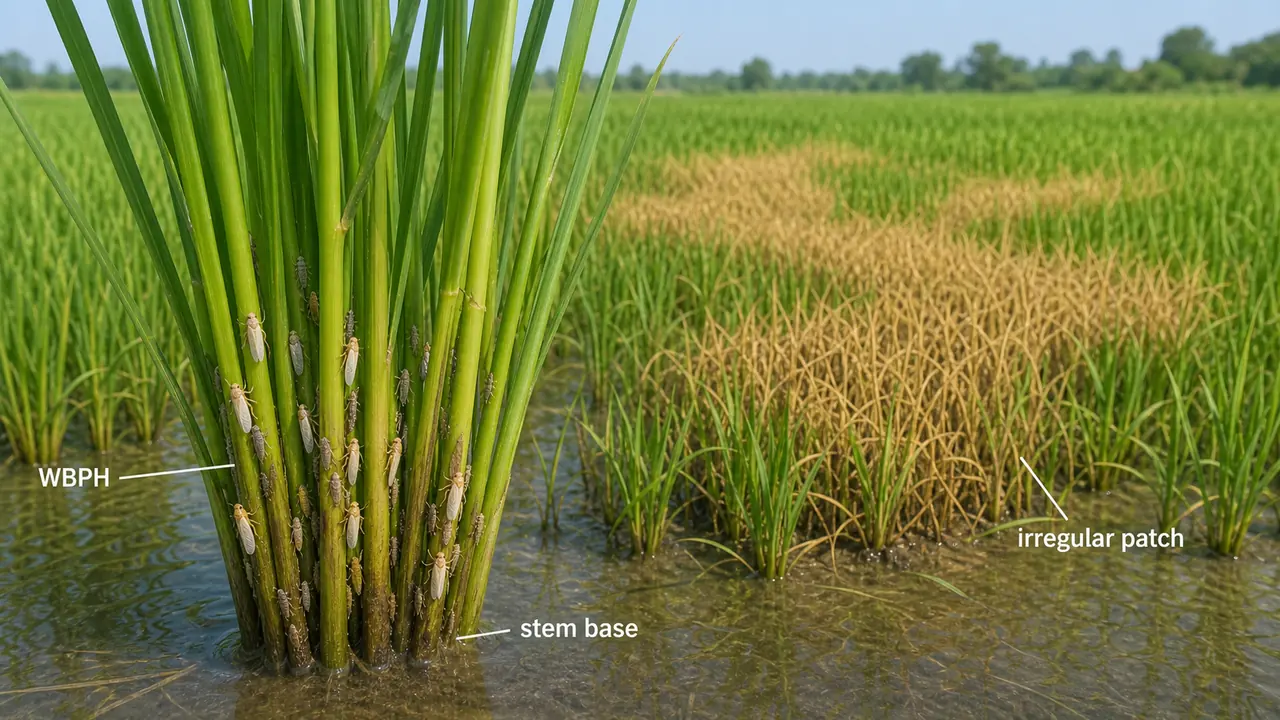
Family: Delphacidae | Order: Hemiptera
Pro Content Locked
Upgrade to Pro to access this lesson and all other premium content.
Charged once for one year · ₹1188 total
Save ₹100/month vs ₹2388/year launch price
- All Agriculture & Banking Courses
- AI Lesson Questions (100/day)
- AI Doubt Solver (50/day)
- Glows & Grows Feedback (30/day)
- AI Section Quiz (20/day)
- 22-Language Translation (100/day)
- Recall Questions (20/day)
- AI Quiz (15/day)
- AI Quiz Paper Analysis (100/day)
- AI Step-by-Step Explanations (100/day)
- Spaced Repetition Recall (FSRS)
- AI Tutor
- Immersive Text Questions
- Audio Lessons — Hindi & English
- Mock Tests & Previous Year Papers
- Summary & Mind Maps
- XP, Levels, Leaderboard & Badges
- Generate New Classrooms
- Voice AI Teacher (AgriDots Live)
- AI Revision Assistant
- Knowledge Gap Analysis
- Interactive Revision (LangGraph)
🔒 Secure one-time yearly payment via Razorpay · No hidden fees
A farmer in Odisha notices that his nearly-mature paddy has developed an unpleasant smell, and many grains have turned chaffy with black spots. On closer inspection, he finds long, slender green-brown bugs feeding on the milky grains — these are Gandhi bugs (rice earhead bugs), named for the obnoxious odour they release when disturbed. While the six major rice pests covered in Part 1 cause the bulk of the damage, these "minor" pests can cause serious localised losses. More importantly, this lesson covers the Integrated Pest Management (IPM) strategy for rice — a holistic approach that combines cultural, mechanical, biological, and chemical methods to manage all rice pests sustainably.
Minor and Other Pests of Rice
7. White Backed Plant Hopper (WBPH) — Sogatella furcifera
Family: Delphacidae | Order: Hemiptera
Host range: Rice, maize, millets, sugarcane, grasses
WBPH is closely related to BPH and causes similar damage, but with a key difference in the field pattern.
Damage Symptoms
- Both nymphs and adults suck sap, causing stunted growth and "hopper burn"
- The critical difference: WBPH causes hopper burn in irregular patches, unlike the circular patches of BPH
TIP
BPH vs. WBPH — The Pattern Test:
- BPH (Nilaparvata lugens) = Circular patches of hopper burn
- WBPH (Sogatella furcifera) = Irregular patches of hopper burn
This distinction is a classic exam question. Remember: "BPH = Balls (circular); WBPH = Wavy (irregular)."
Management: Same as BPH — spray Imidacloprid, avoid closer spacing, alternate wetting and drying, use light traps.
8. Rice Earhead Bug / Gandhi Bug — Leptocorisa acuta
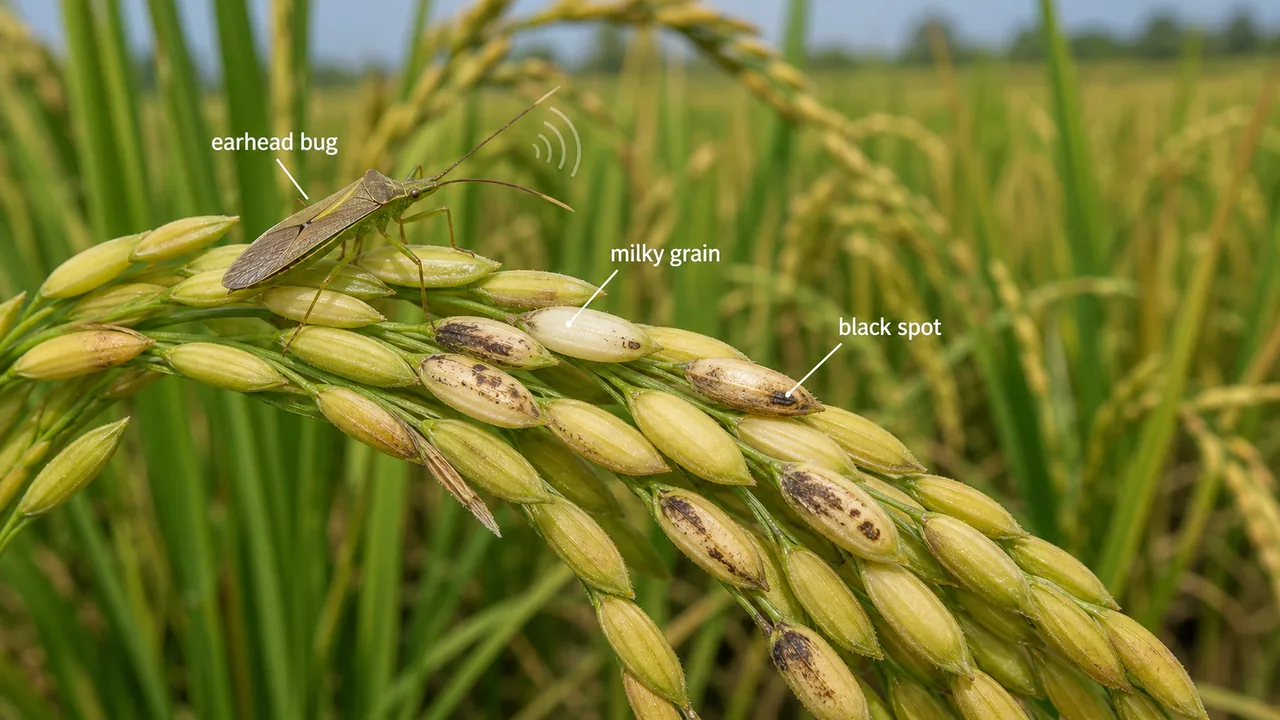
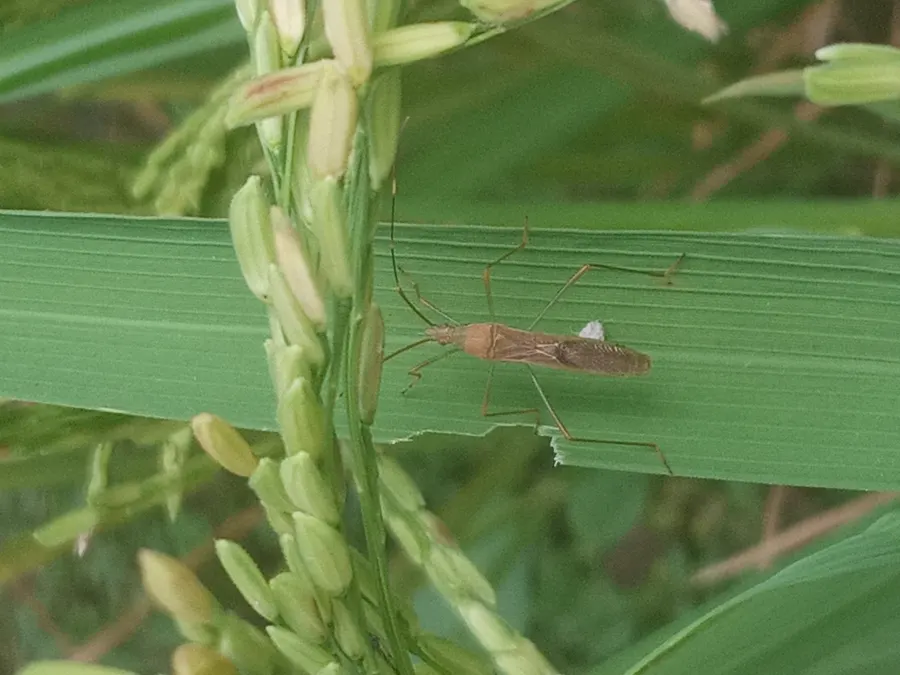
Family: Alydidae | Order: Hemiptera
Host range: Rice, millets | Nature: Periodic pest (appears in certain years, not every year)
The earhead bug gets its nickname "Gandhi bug" from the strong, unpleasant odour it releases — a defensive mechanism against predators.
Damage Symptoms
- Both nymphs and adults suck sap from individual grains at the milky stage
- Affected grains become chaffy with black spots at the feeding puncture site
- Yield loss may be 10-40% depending on severity
- Obnoxious odour emanates when the bugs are disturbed in the field
IMPORTANT
ETL (stage-dependent):
- Flowering stage: 5 bugs / 100 panicles or 1 bug/hill
- Milky stage: 16 bugs / 100 panicles or 3 bugs/hill
The higher ETL at milky stage reflects that the critical damage window (flowering) has partly passed.
Management
- Resistant variety: Badshahbhog
- Spray Malathion 50 EC
Agricultural context: In the rain-fed rice areas of Chhattisgarh and eastern MP, earhead bugs appear in swarms during certain years (periodic pest behaviour), particularly when the monsoon extends late into October. Farmers often detect them by smell before seeing them.
9. Mealy Bug — Brevennia rehi
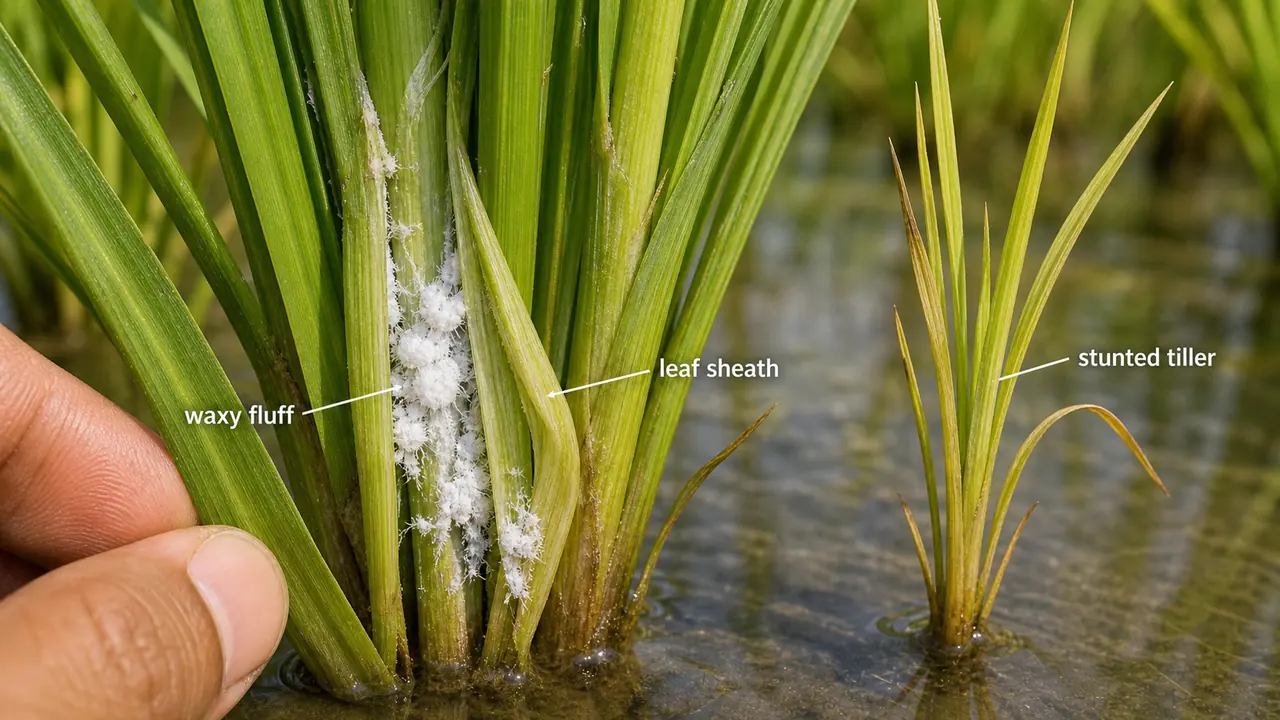
Family: Pseudococcidae | Order: Hemiptera
Host range: Rice, graminaceous weeds
Damage Symptoms
- Presence of white waxy fluff in the leaf sheath is the diagnostic symptom
- Plants become stunted with reduced vigour
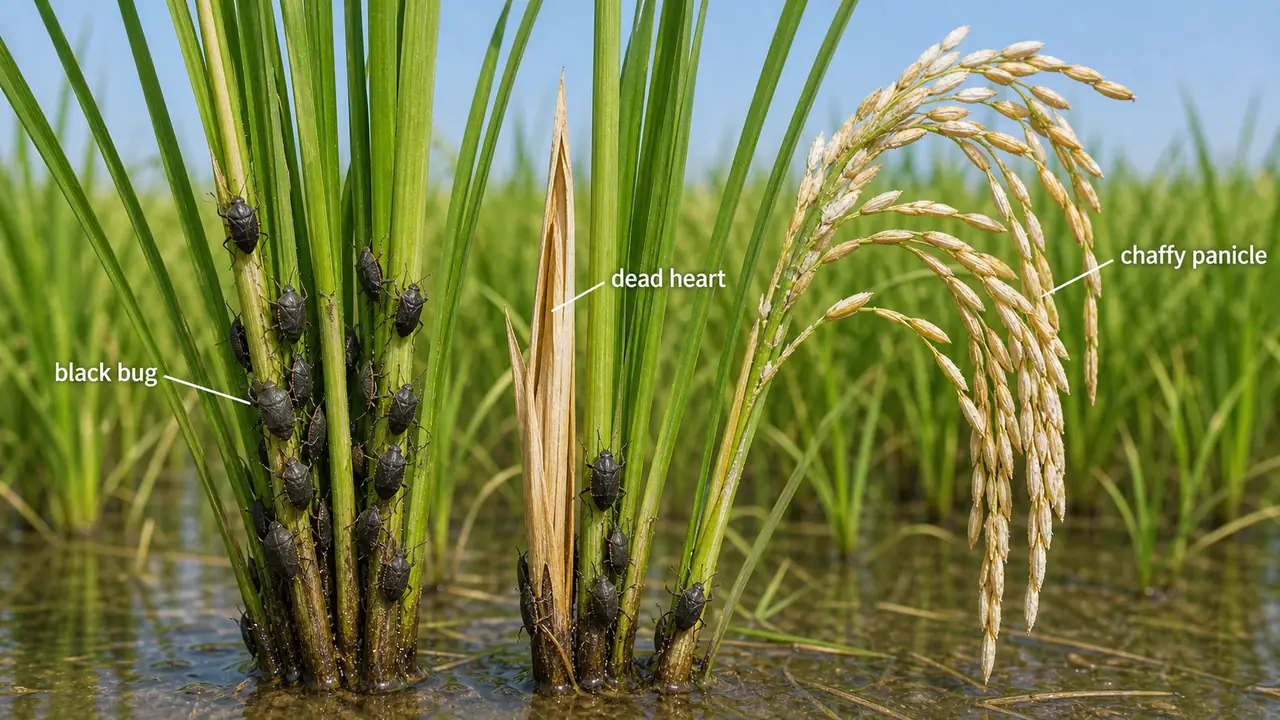
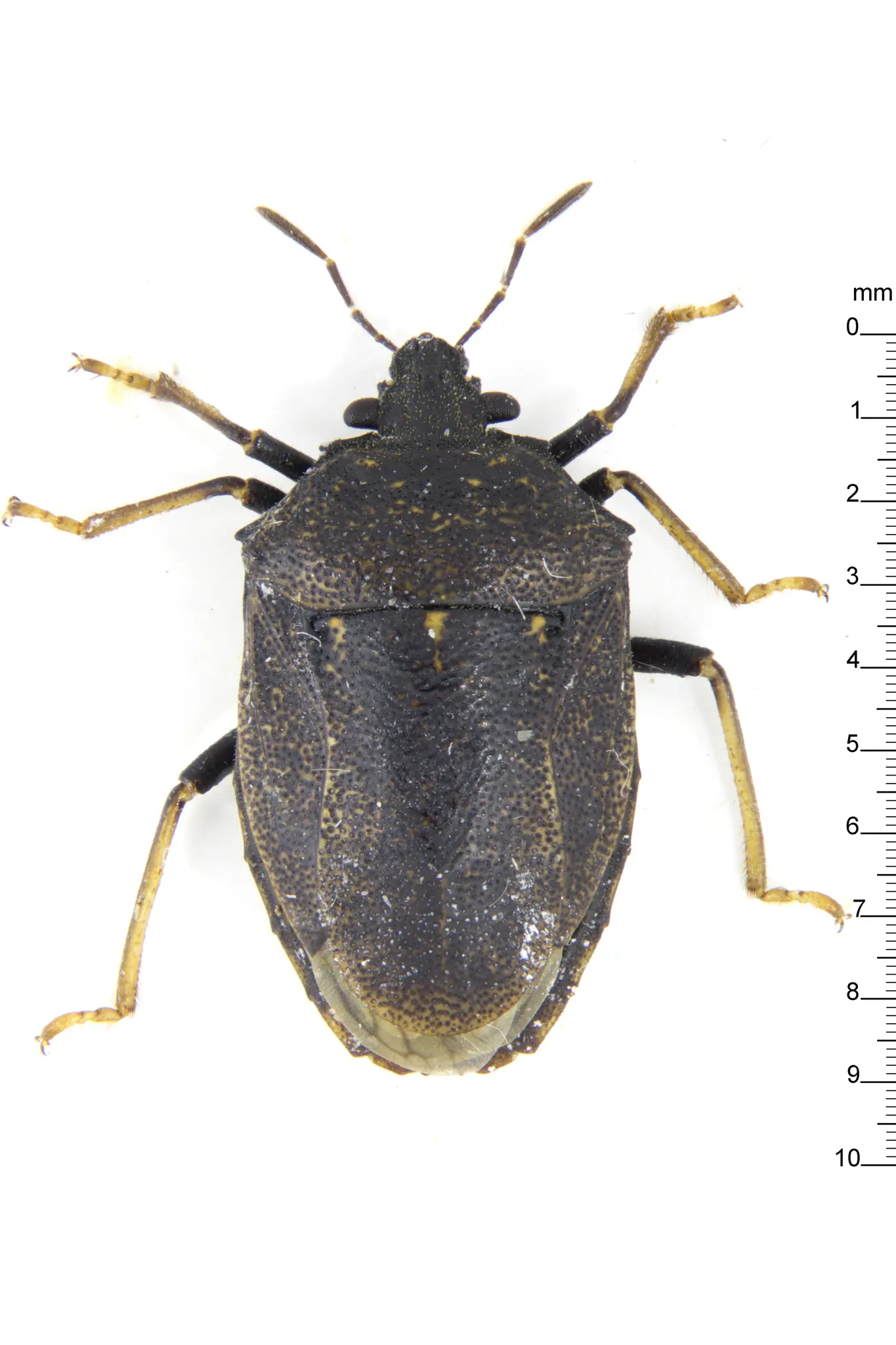
10. Rice Black Bug — Scotinophara lurida and S. coarctata
Family: Podopidae | Order: Hemiptera
Host range: Rice, millets
Damage Symptoms
- During tillering: Causes drying up of central shoot (dead heart), stunted growth, and reduced tillers
- During reproductive stage: Affects panicle development and causes chaffy grains (white ears)
NOTE
ETL: 10% damage at tillering stage or 5 bugs/hill. Note that black bug can cause both "dead heart" and "white ears" — symptoms usually associated with stem borers. The difference is that black bug feeds from outside (sucking), while stem borer feeds from inside (boring).
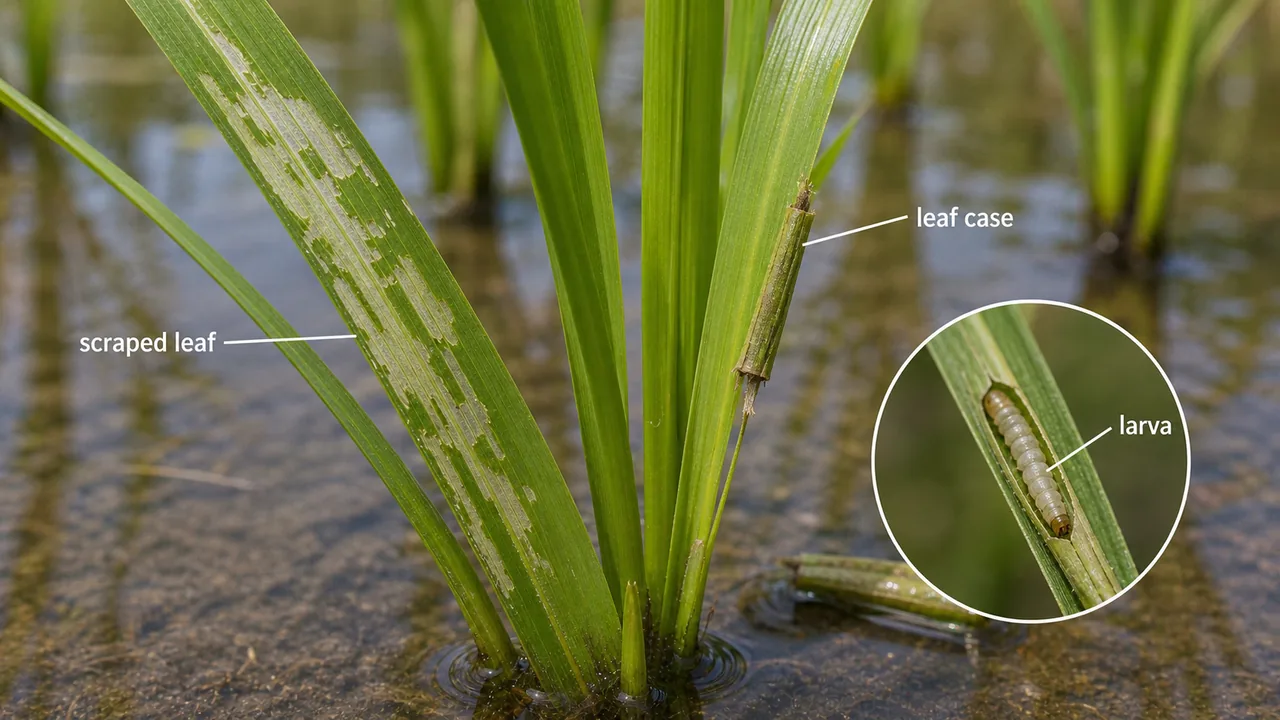
11. Rice Case Worm — Nymphula depunctalis
Family: Pyralidae | Order: Lepidoptera
Damage Symptoms
- Larvae feed by scraping the under surface of the leaf blade, leaving the upper epidermis intact
- Larvae construct tubular cases from leaf pieces — a unique behaviour where the larva lives inside a portable leaf-tube case while feeding
Management
- A rope may be passed over the young crop to dislodge the larval cases into the water — a simple but effective mechanical control method
11A. Rice Leaf Folder — Cnaphalocrocis medinalis
Family: Pyralidae | Order: Lepidoptera
Damage Symptoms
- The larva folds or fastens the longitudinal leaf margins together and remains protected inside the folded leaf.
- Feeding from within the fold scrapes the green tissue, producing elongated whitish patches and reduced photosynthetic area.
NOTE
Leaf folder is often grouped with stem-borer moth pests in monitoring programs, which is why light traps are commonly mentioned for both in rice IPM.
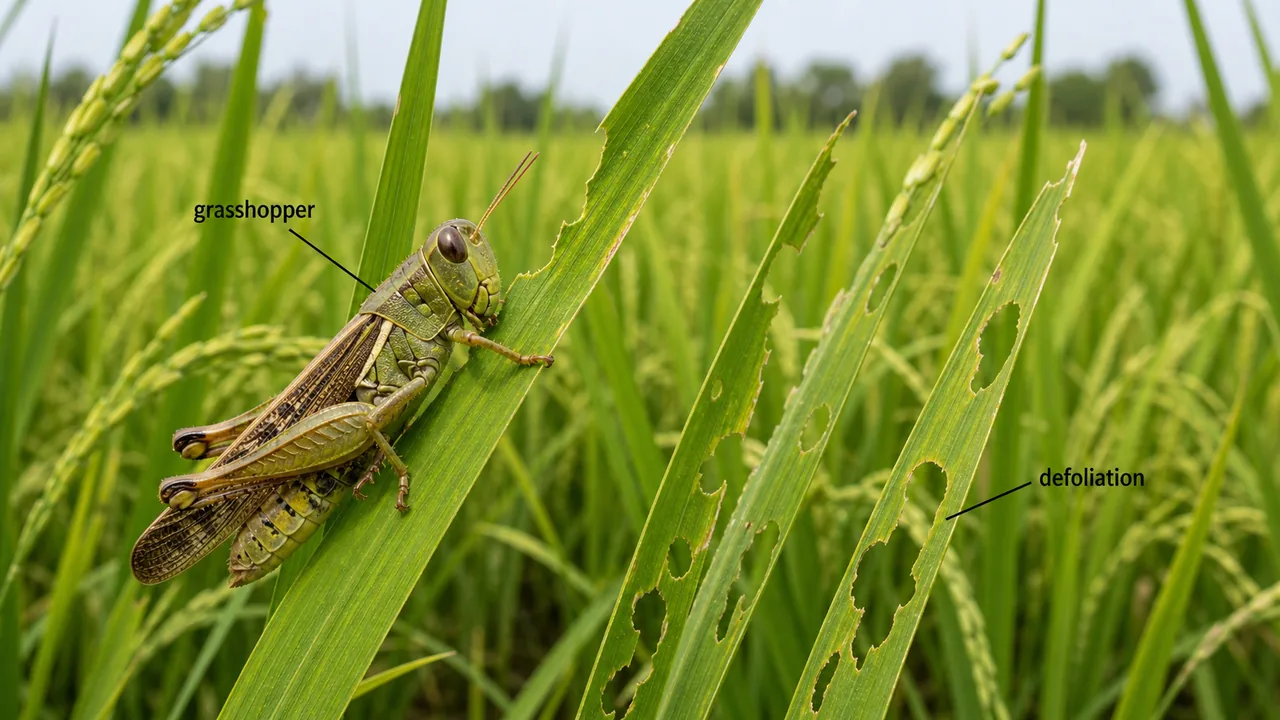
12. Grasshopper — Hieroglyphus banian
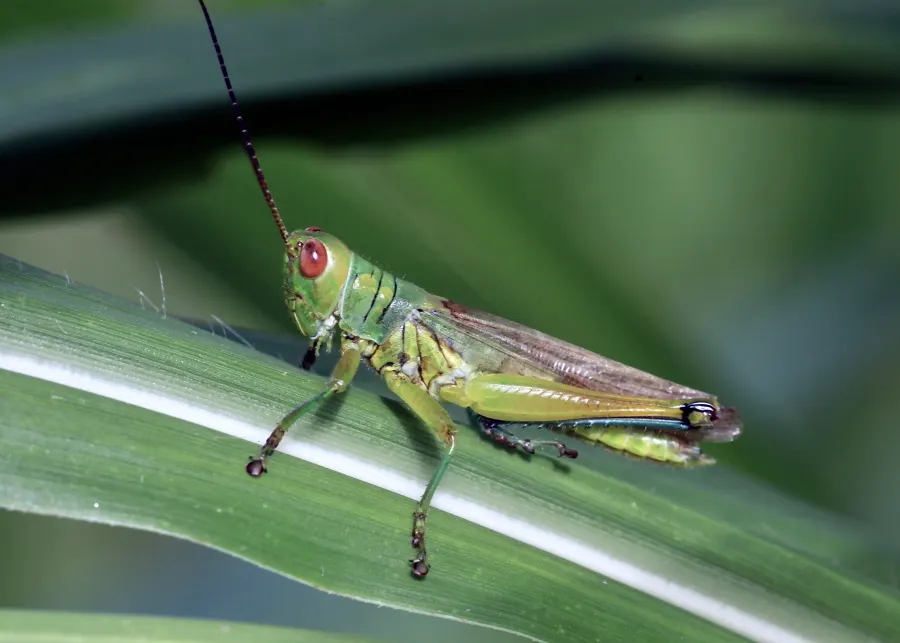
Host range: Rice and grasses
Damage Symptoms
- Feeds on leaves, causing defoliation
- Can cause significant damage in outbreak years
- A sporadic pest that is normally kept in check by natural enemies
13. Rice Whorl Maggot
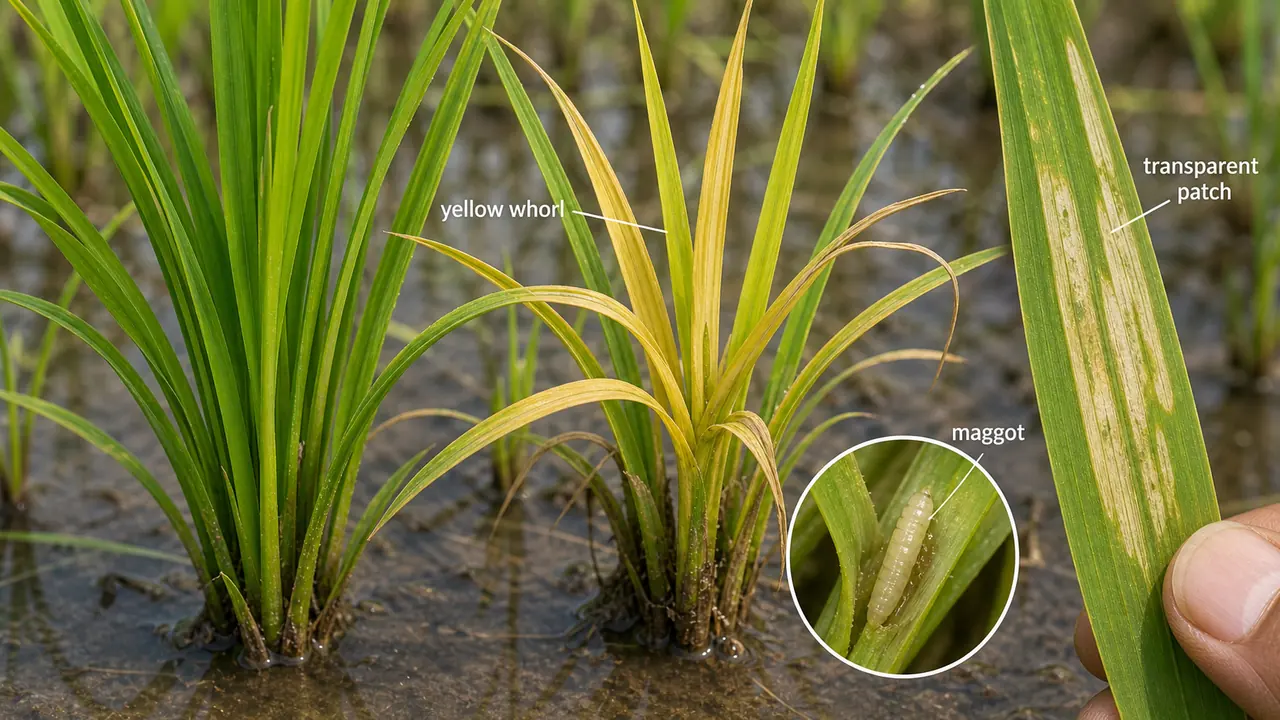
Damage Symptoms
- Maggot feeds inside the leaf whorl causing yellowing and wilting of central leaves
- Damaged leaves show transparent patches when held up to light
- Most damaging in the early vegetative stage
Comparing the Minor Pests
| Pest | Scientific Name | Key Symptom | How to Distinguish |
|---|---|---|---|
| WBPH | Sogatella furcifera | Hopper burn (irregular) | Irregular pattern (vs. circular for BPH) |
| Earhead Bug | Leptocorisa acuta | Chaffy grains + smell | Obnoxious odour; feeds at milky stage |
| Mealy Bug | Brevennia rehi | White waxy fluff | Fluff in leaf sheath |
| Black Bug | Scotinophara lurida | Dead heart + white ears | Sucking pest (not boring) |
| Case Worm | Nymphula depunctalis | Leaf cases in water | Portable tubular leaf cases |
| Leaf Folder | Cnaphalocrocis medinalis | Folded leaves with feeding inside | Longitudinal leaf margins fastened together |
| Grasshopper | Hieroglyphus banian | Defoliation | Large, obvious insect; sporadic |
Integrated Pest Management (IPM) for Rice
IMPORTANT
Rice IPM is a comprehensive strategy that integrates multiple management methods. Exam questions frequently ask about specific IPM components for rice. Master this section thoroughly.
IPM follows the principle of using multiple tactics in a coordinated way, prioritising cultural and biological methods and using chemicals only when pest populations exceed ETL.
A. Cultural Methods — The Foundation of Rice IPM
| Practice | Target Pest | How It Works |
|---|---|---|
| Use resistant/tolerant varieties | All pests | Built-in genetic resistance reduces pest survival |
| Maintain 20 x 15 cm spacing | BPH, WBPH | Opens canopy; reduces humidity at plant base |
| Alternate wetting and drying | BPH, WBPH | Disrupts habitat of hoppers at stem base |
| Plant with alleys (25 cm every 2 m) | BPH, WBPH | Improves aeration and sunlight penetration |
| Clip leaf tips before transplanting | Stem borer, Hispa | Removes stem borer egg masses and hispa larvae |
| Avoid excessive nitrogen | BPH, blast, hispa | Lush growth attracts sucking pests |
| Synchronous planting in locality | All pests | Prevents staggered sowing that provides continuous food |
| Destroy stubbles after harvest | Stem borer | Kills hibernating larvae in stubbles |
TIP
Two cultural practices to always remember: (1) Clip leaf tips before transplanting — this simple act removes both stem borer eggs and hispa larvae in one step. (2) Alternate wetting and drying — this disrupts BPH/WBPH habitat while also saving water.
B. Mechanical Methods
- Use light traps to attract and kill moths (stem borer, leaf folder) and hoppers
- Use sweep nets for monitoring GLH and BPH populations
- Pass rope over young crop to dislodge case worm larvae
- Remove and destroy egg masses of stem borer from leaves
C. Biological Control — Key Biocontrol Agents
| Pest | Biocontrol Agent | Type | Stage Attacked |
|---|---|---|---|
| Yellow Stem Borer | Trichogramma japonicum | Egg parasitoid | Eggs |
| Rice Hispa | Eulophus femoralis | Larval parasitoid | Larvae |
| BPH/WBPH | Spiders, Cyrtorhinus lividipennis | Predators | Nymphs & adults |
| Stem Borer | Bacillus thuringiensis var kurstaki | Microbial insecticide | Larvae |
NOTE
Spider conservation is key to BPH management. When spiders are present at 1/hill, the ETL for BPH is raised from 8-10 to 20/hill — the spiders provide sufficient natural control. This is why indiscriminate insecticide spraying (which kills spiders) often worsens BPH outbreaks.
Agricultural context: The "BPH resurgence" phenomenon seen in the 1970s-80s was largely caused by excessive insecticide use that killed natural enemies (especially spiders) while the BPH developed resistance. This taught entomologists that IPM — not calendar spraying — is the sustainable approach.
D. Chemical Control
| Chemical | Target Pests | Remarks |
|---|---|---|
| Imidacloprid | BPH, WBPH, GLH | Neonicotinoid; most recommended for hoppers |
| Chlorpyriphos | Hispa, stem borer | Organophosphate |
| Malathion 50 EC | Earhead bug | Safe insecticide |
| Neem seed kernel extract (NSKE) 1% | Stem borer | Reduces oviposition; botanical |
TIP
Chemical control in IPM is the last resort, not the first. Apply chemicals only when pest populations exceed ETL. The order of preference is: Cultural → Mechanical → Biological → Chemical.
E. Resistant Varieties Summary
| Pest | Resistant Varieties |
|---|---|
| Yellow Stem Borer | Ratna, Jaya, TKM 6, IR 20, IR 26, Sayasree, Saket |
| Gall Midge | IR 20, IR 50, CR 1009 |
| Thrips | PTB 12, PTB 20, PT 321, H 4 |
| Earhead Bug | Badshahbhog |
Exam Tips and Mnemonics
TIP
"Big 4" Sucking Pests of Rice: BPH, WBPH, GLH, and Earhead Bug.
- BPH and WBPH both cause "hopper burn" — but BPH = circular, WBPH = irregular
- GLH is primarily important as a vector of tungro virus
- Earhead Bug feeds at milky stage and produces an obnoxious odour
IPM Order Mnemonic: "Culture Makes Better Crops" — Cultural → Mechanical → Biological → Chemical
Biocontrol Mnemonic: "Tricho for eggs, Eulophus for larvae, spiders for hoppers, Bt for borers"
Summary Table: Rice Pests Part 2 — Key Facts
| Fact | Answer |
|---|---|
| Hopper burn in irregular patches | WBPH (Sogatella furcifera) |
| Hopper burn in circular patches | BPH (Nilaparvata lugens) |
| Feeds on milky grains; obnoxious smell | Earhead bug (Leptocorisa acuta) |
| Resistant variety for earhead bug | Badshahbhog |
| White waxy fluff in leaf sheath | Mealy bug (Brevennia rehi) |
| Egg parasitoid for stem borer | Trichogramma japonicum |
| Larval parasitoid for hispa | Eulophus femoralis |
| Predator of BPH | Spiders, Cyrtorhinus lividipennis |
| Clip leaf tips removes which pests | Stem borer eggs + hispa larvae |
| Main chemical for hoppers | Imidacloprid |
| Most important cultural practice | Alternate wetting and drying |
TIP
Next: The sorghum pests lesson covers shoot fly, stem borer, earhead bug, and sorghum midge — many of which share genera with rice pests but differ in species.
Summary Cheat Sheet
| Topic | Key Takeaway |
|---|---|
| Hopper burn in irregular patches | WBPH (Sogatella furcifera) |
| Hopper burn in circular patches | BPH (Nilaparvata lugens) |
| Vector pest in this lesson set | GLH transmits tungro virus |
| Milky-stage feeding pest with smell | Earhead bug (Leptocorisa acuta) |
| Waxy fluff pest | Mealy bug (Brevennia rehi) |
| Egg parasitoid for stem borer | Trichogramma japonicum |
| Larval parasitoid for rice hispa | Eulophus femoralis |
| Key predators of BPH/WBPH | Spiders and Cyrtorhinus lividipennis |
| Main hopper insecticide | Imidacloprid |
| Important botanical option | NSKE 1% for stem borer oviposition reduction |
| Most important IPM lesson | Conserve natural enemies and spray only after ETL |
| Resistant variety named for earhead bug | Badshahbhog |