🌿 Sorghum Pests: From Shoot Fly to Earhead Bug
Complete guide to all 7 major pests of sorghum (jowar) — shoot fly, stem borer, pink stem borer, shoot bug, earhead bug, sorghum midge, and aphids with scientific names, ETL, damage, IPM, and exam mnemonics
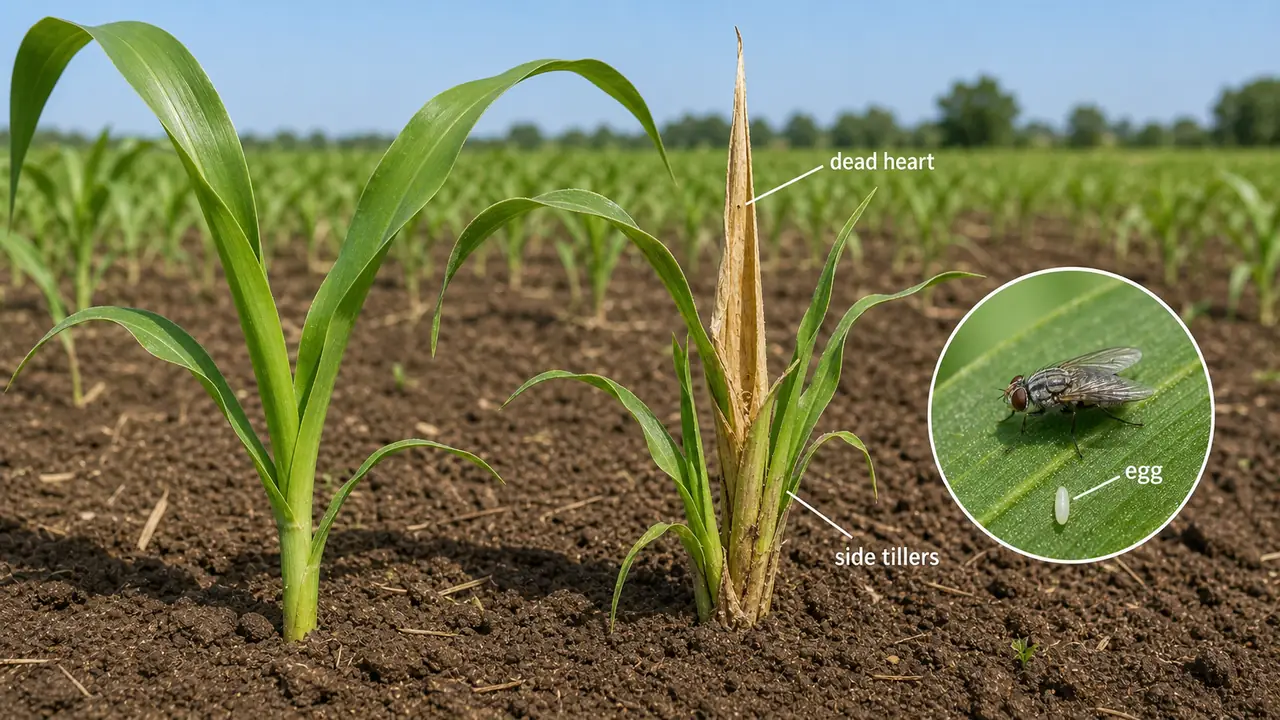
In the rain-fed regions of Maharashtra's Marathwada, a kharif sorghum field tells a story through its tillers. Healthy plants stand tall with a single central shoot, but scattered among them are plants with dried-up central shoots and multiple side tillers sprouting from the base. These "dead hearts" are the work of the sorghum shoot fly (Atherigona soccata) — the most common and consistently damaging pest of sorghum at the seedling stage. When the same crop reaches the grain-filling stage, a different set of enemies attacks the earheads. Understanding the complete pest complex of sorghum — from seedling to harvest — is essential for both farm advisory work and competitive exams.
Sorghum Pest Complex at a Glance
Sorghum Pests — Quick Reference Table
| S.No. | Pest | Scientific Name | Family | Order | Key Damage |
|---|---|---|---|---|---|
| 1 | Sorghum Shoot Fly | Atherigona soccata | Muscidae | Diptera | Dead heart |
| 2 | Stem Borer | Chilo partellus | Crambidae | Lepidoptera | Dead heart + shot hole |
| 3 | Pink Stem Borer | Sesamia inferens | Noctuidae | Lepidoptera | Dead heart |
| 4 | Shoot Bug | Peregrinus maidis | Delphacidae | Hemiptera | Sooty mould |
| 5 | Earhead Bug | Calocoris angustatus | Miridae | Hemiptera | Chaffy grains |
| 6 | Sorghum Midge | Contarinia sorghicola | Cecidomyiidae | Diptera | White pupal cases |
| 7 | Plant Lice (Aphids) | Rhopalosiphum maidis, Melanaphis sacchari | Aphididae | Hemiptera | Sooty mould |
Pest Damage by Crop Stage
Understanding which pests attack at which stage helps both in field diagnosis and exam preparation:
Pro Content Locked
Upgrade to Pro to access this lesson and all other premium content.
Charged once for one year · ₹1188 total
Save ₹100/month vs ₹2388/year launch price
- All Agriculture & Banking Courses
- AI Lesson Questions (100/day)
- AI Doubt Solver (50/day)
- Glows & Grows Feedback (30/day)
- AI Section Quiz (20/day)
- 22-Language Translation (100/day)
- Recall Questions (20/day)
- AI Quiz (15/day)
- AI Quiz Paper Analysis (100/day)
- AI Step-by-Step Explanations (100/day)
- Spaced Repetition Recall (FSRS)
- AI Tutor
- Immersive Text Questions
- Audio Lessons — Hindi & English
- Mock Tests & Previous Year Papers
- Summary & Mind Maps
- XP, Levels, Leaderboard & Badges
- Generate New Classrooms
- Voice AI Teacher (AgriDots Live)
- AI Revision Assistant
- Knowledge Gap Analysis
- Interactive Revision (LangGraph)
🔒 Secure one-time yearly payment via Razorpay · No hidden fees
In the rain-fed regions of Maharashtra's Marathwada, a kharif sorghum field tells a story through its tillers. Healthy plants stand tall with a single central shoot, but scattered among them are plants with dried-up central shoots and multiple side tillers sprouting from the base. These "dead hearts" are the work of the sorghum shoot fly (Atherigona soccata) — the most common and consistently damaging pest of sorghum at the seedling stage. When the same crop reaches the grain-filling stage, a different set of enemies attacks the earheads. Understanding the complete pest complex of sorghum — from seedling to harvest — is essential for both farm advisory work and competitive exams.
Sorghum Pest Complex at a Glance
Sorghum Pests — Quick Reference Table
| S.No. | Pest | Scientific Name | Family | Order | Key Damage |
|---|---|---|---|---|---|
| 1 | Sorghum Shoot Fly | Atherigona soccata | Muscidae | Diptera | Dead heart |
| 2 | Stem Borer | Chilo partellus | Crambidae | Lepidoptera | Dead heart + shot hole |
| 3 | Pink Stem Borer | Sesamia inferens | Noctuidae | Lepidoptera | Dead heart |
| 4 | Shoot Bug | Peregrinus maidis | Delphacidae | Hemiptera | Sooty mould |
| 5 | Earhead Bug | Calocoris angustatus | Miridae | Hemiptera | Chaffy grains |
| 6 | Sorghum Midge | Contarinia sorghicola | Cecidomyiidae | Diptera | White pupal cases |
| 7 | Plant Lice (Aphids) | Rhopalosiphum maidis, Melanaphis sacchari | Aphididae | Hemiptera | Sooty mould |
Pest Damage by Crop Stage
Understanding which pests attack at which stage helps both in field diagnosis and exam preparation:
| Crop Stage | Pests Active | Primary Damage |
|---|---|---|
| Seedling (1-3 weeks) | Shoot fly | Dead heart |
| Vegetative (3-6 weeks) | Stem borer, Pink stem borer | Dead heart, shot hole |
| Boot to flowering | Shoot bug, Aphids | Sap sucking, sooty mould |
| Grain filling | Earhead bug, Sorghum midge | Chaffy/shrivelled grains |
1. Sorghum Shoot Fly — Atherigona soccata
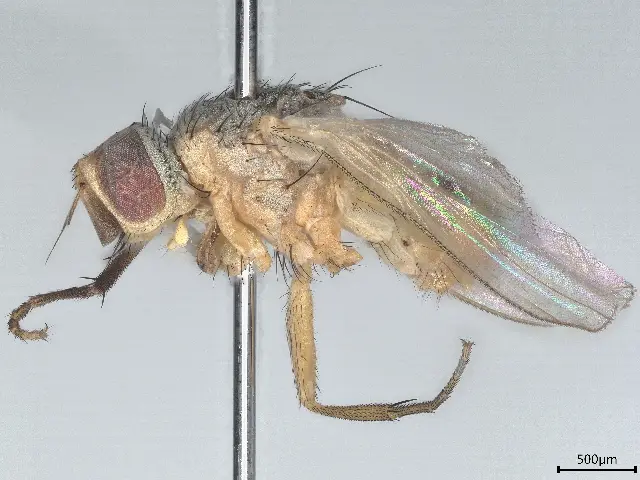
Family: Muscidae | Order: Diptera
Host range: Maize, ragi, bajra, rice, wheat, and grasses
The shoot fly is the single most important pest of sorghum at the seedling stage. Its damage at the nursery/early stage can necessitate complete resowing.
Damage Symptoms
- The maggot hatches on the leaf surface, migrates between the leaf sheath and stem, reaches the growing point, and bores inside the stem to cut the growing point
- This results in the characteristic "dead heart" symptom (asked in exams)
- The infested plant responds by producing side tillers from the base as a compensatory response
- Shoot fly lays cigar-shaped eggs on leaves — a distinctive diagnostic feature
- Attack is more severe during summer than kharif season because the pest population carries over from weeds
IMPORTANT
ETL: 10% dead hearts or 1 egg per plant. Sorghum shoot fly (Atherigona soccata) is the most important seedling pest. This was asked in exams.
Management
- Use higher seed rate (to compensate for dead-heart plants that will be thinned out)
- Use fish meal trap — the fly is attracted to the fermented fish meal scent
- Early sowing, immediately after the onset of monsoon (early-sown crops escape peak fly activity)
- Apply phorate or cartap hydrochloride or carbofuran as soil application
TIP
Shoot fly species vary by crop — a classic exam trap:
- Sorghum shoot fly = Atherigona soccata
- Maize shoot fly = Atherigona orientalis
- Pearl millet shoot fly = Atherigona approximata
All three belong to genus Atherigona (family Muscidae), but the species is different for each crop. Exams test this distinction frequently.
2. Stem Borer — Chilo partellus
Family: Crambidae | Order: Lepidoptera
Host range: Maize, sorghum, sugarcane, bajra, rice, Sorghum halepense, finger millet
The stem borer is the most destructive pest of sorghum overall. While shoot fly damages seedlings, the stem borer attacks from one month after sowing until earhead emergence.
Damage Symptoms
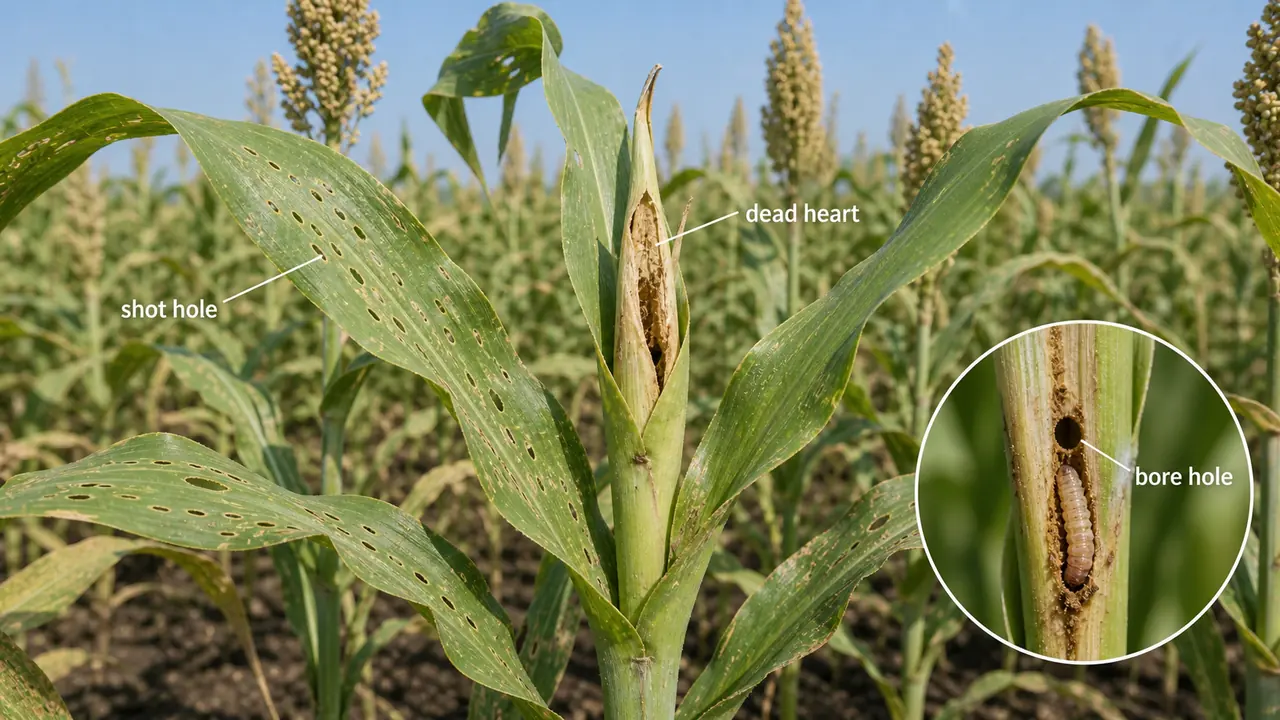
- Central shoot withering leading to "dead heart" is the main symptom
- Bore holes are visible on the stem near the nodes
- Holes at the base of the sorghum peduncle indicate Chilo partellus larvae boring into internodes
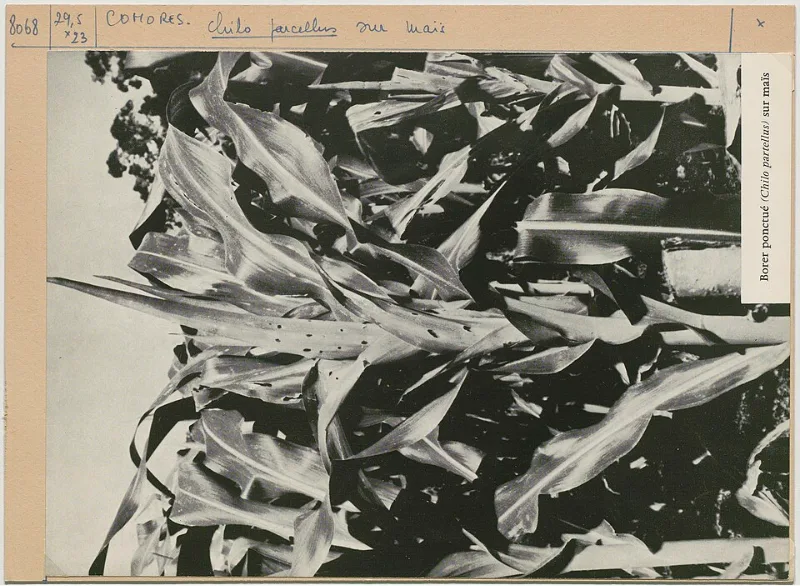
- Young larvae crawl and feed on tender folded leaves, causing typical "shot hole" or "pin hole" symptom — rows of small holes in unfolded leaves
- Egg laying is classically remembered on the underside / lower surface of the leaf, which helps explain why the earliest leaf-feeding damage appears before stem boring becomes obvious.
- Internally, tunnelling caterpillars can be found inside the stem
- Larvae hibernate in sorghum stubbles between seasons
TIP
Stem borer produces TWO symptoms: "Dead heart" (wilted central shoot) AND "shot hole" (pin holes on leaves). The shot hole symptom appears first when young larvae feed on folded leaves; dead heart appears later when they bore into the stem.
Agricultural context: Farmers in Karnataka's northern districts know that leaving sorghum stubbles in the field after harvest allows stem borer larvae to survive and attack the next crop. Stubble destruction (by burning, composting, or deep ploughing) is the first step in breaking the pest cycle.
3. Pink Stem Borer — Sesamia inferens
Family: Noctuidae | Order: Lepidoptera
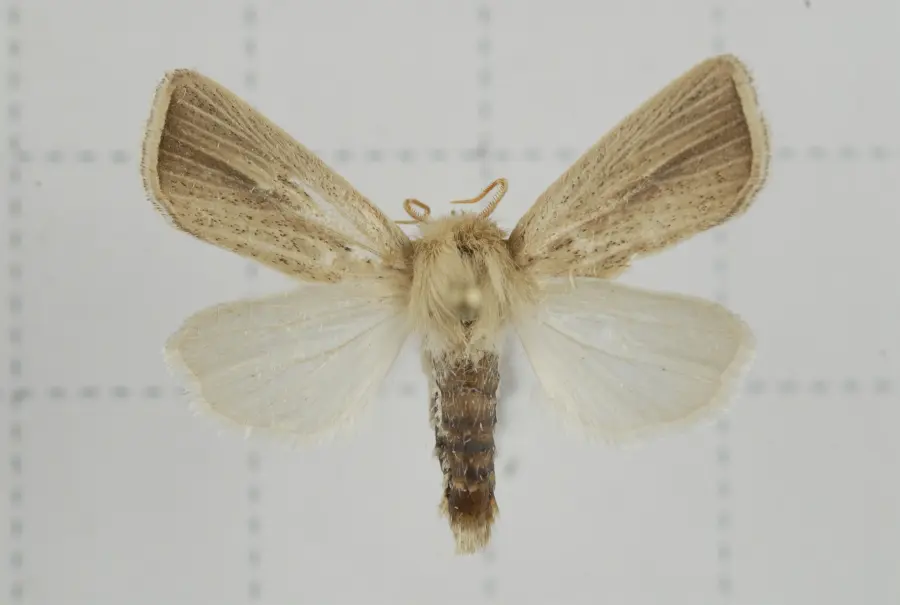
Host range: Sorghum, maize, rice, wheat, sugarcane, bajra, ragi, barley, guinea grasses — a truly polyphagous pest.
Damage Symptoms
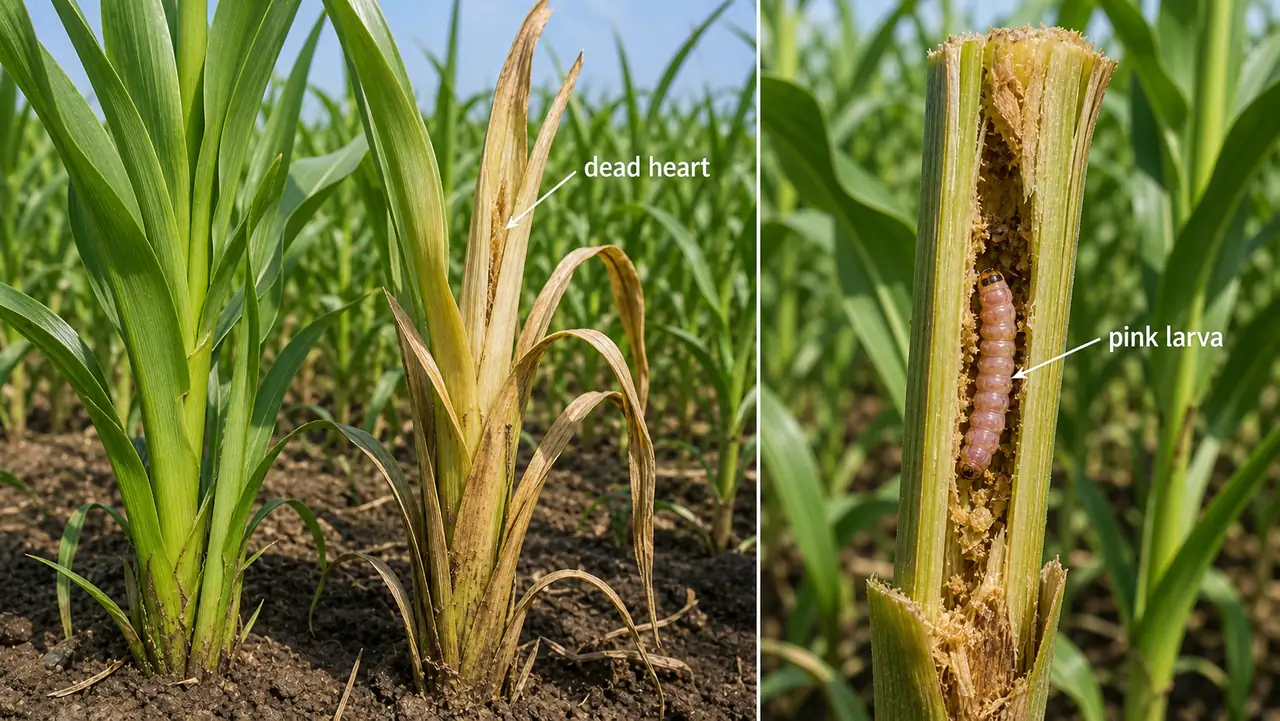
- The distinctively pink-coloured larva bores into the stem and damages the central shoot, resulting in dead heart
Biological Control Agents
The pink stem borer has a rich set of natural enemies that are important for exam questions:
| Biocontrol Agent | Type | Stage Attacked |
|---|---|---|
| Telenomus sp. | Egg parasitoid | Eggs |
| Trichogramma chilonis | Egg parasitoid | Eggs |
| Apanteles flavipes | Larval parasitoid | Larvae |
| Bracon hebetor | Larval parasitoid | Larvae |
| Tetrastichus ayyari | Pupal parasitoid | Pupae |
NOTE
Notice how biological control covers all three stages — egg parasitoids (Telenomus, Trichogramma), larval parasitoids (Apanteles, Bracon), and pupal parasitoid (Tetrastichus). This comprehensive natural enemy complex is a frequently tested topic.
IMPORTANT
Dead heart distinction: Shoot fly (young crop ≤3 weeks, Diptera maggot, cigar-shaped eggs) → dead heart + more side tillers. Stem borer (older crop, Lepidoptera caterpillar) → dead heart + bore holes at peduncle base + shot holes. Termite (Odontotermes obesus) causes poor germination and hollowing of setts — distinct from dead heart pests.
Comparing the Three "Dead Heart" Pests of Sorghum
| Feature | Shoot Fly | Stem Borer | Pink Stem Borer |
|---|---|---|---|
| Scientific name | Atherigona soccata | Chilo partellus | Sesamia inferens |
| Order | Diptera | Lepidoptera | Lepidoptera |
| Damaging stage | Maggot | Caterpillar | Pink caterpillar |
| Attack timing | Seedling (1-3 weeks) | 1 month onwards | Variable |
| Additional symptom | Side tillers | Shot hole on leaves | None specific |
| Destructiveness | Most important at seedling | Most destructive overall | Moderate |
| Host specificity | Multiple cereals | Multiple cereals | Highly polyphagous |
TIP
Exam trap: All three cause "dead heart" in sorghum, but they differ in order, timing, and additional symptoms. The stem borer also causes "shot hole" — this double symptom is the distinguishing feature.
4. Shoot Bug — Peregrinus maidis
Family: Delphacidae | Order: Hemiptera
Host range: Sorghum, maize, rice, millets
Damage Symptoms
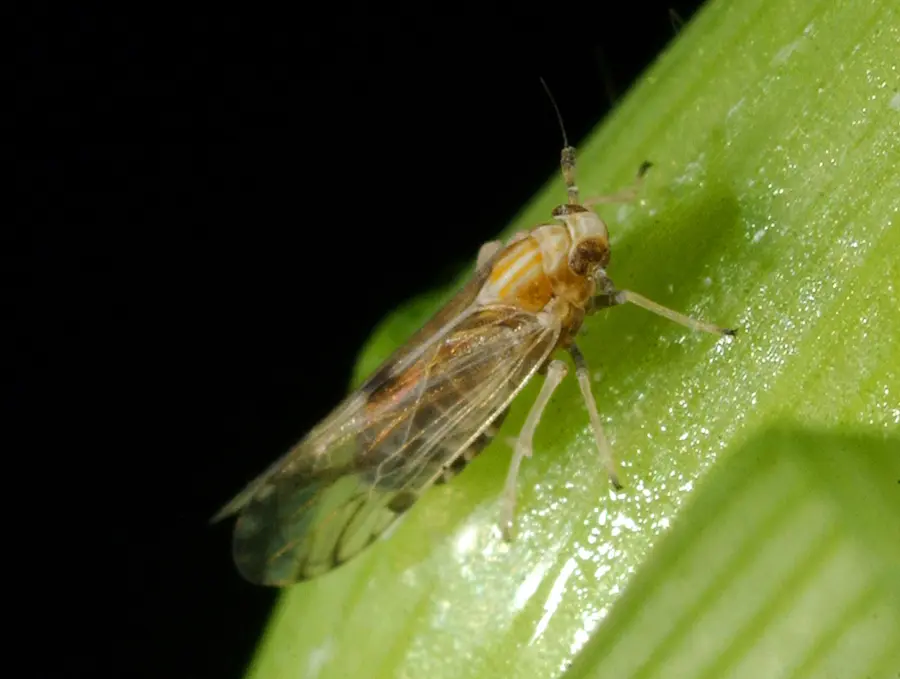
- Adults and nymphs suck sap from plants
- Feeding often occurs in gregarious clusters, so injury may appear as concentrated patches rather than evenly scattered plants
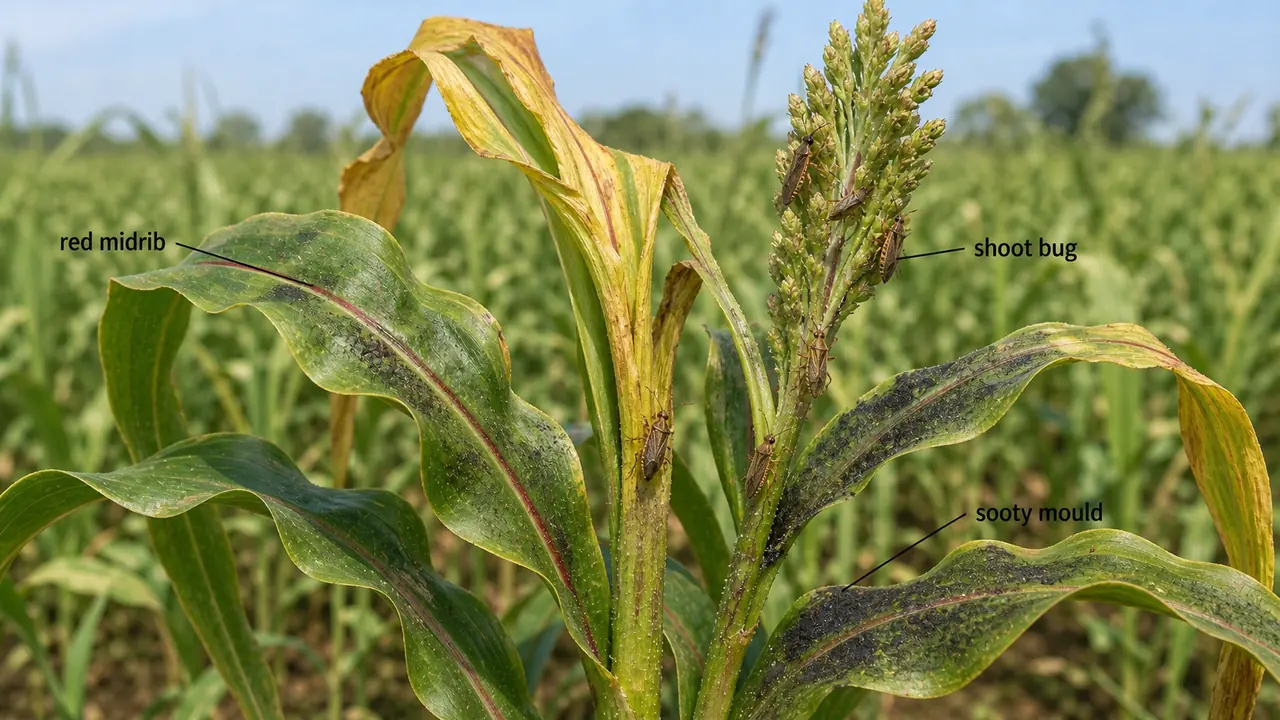
- Attacked plants become stunted and yellow; leaves wither from top downwards
- Panicle formation is inhibited; plants die if attack is severe
- Honeydew secreted by the bug causes growth of sooty mould on leaves — a black, powdery coating
- The midribs of leaves turn red due to egg-laying and may subsequently dry up
5. Earhead Bug — Calocoris angustatus
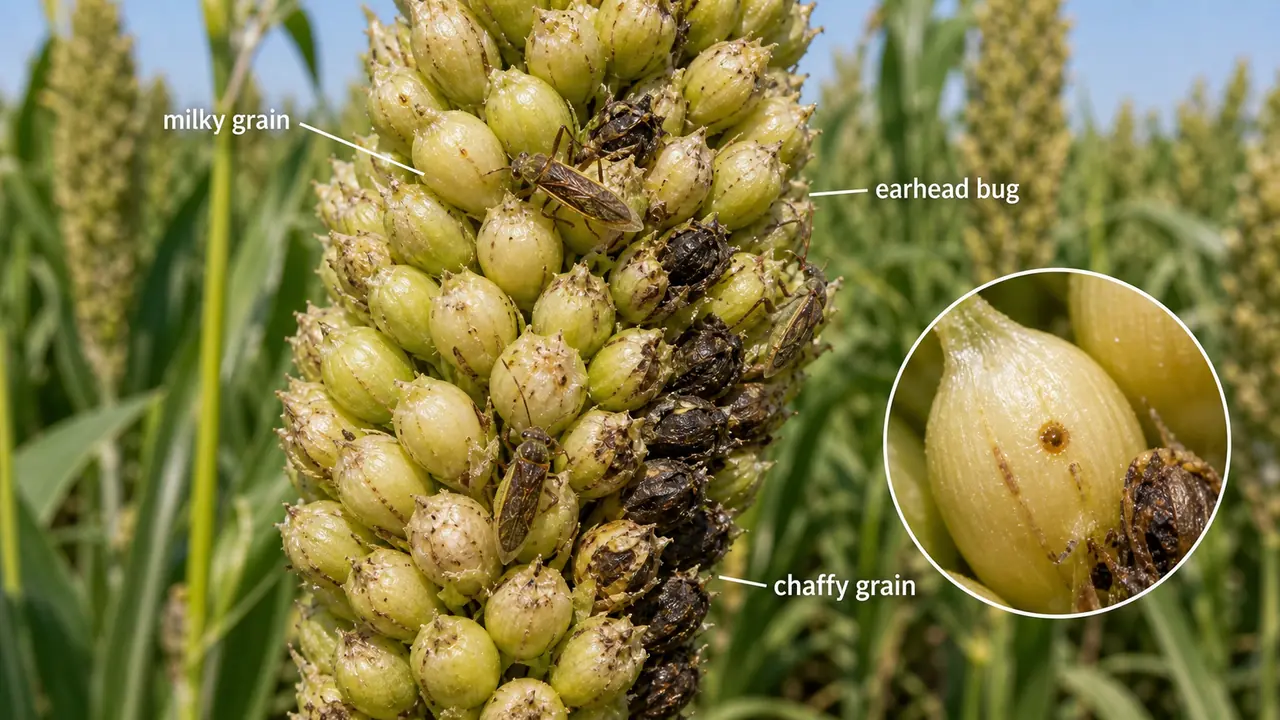
Family: Miridae | Order: Hemiptera
Host range: Pearl millet, maize, tenai, sugarcane, and grasses
This bug attacks the most valuable part of the crop — the grain-filled earheads.
Damage Symptoms
- Adults and nymphs damage the earheads by feeding on them
- They suck the juice from grains at the milky stage
- Sucked-out grains shrink, turn black, and become ill-filled (chaffy)
- Older grains show distinct feeding punctures that reduce grain quality
- The eggs are often remembered as cigar-shaped, a useful recall point when differentiating sorghum earhead bug from other grain-stage sap feeders
NOTE
ETL: 10 bugs per earhead
Agricultural context: In the rabi sorghum belt of Maharashtra and Karnataka, earhead bug damage reduces both yield and grain quality. Damaged grains fetch lower market prices because of the black discolouration.
6. Sorghum Midge — Contarinia sorghicola
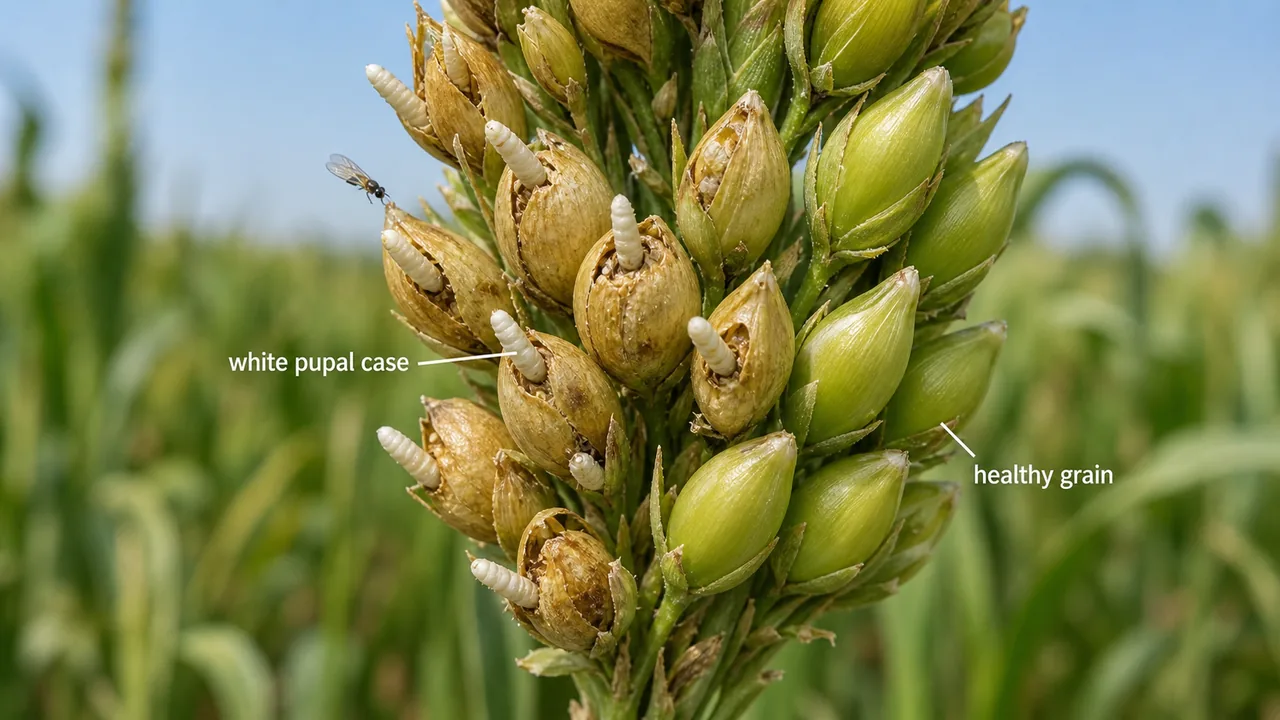
Family: Cecidomyiidae | Order: Diptera
Hosts: Sorghum — cultivated and wild species
Damage Symptoms
- A maggot feeds on the developing grains and pupates inside them
- White pupal cases protruding from the grains, often visible between the glumes, and chaffy grains with holes are the diagnostic symptoms
- Late-flowering sorghum is particularly susceptible because it coincides with peak midge populations
TIP
"White pupal cases sticking out of grains" — this visual cue is the hallmark of sorghum midge damage. No other pest produces this symptom. Remember: "Midge = Mini pupal cases in grains."
7. Plant Lice (Aphids) — Rhopalosiphum maidis & Melanaphis sacchari
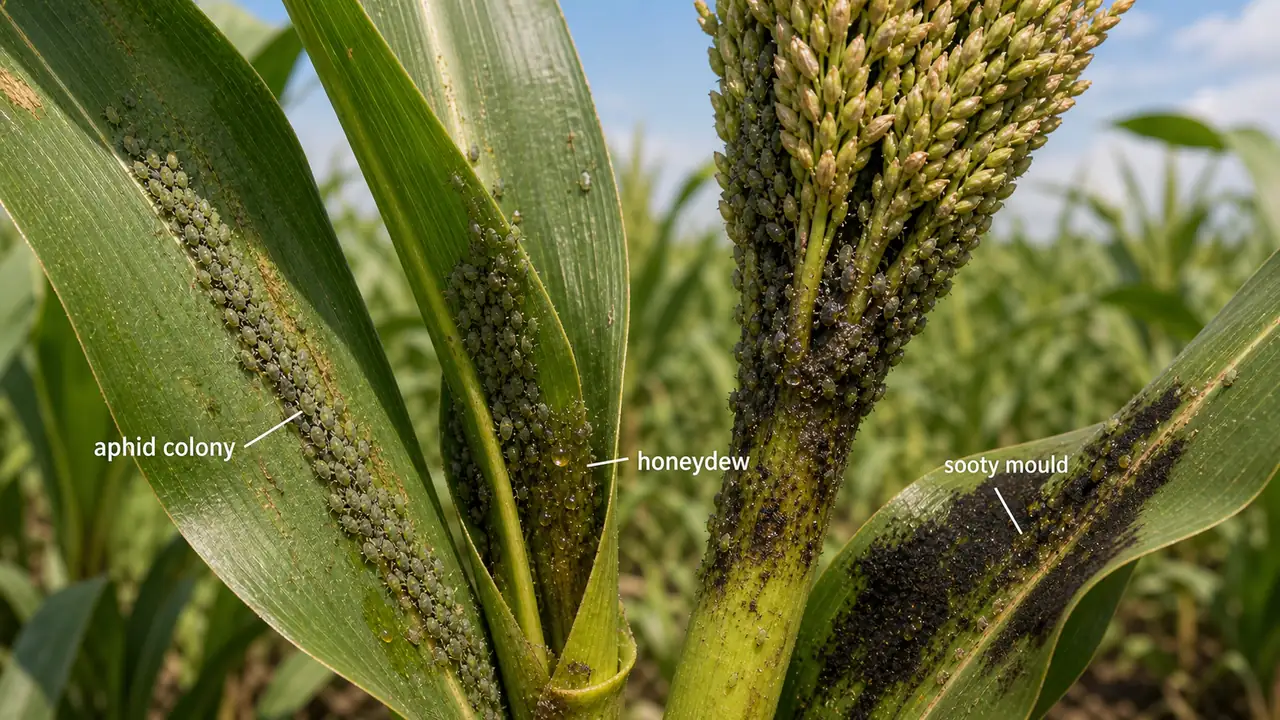
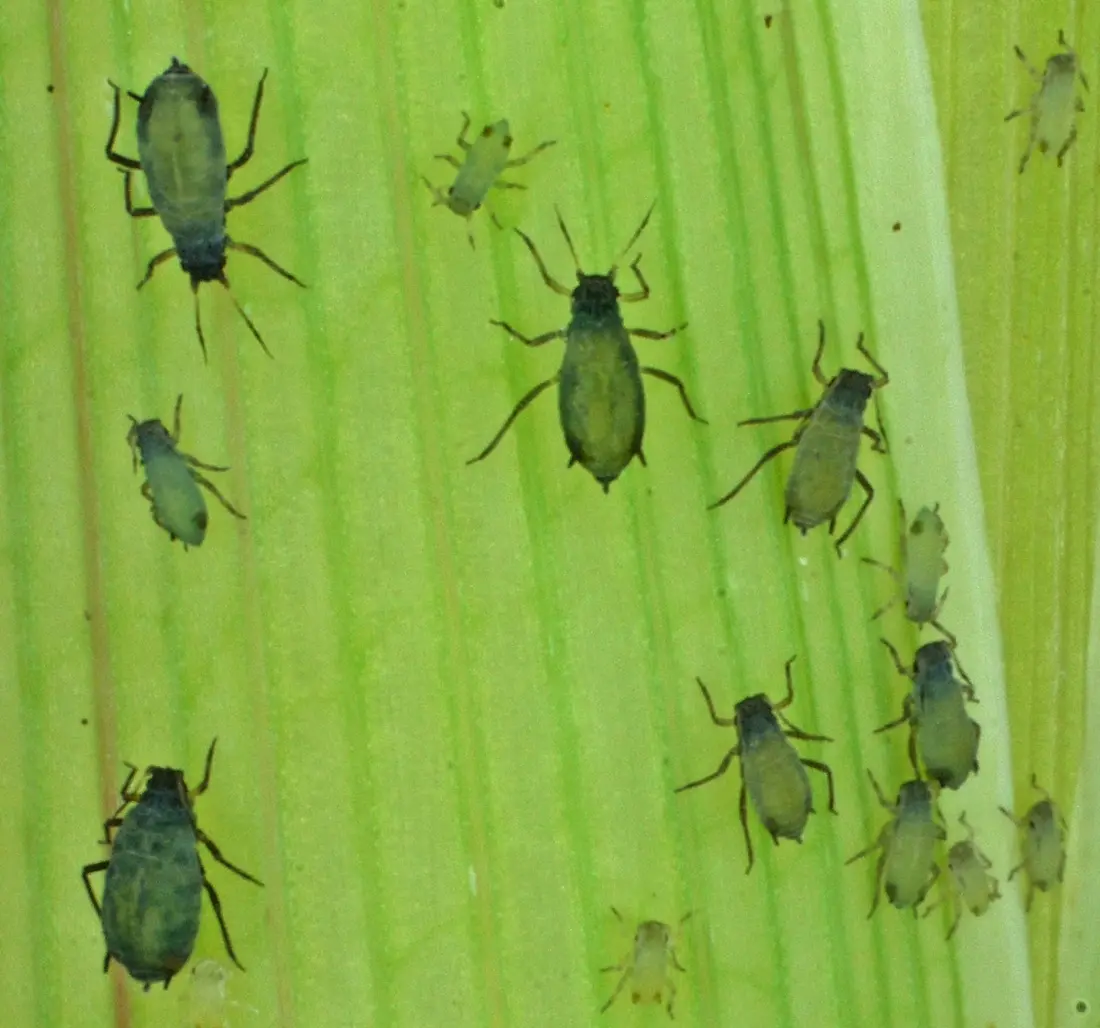
Family: Aphididae | Order: Hemiptera
Damage Symptoms
- Colonies form on leaves, central whorl, stems, and earheads
- Suck plant sap causing yellowing and wilting
- Produce honeydew, leading to sooty mould development
- Rhopalosiphum maidis also transmits maize dwarf mosaic virus and sugarcane mosaic virus
Integrated Pest Management in Sorghum
A. Cultural Methods
- Intercropping: Sow sorghum:lablab/cowpea in 4:1 ratio to minimise stem borer damage. The legume crop acts as a barrier and harbours natural enemies.
- Seed rate: Use increased seed rate up to 12.5 kg/ha and remove shoot fly-damaged seedlings during thinning (or raise nursery and transplant only healthy seedlings)
- Early sowing immediately after monsoon onset to escape shoot fly peak
B. Mechanical Method
- Set up sex pheromone traps at 12/ha to attract male moths of Helicoverpa sp. from flowering to grain hardening
C. Biological Methods
- Apply NPV (Nuclear Polyhedrosis Virus) at 250 LE/ha in two applications at 10-day intervals, along with crude sugar (2.5 kg) and cotton seed kernel powder (250 g) on earheads to control Helicoverpa larvae
D. Chemical Methods
- Use seeds pelleted with insecticides (soil-applied systemics)
- Arpocarb fishmeal formulation is particularly effective for attracting shoot fly adults (especially females)
Exam Tips and Mnemonics
TIP
"SSPEC" — The Key Sorghum Pests:
- Shoot fly (A. soccata) — Dead heart at seedling stage; ETL: 10% dead hearts
- Stem borer (C. partellus) — Dead heart + shot hole; most destructive
- Pink stem borer (S. inferens) — Dead heart; pink larva; polyphagous
- Earhead bug (C. angustatus) — Chaffy grains; ETL: 10/earhead
- Contarinia midge (C. sorghicola) — White pupal cases in grains
Key IPM fact: Intercrop sorghum:lablab/cowpea at 4:1 ratio. This ratio is frequently asked.
Key chemical: Arpocarb fishmeal formulation for shoot fly.
Summary Table: Sorghum Pests at a Glance
| Fact | Answer |
|---|---|
| Most important seedling pest of sorghum | Shoot fly (Atherigona soccata) |
| Shoot fly ETL | 10% dead hearts or 1 egg/plant |
| Most destructive pest of sorghum overall | Stem borer (Chilo partellus) |
| Pest causing both dead heart and shot hole | Stem borer (Chilo partellus) |
| Pink-coloured larva causing dead heart | Sesamia inferens (Pink Stem Borer) |
| Earhead bug ETL | 10 bugs per earhead |
| White pupal cases in grains | Sorghum midge (Contarinia sorghicola) |
| IPM intercrop ratio | Sorghum:lablab/cowpea = 4:1 |
| Shoot fly attractant | Fish meal trap / Arpocarb fishmeal |
| Sooty mould on sorghum caused by | Shoot bug (Peregrinus maidis) / Aphids |
Summary Cheat Sheet
| Concept / Topic | Key Details |
|---|---|
| Sorghum shoot fly | Atherigona soccata (Muscidae, Diptera) — most important seedling pest |
| Shoot fly ETL | 10% dead hearts or 1 egg/plant |
| Shoot fly management | Fish meal trap; higher seed rate; early sowing after monsoon |
| Stem borer (Chilo partellus) | Most destructive pest of sorghum overall |
| Stem borer symptoms | Dead heart + shot hole/pin hole on leaves |
| Stem borer hibernation | Larvae in stubbles between seasons |
| Pink stem borer (Sesamia inferens) | Pink larva; most polyphagous of all stem borers |
| Pink borer biocontrol | Egg: Telenomus, Trichogramma chilonis; Larva: Apanteles flavipes, Bracon hebetor; Pupa: Tetrastichus ayyari |
| Shoot bug (Peregrinus maidis) | Sap sucking; sooty mould; midribs turn red |
| Earhead bug (Calocoris angustatus) | Miridae; sucks juice from milky grains; chaffy, black grains |
| Earhead bug ETL | 10 bugs per earhead |
| Sorghum midge (Contarinia sorghicola) | White pupal cases protruding from grains — diagnostic hallmark |
| Aphids | R. maidis + M. sacchari; sooty mould; transmit maize dwarf mosaic virus + sugarcane mosaic virus |
| IPM intercrop ratio | Sorghum:lablab/cowpea = 4:1 |
| IPM seed rate | Up to 12.5 kg/ha |
| Chemical for shoot fly | Arpocarb fishmeal formulation |
| NPV for Helicoverpa | 250 LE/ha in two applications at 10-day intervals |
| Three dead heart pests | Shoot fly (Diptera), Stem borer (Crambidae), Pink borer (Noctuidae) |
TIP
Next: Pearl millet (bajra) shares Chilo partellus and Sesamia inferens with sorghum, but the shoot fly species changes to Atherigona approximata. The next lesson also covers white grub — India's National Pest.