🌽 Maize Pests: From Stem Borer to Fall Armyworm
Complete guide to all major and minor pests of maize — stem borer, shoot fly, pink borer, corn earworm, fall armyworm (FAW), aphid, web worm, shoot bug, with scientific names, damage, management, and exam mnemonics
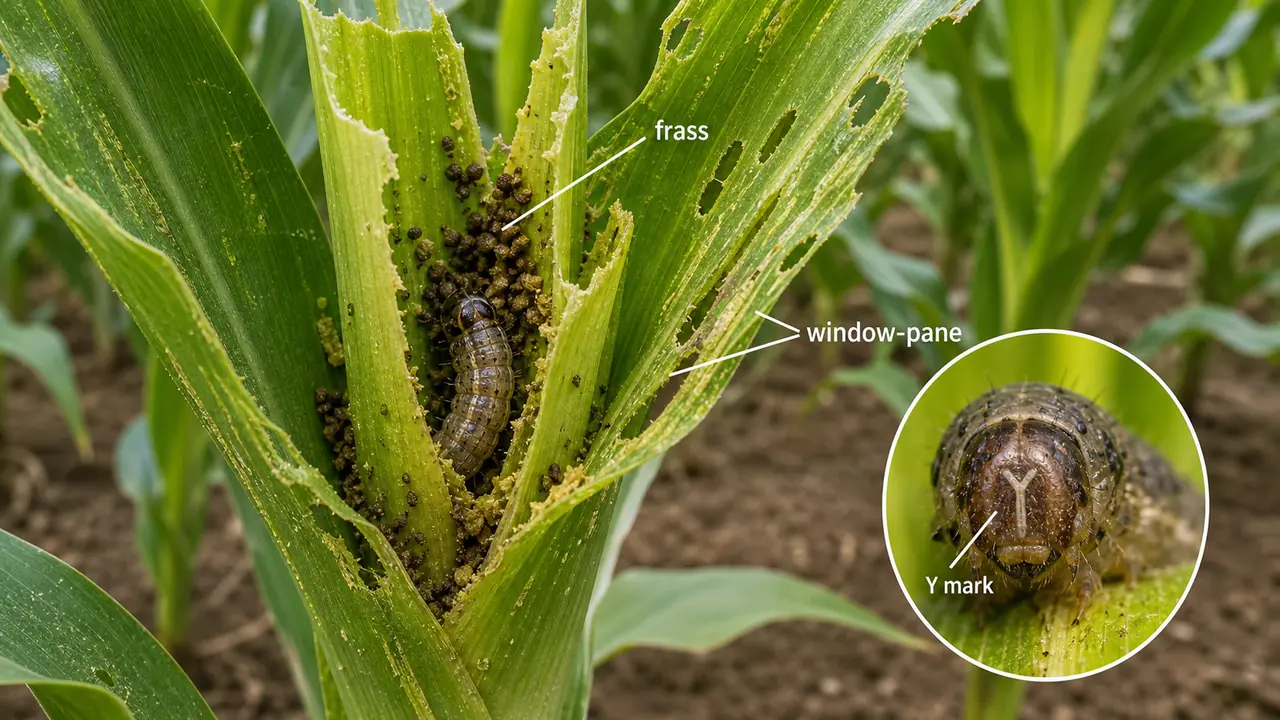
In May 2018, maize farmers in Karnataka's Shivamogga district reported something they had never seen before: their maize whorls were being shredded by voracious caterpillars that left behind copious frass (faecal pellets) and characteristic ragged leaves. This was India's first encounter with the Fall Armyworm (Spodoptera frugiperda) — an invasive pest from the Americas that has since spread to every maize-growing state. But the Fall Armyworm joined an already formidable lineup of maize enemies. The stem borer (Chilo partellus) remains the most destructive, while the corn earworm (Helicoverpa armigera) attacks the valuable cobs. Understanding the complete maize pest complex is essential for field-level management and competitive examinations.
Maize Pest Complex at a Glance
Maize Pests — Quick Reference Table
Major Pests
| S.No. | Pest | Scientific Name | Family | Order | Key Damage |
|---|---|---|---|---|---|
| 1 | Maize Shoot Fly | Atherigona orientalis | Muscidae | Diptera | Dead heart |
| 2 | Stem Borer | Chilo partellus | Crambidae | Lepidoptera | Dead heart + shot hole |
| 3 | Pink Stem Borer | Sesamia inferens | Noctuidae | Lepidoptera | Dead heart |
| 4 | Corn Earworm | Helicoverpa armigera | Noctuidae | Lepidoptera | Cob grain damage |
| 5 | Fall Armyworm | Spodoptera frugiperda | Noctuidae | Lepidoptera | Whorl defoliation |
| 6 | Aphid | Rhopalosiphum maidis | Aphididae | Hemiptera | Sooty mould; virus vector |
| 7 | Web Worm | Cryptoblabes gnidiella | Pyraustidae | Lepidoptera | Webbed tassels |
| 8 | Shoot Bug | Peregrinus maidis | Delphacidae | Hemiptera | Sap sucking; sooty mould |
Minor Pests
| S.No. | Pest | Scientific Name | Family | Order |
|---|---|---|---|---|
| 9 | Climbing Cut Worm | Mythimna separata | Noctuidae | Lepidoptera |
| 10 | Ash Weevil | Myllocerus sp. | Curculionidae | Coleoptera |
| 11 | Phadka Grasshopper | Hieroglyphus nigrorepletus | Acrididae | Orthoptera |
| 12 | Leafhopper | Pyrilla perpusilla | Lophopidae | Hemiptera |
Pest Damage by Crop Stage
| Crop Stage | Pests Active | Primary Damage |
|---|---|---|
| Seedling (1-3 weeks) | Shoot fly, Cut worm | Dead heart; seedling cut at base |
| Vegetative/Whorl (3-8 weeks) | Stem borer, Pink stem borer, FAW | Dead heart; shot hole; whorl damage |
| Tasselling/Silking | Web worm, Aphid, Shoot bug | Webbed tassels; sap sucking |
| Cob filling | Corn earworm, FAW | Grain feeding inside cob |
1. Stem Borer — Chilo partellus (The Most Destructive)
Family: Crambidae | Order: Lepidoptera
Pro Content Locked
Upgrade to Pro to access this lesson and all other premium content.
Charged once for one year · ₹1188 total
Save ₹100/month vs ₹2388/year launch price
- All Agriculture & Banking Courses
- AI Lesson Questions (100/day)
- AI Doubt Solver (50/day)
- Glows & Grows Feedback (30/day)
- AI Section Quiz (20/day)
- 22-Language Translation (100/day)
- Recall Questions (20/day)
- AI Quiz (15/day)
- AI Quiz Paper Analysis (100/day)
- AI Step-by-Step Explanations (100/day)
- Spaced Repetition Recall (FSRS)
- AI Tutor
- Immersive Text Questions
- Audio Lessons — Hindi & English
- Mock Tests & Previous Year Papers
- Summary & Mind Maps
- XP, Levels, Leaderboard & Badges
- Generate New Classrooms
- Voice AI Teacher (AgriDots Live)
- AI Revision Assistant
- Knowledge Gap Analysis
- Interactive Revision (LangGraph)
🔒 Secure one-time yearly payment via Razorpay · No hidden fees
In May 2018, maize farmers in Karnataka's Shivamogga district reported something they had never seen before: their maize whorls were being shredded by voracious caterpillars that left behind copious frass (faecal pellets) and characteristic ragged leaves. This was India's first encounter with the Fall Armyworm (Spodoptera frugiperda) — an invasive pest from the Americas that has since spread to every maize-growing state. But the Fall Armyworm joined an already formidable lineup of maize enemies. The stem borer (Chilo partellus) remains the most destructive, while the corn earworm (Helicoverpa armigera) attacks the valuable cobs. Understanding the complete maize pest complex is essential for field-level management and competitive examinations.
Maize Pest Complex at a Glance
Maize Pests — Quick Reference Table
Major Pests
| S.No. | Pest | Scientific Name | Family | Order | Key Damage |
|---|---|---|---|---|---|
| 1 | Maize Shoot Fly | Atherigona orientalis | Muscidae | Diptera | Dead heart |
| 2 | Stem Borer | Chilo partellus | Crambidae | Lepidoptera | Dead heart + shot hole |
| 3 | Pink Stem Borer | Sesamia inferens | Noctuidae | Lepidoptera | Dead heart |
| 4 | Corn Earworm | Helicoverpa armigera | Noctuidae | Lepidoptera | Cob grain damage |
| 5 | Fall Armyworm | Spodoptera frugiperda | Noctuidae | Lepidoptera | Whorl defoliation |
| 6 | Aphid | Rhopalosiphum maidis | Aphididae | Hemiptera | Sooty mould; virus vector |
| 7 | Web Worm | Cryptoblabes gnidiella | Pyraustidae | Lepidoptera | Webbed tassels |
| 8 | Shoot Bug | Peregrinus maidis | Delphacidae | Hemiptera | Sap sucking; sooty mould |
Minor Pests
| S.No. | Pest | Scientific Name | Family | Order |
|---|---|---|---|---|
| 9 | Climbing Cut Worm | Mythimna separata | Noctuidae | Lepidoptera |
| 10 | Ash Weevil | Myllocerus sp. | Curculionidae | Coleoptera |
| 11 | Phadka Grasshopper | Hieroglyphus nigrorepletus | Acrididae | Orthoptera |
| 12 | Leafhopper | Pyrilla perpusilla | Lophopidae | Hemiptera |
Pest Damage by Crop Stage
| Crop Stage | Pests Active | Primary Damage |
|---|---|---|
| Seedling (1-3 weeks) | Shoot fly, Cut worm | Dead heart; seedling cut at base |
| Vegetative/Whorl (3-8 weeks) | Stem borer, Pink stem borer, FAW | Dead heart; shot hole; whorl damage |
| Tasselling/Silking | Web worm, Aphid, Shoot bug | Webbed tassels; sap sucking |
| Cob filling | Corn earworm, FAW | Grain feeding inside cob |
1. Stem Borer — Chilo partellus (The Most Destructive)
Family: Crambidae | Order: Lepidoptera
Host range: Jowar, bajra, sugarcane, and rice
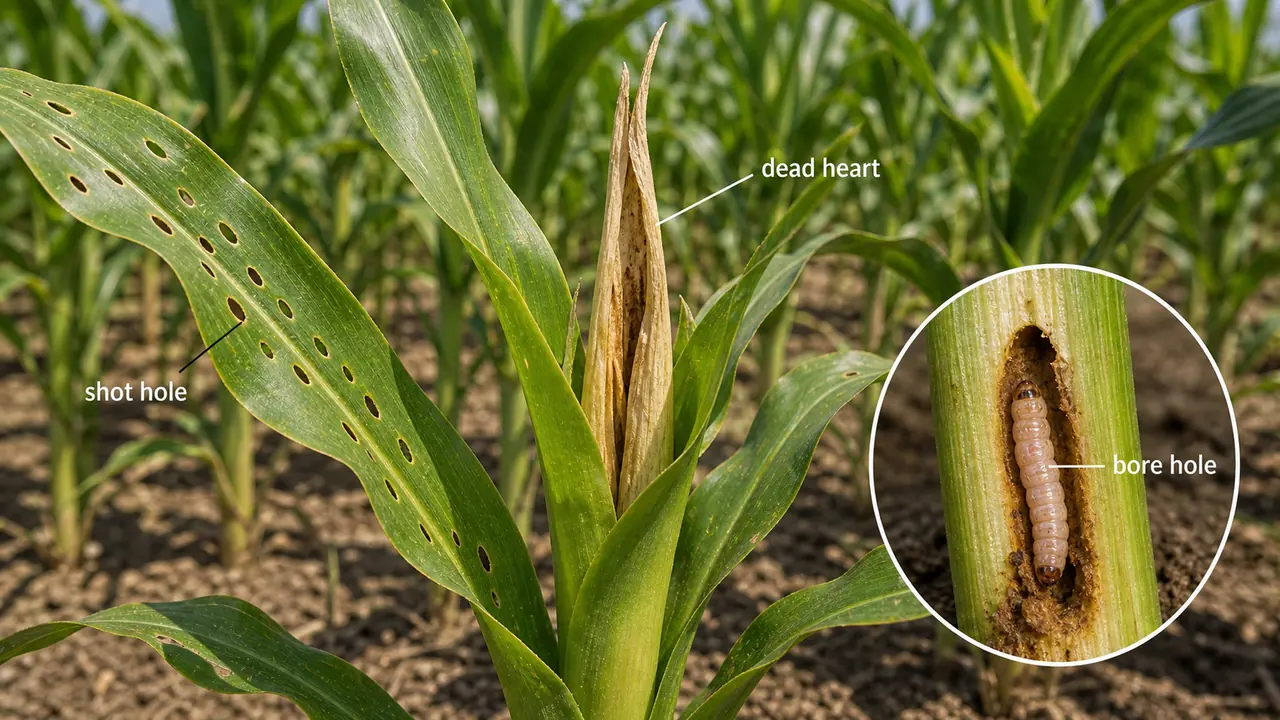
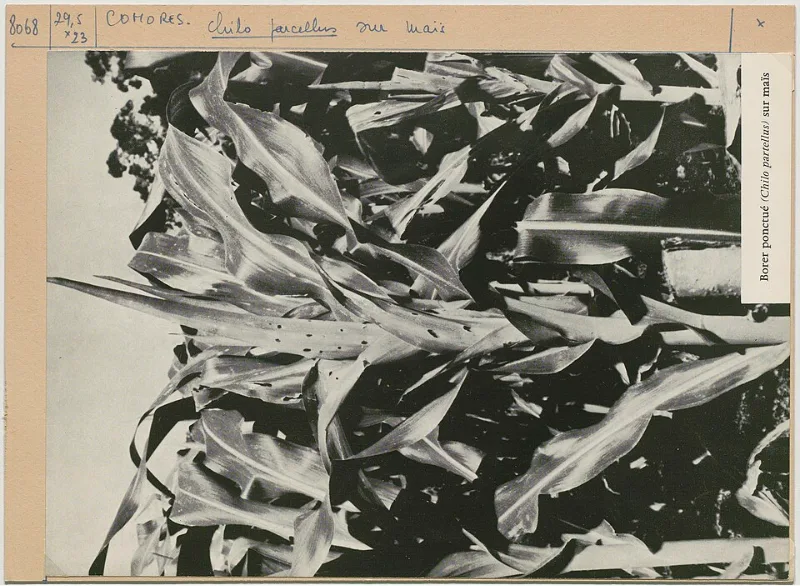
The stem borer is the single most destructive pest of maize. It attacks from about one month after sowing until cob emergence.
Damage Symptoms
- Central shoot withering leading to "dead heart" is the classic symptom
- Bore holes are visible on the stem near the nodes
- Young larvae crawl and feed on tender folded leaves, causing typical "shot hole/pin hole" symptom — when the folded leaf unfolds, a neat row of holes appears
- Internally, tunnelling caterpillars damage the vascular system
- Larvae hibernate in maize stubbles between seasons
- Damage period: one month after sowing until cob emergence
IMPORTANT
Chilo partellus is the most destructive pest of maize. It causes both "dead heart" in young plants and "shot hole/pin hole" symptoms on folded leaves. This dual symptom is the key identifier.
Agricultural context: In the maize belt of Bihar and Jharkhand, farmers who plough in or destroy maize stubbles after harvest significantly reduce stem borer carry-over. Stubble management is the first and cheapest line of defence.
2. Maize Shoot Fly — Atherigona orientalis
Family: Muscidae | Order: Diptera
Host range: Maize, sorghum, ragi, and bajra
Damage Symptoms
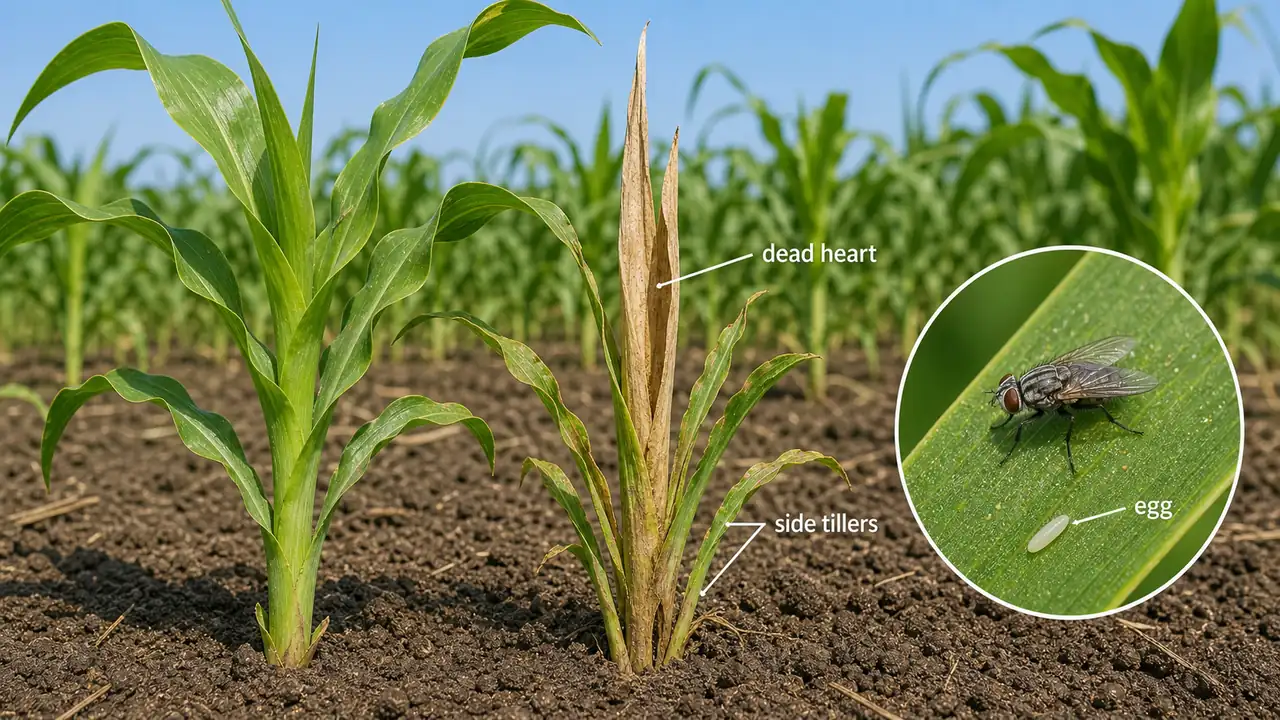
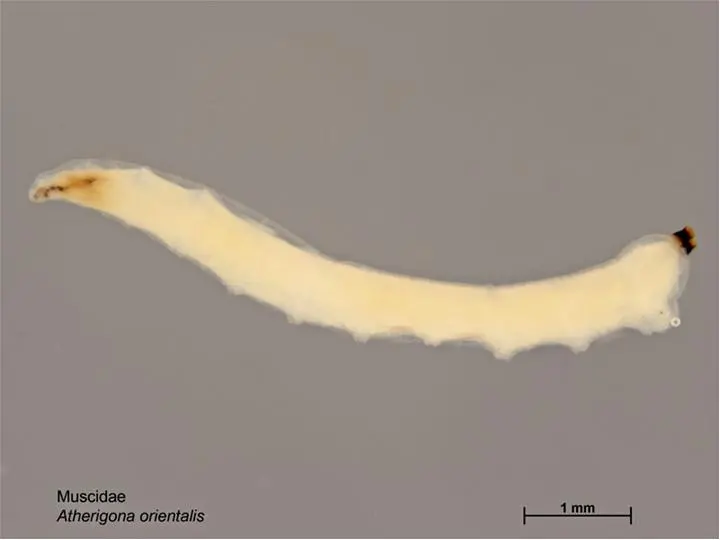
- The maggot feeds on the young growing shoots, resulting in "dead hearts"
- Similar to sorghum and pearl millet shoot fly damage, but caused by a different species
IMPORTANT
Shoot fly species by crop — a frequently tested distinction:
| Crop | Species | Memory Aid |
|---|---|---|
| Sorghum | A. soccata | Sorghum = Soccata |
| Maize | A. orientalis | Maize = Orientalis |
| Pearl millet | A. approximata | Pearl millet = aPProximata |
All belong to genus Atherigona (Muscidae, Diptera), but the species differs by crop.
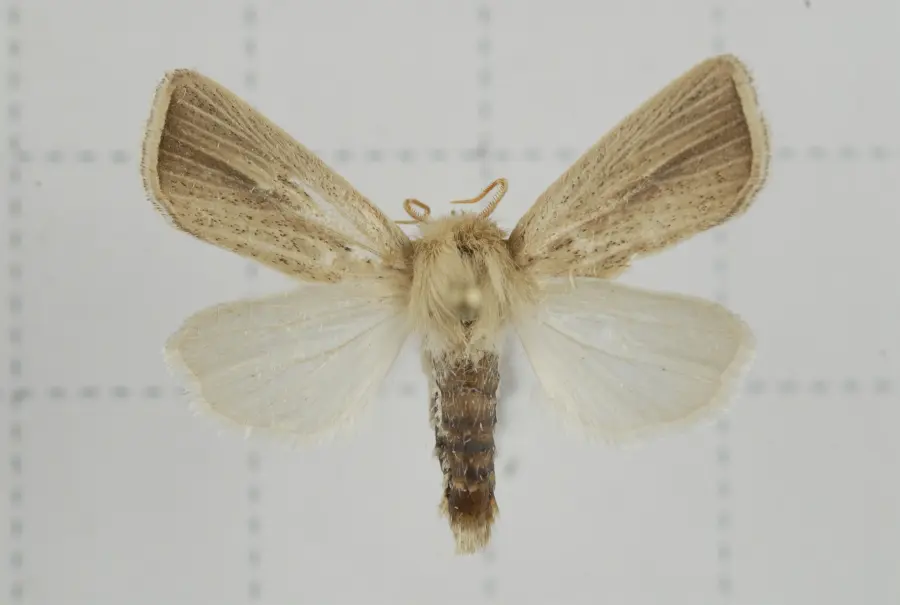
3. Pink Stem Borer — Sesamia inferens
Family: Noctuidae | Order: Lepidoptera
Host range: Sorghum, maize, rice, wheat, sugarcane, bajra, ragi, and guinea grass — the most polyphagous stem borer.
Damage Symptoms
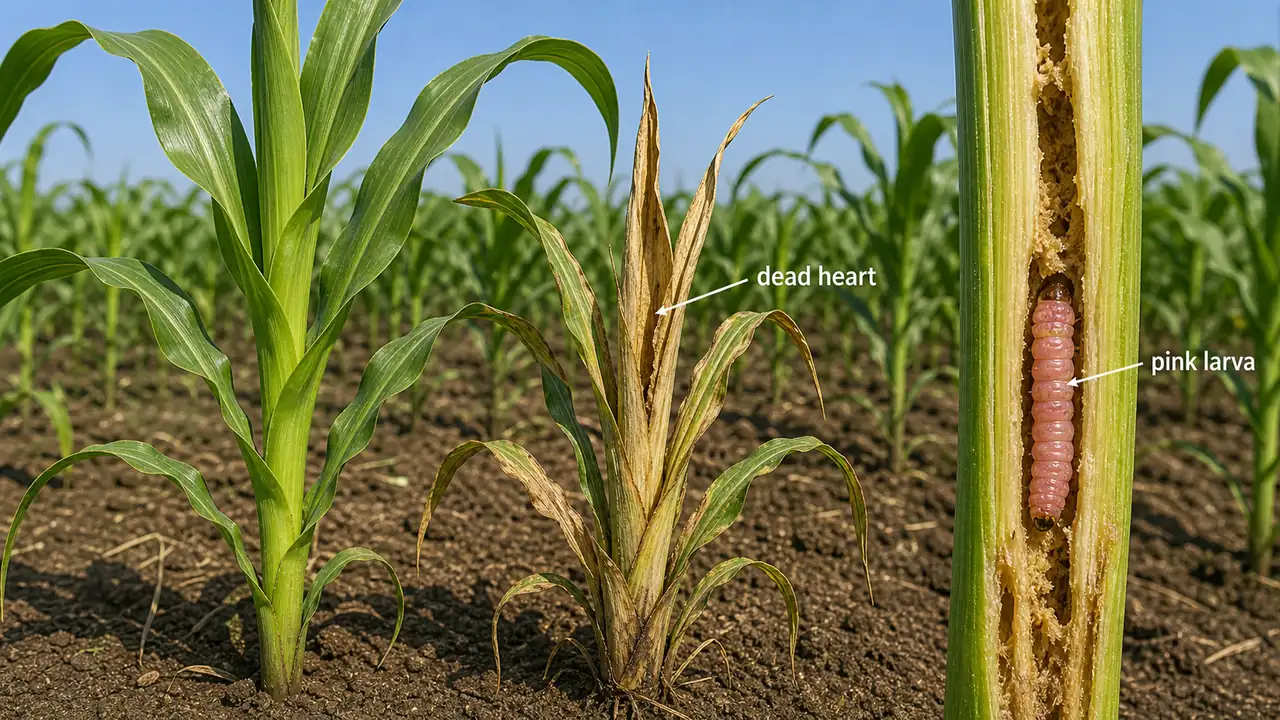
- Pink larva enters the stem causing dead heart symptom similar to that of stem borer
- Distinguished from Chilo partellus by the distinctly pink body colour of the larva
Management
- Clipping of lower leaves (removes eggs)
- Burning/composting of stubbles
- Intercropping with soybean (creates unfavourable microclimate for borers)
Comparing the Three "Dead Heart" Pests of Maize
| Feature | Stem Borer | Shoot Fly | Pink Stem Borer |
|---|---|---|---|
| Scientific name | Chilo partellus | Atherigona orientalis | Sesamia inferens |
| Order | Lepidoptera | Diptera | Lepidoptera |
| Damaging stage | Cream caterpillar | Maggot | Pink caterpillar |
| Additional symptoms | Shot hole on leaves | Side tillers | None specific |
| Destructiveness | Most destructive | Important at seedling | Moderate |
| Attack timing | 1 month onwards | Seedling stage | Variable |
| Hibernation | In stubbles | — | — |
4. Corn Earworm / Cob Borer — Helicoverpa armigera
Family: Noctuidae | Order: Lepidoptera
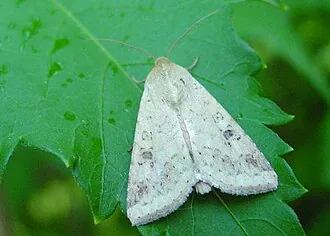
Helicoverpa armigera is one of the most polyphagous pests in Indian agriculture. In maize, it specifically targets the valuable cobs.
Damage Symptoms
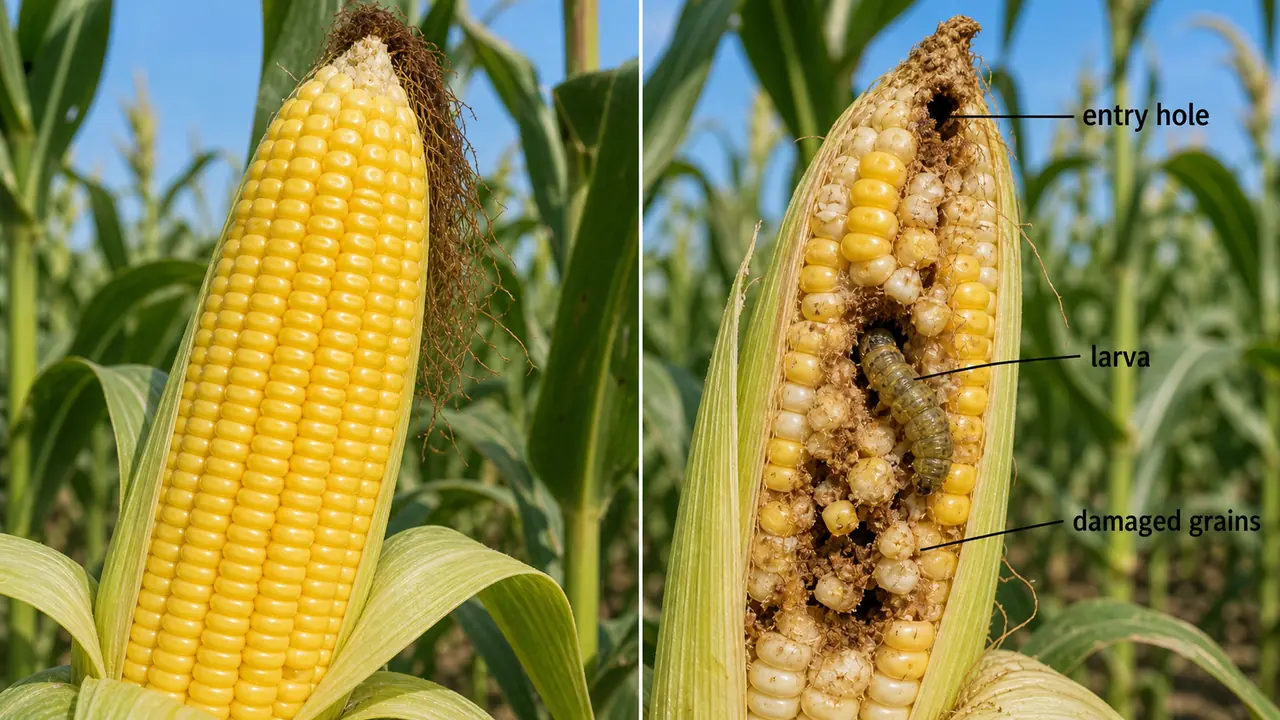
- Larvae feed on the developing grains inside the cob
- Entry holes visible at the tip or side of the cob
- Can cause significant yield losses, especially in sweet corn and baby corn
- The same pest attacks cotton (as American bollworm), gram (as pod borer), and tomato (as fruit borer)
TIP
Helicoverpa armigera has three common names based on the crop it attacks:
- In maize → Corn earworm / Cob borer
- In cotton → American bollworm
- In gram/pulses → Gram pod borer
- In tomato → Tomato fruit borer
It is the single most polyphagous pest in Indian agriculture and the most frequently asked pest in exams.
Agricultural context: Damage is more severe where maize follows cotton — the Helicoverpa population carries over from the cotton crop. Crop rotation with non-host crops breaks this cycle.
5. Fall Armyworm (FAW) — Spodoptera frugiperda
Family: Noctuidae | Order: Lepidoptera
IMPORTANT
Fall Armyworm (FAW) is an invasive pest first reported in India in 2018 (Karnataka). It has since become one of the most serious threats to maize production nationwide.
Origin: Native to tropical and subtropical Americas
Host range: Maize (preferred host), sorghum, rice, sugarcane, and over 350 plant species
Damage Symptoms
- Larvae feed voraciously on whorl leaves, causing extensive defoliation
- Characteristic window-pane feeding — larvae eat one leaf surface, leaving the other intact like a translucent window
- Ragged, torn leaves with large quantities of frass (faecal pellets) visible in the whorl
- Can bore into cobs and feed on developing grains
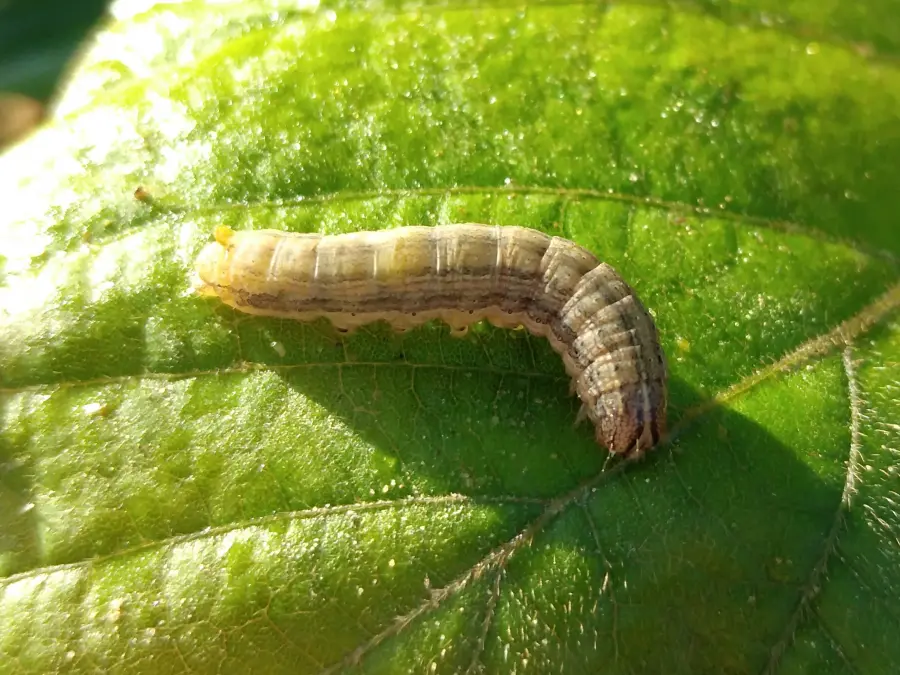
- Diagnostic feature: Inverted "Y" mark on the head capsule of the larva — the single most reliable identification characteristic
Management
- Early detection through pheromone traps (lures specific to FAW)
- Apply Bacillus thuringiensis (Bt) or Metarhizium rileyi (entomopathogenic fungus)
- Release Trichogramma pretiosum as egg parasitoid
- Spray Emamectin benzoate 5 SG or Chlorantraniliprole 18.5 SC
- Intercropping with legumes as push-pull strategy (legumes "push" FAW away; Napier grass borders "pull" it)
TIP
FAW identification mnemonic: "Fall armyworm has an inverted Y on its Face." The inverted Y on the head capsule is the key field identification feature. Also remember: 2018, Karnataka = first report in India.
Agricultural context: The push-pull technology developed by ICIPE (International Centre of Insect Physiology and Ecology) in Africa has been adapted for Indian conditions. Maize is intercropped with desmodium (push crop) and bordered by Napier grass (pull crop). This strategy reduces FAW damage by 60-80% without chemicals.
6. Aphid — Rhopalosiphum maidis
Family: Aphididae | Order: Hemiptera
Distribution: All sorghum and maize-growing areas worldwide
Host range: Sorghum, maize, ragi
Damage Symptoms
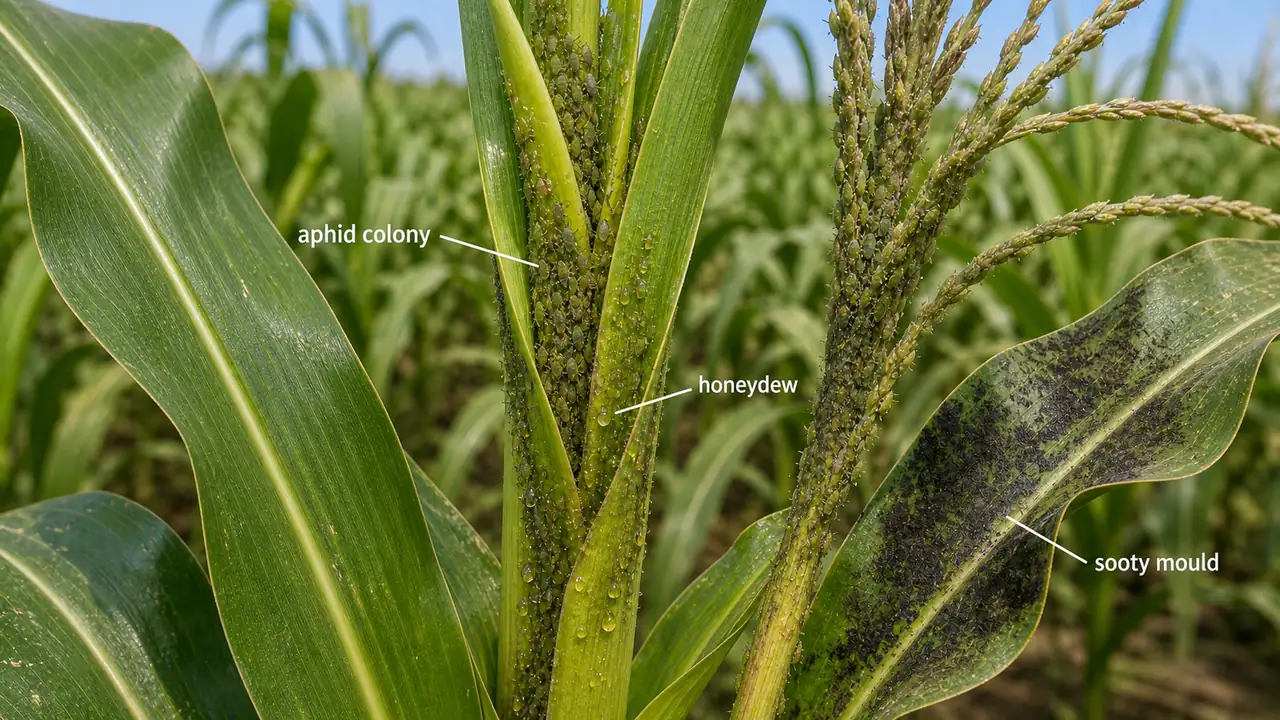
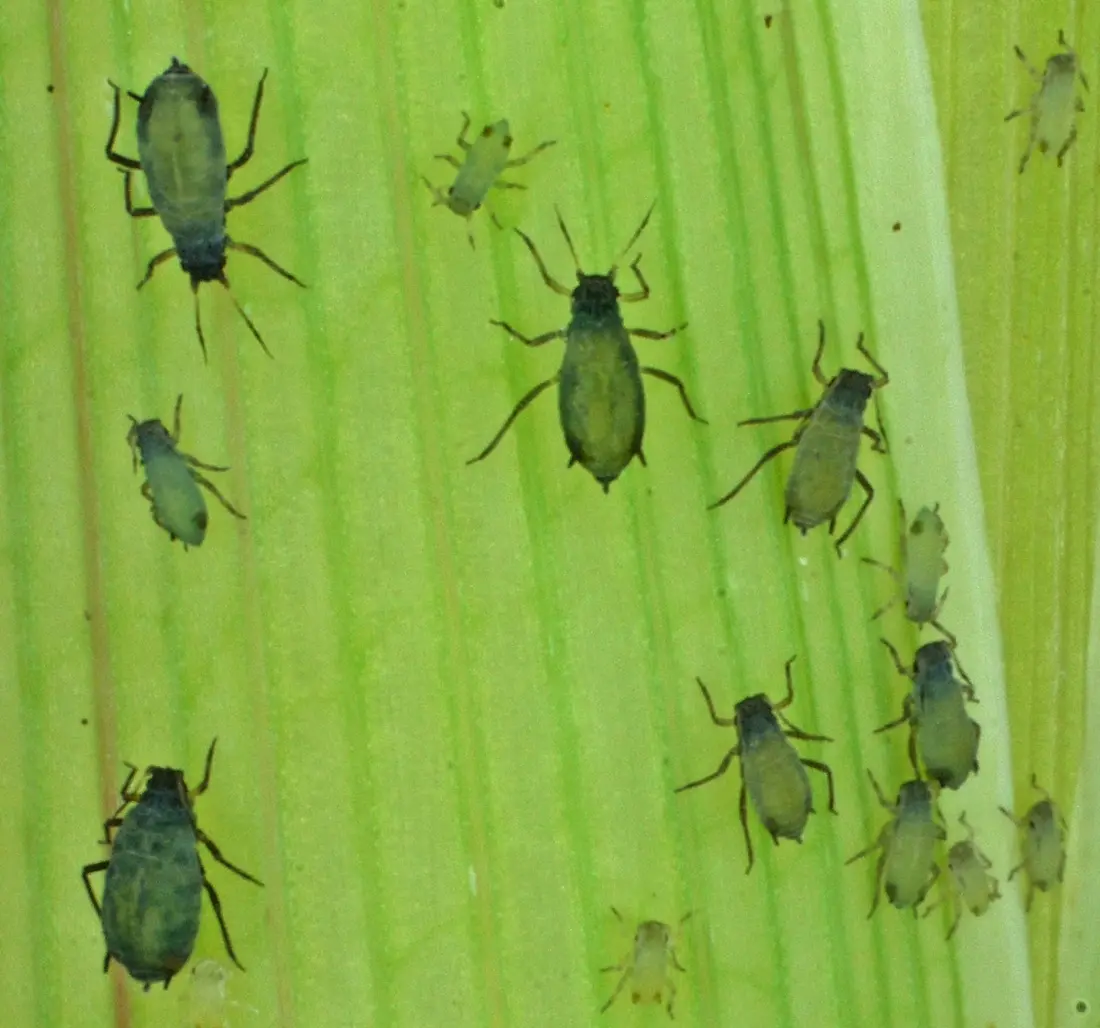
- Colonies form in central leaf whorl, on stems, or in panicles/tassels
- Nymphs and adults suck plant sap causing yellowish mottling of leaves and marginal leaf necrosis
- Produce abundant honeydew on which sooty mould grows (black coating on leaves)
- In panicles/tassels, honeydew may hinder harvesting
- Vector of maize dwarf mosaic virus — the virus transmission role is often more damaging than direct feeding
7. Web Worm — Cryptoblabes gnidiella
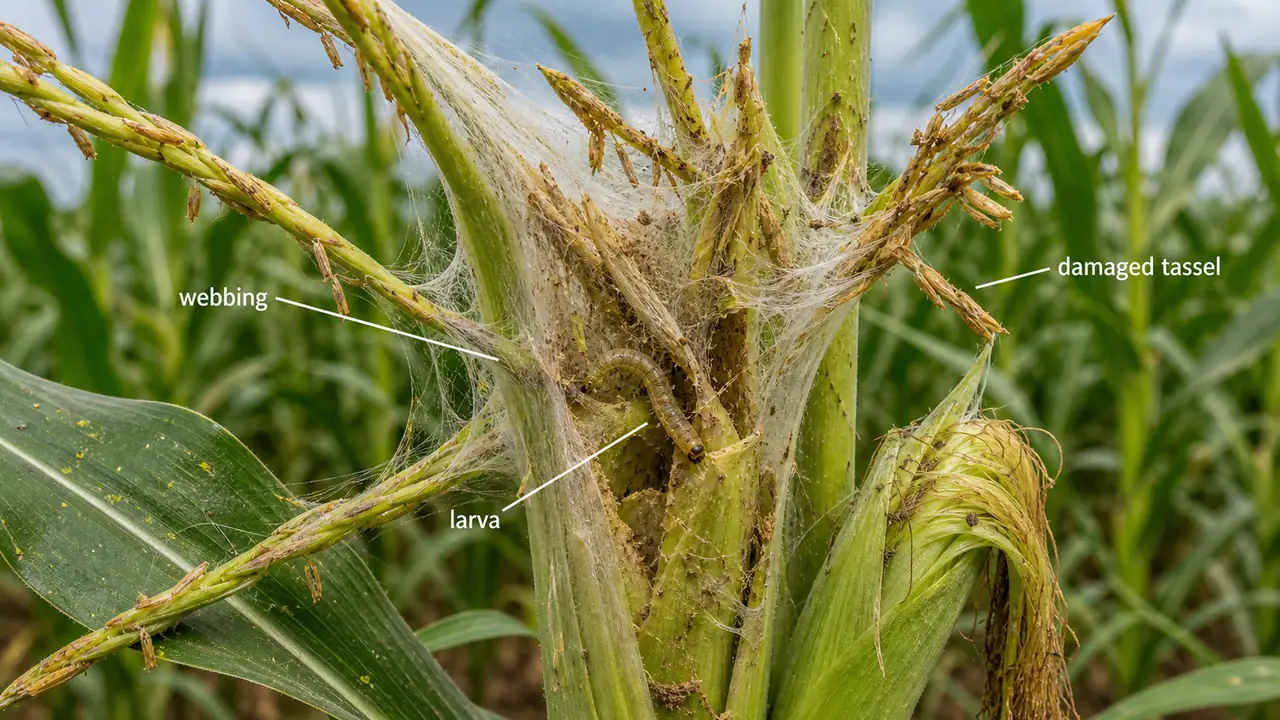
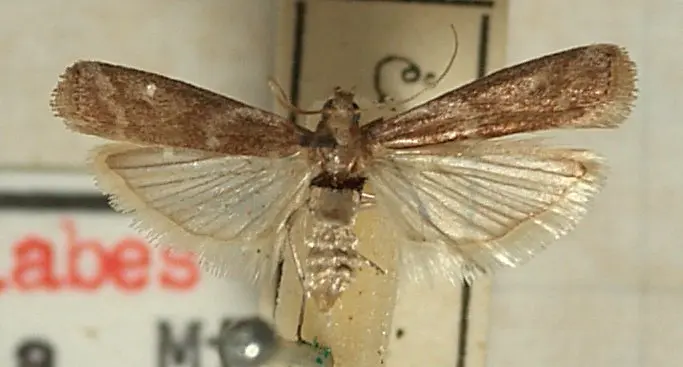
Family: Pyraustidae | Order: Lepidoptera
Damage Symptoms
- Larvae web together leaves and feed within the webbed mass
- Damages developing tassels and ear shoots
- A secondary pest that becomes important in humid conditions
8. Shoot Bug — Peregrinus maidis
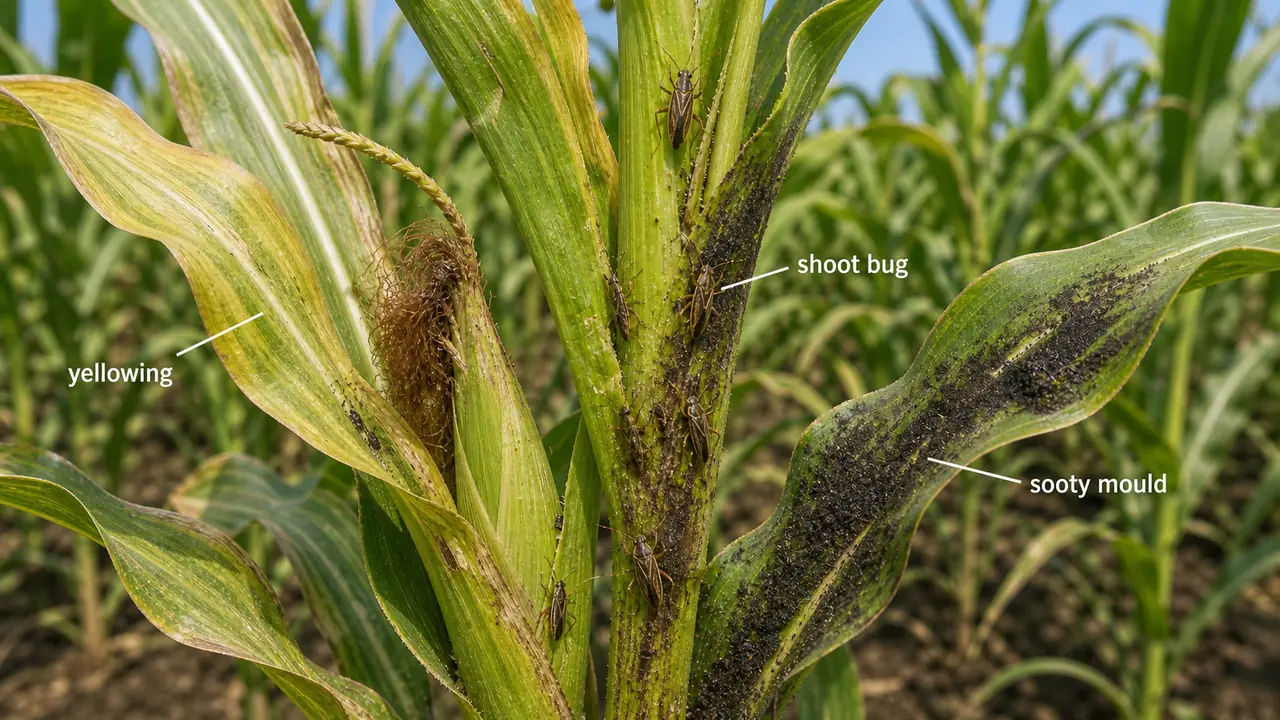
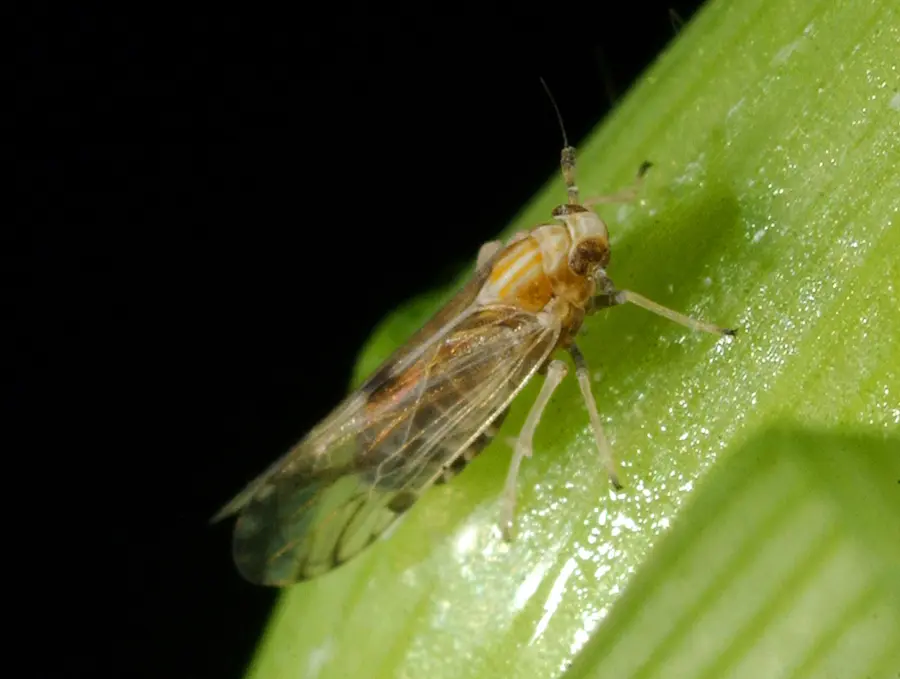
Family: Delphacidae | Order: Hemiptera
Host range: Sorghum, maize, rice, millets
Damage Symptoms
- Adults and nymphs suck sap causing stunted, yellowed plants
- Honeydew secretion leads to sooty mould development
- The same species that attacks sorghum — a shared pest of millets
Minor Pests of Maize
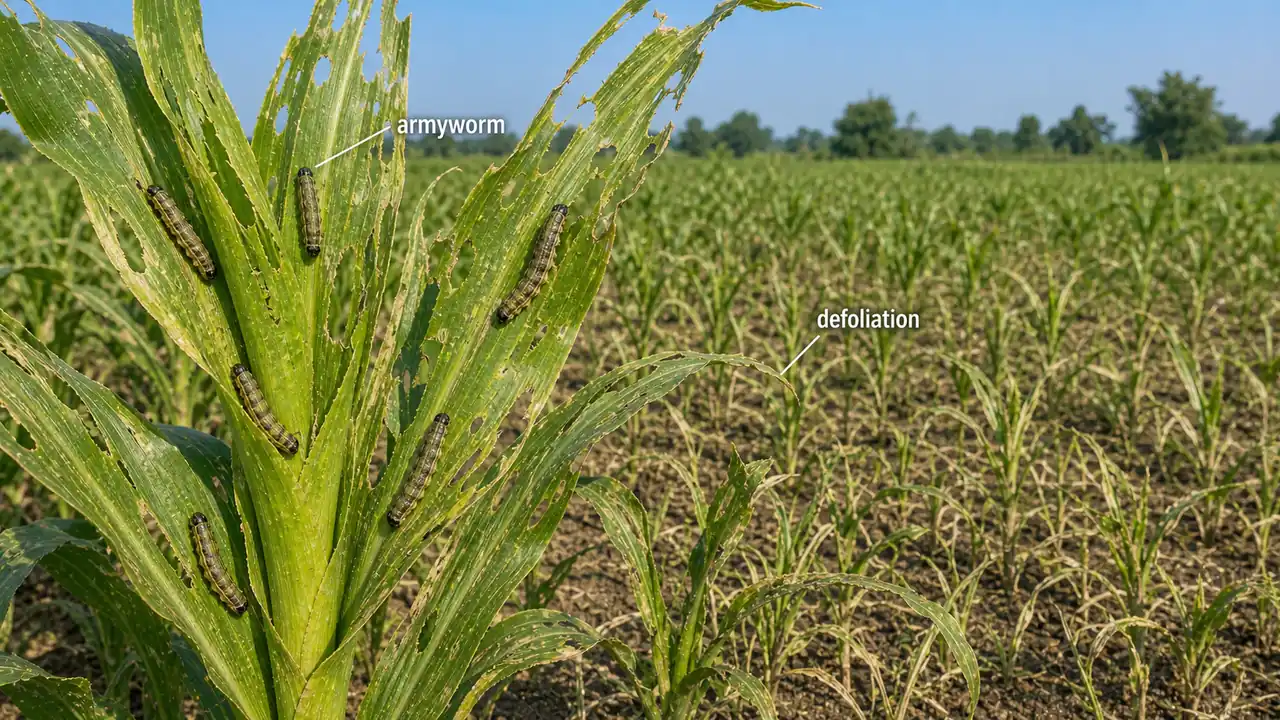
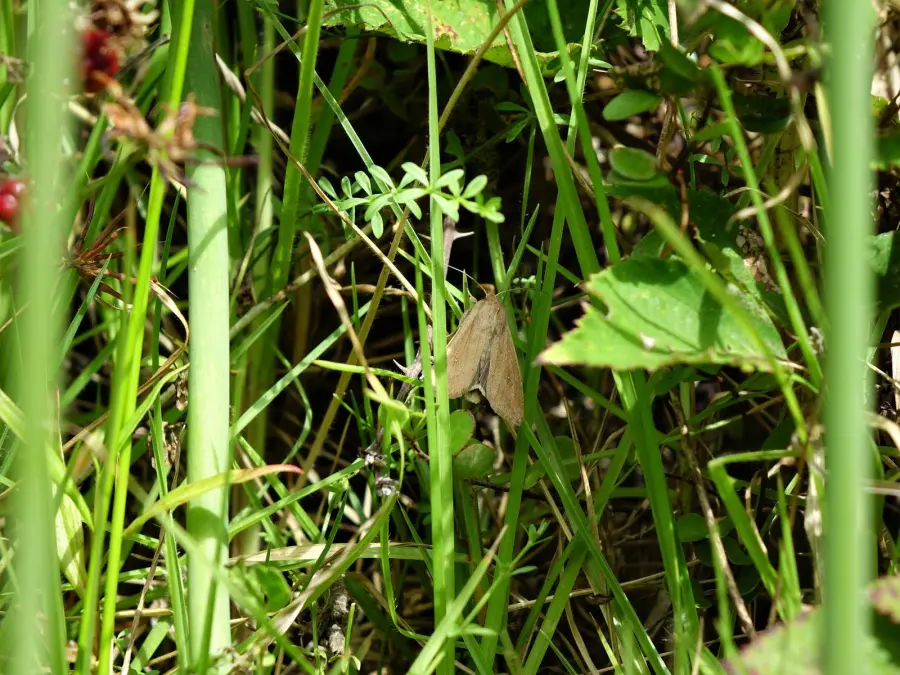
9. Climbing Cut Worm / Armyworm — Mythimna separata
Family: Noctuidae | Order: Lepidoptera
- Larvae feed voraciously on leaves, causing complete defoliation
- In severe cases, fields look as if grazed by cattle — a classic exam description
- Larvae can migrate in army-like bands from one field to another (hence "armyworm")
- A sporadic pest that becomes serious in certain years
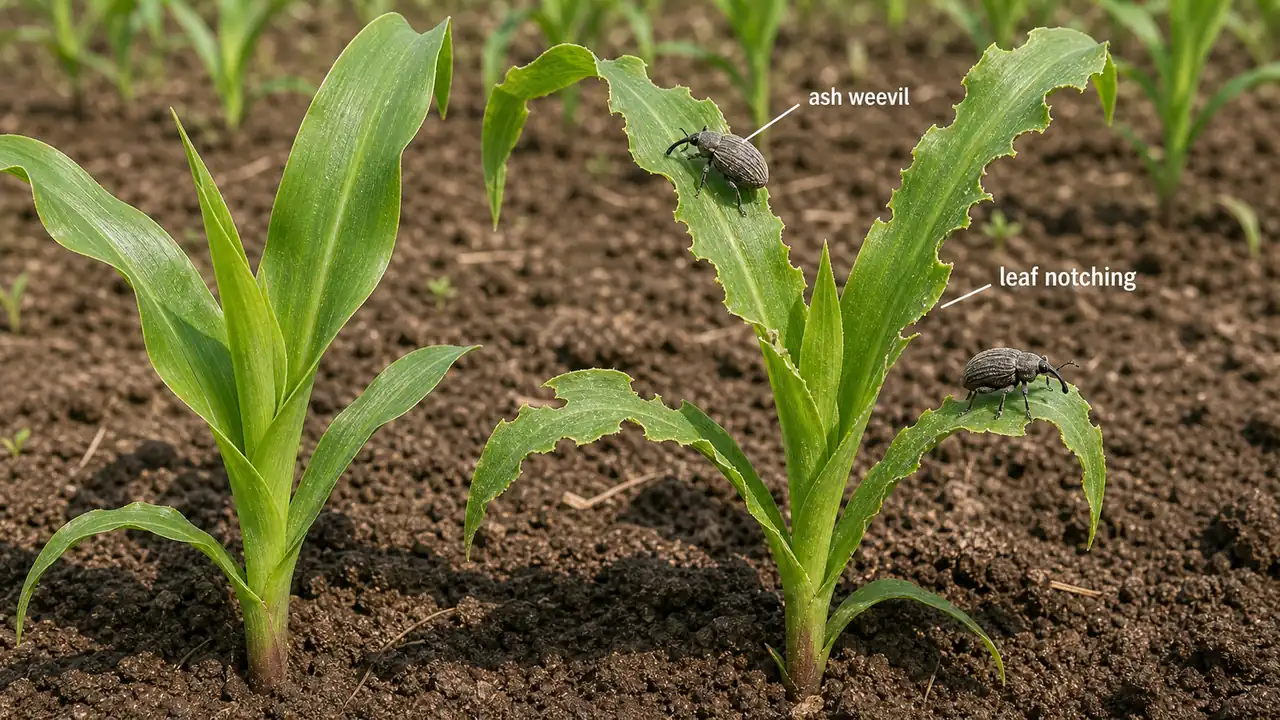
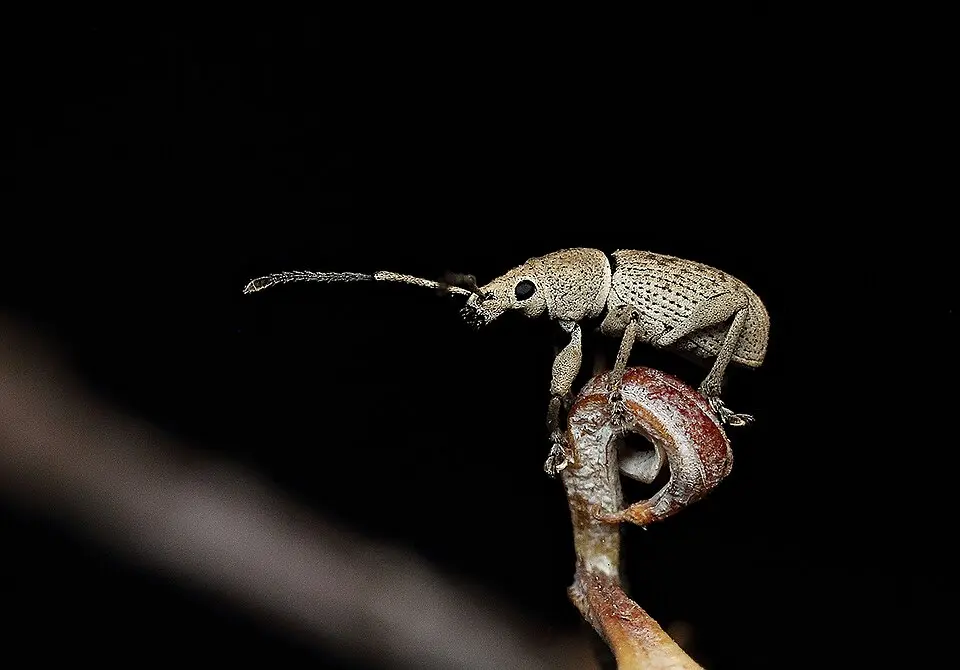
10. Ash Weevil — Myllocerus sp.
Family: Curculionidae | Order: Coleoptera
- Adults feed on leaf margins causing irregular notching
- Can be damaging to young seedlings
11. Phadka Grasshopper — Hieroglyphus nigrorepletus
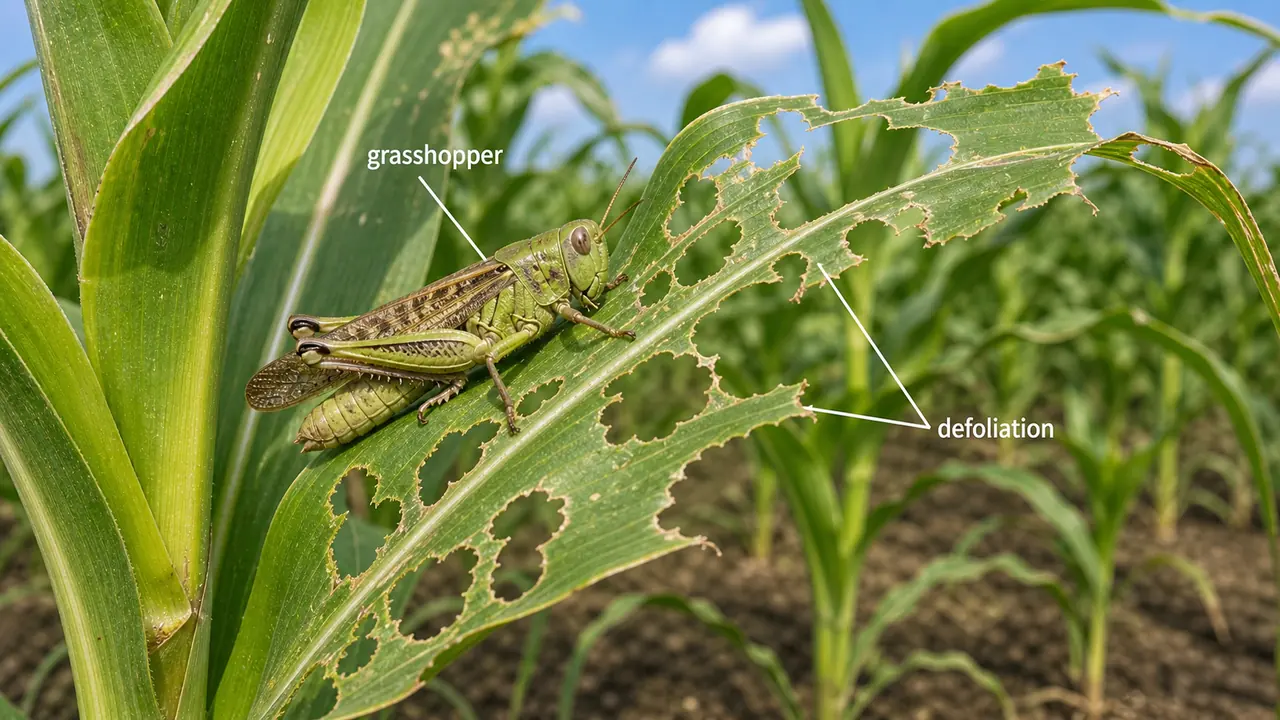
Family: Acrididae | Order: Orthoptera
- Feeds on leaves causing defoliation
- Can cause severe damage during outbreak years
- A sporadic pest
12. Leafhopper — Pyrilla perpusilla
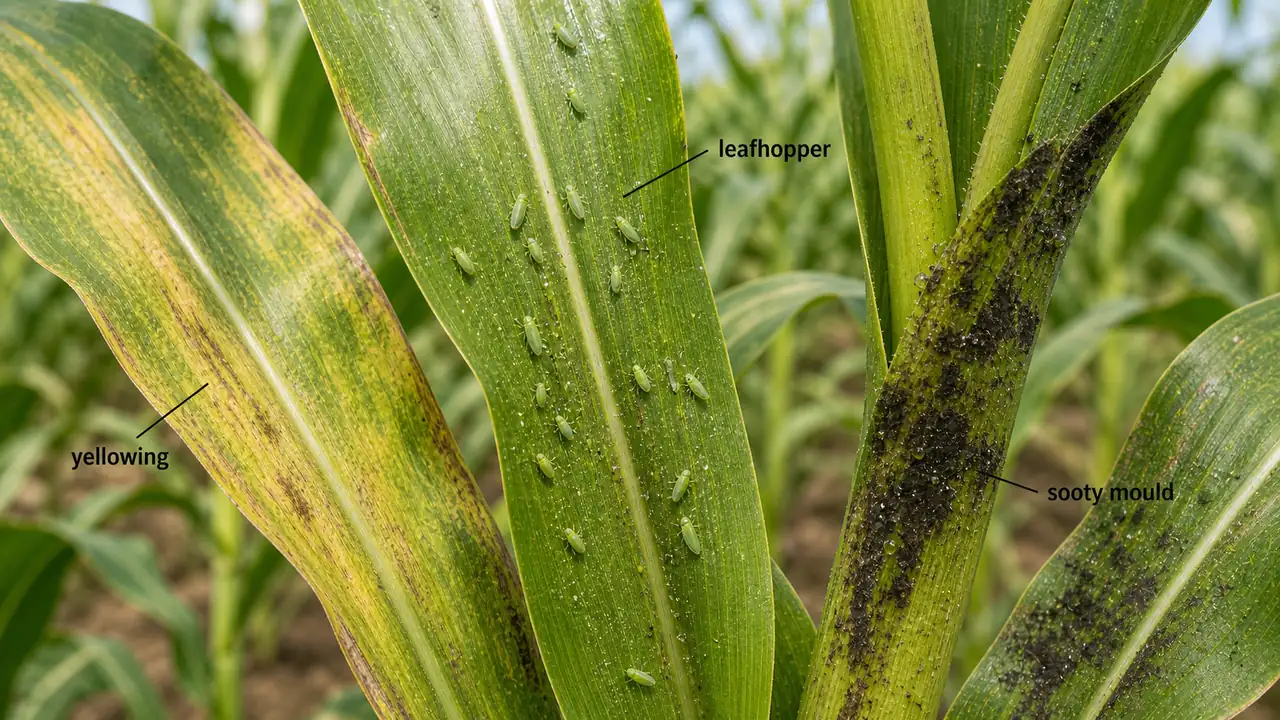
Family: Lophopidae | Order: Hemiptera
- Sucks sap from leaves causing yellowing
- Honeydew secretion and sooty mould development
- Also a major pest of sugarcane (sugarcane pyrilla)
Field Diagnosis: Maize — Where's the Damage?
Step 1: Check the plant part affected
Whorl/leaves damaged?
- Ragged, irregular holes in whorl leaves + wet frass? → Fall Armyworm (S. frugiperda) — invasive pest since 2018; multiple larvae per plant; feeds deep inside whorl
- Shot holes in unfolded leaves + dead heart? → Stem Borer (C. partellus) — most common; bore into stem after initial leaf feeding
Cob/grain damaged?
- Entry holes at cob tip or side, grains eaten? → Corn Earworm (H. armigera) — same pest as cotton bollworm and gram pod borer
- Webbing on cob surface? → Web Worm (C. gnidiella)
Whole plant symptoms?
- Colonies of small insects on tassels/leaves, sticky honeydew? → Aphid (R. maidis) — check for sooty mold
- Shoots damaged, honeydew? → Shoot Bug (P. maidis)
- Dead heart with pink larva? → Pink Stem Borer (S. inferens) — polyphagous, also attacks rice/sugarcane
Key distinction: Fall Armyworm (FAW) vs Stem Borer — FAW causes ragged holes with wet frass in whorl, stem borer causes clean shot holes + stem boring. FAW larvae have an inverted Y-mark on the head.
Exam Tips and Mnemonics
TIP
"SPEC-FAW" — The Key Maize Pests:
- Stem borer (C. partellus) — Most destructive; dead heart + shot hole
- Pink stem borer (S. inferens) — Pink larva; polyphagous
- Earworm (H. armigera) — Polyphagous; feeds on cob grains
- Corn shoot fly (A. orientalis) — Dead heart at seedling stage
- FAW (S. frugiperda) — Invasive (2018); inverted "Y" mark
Key numbers:
- 2018 = FAW first reported in India (Karnataka)
- 350+ = plant species FAW can attack
- 3 = common names for H. armigera (earworm, bollworm, pod borer)
Cross-crop stem borer fact: Chilo partellus is the most destructive pest of BOTH sorghum AND maize. Same species, same symptoms.
Summary Table: Maize Pests at a Glance
| Fact | Answer |
|---|---|
| Most destructive pest of maize | Stem borer (Chilo partellus) |
| Stem borer symptoms (two) | Dead heart + shot hole (pin hole) |
| Maize shoot fly species | Atherigona orientalis |
| Most polyphagous pest on maize | Helicoverpa armigera (Corn earworm) |
| FAW first reported in India | 2018, Karnataka |
| FAW diagnostic larval feature | Inverted "Y" mark on head capsule |
| FAW management — biocontrol | Trichogramma pretiosum, Bt, Metarhizium rileyi |
| Aphid transmits | Maize dwarf mosaic virus |
| Field looks "grazed by cattle" | Armyworm (Mythimna separata) |
| Shoot bug causes | Sooty mould from honeydew |
| Pink stem borer — most polyphagous borer | Sesamia inferens |
| Push-pull strategy for FAW | Desmodium (push) + Napier grass (pull) |
Summary Cheat Sheet
| Concept / Topic | Key Details |
|---|---|
| Most destructive pest of maize | Stem borer (Chilo partellus) — Crambidae, Lepidoptera |
| Stem borer symptoms | Dead heart + shot hole/pin hole on folded leaves |
| Stem borer hibernation | Larvae hibernate in maize stubbles |
| Maize shoot fly | Atherigona orientalis (Muscidae, Diptera) — dead heart at seedling |
| Shoot fly species by crop | Sorghum = soccata, Maize = orientalis, Pearl millet = approximata |
| Pink stem borer | Sesamia inferens (Noctuidae) — most polyphagous stem borer; pink larva |
| Corn earworm | Helicoverpa armigera — feeds on cob grains; most polyphagous pest |
| H. armigera common names | Corn earworm, American bollworm (cotton), Gram pod borer, Tomato fruit borer |
| Fall Armyworm (FAW) | Spodoptera frugiperda; invasive from Americas; first India report 2018, Karnataka |
| FAW diagnostic feature | Inverted "Y" mark on larval head capsule |
| FAW damage | Whorl defoliation; window-pane feeding; copious frass |
| FAW host range | Maize preferred; attacks 350+ plant species |
| FAW biocontrol | Trichogramma pretiosum, Bt, Metarhizium rileyi |
| Push-pull strategy | Desmodium (push) + Napier grass (pull); reduces FAW 60-80% |
| Aphid (R. maidis) | Sooty mould; vector of maize dwarf mosaic virus |
| Shoot bug (Peregrinus maidis) | Sap sucking; sooty mould from honeydew |
| Armyworm (Mythimna separata) | Field looks "grazed by cattle"; migrates in army-like bands |
| Leafhopper (Pyrilla perpusilla) | Also major pest of sugarcane |
| Phadka grasshopper | Hieroglyphus nigrorepletus — sporadic pest |
TIP
Next: Wheat pests differ significantly from other cereals — the major enemies include armyworm, nematodes (Molya and ear-cockle), and termites rather than stem borers.