🛡️ Cotton IPM: Season-Wise Integrated Pest Management Strategy
Complete integrated pest management calendar for cotton — pre-sowing to harvest management, Bt cotton refuge strategy, biological control agents, resistant varieties, ETL values, and chemical control for IBPS AFO and ICAR exams.
The previous two lessons covered cotton's major enemies — bollworms (spotted, American, pink) and sucking pests (jassid, aphid, whitefly, thrips, stainers). Now we bring it all together into a single, season-wise Integrated Pest Management (IPM) strategy.
A cotton farmer in Telangana sprays insecticides six times in a season. Another farmer in the same district uses Bt cotton, releases Trichogramma wasps, monitors pest populations with pheromone traps, and sprays only once — when the ETL is crossed. At harvest, the second farmer gets comparable yields at one-third the input cost, with healthier soil and preserved natural enemies. This is IPM in action.
Cotton faces a complex of 15+ pests across its entire growth cycle — from sucking pests in the vegetative stage to bollworms in the reproductive stage and stainer bugs at harvest. No single control method works against all of them. IPM combines cultural practices, biological control, Bt cotton technology, and judicious chemical use in a systematic, season-wise approach.
Pro Content Locked
Upgrade to Pro to access this lesson and all other premium content.
Charged once for one year · ₹1188 total
Save ₹100/month vs ₹2388/year launch price
- All Agriculture & Banking Courses
- AI Lesson Questions (100/day)
- AI Doubt Solver (50/day)
- Glows & Grows Feedback (30/day)
- AI Section Quiz (20/day)
- 22-Language Translation (100/day)
- Recall Questions (20/day)
- AI Quiz (15/day)
- AI Quiz Paper Analysis (100/day)
- AI Step-by-Step Explanations (100/day)
- Spaced Repetition Recall (FSRS)
- AI Tutor
- Immersive Text Questions
- Audio Lessons — Hindi & English
- Mock Tests & Previous Year Papers
- Summary & Mind Maps
- XP, Levels, Leaderboard & Badges
- Generate New Classrooms
- Voice AI Teacher (AgriDots Live)
- AI Revision Assistant
- Knowledge Gap Analysis
- Interactive Revision (LangGraph)
🔒 Secure one-time yearly payment via Razorpay · No hidden fees
The previous two lessons covered cotton's major enemies — bollworms (spotted, American, pink) and sucking pests (jassid, aphid, whitefly, thrips, stainers). Now we bring it all together into a single, season-wise Integrated Pest Management (IPM) strategy.
A cotton farmer in Telangana sprays insecticides six times in a season. Another farmer in the same district uses Bt cotton, releases Trichogramma wasps, monitors pest populations with pheromone traps, and sprays only once — when the ETL is crossed. At harvest, the second farmer gets comparable yields at one-third the input cost, with healthier soil and preserved natural enemies. This is IPM in action.
Cotton faces a complex of 15+ pests across its entire growth cycle — from sucking pests in the vegetative stage to bollworms in the reproductive stage and stainer bugs at harvest. No single control method works against all of them. IPM combines cultural practices, biological control, Bt cotton technology, and judicious chemical use in a systematic, season-wise approach.
This lesson covers:
- Pre-sowing practices — deep ploughing, debris destruction, variety selection
- Vegetative stage — seed treatment, sucking pest monitoring, natural enemy conservation
- Reproductive stage — ETL-based intervention, Trichogramma release, Bt cotton
- Maturity stage — stainer bug monitoring, timely harvest, residue destruction
- Key reference tables — ETLs, biocontrol agents, resistant varieties, chemicals
The IPM Logic: Match the Method to the Growth Stage
The guiding principle of cotton IPM is simple: prevent early, monitor continuously, and intervene only when necessary. Each crop growth stage has different vulnerable parts and different dominant pests. The management strategy must match.
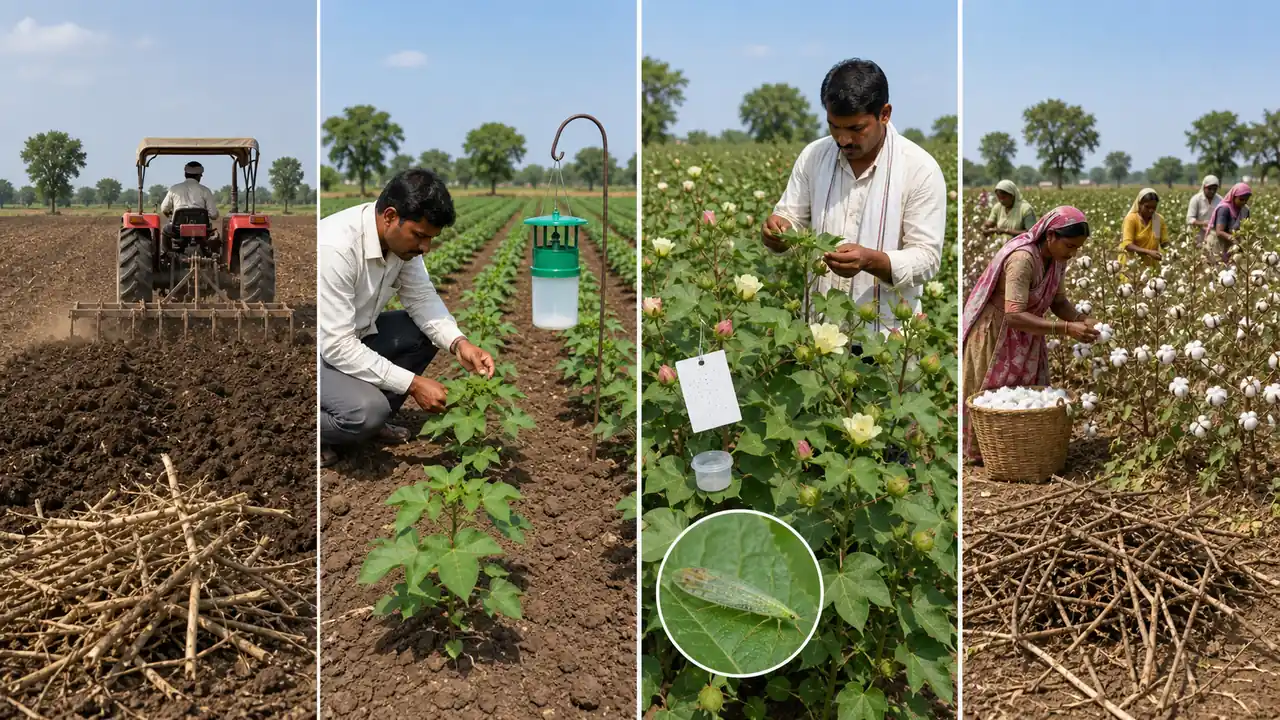
Season-Wise IPM Calendar
Pre-Sowing (February - April)
These are preventive measures taken before the crop is even planted. They target overwintering stages of pests in the soil and on plant debris.
| Activity | Target Pest | Details | Why It Works |
|---|---|---|---|
| Deep ploughing | Pink bollworm, Spodoptera | Plough in February | Exposes pupae to predators, sun, and desiccation |
| Burn plant debris | Pink bollworm | Destroy previous season's crop residues | Eliminates overwintering larvae in old bolls |
| Remove alternate hosts | Whitefly | No brinjal, bhendi, tomato near cotton | Breaks the pest-host bridge between seasons |
| Select resistant varieties | Bollworms | Choose Bt cotton (Bollgard I or II) | Built-in protection reduces spray dependency |
Vegetative Stage (Sowing to Square Formation)
This stage is dominated by sucking pests. Bollworms are not yet a major concern because there are no fruiting parts to attack.
| Activity | Target Pest | Details | Why It Works |
|---|---|---|---|
| Seed treatment | Sucking pests | Imidacloprid seed treatment | Systemic protection in seedling stage |
| Monitor jassid | Leafhopper | Watch for hopper burn symptoms | Early detection prevents severe bronze damage |
| Monitor thrips | Thrips | ETL: 1/leaf; look for silvery sheen | Lowest ETL among cotton pests |
| Conserve natural enemies | Aphid | Protect Coccinella, Chrysoperla, Aphelinus | Natural enemies keep aphid populations in check |
| Install light traps | Bollworms | Monitor moth emergence patterns | Advance warning of bollworm build-up |
| Install pheromone traps | Helicoverpa, pink bollworm | Species-specific traps | Monitor AND mass trap adult moths |
Reproductive Stage (Square to Boll Formation)
This is the critical stage when bollworms become the primary threat. The economic parts of the plant (squares, flowers, bolls) are now present.
| Activity | Target Pest | Details | Why It Works |
|---|---|---|---|
| Monitor ETL | Helicoverpa | 10% fruiting parts or 1 egg/plant | Spray only when economic loss is imminent |
| Release Trichogramma | Bollworms | Egg parasitoid, inundative release | Kills bollworm eggs before larvae can bore |
| Release Chrysoperla | Bollworms | 1,00,000/ha | General predator of eggs and small larvae |
| Endosulfan spray | Bollworms | 35 EC @ 0.2 l/ha at early square formation | Chemical backup when bio-control is insufficient |
| Crop rotation planning | Whitefly | Non-preferred hosts: sorghum, ragi, maize | Reduces whitefly carryover to next season |
Maturity Stage (Boll Opening to Harvest)
At this stage, stainer bugs become the main concern. They attack open bolls and reduce lint quality.
| Activity | Target Pest | Details | Why It Works |
|---|---|---|---|
| Monitor red cotton bug | Dysdercus cingulatus | Check for lint staining | Prevents quality downgrade and price loss |
| Monitor dusky cotton bug | Oxycarenus hyalinipennis | Check for black lint staining | Different pest, different staining colour |
| Timely picking | Pink bollworm | Pick bolls as soon as they open | Reduces carryover infestation to next season |
| Destroy crop residues | All pests | Post-harvest sanitation | Breaks the pest cycle for the next crop |
Bt Cotton Technology — Detailed Comparison
Bt cotton is the backbone of bollworm management in India. Over 90% of India's cotton area is now under Bt cotton. Understanding the difference between Bollgard I and II is critical for exams.
| Feature | Bollgard I | Bollgard II |
|---|---|---|
| Cry Protein | Cry 1 Ac only | Cry 1 Ac + Cry 2 Ab |
| Target Pests | American bollworm (Helicoverpa) | Spodoptera + Helicoverpa |
| Duration of Protection | Limited (protein expression declines late season) | Season-long (dual protein maintains efficacy) |
| Refuge Requirement | 20% non-Bt cotton | 20% non-Bt cotton |
| Commercial Status | Older technology | Current standard |
IMPORTANT
Bt Cotton Refuge Strategy: A minimum of 20% non-Bt cotton refuge must be planted around Bt cotton fields. The logic is simple — susceptible bollworms from the refuge mate with any resistant survivors from the Bt field, diluting resistance genes and delaying the evolution of Bt-resistant populations. This is a mandatory requirement, not optional.
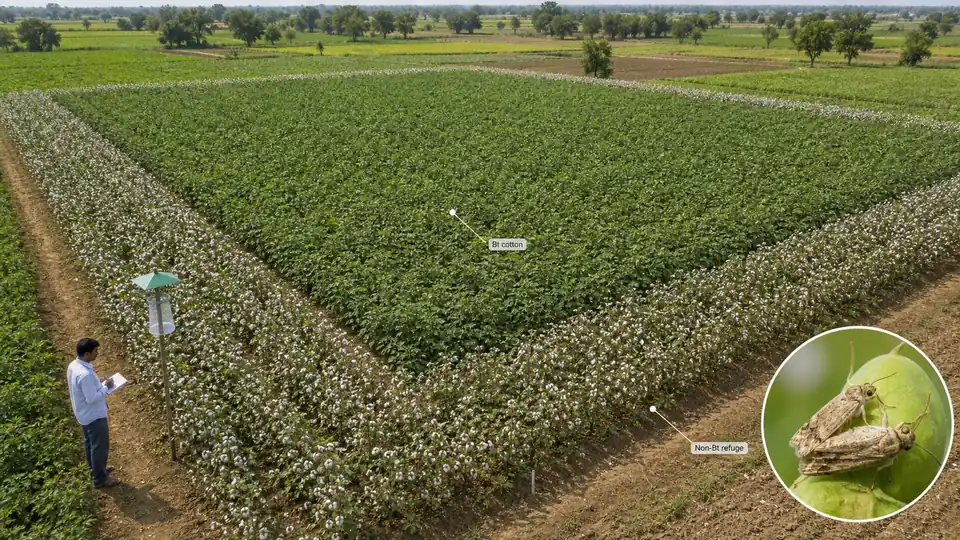
Agricultural Example
In 2002, when Bt cotton (Bollgard I) was first introduced in India, American bollworm damage dropped from 40-50% to less than 5% in adopting regions. However, Spodoptera became a secondary problem because Cry 1 Ac does not target it. Bollgard II (with added Cry 2 Ab) addressed this gap, providing season-long protection against both pests.
Biological Control Agents for Cotton — Complete List
| Bio-control Agent | Target Pest | Type | Dosage/Notes |
|---|---|---|---|
| Trichogramma spp. | Bollworm eggs | Egg parasitoid | Inundative release |
| Chelonus blackburnii | Bollworms | Egg-larval parasitoid | — |
| Chrysoperla | Bollworms | Predator | 1,00,000/ha |
| Bracon greeni | Pink bollworm | Larval parasitoid | — |
| Chelonus pectinophorae | Pink bollworm | Larval parasitoid | — |
| Coccinella septumpunctata | Aphid | Predator (ladybird beetle) | Conserve |
| Monochilus sexmaculatus | Aphid | Predator (ladybird beetle) | Conserve |
| Aphelinus mali | Aphid | Parasitoid | Conserve |
| A. flavipes | Aphid | Parasitoid | Conserve |
TIP
For exams, group bio-control agents by their target:
- Bollworms: Trichogramma (egg), Chelonus blackburnii (egg-larval), Chrysoperla (predator)
- Pink bollworm specifically: Bracon greeni, Chelonus pectinophorae (larval)
- Aphid: Ladybird beetles (Coccinella, Monochilus) + parasitoids (Aphelinus)
Resistant Varieties Summary
Helicoverpa Resistant
L 1245, LD 135, Sujata, LK 861, Abadhita
Spotted Bollworm Resistant
L 1245, JK 119-25-54, BCS 10, BCS 10-75, FBRN 2-6, HAO 66-107-1/1, Hopi, Deltapine, LH 95, UK 48G 27, Sanguineum
NOTE
L 1245 appears in both lists — it is resistant to both Helicoverpa AND spotted bollworm, making it a versatile choice for exam answers.
ETL Quick Reference for All Cotton Pests
| Pest | ETL | Unit |
|---|---|---|
| American bollworm (Helicoverpa armigera) | 10% fruiting parts or 1 egg/plant or 1 larva/plant | Per plant/field |
| Cotton aphid (Aphis gossypii) | 5% infested plants | Plant-level |
| Thrips (Thrips tabaci) | 1 No./leaf | Per leaf |
| Whitefly (Bemisia tabaci) | 5-10 nymphs/leaf | Per leaf |
Chemical Control Summary
| Pest | Chemical | Dosage |
|---|---|---|
| Sucking pests (seedling) | Imidacloprid | Seed treatment |
| Bollworms (early square) | Endosulfan 35 EC | 0.2 l/ha |
NOTE
In IPM, chemical control is the last resort, used only when biological control and cultural practices have failed and the ETL has been crossed. The goal is not zero chemical use, but intelligent, minimal chemical use.
Key Symptoms Quick Revision — The Master Table
| Symptom | Pest | Why This Symptom Occurs |
|---|---|---|
| Hopper burn (bronze/brick red leaves) | Jassid / Leafhopper | Toxin injection + sap loss |
| Sooty mould + stunted growth | Aphid | Honeydew excretion supports fungal growth |
| Silvery sheen on leaves | Thrips | Rasping-sucking damages surface cells |
| Leaf curl virus transmission | Whitefly | Vector of CLCuD |
| Flaring up of square | Spotted bollworm | Larval boring causes square to flare open |
| Rosette appearance of flowers | Pink bollworm | Petals fused due to larval feeding |
| Head inside boll, body outside | American bollworm | Characteristic feeding posture |
| Lint staining (red/yellow) | Red cotton bug (Dysdercus) | Direct feeding + Nematospora bacterium |
| Black lint staining | Dusky cotton bug | Sap feeding on open boll seeds |
| Leaf curling, bushy shoots | Mealybug | Toxin injection during sap feeding |
Quick Symptom-to-Pest Reference for Field Officers
In one glance — match what you see to the pest:
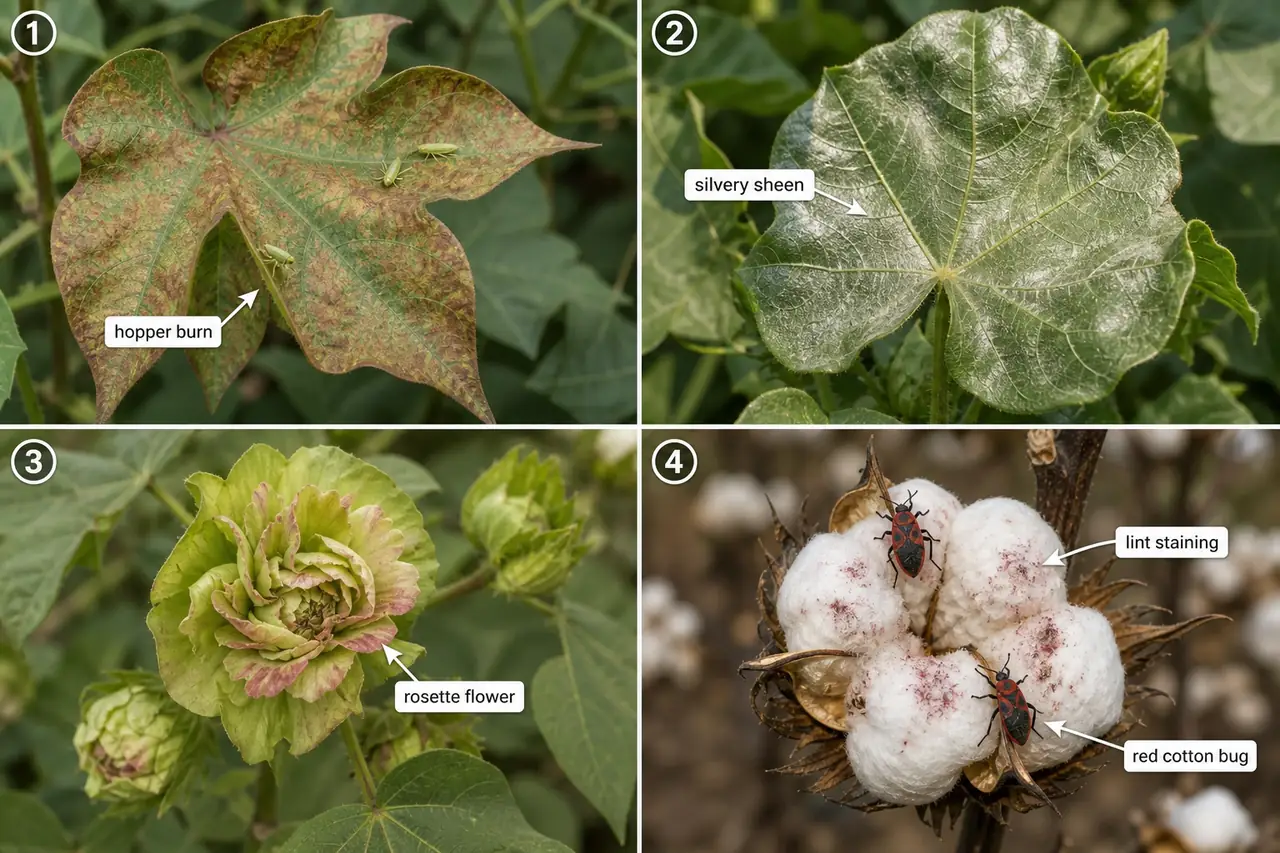
| What You See | Pest | Action Priority |
|---|---|---|
| Bronze/brick red leaves (hopper burn) | Jassid | Moderate — spray if population high |
| Sooty mold on leaves, stunted growth | Aphid | Moderate — conserve natural enemies first |
| Silvery sheen on leaves | Thrips | Low unless bud stage |
| Leaf curling + stunted + virus symptoms | Whitefly (CLCuD vector) | HIGH — vector control critical |
| Square flaring open | Spotted bollworm | High — check for bore holes |
| Rosette flowers (petals stuck) | Pink bollworm | High — hidden inside locules |
| Head-in feeding in boll | American bollworm | HIGH — ETL: 1 larva/plant |
| Red bugs on open bolls, lint stained | Red cotton bug | Moderate — lint quality loss |
| White cottony masses on stems | Mealybug | High if spreading |
Exam Tips and Mnemonics
TIP
Mnemonic — "DEEP BRIGHT" for Pre-Sowing IPM:
- Deep ploughing (expose pupae)
- Eliminate debris (burn residues)
- Exclude alternate hosts (no bhendi/tomato nearby)
- Pick resistant varieties (Bt cotton)
Season-Stage-Pest Logic:
- Vegetative stage → Sucking pests dominate (no fruiting parts for bollworms)
- Reproductive stage → Bollworms dominate (squares and bolls present)
- Maturity stage → Stainer bugs dominate (open bolls with exposed lint)
Bt Cotton Numbers:
- Bollgard I = 1 protein, 1 target
- Bollgard II = 2 proteins, 2 targets
- Refuge = 20% (think: "20% non-Bt = 20% insurance against resistance")
Bio-control Agent Memory Aid:
- "Tricho for eggs" — Trichogramma is always an egg parasitoid
- "Chryso for eating" — Chrysoperla is always a predator
- "Chelonus for in-between" — egg-larval parasitoid
Summary Table for Quick Revision
| Topic | Key Fact |
|---|---|
| IPM principle | Prevent early, monitor continuously, intervene only at ETL |
| Pre-sowing | Deep ploughing, burn debris, remove alternate hosts, select Bt cotton |
| Vegetative stage | Seed treatment, monitor sucking pests, conserve natural enemies, install traps |
| Reproductive stage | Monitor ETL, release Trichogramma + Chrysoperla, spray endosulfan if needed |
| Maturity stage | Monitor stainer bugs, timely picking, destroy crop residues |
| Bollgard I vs II | I = Cry 1 Ac (Helicoverpa); II = Cry 1 Ac + Cry 2 Ab (Helicoverpa + Spodoptera) |
| Refuge requirement | 20% non-Bt cotton — mandatory to delay resistance |
| Key ETLs | Aphid 5%, Thrips 1/leaf, Whitefly 5-10/leaf, Helicoverpa 10% or 1/plant |
| Key bio-agents | Trichogramma (egg), Chrysoperla (predator), Coccinella (aphid) |
| Chemical (last resort) | Endosulfan 35 EC @ 0.2 l/ha at early square |
| Dual-resistant variety | L 1245 (resists Helicoverpa + spotted bollworm) |
TIP
Next: Groundnut pests — a unique pest complex spanning five insect orders, including underground pod borers, gregarious marching caterpillars, and trap crop strategies.