🦗 Polyphagous Pests: Locusts, White Grub & Termites
Complete guide to India's major polyphagous pests — red hairy caterpillar, white grub (National Pest), desert locust, migratory locust, Bombay locust, and termites with scientific names, damage, management, comparison tables, and exam mnemonics
In June 2020, massive swarms of desert locusts (Schistocerca gregaria) descended on Rajasthan and Gujarat, devouring standing crops across hundreds of kilometres. Videos of farmers banging utensils and playing loud music to scare the swarms went viral. Meanwhile, underground, fat white C-shaped grubs of the white grub (Holotrichia consanguinea) — officially designated India's National Pest — were silently destroying the roots of freshly sown kharif crops in the same region. These are polyphagous pests — insects that do not specialise on any single crop but attack a vast range of plants. When they appear, no crop is safe. Understanding these pests is critical for both agricultural extension and competitive exams.
What Makes a Pest "Polyphagous"?
A polyphagous pest feeds on plants from multiple botanical families. Unlike monophagous pests (e.g., yellow stem borer on rice only) or oligophagous pests (e.g., mustard aphid on crucifers), polyphagous pests can survive on almost any vegetation. This makes them:
Pro Content Locked
Upgrade to Pro to access this lesson and all other premium content.
Charged once for one year · ₹1188 total
Save ₹100/month vs ₹2388/year launch price
- All Agriculture & Banking Courses
- AI Lesson Questions (100/day)
- AI Doubt Solver (50/day)
- Glows & Grows Feedback (30/day)
- AI Section Quiz (20/day)
- 22-Language Translation (100/day)
- Recall Questions (20/day)
- AI Quiz (15/day)
- AI Quiz Paper Analysis (100/day)
- AI Step-by-Step Explanations (100/day)
- Spaced Repetition Recall (FSRS)
- AI Tutor
- Immersive Text Questions
- Audio Lessons — Hindi & English
- Mock Tests & Previous Year Papers
- Summary & Mind Maps
- XP, Levels, Leaderboard & Badges
- Generate New Classrooms
- Voice AI Teacher (AgriDots Live)
- AI Revision Assistant
- Knowledge Gap Analysis
- Interactive Revision (LangGraph)
🔒 Secure one-time yearly payment via Razorpay · No hidden fees
In June 2020, massive swarms of desert locusts (Schistocerca gregaria) descended on Rajasthan and Gujarat, devouring standing crops across hundreds of kilometres. Videos of farmers banging utensils and playing loud music to scare the swarms went viral. Meanwhile, underground, fat white C-shaped grubs of the white grub (Holotrichia consanguinea) — officially designated India's National Pest — were silently destroying the roots of freshly sown kharif crops in the same region. These are polyphagous pests — insects that do not specialise on any single crop but attack a vast range of plants. When they appear, no crop is safe. Understanding these pests is critical for both agricultural extension and competitive exams.
What Makes a Pest "Polyphagous"?
A polyphagous pest feeds on plants from multiple botanical families. Unlike monophagous pests (e.g., yellow stem borer on rice only) or oligophagous pests (e.g., mustard aphid on crucifers), polyphagous pests can survive on almost any vegetation. This makes them:
- Difficult to control through crop rotation (they simply shift to the next crop)
- Capable of explosive population build-up (unlimited food supply)
- Devastating during outbreaks (nothing stops their spread across crops)
| Feeding Range | Term | Example |
|---|---|---|
| One plant species | Monophagous | Rice yellow stem borer (Scirpophaga incertulas) |
| One plant family | Oligophagous | Mustard aphid (Lipaphis erysimi) on crucifers |
| Many plant families | Polyphagous | White grub, Locusts, Helicoverpa armigera |
1. Red Hairy Caterpillar — Amsacta moorei
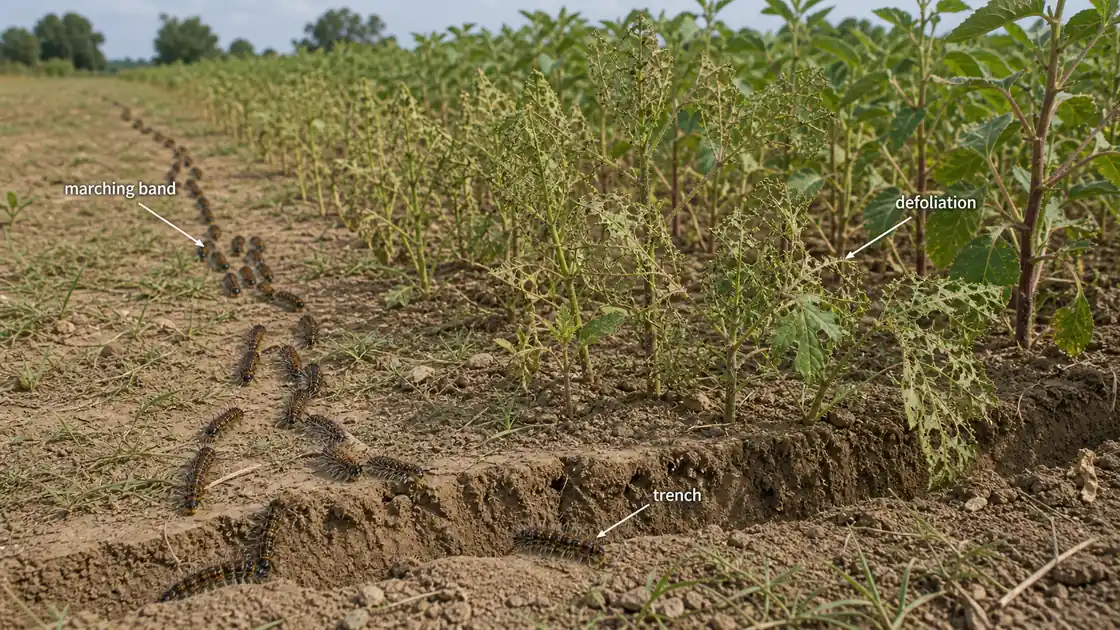
Family: Arctiidae | Order: Lepidoptera
Host range: Feeds on all kinds of vegetation of the kharif season — groundnut, bajra, jowar, cotton, castor, sesame, vegetables, and weeds.
Damage Symptoms
- During severe attack, caterpillars march in bands destroying field after field — similar to armyworm behaviour
- Voracious feeders that can completely defoliate crops overnight
- Hairy caterpillars with red-brown body covered in dense tufts of hair
- Appear in enormous numbers after the first monsoon rains
NOTE
Do not confuse the two "red hairy caterpillars":
| Feature | Amsacta moorei | Amsacta albistriga |
|---|---|---|
| Common name | Red hairy caterpillar (polyphagous) | Red hairy caterpillar of groundnut |
| Host range | All kharif crops (truly polyphagous) | Primarily groundnut |
| Family | Arctiidae | Arctiidae |
| Exam context | Listed under polyphagous pests | Listed under groundnut pests |
Both are in the same genus (Amsacta) and family, but moorei is the truly polyphagous species tested under this topic.
Agricultural context: In the dryland farming areas of Andhra Pradesh and Rajasthan, red hairy caterpillar outbreaks occur after good early monsoon rains. Farmers dig trenches around their fields to prevent the marching caterpillars from entering — the caterpillars fall into the trenches and cannot climb out.
IMPORTANT
Pupal stage undergoes diapause 15–20 cm below soil surface. Deep summer ploughing (>20 cm) exposes and destroys these pupae. Asked in exams 2023.
2. White Grub — Holotrichia consanguinea (National Pest)
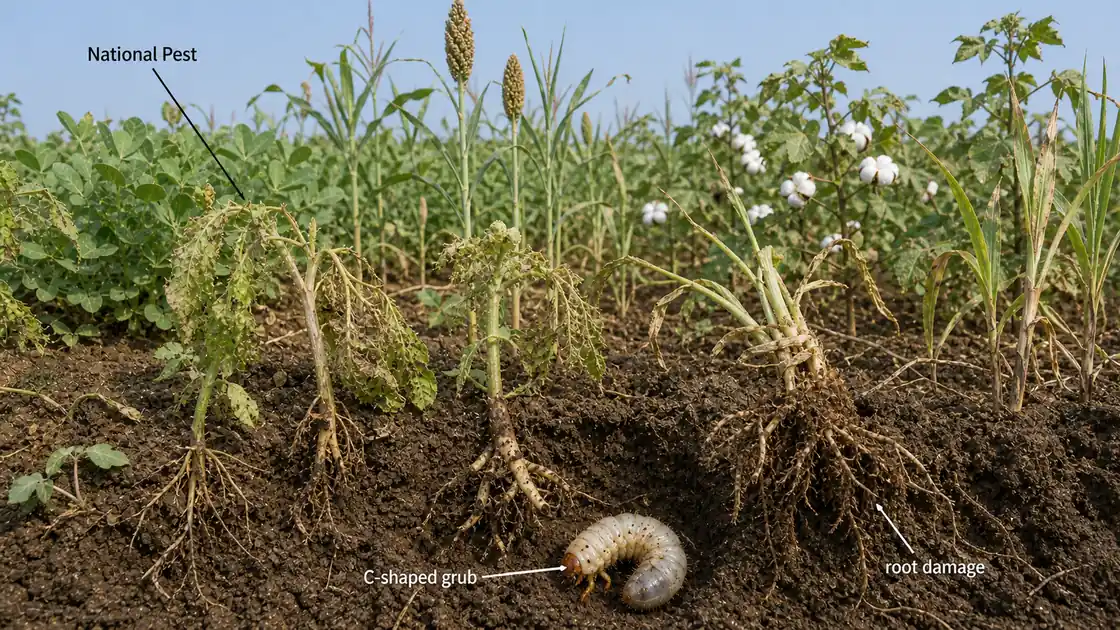
Family: Melolonthidae | Order: Coleoptera
IMPORTANT
White grub is officially designated as a National Pest of India. This is one of the most frequently asked facts in competitive exams — exams, NABARD, ICAR, and state agriculture exams all test this.
Host range: Feeds on all kinds of kharif vegetation — groundnut, bajra, jowar, sesame, cotton, sugarcane, vegetables, and many more crops.
Understanding the White Grub Life Cycle
The white grub has a fascinating life cycle that is essential for both management and exam questions:
| Stage | Location | Activity | Season |
|---|---|---|---|
| Adult beetles | Above ground (trees) | Feed on leaves of neem, Ailanthus, Acacia | Emerge after first monsoon rains |
| Mating | On trees (especially neem) | Adults aggregate on trees at dusk | June-July |
| Egg laying | In soil near crops | Females return to soil to lay eggs | July |
| Grubs | Underground | Feed on roots of standing crops | July-October |
| Pupae | Deep in soil | Overwinter in soil | November-May |
Damage Symptoms
- Grubs damage field crops (roots); adults damage trees (leaves) — dual damage
- Grubs are 'C' shaped, whitish yellow, found near the base of plant clumps
- Grub feeding on roots causes wilting, yellowing of leaves, and eventually the plant dries out
- Affected plants come off easily when pulled (roots are destroyed)
- Sometimes resowing is required due to the severity of attack
- Adults are dark brown beetles attracted to neem trees during monsoon for mating
Management
| Method | How It Works |
|---|---|
| Light traps | Attract and destroy adult beetles at night |
| Summer ploughing | Exposes pupae to sun, desiccation, and bird predation |
| Phorate 10G | Soil-applied granular insecticide kills grubs |
| Beetle collection | Collect adults from neem/Ailanthus/Acacia trees at dusk |
| Adequate irrigation | Moist soil conditions reduce grub survival |
| Crop rotation | Rotate with non-preferred crops in endemic areas |
TIP
White grub lifecycle mnemonic: "Grubs Below, Beetles aBove."
- Below ground: 'C'-shaped grubs feed on roots of crops (main damage)
- Above ground: Adults feed on leaves of trees (secondary damage)
- Adults are attracted to neem trees — community beetle collection from neem trees is the cheapest control method
- Key chemical: Phorate 10G (soil application)
3. Locusts — The Most Devastating Insects
Locusts are the most catastrophic of all insect pests. They are short-horned grasshoppers (family Acrididae, order Orthoptera) that undergo a remarkable transformation: under certain conditions, solitary grasshoppers change behaviour and appearance to form gregarious swarms that can migrate hundreds of kilometres, consuming all vegetation in their path.
What Makes Locusts Special?
| Feature | Ordinary Grasshopper | Locust (Swarm Phase) |
|---|---|---|
| Behaviour | Solitary, sedentary | Gregarious, migratory |
| Colour | Green (cryptic) | Yellow-brown (conspicuous) |
| Movement | Short hops | Fly 100+ km/day in swarms |
| Damage | Local, minor | Total crop destruction |
| Trigger | — | Crowding after rains in breeding areas |
Three Locust Species of India
A. Desert Locust — Schistocerca gregaria
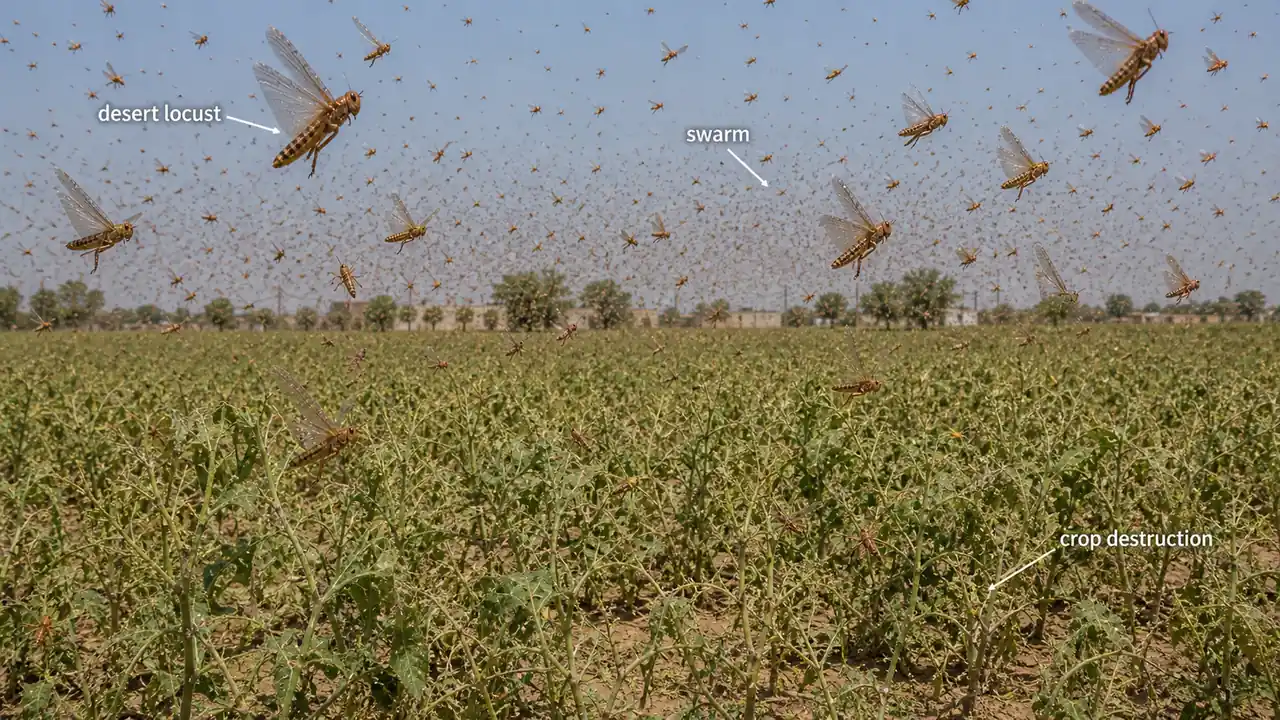
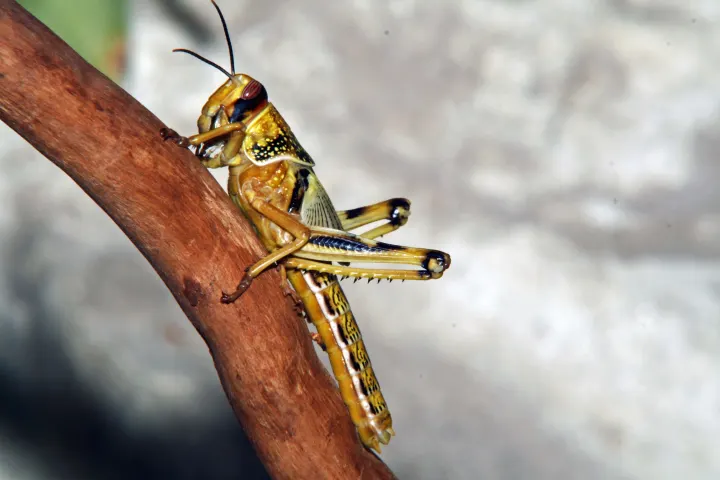
Family: Acrididae | Order: Orthoptera
IMPORTANT
Desert locust is the most destructive of all three locust species — and among the most destructive of all insect pests worldwide.
- Forms massive swarms containing billions of individuals
- A single swarm can cover 1,200 km2 and consume 2,500 tonnes of vegetation per day
- The economically damaging stages are both the hopper (nymph) bands and the adult swarms
- Breeding areas in India: Rajasthan and parts of Gujarat
- International monitoring coordinated by FAO (Food and Agriculture Organization)
- Recent outbreak: 2019-2020, when swarms from East Africa reached India via Pakistan
B. Migratory Locust — Locusta migratoria
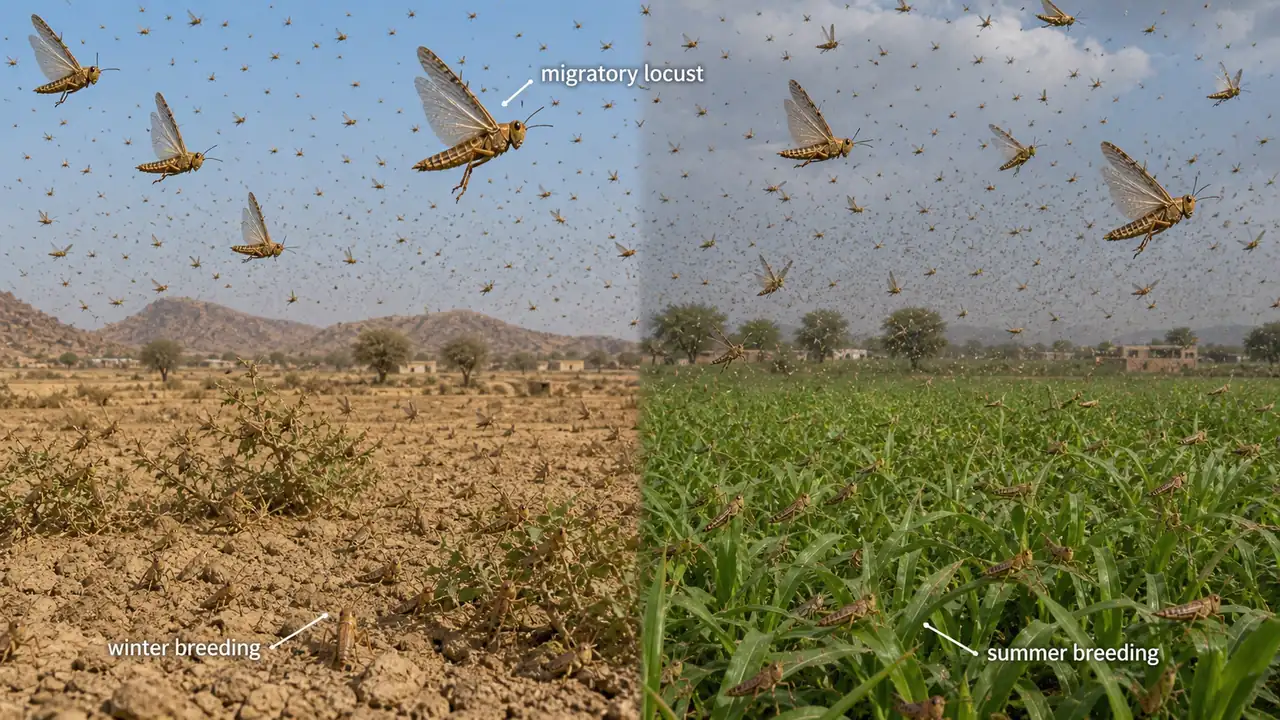
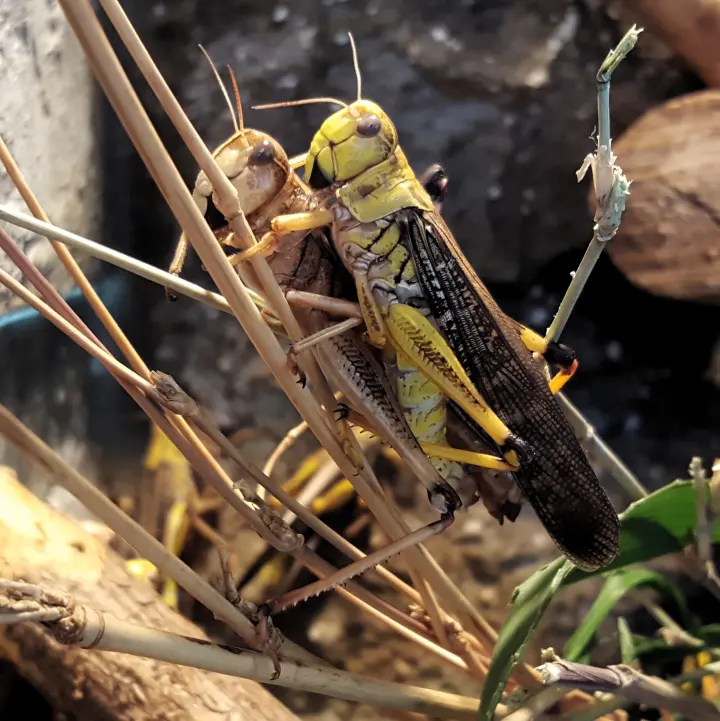
Family: Acrididae | Order: Orthoptera
- Breeds twice in a year:
- Winter-Spring breeding: Pakistan
- Older climatic recall notes add that migratory locust does not normally oviposit below about 40% relative humidity.
- Summer-Monsoon breeding: Rajasthan and Gujarat
- May have many broods per year under favourable conditions
- Eggs are laid in sandy soil, commonly around 10-15 cm deep
C. Bombay Locust — Patanga succincta
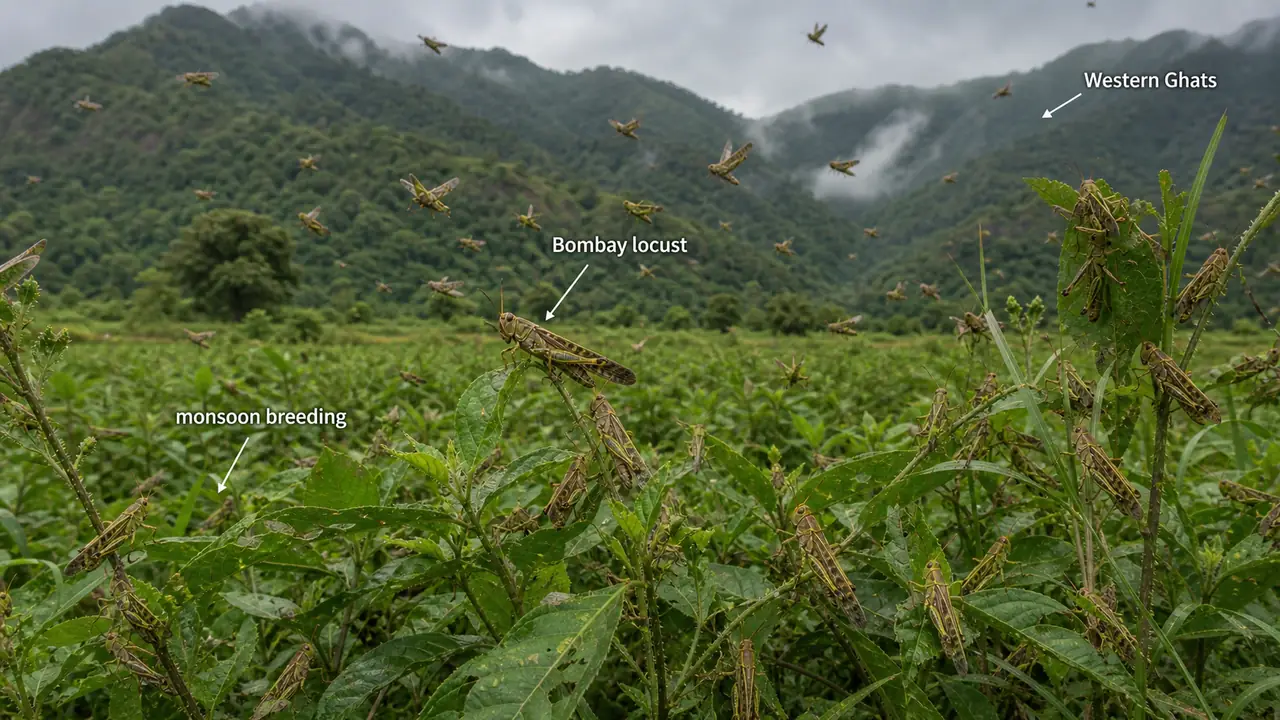
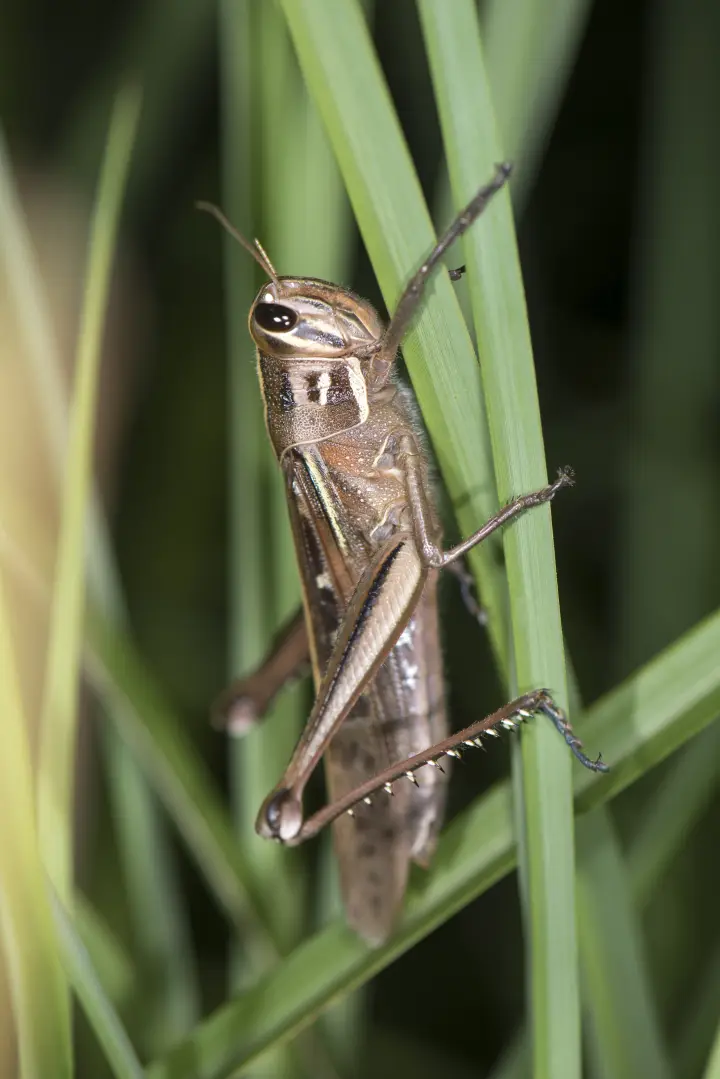
Family: Acrididae | Order: Orthoptera
- Breeds during monsoon in the Western Ghats
- Has only one brood in a year
- Mostly confined to Gujarat and Tamil Nadu
- Less destructive than the other two species
- In the gregarious phase, sexually mature adults are classically remembered as turning yellow
Locust Comparison Table — Essential for Exams
| Feature | Desert Locust | Migratory Locust | Bombay Locust |
|---|---|---|---|
| Scientific Name | Schistocerca gregaria | Locusta migratoria | Patanga succincta |
| Destructiveness | Most destructive | Moderate | Least of three |
| Broods/Year | Multiple | Multiple (2+) | One |
| Breeding season | Multiple | Winter (Pakistan) + Summer (India) | Monsoon only |
| Breeding Area (India) | Rajasthan, Gujarat | Rajasthan, Gujarat | Western Ghats |
| Distribution | Rajasthan to Gujarat | Pakistan to Rajasthan | Gujarat, Tamil Nadu |
| International monitoring | FAO | — | — |
TIP
Quick memory aid for the three locust species:
- Desert (Schistocerca) = Most Destructive; Desert regions
- Migratory (Locusta) = Multiple broods; Migrates from Pakistan
- Bombay (Patanga) = Breeds once; Western Ghats; Gujarat & TN
Mnemonic: "Desert Destroys, Migratory Multiplies, Bombay Breeds once."
Locust Management Anchors
- Trenching is a classical field method for intercepting marching hopper bands and is remembered alongside red hairy caterpillar control in older extension tables
- Poison bait is the other standard textbook recall for direct locust suppression
- Effective locust control depends on coordinated warning and surveillance systems rather than isolated field-by-field action
4. Termite — Odontotermes obesus
Family: Termitidae | Order: Isoptera
IMPORTANT
Termites are called White ants, but they are NOT true ants. They belong to order Isoptera, not Hymenoptera (the order of true ants, bees, and wasps). This is one of the most classic exam questions in entomology.
Colony Structure — Exam-Important Facts
| Caste | Role | Key Fact |
|---|---|---|
| Queen | Egg laying | Lays 1 egg per second (70,000-80,000 per day) |
| King | Mating | Develops from unfertilized eggs |
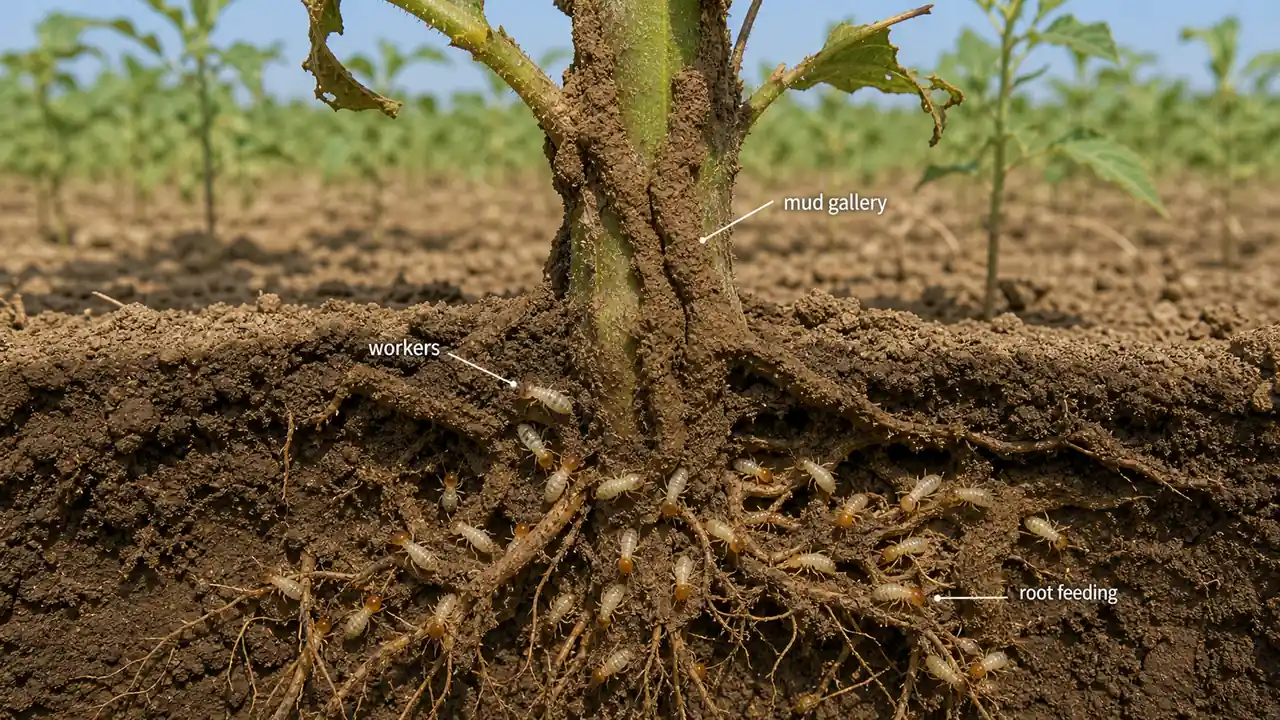
| Workers | Feeding, building | Workers cause damage to crops (not soldiers) |
| Soldiers | Colony defence | Large mandibles; do not feed on crops |
| Alates | Reproduction | Winged forms that swarm, mate, shed wings, start new colonies |
Damage Symptoms
- Feed on roots and underground parts of plants
- Create mud galleries on stems and trunks (tubes of mud built over the surface)
- Attack stored wood, books, and other cellulose materials
- Particularly damaging in dryland and rainfed crops
- Social insects living in organised colonies with clearly defined castes
- Colony members exchange food through trophallaxis, and the dwelling place is commonly remembered as a mound or termitarium
TIP
Five termite facts every exam candidate must know:
- Order: Isoptera — NOT Hymenoptera
- Common name: "White ants" — but NOT true ants
- Queen egg-laying rate: 1 egg/second = 70,000-80,000/day
- Workers cause the crop damage (not soldiers)
- King develops from unfertilized eggs (similar to drones in honey bees — arrhenotokous reproduction)
Agricultural context: In dryland farming areas of Karnataka, Maharashtra, and Rajasthan, termites are a persistent problem. Farmers recognize termite infestation by the mud tubes running up plant stems and the loose, hollowed-out roots when damaged plants are pulled up. Adequate irrigation is the simplest preventive measure — termites thrive in dry conditions. In the same field-sanitation logic, well-decomposed FYM is safer than undecomposed FYM because fresh cellulose-rich organic matter favours termite build-up.
Complete Polyphagous Pest Comparison
| Pest | Scientific Name | Scope | Key Fact |
|---|---|---|---|
| Desert Locust | Schistocerca gregaria | International pest | Most destructive; swarms cross continents |
| White Grub | Holotrichia consanguinea | National pest | One generation/year; larvae feed on roots; sandy/sandy loam soil |
| Red Hairy Caterpillar | Amsacta moorei | Regional | Kharif defoliator; moves in bands; pupae diapause 15–20 cm (exams 2023) |
| Bombay Locust | Patanga succincta | Regional | Western Ghats; one brood/year; monsoon breeding |
| Migratory Locust | Locusta migratoria | Regional | Twice/year; winter: Pakistan, summer: Rajasthan-Gujarat |
| Termite | Odontotermes obesus | Pan-India | Queen: 1 egg/sec; "white ant"; workers cause damage |
TIP
"Desert = Most Destructive, Bombay = One brood, Migratory = Two broods."
Polyphagous Pests — A Master Comparison
| Feature | Red Hairy Caterpillar | White Grub | Desert Locust | Termite |
|---|---|---|---|---|
| Scientific name | Amsacta moorei | Holotrichia consanguinea | Schistocerca gregaria | Odontotermes obesus |
| Order | Lepidoptera | Coleoptera | Orthoptera | Isoptera |
| Season | Kharif | Kharif | Any (swarm-dependent) | Year-round |
| Damaging stage | Caterpillar | Grub (underground) | Nymph + Adult | Workers |
| Movement | Marches in bands | Stationary (soil) | Flies in swarms (100+ km/day) | Underground tunnels |
| Special status | — | National Pest | Most destructive insect | "White ants" |
| Key control | Trenching | Phorate 10G; beetle collection | FAO monitoring; aerial spraying | Irrigation; Chlorpyriphos |
Field Diagnosis: Polyphagous Pest — Which One?
Damage across multiple crops? Check these signs:
- Bands of hairy caterpillars marching across field after first monsoon rains? → Red Hairy Caterpillar (Amsacta) — dig trenches to trap; light traps + bonfires
- Plants wilting, pull out easily, C-shaped white grubs in soil near roots? → White Grub (Holotrichia) — National Pest; adults fly to neem trees at dusk in June-July; collect beetles there
- Massive swarm of hoppers arriving from Rajasthan/Pakistan border, devastating everything? → Desert Locust (S. gregaria) — FAO monitoring; aerial spray; most destructive insect on Earth (single swarm = 10⁹ insects)
- Sandy egg-laying patches or marching hopper bands around field margins? → remember the classical trenching + poison bait response before large-scale coordinated spray operations
- Mud galleries on plant base, poor germination, root damage across crops? → Termites (Odontotermes) — year-round; irrigate to reduce; treat soil with chlorpyriphos
Key distinction: Red hairy caterpillar and locust are above-ground, visible. White grub and termite are underground, hidden — you only see wilting by the time damage is severe.
Exam Tips and Mnemonics
TIP
"RWLT" — The Four Polyphagous Pests:
- Red hairy caterpillar (Amsacta moorei) — Kharif; marches in bands
- White grub (Holotrichia consanguinea) — National Pest; 'C'-shaped grub; neem attraction
- Locusts (3 species) — Short-horned grasshoppers; most devastating insects
- Termite (Odontotermes obesus) — White ants; Isoptera; queen lays 1 egg/second
Critical exam facts (must memorise):
- White grub = National Pest of India
- Desert locust = Most destructive locust species
- Locust damaging stages = nymph + adult
- Locust eggs are commonly laid in sandy soil around 10-15 cm deep
- Termite order = Isoptera (not Hymenoptera)
- Queen termite = 1 egg/second = 70,000-80,000/day
- Termite workers (not soldiers) = cause crop damage
- King termite develops from unfertilized eggs
Summary Cheat Sheet
| Concept / Topic | Key Details |
|---|---|
| Red hairy caterpillar (polyphagous) | Amsacta moorei — Arctiidae; feeds on all kharif vegetation |
| Marches in bands destroying fields | Amsacta moorei — armyworm-like marching behaviour |
| National Pest of India | Holotrichia consanguinea (White grub) — Melolonthidae; Coleoptera |
| White grub body shape | 'C' shaped, whitish yellow |
| White grub dual damage | Grubs damage roots (crops); adults damage leaves (trees) |
| White grub adults attracted to | Neem trees during monsoon for mating |
| White grub control chemical | Phorate 10G (soil application) |
| Most destructive locust | Schistocerca gregaria (Desert locust) — FAO-monitored |
| Breeds twice a year | Locusta migratoria (Migratory locust) — winter (Pakistan) + summer (India) |
| Only one brood per year | Patanga succincta (Bombay locust) — monsoon breeding |
| Bombay locust breeds in | Western Ghats; confined to Gujarat and Tamil Nadu |
| Locust family | Acrididae (short-horned grasshoppers); Order Orthoptera |
| Termites common name | White ants — but NOT true ants |
| Termite order | Isoptera (not Hymenoptera) |
| Queen termite egg rate | 1 egg/second = 70,000-80,000/day |
| Termite caste causing damage | Workers (not soldiers) |
| King termite develops from | Unfertilized eggs |