🪲 Sugarcane Borers: Early Shoot, Top, Internode, Root & Gurdaspur Borer
Complete guide to all five sugarcane borers — early shoot borer (Chilo infuscatellus), internode borer, top borer (Scirpophaga excerptalis), root borer, and Gurdaspur borer — with dead heart identification, ETL, biological control, and resistant varieties for IBPS AFO and ICAR exams.
Why Borers Are the Greatest Threat to Sugarcane
A sugarcane farmer in Uttar Pradesh's Lakhimpur Kheri district — the heart of India's sugar belt — notices that some young shoots have wilted and turned straw-coloured. She pulls one out, and it comes away easily with a rotting smell. Three months later, she sees reddish-brown dead hearts in her mature canes that refuse to budge when pulled. Two different borers, two different growth stages, two completely different management approaches.
Borers are the most destructive group of sugarcane pests in India. They bore into different parts of the cane — shoots, internodes, tops, and roots — at different crop stages. Because the damage is internal, it is often invisible until significant yield and sugar recovery losses have already occurred. India loses an estimated 10-15% of its sugarcane production annually to borers.
For competitive exams, the key skill is distinguishing between borers based on their damage symptoms, particularly the "dead heart" characteristics of early shoot borer versus top borer.
Pro Content Locked
Upgrade to Pro to access this lesson and all other premium content.
Charged once for one year · ₹1188 total
Save ₹100/month vs ₹2388/year launch price
- All Agriculture & Banking Courses
- AI Lesson Questions (100/day)
- AI Doubt Solver (50/day)
- Glows & Grows Feedback (30/day)
- AI Section Quiz (20/day)
- 22-Language Translation (100/day)
- Recall Questions (20/day)
- AI Quiz (15/day)
- AI Quiz Paper Analysis (100/day)
- AI Step-by-Step Explanations (100/day)
- Spaced Repetition Recall (FSRS)
- AI Tutor
- Immersive Text Questions
- Audio Lessons — Hindi & English
- Mock Tests & Previous Year Papers
- Summary & Mind Maps
- XP, Levels, Leaderboard & Badges
- Generate New Classrooms
- Voice AI Teacher (AgriDots Live)
- AI Revision Assistant
- Knowledge Gap Analysis
- Interactive Revision (LangGraph)
🔒 Secure one-time yearly payment via Razorpay · No hidden fees
Why Borers Are the Greatest Threat to Sugarcane
A sugarcane farmer in Uttar Pradesh's Lakhimpur Kheri district — the heart of India's sugar belt — notices that some young shoots have wilted and turned straw-coloured. She pulls one out, and it comes away easily with a rotting smell. Three months later, she sees reddish-brown dead hearts in her mature canes that refuse to budge when pulled. Two different borers, two different growth stages, two completely different management approaches.
Borers are the most destructive group of sugarcane pests in India. They bore into different parts of the cane — shoots, internodes, tops, and roots — at different crop stages. Because the damage is internal, it is often invisible until significant yield and sugar recovery losses have already occurred. India loses an estimated 10-15% of its sugarcane production annually to borers.
For competitive exams, the key skill is distinguishing between borers based on their damage symptoms, particularly the "dead heart" characteristics of early shoot borer versus top borer.
The Five Sugarcane Borers at a Glance
All five major sugarcane borers belong to Order Lepidoptera. They are divided between two families based on their taxonomy.
| S.No. | Common Name | Scientific Name | Family | Order |
|---|---|---|---|---|
| 1. | Early shoot borer | Chilo infuscatellus | Crambidae | Lepidoptera |
| 2. | Internode borer | Chilo sacchariphagus indicus | Crambidae | Lepidoptera |
| 3. | Top borer | Scirpophaga excerptalis | Pyralidae | Lepidoptera |
| 4. | Root borer | Emmalocera depressella | Pyralidae | Lepidoptera |
| 5. | Gurdaspur borer | Bissetia steniellus | Crambidae | Lepidoptera |
IMPORTANT
Family Pattern: The two Chilo species (early shoot borer and internode borer) plus Gurdaspur borer belong to Crambidae, while top borer and root borer belong to Pyralidae. All five are Lepidoptera.
1. Early Shoot Borer — The Seedling Killer
Scientific Name: Chilo infuscatellus
Family: Crambidae | Order: Lepidoptera
Host Range: Pearl millet, oat, barley, maize
When It Attacks
Early shoot borer is the major pest in the early stage of the crop, attacking 1-3 month old sugarcane. It is the first borer that farmers encounter each season.
Damage Symptoms
The symptoms follow a clear sequence:
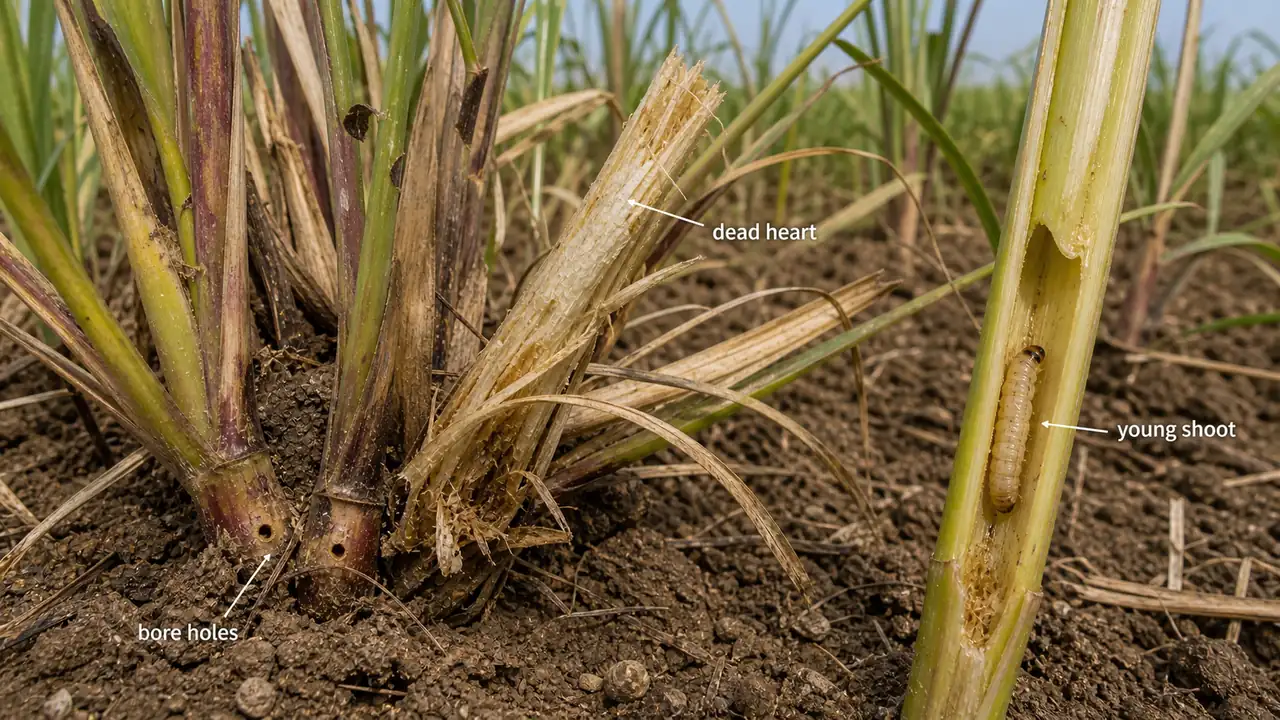
- The larva bores into the young shoot near the ground level, creating bore holes at the base
- It feeds inside the shoot, destroying the growing point
- This causes the characteristic dead heart in 1-3 month old crop
- The dead heart can be easily pulled out — it slides out with minimal effort
- The rotting portion emits an offensive odour
- Multiple bore holes are visible at the base of the shoot just above ground level
TIP
Key Identification — The "Pull Test": If the dead heart comes out easily and smells bad, it is early shoot borer. If it does NOT come out easily and is reddish-brown, it is top borer. This simple field test is the most frequently asked exam question about sugarcane borers.
ETL
15% dead hearts
Agricultural Example
In Bihar's sugarcane-growing districts, early shoot borer attacks during March-May can destroy up to 30% of new shoots. However, the crop has a natural compensatory ability — surviving tillers grow more vigorously to partially compensate for the lost shoots. This is why the ETL is set relatively high at 15% dead hearts rather than a lower threshold.
2. Internode Borer — The Sugar Thief
Scientific Name: Chilo sacchariphagus indicus
Family: Crambidae | Order: Lepidoptera
When It Attacks
Internode borer attacks during the grand growth phase (4-7 months), when the internodes are elongating and filling with sucrose.
Damage Symptoms
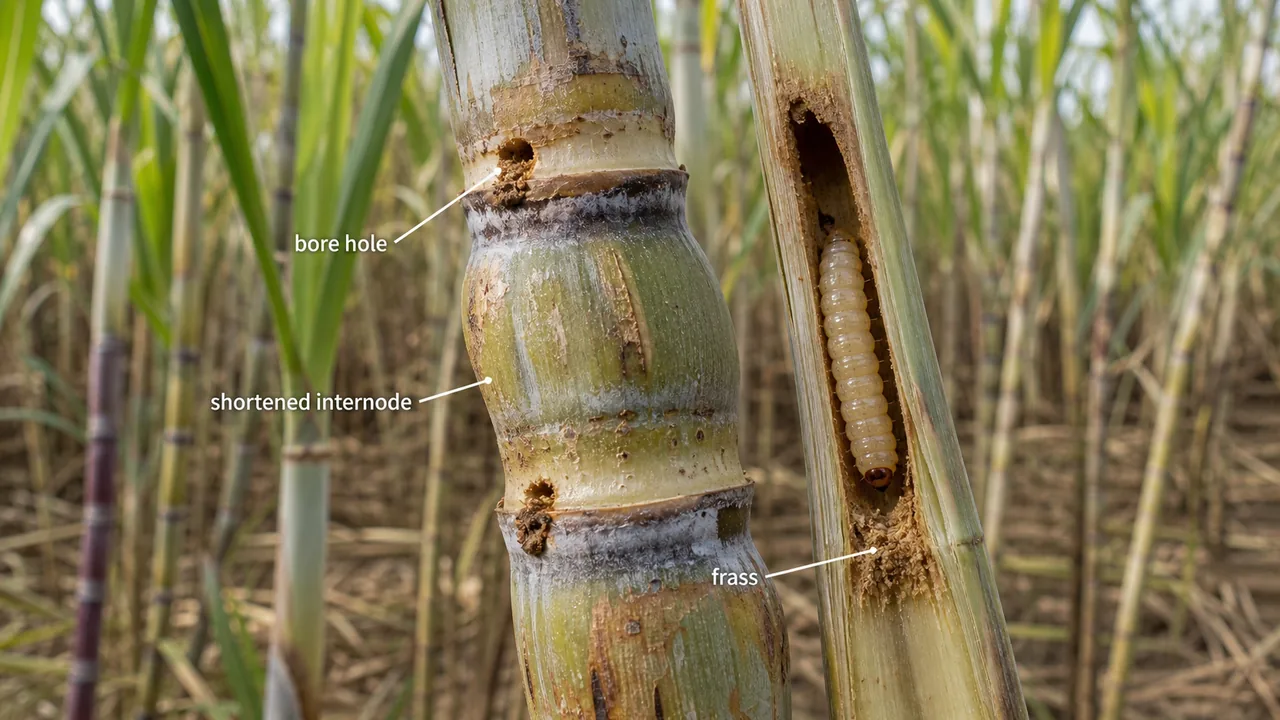
- Bores into internodes creating tunnels inside the cane
- Bore holes visible on internodes with frass (excrement) extrusion
- Reduces sugar recovery and affects cane quality
- Does not cause dead heart — the growing point remains intact
NOTE
Unlike early shoot borer and top borer, internode borer does NOT cause dead heart. Its damage is economic rather than lethal — it reduces sugar content through internal tunnelling. A cane may look healthy externally but have poor juice quality when crushed.
Agricultural Significance
Sugar mills in Tamil Nadu and Karnataka often reject heavily borer-damaged cane because the tunnels reduce extractable juice. This means the farmer loses not just yield but also the price per tonne, creating a double economic impact.
3. Top Borer — The Mature Cane Destroyer
Scientific Name: Scirpophaga excerptalis
Family: Pyralidae | Order: Lepidoptera
Host Range: Millets and other grasses
When It Attacks
Top borer attacks grown-up canes (4+ months), targeting the growing apex — the exact opposite growth stage from early shoot borer.
Damage Symptoms
Top borer produces a complex of symptoms that are heavily tested in exams:
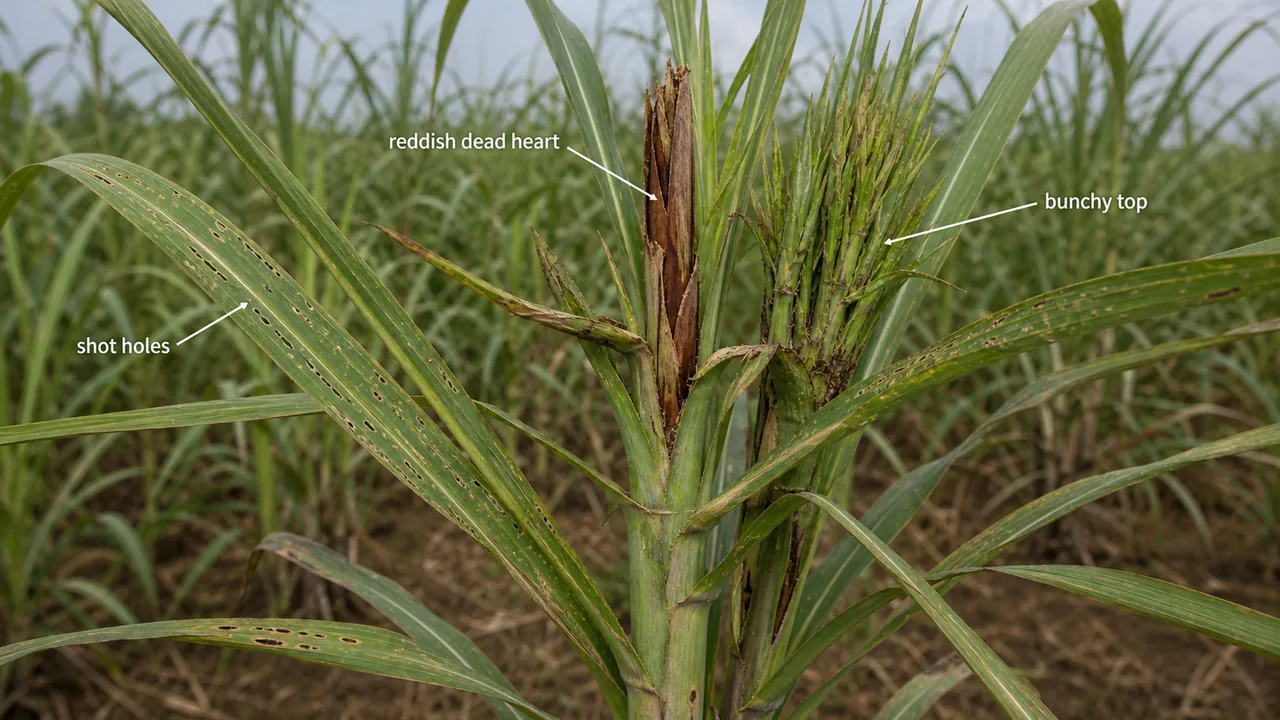
- Causes dead heart in grown-up canes — this is the most important distinction from early shoot borer
- The dead heart cannot be easily pulled out (unlike early shoot borer)
- Dead heart is reddish brown in colour (not straw-coloured like early shoot borer)
- Parallel row of shot holes in the emerging leaves — created as the larva bores through the rolled-up leaf whorl
- Red tunnels in the midribs of leaves
- Bunchy top appearance due to the growth of side shoots after the main growing point is destroyed
- The larva bores into the midrib of unfolded leaves and mines its way down to the base
IMPORTANT
The Critical Exam Distinction:
| Feature | Early Shoot Borer | Top Borer |
|---|---|---|
| Crop age | 1-3 months (young) | 4+ months (grown up) |
| Dead heart pull test | Easily pulled out | Cannot be pulled |
| Dead heart colour | Straw-coloured | Reddish brown |
| Smell | Offensive odour | No offensive odour |
| Additional symptoms | Bore holes at base | Shot holes, bunchy top, red midrib tunnels |
Management
Top borer has the most comprehensive biological control programme among sugarcane borers:
Resistant Varieties: Co 724, CoJ 67, Co 1158, Co 1111
Biological Control — Multi-Stage Attack:
| Stage Targeted | Bio-control Agent | Details |
|---|---|---|
| Egg | Telenomus beneficiens | Egg parasitoid |
| Egg | Tetrastichus schoenobi | Egg parasitoid |
| Egg | Trichogramma chilonis | Egg parasitoid |
| Larval | Goniozus indicus | Larval parasitoid |
| Larval | Chelonus sp. | Larval parasitoid |
| Prepupal | Isotima javensis | Ichneumonid parasitoid, 100 pairs/ha |
| Pupal | Tetrastichus ayyari | Pupal parasitoid |
TIP
Exam Strategy for Top Borer Bio-control: Remember the four stages attacked — Egg, Larval, Pre-Pupal, Pupal (ELPP). The key names to memorise:
- Egg = "TTT" (Telenomus, Tetrastichus schoenobi, Trichogramma)
- Prepupal = Isotima javensis (the only ichneumonid in sugarcane bio-control)
- Pupal = Tetrastichus ayyari
4. Root Borer — The Hidden Attacker
Scientific Name: Emmalocera depressella
Family: Pyralidae | Order: Lepidoptera
Damage Symptoms
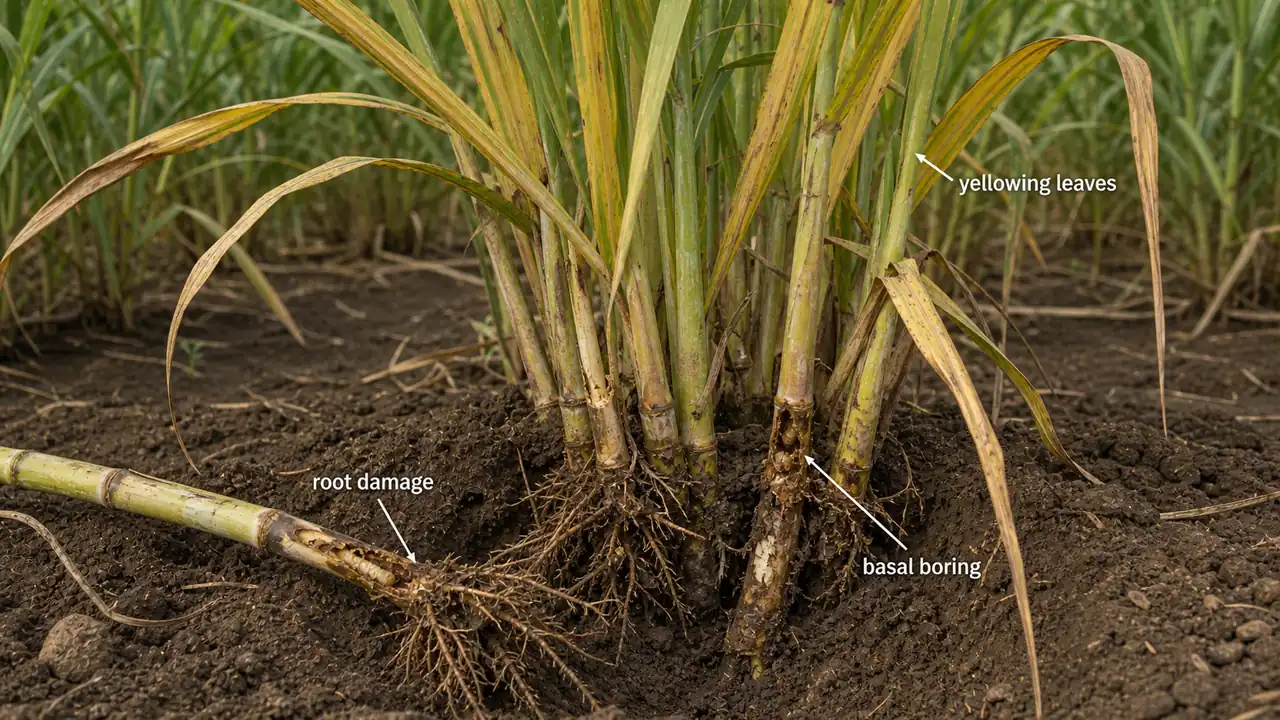
- Bores into the roots and base of the cane
- Causes drying and yellowing of leaves from the top downward
- Affected canes can be easily pulled out because roots are destroyed
- Does not cause typical "dead heart" — symptoms resemble water stress
NOTE
Root borer damage is often confused with drought stress because the above-ground symptoms (yellowing, wilting) are similar. The key difference: pulling the affected cane reveals damaged roots with bore holes, while drought-stressed plants have intact roots.
5. Gurdaspur Borer — The Regional Specialist
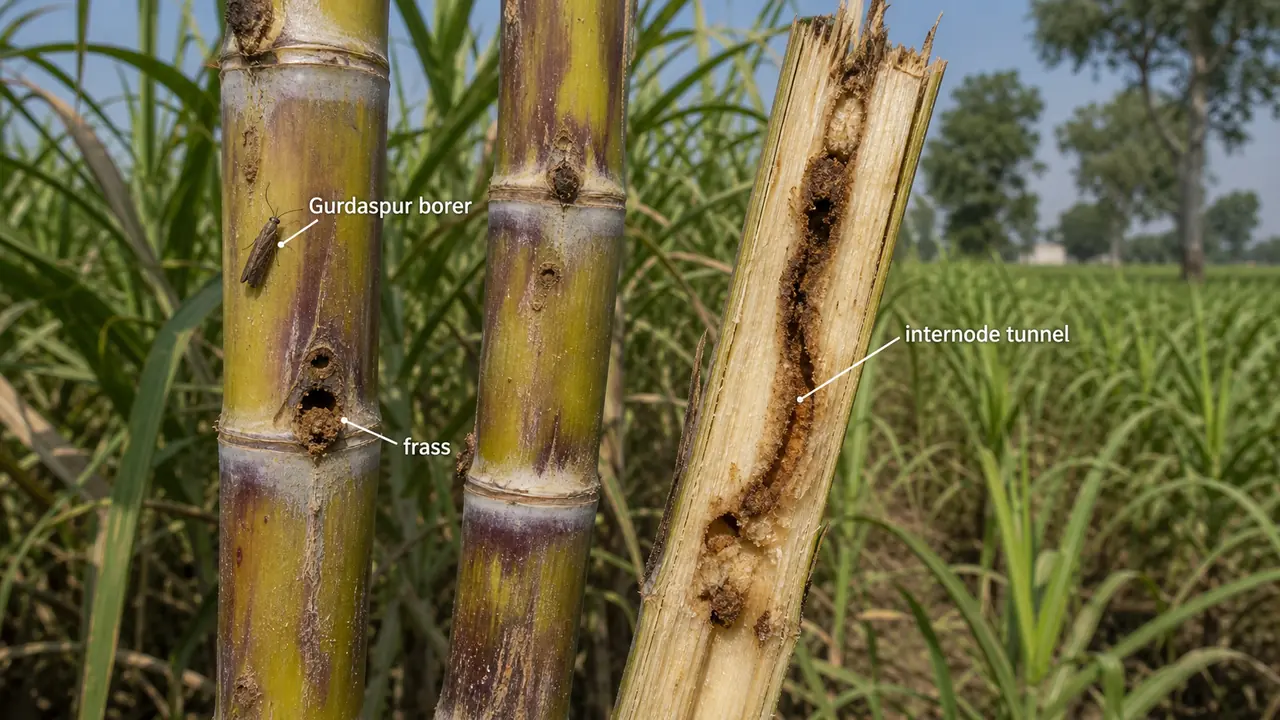
Scientific Name: Bissetia steniellus
Family: Crambidae | Order: Lepidoptera
Damage Symptoms
- Named after Gurdaspur district in Punjab where it was first reported as a serious pest
- Bores into the internodes causing internal damage
- Affects cane yield and sugar recovery
- Similar to internode borer in its damage pattern
TIP
The name "Gurdaspur borer" itself is a common exam question. Remember: Gurdaspur = Geographically named pest from Punjab. It is the only sugarcane borer named after its location of first serious occurrence.
Comparison Table: All Five Sugarcane Borers
This is the master comparison table for exam revision. Study the differences in plant part attacked, dead heart characteristics, and family.
| Feature | Early Shoot Borer | Internode Borer | Top Borer | Root Borer | Gurdaspur Borer |
|---|---|---|---|---|---|
| Scientific Name | Chilo infuscatellus | C. sacchariphagus indicus | Scirpophaga excerptalis | Emmalocera depressella | Bissetia steniellus |
| Family | Crambidae | Crambidae | Pyralidae | Pyralidae | Crambidae |
| Plant Part | Young shoots | Internodes | Growing apex | Roots/base | Internodes |
| Crop Age | 1-3 months | 4-7 months | 4+ months | Any | Any |
| Dead Heart? | Yes (easily pulled, offensive odour) | No | Yes (cannot be pulled, reddish brown) | No | No |
| Key Feature | Offensive odour | Reduces sugar recovery | Bunchy top, shot holes | Root destruction | Named after Punjab district |
| ETL | 15% dead hearts | — | — | — | — |
Exam Tips and Mnemonics
TIP
Mnemonic — "EITRG" for the Five Borers:
- Early shoot borer = Easy to pull (offensive odour, 1-3 months)
- Internode borer = Internal tunnelling (reduces sugar, no dead heart)
- Top borer = Tough to pull (reddish brown, bunchy top, shot holes)
- Root borer = Root destruction (yellowing from top)
- Gurdaspur borer = Geographically named (Punjab)
Family Memory Aid:
- Crambidae has the Chilo borers (C. infuscatellus, C. sacchariphagus) plus Gurdaspur
- Pyralidae has the "Point" borers — top (apex point) and root (base point)
Dead Heart "Pull Test" — The Number 1 Exam Question:
- Easy pull + bad smell = Early shoot borer (young crop)
- Tough pull + reddish brown = Top borer (mature crop)
- No dead heart at all = Internode borer, Root borer, or Gurdaspur borer
Top Borer Bio-control — "3 Egg, 2 Larval, 1 Prepupal, 1 Pupal":
- The only ichneumonid: Isotima javensis (prepupal stage, 100 pairs/ha)
Summary Cheat Sheet
| Concept / Topic | Key Details |
|---|---|
| All sugarcane borers | Order Lepidoptera; families: Crambidae and Pyralidae |
| Early shoot borer | Chilo infuscatellus — Crambidae; dead heart in 1-3 month crop; easily pulled out; offensive odour |
| Early shoot borer ETL | 15% dead hearts |
| Internode borer | Chilo sacchariphagus indicus — Crambidae; tunnels in internodes; reduces sugar recovery; no dead heart |
| Top borer | Scirpophaga excerptalis — Pyralidae; dead heart in mature cane; cannot be pulled; reddish brown |
| Top borer additional symptoms | Shot holes in leaves, red tunnels in midribs, bunchy top |
| Top borer resistant varieties | Co 724, CoJ 67, Co 1158, Co 1111 |
| Top borer bio-control (egg) | "TTT" — Telenomus beneficiens, Tetrastichus schoenobi, Trichogramma chilonis |
| Top borer bio-control (prepupal) | Isotima javensis — only ichneumonid; 100 pairs/ha |
| Top borer bio-control (pupal) | Tetrastichus ayyari |
| Root borer | Emmalocera depressella — Pyralidae; root damage; yellowing resembles drought stress |
| Gurdaspur borer | Bissetia steniellus — Crambidae; named after Gurdaspur district, Punjab |
| Key exam distinction | Dead heart pull test: easy pull + odour = ESB; tough pull + reddish brown = top borer |