🪲 Sugarcane Root Feeders: White Grub and Termites
Complete guide to white grub (Holotrichia consanguinea) and termites (Odontotermes obesus) in sugarcane — identification, damage symptoms, C-shaped grub recognition, sett treatment, resistant varieties, and management for IBPS AFO and ICAR exams.
Why Root Feeders Are the Most Deceptive Sugarcane Pests
A sugarcane farmer in Maharashtra's Kolhapur district sees his crop wilting and yellowing during July, even though there has been adequate rainfall. He assumes it is a nutrient deficiency and applies more fertiliser. The yellowing worsens. Finally, when he pulls an affected cane, it comes out effortlessly — the roots have been completely eaten away. Below the soil, he finds fat, C-shaped white grubs curled around the base of the clump.
Root feeders — white grubs and termites — are the most deceptive pests in sugarcane because all damage occurs underground, invisible until it is too late. By the time above-ground symptoms appear (yellowing, wilting, lodging), the root system is already severely damaged. Together, these two soil pests cause significant establishment failures and yield losses, particularly in light-textured soils.
Classification of Sugarcane Root Feeders
| S.No. | Common Name | Scientific Name | Family | Order |
|---|---|---|---|---|
| 1. | White grub | Holotrichia consanguinea | Melolonthidae | Coleoptera |
| 2. | Termites | Odontotermes obesus | Termitidae | Isoptera |
IMPORTANT
Pro Content Locked
Upgrade to Pro to access this lesson and all other premium content.
Charged once for one year · ₹1188 total
Save ₹100/month vs ₹2388/year launch price
- All Agriculture & Banking Courses
- AI Lesson Questions (100/day)
- AI Doubt Solver (50/day)
- Glows & Grows Feedback (30/day)
- AI Section Quiz (20/day)
- 22-Language Translation (100/day)
- Recall Questions (20/day)
- AI Quiz (15/day)
- AI Quiz Paper Analysis (100/day)
- AI Step-by-Step Explanations (100/day)
- Spaced Repetition Recall (FSRS)
- AI Tutor
- Immersive Text Questions
- Audio Lessons — Hindi & English
- Mock Tests & Previous Year Papers
- Summary & Mind Maps
- XP, Levels, Leaderboard & Badges
- Generate New Classrooms
- Voice AI Teacher (AgriDots Live)
- AI Revision Assistant
- Knowledge Gap Analysis
- Interactive Revision (LangGraph)
🔒 Secure one-time yearly payment via Razorpay · No hidden fees
Why Root Feeders Are the Most Deceptive Sugarcane Pests
A sugarcane farmer in Maharashtra's Kolhapur district sees his crop wilting and yellowing during July, even though there has been adequate rainfall. He assumes it is a nutrient deficiency and applies more fertiliser. The yellowing worsens. Finally, when he pulls an affected cane, it comes out effortlessly — the roots have been completely eaten away. Below the soil, he finds fat, C-shaped white grubs curled around the base of the clump.
Root feeders — white grubs and termites — are the most deceptive pests in sugarcane because all damage occurs underground, invisible until it is too late. By the time above-ground symptoms appear (yellowing, wilting, lodging), the root system is already severely damaged. Together, these two soil pests cause significant establishment failures and yield losses, particularly in light-textured soils.
Classification of Sugarcane Root Feeders
| S.No. | Common Name | Scientific Name | Family | Order |
|---|---|---|---|---|
| 1. | White grub | Holotrichia consanguinea | Melolonthidae | Coleoptera |
| 2. | Termites | Odontotermes obesus | Termitidae | Isoptera |
IMPORTANT
White grub and termites belong to completely different insect orders — Coleoptera (beetles) and Isoptera (termites) respectively. Despite both being soil-dwelling pests, their biology, behaviour, and management are fundamentally different.
1. White Grub — The C-Shaped Root Destroyer
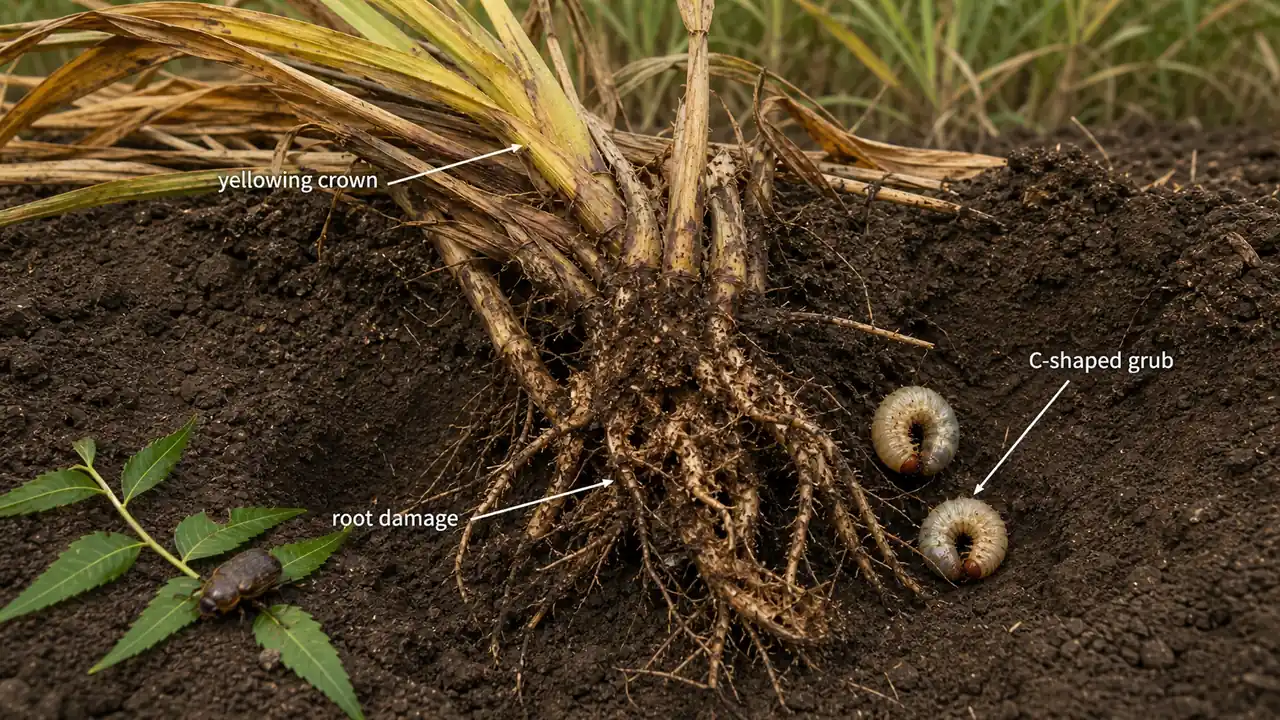
Scientific Name: Holotrichia consanguinea
Family: Melolonthidae | Order: Coleoptera
Host Range: Sorghum, maize, pearl millet, chillies, bhendi, brinjal — a polyphagous soil pest
Life Cycle Connection to Damage
Understanding the white grub's life cycle explains its damage pattern:
- Adult beetles emerge during the monsoon season and fly to nearby neem trees for mating and feeding
- Females return to the soil to lay eggs near crop roots
- Grubs hatch and feed on roots for several months
- The grub stage causes all the crop damage
Damage Symptoms
- Drying of crown, preceded by progressive yellowing and wilting of leaves
- Affected canes come off easily when pulled — because the roots are extensively damaged
- The grub itself is 'C' shaped, whitish yellow in colour, found close to the base of the clump when soil is dug
- Adults are dark brown beetles attracted to neem trees during monsoon season
IMPORTANT
The 'C' shaped whitish-yellow grub is the most tested morphological feature in exams. If a question describes a soil-dwelling pest with a C-shaped larva damaging sugarcane roots, the answer is always white grub (Holotrichia consanguinea).
Agricultural Example
In Rajasthan's sugarcane-growing pockets, adult white grub beetles swarm around neem, Ailanthus, and Acacia trees during the first monsoon rains in June-July. Alert farmers collect and destroy these beetles during their evening swarms — a single night of collection can significantly reduce the grub population in adjacent fields.
Management
| Method | Details | Rationale |
|---|---|---|
| Resistant cultivars | Co 6304, Co 1158, Co 5510 | Root systems that tolerate or resist grub feeding |
| Light traps | Set up during monsoon near neem trees | Attract and destroy adult beetles before egg-laying |
| Beetle collection | Collect adults from neem, Ailanthus, Acacia trees | Reduces egg-laying population directly |
| Adequate irrigation | Maintain soil moisture | Moisture stress worsens grub damage |
| Crop rotation | In endemic areas | Breaks the grub population build-up cycle |
2. Termites — The Sett Destroyers
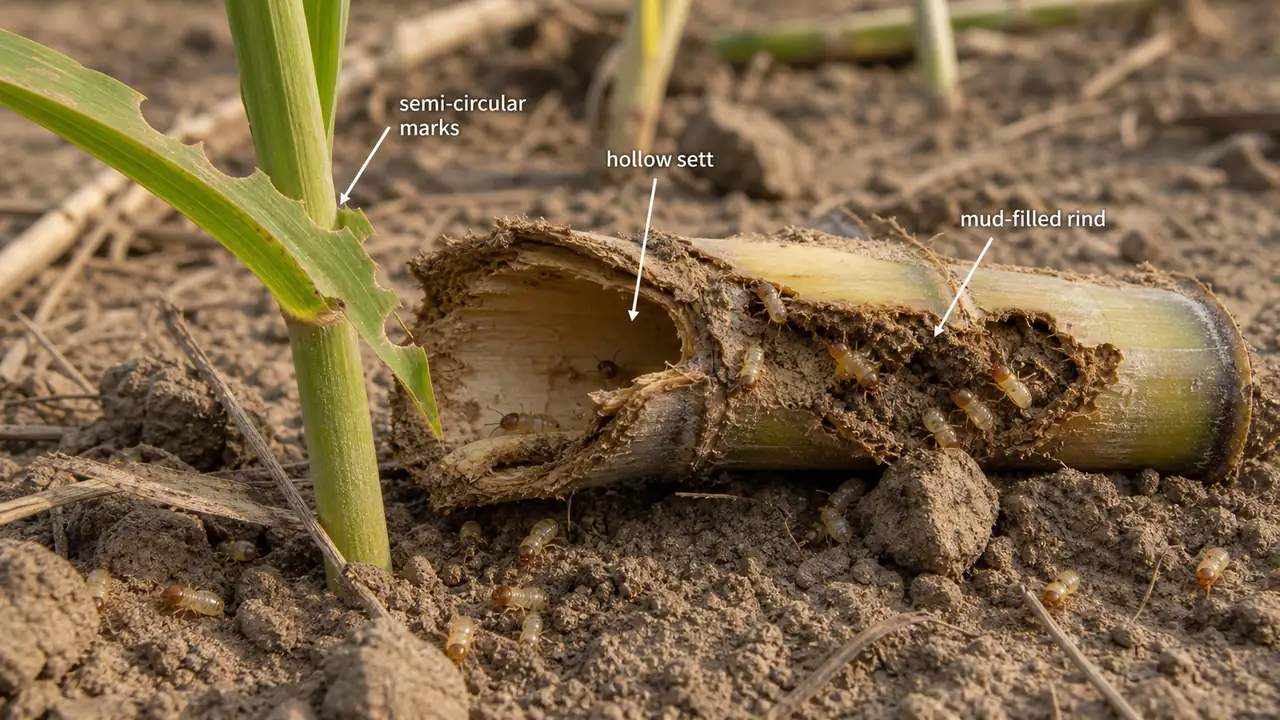
Scientific Name: Odontotermes obesus
Family: Termitidae | Order: Isoptera
Why Termites Are Especially Dangerous to Sugarcane
Sugarcane is propagated vegetatively through setts (stem cuttings), not seeds. Termites attack these setts in the soil before they even germinate, causing total establishment failure in affected patches. This makes termite management a planting-time priority.
Damage Symptoms — A Four-Stage Progression
- At planting: Poor germination of setts — termites hollow out the setts before buds can sprout
- In standing crop: Characteristic semi-circular feeding marks on the margins of leaves
- Internal damage: Setts become hollow inside and may be filled with soil; cane collapses if disturbed
- Advanced stage: Rind filled with mud — termites pack mud into the tunnels they create
Soil preference: A major problem specifically in light (sandy) soils where moisture retention is poor
Adult appearance: Cream-coloured tiny insects resembling ants but with dark-coloured heads
TIP
Three Diagnostic Signs of Termite Damage (Exam Essentials):
- Semi-circular feeding marks on leaf margins
- Setts hollow inside, filled with soil
- Rind filled with mud
If an exam question mentions any of these three signs, the answer is termites.
Agricultural Example
In Haryana's light-soil sugarcane areas, farmers who plant setts without chemical treatment can lose 30-40% of their planted setts to termites. The economic loss is not just the lost setts but also the cost of gap-filling and the delay in crop establishment, which pushes the entire crop cycle late.
NOTE
Termites are social insects belonging to Order Isoptera — NOT Hymenoptera (which includes ants, bees, and wasps). Despite looking similar to ants, termites are more closely related to cockroaches. This taxonomic distinction is a common exam trap.
Management
| Method | Chemical | Dosage |
|---|---|---|
| Sett treatment (primary) | Imidacloprid 70 WS | 100-150 g per 100 setts |
| Spray (standing crop) | Chlorantraniliprole 18.5 SC | 500-625 ml in 500 L water/ha |
| Spray (alternative) | Imidacloprid 17.8 SL | 350 ml in 500 L water/ha |
Comparison: White Grub vs Termites
This comparison table is essential for exams. Despite both being root/soil pests, they differ in almost every characteristic.
| Feature | White Grub | Termites |
|---|---|---|
| Scientific Name | Holotrichia consanguinea | Odontotermes obesus |
| Order | Coleoptera | Isoptera |
| Family | Melolonthidae | Termitidae |
| Larval Morphology | 'C' shaped, whitish yellow | Social colony, cream-coloured workers |
| Soil Preference | All soil types | Light (sandy) soils especially |
| Primary Target | Roots of standing crop | Setts (before germination) |
| Key Above-Ground Symptom | Crown drying, yellowing | Semi-circular leaf marks, poor germination |
| Key Below-Ground Sign | C-shaped grubs at root base | Hollow setts, mud-filled rind |
| Adult Behaviour | Fly to neem trees in monsoon | Form mud tubes, social colonies |
| Chemical Control | Not primary (cultural methods preferred) | Sett treatment with Imidacloprid |
| Resistant Varieties | Co 6304, Co 1158, Co 5510 | — |
How Root Feeders Compare to Borers
Students often confuse root feeders with borers because both cause internal damage. This table clarifies the differences.
| Feature | Root Feeders (White Grub, Termites) | Borers (ESB, Top Borer, etc.) |
|---|---|---|
| Location of damage | Below ground (roots, setts) | Above ground (shoots, internodes) |
| Order | Coleoptera, Isoptera | Lepidoptera |
| Dead heart? | No (yellowing and wilting instead) | Yes (ESB and top borer) |
| Impact on sugar quality | Indirect (reduced growth) | Direct (internode borer reduces juice) |
| Detection difficulty | Very high (underground) | Moderate (bore holes visible) |
Field Diagnosis: Sugarcane — Underground Damage?
When sugarcane plants wilt or show poor establishment despite adequate water:
- Pull up affected cane — comes out easily? Dig near roots — find C-shaped white grubs? → White Grub (Holotrichia) — Coleoptera; adults attracted to neem trees at dusk in June-July
- Mud galleries on sett base or lower internodes? Roots eaten/sheathed in mud? → Termites (Odontotermes) — treat setts with chlorpyriphos before planting
- Plants yellowing but no visible underground pests? → Check for waterlogging or soil-borne disease — not every wilting is a pest
Key distinction from borers: Root feeders cause yellowing and wilting (no dead heart). Borers cause dead heart and bore holes above ground. If there's no dead heart symptom, check underground.
Exam Tips and Mnemonics
TIP
Mnemonic — "WHITE GRUB = C-CAN" (C-shaped, Coleoptera, Adults fly to Neem):
- C = C-shaped grub (the most tested feature)
- C = Coleoptera (beetle order)
- A = Adults attracted to neem in monsoon
- N = Neem, Ailanthus, Acacia (adult feeding trees)
Mnemonic — "TERMITES = SLIM" (Sandy soil, Light, Isoptera, Mud in rind):
- S = Sandy (light) soils preferred
- L = Lost setts (poor germination)
- I = Isoptera (NOT Hymenoptera)
- M = Mud-filled rind, semi-circular marks
Sett Treatment Dosage:
- Imidacloprid 70 WS: "100-150 per 100" (100-150 g per 100 setts — the repeated "100" makes it easy to recall)
Common Exam Trap:
- Termites look like ants but are Order Isoptera, not Hymenoptera
- White grub looks like a worm but is Order Coleoptera (beetle larva), not a true worm
Summary Cheat Sheet
| Concept / Topic | Key Details |
|---|---|
| White grub | Holotrichia consanguinea — Order Coleoptera; Family Melolonthidae |
| White grub morphology | 'C' shaped, whitish yellow grub near base of clump |
| White grub damage | Drying of crown; root destruction; canes pull out easily |
| White grub adults | Dark brown beetles attracted to neem trees during monsoon |
| White grub resistant varieties | Co 6304, Co 1158, Co 5510 |
| Termites | Odontotermes obesus — Order Isoptera (not Hymenoptera); Family Termitidae |
| Termite damage signs | Poor sett germination; semi-circular feeding marks; setts hollow inside; rind filled with mud |
| Termite soil preference | Light (sandy) soils |
| Termite sett treatment | Imidacloprid 70 WS @ 100-150 g per 100 setts |
| Termite spray | Chlorantraniliprole 18.5 SC (500-625 ml/ha) or Imidacloprid 17.8 SL (350 ml/ha) |
| Key difference | White grub = C-shaped grub eating roots; Termites = social colony hollowing setts |