🐛 Sugarcane Sap & Foliage Feeders: Pyrilla, Whitefly, Mealybug, Scale Insects & Woolly Aphid
Complete guide to sugarcane sap feeders — Pyrilla perpusilla (richman's pest), whitefly, mealybug, scale insects, woolly aphid — with Epiricania melanoleuca bio-control, damage symptoms, and management for IBPS AFO and ICAR exams.
Why Sap Feeders Silently Drain Sugarcane
Walk through a sugarcane field in western Uttar Pradesh during September, and you may notice something odd: the lower leaves are coated with a black, sooty film, while the upper canopy appears healthy. Look more closely at the leaf undersides and you will find colonies of tiny insects — some white, some pink, some covered in a waxy coating — all feeding on the plant's sap. This is the work of sap feeders, a large group of sugarcane pests that weaken plants by sucking cell sap, secreting honeydew, and promoting sooty mould growth.
While borers cause dramatic dead hearts and broken canes, sap feeders cause a slow, steady decline in plant vigour. They reduce cane weight, lower sugar content, and in severe cases cause entire leaves to dry and fall. Among them, Pyrilla stands out as the most important sap feeder of sugarcane in India — so important that it has earned its own nickname: the "richman's pest".
Pro Content Locked
Upgrade to Pro to access this lesson and all other premium content.
Charged once for one year · ₹1188 total
Save ₹100/month vs ₹2388/year launch price
- All Agriculture & Banking Courses
- AI Lesson Questions (100/day)
- AI Doubt Solver (50/day)
- Glows & Grows Feedback (30/day)
- AI Section Quiz (20/day)
- 22-Language Translation (100/day)
- Recall Questions (20/day)
- AI Quiz (15/day)
- AI Quiz Paper Analysis (100/day)
- AI Step-by-Step Explanations (100/day)
- Spaced Repetition Recall (FSRS)
- AI Tutor
- Immersive Text Questions
- Audio Lessons — Hindi & English
- Mock Tests & Previous Year Papers
- Summary & Mind Maps
- XP, Levels, Leaderboard & Badges
- Generate New Classrooms
- Voice AI Teacher (AgriDots Live)
- AI Revision Assistant
- Knowledge Gap Analysis
- Interactive Revision (LangGraph)
🔒 Secure one-time yearly payment via Razorpay · No hidden fees
Why Sap Feeders Silently Drain Sugarcane
Walk through a sugarcane field in western Uttar Pradesh during September, and you may notice something odd: the lower leaves are coated with a black, sooty film, while the upper canopy appears healthy. Look more closely at the leaf undersides and you will find colonies of tiny insects — some white, some pink, some covered in a waxy coating — all feeding on the plant's sap. This is the work of sap feeders, a large group of sugarcane pests that weaken plants by sucking cell sap, secreting honeydew, and promoting sooty mould growth.
While borers cause dramatic dead hearts and broken canes, sap feeders cause a slow, steady decline in plant vigour. They reduce cane weight, lower sugar content, and in severe cases cause entire leaves to dry and fall. Among them, Pyrilla stands out as the most important sap feeder of sugarcane in India — so important that it has earned its own nickname: the "richman's pest".
Classification of Sugarcane Sap Feeders
Major Pests
| S.No. | Common Name | Scientific Name | Family | Order |
|---|---|---|---|---|
| 1. | Whitefly (A) | Aleurolobus barodensis | Aleyrodidae | Hemiptera |
| 1. | Whitefly (B) | Neomaskellia bergii, N. andropogonis | Aleyrodidae | Hemiptera |
| 2. | Sugarcane Pyrilla (Leafhopper) | Pyrilla perpusilla | Lophopidae | Hemiptera |
| 3. | Mealybug | Saccharicoccus sacchari | Pseudococcidae | Hemiptera |
| 4. | Scale insects | Melanaspis glomerata | Diaspididae | Hemiptera |
| 5. | Sugarcane woolly aphid | Ceratovacuna lanigera | Aphididae | Hemiptera |
Minor Pests
| S.No. | Common Name | Scientific Name | Family | Order |
|---|---|---|---|---|
| 6. | Aphid | Melanaphis sacchari, Rhopalosiphum maidis | Aphididae | Hemiptera |
| 7. | Gurdaspur borer | Bissetia steniellus | Crambidae | Lepidoptera |
| 8. | Grasshopper | Oxya velox | Acrididae | Orthoptera |
| 9. | Sugarcane mite | Schizotetranychus andropogoni | Tetranychidae | Acari |
IMPORTANT
All major sap feeders of sugarcane belong to Order Hemiptera. This consistent pattern makes classification questions straightforward — if the question asks about a sucking pest of sugarcane, the order is almost certainly Hemiptera.
1. Whiteflies — Two Species, Different Symptoms
Sugarcane is attacked by two groups of whiteflies, each producing distinct symptoms.
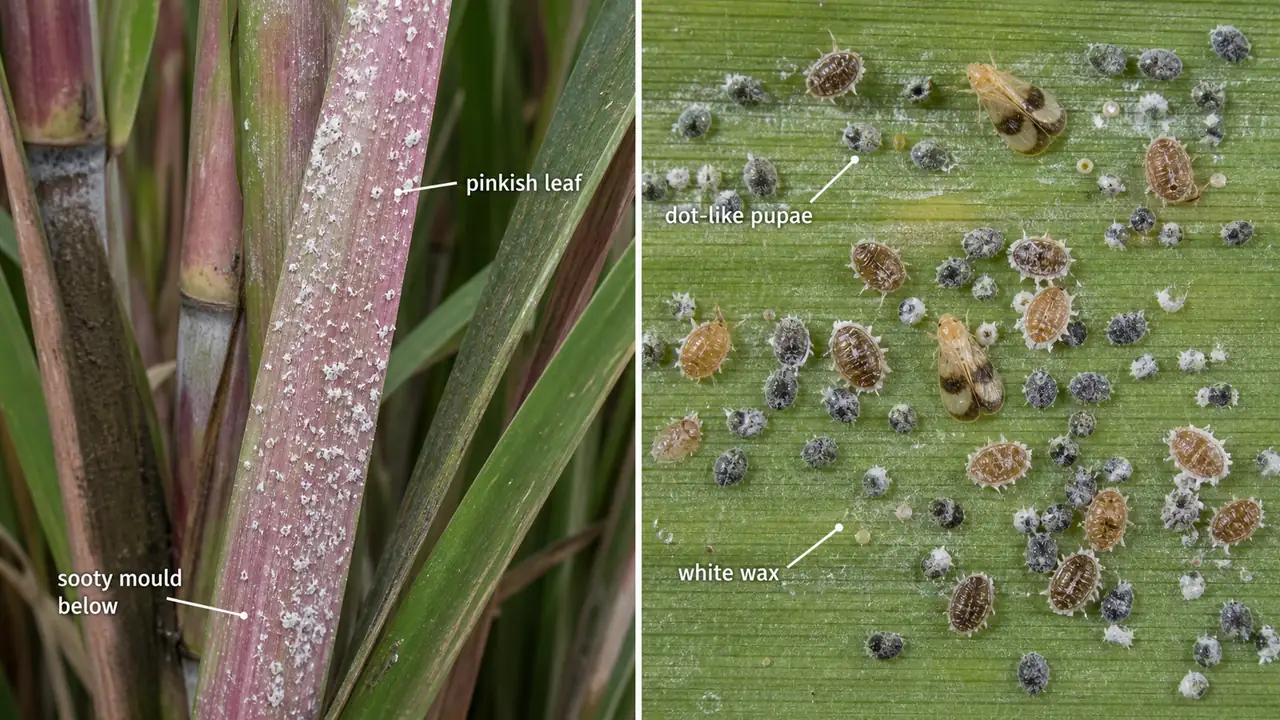
A) Aleurolobus barodensis (Aleyrodidae: Hemiptera)
- Infested leaves turn pinkish and gradually dry
- The infested leaves themselves look white (from insect bodies)
- Leaves below the infested zone are black due to sooty mould growth on honeydew dripping down from above
B) Neomaskellia bergii & N. andropogonis (Aleyrodidae: Hemiptera)
- Black, grey, or white dot-like pupae on the undersurface of leaves
- Nymph is oval in shape and brownish
- Bodies surrounded by white wax
- Pale brown adult has black bands on wings
TIP
Exam Distinction: Aleurolobus barodensis causes pinkish leaves (the infested leaves themselves change colour), while Neomaskellia species show dot-like pupae on the undersurface. If the question mentions pinkish discolouration, it is A. barodensis.
2. Sugarcane Pyrilla — The "Richman's Pest"
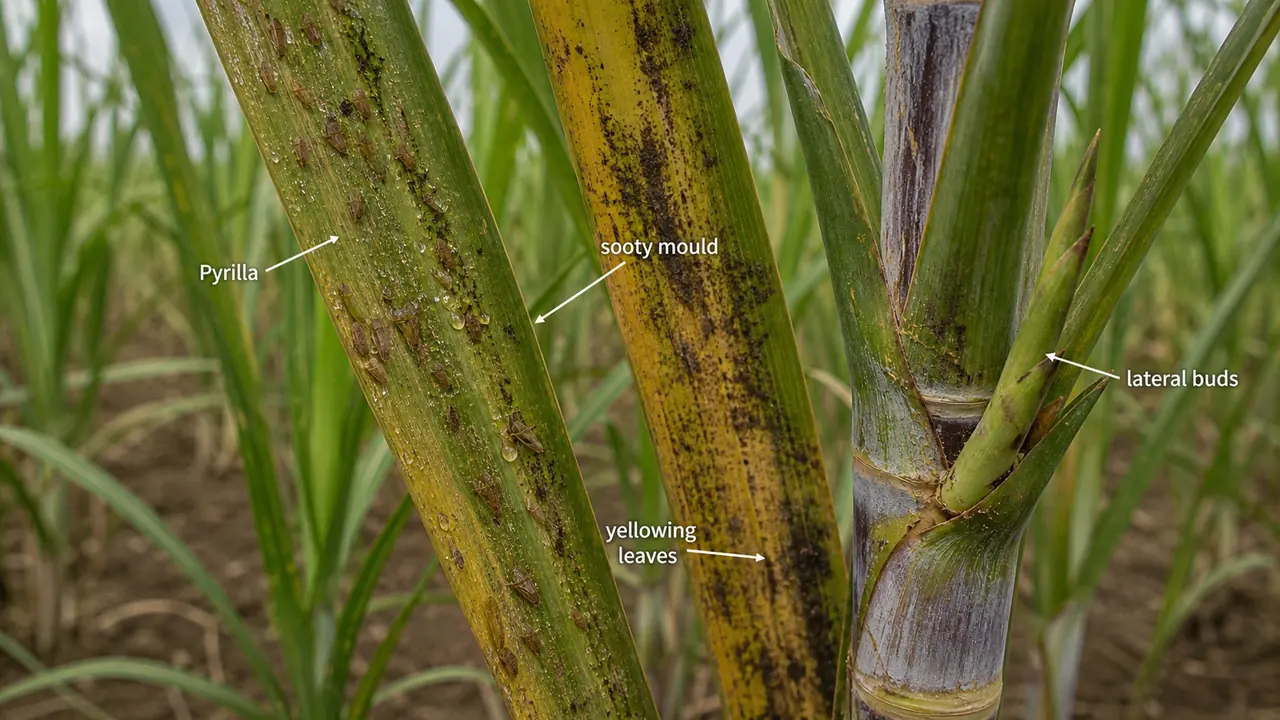
Scientific Name: Pyrilla perpusilla
Family: Lophopidae | Order: Hemiptera
Host Range: Sugarcane, wheat, barley, oats, maize, sorghum, baru, guinea grass, sudan grass
Why "Richman's Pest"?
Pyrilla earned this unique nickname because high nitrogen application favours its multiplication. Farmers who can afford to apply generous amounts of nitrogenous fertiliser (i.e., "rich" farmers) inadvertently create ideal conditions for Pyrilla outbreaks. This nitrogen-Pyrilla connection is one of the most frequently tested facts in competitive exams.
Damage Symptoms
- Can cause severe damage during long spells of rainy or cloudy days — the humid conditions favour rapid population build-up
- Symptoms include yellow leaves covered with black sooty mould
- Top leaves get dried up and lateral buds germinate (side shoots appear)
Agricultural Example
In the sugarcane belt of western UP, Pyrilla outbreaks are most common in September-October when the monsoon is waning but humidity remains high. Farmers who applied heavy doses of urea earlier in the season find their fields worst affected — a classic case of one agronomic practice (high N) creating a pest management problem.
Management — The Complete Arsenal
| Method | Type | Details |
|---|---|---|
| Avoid excess nitrogen | Cultural | High N favours Pyrilla — apply balanced fertilisation |
| Light traps | Cultural | Attract and monitor adult Pyrilla |
| Detrashing | Cultural | Remove dry leaves at 150 DAP and 210 DAP — destroys egg masses and nymphs |
| Epiricania melanoleuca | Biological | Release 4000-5000 cocoons or 4-6 lakh eggs per ha |
| Conserve predators | Biological | Brumus suturalis, Chilomenes sexmaculatus, Coccinella septumpunctata |
| Endosulfan 35 EC | Chemical | 2 L in 1000 L water/ha (last resort) |
IMPORTANT
Bio-control of Pyrilla: Epiricania melanoleuca is THE most important biological control agent for Pyrilla — and one of the most famous bio-control success stories in Indian entomology. Key facts:
- It is a Lepidopteran (moth) whose larvae are ectoparasites of Pyrilla nymphs and adults
- Release rate: 4000-5000 cocoons/ha or 4-6 lakh eggs/ha
- It is often described as a "predator" but technically functions as an ectoparasite
3. Mealybug — Hidden Under the Leaf Sheath
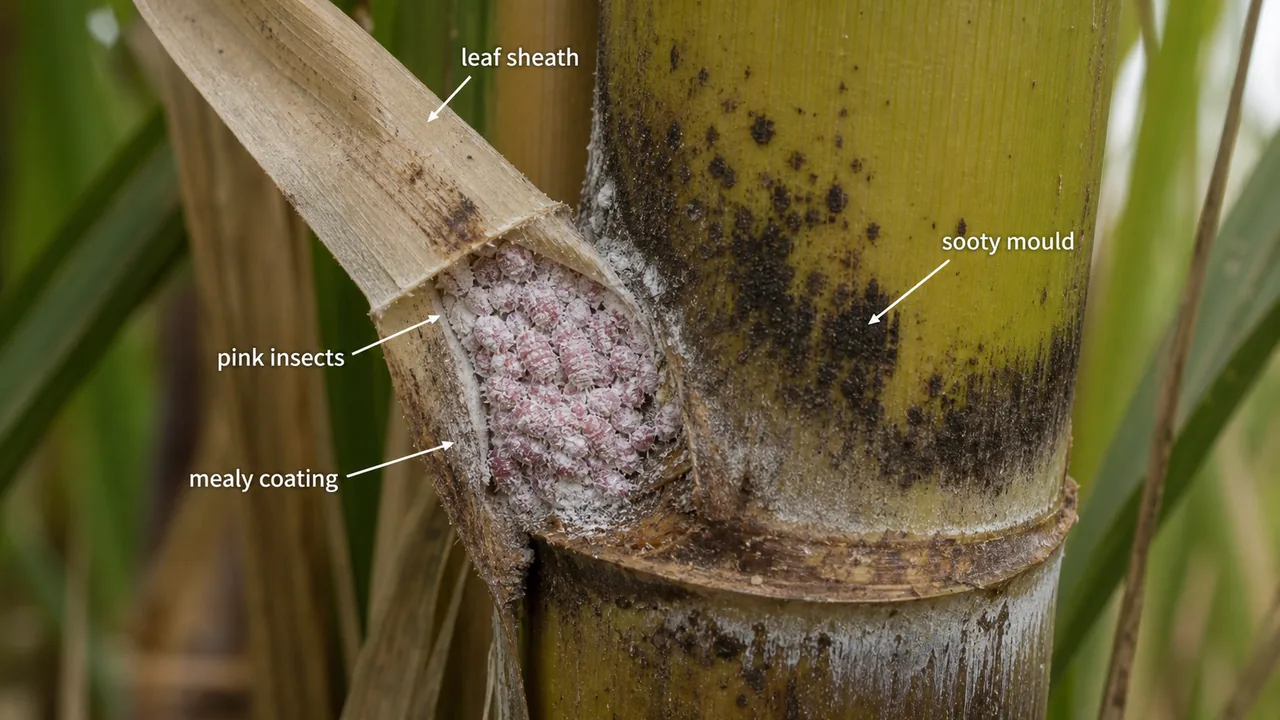
Scientific Name: Saccharicoccus sacchari
Family: Pseudococcidae | Order: Hemiptera
Host Range: Sugarcane, reeds, some grasses
Damage Symptoms
- Pinkish oval insects found beneath the leaf sheath on the nodes — hidden from casual observation
- Bodies have a whitish mealy coating (waxy secretion)
- Sooty mould develops on the plant surface above the colony
- Main cane becomes stunted; roots may also be attacked
NOTE
Mealybugs are typically discovered only when a farmer strips the leaf sheath — the insects cluster at the nodes beneath the sheath where they are protected from natural enemies and pesticides. Sooty mould on the exterior is often the first visible clue of their presence.
Agricultural Example
Sugar mill laboratories in Karnataka sometimes notice unexplained low sugar recovery from cane that looks externally normal. On closer inspection, mealybug colonies at the nodes have been siphoning nutrients and stunting internode development — reducing both weight and juice quality.
4. Scale Insects — Encrustation on Cane
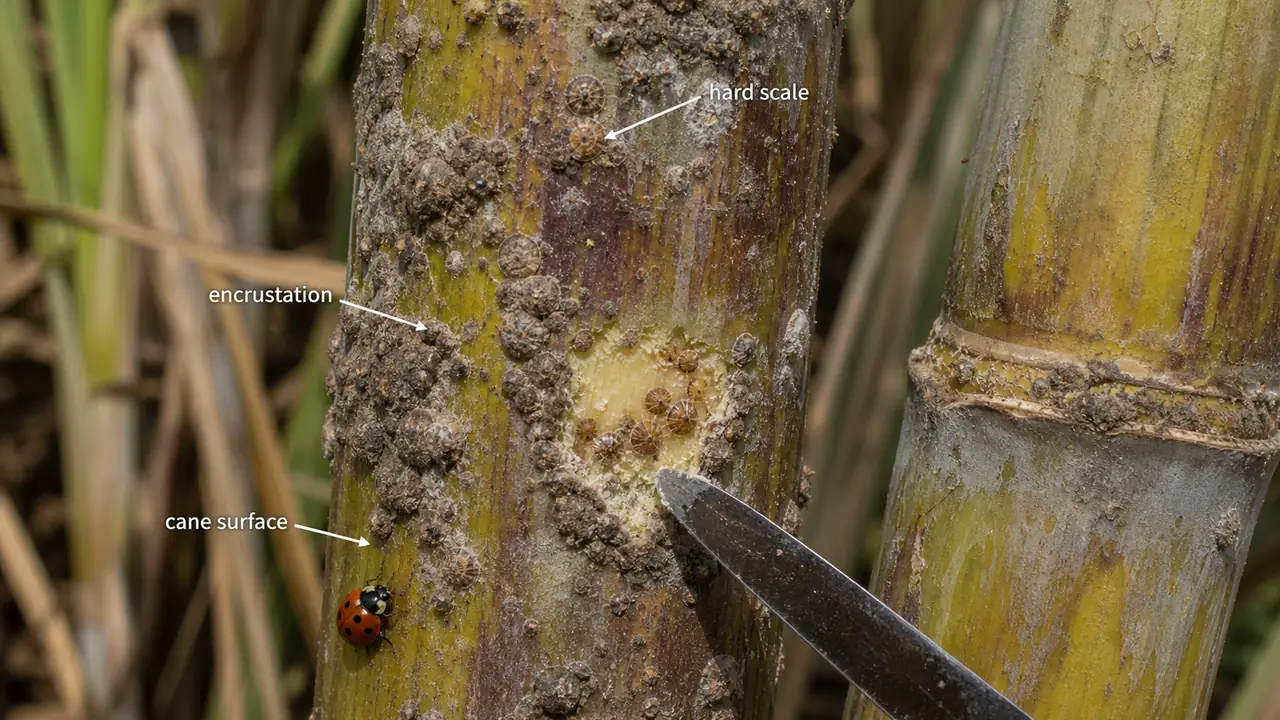
Scientific Name: Melanaspis glomerata
Family: Diaspididae | Order: Hemiptera
Damage Symptoms
- Form hard, crusty encrustations on the cane surface
- Suck sap continuously, weakening the plant
- Heavily infested canes show poor vigour and reduced juice quality
Management
- Primarily controlled through natural predators: Chilocorus nigritus and Pharoscymnus horni (both are ladybird beetles from Family Coccinellidae)
TIP
Scale insects in sugarcane are primarily managed by predatory ladybird beetles, not by chemicals. Remember: Chilocorus nigritus and Pharoscymnus horni — both "beetle" names for a "beetle" (scale) pest.
4b. Aphid — Rhopalosiphum maidis as Mosaic Virus Vector
IMPORTANT
Rhopalosiphum maidis is the vector of sugarcane mosaic virus — the most important viral disease of sugarcane. Transmission occurs in a non-persistent manner.
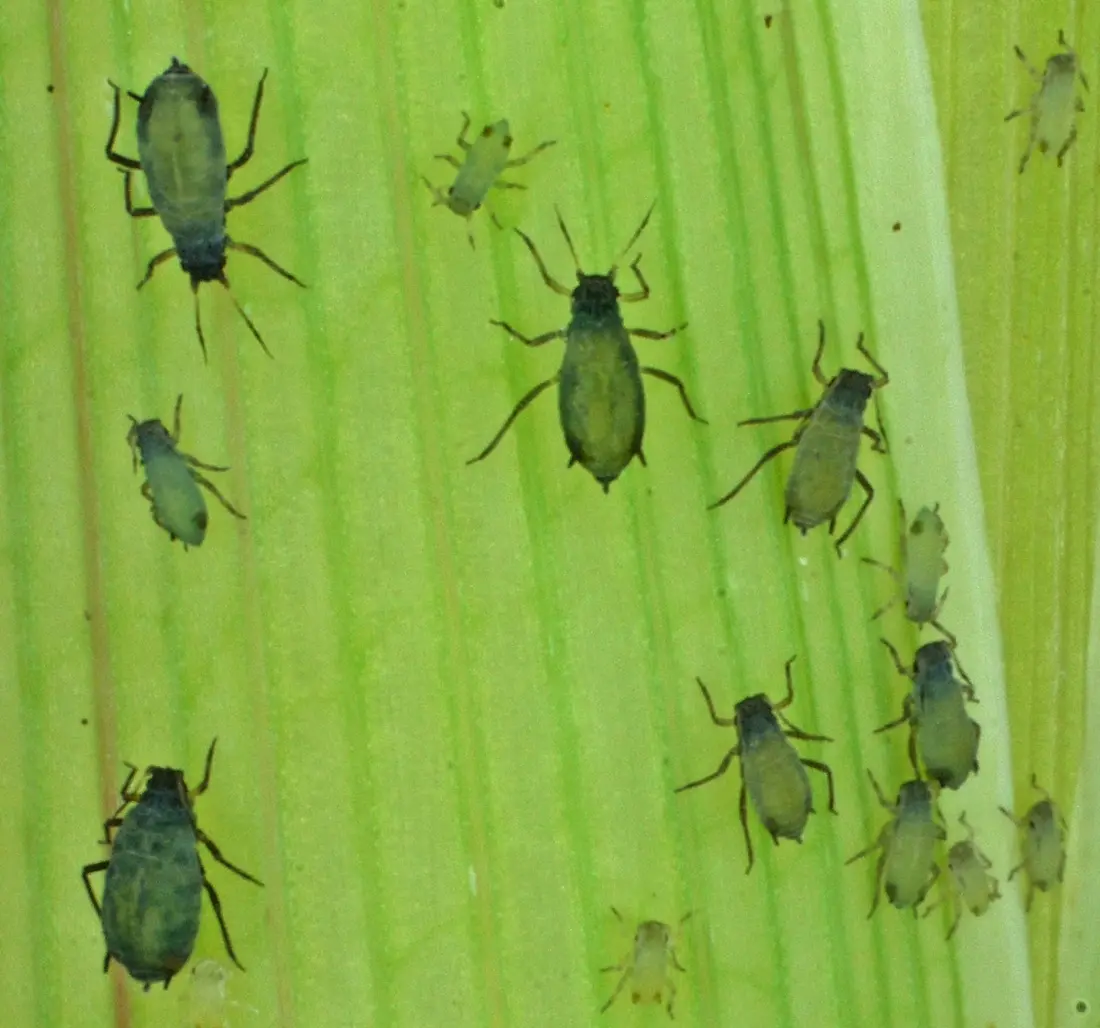
5. Sugarcane Woolly Aphid — The White Mass Maker
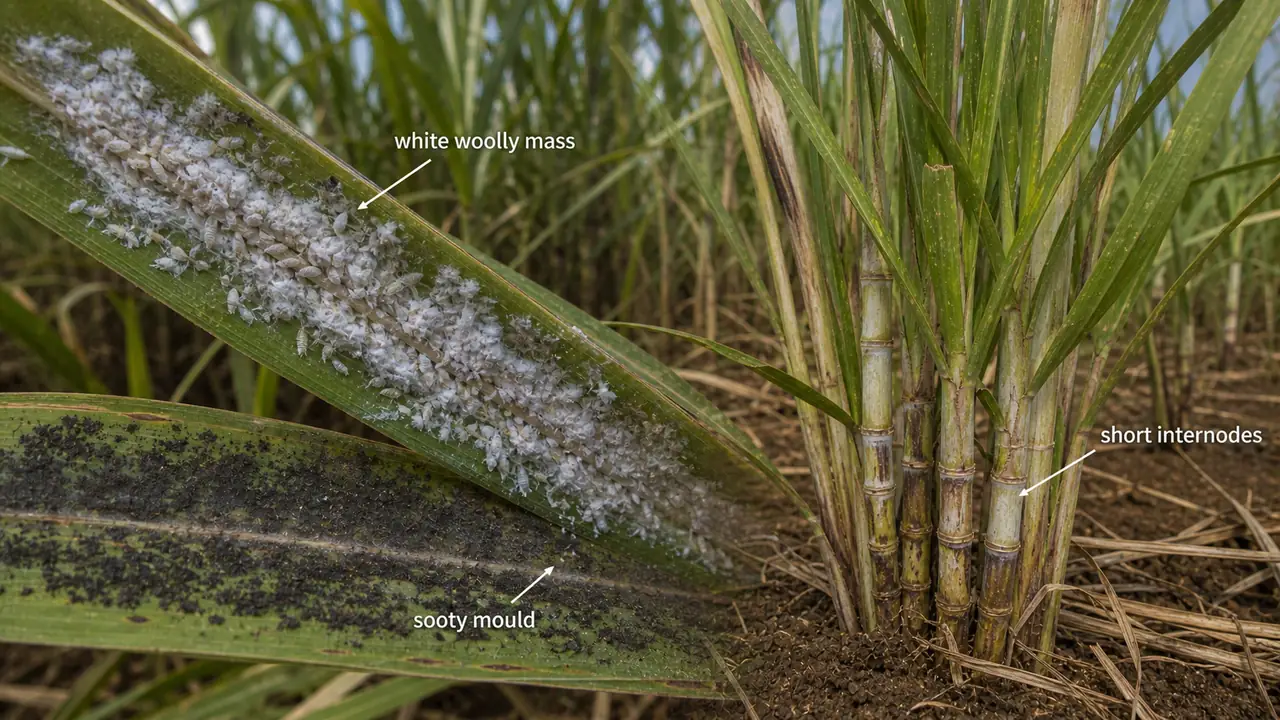
Scientific Name: Ceratovacuna lanigera
Family: Aphididae | Order: Hemiptera
Damage Symptoms
- Congregation of large numbers of white-coloured nymphs and adults on the undersurface of leaves — the white woolly mass is diagnostic
- Honeydew secretion with sooty mould on the upper surface of leaves
- Affected canes develop short internodes and narrow leaves with reduced girth
IMPORTANT
Sugarcane woolly aphid is identified by the white woolly mass on the leaf underside. Its most distinctive damage is short internodes and reduced girth — this growth reduction distinguishes it from other sap feeders that primarily cause yellowing or sooty mould without affecting cane dimensions.
Agricultural Example
The woolly aphid outbreak of 2002-2004 in Maharashtra's sugarcane belt caused panic among farmers. Entire fields appeared covered in white, fluffy masses. The pest had been recently introduced and natural enemies were absent. Eventually, the introduction of predatory beetles and parasitoids brought it under control — a textbook case of classical biological control.
6. Minor Pests Worth Recognising
These pests are less central than Pyrilla or woolly aphid, but they still appear in classification, vector, and field-diagnosis questions.
A) Aphid — Melanaphis sacchari / Rhopalosiphum maidis
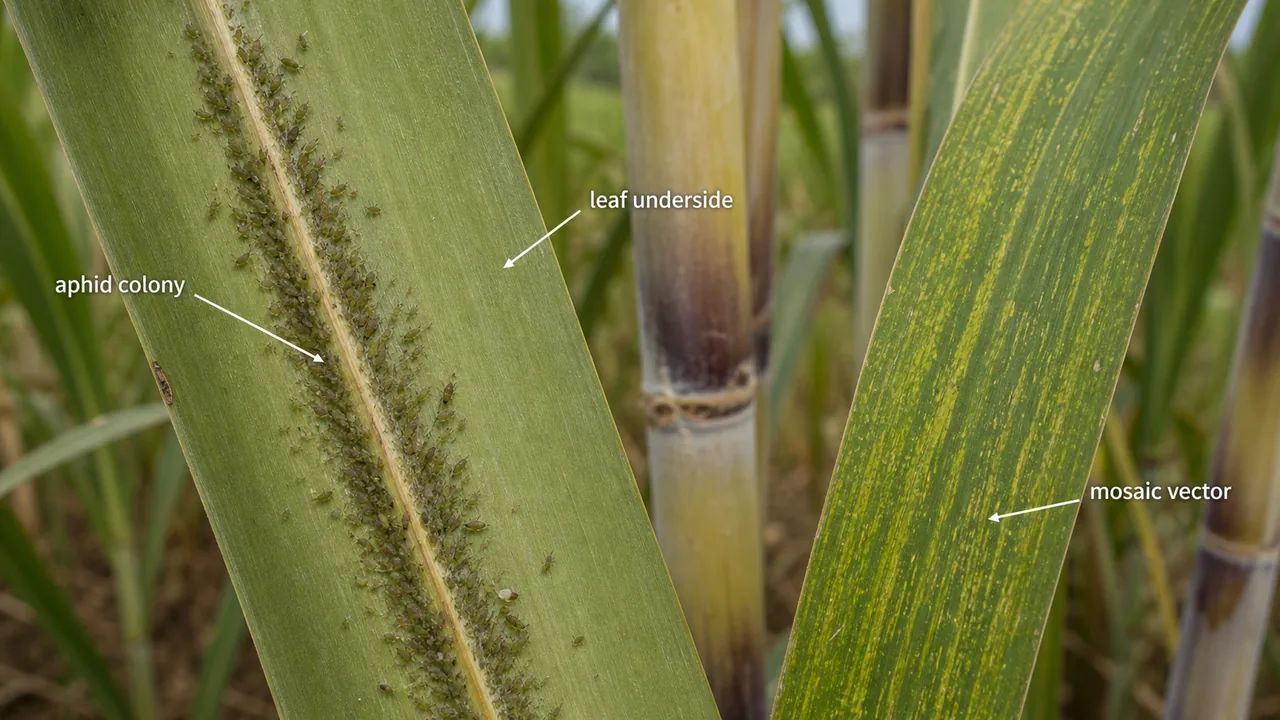
- Small soft-bodied aphids cluster on the underside of leaves, especially near the midrib
- Rhopalosiphum maidis is the important vector of sugarcane mosaic virus
- Transmission is non-persistent, so even brief feeding can spread infection
B) Gurdaspur Borer — Bissetia steniellus
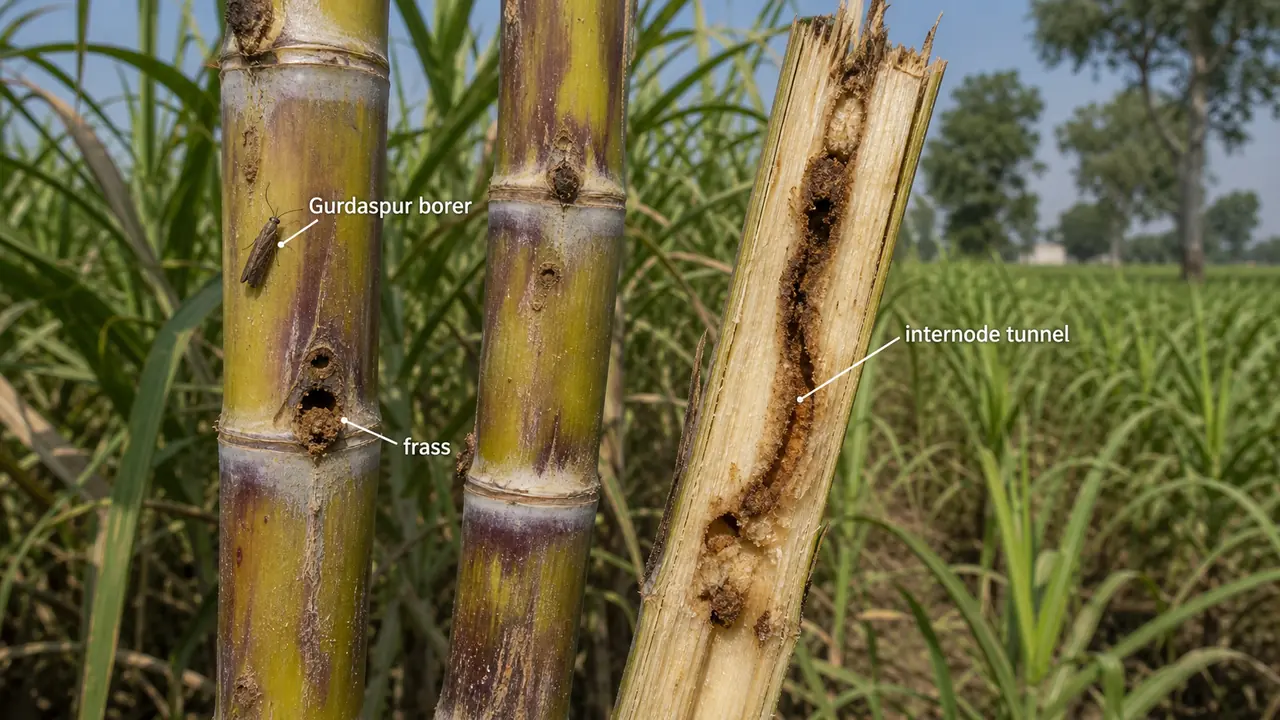
- A minor but exam-relevant sugarcane pest named after Gurdaspur district of Punjab
- Internodes show entry holes with frass and internal tunnelling
- It is a borer, not a sap feeder, so it does not fit the honeydew-sooty mould pattern
C) Grasshopper — Oxya velox
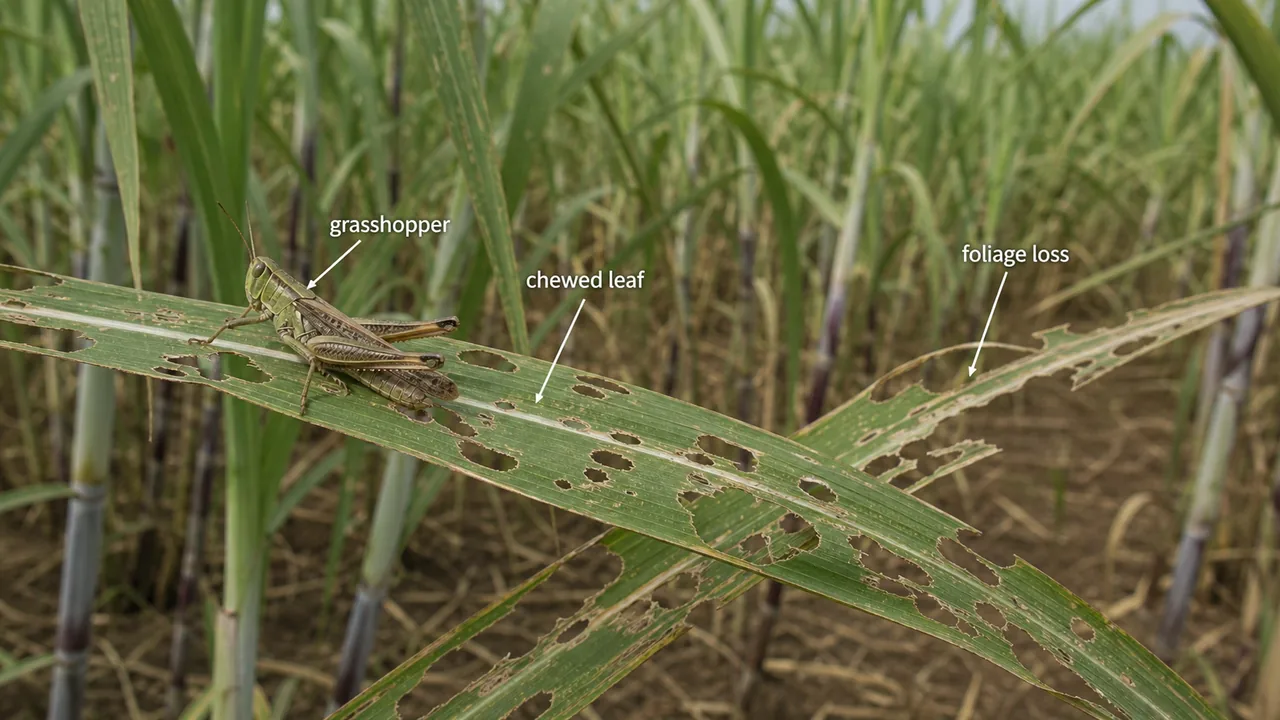
- Causes irregular chewing damage and defoliation on sugarcane leaves
- Recognised by its strong hind legs and external chewing, unlike sap feeders
- Important mainly as a minor foliage feeder
D) Sugarcane Mite — Schizotetranychus andropogoni
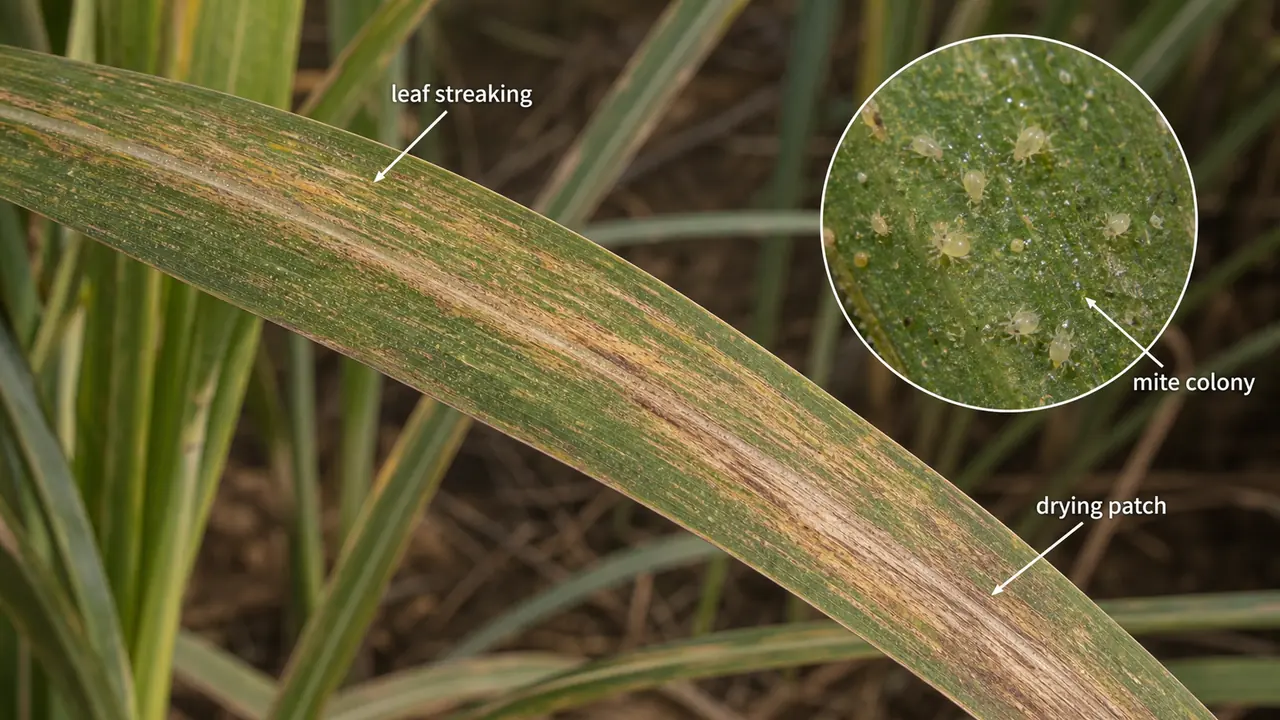
- Produces bronzed streaking, silvery stippling, and drying patches on leaves
- The mites themselves are tiny, so field diagnosis relies more on leaf symptoms than naked-eye body detail
- Best treated as a minor sap-removing foliage pest rather than a major sugarcane pest
Comparison: All Five Major Sap Feeders
| Pest | Scientific Name | Key Symptom | Diagnostic Feature | Family |
|---|---|---|---|---|
| Pyrilla | Pyrilla perpusilla | Yellow leaves + sooty mould | "Richman's pest" (favoured by high N) | Lophopidae |
| Whitefly (A. barodensis) | Aleurolobus barodensis | Pinkish leaves | White appearance above, sooty mould below | Aleyrodidae |
| Mealybug | Saccharicoccus sacchari | Pinkish oval insects at nodes | Whitish mealy coating, hidden under leaf sheath | Pseudococcidae |
| Scale insect | Melanaspis glomerata | Hard encrustation on cane | Controlled by Chilocorus nigritus | Diaspididae |
| Woolly aphid | Ceratovacuna lanigera | White woolly mass on leaf underside | Short internodes + reduced girth | Aphididae |
Biological Control Agents — Complete Summary
| Pest | Bio-control Agent | Type | Dosage/Details |
|---|---|---|---|
| Pyrilla | Epiricania melanoleuca | Lepidopteran ectoparasite | 4000-5000 cocoons or 4-6 lakh eggs/ha |
| Pyrilla | Coccinella septumpunctata | Predator (ladybird beetle) | Conserve |
| Pyrilla | Chilomenes sexmaculatus | Predator (ladybird beetle) | Conserve |
| Pyrilla | Brumus suturalis | Predator | Conserve |
| Scale insects | Chilocorus nigritus | Predator (ladybird beetle) | Conserve |
| Scale insects | Pharoscymnus horni | Predator (ladybird beetle) | Conserve |
How Sap Feeders Compare to Borers and Root Feeders
| Feature | Sap Feeders | Borers | Root Feeders |
|---|---|---|---|
| Feeding method | Suck cell sap | Bore into plant tissue | Feed on roots/setts underground |
| Damage visibility | Sooty mould, yellowing (visible) | Dead hearts, bore holes (visible) | Underground (invisible until late) |
| Order | Hemiptera (mostly) | Lepidoptera (all) | Coleoptera / Isoptera |
| Economic impact | Reduced vigour, lower sugar | Yield loss, dead tillers | Establishment failure |
| Management focus | Bio-control + cultural | Bio-control + resistant varieties | Chemical sett treatment + cultural |
Field Diagnosis: Sugarcane — Sap Feeder or Something Else?
When you see honeydew/sooty mold on sugarcane:
- Elongated insect with beak-like head (opisthorhynchous), honeydew dripping, sooty mold? → Pyrilla (P. perpusilla) — "richman's pest", favoured by excess nitrogen; biocontrol by Epiricania melanoleuca
- White waxy masses on leaf sheaths/nodes? → Mealybug (S. sacchari) — peel open sheath to find pink insects underneath
- Encrusted appearance on internodes, hard scale covers? → Scale Insect (M. glomerata) — scrape with fingernail, pink fluid = live infestation
- White woolly masses on leaf undersurface? → Woolly Aphid (C. lanigera) — invasive pest; look for thick white waxy covering
- Small white flies rising from leaf undersurface when disturbed? → Whitefly — check for sooty mold on upper leaf surface
Quick distinction: Sap feeders cause yellowing + honeydew + sooty mold. Borers cause dead heart + bore holes. Root feeders cause wilting + poor establishment.
Exam Tips and Mnemonics
TIP
Mnemonic — "PYRILLA = RICH N" (Richman's pest, favoured by high Nitrogen):
- Pyrilla = "Richman's pest"
- I = Favoured by high N (nitrogen)
- Bio-control = Epiricania melanoleuca (4000-5000 cocoons/ha)
- Detrash at 150 and 210 DAP
Mnemonic — "WMSW" for Sap Feeder Symptoms:
- Whitefly = Pinkish leaves (think: White fly makes Pink leaves — colour contrast)
- Mealybug = Mealy coating at Nodes (hidden under leaf sheath)
- Scale = Hard crust, Chilocorus predator
- Woolly aphid = White mass, Short internodes
Bio-control Memory Aid:
- Pyrilla → Epiricania melanoleuca (the famous one — a moth controlling a hopper!)
- Scale → Chilocorus nigritus (ladybird eating scale — beetle eating beetle)
- All three Pyrilla predators are coccinellids (ladybird beetles): Coccinella, Chilomenes, Brumus
Common Exam Trap:
- Epiricania melanoleuca is a Lepidopteran (moth), not a Hymenopteran parasitoid
- Pyrilla belongs to family Lophopidae, not the more common Cicadellidae
Summary Cheat Sheet
| Concept / Topic | Key Details |
|---|---|
| All major sap feeders | Order Hemiptera |
| Pyrilla | Pyrilla perpusilla — Family Lophopidae; "Richman's pest" (high N favours it) |
| Pyrilla symptoms | Yellow leaves + black sooty mould; lateral buds germinate |
| Pyrilla bio-control | Epiricania melanoleuca — 4000-5000 cocoons/ha or 4-6 lakh eggs/ha |
| Pyrilla predators | Brumus suturalis, Chilomenes sexmaculatus, Coccinella septumpunctata |
| Pyrilla cultural control | Avoid excess N; detrash at 150 DAP and 210 DAP; light traps |
| Whitefly (A. barodensis) | Pinkish leaves; sooty mould on leaves below |
| Whitefly (Neomaskellia spp.) | Black/grey/white dot-like pupae on leaf undersurface; white wax |
| Mealybug | Saccharicoccus sacchari — pinkish oval insects at nodes; whitish mealy coating; hidden under leaf sheath |
| Scale insects | Melanaspis glomerata — hard encrustation; predators: Chilocorus nigritus, Pharoscymnus horni |
| Woolly aphid | Ceratovacuna lanigera — white woolly mass; short internodes and reduced girth |
| Chemical (last resort) | Endosulfan 35 EC — 2 L in 1000 L water/ha (for Pyrilla) |
| Epiricania classification | Lepidopteran ectoparasite (moth, not Hymenopteran parasitoid) |