🛡️ Sugarcane IPM: Season-Wise Integrated Pest Management Strategy
Complete integrated pest management calendar for sugarcane — planting to harvest management, biological control agents for borers and Pyrilla, resistant varieties, sett treatment, ETL values, chemical control, and detrashing schedules for IBPS AFO and ICAR exams.
Why Sugarcane Needs a Unique IPM Approach
Consider a sugarcane crop in Tamil Nadu's Cauvery delta — it stays in the field for 12 to 18 months, far longer than any cereal or pulse crop. During this extended period, the crop faces a succession of different pest complexes: early shoot borer in the first three months, internode and top borers during grand growth, Pyrilla during humid weather, white grubs during the monsoon, and scale insects and mealybugs year-round.
No single pest control method can protect a crop for 12+ months. This is why sugarcane demands a systematic, season-wise Integrated Pest Management (IPM) approach that matches the right control method to the right pest at the right growth stage. The farmer who understands this seasonal logic not only saves money on unnecessary sprays but also preserves the natural enemies that do much of the pest control work for free.
For competitive exams, sugarcane IPM questions test your understanding of (1) which practice applies at which crop stage, (2) specific bio-control agents with dosages, (3) resistant varieties, and (4) the logic connecting nitrogen management to Pyrilla outbreaks.
Pro Content Locked
Upgrade to Pro to access this lesson and all other premium content.
Charged once for one year · ₹1188 total
Save ₹100/month vs ₹2388/year launch price
- All Agriculture & Banking Courses
- AI Lesson Questions (100/day)
- AI Doubt Solver (50/day)
- Glows & Grows Feedback (30/day)
- AI Section Quiz (20/day)
- 22-Language Translation (100/day)
- Recall Questions (20/day)
- AI Quiz (15/day)
- AI Quiz Paper Analysis (100/day)
- AI Step-by-Step Explanations (100/day)
- Spaced Repetition Recall (FSRS)
- AI Tutor
- Immersive Text Questions
- Audio Lessons — Hindi & English
- Mock Tests & Previous Year Papers
- Summary & Mind Maps
- XP, Levels, Leaderboard & Badges
- Generate New Classrooms
- Voice AI Teacher (AgriDots Live)
- AI Revision Assistant
- Knowledge Gap Analysis
- Interactive Revision (LangGraph)
🔒 Secure one-time yearly payment via Razorpay · No hidden fees
Why Sugarcane Needs a Unique IPM Approach
Consider a sugarcane crop in Tamil Nadu's Cauvery delta — it stays in the field for 12 to 18 months, far longer than any cereal or pulse crop. During this extended period, the crop faces a succession of different pest complexes: early shoot borer in the first three months, internode and top borers during grand growth, Pyrilla during humid weather, white grubs during the monsoon, and scale insects and mealybugs year-round.
No single pest control method can protect a crop for 12+ months. This is why sugarcane demands a systematic, season-wise Integrated Pest Management (IPM) approach that matches the right control method to the right pest at the right growth stage. The farmer who understands this seasonal logic not only saves money on unnecessary sprays but also preserves the natural enemies that do much of the pest control work for free.
For competitive exams, sugarcane IPM questions test your understanding of (1) which practice applies at which crop stage, (2) specific bio-control agents with dosages, (3) resistant varieties, and (4) the logic connecting nitrogen management to Pyrilla outbreaks.
The IPM Principle: Seasonal Succession of Pests
Understanding pest succession across the sugarcane growth cycle is the foundation of IPM planning:
| Crop Stage | Duration | Dominant Pests | Why These Pests? |
|---|---|---|---|
| Planting | Jan-Mar | Termites, white grub | Setts and roots are vulnerable in soil |
| Early growth | 1-3 months | Early shoot borer | Young, tender shoots available |
| Grand growth | 4-7 months | Top borer, internode borer, Pyrilla | Growing apex and internodes expanding; humid weather favours Pyrilla |
| Maturity | 8-12 months | Scale insects, mealybug, woolly aphid | Long exposure allows slow-building pests to reach damaging levels |
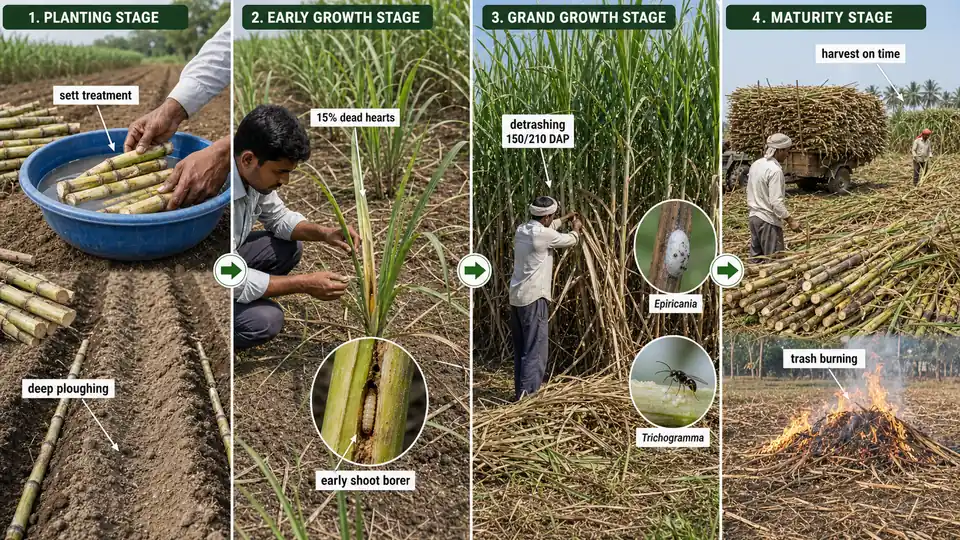
Season-Wise IPM Calendar
Planting Stage (January - March)
The goal at planting is to protect setts from soil pests and lay the groundwork for the entire season's pest management.
| Activity | Target Pest | Details | Why It Works |
|---|---|---|---|
| Sett treatment | Termites | Imidacloprid 70 WS @ 100-150 g per 100 setts | Systemic protection during vulnerable germination phase |
| Select resistant varieties | Multiple | Borers: Co 724, CoJ 67, Co 1158, Co 1111; White grub: Co 6304, Co 5510 | Built-in resistance reduces need for interventions later |
| Deep ploughing | White grub, termites | Expose soil-dwelling stages to sun and predators | Physical disruption of pest life cycle |
| Light traps | White grub adults | Set up during monsoon season near neem trees | Intercept beetles before they lay eggs |
TIP
Resistant Variety Overlap: Co 1158 appears in both borer-resistant and white grub-resistant lists, making it a versatile choice. For exams, this dual resistance is worth noting.
Early Growth Stage (1-3 Months)
This is the stage when early shoot borer is the primary concern. Sucking pests begin their build-up.
| Activity | Target Pest | Details | Why It Works |
|---|---|---|---|
| Monitor dead hearts | Early shoot borer | ETL: 15% dead hearts | Action only needed above this threshold |
| Remove dead hearts | Early shoot borer | Pull out and destroy affected shoots | Removes larvae before they pupate |
| Avoid excess nitrogen | Pyrilla | Balanced fertilisation, not excessive urea | High N favours Pyrilla — prevention at this stage |
| Adequate irrigation | Termites, white grub | Maintain soil moisture | Moisture stress worsens soil pest damage |
Grand Growth Stage (4-7 Months)
This is the most active stage for pest management. Multiple pests are present, and biological control becomes critical.
| Activity | Target Pest | Details | Why It Works |
|---|---|---|---|
| Detrashing | Pyrilla, borers | Remove dry leaves at 150 DAP and 210 DAP | Destroys egg masses and exposes pests to natural enemies |
| Release Epiricania melanoleuca | Pyrilla | 4000-5000 cocoons/ha or 4-6 lakh eggs/ha | The most effective bio-control for Pyrilla |
| Release egg parasitoids | Top borer | Trichogramma chilonis, Telenomus beneficiens | Kills eggs before larvae can bore in |
| Monitor sooty mould | Whitefly, mealybug | Black mould on leaves = sap feeder present | Early warning system for hidden infestations |
| Conserve predators | Scale insects | Chilocorus nigritus, Pharoscymnus horni | Avoid broad-spectrum sprays that kill predators |
Maturity Stage (8-12 Months)
The focus shifts to preventing pest carryover to the next season (especially important in ratoon crops).
| Activity | Target Pest | Details | Why It Works |
|---|---|---|---|
| Harvest at maturity | All | Do not delay harvest | Avoids ratoon build-up of pests |
| Trash burning | Borers, termites | Destroy pupae and overwintering stages | Breaks pest cycle for next season |
| Crop rotation | White grub, termites | Rotate with non-host crops in endemic areas | Prevents population build-up over years |
Biological Control — The Complete Arsenal
Sugarcane has one of the most developed biological control programmes in Indian agriculture. Understanding the bio-control agent for each pest is critical for exams.
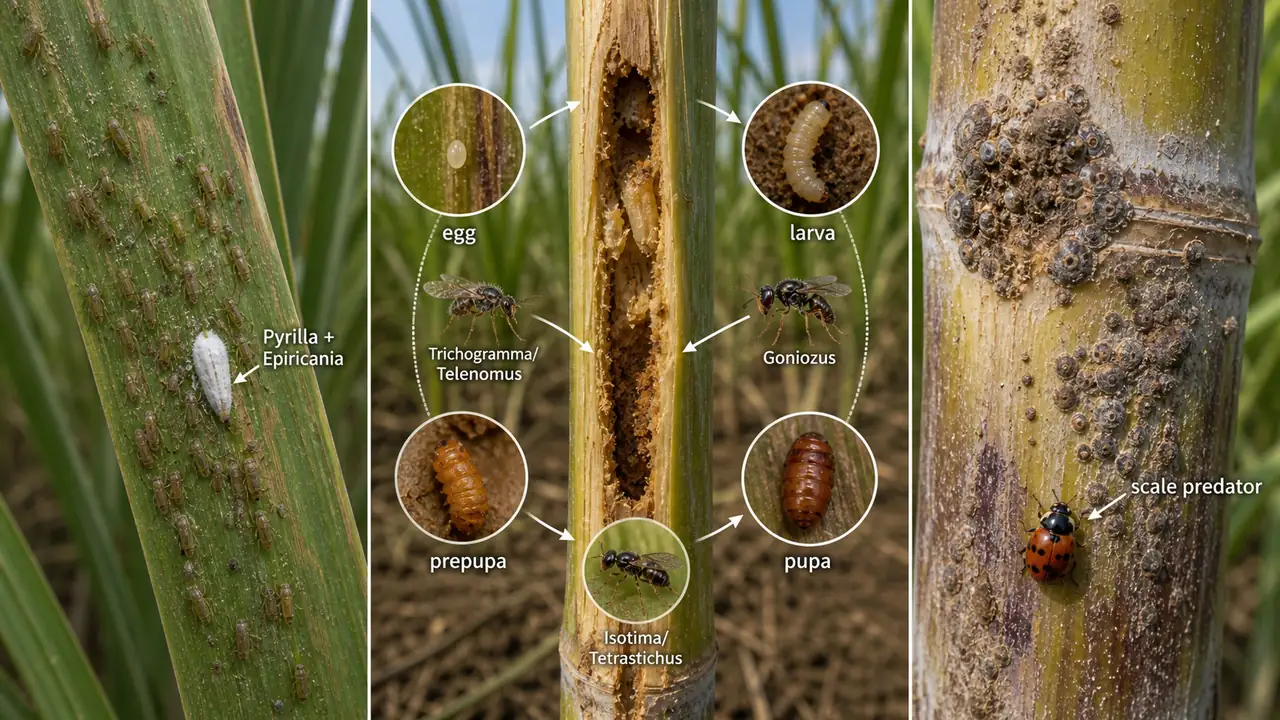
Bio-control Agents by Target Pest
| Bio-control Agent | Target Pest | Type | Dosage/Details |
|---|---|---|---|
| Epiricania melanoleuca | Pyrilla | Lepidopteran ectoparasite | 4000-5000 cocoons or 4-6 lakh eggs/ha |
| Isotima javensis | Top borer | Ichneumonid (prepupal parasitoid) | 100 pairs/ha |
| Trichogramma chilonis | Top borer | Egg parasitoid | Inundative release |
| Telenomus beneficiens | Top borer | Egg parasitoid | — |
| Tetrastichus schoenobi | Top borer | Egg parasitoid | — |
| Goniozus indicus | Top borer | Larval parasitoid | — |
| Tetrastichus ayyari | Top borer | Pupal parasitoid | — |
| Chilocorus nigritus | Scale insects | Predator (ladybird beetle) | Conserve |
| Pharoscymnus horni | Scale insects | Predator (ladybird beetle) | Conserve |
| Coccinella septumpunctata | Pyrilla | Predator (ladybird beetle) | Conserve |
| Chilomenes sexmaculatus | Pyrilla | Predator (ladybird beetle) | Conserve |
| Brumus suturalis | Pyrilla | Predator | Conserve |
Top Borer Bio-control — The Multi-Stage Approach
This is the most comprehensive bio-control programme for any sugarcane pest, attacking the pest at four different life stages.
| Life Stage Targeted | Bio-control Agent | Notes |
|---|---|---|
| Egg | Trichogramma chilonis, Telenomus beneficiens, Tetrastichus schoenobi | Three egg parasitoids — "TTT" |
| Larval | Goniozus indicus, Chelonus sp. | Two larval parasitoids |
| Prepupal | Isotima javensis | The ONLY ichneumonid; 100 pairs/ha |
| Pupal | Tetrastichus ayyari | Final stage before adult emergence |
IMPORTANT
For exams, remember the top borer bio-control hierarchy:
- Egg stage (3 agents): "TTT" — Trichogramma, Telenomus, Tetrastichus schoenobi
- Larval stage (2 agents): Goniozus + Chelonus
- Prepupal (1 agent): Isotima javensis (ichneumonid, 100 pairs/ha)
- Pupal (1 agent): Tetrastichus ayyari
Cultural Control Methods — Summary
| Practice | Target | Details | Key Number |
|---|---|---|---|
| Resistant varieties (borers) | Top borer | Co 724, CoJ 67, Co 1158, Co 1111 | 4 varieties |
| Resistant varieties (white grub) | White grub | Co 6304, Co 1158, Co 5510 | 3 varieties |
| Sett treatment | Termites | Imidacloprid 70 WS | 100-150 g/100 setts |
| Detrashing | Pyrilla, borers | Remove dry leaves | 150 DAP and 210 DAP |
| Nitrogen management | Pyrilla | Avoid excess N | "Richman's pest" logic |
| Crop rotation | White grub, termites | Rotate in endemic areas | — |
| Irrigation | Termites, white grub | Adequate moisture | Stress worsens damage |
Chemical Control — Last Resort Only
| Pest | Chemical | Dosage | When to Apply |
|---|---|---|---|
| Termites (sett treatment) | Imidacloprid 70 WS | 100-150 g per 100 setts | At planting |
| Termites (spray) | Chlorantraniliprole 18.5 SC | 500-625 ml in 500 L water/ha | Standing crop |
| Termites (spray alternative) | Imidacloprid 17.8 SL | 350 ml in 500 L water/ha | Standing crop |
| Pyrilla | Endosulfan 35 EC | 2 L in 1000 L water/ha | Only when bio-control insufficient |
NOTE
In sugarcane IPM, chemicals are used primarily for soil pests (termites) where biological control is impractical. For above-ground pests like Pyrilla, the first line of defence should always be Epiricania melanoleuca and cultural practices. Chemicals are the last resort.
ETL Values for Sugarcane Pests
| Pest | ETL | Stage to Monitor |
|---|---|---|
| Early shoot borer | 15% dead hearts | 1-3 months after planting |
NOTE
Only early shoot borer has a well-defined ETL for sugarcane. Most other sugarcane pests are managed based on visible symptoms rather than quantified thresholds. This makes the 15% dead heart figure especially important for exams.
Pest-Wise Management Quick Reference
| Pest | Cultural | Biological | Chemical |
|---|---|---|---|
| Early shoot borer | Remove dead hearts, resistant varieties | — | — |
| Top borer | Resistant varieties (Co 724, etc.) | Isotima javensis, Trichogramma, Telenomus, Tetrastichus | — |
| Internode borer | Resistant varieties | — | — |
| White grub | Light traps, crop rotation, irrigation, beetle collection | — | — |
| Termites | Sett treatment, irrigation | — | Imidacloprid, Chlorantraniliprole |
| Pyrilla | Avoid excess N, detrashing (150 & 210 DAP) | Epiricania melanoleuca (4000-5000 cocoons/ha) | Endosulfan 35 EC |
| Scale insects | — | Chilocorus nigritus, Pharoscymnus horni | — |
| Woolly aphid | — | Predatory beetles | — |
| Mealybug | Detrashing | — | — |
How Cotton IPM Compares to Sugarcane IPM
This cross-crop comparison helps build connections for exams that test IPM principles.
| Feature | Cotton IPM | Sugarcane IPM |
|---|---|---|
| Crop duration | 5-6 months | 12-18 months |
| Dominant technology | Bt cotton (Cry proteins) | Resistant varieties (no Bt sugarcane) |
| Key bio-control | Trichogramma (bollworm eggs) | Epiricania melanoleuca (Pyrilla) |
| Refuge strategy | 20% non-Bt required | Not applicable |
| Nitrogen-pest link | Not prominent | Critical (excess N → Pyrilla) |
| Main soil pest | — | Termites (sett treatment) |
| Chemical use | Endosulfan for bollworms | Imidacloprid for termites |
| Detrashing | Not applicable | 150 and 210 DAP (Pyrilla + borers) |
Field Diagnosis: Sugarcane — Quick Decision Guide
What symptom do you see?
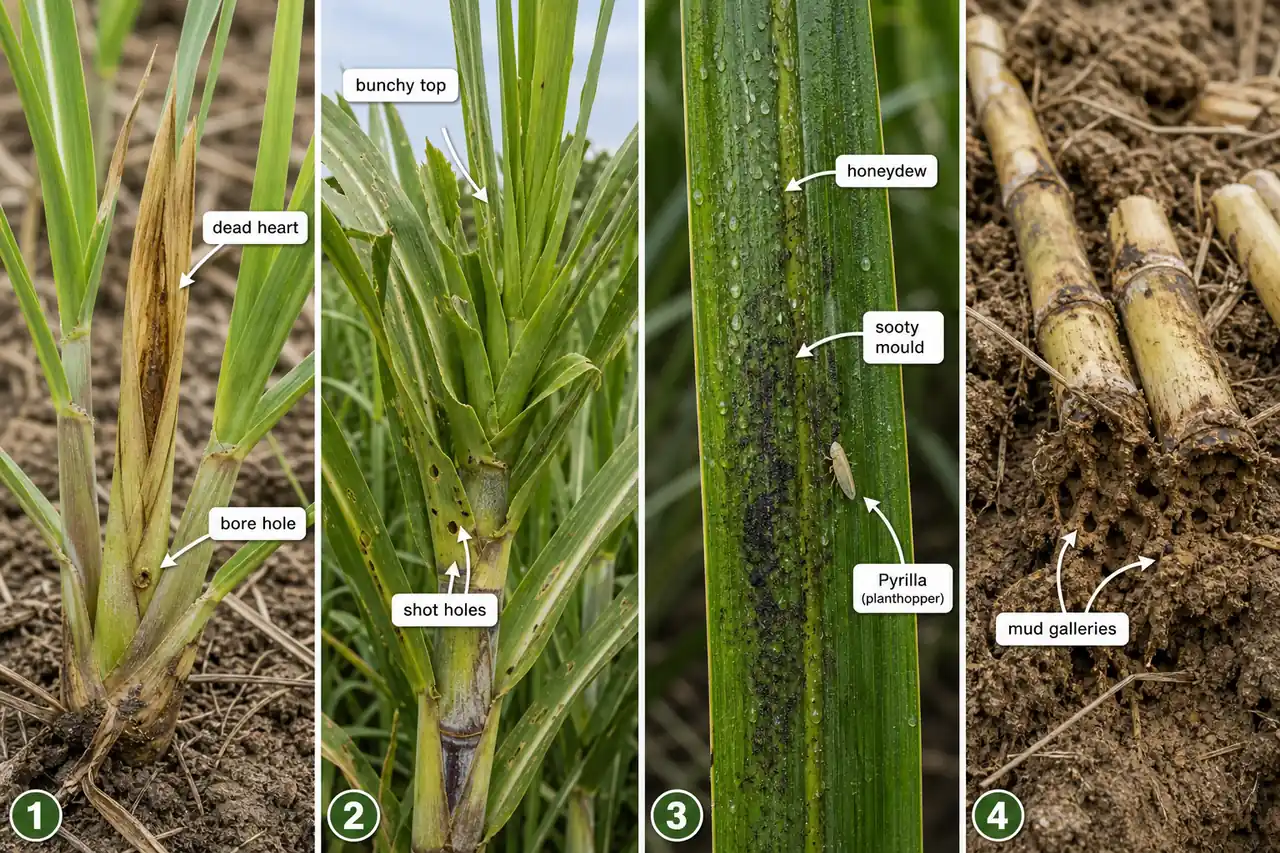
| Symptom | Pest Category | Specific Pest | First Action |
|---|---|---|---|
| Dead heart at seedling/tillering stage | Borer | Early Shoot Borer (C. infuscatellus) | Check ETL: 15% dead hearts |
| Dead heart + bore hole at internode | Borer | Internode Borer (C. sacchariphagus) | Release Trichogramma |
| Top shoot dead, bunchy growth | Borer | Top Borer (S. excerptalis) | Detrash at 150 + 210 DAP |
| Honeydew + sooty mold + beak-headed insect | Sap feeder | Pyrilla (P. perpusilla) | Release Epiricania; reduce N |
| White waxy masses under leaf sheath | Sap feeder | Mealybug (S. sacchari) | Detrash; conserve parasitoids |
| Encrusted stems, hard scale covers | Sap feeder | Scale Insect (M. glomerata) | Detrash; spray fish oil rosin |
| Poor germination, mud galleries | Root feeder | Termites (Odontotermes) | Sett treatment with chlorpyriphos |
| Plants wilt, C-shaped grubs in soil | Root feeder | White Grub (Holotrichia) | Phorate 10G; collect adult beetles |
Exam Tips and Mnemonics
TIP
Quick Revision Checklist — "6 Things to Know for Sugarcane IPM":
- Early shoot borer ETL = 15% dead hearts
- Pyrilla = "richman's pest" (high N), bio-control = Epiricania (4000-5000 cocoons/ha)
- White grub = C-shaped, adults fly to neem in monsoon
- Termites = light soils, sett treatment with Imidacloprid (100-150 g/100 setts)
- Woolly aphid = white mass, short internodes, reduced girth
- Top borer = dead heart cannot be pulled, reddish brown, shot holes, bunchy top
Detrashing Schedule — "150 and 210":
- Detrash at 150 DAP (5 months) and 210 DAP (7 months)
- This targets Pyrilla and borer populations during grand growth
Bio-control Dosages — The Only Two You Must Know:
- Epiricania melanoleuca: 4000-5000 cocoons/ha (or 4-6 lakh eggs/ha) for Pyrilla
- Isotima javensis: 100 pairs/ha for top borer (prepupal stage)
Resistant Variety Memory Aid:
- "Co 724" = The marquee borer-resistant variety (appears first in every list)
- "Co 1158" = Double duty — resists both borers AND white grub
- "Co 6304" = White grub specialist
Seasonal Logic for Exams:
- If the question mentions "planting stage" → answer is likely termite management (sett treatment)
- If "1-3 months" → early shoot borer
- If "grand growth" or "humid weather" → Pyrilla or top borer
- If "harvest" → crop sanitation, trash burning
Summary Cheat Sheet
| Concept / Topic | Key Details |
|---|---|
| IPM principle | Match the right method to the right pest at the right growth stage |
| Planting stage | Sett treatment (Imidacloprid 70 WS @ 100-150 g/100 setts); resistant varieties; deep ploughing |
| Early growth (1-3 mo) | Monitor ESB dead hearts; ETL = 15% dead hearts; avoid excess N |
| Grand growth (4-7 mo) | Detrash at 150 DAP and 210 DAP; release Epiricania for Pyrilla; release Trichogramma for top borer |
| Maturity (8-12 mo) | Harvest on time; burn trash; crop rotation |
| Star bio-control agent | Epiricania melanoleuca for Pyrilla — 4000-5000 cocoons/ha or 4-6 lakh eggs/ha |
| Top borer bio-control | Egg: "TTT" (Trichogramma, Telenomus, Tetrastichus schoenobi); Prepupal: Isotima javensis 100 pairs/ha; Pupal: Tetrastichus ayyari |
| Borer-resistant varieties | Co 724, CoJ 67, Co 1158, Co 1111 |
| White grub-resistant varieties | Co 6304, Co 1158, Co 5510 |
| Dual-resistant variety | Co 1158 — resists both borers and white grub |
| Key ETL | Early shoot borer = 15% dead hearts (only defined ETL for sugarcane) |
| Chemical control | Termites: Imidacloprid sett treatment; Pyrilla: Endosulfan 35 EC (last resort) |
| Nitrogen-pest link | Excess N favours Pyrilla outbreak — "richman's pest" |