🧅 Onion & Cole Crop Pests: Thrips, DBM (Insecticide Resistance), Cabbage Butterfly & Sawfly
Complete guide to pests of onion and cole crops — onion thrips, onion fly, diamondback moth (insecticide resistance champion), cabbage butterfly, mustard sawfly, and cabbage aphid. With comparison tables, trap crop strategies, IPM, and exam mnemonics for exams, NABARD & ICAR.
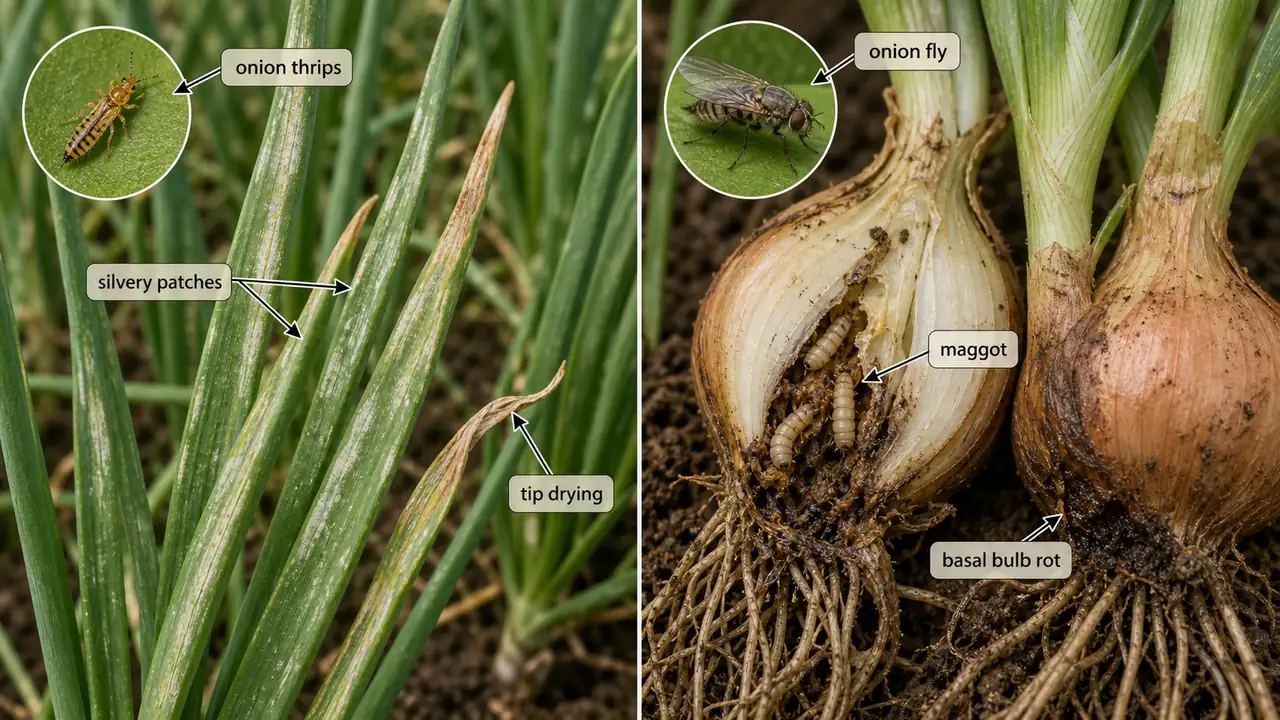
Field scenario: In Nashik (Maharashtra) — India's onion capital — a farmer walks through his rabi onion field and notices silvery white patches spreading across the tubular leaves, which are drying from the tip downward. This is the unmistakable damage of onion thrips (Thrips tabaci), the most important pest of onion worldwide. Several hundred kilometres north in the vegetable belt of Punjab, a cabbage grower faces a different challenge: despite spraying multiple insecticides, tiny green caterpillars continue eating holes in his cabbage heads. This is the diamondback moth (Plutella xylostella) — notorious for developing resistance to nearly every insecticide class, and manageable primarily through a simple trap crop strategy: planting mustard nearby to attract 80-90% of the pest away from cabbage.
Onion and cole crops (cabbage, cauliflower, knol-khol) are important rabi/winter vegetables of India. Their pests include some of the most frequently examined topics in entomology — particularly the DBM's insecticide resistance and the role of mustard as a trap crop.
Pro Content Locked
Upgrade to Pro to access this lesson and all other premium content.
Charged once for one year · ₹1188 total
Save ₹100/month vs ₹2388/year launch price
- All Agriculture & Banking Courses
- AI Lesson Questions (100/day)
- AI Doubt Solver (50/day)
- Glows & Grows Feedback (30/day)
- AI Section Quiz (20/day)
- 22-Language Translation (100/day)
- Recall Questions (20/day)
- AI Quiz (15/day)
- AI Quiz Paper Analysis (100/day)
- AI Step-by-Step Explanations (100/day)
- Spaced Repetition Recall (FSRS)
- AI Tutor
- Immersive Text Questions
- Audio Lessons — Hindi & English
- Mock Tests & Previous Year Papers
- Summary & Mind Maps
- XP, Levels, Leaderboard & Badges
- Generate New Classrooms
- Voice AI Teacher (AgriDots Live)
- AI Revision Assistant
- Knowledge Gap Analysis
- Interactive Revision (LangGraph)
🔒 Secure one-time yearly payment via Razorpay · No hidden fees
Field scenario: In Nashik (Maharashtra) — India's onion capital — a farmer walks through his rabi onion field and notices silvery white patches spreading across the tubular leaves, which are drying from the tip downward. This is the unmistakable damage of onion thrips (Thrips tabaci), the most important pest of onion worldwide. Several hundred kilometres north in the vegetable belt of Punjab, a cabbage grower faces a different challenge: despite spraying multiple insecticides, tiny green caterpillars continue eating holes in his cabbage heads. This is the diamondback moth (Plutella xylostella) — notorious for developing resistance to nearly every insecticide class, and manageable primarily through a simple trap crop strategy: planting mustard nearby to attract 80-90% of the pest away from cabbage.
Onion and cole crops (cabbage, cauliflower, knol-khol) are important rabi/winter vegetables of India. Their pests include some of the most frequently examined topics in entomology — particularly the DBM's insecticide resistance and the role of mustard as a trap crop.
How This Lesson Is Organised
We cover onion pests first (2 pests), then cole crop pests (4 pests). The cole crop section focuses heavily on the diamondback moth because its insecticide resistance story, trap crop management, and biocontrol options are among the most tested topics in competitive exams.
Onion Pests
Classification Table — Onion
| No. | Common Name | Scientific Name | Family: Order | Key Feature |
|---|---|---|---|---|
| 1 | Onion Thrips | Thrips tabaci | Thripidae: Thysanoptera | Silvery white patches; tip drying |
| 2 | Onion Fly | Delia antiqua | Anthomyiidae: Diptera | Rotten, shredded leaves; bulb damage |
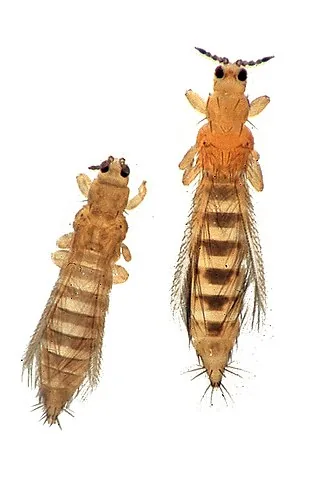
1. Onion Thrips — Thrips tabaci (Thripidae: Thysanoptera)
IMPORTANT
Drying from the tip downward with white silvery patches on onion leaves = Thrips tabaci. This is one of the most commonly asked pest identification facts in competitive exams.
Typical diagnosis: Drying from the tip downward with white patches = Thrips tabaci. This tip-drying symptom is specific to onion thrips.
Agricultural context: Onion thrips can reduce bulb size by 30-50% in severe infestations. In major onion-growing districts like Nashik, Junagadh, and Chitradurga, thrips management is the single most important factor determining yield and quality.
Damage Symptoms
- Small white silvery patches all over the leaves (feeding scars)
- In severe infestation, leaves dry from tip downward
- Both nymphs and adults lacerate leaf tissue with their rasping mouthparts and suck the oozing sap
- Heavy infestation causes premature death of leaves, reducing bulb size
- Thrips also transmit Iris Yellow Spot Virus (IYSV) in onion
- Some exam-oriented pest tables also recall the eggs as kidney-shaped
Comparison: Thrips Across Crops
| Crop | Thrips Species | Key Symptom |
|---|---|---|
| Onion | Thrips tabaci | Silvery patches; tip drying |
| Chilli | Scirtothrips dorsalis | Upward leaf curling |
| Tomato | Thrips tabaci, Frankliniella | Silvery streaks; vector of TSWV |
| Groundnut | Thrips palmi, Frankliniella schultzei | Vector of bud necrosis |
| Citrus | Thrips nilgiriensis | Fruit scarring |
Management
- Spray fipronil 5 SC or carbosulfan 25 EC at 15-day intervals during peak infestation
After the DBM section, here is a quick reference for flea beetles and weevils on cole crops:
Flea Beetles and Weevils on Cole Crops
| Pest | Damage Pattern | How to Identify |
|---|---|---|
| Flea beetles | Small round shot-holes on cabbage, mustard, radish | Tiny beetles that hop when disturbed |
| Weevils | Regular semicircular notches along leaf edges | Larger, slower beetles with snout |
TIP
Flea beetles = round shot-holes (mid-leaf); Weevils = semicircular edge notches (margins); Thrips = silvery streaks; Mites = downward leaf curl.
- Use overhead sprinkler irrigation to wash off thrips (effective cultural practice)
- Maintain proper spacing for air circulation
- Intercrop with coriander (repellent effect)
- Apply neem oil (1500 ppm azadirachtin)
- Avoid excessive nitrogen (promotes lush, succulent growth that attracts thrips)
TIP
Exam mnemonic: "Silvery patches on onion = Thrips Tabaci" — STT. Also remember: Thrips tabaci attacks both onion and tomato but causes different symptoms in each (silvery patches in onion vs. silvery streaks + TSWV transmission in tomato).
2. Onion Fly / Onion Maggot — Delia antiqua (Anthomyiidae: Diptera)
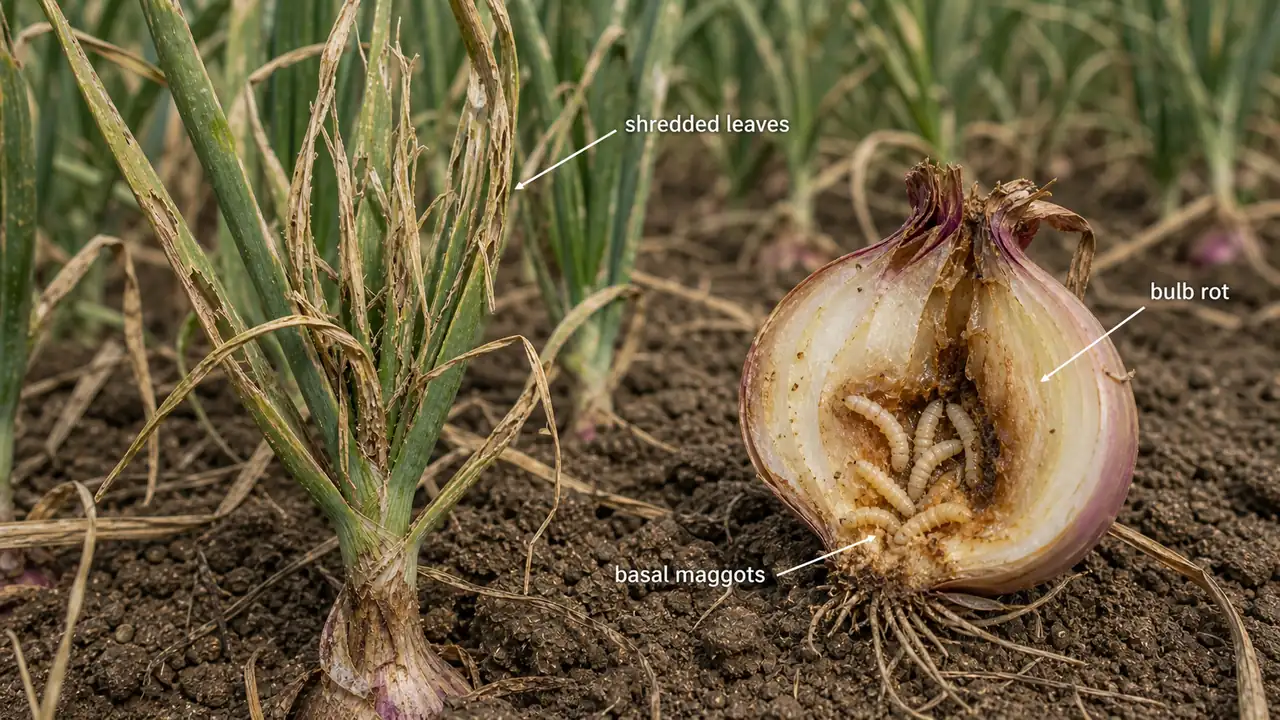
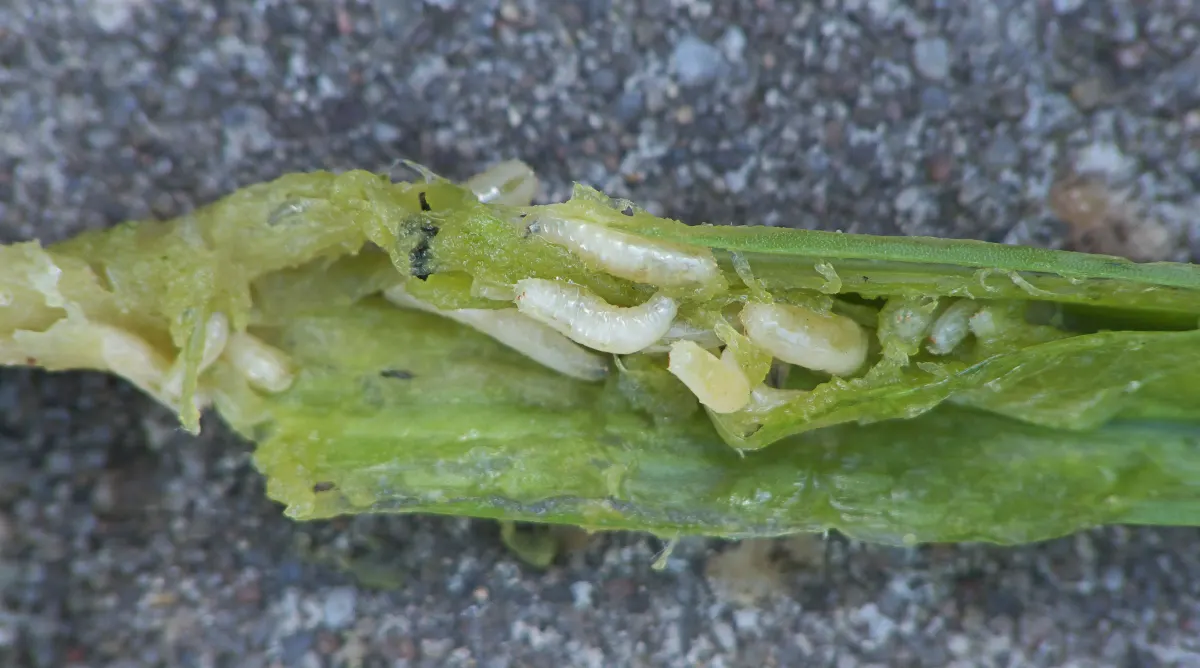
Agricultural context: Onion fly is more common in temperate and highland onion-growing areas. The maggot bores into developing bulbs from the base, causing the entire plant to rot and collapse.
Damage Symptoms
- Onion leaves get rotten, shredded, and rolled up
- Growth of onion bulbs gets hampered
- Tissues decay and become unfit for marketing
- Maggots bore into the developing bulbs from the basal plate
- Infested bulbs emit a foul odour
Management
- Treat seeds with insecticides before sowing
- Apply carbofuran 3G in the soil at sowing
- Remove and destroy infested plants immediately
- Practice crop rotation — avoid growing onion in the same field consecutively
- Avoid raw manure (attracts egg-laying flies)
Cole Crop Pests (Cabbage, Cauliflower, Knol-khol)
Classification Table — Cole Crops
| No. | Common Name | Scientific Name | Family: Order | Key Feature |
|---|---|---|---|---|
| 1 | Diamondback Moth (DBM) | Plutella xylostella | Yponomeutidae: Lepidoptera | Insecticide resistance; mustard trap crop |
| 2 | Cabbage Butterfly | Pieris brassicae, P. rapae | Pieridae: Lepidoptera | Large-scale defoliation |
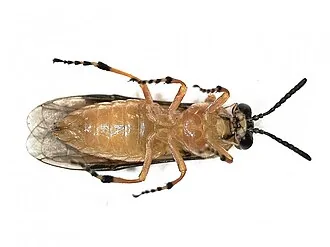
| 3 | Mustard Sawfly | Athalia lugens proxima | Tenthredinidae: Hymenoptera | Destructive Hymenoptera (unusual) |
| 4 | Cabbage Aphid | Brevicoryne brassicae | Aphididae: Hemiptera | Leaf crinkling; sooty mould |
1. Diamondback Moth (DBM) — Plutella xylostella (Yponomeutidae: Lepidoptera)
IMPORTANT
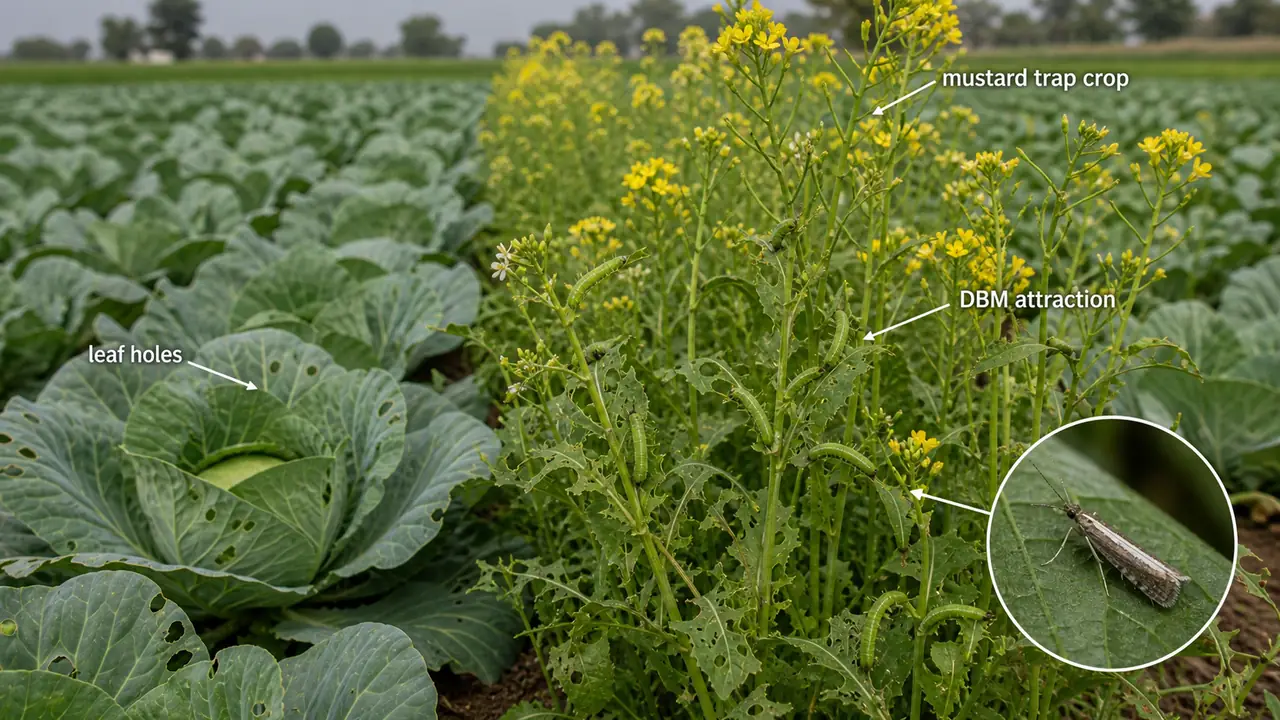
Plutella xylostella (DBM) is the most serious pest of cabbage worldwide. It has developed resistance against most insecticide classes, making it one of the most difficult pests to control chemically. The primary management strategy is growing mustard as a trap crop, which attracts 80-90% of DBM away from cabbage.
Agricultural context: DBM costs the global cabbage and crucifer industry over $4 billion annually. In India, farmers who plant rows of mustard around their cabbage fields consistently report lower DBM damage than those relying solely on chemical sprays — a powerful example of ecological pest management.
Damage Symptoms
- Young caterpillars cause small yellow mines on leaves (leaf mining in early instars)
- Scraping of epidermal leaf tissues producing typical whitish patches on leaves
- Full-grown larvae bite holes in leaves and feed on the curd/head
- Severe infestations make heads unmarketable
- Characteristic: when disturbed, larvae wriggle vigorously and drop from the leaf on a silk thread
Why "Diamondback" Moth?
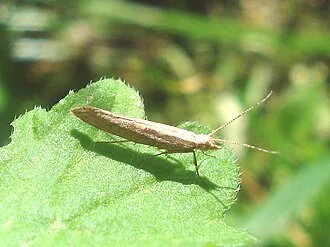
The adult moth has a series of diamond-shaped markings along the back when wings are folded — hence the name.
Insecticide Resistance History
| Insecticide Class | Resistance Developed |
|---|---|
| Organochlorines (DDT) | 1950s |
| Organophosphates (Malathion) | 1960s-70s |
| Carbamates (Carbaryl) | 1970s-80s |
| Pyrethroids (Cypermethrin) | 1980s-90s |
| Bt formulations | 2000s (partial) |
Management
- Grow mustard as trap crop — plant 2 rows of mustard for every 25 rows of cabbage. Mustard attracts 80-90% of DBM moths for egg laying.
- Use Cotesia plutellae (braconid wasp parasitoid) for biological control
- Spray Bacillus thuringiensis (Bt) formulations — still partially effective
- Rotate insecticide classes — never use the same group repeatedly
- Conserve natural enemies: Diadegma spp. (ichneumonid parasitoid)
- Use diamondback moth pheromone traps for monitoring
Trap Crop Effectiveness
| Strategy | DBM Reduction on Cabbage |
|---|---|
| Mustard trap crop (2 rows per 25) | 80-90% |
| Bt spray alone | 60-70% |
| Chemical spray alone | Variable (resistance issue) |
| Mustard + Bt spray combination | 90-95% |
TIP
Three exam facts for DBM — always asked:
- Most serious pest of cabbage
- Resistant to most insecticides
- Mustard trap crop attracts 80-90% DBM
Bonus: Family is Yponomeutidae (sometimes placed in Plutellidae in recent classifications).
2. Cabbage Butterfly — Pieris brassicae, P. rapae (Pieridae: Lepidoptera)
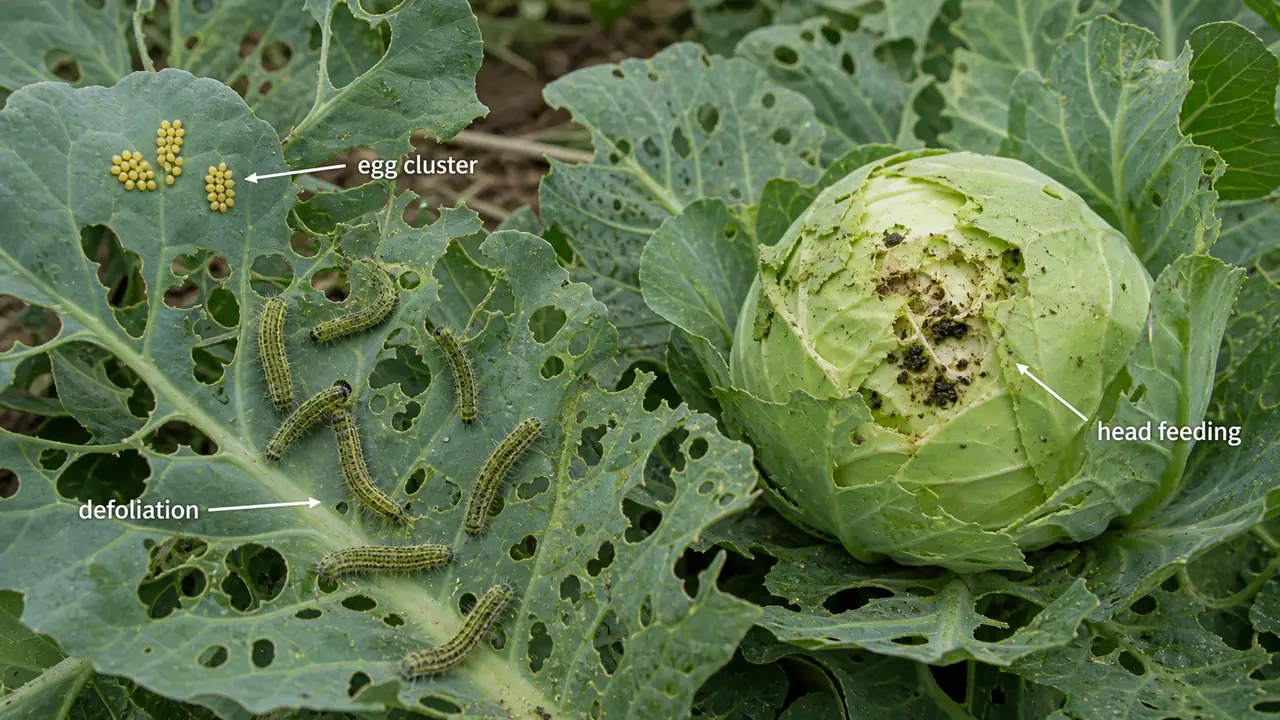
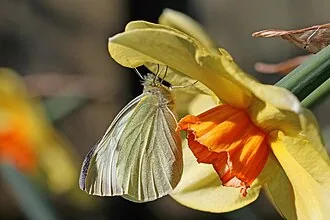
Agricultural context: The large white butterfly (Pieris brassicae) is a conspicuous pest of cabbage in the northern plains during winter. Unlike DBM which is tiny and hard to see, the cabbage butterfly is easily visible, and its bright yellow egg clusters on leaves are easy to spot and destroy.
Damage Symptoms
- Defoliation of cabbage leaves — can strip entire plants
- Bores into the heads of cabbage, contaminating them with frass
- First-instar caterpillars scrape leaf surface (gregarious)
- Later instars eat leaves from margins inward, leaving only the main veins
- Often entire plants are eaten up in severe infestations
Comparison: Cabbage Butterfly vs. Diamondback Moth
| Feature | Cabbage Butterfly | Diamondback Moth |
|---|---|---|
| Scientific name | Pieris brassicae | Plutella xylostella |
| Family | Pieridae | Yponomeutidae |
| Size | Large (wingspan 5-6 cm) | Small (wingspan 1.5 cm) |
| Eggs | Yellow, bottle-shaped, in clusters | Single, on leaf undersurface |
| Damage | Defoliation + boring into heads | Mining + holes in leaves |
| Insecticide resistance | Not a major issue | Highly resistant |
| Key parasitoid | Apanteles glomeratus | Cotesia plutellae |
NOTE
Cabbage butterfly also attacks cauliflower, knol-khol, turnip, radish, sarson, and toria (Brassica campestris) — essentially all cruciferous crops.
Management
- Conserve larval parasitoid Apanteles glomeratus (Braconidae) in natural populations
- Hand-pick and destroy egg masses (visible yellow clusters) and caterpillars
- Spray contact insecticides on young caterpillars
- Bt formulations are effective
3. Mustard Sawfly — Athalia lugens proxima (Tenthredinidae: Hymenoptera)
IMPORTANT
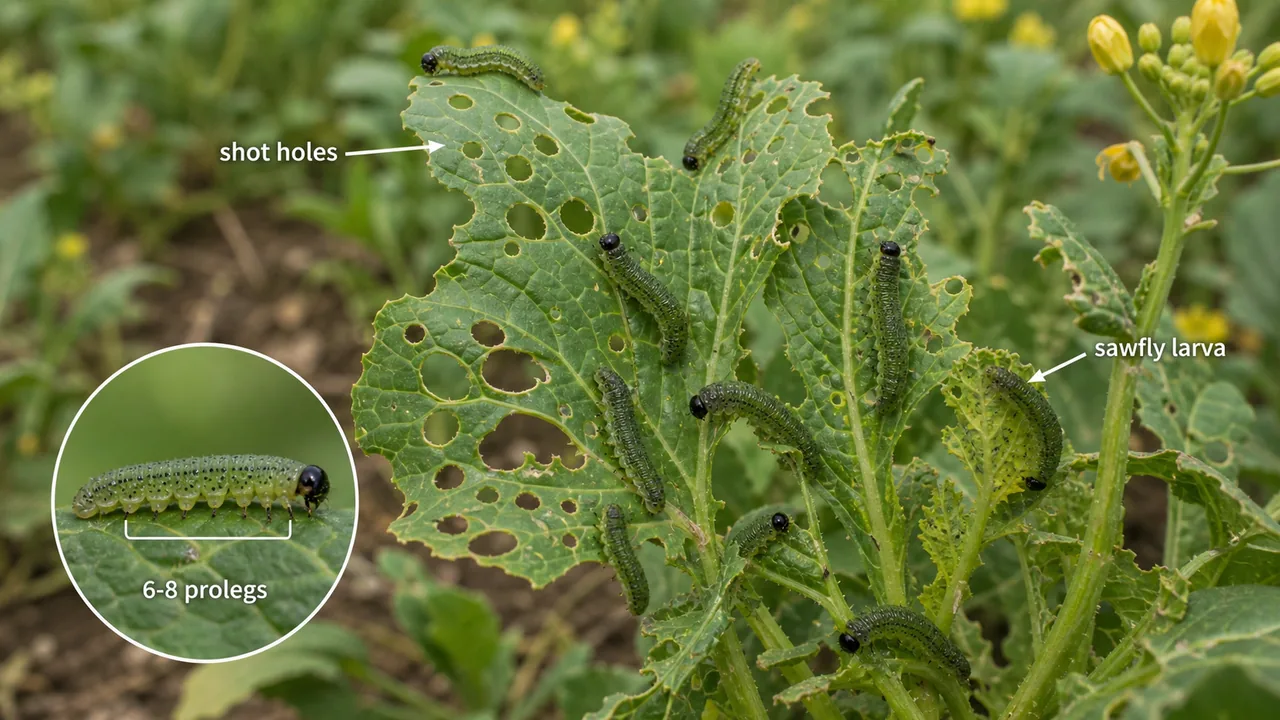
Mustard sawfly is one of the few pests belonging to order Hymenoptera that is destructive to crops. Most Hymenoptera are beneficial (parasitoids, pollinators), but sawflies are plant feeders. The larvae look like caterpillars but have 6-8 pairs of prolegs (versus 5 pairs in Lepidoptera caterpillars).
Agricultural context: In the mustard-growing belts of Rajasthan, Haryana, and UP, sawfly larvae can destroy entire seedling-stage crops within days. The grubs, which are dark green with a black head, feed voraciously during October-November.
Damage Symptoms
- Grubs alone are destructive — they bite holes into leaves, preferring young growth
- Skeletonise the leaves completely
- Sometimes even the epidermis of the shoot is eaten up
- Seedlings succumb; older plants fail to bear seed when attacked
- Feeding pattern: initially nibbles leaves, then feeds from margins toward the midrib
- Grubs create numerous shot holes and can riddle entire leaves
Distinguishing Sawfly Larvae from Caterpillars
| Feature | Sawfly Larva (Hymenoptera) | Caterpillar (Lepidoptera) |
|---|---|---|
| Prolegs | 6-8 pairs | Typically 5 pairs (or fewer) |
| Body texture | Smooth, shiny | Often hairy or spiny |
| Head | Dark, distinct | Variable |
| Order | Hymenoptera | Lepidoptera |
| Pupation | In soil (cocoon) | Variable (soil, leaf, etc.) |
TIP
Exam mnemonic: "Sawfly pupates in soil" — deep summer ploughing destroys pupae. "Sawfly has Six-to-eight prolegs" (more than Lepidoptera's 5). It belongs to Hymenoptera — unusual for a crop pest.
Management
- Deep summer ploughing to destroy pupae in soil
- Spray malathion 50 EC
- Use Beauveria bassiana for biological control
- Hand-pick and destroy larvae during early infestation
- Avoid late sowing — early sowing helps the crop escape peak sawfly activity
4. Cabbage Aphid — Brevicoryne brassicae (Aphididae: Hemiptera)
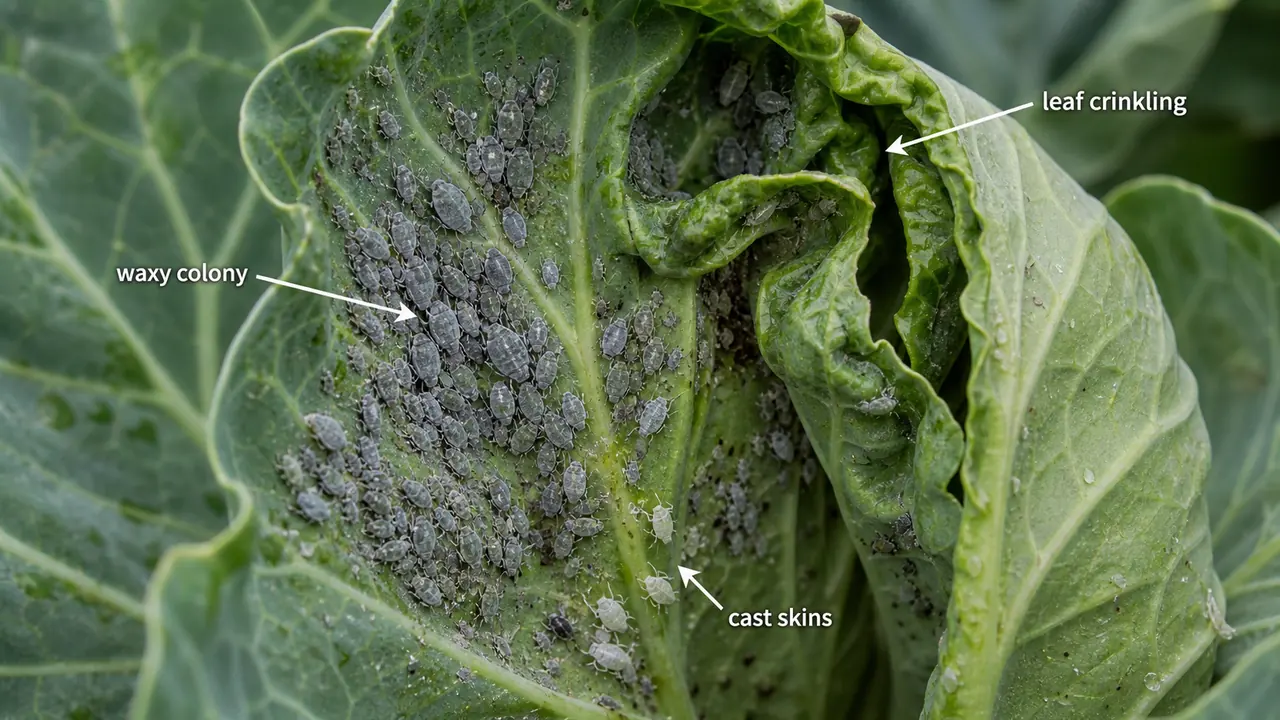
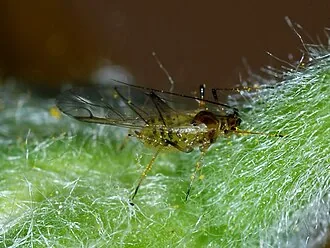
Agricultural context: In cool-weather cauliflower and cabbage fields, grey-green aphid colonies cluster thickly on the undersides of leaves and on developing curds. Their waxy coating makes them look powdery — distinguishing them from the shiny green Myzus persicae (peach aphid).
Damage Symptoms
- Yellowing of leaves
- Crinkling and cupping of leaves
- Distorted primordia (malformed heads/curds)
- Presence of white cast skin at the base of the plant (shed exoskeletons)
- Both nymphs and adults suck sap from leaves, buds, and pods
- Heavy honeydew secretion leads to sooty mould
Comparison: Aphids of Cruciferous Crops
| Aphid Species | Common Name | Primary Crop | Key Feature |
|---|---|---|---|
| Brevicoryne brassicae | Cabbage Aphid | Cabbage, cauliflower | Grey-green; waxy coating |
| Lipaphis erysimi | Mustard Aphid | Mustard, rapeseed | Yellow-green; causes wilting |
| Myzus persicae | Green Peach Aphid | Multiple crops | Shiny green; vector of 100+ viruses |
NOTE
Mustard Aphid (Lipaphis erysimi) is closely related and often confused with cabbage aphid. Key predator for both: Coccinella septempunctata (seven-spotted ladybird beetle). This predator-prey pair is commonly asked.
Management
- Conserve predator ladybird beetle (Coccinella septempunctata)
- Spray dimethoate 30 EC or imidacloprid
- Remove and destroy heavily infested plant parts
- Use reflective mulches to repel aphids
Other Exam-Listed Cole Pests
Some mixed vegetable pest tables add a few more cole-crop feeders beyond the four core pests above. They are lower priority than DBM in this lesson, but they help absorb cross-page table recall cleanly.
| Pest | Key Feature |
|---|---|
| Cabbage borer (Hellula undalis) | Larvae bore into the stem and stalk, consuming inner tissues and weakening young plants |
| Semilooper (Plusia orichalcea) | Larvae defoliate leaves and may leave stronger veins behind under heavy feeding |
| Painted bug (Bagrada cruciferarum) | Sap-feeding crucifer bug best revised alongside mustard and cole crop pest tables |
NOTE
These are best kept as supplementary cole-crop table facts. The dominant exam anchors in this lesson remain DBM, cabbage butterfly, mustard sawfly, and cabbage aphid.
Comparison: Trap Crops and Biocontrol in Cole Crops
| Pest | Trap Crop | Key Biocontrol Agent |
|---|---|---|
| DBM (Plutella xylostella) | Mustard (80-90% attraction) | Cotesia plutellae (parasitoid) |
| Cabbage Butterfly (Pieris brassicae) | — | Apanteles glomeratus (parasitoid) |
| Mustard Sawfly (Athalia lugens proxima) | — | Beauveria bassiana (fungus) |
| Cabbage Aphid (Brevicoryne brassicae) | — | Coccinella septempunctata (predator) |
Exam Tips and Mnemonics
- Silvery patches on onion = Thrips tabaci — the most asked onion pest fact
- DBM's three exam facts: Most serious cabbage pest + insecticide resistance + mustard trap crop (80-90%)
- Mustard sawfly is Hymenoptera — rare for a crop pest. Has 6-8 prolegs (vs. 5 in Lepidoptera). Pupates in soil.
- Parasitoid pairs: Cotesia plutellae controls DBM; Apanteles glomeratus controls cabbage butterfly — do not mix them up
- Predator of aphids: Coccinella septempunctata (seven-spot ladybird) — India's most important aphid biocontrol agent
- Onion fly (Delia antiqua) — Anthomyiidae (Diptera) — maggots rot bulbs from the base
- Shot holes in mustard leaves = mustard sawfly (not flea beetle, which causes similar-looking tiny holes but is a Coleoptera pest)
Summary Cheat Sheet
| No. | Pest | Crop | Scientific Name | Family: Order | Key Exam Fact |
|---|---|---|---|---|---|
| 1 | Onion Thrips | Onion | Thrips tabaci | Thripidae: Thysanoptera | Silvery white patches; tip drying; most important onion pest |
| 2 | Onion Fly | Onion | Delia antiqua | Anthomyiidae: Diptera | Maggots rot bulbs from base; shredded leaves |
| 3 | Diamondback Moth | Cole crops | Plutella xylostella | Yponomeutidae: Lepidoptera | Most serious cabbage pest; insecticide resistant; mustard trap crop 80-90% |
| 4 | Cabbage Butterfly | Cole crops | Pieris brassicae | Pieridae: Lepidoptera | Defoliation; bores into heads; parasitoid: Apanteles glomeratus |
| 5 | Mustard Sawfly | Mustard, cole crops | Athalia lugens proxima | Tenthredinidae: Hymenoptera | Hymenoptera pest (unusual); 6-8 prolegs; pupates in soil |
| 6 | Cabbage Aphid | Cole crops | Brevicoryne brassicae | Aphididae: Hemiptera | Waxy grey-green; crinkling; predator: Coccinella septempunctata |