🥔 Potato Pests: Tuber Moth (Field + Storage), Cutworm & Green Leafhopper
Complete guide to potato pests — potato tuber moth (unique field-and-storage pest), greasy cutworm (nocturnal stem cutter), and green leafhopper (hopper burn). With comparison tables, IPM strategies, and exam mnemonics for exams, NABARD & ICAR.
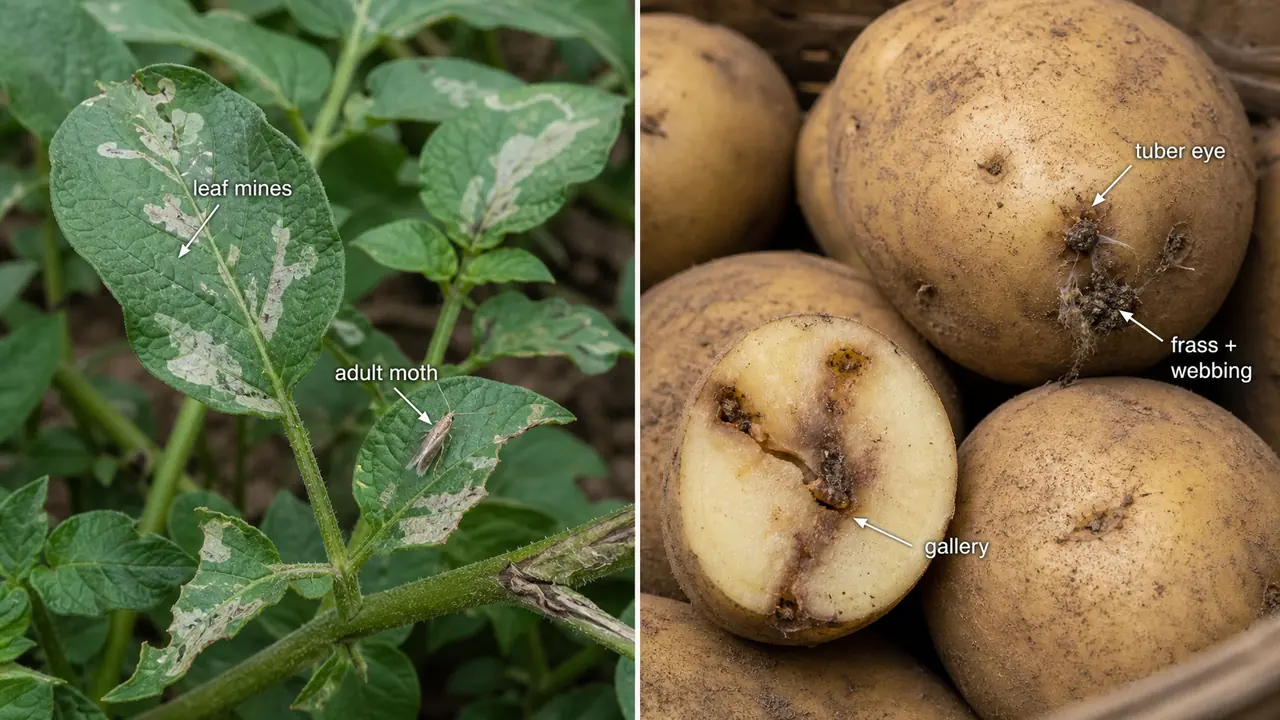
Field scenario: A potato farmer in Farrukhabad (Uttar Pradesh) opens his country-style storage pit to find that many tubers have small tunnels near the "eyes," and the flesh inside has turned brownish and rotten. The same pest had earlier caused silvery blotch mines on the foliage in his field. This is the potato tuber moth (Phthorimaea operculella) — one of the very few pests that damages a crop both during cultivation and in storage. In an adjoining field, a young potato crop shows seedlings cut clean at the soil surface overnight — the unmistakable work of the greasy cutworm (Agrotis ipsilon), a nocturnal feeder that hides in soil cracks during the day.
Potato is India's most important vegetable crop, with over 50 million tonnes produced annually. While it faces fewer pest species than crops like cotton or rice, the three pests covered here are highly significant: the tuber moth for its unique dual-habitat damage, the cutworm for its destructive nocturnal behaviour, and the green leafhopper for causing "hopper burn."
Pro Content Locked
Upgrade to Pro to access this lesson and all other premium content.
Charged once for one year · ₹1188 total
Save ₹100/month vs ₹2388/year launch price
- All Agriculture & Banking Courses
- AI Lesson Questions (100/day)
- AI Doubt Solver (50/day)
- Glows & Grows Feedback (30/day)
- AI Section Quiz (20/day)
- 22-Language Translation (100/day)
- Recall Questions (20/day)
- AI Quiz (15/day)
- AI Quiz Paper Analysis (100/day)
- AI Step-by-Step Explanations (100/day)
- Spaced Repetition Recall (FSRS)
- AI Tutor
- Immersive Text Questions
- Audio Lessons — Hindi & English
- Mock Tests & Previous Year Papers
- Summary & Mind Maps
- XP, Levels, Leaderboard & Badges
- Generate New Classrooms
- Voice AI Teacher (AgriDots Live)
- AI Revision Assistant
- Knowledge Gap Analysis
- Interactive Revision (LangGraph)
🔒 Secure one-time yearly payment via Razorpay · No hidden fees
Field scenario: A potato farmer in Farrukhabad (Uttar Pradesh) opens his country-style storage pit to find that many tubers have small tunnels near the "eyes," and the flesh inside has turned brownish and rotten. The same pest had earlier caused silvery blotch mines on the foliage in his field. This is the potato tuber moth (Phthorimaea operculella) — one of the very few pests that damages a crop both during cultivation and in storage. In an adjoining field, a young potato crop shows seedlings cut clean at the soil surface overnight — the unmistakable work of the greasy cutworm (Agrotis ipsilon), a nocturnal feeder that hides in soil cracks during the day.
Potato is India's most important vegetable crop, with over 50 million tonnes produced annually. While it faces fewer pest species than crops like cotton or rice, the three pests covered here are highly significant: the tuber moth for its unique dual-habitat damage, the cutworm for its destructive nocturnal behaviour, and the green leafhopper for causing "hopper burn."
How This Lesson Is Organised
We start with the most exam-important pest (potato tuber moth — unique field + storage damage), then move to the cutworm (nocturnal habit and poison baiting management), and finally the green leafhopper (hopper burn). Each pest section includes management strategies and exam-focused comparison tables.
Pest Classification Table — Potato
| No. | Common Name | Scientific Name | Family: Order | Key Feature |
|---|---|---|---|---|
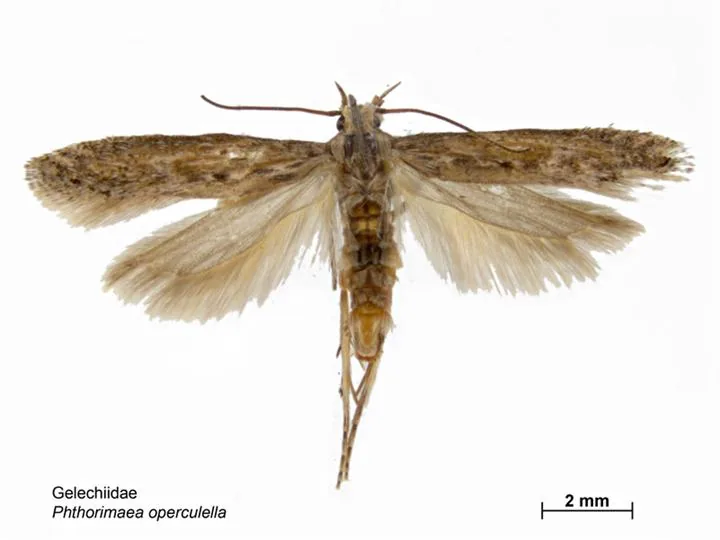
| 1 | Potato Tuber Moth | Phthorimaea operculella | Gelechiidae: Lepidoptera | Pest of both field AND storage |
| 2 | Greasy Cutworm | Agrotis ipsilon | Noctuidae: Lepidoptera | Nocturnal stem cutting |
| 3 | Green Leafhopper | Empoasca kerri | Cicadellidae: Hemiptera | Leaf tip browning (hopper burn) |
1. Potato Tuber Moth — Phthorimaea operculella (Gelechiidae: Lepidoptera)
IMPORTANT
Phthorimaea operculella is unique among vegetable pests because it causes damage both in the field (mining foliage and stems) and in storage (boring into tubers). It belongs to family Gelechiidae — the same family as the cotton pink bollworm (Pectinophora gossypiella).
Agricultural context: In the Indo-Gangetic plains, where potato is stored in traditional country stores (without cold storage), tuber moth can destroy 30-70% of stored tubers within a few months. The pest problem is less severe in cold storage (below 10 degrees C) because the low temperature arrests insect development.
Damage Symptoms
In the Field
- Larvae tunnel into foliage and stems, creating silvery blotch mines
- Mining weakens the plant and reduces photosynthesis
- In severe infestations, plants look scorched
In Storage
- Larvae bore into tubers, forming galleries near tuber eyes
- Feeding creates tunnels through the tuber flesh
- Attacked tubers develop bacterial infection, turning soft and unfit for consumption or seed purposes
- Silken webbing and frass visible near tuber eyes
Field vs. Storage Damage Comparison
| Aspect | Field Damage | Storage Damage |
|---|---|---|
| Plant part attacked | Foliage, stems | Tubers |
| Symptom | Silvery blotch mines | Galleries near tuber eyes |
| Secondary infection | Minimal | Bacterial rot (severe) |
| Economic impact | Reduced photosynthesis | Total loss of stored tubers |
| Season | During crop growth | After harvest, in storage |
Family Connection: Gelechiidae Pests
| Pest | Crop | Common Name |
|---|---|---|
| Phthorimaea operculella | Potato | Potato Tuber Moth |
| Pectinophora gossypiella | Cotton | Pink Bollworm |
| Scrobipalpa heliopa | Tobacco | Tobacco Stem Borer |
TIP
Exam mnemonic: "Phthorimaea damages Potato in Plant and Pit (storage)" — four P's. Family Gelechiidae connects it to cotton pink bollworm — both bore into the harvested product.
Management
Field Management
- Earth up tubers properly to prevent exposure (exposed tubers attract egg-laying moths)
- Irrigate regularly — dry, cracked soil exposes tubers
- Harvest tubers at proper maturity — do not leave them in the field after haulm drying
Storage Management
- Store tubers in cold storage below 10 degrees C (most effective measure)
- Proper curing and healing of tubers before storage
- Use CIPC (Chlorpropham) as sprout inhibitor in cold stores
- Apply Granulosis Virus (GV) — Phthorimaea operculella GV is an effective biocontrol in storage
- Cover stored tubers with dried lantana leaves or neem leaves (traditional practice)
- Apply sand + DDVP (dichlorvos) mixture over tubers in country stores
2. Greasy Cutworm / Black Cutworm — Agrotis ipsilon (Noctuidae: Lepidoptera)
IMPORTANT
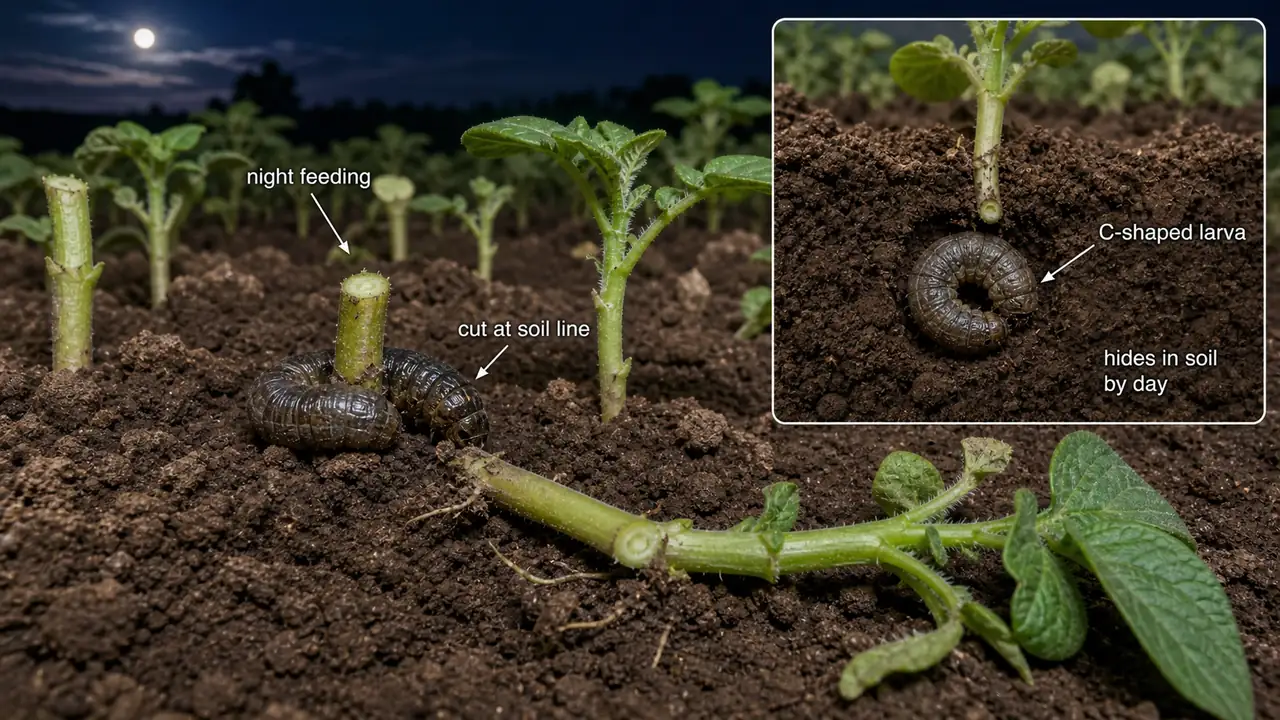
Agrotis ipsilon is a polyphagous, nocturnal pest. Its signature damage is cutting seedlings at ground level during the night. It attacks potato, chilli, tomato, cabbage, and many other crops.
Agricultural context: Early morning inspections of potato and vegetable fields during winter often reveal freshly cut seedlings lying on the soil surface. The fat, greasy-looking caterpillar hides just below the soil surface near the cut plant — if you dig around the base of the cut seedling, you will find it curled up in a C-shape.
Damage Symptoms
- Young larvae feed on the epidermis of leaves (minor damage)
- Older larvae emerge at night and feed on young plants by cutting their stems at ground level
- They also damage tubers by eating away part of them
- Strictly nocturnal — hide in soil cracks and under clods during the day
- A single larva can cut several seedlings in one night
Identification Features
| Feature | Detail |
|---|---|
| Larva colour | Dark grey/brown; greasy skin texture |
| Resting posture | Curled in C-shape in soil |
| Feeding habit | Strictly nocturnal |
| Generation | Multiple generations per year |
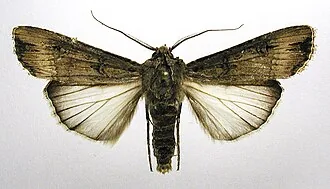
| Adult moth | Greyish-brown; kidney-shaped spot on forewing |
Cross-Crop Cutworm Damage
| Crop | Symptom | Key Fact |
|---|---|---|
| Potato | Seedlings cut at base + tuber damage | Older larvae also eat tubers |
| Chilli | Seedlings cut at ground level | Common exam question |
| Cabbage | Transplants cut at soil surface | More damage in transplanted crops |
TIP
Exam mnemonic: "Agrotis = At Ground level, at night" — it cuts at ground level and is nocturnal. Do NOT confuse with Spodoptera litura (tobacco cutworm), which scrapes chlorophyll and causes papery white leaves but does NOT cut stems.
Management
- Collect and destroy larvae during early morning hours (they are just below the soil surface near cut plants)
- Use poison baiting: rice bran + jaggery (10%) + insecticide — spread in the evening near plant rows
- Apply chlorpyriphos 20 EC drench in soil around plant bases
- Flood irrigation can expose and drown larvae
- Use light traps to monitor adult moth activity
- Clean cultivation — remove weeds and crop debris that provide shelter
3. Green Leafhopper — Empoasca kerri (Cicadellidae: Hemiptera)
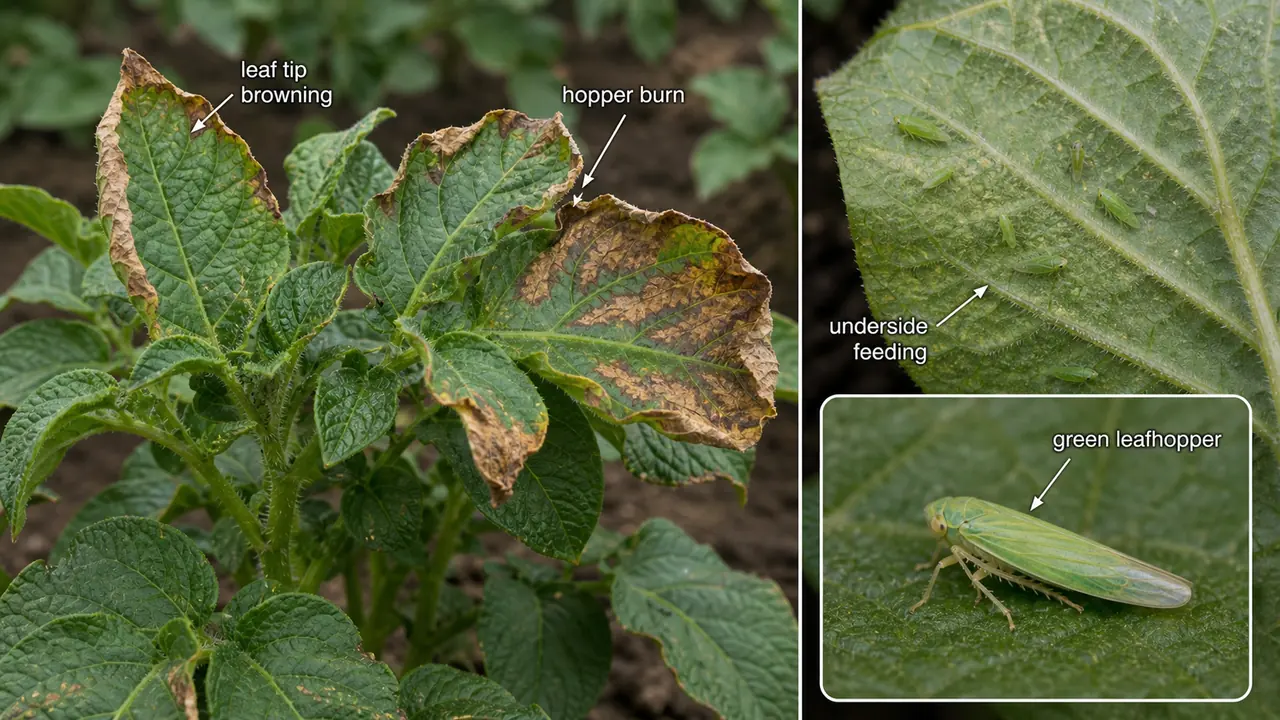
Agricultural context: In potato fields of the Deccan Plateau during dry weather, the leaf tips of potato plants turn brown and eventually the entire leaf dries up — a condition known as "hopper burn." This is caused by the green leafhopper, which sucks sap while injecting toxic saliva.
Damage Symptoms
- Tips of affected leaves become brown (tip burn)
- Leaves curl upward and dry
- Hopper burn in severe infestation — entire leaves turn brown from the margins inward
- Both nymphs and adults suck sap from the lower leaf surface
- Reduced tuber development in severe infestations
Hopper Burn Comparison Across Crops
| Crop | Leafhopper Species | Symptom |
|---|---|---|
| Potato | Empoasca kerri | Leaf tip browning, hopper burn |
| Rice | Nephotettix virescens (GLH) | Yellowing, virus transmission (tungro) |
| Cotton | Amrasca biguttula biguttula | Leaf reddening, hopper burn |
| Brinjal | Cestius phycitis | Little Leaf disease (phytoplasma) |
Management
- Spray systemic insecticides (dimethoate 30 EC or imidacloprid)
- Use resistant/tolerant potato varieties
- Maintain proper plant spacing for air circulation
- Avoid excessive nitrogen — promotes succulent growth that attracts leafhoppers
- Install yellow sticky traps for monitoring
Other Exam-Listed Potato Pests
Some agriculture handbooks list a few additional potato pests beyond the three core ones above. They are lower-yield than tuber moth or cutworm in this course, but they help absorb page-level revision facts from mixed vegetable tables.
| Pest | Key Feature |
|---|---|
| Potato aphid (Myzus persicae) | Nymphs and adults suck sap from leaves; revise it as the same green-peach-aphid complex seen on several vegetable crops |
| Hadda beetle (Henosepilachna vigintioctopunctata) | Grubs and adults scrape the leaf epidermis, producing skeletonized foliage rather than simple chewing holes |
NOTE
These two are best treated as supporting recall for potato pest tables. The high-priority potato exam anchors remain potato tuber moth (field + storage), cutworm (ground-level cutting), and green leafhopper (hopper burn).
Comparison: Three Potato Pests — Habits and Damage
| Feature | Tuber Moth | Cutworm | Green Leafhopper |
|---|---|---|---|
| Scientific name | Phthorimaea operculella | Agrotis ipsilon | Empoasca kerri |
| Order | Lepidoptera | Lepidoptera | Hemiptera |
| Part attacked | Foliage (field) + tubers (storage) | Stems, seedlings, tubers | Leaves |
| Feeding habit | Mining (field) + boring (storage) | Cutting at ground level | Sap sucking |
| Active time | Day and night | Strictly nocturnal | Day (nymphs + adults) |
| Unique feature | Dual habitat (field + storage) | C-shaped resting posture | Hopper burn |
| Key management | Cold storage; GV biocontrol | Poison baiting in evening | Systemic insecticides |
Exam Tips and Mnemonics
- "Field AND Storage" — Phthorimaea operculella is the unique dual-habitat pest. No other vegetable pest is equally important in both locations.
- Gelechiidae family connects potato tuber moth to cotton pink bollworm (Pectinophora gossypiella) — both bore into stored/harvested products
- GV (Granulosis Virus) is the biocontrol for tuber moth in storage — different from NPV used for Helicoverpa and Spodoptera
- Ground-level cutting = Agrotis ipsilon — not Spodoptera litura. This distinction is tested across chilli, potato, and cabbage.
- Poison baiting formula: Rice bran + jaggery + insecticide (applied in evening) — standard management for cutworms
- Hopper burn = leaf tip browning progressing inward — seen in potato (Empoasca kerri) and cotton (Amrasca biguttula biguttula)
- CIPC (Chlorpropham) is a sprout inhibitor used in potato cold storage — not an insecticide per se
Summary Cheat Sheet
| No. | Pest | Scientific Name | Family: Order | Key Exam Fact |
|---|---|---|---|---|
| 1 | Potato Tuber Moth | Phthorimaea operculella | Gelechiidae: Lepidoptera | Field + storage pest; galleries near tuber eyes; biocontrol = Granulosis Virus (GV); Gelechiidae (like pink bollworm) |
| 2 | Greasy Cutworm | Agrotis ipsilon | Noctuidae: Lepidoptera | Nocturnal; cuts stems at ground level; poison baiting in evening; C-shaped resting posture |
| 3 | Green Leafhopper | Empoasca kerri | Cicadellidae: Hemiptera | Hopper burn; leaf tip browning; sap sucking from lower surface |