🪵 Tea & Tobacco Pests: Tea Mosquito Bug, Tobacco Caterpillar, Cutworms, Aphid Vectors & More
Complete guide to pests of tea and tobacco — tea mosquito bug (toxic saliva), tobacco caterpillar (polyphagous defoliator), Helicoverpa (cannibalistic bollworm), cutworms, stem borer, ground beetles, whitefly, and green peach aphid (100+ virus vector). With comparison tables, IPM, and exam mnemonics.
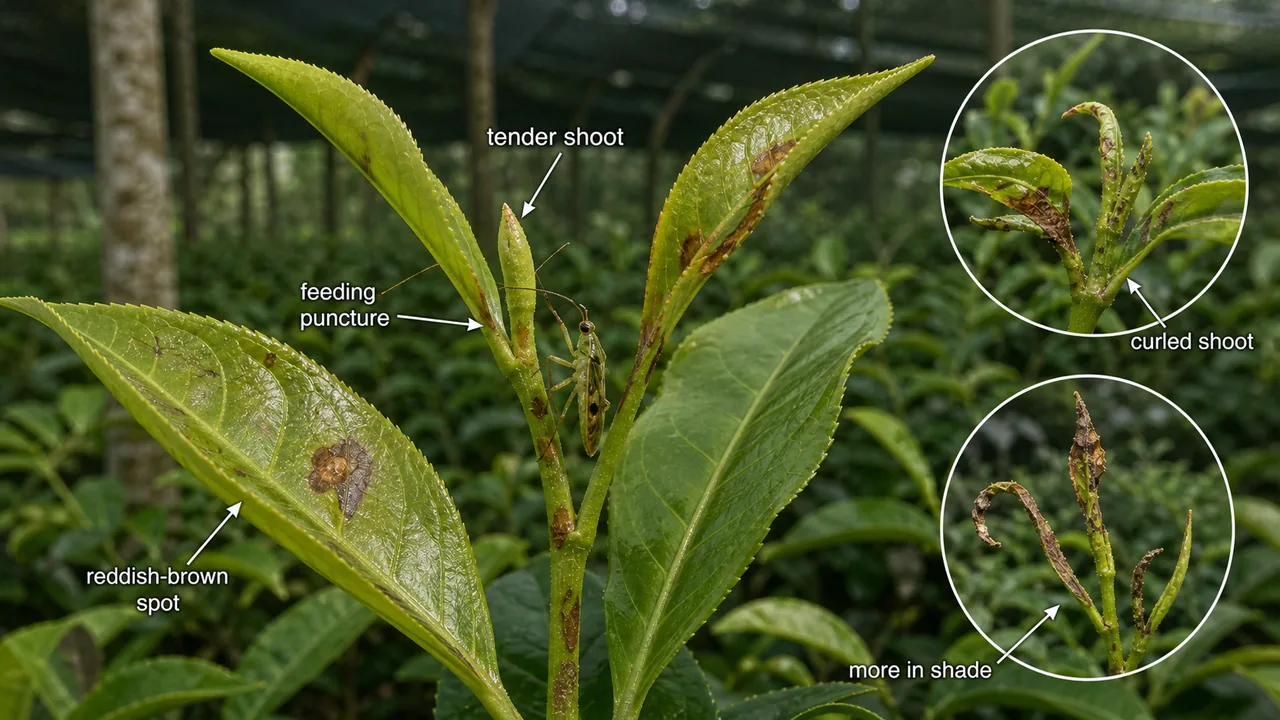
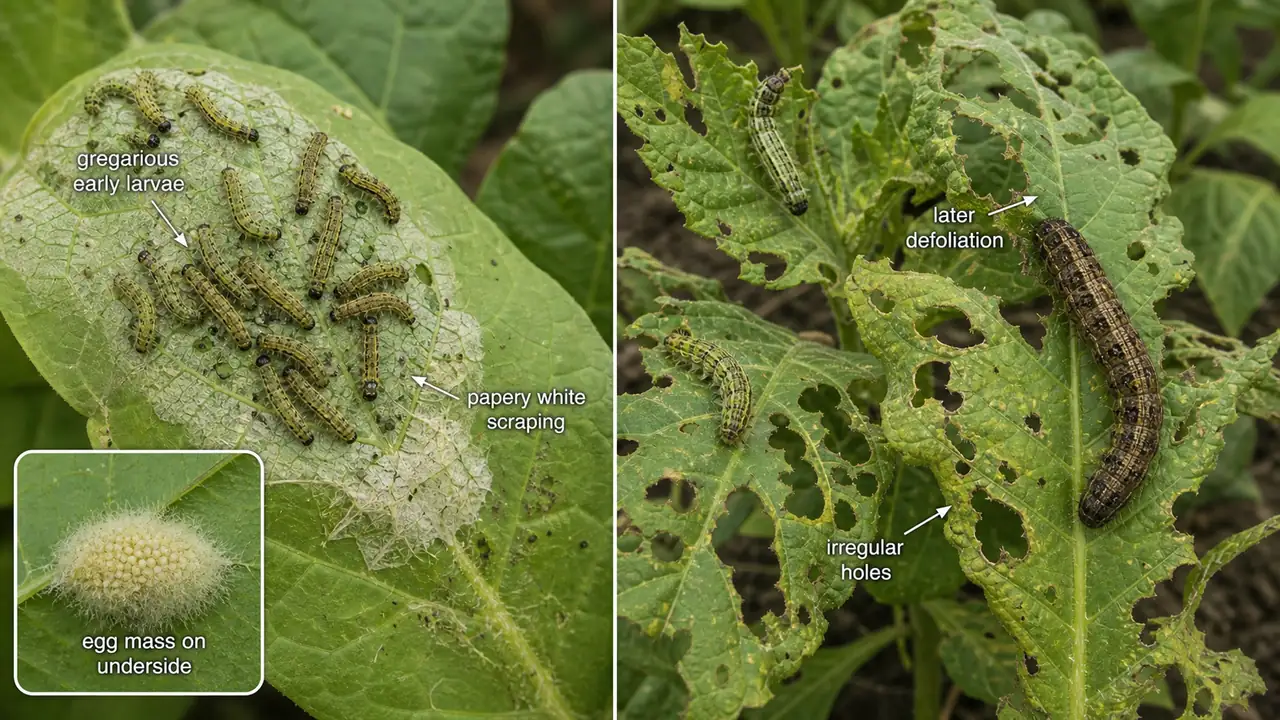
Field scenario: In the misty tea gardens of Assam, a planter notices reddish-brown spots spreading across the tender two-leaves-and-a-bud — the most valuable harvest portion. The young leaves are curling and drying, and the processed tea from these bushes will have a distinctly bitter, off-flavour. The culprit is the tea mosquito bug (Helopeltis theivora), which injects toxic saliva while feeding, causing tissue necrosis far beyond the actual feeding puncture. The pest is worse in shaded areas — a crucial management clue. Several states away in Andhra Pradesh's tobacco belt, a farmer finds his transplanted seedlings skeletonised overnight: the chlorophyll has been scraped off, leaving behind a ghostly papery white appearance — the classic damage of the tobacco caterpillar (Spodoptera litura) in its gregarious early instars.
Tea and tobacco are high-value commercial crops where pest damage directly affects product quality and export value. Tea pest management must balance pest control with safety (residue limits are strict for export tea), while tobacco pest management involves several cross-crop pests that appear on other crops under different names.
Pro Content Locked
Upgrade to Pro to access this lesson and all other premium content.
Charged once for one year · ₹1188 total
Save ₹100/month vs ₹2388/year launch price
- All Agriculture & Banking Courses
- AI Lesson Questions (100/day)
- AI Doubt Solver (50/day)
- Glows & Grows Feedback (30/day)
- AI Section Quiz (20/day)
- 22-Language Translation (100/day)
- Recall Questions (20/day)
- AI Quiz (15/day)
- AI Quiz Paper Analysis (100/day)
- AI Step-by-Step Explanations (100/day)
- Spaced Repetition Recall (FSRS)
- AI Tutor
- Immersive Text Questions
- Audio Lessons — Hindi & English
- Mock Tests & Previous Year Papers
- Summary & Mind Maps
- XP, Levels, Leaderboard & Badges
- Generate New Classrooms
- Voice AI Teacher (AgriDots Live)
- AI Revision Assistant
- Knowledge Gap Analysis
- Interactive Revision (LangGraph)
🔒 Secure one-time yearly payment via Razorpay · No hidden fees
Field scenario: In the misty tea gardens of Assam, a planter notices reddish-brown spots spreading across the tender two-leaves-and-a-bud — the most valuable harvest portion. The young leaves are curling and drying, and the processed tea from these bushes will have a distinctly bitter, off-flavour. The culprit is the tea mosquito bug (Helopeltis theivora), which injects toxic saliva while feeding, causing tissue necrosis far beyond the actual feeding puncture. The pest is worse in shaded areas — a crucial management clue. Several states away in Andhra Pradesh's tobacco belt, a farmer finds his transplanted seedlings skeletonised overnight: the chlorophyll has been scraped off, leaving behind a ghostly papery white appearance — the classic damage of the tobacco caterpillar (Spodoptera litura) in its gregarious early instars.
Tea and tobacco are high-value commercial crops where pest damage directly affects product quality and export value. Tea pest management must balance pest control with safety (residue limits are strict for export tea), while tobacco pest management involves several cross-crop pests that appear on other crops under different names.
How This Lesson Is Organised
We cover the single most important tea pest first (Helopeltis theivora), then all seven tobacco pests in order of exam importance: tobacco caterpillar, Helicoverpa (gram pod borer), cutworms, stem borer, ground beetles, whitefly, and the green peach aphid. The lesson concludes with cross-crop pest connections and a unified summary table.
Tea Pests
Classification Table — Tea
| No. | Common Name | Scientific Name | Family: Order | Key Feature |
|---|---|---|---|---|
| 1 | Tea Mosquito Bug | Helopeltis theivora | Miridae: Hemiptera | Most serious tea pest; toxic saliva |
NOTE
Tea has many other pests (tea red spider mite, tea tortrix, flush worm, etc.), but for competitive exams (IBPS AFO, NABARD Grade A, and ICAR), Helopeltis theivora is by far the most frequently asked.
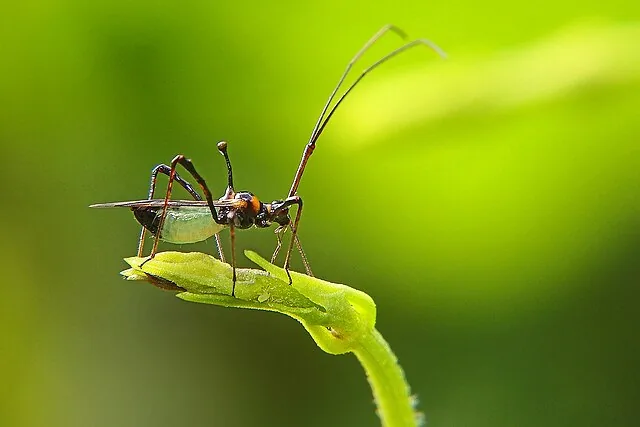
1. Tea Mosquito Bug — Helopeltis theivora (Miridae: Hemiptera)
IMPORTANT
Helopeltis theivora is the most important pest of tea. It causes more damage in shaded areas than in open-pruned sections. It injects toxic saliva while feeding, causing necrosis far beyond the actual feeding site.
Agricultural context: Tea quality depends entirely on the tender "two leaves and a bud." When Helopeltis damages these, the processed tea develops an off-flavour, reducing its auction price significantly. Export-quality tea requires virtually zero Helopeltis damage.
Damage Symptoms
- Considered the most serious pest of tea in India
- Causes more damage in shaded areas (important management clue)
- Adults and nymphs suck sap from buds, young leaves, and tender stems
- Puncture plant tissues with their needle-like rostrum and inject toxic saliva
- Feeding punctures appear as reddish-brown spots that enlarge into necrotic patches
- Leaves curl up, become badly deformed, and shoots dry up
- Processed tea from damaged shoots has bitter, off-flavour
Comparison: Helopeltis Species Across Crops
| Species | Primary Crop | Key Symptom | Common Name |
|---|---|---|---|
| Helopeltis theivora | Tea | Reddish-brown spots; curled shoots | Tea mosquito bug |
| Helopeltis antonii | Guava, cashew | Corky scab ("kajji") on fruits | Tea mosquito bug |
Both species inject toxic saliva while feeding. The damage pattern differs because of the different plant parts attacked (tender leaves in tea vs. fruits in guava).
Management
- Prune shade trees to reduce humidity and shade — Helopeltis thrives in humid, shaded conditions
- Spray systemic insecticides (thiamethoxam) — but strictly follow waiting periods for export tea
- Maintain proper spacing between tea bushes for air circulation
- Plucking at shorter intervals removes infested tender leaves before damage spreads
- Biological control with predatory reduviid bugs and spiders
- Avoid indiscriminate spraying that kills natural enemies
TIP
Exam facts for tea mosquito bug:
- Most serious pest of tea
- More damage in shaded areas
- Toxic saliva injection — necrosis beyond feeding site
- Related species H. antonii causes "kajji" on guava
Tobacco Pests
Classification Table — Tobacco
| No. | Common Name | Scientific Name | Family: Order | Key Feature |
|---|---|---|---|---|
| 1 | Tobacco Caterpillar | Spodoptera litura | Noctuidae: Lepidoptera | Papery white leaf; gregarious |
| 2 | Gram Pod Borer | Helicoverpa armigera | Noctuidae: Lepidoptera | Cannibalistic; polyphagous |
| 3 | Cutworms | Agrotis ipsilon | Noctuidae: Lepidoptera | Nocturnal stem cutting |
| 4 | Stem Borer | Scrobipalpa heliopa | Gelechiidae: Lepidoptera | Bores into stem |
| 5 | Ground Beetles | Mesomorphus villiger, Seleron latipes, Opatroides frater | Tenebrionidae: Coleoptera | Nocturnal seedling feeders |
| 6 | Whitefly | Bemisia tabaci | Aleyrodidae: Hemiptera | Viral disease vector |
| 7 | Aphid | Myzus nicotianae, Myzus persicae | Aphididae: Hemiptera | Vector of 100+ viruses |
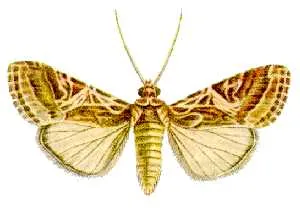
1. Tobacco Caterpillar — Spodoptera litura (Noctuidae: Lepidoptera)
IMPORTANT
Spodoptera litura is a highly polyphagous pest. The trap crop grown around groundnut fields for tobacco caterpillar and leaf miner control is cowpea. Early-instar larvae are gregarious and cause the characteristic papery white appearance on leaves.
Agricultural context: In the FCV (Flue-Cured Virginia) tobacco belt of Andhra Pradesh, Spodoptera litura is the number one defoliator. Tobacco leaves are the final product, so any leaf damage directly translates to economic loss. Farmers use multiple strategies: NPV sprays, pheromone traps, and cowpea border crops.
Damage Symptoms
- In early stages, caterpillars are gregarious and scrape the chlorophyll from the leaf lamina, giving a papery white appearance
- Later they become voracious feeders, making irregular holes in the leaves
- Skeletonisation of leaves — only veins and petioles remain
- Heavy defoliation in severe cases, rendering leaves unmarketable
Cross-Crop Names for Spodoptera litura
| Crop | Common Name | Key Symptom |
|---|---|---|
| Tobacco | Tobacco Caterpillar | Papery white leaves; defoliation |
| Chilli | Tobacco Cutworm | Same papery white symptom |
| Groundnut | Tobacco Caterpillar | Defoliation; trap crop = cowpea |
| Cotton | Tobacco Cutworm | Polyphagous pest |
Management
- Collect and destroy egg masses (laid in clusters, covered with brown hair) and gregarious early-instar larvae
- Use pheromone traps (Spodolure) — 10 traps per hectare
- Spray SlNPV (Spodoptera litura NPV) @ 250 LE per hectare
- Apply poison bait: rice bran + jaggery (10%) + carbaryl 50 WP — spread in the evening
- Grow cowpea as trap crop around the field
TIP
Exam mnemonic: "Spodoptera Litura → Spray Litura-NPV (SlNPV)." Trap crop for groundnut/tobacco caterpillar = cowpea. Do NOT confuse with trap crops for other pests (marigold for Helicoverpa, mustard for DBM, castor for Earias).
2. Gram Pod Borer — Helicoverpa armigera (Noctuidae: Lepidoptera)
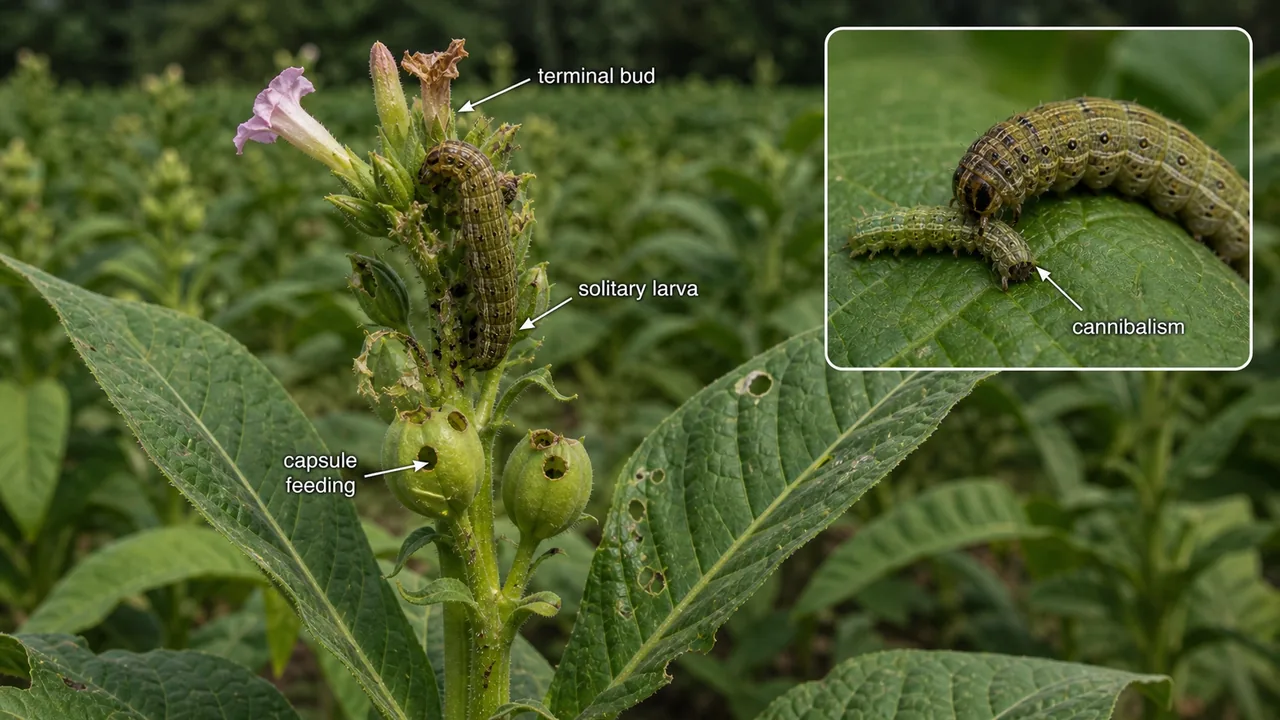
Agricultural context: Helicoverpa armigera attacks tobacco leaves, flowers, and developing capsules. On tobacco, it is called the budworm because it prefers to feed on the terminal bud and young leaves.
Key Facts
- Same pest as the tomato fruit borer and cotton American bollworm
- Feeds on leaves, flowers, and developing capsules of tobacco
- Cannibalism is a common phenomenon — when two larvae meet on a plant, the larger one often eats the smaller one
- Highly polyphagous — attacks over 200 plant species across more than 60 families
Comparison: Helicoverpa vs. Spodoptera on Tobacco
| Feature | Helicoverpa armigera | Spodoptera litura |
|---|---|---|
| Common name on tobacco | Budworm / Gram pod borer | Tobacco caterpillar |
| Feeding preference | Buds, capsules (reproductive parts) | Leaves (vegetative parts) |
| Gregarious? | No (solitary; cannibalistic) | Yes (early instars) |
| NPV used | HaNPV | SlNPV |
| Trap crop | Marigold | Cowpea |
Management
- Use HaNPV for biocontrol
- Install Helilure pheromone traps
- Spray Bt formulations
- Bird perches (T-shaped sticks) in the field to attract insectivorous birds
3. Cutworms — Agrotis ipsilon (Noctuidae: Lepidoptera)
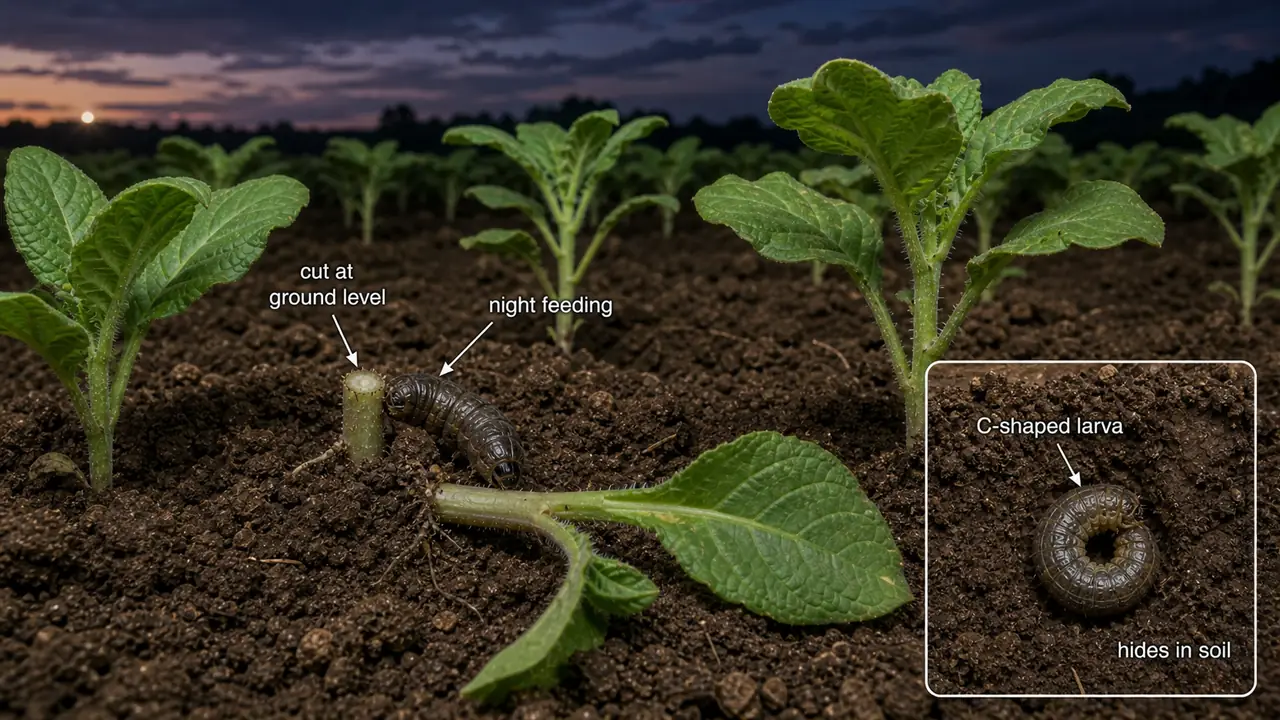
- Nocturnal feeders that cut seedlings at ground level
- Hide in soil during the day, curled in a C-shape
- Polyphagous — attacks tobacco, potato, chilli, cabbage, and many other crops
- Management: poison baiting (rice bran + jaggery + insecticide) applied in the evening
4. Stem Borer — Scrobipalpa heliopa (Gelechiidae: Lepidoptera)
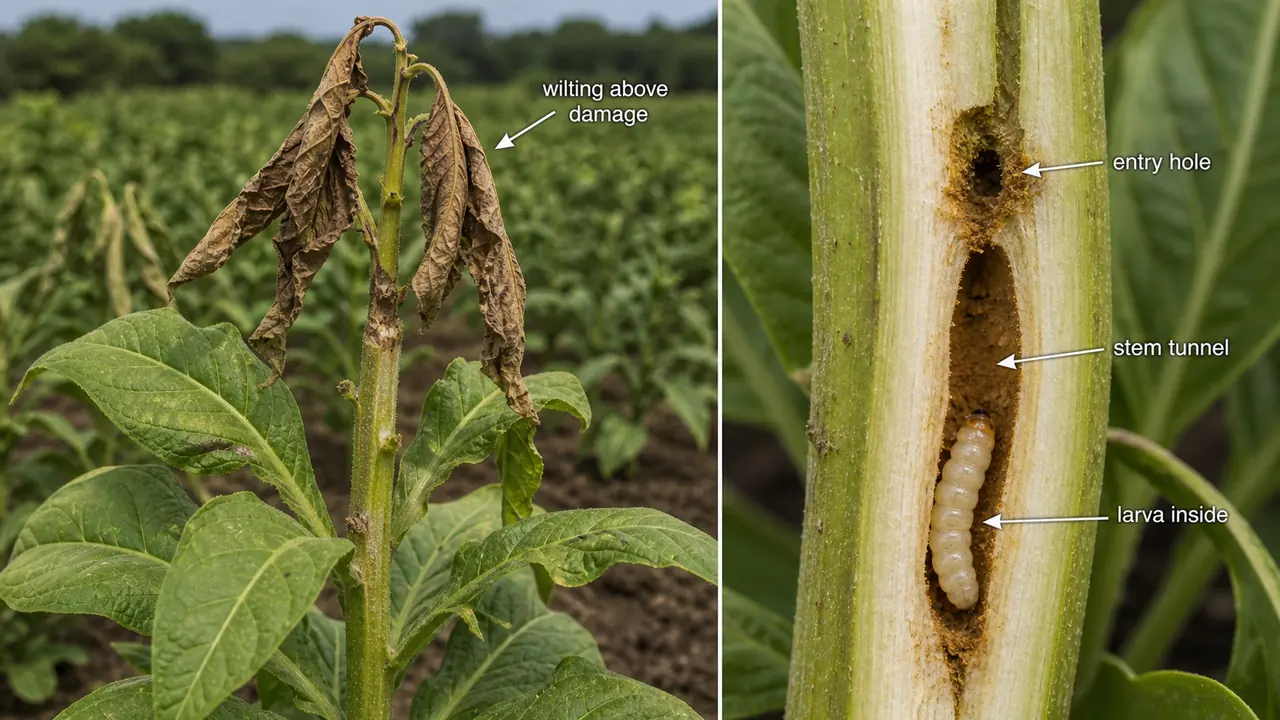
- Larva bores into the tobacco stem, causing wilting
- Weakens the plant structure, especially at the base
- Belongs to family Gelechiidae — same family as the potato tuber moth and cotton pink bollworm
Gelechiidae Family Connection
| Pest | Crop | Common Name |
|---|---|---|
| Scrobipalpa heliopa | Tobacco | Tobacco Stem Borer |
| Phthorimaea operculella | Potato | Potato Tuber Moth |
| Pectinophora gossypiella | Cotton | Pink Bollworm |
TIP
Exam connection: Three important Gelechiidae pests: tobacco stem borer, potato tuber moth, and cotton pink bollworm. All bore into plant tissues and belong to the same family.
5. Ground Beetles — Mesomorphus villiger, Seleron latipes, Opatroides frater (Tenebrionidae: Coleoptera)
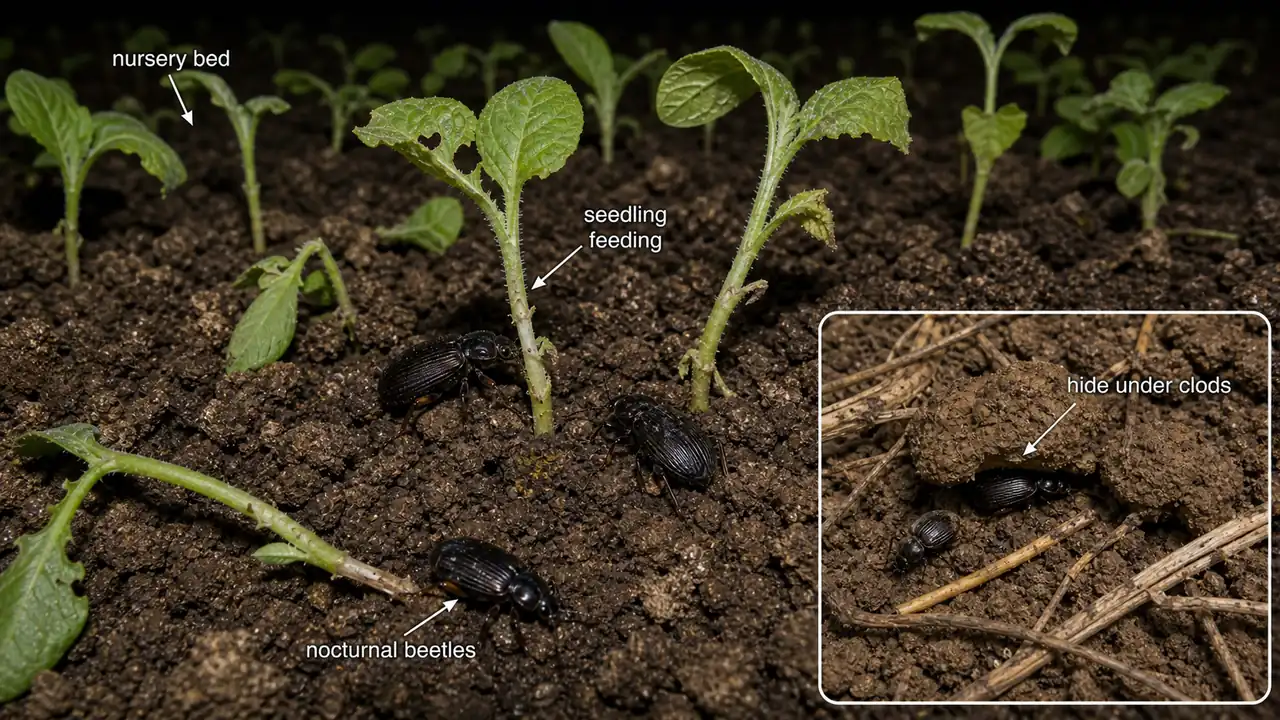
- Feed on seedlings and young tobacco plants in nursery beds
- Nocturnal in habit — hide under clods and debris during the day
- Family Tenebrionidae (darkling beetles)
- Management: clean nursery beds; apply insecticide drenches; remove hiding places
6. Whitefly — Bemisia tabaci (Aleyrodidae: Hemiptera)
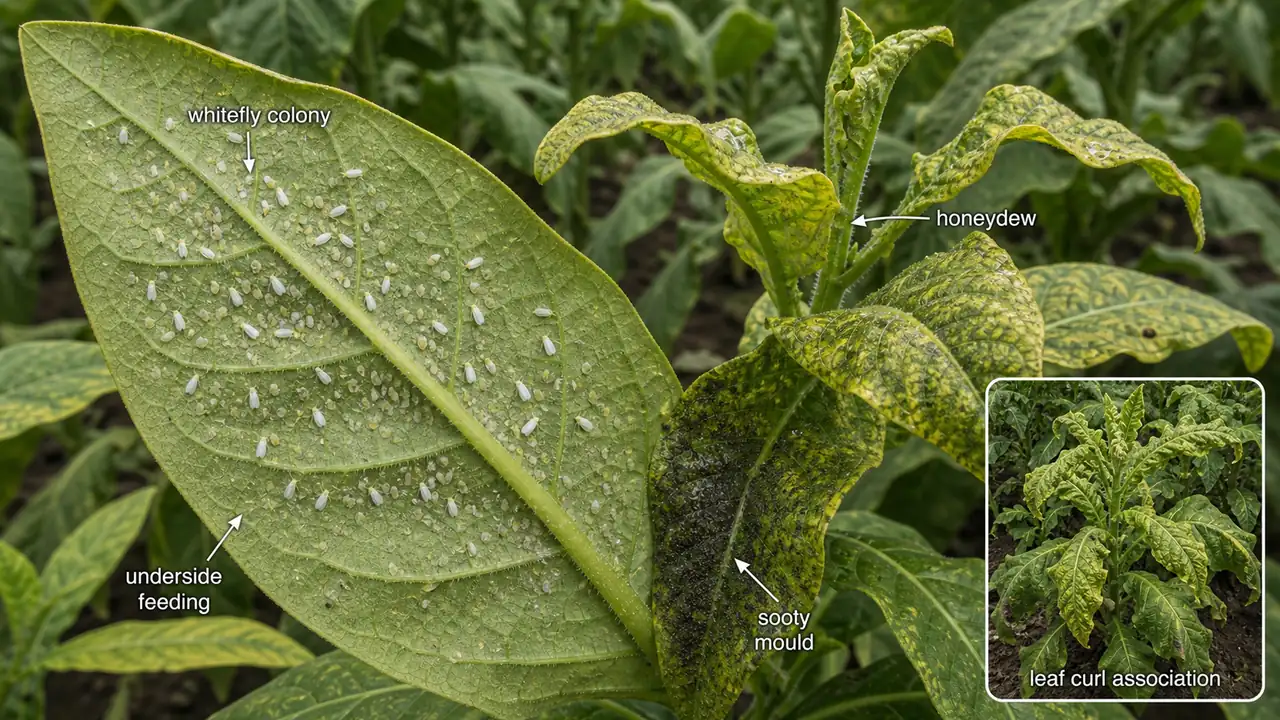
- Sap sucking pest causing yellowing and weakening
- Vector of viral diseases in tobacco (Tobacco Leaf Curl Virus)
- Honeydew secretion leads to sooty mould
- Management: spray imidacloprid or thiamethoxam; use yellow sticky traps
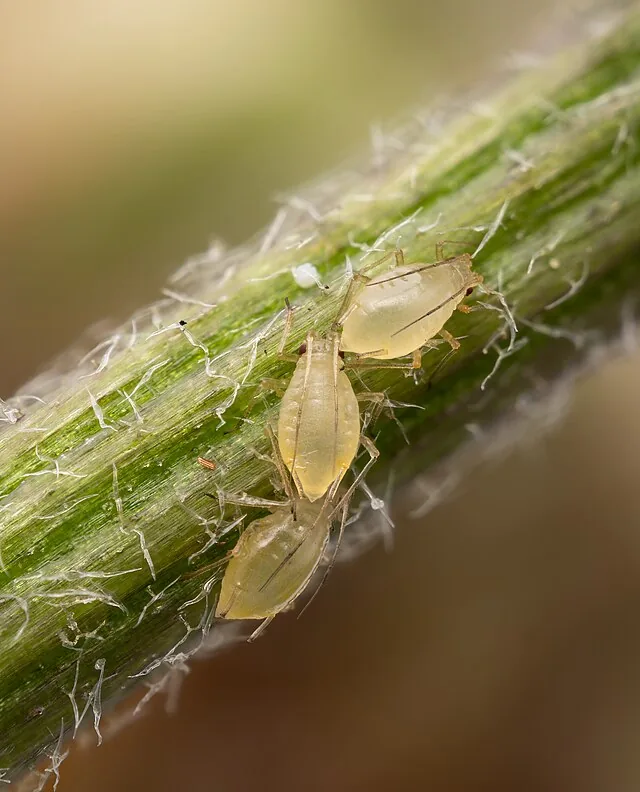
7. Aphid — Myzus nicotianae, Myzus persicae (Aphididae: Hemiptera)
IMPORTANT
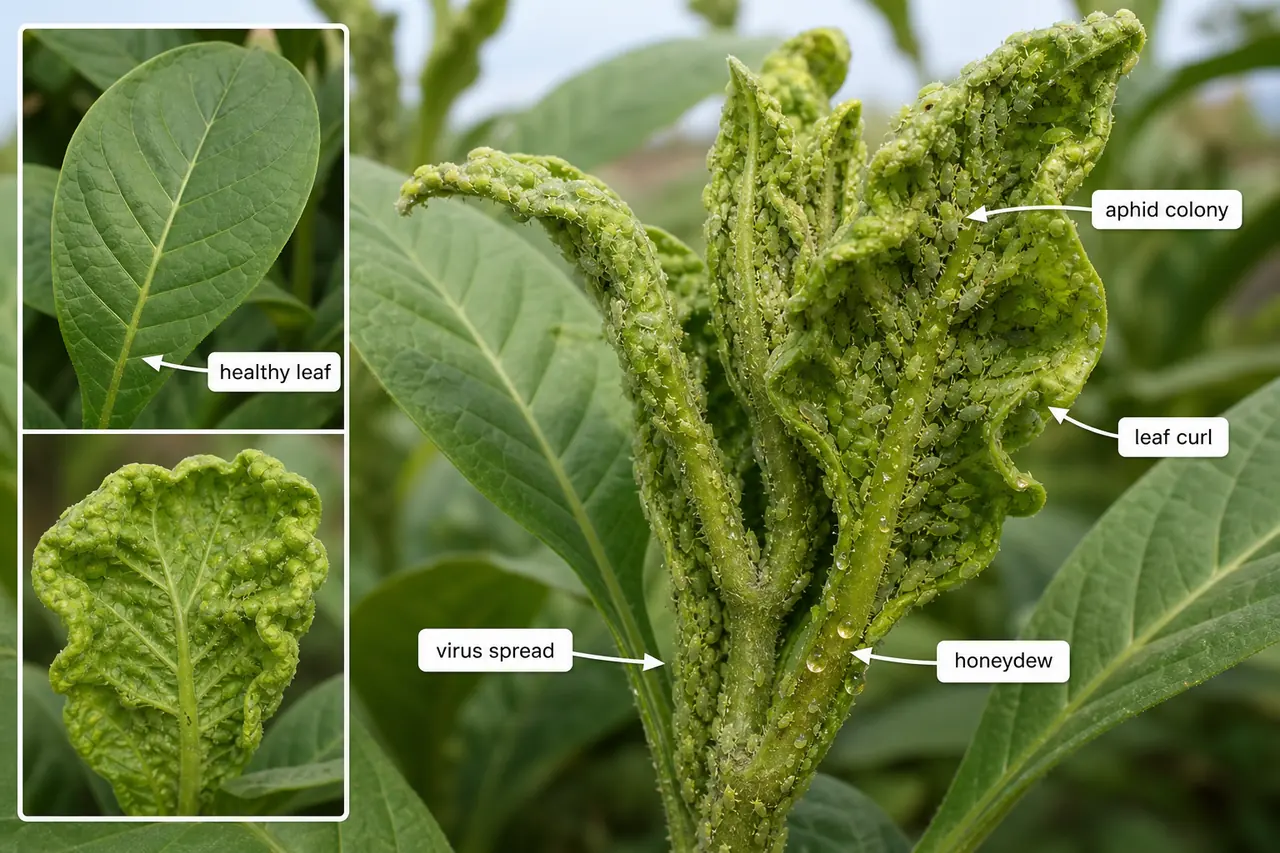
Myzus persicae (Green Peach Aphid) is one of the most important virus vectors among all aphids worldwide. It transmits over 100 plant viruses across numerous crops, making it the single most polyphagous aphid vector.
Damage Symptoms
- Suck sap from leaves, causing curling and distortion
- Secrete honeydew leading to sooty mould development
- Primary importance is as a virus vector, not direct feeding damage
Important Virus-Vector Relationships of Aphids
| Aphid Species | Disease Transmitted | Crop |
|---|---|---|
| Myzus persicae | 100+ viruses | Multiple crops |
| Pentalonia nigronervosa | BBTV (Bunchy Top) | Banana |
| Toxoptera citricidus | CTV (Tristeza) | Citrus |
| Aphis gossypii | Various mosaic viruses | Cotton, vegetables |
| Lipaphis erysimi | Turnip Mosaic Virus | Mustard |
Management
- Spray dimethoate 30 EC or imidacloprid
- Conserve predators: Coccinella septempunctata, Chrysoperla carnea, syrphid flies
- Remove virus-infected plants immediately
- Use reflective silver mulch to repel aphids
TIP
Exam mnemonic: "Myzus persicae = Most Polyphagous aphid vector" (MP = Most Polyphagous). Transmits 100+ viruses. It is also called the Green Peach Aphid because it was first described on peach.
Cross-Crop Pest Connections — Summary
Understanding that the same pest appears under different names on different crops is crucial for exams. Here is a consolidated view:
| Pest Species | Tobacco Name | Other Crop Name | Other Crop |
|---|---|---|---|
| Spodoptera litura | Tobacco Caterpillar | Tobacco Cutworm | Chilli, groundnut |
| Helicoverpa armigera | Budworm | American Bollworm / Gram Pod Borer / Fruit Borer | Cotton / Chickpea / Tomato |
| Agrotis ipsilon | Cutworm | Black Cutworm / Greasy Cutworm | Potato, chilli, cabbage |
| Bemisia tabaci | Whitefly | Whitefly | Tomato, okra, chilli, cotton |
| Myzus persicae | Green Peach Aphid | Green Peach Aphid | Multiple crops |
Comparison: Trap Crops Across All Pests (Consolidated)
| Pest | Trap Crop | Primary Crop |
|---|---|---|
| Spodoptera litura (Tobacco caterpillar) | Cowpea | Groundnut, tobacco |
| Helicoverpa armigera (Fruit borer) | Marigold | Tomato |
| Plutella xylostella (DBM) | Mustard (80-90%) | Cabbage |
| Earias vittella (Shoot borer) | Castor | Okra |
TIP
Trap crop mnemonic — "CMMC": Cowpea for Spodoptera, Marigold for Helicoverpa, Mustard for DBM, Castor for Earias. Learn these four pairs — they appear in almost every competitive exam.
Exam Tips and Mnemonics
- Tea mosquito bug: Most serious tea pest; more damage in shaded areas; toxic saliva; H. theivora (tea) vs. H. antonii (guava)
- Papery white leaves = Spodoptera litura (early instars scraping chlorophyll gregariously)
- Cannibalism is characteristic of Helicoverpa armigera — not Spodoptera
- NPV types: HaNPV for Helicoverpa; SlNPV for Spodoptera — the prefix matches the species initial
- Gelechiidae trio: Tobacco stem borer, potato tuber moth, cotton pink bollworm — all borers in the same family
- Ground beetles of tobacco = Tenebrionidae (darkling beetles) — nocturnal nursery pests
- Myzus persicae transmits 100+ viruses — the most polyphagous aphid vector in the world
- Trap crop formula: Cowpea (Spodoptera), Marigold (Helicoverpa), Mustard (DBM), Castor (Earias)
Summary Cheat Sheet
| No. | Pest | Crop | Scientific Name | Family: Order | Key Exam Fact |
|---|---|---|---|---|---|
| 1 | Tea Mosquito Bug | Tea | Helopeltis theivora | Miridae: Hemiptera | Most serious tea pest; more damage in shade; toxic saliva |
| 2 | Tobacco Caterpillar | Tobacco | Spodoptera litura | Noctuidae: Lepidoptera | Papery white leaves; gregarious; SlNPV; trap crop = cowpea |
| 3 | Gram Pod Borer | Tobacco | Helicoverpa armigera | Noctuidae: Lepidoptera | Cannibalistic; polyphagous; HaNPV; trap crop = marigold |
| 4 | Cutworm | Tobacco | Agrotis ipsilon | Noctuidae: Lepidoptera | Nocturnal; cuts seedlings at ground level; poison baiting |
| 5 | Stem Borer | Tobacco | Scrobipalpa heliopa | Gelechiidae: Lepidoptera | Gelechiidae family (same as pink bollworm + tuber moth) |
| 6 | Ground Beetles | Tobacco | Mesomorphus villiger et al. | Tenebrionidae: Coleoptera | Tenebrionidae (darkling beetles); nocturnal nursery pests |
| 7 | Whitefly | Tobacco | Bemisia tabaci | Aleyrodidae: Hemiptera | Vector of Tobacco Leaf Curl Virus |
| 8 | Aphid | Tobacco | Myzus persicae | Aphididae: Hemiptera | Green Peach Aphid; vector of 100+ viruses; most polyphagous aphid vector |