🥭 Mango Pests: 11 Major Insect Pests, Identification & IPM Strategies
Master all 11 major pests of mango — from hoppers and fruit flies to stem borers and mealy bugs. Covers scientific names, damage symptoms, IPM, and exam-focused mnemonics for exams, NABARD & ICAR.
Picture this: A mango grower in Malihabad (Uttar Pradesh) walks through his orchard during February and notices sticky, blackened inflorescences. Flowers are dropping, and a sooty film covers the leaves. On closer inspection, tiny wedge-shaped insects leap away from the panicles. This is the classic attack of mango hoppers — the single most devastating pest of the king of fruits.
Mango (Mangifera indica) is India's most important fruit crop, contributing nearly 50% of the world's production. Over 200 insect species feed on mango, but 11 pests are of major economic importance. Knowing their scientific names, damage symptoms, and management is essential for exams, NABARD, and ICAR examinations.
How This Lesson Is Organised
We move from the most damaging pests (hoppers, fruit fly) to the less commonly examined ones (flower webber, leaf caterpillar). For each pest you will find:
- Correct scientific name with family and order
- Host range and distribution
- Damage symptoms (with exam-important keywords highlighted)
- IPM and management measures
- Exam tips and mnemonics
Master Identification Table — All 11 Mango Pests
| No. | Common Name | Scientific Name | Family | Order | Part Attacked |
|---|---|---|---|---|---|
| 1 | Mango Hoppers | Idioscopus niveosparus, I. clypealis, Amritodus atkinsoni | Cicadellidae | Hemiptera | Inflorescence, shoots |
| 2 | Stem Borer | Batocera rufomaculata | Cerambycidae | Coleoptera | Bark, main stem |
| 3 | Fruit Fly | Bactrocera dorsalis | Tephritidae | Diptera | Fruits (pulp) |
| 4 | Mango Nut Weevil | Sternochaetus mangiferae | Curculionidae | Coleoptera | Seed (stone) |
| 5 | Mango Mealy Bug | Drosicha mangiferae | Pseudococcidae | Hemiptera | Shoots, panicles |
| 6 | Bark Eating Caterpillar | Indarbela tetraonis, I. quadrinotata | Metarbelidae | Lepidoptera | Trunk, branch junctions |
| 7 | Flower Gall Midge | Procystiphora mangiferae, Erosomyia indica, Dasineura amaramanjarae | Cecidomyiidae | Diptera | Flower buds |
| 8 | Mango Leaf Webber | Orthaga exvinacea | Noctuidae | Lepidoptera | Leaves |
| 9 | Shoot Borer | Chlumetia transversa | Noctuidae | Lepidoptera | Tender shoots |
| 10 | Leaf Caterpillar | Bombotelia jacosatrix | Noctuidae | Lepidoptera | Tender leaves |
| 11 | Flower Webber | Eublemma versicolor | Noctuidae | Lepidoptera | Flowers |
TIP
Pro Content Locked
Upgrade to Pro to access this lesson and all other premium content.
Charged once for one year · ₹1188 total
Save ₹100/month vs ₹2388/year launch price
- All Agriculture & Banking Courses
- AI Lesson Questions (100/day)
- AI Doubt Solver (50/day)
- Glows & Grows Feedback (30/day)
- AI Section Quiz (20/day)
- 22-Language Translation (100/day)
- Recall Questions (20/day)
- AI Quiz (15/day)
- AI Quiz Paper Analysis (100/day)
- AI Step-by-Step Explanations (100/day)
- Spaced Repetition Recall (FSRS)
- AI Tutor
- Immersive Text Questions
- Audio Lessons — Hindi & English
- Mock Tests & Previous Year Papers
- Summary & Mind Maps
- XP, Levels, Leaderboard & Badges
- Generate New Classrooms
- Voice AI Teacher (AgriDots Live)
- AI Revision Assistant
- Knowledge Gap Analysis
- Interactive Revision (LangGraph)
🔒 Secure one-time yearly payment via Razorpay · No hidden fees
Picture this: A mango grower in Malihabad (Uttar Pradesh) walks through his orchard during February and notices sticky, blackened inflorescences. Flowers are dropping, and a sooty film covers the leaves. On closer inspection, tiny wedge-shaped insects leap away from the panicles. This is the classic attack of mango hoppers — the single most devastating pest of the king of fruits.
Mango (Mangifera indica) is India's most important fruit crop, contributing nearly 50% of the world's production. Over 200 insect species feed on mango, but 11 pests are of major economic importance. Knowing their scientific names, damage symptoms, and management is essential for exams, NABARD, and ICAR examinations.
How This Lesson Is Organised
We move from the most damaging pests (hoppers, fruit fly) to the less commonly examined ones (flower webber, leaf caterpillar). For each pest you will find:
- Correct scientific name with family and order
- Host range and distribution
- Damage symptoms (with exam-important keywords highlighted)
- IPM and management measures
- Exam tips and mnemonics
Master Identification Table — All 11 Mango Pests
| No. | Common Name | Scientific Name | Family | Order | Part Attacked |
|---|---|---|---|---|---|
| 1 | Mango Hoppers | Idioscopus niveosparus, I. clypealis, Amritodus atkinsoni | Cicadellidae | Hemiptera | Inflorescence, shoots |
| 2 | Stem Borer | Batocera rufomaculata | Cerambycidae | Coleoptera | Bark, main stem |
| 3 | Fruit Fly | Bactrocera dorsalis | Tephritidae | Diptera | Fruits (pulp) |
| 4 | Mango Nut Weevil | Sternochaetus mangiferae | Curculionidae | Coleoptera | Seed (stone) |
| 5 | Mango Mealy Bug | Drosicha mangiferae | Pseudococcidae | Hemiptera | Shoots, panicles |
| 6 | Bark Eating Caterpillar | Indarbela tetraonis, I. quadrinotata | Metarbelidae | Lepidoptera | Trunk, branch junctions |
| 7 | Flower Gall Midge | Procystiphora mangiferae, Erosomyia indica, Dasineura amaramanjarae | Cecidomyiidae | Diptera | Flower buds |
| 8 | Mango Leaf Webber | Orthaga exvinacea | Noctuidae | Lepidoptera | Leaves |
| 9 | Shoot Borer | Chlumetia transversa | Noctuidae | Lepidoptera | Tender shoots |
| 10 | Leaf Caterpillar | Bombotelia jacosatrix | Noctuidae | Lepidoptera | Tender leaves |
| 11 | Flower Webber | Eublemma versicolor | Noctuidae | Lepidoptera | Flowers |
TIP
Mnemonic — "HSFM-BF-SLSF": Hoppers, Stem borer, Fruit fly, Mealy bug, Bark caterpillar, Flower gall midge, Shoot borer, Leaf webber, Shoot borer, Leaf caterpillar, Flower webber. Group them by plant part attacked for easier recall.
1. Mango Hoppers — Idioscopus niveosparus, I. clypealis, Amritodus atkinsoni (Cicadellidae: Hemiptera)
IMPORTANT
Mango hoppers are the most devastating pest of mango, prevalent during the flowering season in all mango-growing areas of India.
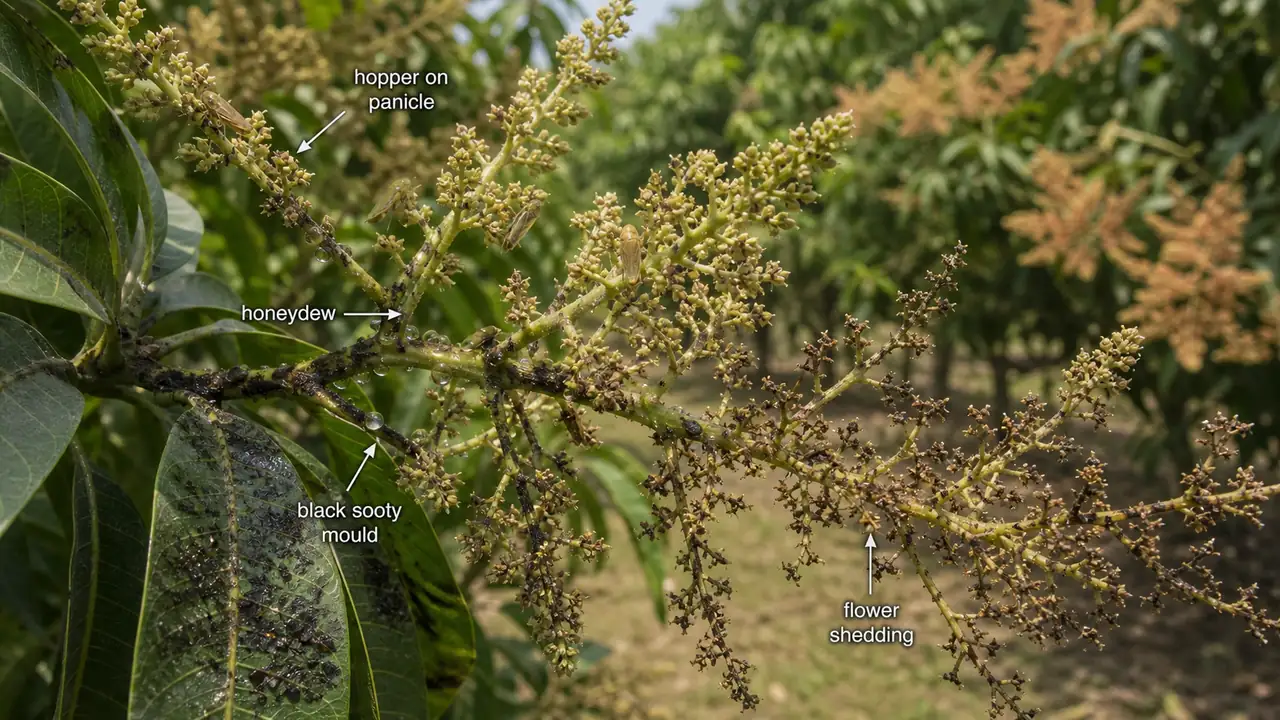
Why they matter: In a bad year, hoppers alone can destroy 25-60% of the mango crop by preventing fruit set.
Host range: Mango
Damage Symptoms
- Both nymphs and adults suck sap from tender shoots and inflorescence, causing withering and shedding of flower buds
- Wilting and drying of shoots and leaves
- Flower stalks and leaves become sticky due to honeydew secretion
- Honeydew encourages growth of black sooty mould on foliage and other parts
- During the non-flowering season, hoppers shelter in cracks and crevices on the bark
Field Identification
| Feature | What to Look For |
|---|---|
| Insect shape | Small, wedge-shaped, 4-5 mm long |
| Behaviour | Leap (hop) when disturbed |
| Season | Peak during February-March (flowering) |
| Diagnostic sign | Sticky honeydew + black sooty mould on panicles |
| Egg laying | Eggs are commonly inserted on the underside of leaves and other tender mango tissues |
IPM and Management
- Avoid close planting — incidence is severe in overcrowded orchards
- Prune dense canopy to allow aeration and sunlight
- Avoid excess nitrogenous fertilizers (promotes succulent growth)
- Two sprays of imidacloprid 17.8 SL (0.3 ml/L) at panicle emergence and at full bloom
TIP
Exam mnemonic: Three species — Idioscopus niveosparus, I. clypealis, Amritodus atkinsoni. Remember "IIA attacks mango inflorescence." Sooty mould on honeydew is the clincher symptom.
2. Stem Borer — Batocera rufomaculata (Cerambycidae: Coleoptera)
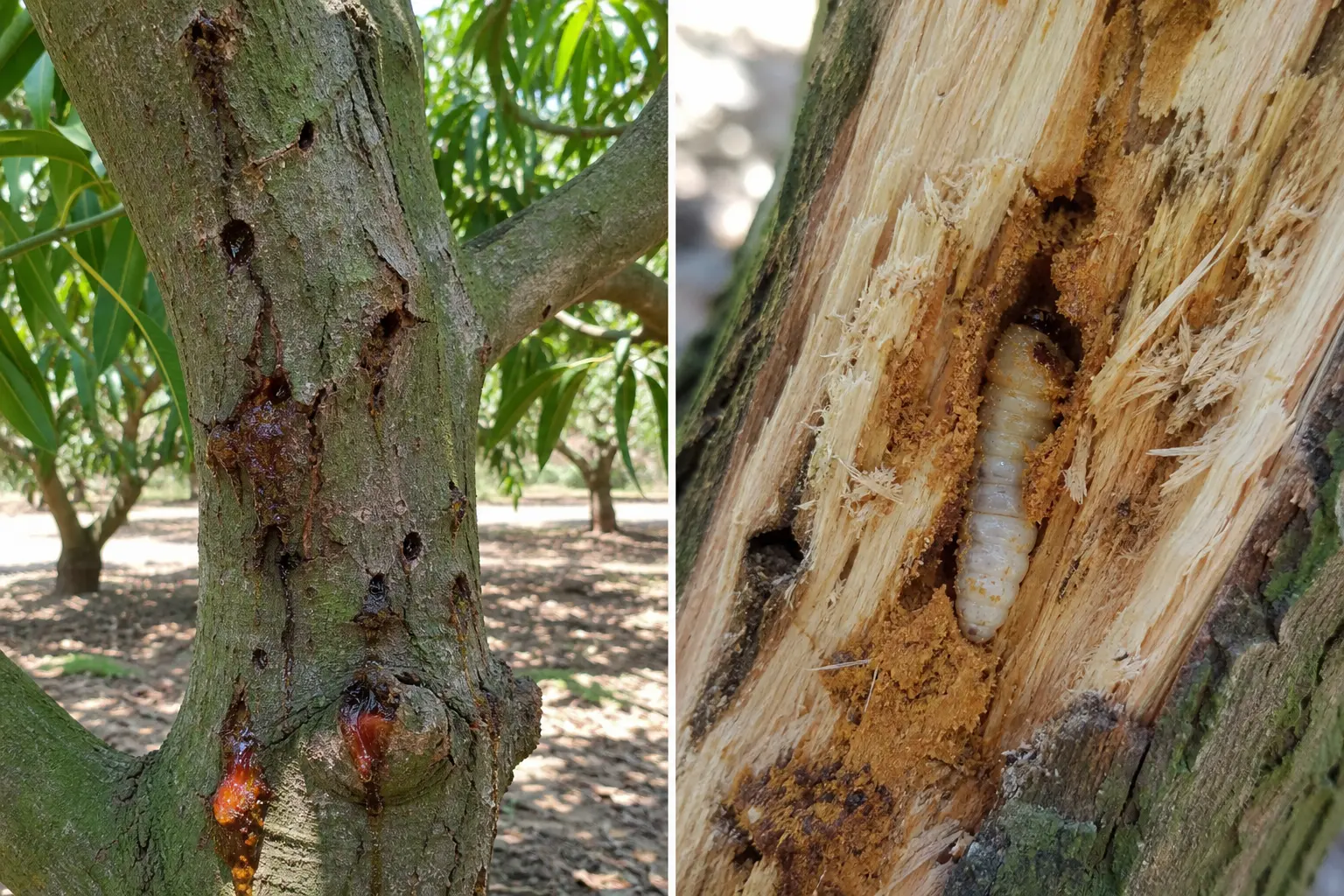
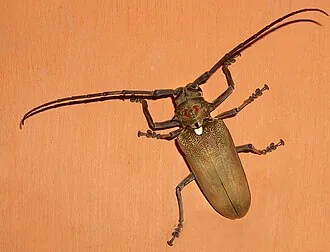
Agricultural context: In old mango orchards of Maharashtra, entire mature trees sometimes die from the inside out. The culprit is the longhorn beetle Batocera rufomaculata, whose grubs silently tunnel through the heartwood for months before external symptoms appear.
Distribution: India, Bangladesh
Host range: Mango, rubber, jack-fruit, fig, papaya, apple, eucalyptus, mulberry, moringa, and silk cotton — highly polyphagous
Damage Symptoms
- Grubs tunnel into the bark of branches and main stem
- Early signs: shedding of leaves and drying of terminal shoots
- Advanced damage to the main stem causes tree death
Management
- Grow tolerant varieties: Neelam, Humayudin
- Remove alternative hosts like moringa and silk cotton from the vicinity
- Inject DDVP or kerosene into tunnels and plug with mud
TIP
Exam fact: Batocera rufomaculata belongs to Cerambycidae (longhorn beetles). Tolerant varieties Neelam and Humayudin are commonly asked.
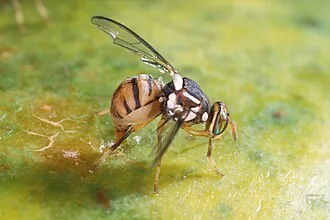
3. Fruit Fly — Bactrocera dorsalis (Tephritidae: Diptera)
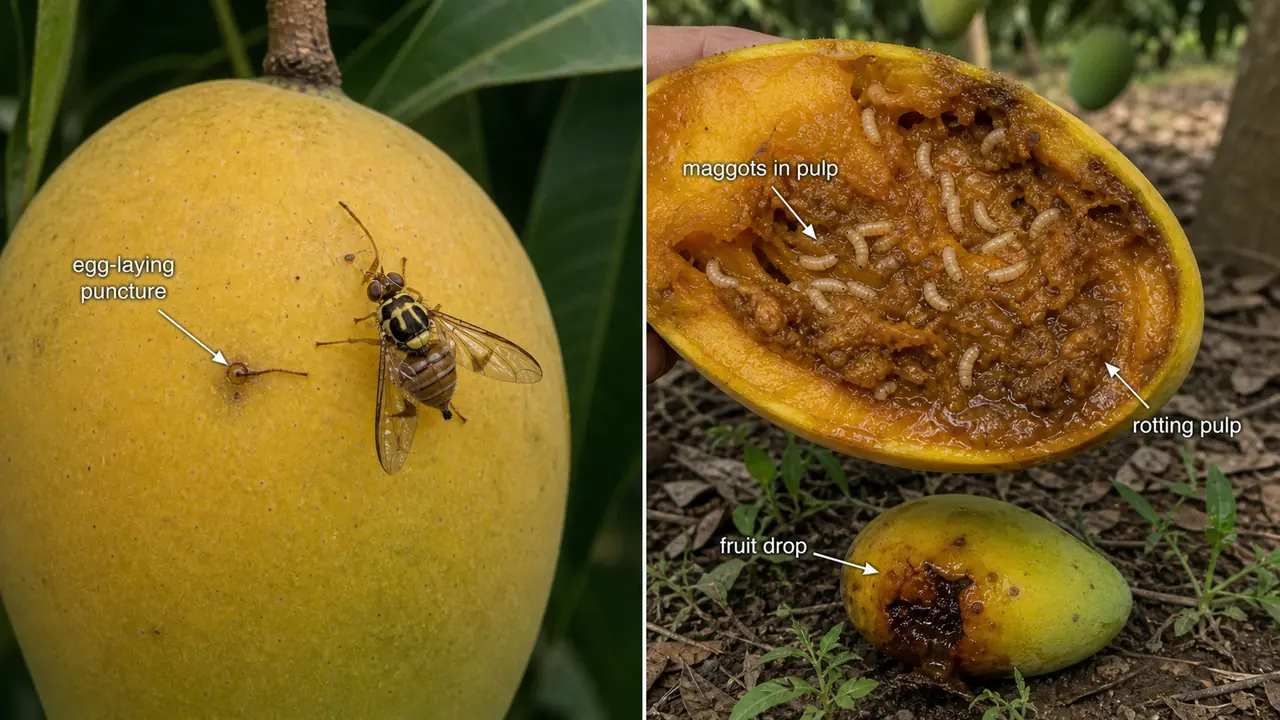
IMPORTANT
Mango fruit fly is a quarantine pest of international importance. It is one of the main reasons for restrictions on Indian mango exports to the EU and the USA.
Real-world impact: India's mango export earnings depend heavily on managing this single pest. Consignments are rejected at ports if even one maggot is found.
Host range: Mango, guava, peach, apricot, cherry, pear, ber, citrus, banana, papaya, avocado, passion fruit, coffee, melons, jack fruit, strawberry — highly polyphagous
Damage Symptoms
- Female punctures ripe or ripening fruit and lays eggs under the skin
- Maggots destroy the pulp, converting it into a bad-smelling, discoloured semi-liquid mass unfit for consumption
- Infestation causes fruit drop; liquid oozes from fruit on pressing
Management
- Apply a bait spray of malathion 50 EC @ 2 ml/L with molasses or jaggery (10 g/L) before ripening
- Use Vapour Heat Treatment (VHT): 46°C for 10 minutes — approved quarantine treatment for export
- Protein hydrolysate used as attractant in bait traps (MAT — Male Annihilation Technique)
- Fruit fly pupates in soil beneath fallen fruits — collect and destroy fallen fruits daily
- Light raking or disturbance of the soil around tree basins helps expose and destroy overwintering fruit-fly pupae in mango orchards
- Use methyl eugenol traps (parapheromone) for monitoring and mass trapping
Comparison: Fruit Flies Across Crops
| Crop | Fruit Fly Species | Family |
|---|---|---|
| Mango | Bactrocera dorsalis | Tephritidae |
| Guava | Bactrocera diversus | Tephritidae |
| Pomegranate | Bactrocera zonata | Tephritidae |
| Cucurbits | Bactrocera cucurbitae | Tephritidae |
TIP
Exam mnemonic: "Dorsalis for manDo (mango), Diversus for guava (Different crop), Zonata for anar (pomegranate Zone)." VHT is the approved quarantine treatment for export — always asked.
4. Mango Nut Weevil / Mango Stone Weevil — Sternochaetus mangiferae (Curculionidae: Coleoptera)
NOTE
Mango nut weevil is of quarantine importance. It damages the seed (stone) inside the fruit, making external detection extremely difficult.
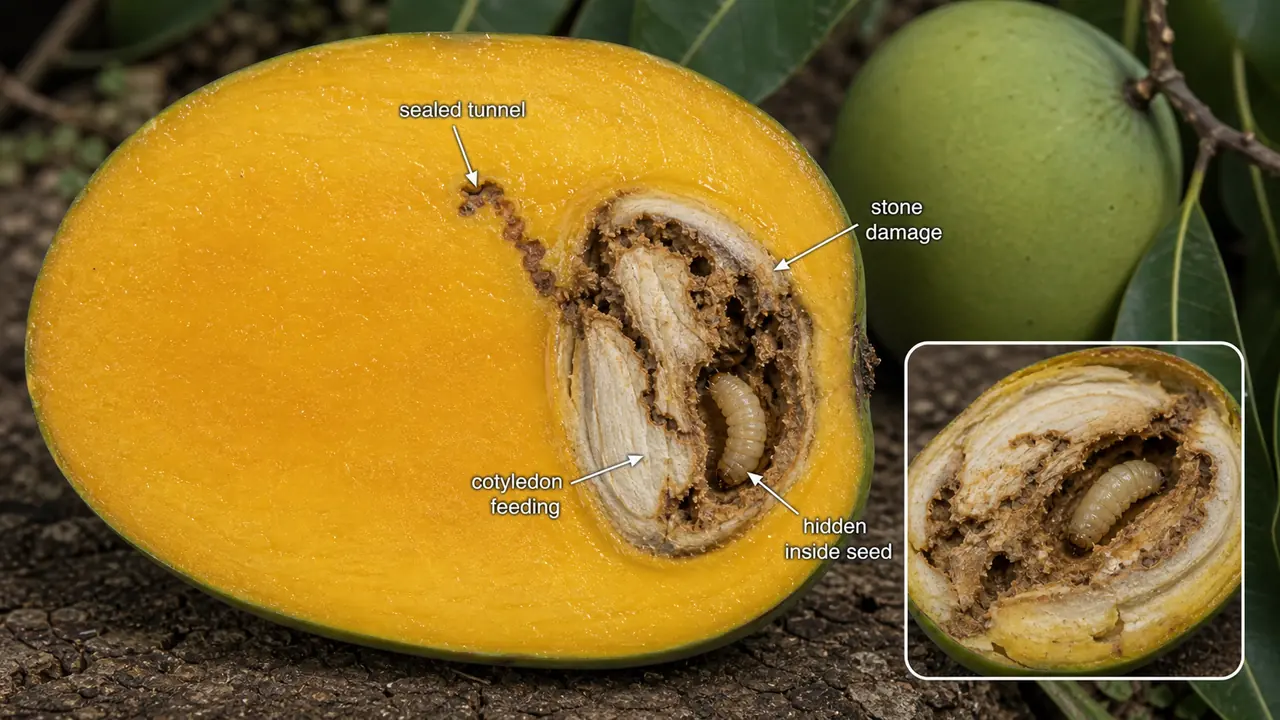
Agricultural context: A fruit may look perfectly healthy on the outside, but when you cut it open, the stone is completely hollowed out by the weevil grub. Sternochaetus mangiferae causes semi-ripe mango fruit drop with a dead spot; larva feeds inside the seed/kernel. This hidden damage is why it is treated as a quarantine pest.
Host range: Mango (monophagous)
Damage Symptoms
- A small T-shaped mark may be noticed on young marble-sized fruits where the female has punctured tissue before the grub reaches the stone
- Grub tunnels in a zig-zag manner through the pulp, endocarp, and seed coat, finally reaching and destroying the cotyledons
- As the fruit develops, the tunnel gets sealed — making external detection difficult
- Adults that emerge from pupae also feed on the developing seed and hasten the maturity of infested fruit
Management
- Collect and destroy fallen fruits regularly
- Do not use seeds from infested fruits for propagation
- Hot water treatment (48 degrees C for 60 minutes)
TIP
Exam distinction: Nut weevil damages the seed (internal), while fruit fly damages the pulp (external symptoms visible). Both are quarantine pests but for different reasons.
5. Mango Mealy Bug — Drosicha mangiferae (Pseudococcidae: Hemiptera)
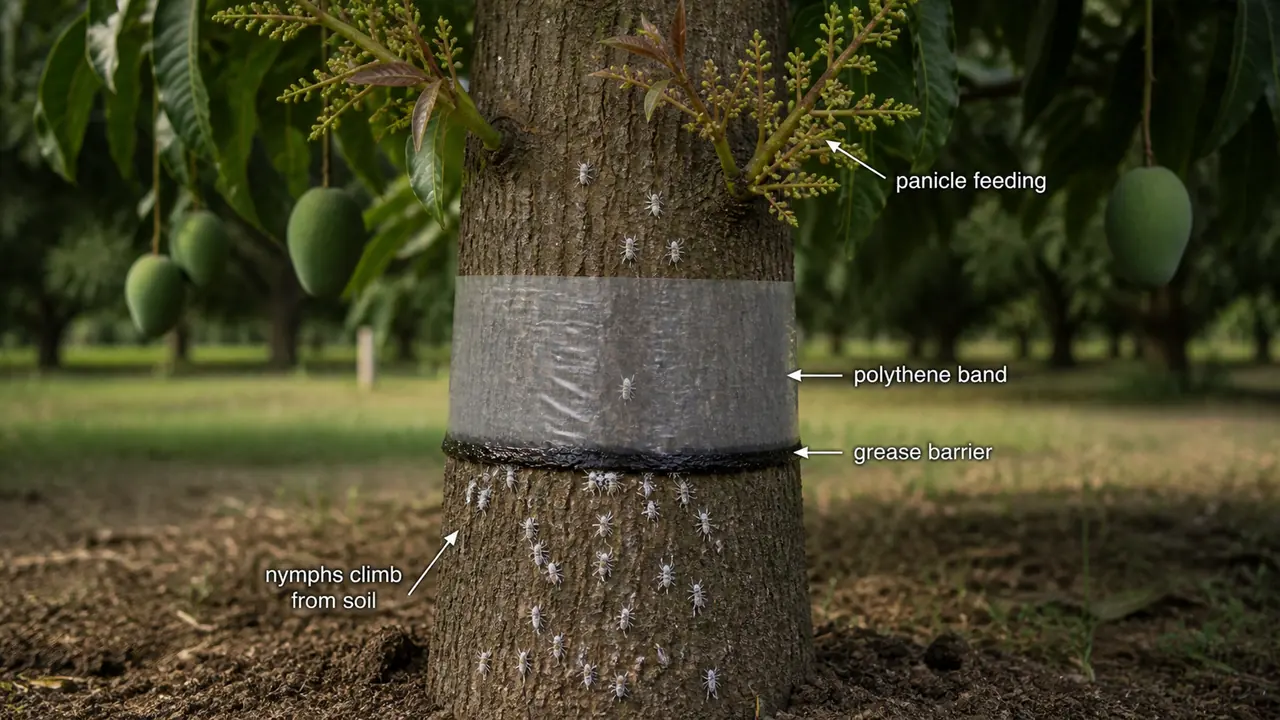
Agricultural context: Every December, mango growers in Uttar Pradesh and Bihar prepare for mealy bug season. They wrap polythene bands around tree trunks — a simple but highly effective barrier against the crawling nymphs.
Host range: Mango, apple, apricot, ber, cherry, citrus, fig, grape vine, guava, jack, jamun, litchi, mulberry, and pomegranate — highly polyphagous
Damage Symptoms
- Damage is caused by nymphs and wingless females
- Eggs are laid in the soil, from where the young nymphs later emerge and crawl upward
- Nymphs climb up the tree from the soil, congregate, and suck juice from young shoots, panicles, and flower pedicels
- Affected parts dry up; yield is reduced substantially
- Heavy infestation leads to complete failure of fruit set
IPM and Management
- Remove weeds (especially Clerodendrum) and grasses by ploughing during June-July
- Plough orchards during summer to expose eggs to natural enemies and sun
- Band the trees with 20 cm wide alkathene/polythene (400 gauge) in mid-December — fix it 50 cm above ground level, just below the junction of branching
- Tie stem with jute thread and apply fruit tree grease on the lower edge of the band
- Grease painting on the mango trunk (below polythene band) prevents nymph climbing
- Complete control package: Tree banding + NSKE 5% spray + Beauveria bassiana = integrated mealy bug management
- Mealy bug causes fruit dropping — nymphs climb from soil, suck flower pedicels and young fruits
IMPORTANT
The polythene banding technique is a classic exam question. Nymphs emerge from soil and crawl up the trunk — the smooth band prevents them from reaching the canopy. Timing (mid-December) and gauge (400) are frequently tested details.
6. Bark Eating Caterpillar — Indarbela tetraonis, I. quadrinotata (Metarbelidae: Lepidoptera)
Host range: Mango, guava, litchi, orange, pomegranate, mulberry, moringa, rose, and many other fruit trees — highly polyphagous
Damage Symptoms
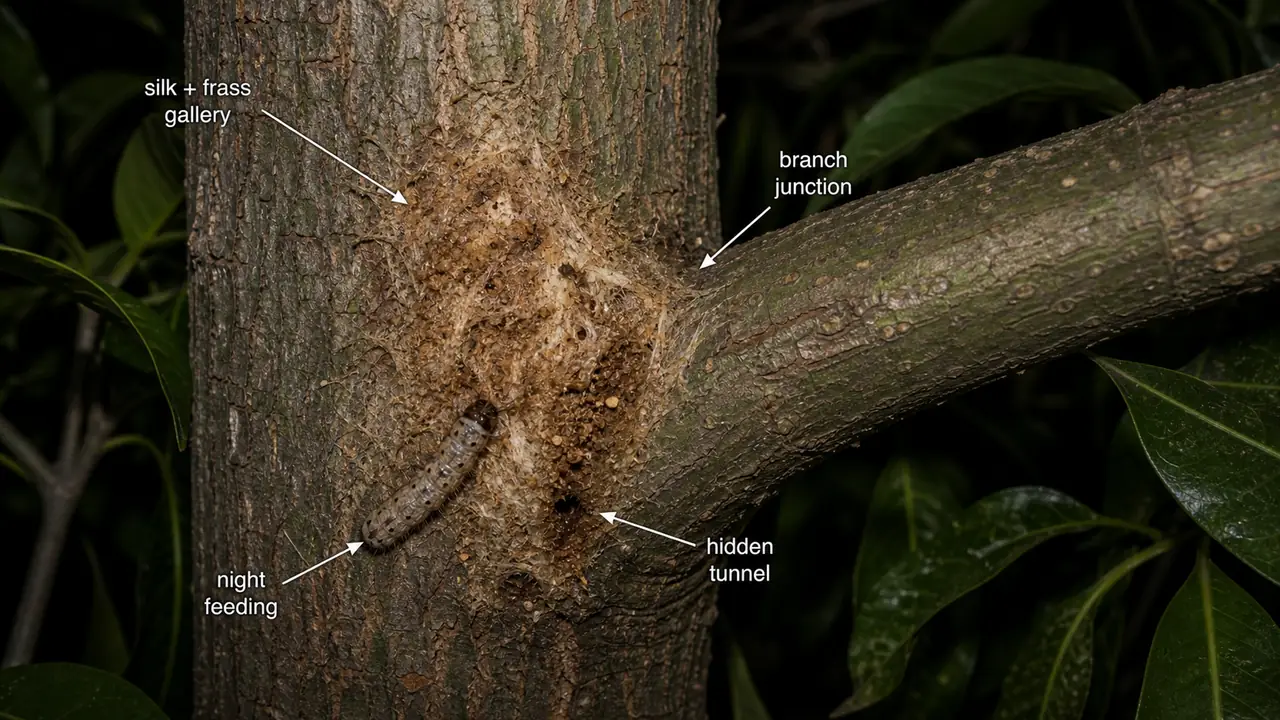
- Caterpillars bore into the trunk or junction of branches, making zig-zag galleries
- Bark damage with galleries webbed with silk and excreta at branch junctions = diagnostic feature of Indarbela sp.
- Caterpillar feeds at night, hides in gallery by day
- Under severe infestation, sap flow is hindered, growth is arrested, and fruit formation drops drastically
Management
- Inject ethylene glycol and kerosene oil (1:3 ratio) into the tunnel using a syringe, then seal the opening with mud
- Alternatively, dip cotton in a fumigant (chloroform, petrol, or kerosene), push it into the tunnel, and seal with clay or mud
- Clean webs and frass from trunks regularly
TIP
Exam clincher: Silk + frass galleries at branch junctions = bark eating caterpillar. The tunnel-sealing management method (inject fumigant + seal with mud) is a favourite question. The ratio 1:3 (ethylene glycol : kerosene) is tested.
7. Flower Gall Midge — Procystiphora mangiferae, Erosomyia indica, Dasineura amaramanjarae (Cecidomyiidae: Diptera)
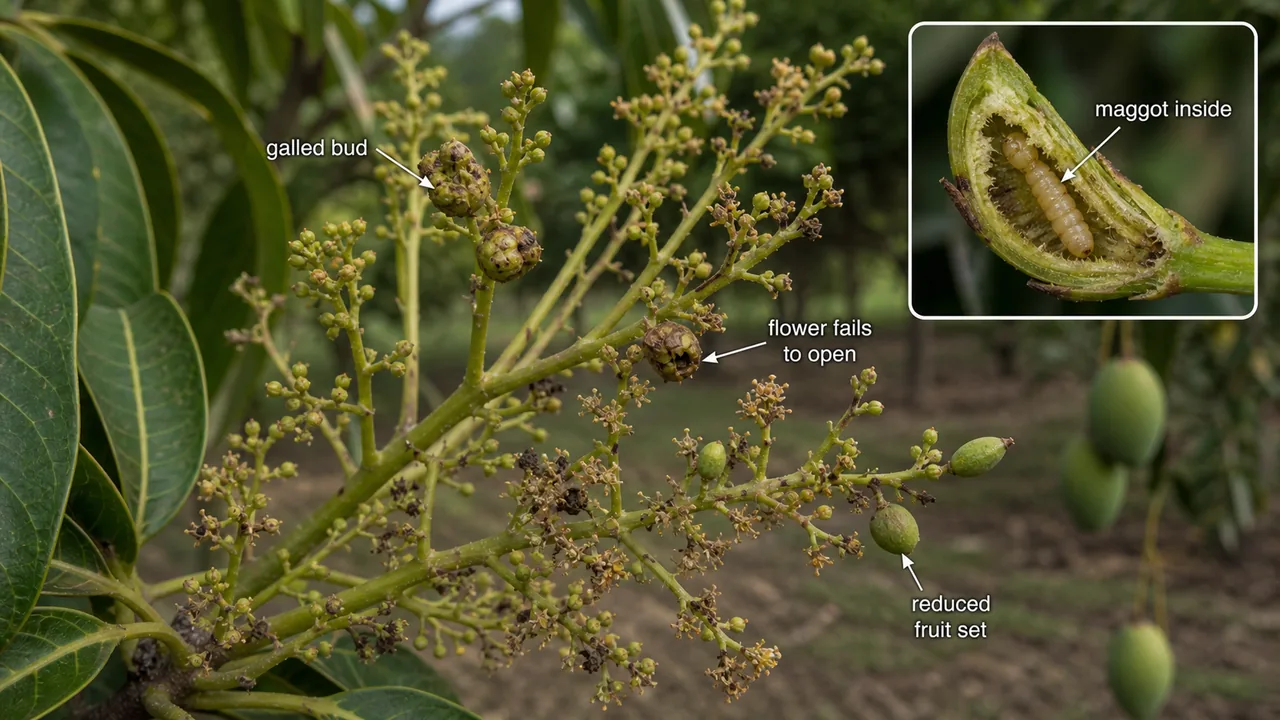
Agricultural context: In some years, mango orchards in South India report near-total failure of fruit set despite abundant flowering. The hidden cause: tiny gall midges whose maggots develop inside unopened flower buds.
Damage Symptoms
- Three species cause galls on mango flowers
- Maggots feed inside flower buds, causing abnormal gall formation
- Affected flowers do not open and fail to set fruit
- Severe infestation can reduce fruit set by over 50%
Management
- Collect and destroy galled flower buds
- Spray neem-based formulations at bud-burst stage
- Deep ploughing around tree basins destroys pupae in soil
8. Mango Leaf Webber — Orthaga exvinacea (Noctuidae: Lepidoptera)
Damage Symptoms
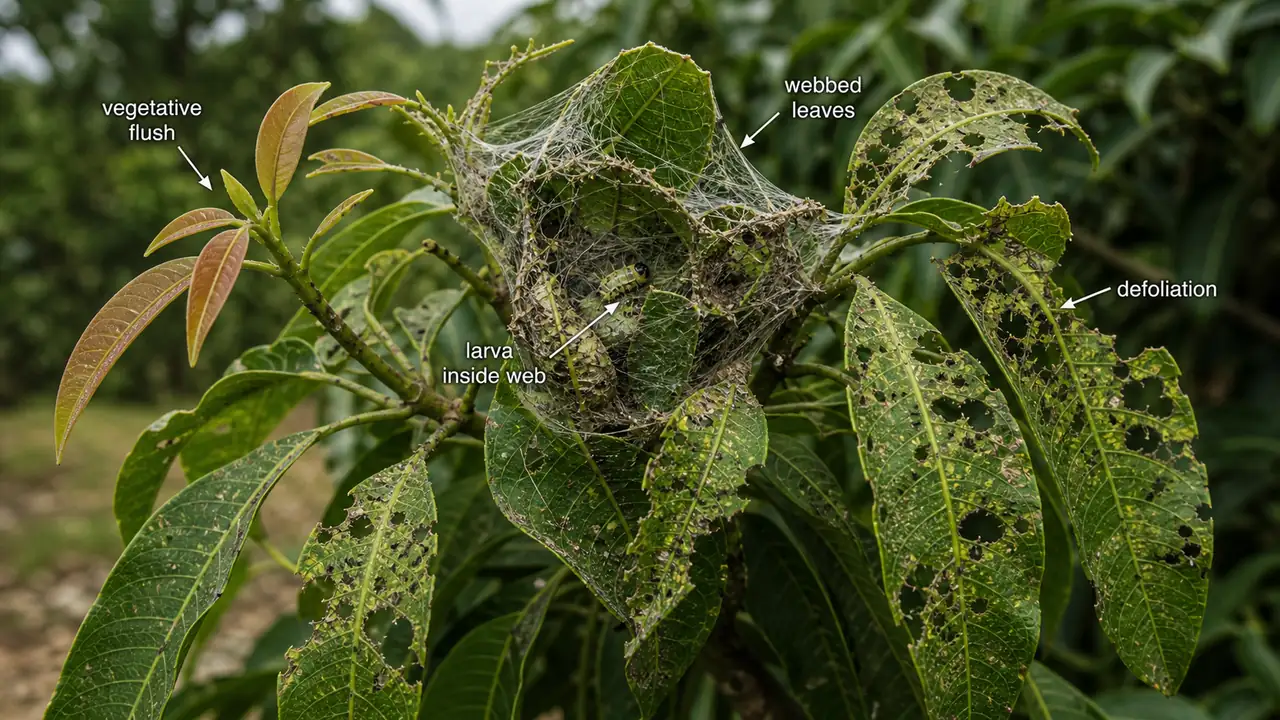
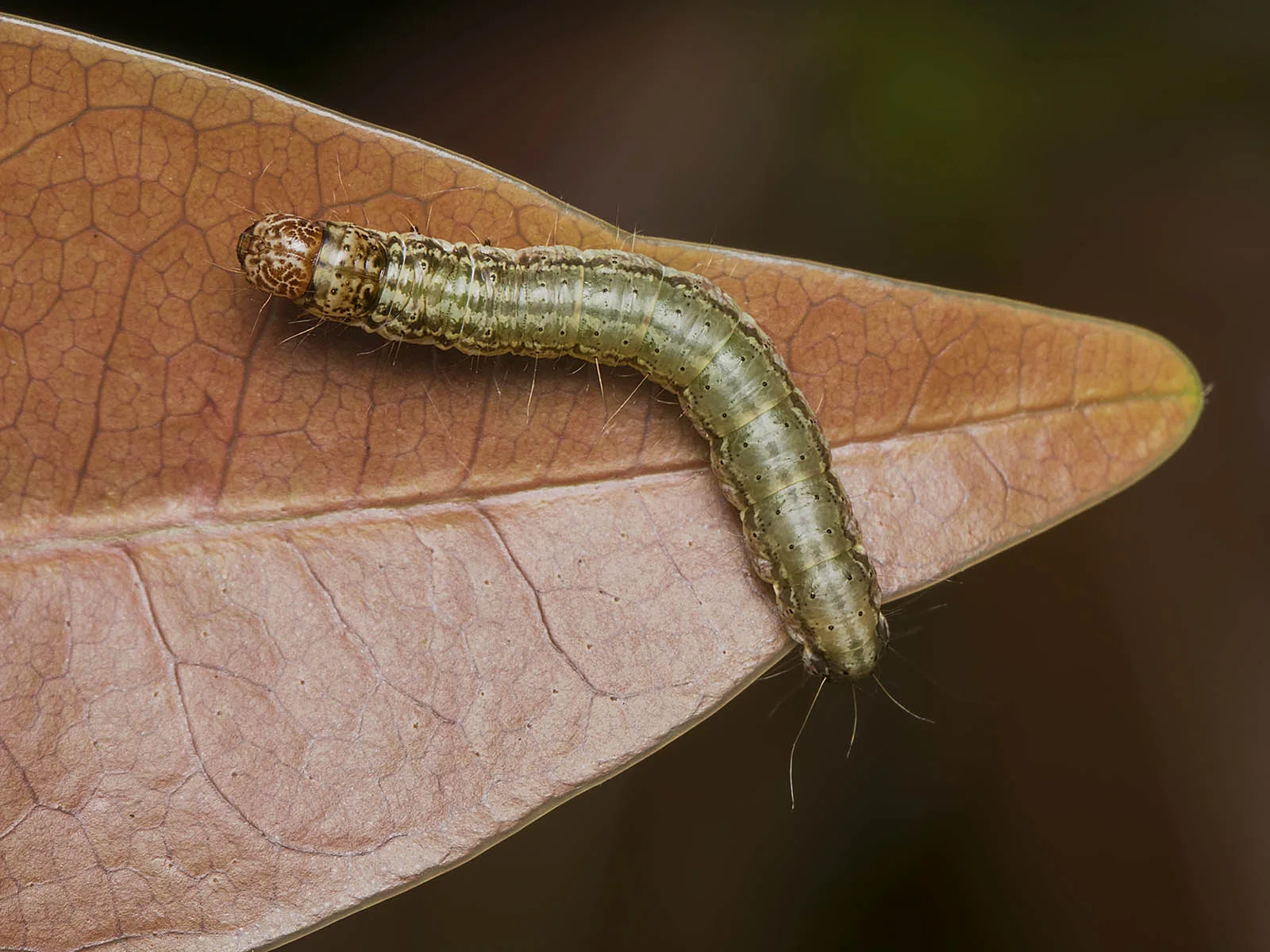
- Larvae web together several leaves using silk threads and feed within the webbed mass
- Causes defoliation and reduces photosynthetic area significantly
- Severe infestation during the vegetative flush stage directly affects subsequent fruit production
Management
- Prune and destroy webbed leaf clusters
- Spray contact insecticides before webbing becomes extensive
- Light traps can reduce adult moth populations
9. Shoot Borer — Chlumetia transversa (Noctuidae: Lepidoptera)
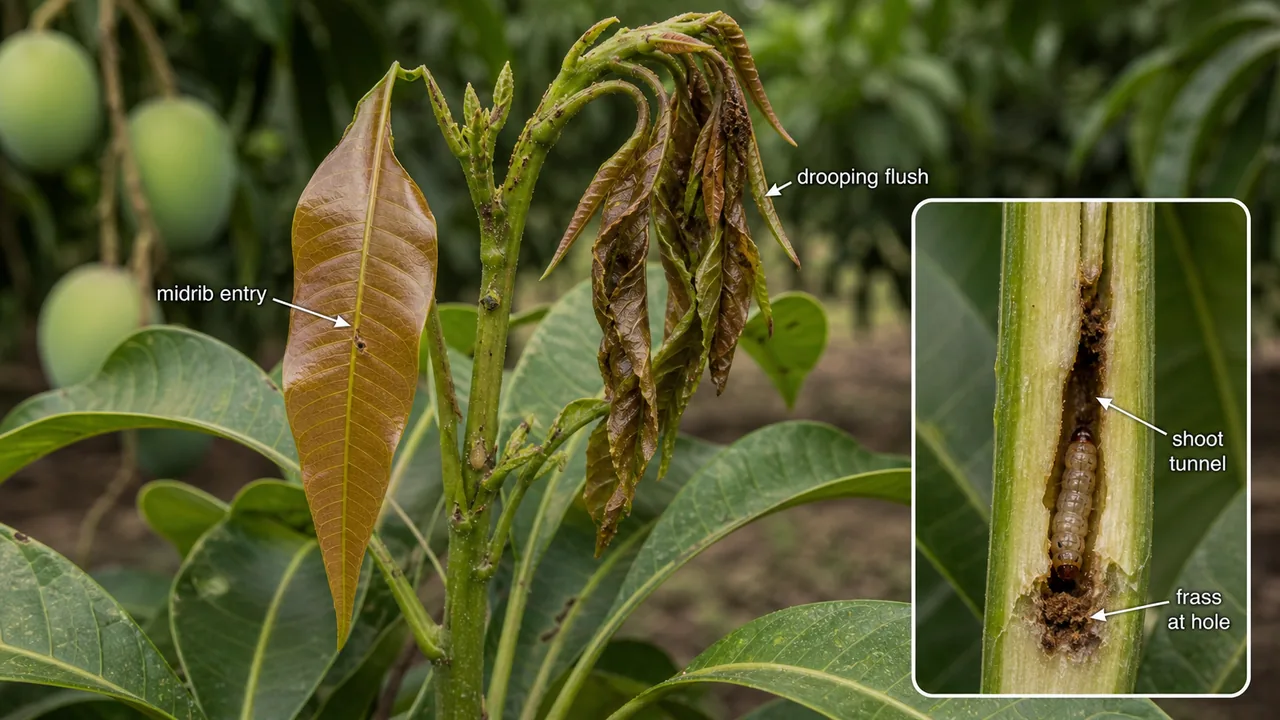
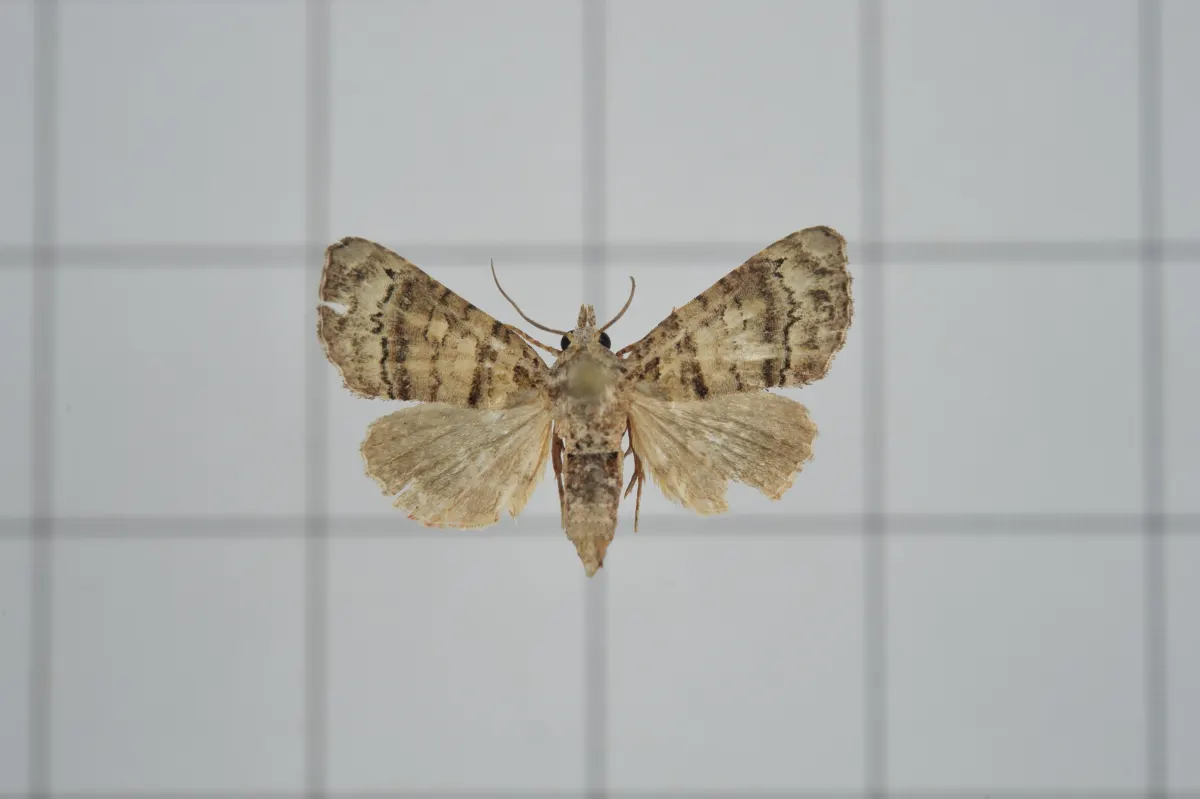
Agricultural context: When young mango flushes wilt and droop despite adequate watering, suspect the shoot borer. The tiny caterpillar enters through the midrib of a tender leaf and tunnels downward into the growing point.
Damage Symptoms
- Neonate caterpillars bore into midribs of tender leaves, emerge, and then bore into tender shoots near the growing point
- Tunnel downwards, ejecting excreta through the entrance hole
- Leaves of affected shoots wither and droop
Management
- Clip off and destroy affected shoots at the initial stage
- In severe attacks, spray carbaryl two times at three-week intervals, starting when the new leaf flush begins
10. Leaf Caterpillar — Bombotelia jacosatrix (Noctuidae: Lepidoptera)
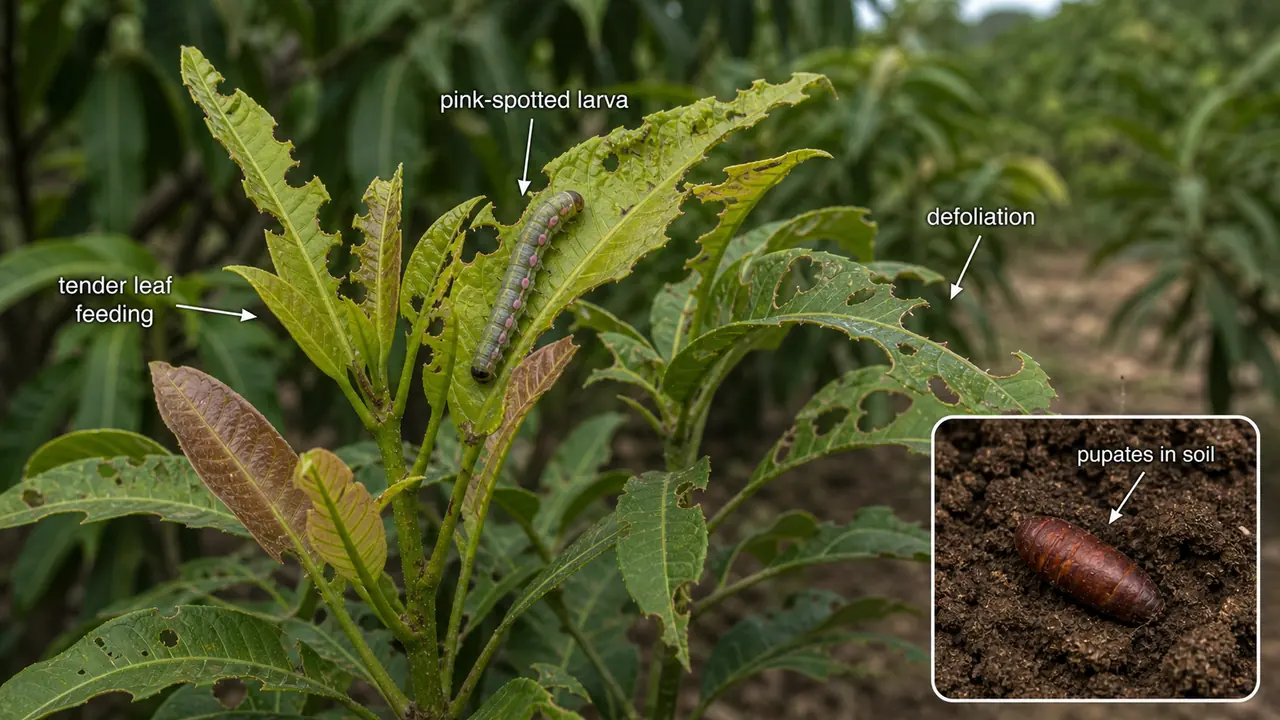
Damage Symptoms
- Larvae feed on tender leaves, causing defoliation
- Larva is smooth-bodied with characteristic pink spots
- Pupation takes place in soil
Identification
| Feature | Description |
|---|---|
| Larva | Smooth, with pink spots on body |
| Adult moth | Dark brown; lower half of hind wings is white |
| Pupation site | Soil |
11. Flower Webber — Eublemma versicolor (Noctuidae: Lepidoptera)
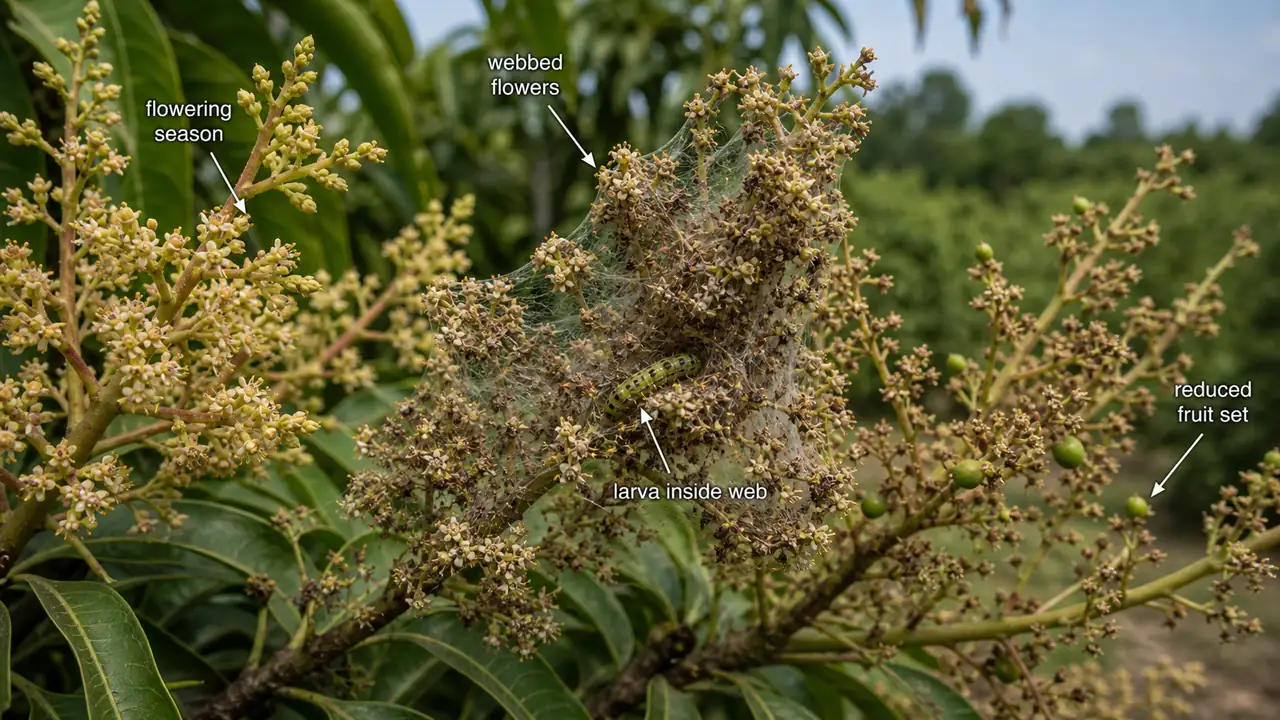
Damage Symptoms
- Larvae web mango flowers and feed within the webbed mass
- Reduces fruit set significantly
- Common during the flowering season (February-March)
Management
- Remove and destroy webbed flower clusters
- Spray insecticides at the early flowering stage before webbing becomes dense
Comparison: Borers of Mango — Where Each Pest Attacks
| Pest | Part Attacked | Stage Causing Damage | Key Diagnostic Sign |
|---|---|---|---|
| Stem Borer (Batocera) | Main stem, branches | Grub | Tree death, tunnels in heartwood |
| Bark Eating Caterpillar (Indarbela) | Trunk, branch junctions | Caterpillar | Silk + frass galleries |
| Shoot Borer (Chlumetia) | Tender shoots | Caterpillar | Wilting of new flush |
| Nut Weevil (Sternochaetus) | Seed inside fruit | Grub | Zig-zag tunnel in stone |
Comparison: Quarantine Pests of Mango
| Pest | Quarantine Concern | Treatment for Export |
|---|---|---|
| Fruit Fly (B. dorsalis) | Maggots in fruit pulp | VHT (Vapour Heat Treatment) |
| Nut Weevil (S. mangiferae) | Grubs in seed — hard to detect externally | Hot water treatment (48 degrees C, 60 min) |
Field Diagnosis: Mango Orchard — Which Pest?
Step 1: Which part of the tree is damaged?
Flowers/inflorescence:
- Sooty mold on panicles + honeydew dripping? → Mango Hoppers (Idioscopus spp.) — wedge-shaped insects jump when disturbed
- Flower buds swollen/galled? → Flower Gall Midge — break open gall, find tiny maggot
Fruits:
- Ripe fruit with brown soft patches, maggots inside pulp? → Fruit Fly (B. dorsalis) — quarantine pest; treat with VHT for export
- Stone/seed destroyed but fruit looks normal outside? → Nut Weevil (S. mangiferae) — cut fruit open, check stone for zig-zag tunnel
Trunk/branches:
- Sawdust-like frass from holes in trunk/branch junctions? → Bark Eating Caterpillar (Indarbela) — look for silk webbing with frass at entry
- Large holes in main stem with oozing sap? → Stem Borer (Batocera) — longhorn beetle
Leaves/shoots:
- New flush wilting/drooping? → Shoot Borer (Chlumetia) — caterpillar inside tender shoot
- Nymphs climbing up trunk from soil (Dec-Jan)? → Mealy Bug (Drosicha) — apply polythene band in December
Exam Tips and Mnemonics
- "SHE Sucks Sap" — Sooty mould from Honeydew of mango hoppers; Every flowering season
- Two quarantine pests of mango: Fruit Fly and Nut Weevil — remember "Fly eats Flesh, Weevil eats seed Within"
- Polythene band in December for mealy bug — "December = Drosicha banding"
- Four Noctuidae moths on mango: Leaf Webber, Shoot Borer, Leaf Caterpillar, Flower Webber — "WBCW — Webber Bores, Caterpillar Webs"
- Bark caterpillar management = inject + seal with mud (same across mango, citrus, guava)
Summary Cheat Sheet
| No. | Pest | Scientific Name | Family: Order | Key Exam Fact |
|---|---|---|---|---|
| 1 | Mango Hoppers | Idioscopus spp., Amritodus | Cicadellidae: Hemiptera | Most devastating mango pest; 3 species; honeydew leads to sooty mould; avoid close planting |
| 2 | Stem Borer | Batocera rufomaculata | Cerambycidae: Coleoptera | Tunnels bark; tolerant varieties: Neelam, Humayudin |
| 3 | Fruit Fly | Bactrocera dorsalis | Tephritidae: Diptera | Quarantine pest; bait spray with malathion + jaggery; VHT for export |
| 4 | Nut Weevil | Sternochaetus mangiferae | Curculionidae: Coleoptera | Quarantine importance; zig-zag tunneling in seed; external detection difficult |
| 5 | Mealy Bug | Drosicha mangiferae | Pseudococcidae: Hemiptera | Polythene banding in mid-December (400 gauge); nymphs crawl up from soil |
| 6 | Bark Caterpillar | Indarbela tetraonis | Metarbelidae: Lepidoptera | Silk + frass galleries; inject ethylene glycol:kerosene (1:3) in tunnel + seal with mud |
| 7 | Flower Gall Midge | Procystiphora mangiferae | Cecidomyiidae: Diptera | Maggots in flower buds; gall formation; no fruit set |
| 8 | Leaf Webber | Orthaga exvinacea | Noctuidae: Lepidoptera | Webs leaves together; defoliation reduces fruit production |
| 9 | Shoot Borer | Chlumetia transversa | Noctuidae: Lepidoptera | Bores into tender shoots via midrib; spray carbaryl |
| 10 | Leaf Caterpillar | Bombotelia jacosatrix | Noctuidae: Lepidoptera | Smooth larva with pink spots; pupates in soil |
| 11 | Flower Webber | Eublemma versicolor | Noctuidae: Lepidoptera | Webs flowers; reduces fruit set during flowering season |