🍌 Banana Pests: Rhizome Weevil, Pseudostem Borer, Aphid (BBTV Vector) & More
Complete guide to major and minor pests of banana — rhizome weevil, pseudostem borer, banana aphid as BBTV vector, and lacewing bug. Includes comparison tables, IPM, and exam mnemonics for exams, NABARD & ICAR.
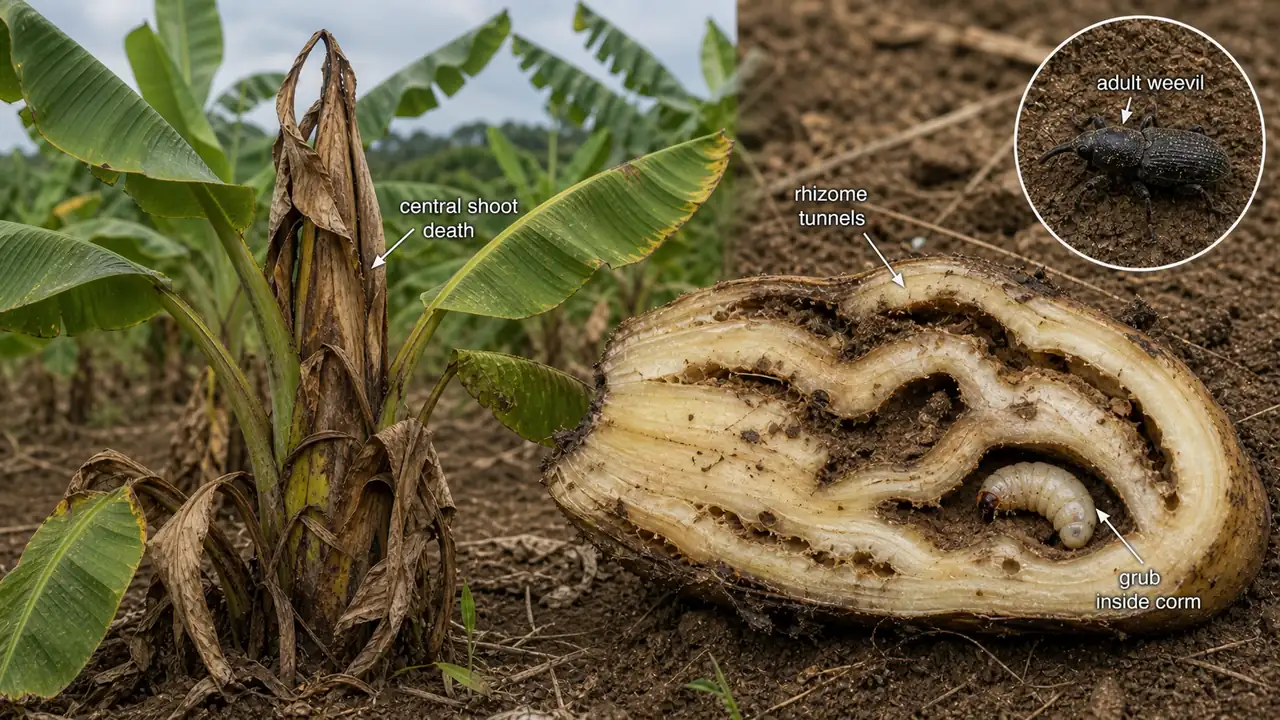
Field scenario: A banana grower in Jalgaon (Maharashtra) notices that the central shoot of several plants has turned brown and collapsed even though the outer leaves still look green. When the rhizome is dug up and cut open, it reveals extensive tunnelling — the unmistakable damage of the banana rhizome weevil. Nearby, a few plants display abnormally small, brittle leaves crowded at the top — the dreaded bunchy top disease, spread by the banana aphid.
Banana (Musa spp.) is India's second most important fruit crop after mango, with production of over 30 million tonnes annually. While fewer pests attack banana compared to mango or citrus, the ones that do can be devastating. The rhizome weevil can kill entire plantations, and the banana aphid transmits the most destructive viral disease of banana worldwide.
How This Lesson Is Organised
We begin with the two weevils that attack different parts of the plant (underground rhizome vs. above-ground pseudostem), then cover the aphid-virus relationship, and finally the minor pests. This progression follows the plant from root to canopy.
Pro Content Locked
Upgrade to Pro to access this lesson and all other premium content.
Charged once for one year · ₹1188 total
Save ₹100/month vs ₹2388/year launch price
- All Agriculture & Banking Courses
- AI Lesson Questions (100/day)
- AI Doubt Solver (50/day)
- Glows & Grows Feedback (30/day)
- AI Section Quiz (20/day)
- 22-Language Translation (100/day)
- Recall Questions (20/day)
- AI Quiz (15/day)
- AI Quiz Paper Analysis (100/day)
- AI Step-by-Step Explanations (100/day)
- Spaced Repetition Recall (FSRS)
- AI Tutor
- Immersive Text Questions
- Audio Lessons — Hindi & English
- Mock Tests & Previous Year Papers
- Summary & Mind Maps
- XP, Levels, Leaderboard & Badges
- Generate New Classrooms
- Voice AI Teacher (AgriDots Live)
- AI Revision Assistant
- Knowledge Gap Analysis
- Interactive Revision (LangGraph)
🔒 Secure one-time yearly payment via Razorpay · No hidden fees
Field scenario: A banana grower in Jalgaon (Maharashtra) notices that the central shoot of several plants has turned brown and collapsed even though the outer leaves still look green. When the rhizome is dug up and cut open, it reveals extensive tunnelling — the unmistakable damage of the banana rhizome weevil. Nearby, a few plants display abnormally small, brittle leaves crowded at the top — the dreaded bunchy top disease, spread by the banana aphid.
Banana (Musa spp.) is India's second most important fruit crop after mango, with production of over 30 million tonnes annually. While fewer pests attack banana compared to mango or citrus, the ones that do can be devastating. The rhizome weevil can kill entire plantations, and the banana aphid transmits the most destructive viral disease of banana worldwide.
How This Lesson Is Organised
We begin with the two weevils that attack different parts of the plant (underground rhizome vs. above-ground pseudostem), then cover the aphid-virus relationship, and finally the minor pests. This progression follows the plant from root to canopy.
Pest Classification Table — Banana
Major Pests
| No. | Common Name | Scientific Name | Family | Order | Part Attacked |
|---|---|---|---|---|---|
| 1 | Rhizome Weevil | Cosmopolites sordidus | Curculionidae | Coleoptera | Rhizome (underground) |
| 2 | Pseudostem Borer | Odoiporus longicollis | Curculionidae | Coleoptera | Pseudostem (above-ground) |
| 3 | Banana Aphid | Pentalonia nigronervosa | Aphididae | Hemiptera | Leaf axils, pseudostem |
| 4 | Lacewing Bug | Stephanitis typicus | Tingidae | Hemiptera | Leaf undersurface |
Minor Pest
| No. | Common Name | Scientific Name | Family | Order | Part Attacked |
|---|---|---|---|---|---|
| 5 | Banana Rusty Thrips | Chaetanaphothrips signipennis | Thripidae | Thysanoptera | Pseudostem surface, leaf sheaths |
| 6 | Tobacco Caterpillar | Spodoptera litura | Noctuidae | Lepidoptera | Leaves |
1. Rhizome Weevil — Cosmopolites sordidus (Curculionidae: Coleoptera)
IMPORTANT
The banana rhizome weevil is a monophagous pest — it feeds only on banana and cocoa. It is the most destructive pest of banana worldwide.
Why this matters: Unlike most weevils that attack multiple crops, Cosmopolites sordidus is highly host-specific. This narrow host range is a favourite exam fact.
Host range: Banana, cocoa
Damage Symptoms
- Grubs bore into the rhizome, causing death of the unopened pipe (central shoot)
- Withering of outer leaves followed by death of the plant
- Tunnelling weakens the rhizome, making plants susceptible to toppling during wind
- Infested suckers spread the pest to new plantations
Life Cycle Highlights
| Stage | Key Feature |
|---|---|
| Egg | Laid singly in small cavities on the rhizome surface |
| Grub | Creamy white, legless, feeds inside rhizome for 2-3 weeks |
| Pupa | Pupates inside the rhizome |
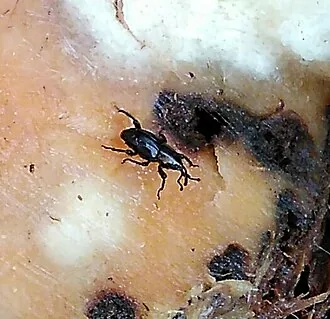
| Adult | Dark brown/black weevil, 10-12 mm, long-lived (up to 2 years) |
IPM and Management
- Use healthy, pest-free suckers for planting (most important measure)
- Dip suckers in chlorpyriphos solution before planting
- Trap adults using pseudostem traps (split pseudostem pieces laid near plants)
- Apply neem cake @ 250 g per plant in the planting pit
- Remove and destroy heavily infested rhizomes
TIP
Exam mnemonic: "Cosmopolites is Confined to banana + cocoa" — the two C's remind you it is monophagous. Most other Curculionidae members are polyphagous, making this a standout fact.
2. Pseudostem Borer — Odoiporus longicollis (Curculionidae: Coleoptera)
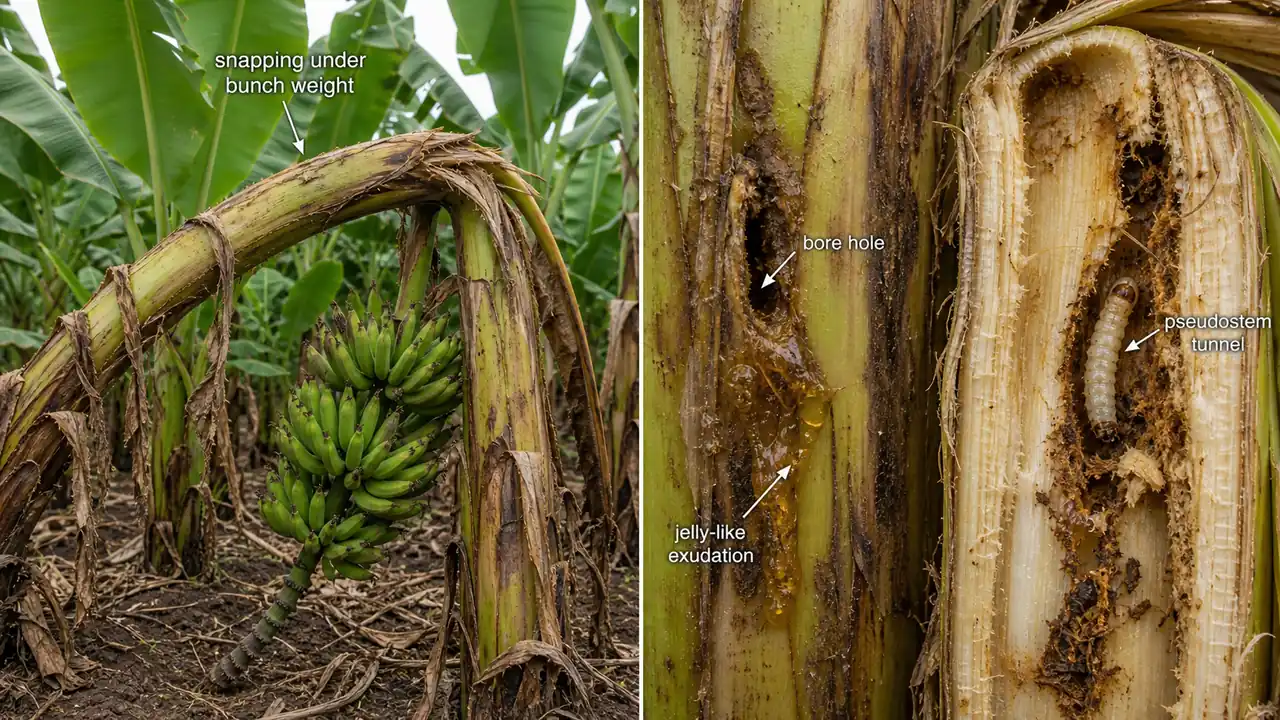
Agricultural context: While the rhizome weevil attacks below ground, the pseudostem borer works above ground. In Kerala and Karnataka, banana pseudostems suddenly snap during fruiting — investigation reveals extensive internal tunnelling by Odoiporus longicollis.
Host range: Banana (monophagous)
Damage Symptoms
- Grubs bore holes and tunnel through the pseudostem, causing wilting
- They also feed on leaf sheath tissues from the inner surface and on decaying tissues
- Severe tunnelling weakens the pseudostem, leading to snapping under the weight of the bunch
- Jelly-like exudation from bore holes on the pseudostem
Management
- Remove and destroy infested pseudostems after harvest
- Inject monocrotophos into bore holes
- Use longitudinal split pseudostem traps to attract adults
- Practice clean cultivation — do not leave pseudostem debris in the field
Comparison: Two Weevils of Banana
| Feature | Rhizome Weevil | Pseudostem Borer |
|---|---|---|
| Scientific name | Cosmopolites sordidus | Odoiporus longicollis |
| Family | Curculionidae | Curculionidae |
| Part attacked | Rhizome (underground) | Pseudostem (above-ground) |
| Key symptom | Death of central shoot (pipe) | Snapping of pseudostem |
| Host specificity | Banana + cocoa | Banana only |
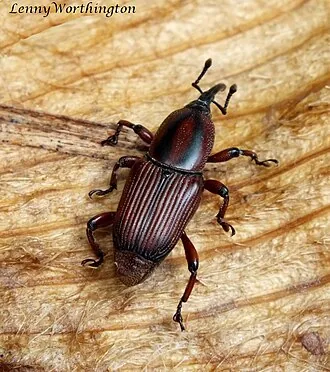
| Adult size | 10-12 mm | 25-40 mm (much larger) |
NOTE
Both banana weevils belong to Curculionidae but attack entirely different plant parts. This comparison is a common exam question.
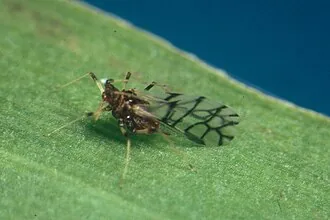
3. Banana Aphid — Pentalonia nigronervosa (Aphididae: Hemiptera)
IMPORTANT
The banana aphid is the vector of Banana Bunchy Top Virus (BBTV) — the most devastating viral disease of banana worldwide. This vector-disease relationship is one of the most asked facts in competitive exams.
Real-world impact: BBTV has wiped out banana plantations across Southeast Asia and the Pacific Islands. In India, it is a serious problem in the northeastern states, Kerala, and Tamil Nadu. There is no cure — infected plants must be destroyed immediately.
Host range: Banana, cardamom, Alocasia sp., Colocasia sp., caladium
Damage Symptoms
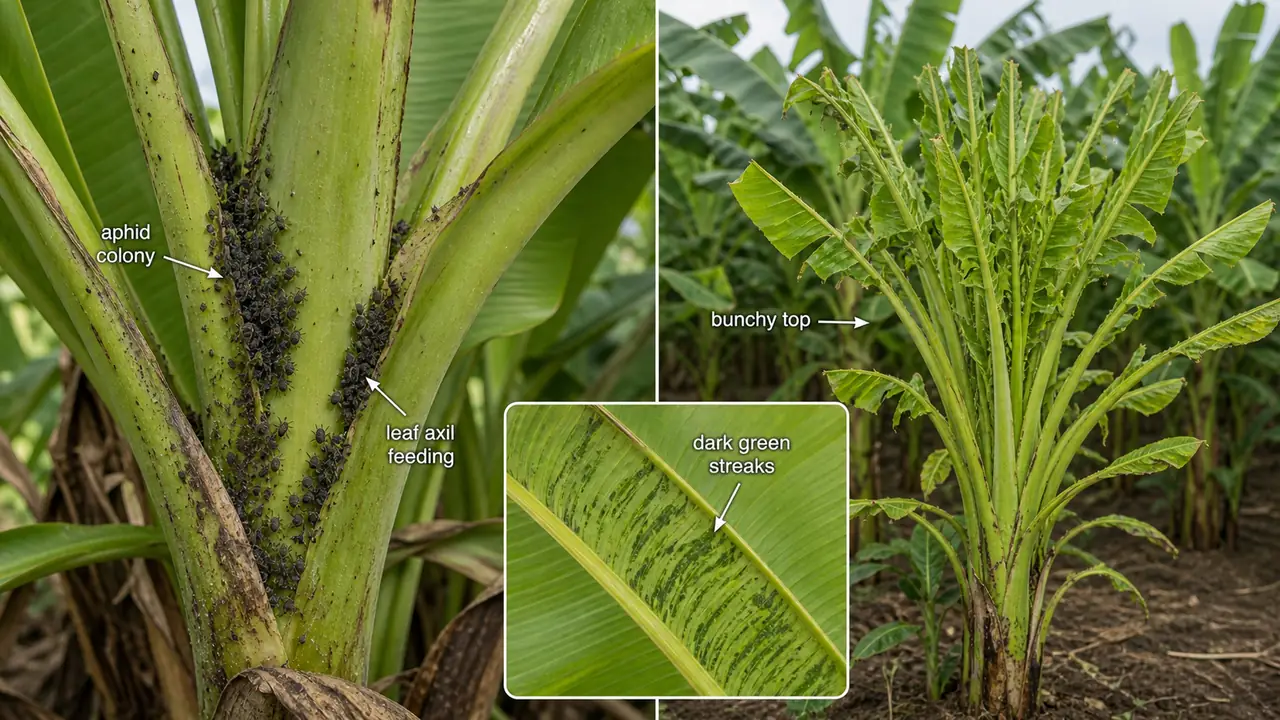
- Aphids form colonies on leaf axils and pseudostems
- Direct damage is minor; the real danger is transmission of BBTV
- Infected plants show green streaks on secondary veins (ventral side of lamina)
- Affected leaves become brittle, small, with elongated petioles
- The crown develops a rosette of narrow, stunted leaves — the characteristic bunchy top appearance
Disease Transmission Details
| Aspect | Detail |
|---|---|
| Vector | Pentalonia nigronervosa |
| Virus | Banana Bunchy Top Virus (BBTV) |
| Transmission type | Persistent (circulative) |
| Acquisition period | 4-12 hours |
| Inoculation period | 15 minutes |
| Main control | Destroy infected plants + control aphid population |
Management
- Uproot and destroy infected plants immediately — do not allow them to serve as virus reservoirs
- Use virus-free planting material (tissue culture plants preferred)
- Spray imidacloprid or dimethoate to control aphid colonies
- Avoid planting near infected gardens
TIP
Exam mnemonic: "Pentalonia causes Bunchy Top — PBT." The aphid transmits BBTV in a persistent manner (not non-persistent). Infected plants must be destroyed immediately — there is no cure.
4. Lacewing Bug — Stephanitis typicus (Tingidae: Hemiptera)
Host range: Banana, ginger, turmeric, cardamom, and jasmine
Damage Symptoms
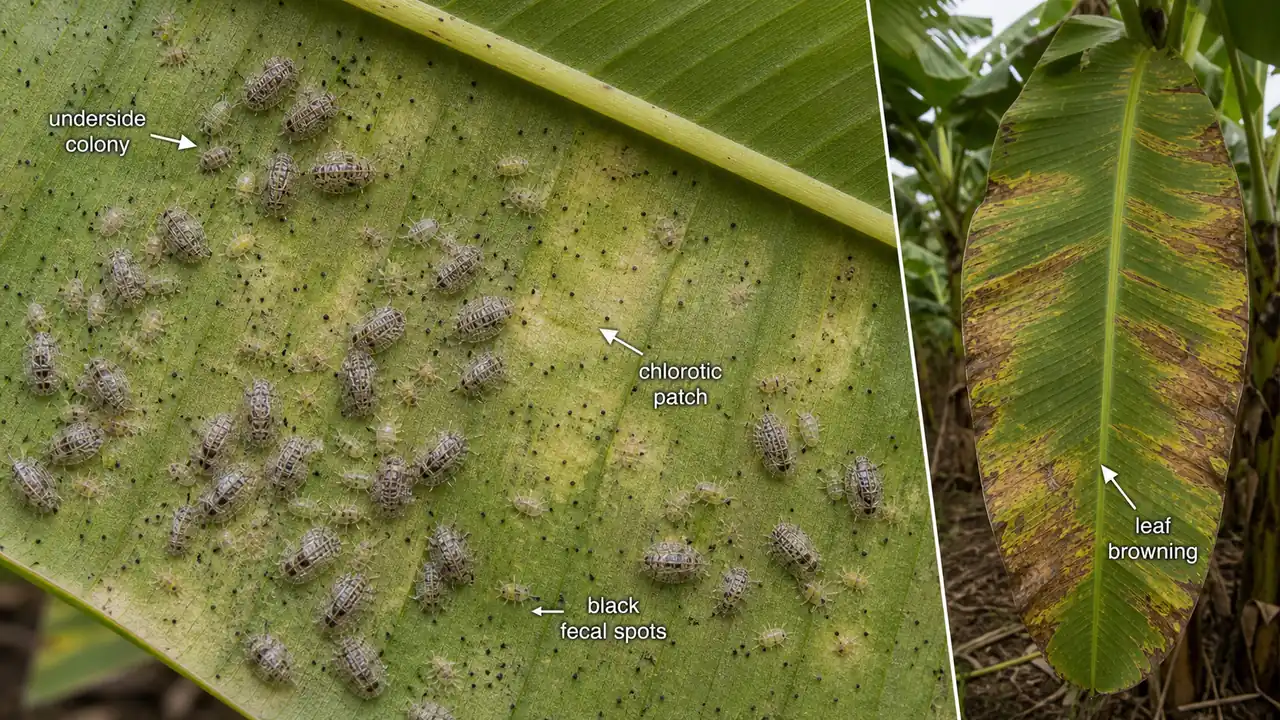
- Both nymphs and adults feed in colonies on the undersurface of leaves
- Cause discolouration (chlorotic patches) on leaves
- Severely infested leaves turn brown and dry up
- Tiny black faecal spots on leaf undersurface are diagnostic
NOTE
Exam distinction: Lacewing bugs (family Tingidae) are plant pests with lace-like wing patterns. Do not confuse them with green lacewings (family Chrysopidae), which are beneficial predators of aphids and soft-bodied insects.
Management
- Spray dimethoate or fish oil rosin soap
- Remove heavily infested leaves
- Maintain field hygiene
5. Tobacco Caterpillar — Spodoptera litura (Noctuidae: Lepidoptera) — Minor Pest
5. Banana Rusty Thrips — Chaetanaphothrips signipennis (Thripidae: Thysanoptera) — Minor Pest
- A minor rasping-sucking pest that shelters in the tight spaces around the pseudostem and leaf sheaths
- Feeding may produce a characteristic slimy exudation on the pseudostem surface, which is the most exam-oriented field clue from older horticulture-entomology tables
- Damage usually stays local and does not rank with the two banana weevils or the BBTV aphid in economic importance
6. Tobacco Caterpillar — Spodoptera litura (Noctuidae: Lepidoptera) — Minor Pest
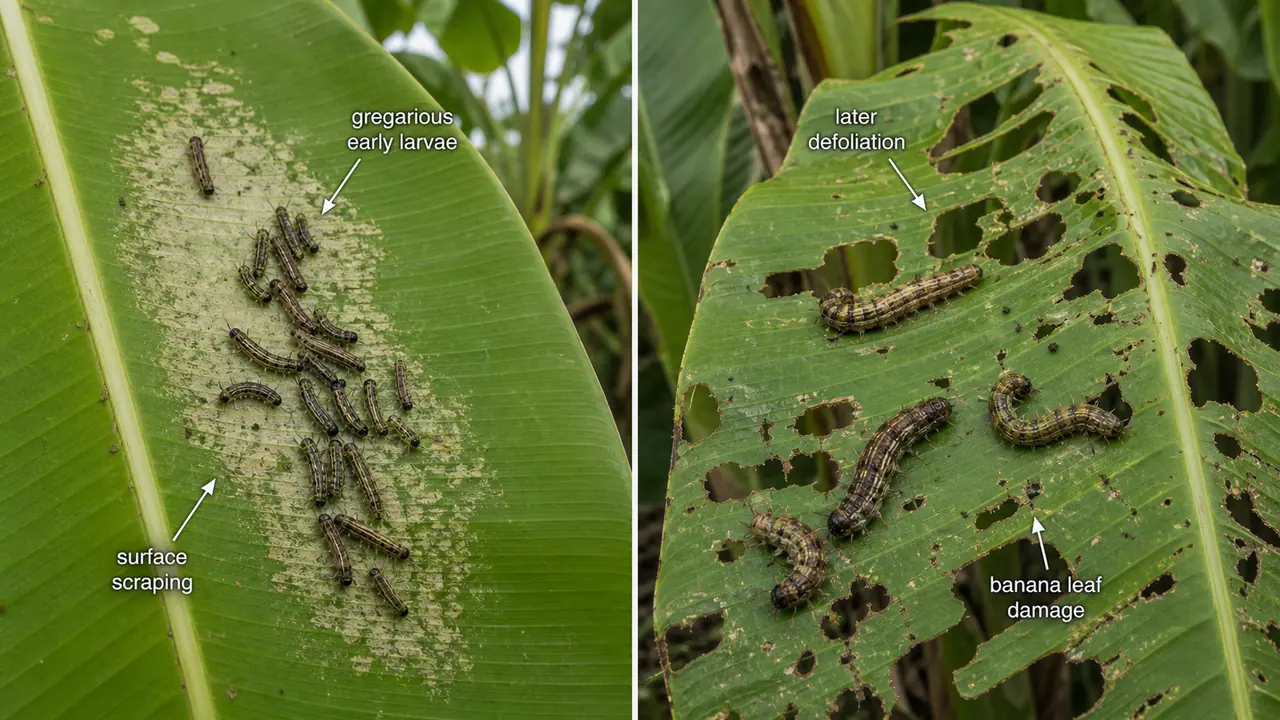
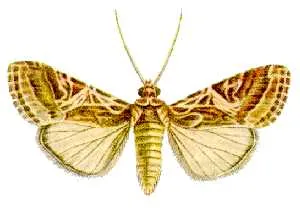
- Highly polyphagous pest that occasionally attacks banana leaves
- Larvae feed on leaves, causing defoliation
- Nocturnal in habit — larvae hide during the day in soil cracks
- Gregarious in early instars; later instars disperse
- Management: collect and destroy egg masses; spray NPV or Bt formulations
Comparison: Important Insect Vectors in Banana and Related Crops
| Vector | Disease Transmitted | Crop | Transmission Type |
|---|---|---|---|
| Pentalonia nigronervosa (Aphid) | Banana Bunchy Top Virus (BBTV) | Banana | Persistent |
| Diaphorina citri (Psyllid) | Citrus Greening (HLB) | Citrus | Persistent |
| Bemisia tabaci (Whitefly) | Tomato Leaf Curl | Tomato | Persistent |
| Cestius phycitis (Leafhopper) | Little Leaf of Brinjal | Brinjal | Persistent |
TIP
Insect-vector-disease relationships are among the most frequently examined topics. Create a separate flash card for each vector-disease pair.
Exam Tips and Mnemonics
- Monophagous weevil: Cosmopolites sordidus feeds only on banana + cocoa — the exception among polyphagous weevils
- Two Curculionidae: Rhizome weevil (below ground) vs. pseudostem borer (above ground) — compare the part attacked
- BBTV vector: Pentalonia nigronervosa — persistent transmission — no cure, only destruction of infected plants
- Tingidae vs. Chrysopidae: Lacewing bug (pest) vs. green lacewing (predator) — do not confuse in exams
- Minor thrips clue: Chaetanaphothrips signipennis is remembered for slimy exudation on the pseudostem
- Minor pest: Spodoptera litura attacks banana only occasionally — it is a major pest of tobacco, chilli, and groundnut
Summary Cheat Sheet
| No. | Pest | Scientific Name | Family: Order | Key Exam Fact |
|---|---|---|---|---|
| 1 | Rhizome Weevil | Cosmopolites sordidus | Curculionidae: Coleoptera | Monophagous (banana + cocoa); bores rhizome; death of central shoot |
| 2 | Pseudostem Borer | Odoiporus longicollis | Curculionidae: Coleoptera | Bores pseudostem; causes snapping; jelly-like exudation |
| 3 | Banana Aphid | Pentalonia nigronervosa | Aphididae: Hemiptera | Vector of BBTV (Bunchy Top Virus); persistent transmission; no cure |
| 4 | Lacewing Bug | Stephanitis typicus | Tingidae: Hemiptera | Tingidae (not Chrysopidae predator); feeds in colonies on leaf undersurface |
| 5 | Banana Rusty Thrips | Chaetanaphothrips signipennis | Thripidae: Thysanoptera | Minor pest; remembered for slimy exudation on pseudostem |
| 6 | Tobacco Caterpillar | Spodoptera litura | Noctuidae: Lepidoptera | Minor pest; polyphagous; nocturnal defoliator |