🍊 Citrus Pests: Psyllid, Leaf Miner, Blackfly, Butterfly & Key Vectors
Complete guide to major and minor pests of citrus — psyllid (greening vector), leaf miner (canker link), blackfly, whitefly, bark caterpillar, citrus butterfly, and citrus aphid (CTV vector). With comparison tables, IPM, and exam mnemonics.
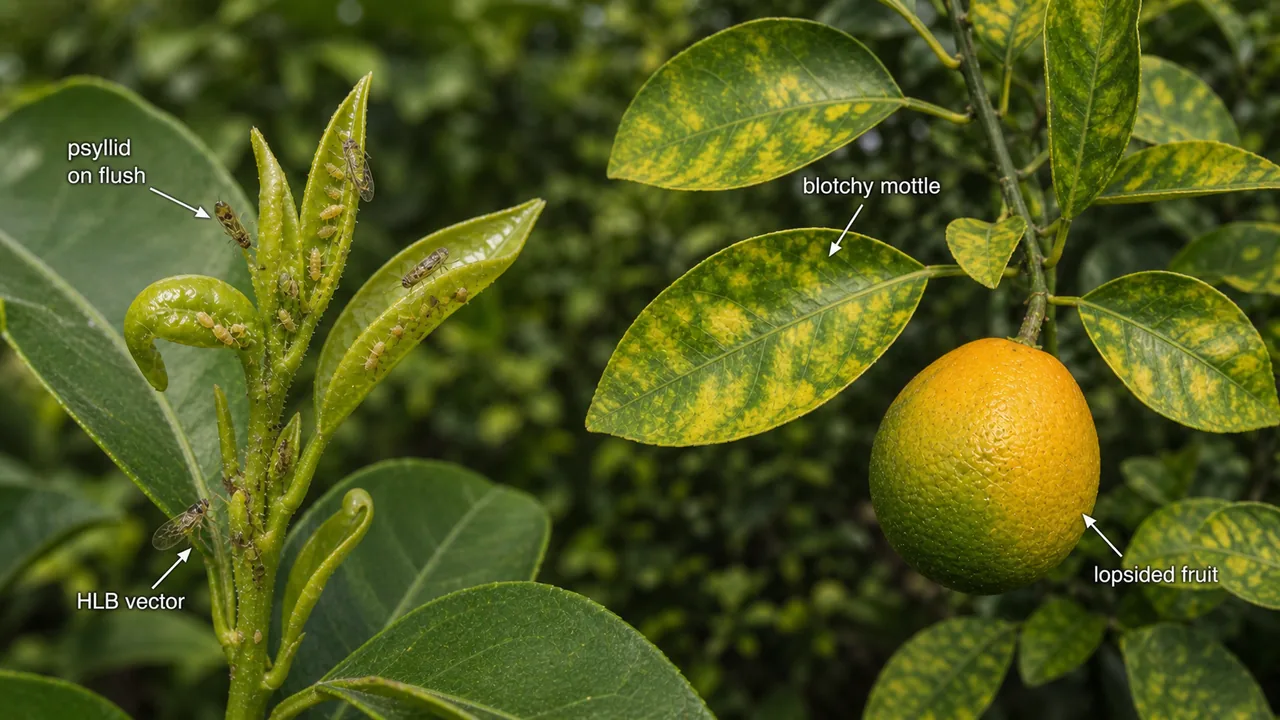
Field scenario: A Nagpur orange grower notices that some trees are producing small, lopsided fruits that remain green on one side even after maturity. The leaves show a blotchy yellow mottle. This is citrus greening disease (Huanglongbing) — and the tiny insect responsible for spreading it, the citrus psyllid (Diaphorina citri), is quietly feeding on the flush leaves nearby. Meanwhile, young leaves on adjacent trees display silvery, winding trails — the serpentine mines of the citrus leaf miner, which opens the door for citrus canker infection.
Citrus (orange, lemon, lime, grapefruit, sweet orange) is India's third most important fruit crop group. These crops face attack from a wide range of sucking pests, borers, and defoliators. Two pest-disease interactions — psyllid-greening and leaf miner-canker — make citrus entomology especially important for competitive exams.
How This Lesson Is Organised
We begin with the two most exam-critical pests (psyllid and leaf miner) because they involve pest-disease interactions. Then we cover sap-sucking pests (blackfly, whitefly), followed by borers, defoliators, and minor pests. Each section highlights what examiners typically ask.
Pro Content Locked
Upgrade to Pro to access this lesson and all other premium content.
Charged once for one year · ₹1188 total
Save ₹100/month vs ₹2388/year launch price
- All Agriculture & Banking Courses
- AI Lesson Questions (100/day)
- AI Doubt Solver (50/day)
- Glows & Grows Feedback (30/day)
- AI Section Quiz (20/day)
- 22-Language Translation (100/day)
- Recall Questions (20/day)
- AI Quiz (15/day)
- AI Quiz Paper Analysis (100/day)
- AI Step-by-Step Explanations (100/day)
- Spaced Repetition Recall (FSRS)
- AI Tutor
- Immersive Text Questions
- Audio Lessons — Hindi & English
- Mock Tests & Previous Year Papers
- Summary & Mind Maps
- XP, Levels, Leaderboard & Badges
- Generate New Classrooms
- Voice AI Teacher (AgriDots Live)
- AI Revision Assistant
- Knowledge Gap Analysis
- Interactive Revision (LangGraph)
🔒 Secure one-time yearly payment via Razorpay · No hidden fees
Field scenario: A Nagpur orange grower notices that some trees are producing small, lopsided fruits that remain green on one side even after maturity. The leaves show a blotchy yellow mottle. This is citrus greening disease (Huanglongbing) — and the tiny insect responsible for spreading it, the citrus psyllid (Diaphorina citri), is quietly feeding on the flush leaves nearby. Meanwhile, young leaves on adjacent trees display silvery, winding trails — the serpentine mines of the citrus leaf miner, which opens the door for citrus canker infection.
Citrus (orange, lemon, lime, grapefruit, sweet orange) is India's third most important fruit crop group. These crops face attack from a wide range of sucking pests, borers, and defoliators. Two pest-disease interactions — psyllid-greening and leaf miner-canker — make citrus entomology especially important for competitive exams.
How This Lesson Is Organised
We begin with the two most exam-critical pests (psyllid and leaf miner) because they involve pest-disease interactions. Then we cover sap-sucking pests (blackfly, whitefly), followed by borers, defoliators, and minor pests. Each section highlights what examiners typically ask.
Pest Classification Table — Citrus
Major Pests
| No. | Common Name | Scientific Name | Family | Order | Key Exam Link |
|---|---|---|---|---|---|
| 1 | Citrus Psyllid | Diaphorina citri | Psyllidae | Hemiptera | Vector of Greening (HLB) |
| 2 | Citrus Leaf Miner | Phyllocnistis citrella | Gracillaridae | Lepidoptera | Predisposes to canker |
| 3 | Citrus Blackfly | Aleurocanthus woglumi | Aleyrodidae | Hemiptera | Leaf curling, bud drop |
| 4 | Citrus Whitefly | Dialeurodes citri | Aleyrodidae | Hemiptera | Sooty mould on honeydew |
| 5 | Bark Caterpillar | Indarbela tetraonis | Metarbelidae | Lepidoptera | Silk + frass galleries |
| 6 | Citrus Butterfly | Papilio demoleus, P. polytes | Papilionidae | Lepidoptera | Severe defoliation |
| 7 | Fruit Sucking Moth | Othreis fullonica | — | — | Pierces ripe fruits |
Minor Pests
| No. | Common Name | Scientific Name | Family | Order | Key Exam Link |
|---|---|---|---|---|---|
| 8 | Leaf Roller | Psorostichya zizyphi | Oecophoridae | Lepidoptera | Rolls and feeds inside leaves |
| 9 | Citrus Aphid | Toxoptera citricidus, T. aurantii | Aphididae | Hemiptera | Vector of CTV (Tristeza) |
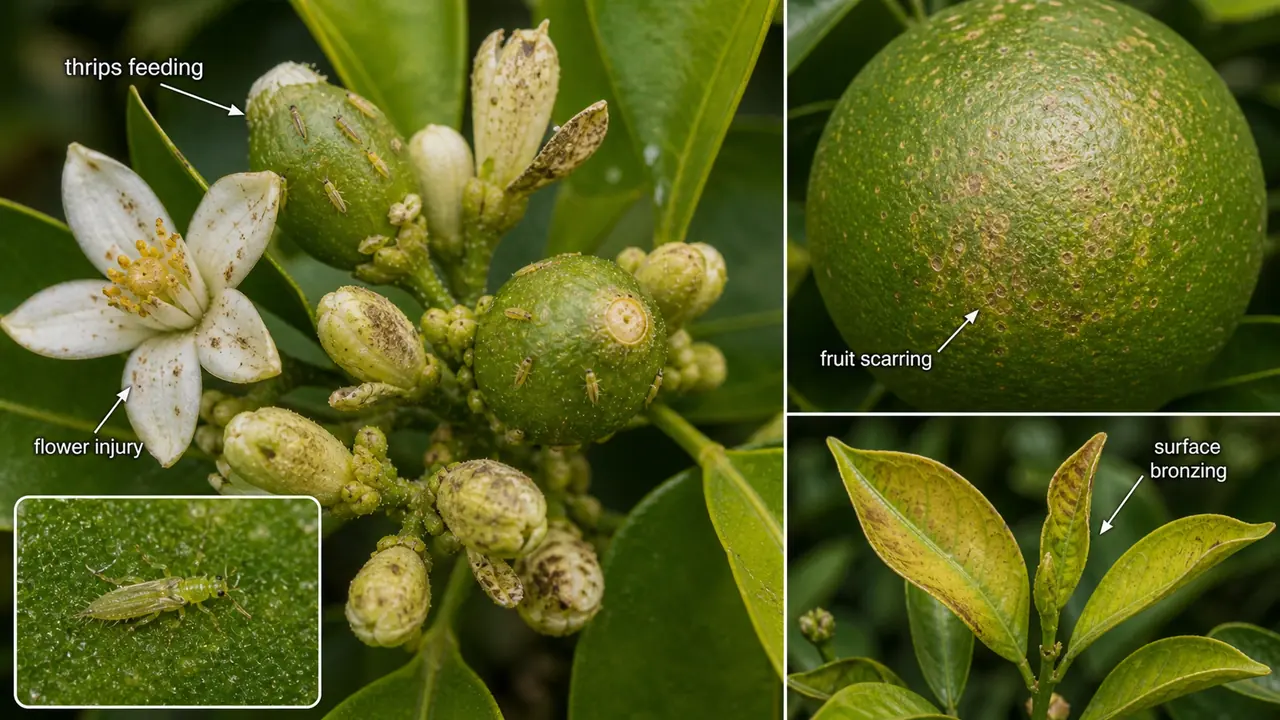
| 10 | Thrips | Thrips nilgiriensis | Thripidae | Thysanoptera | Fruit scarring |
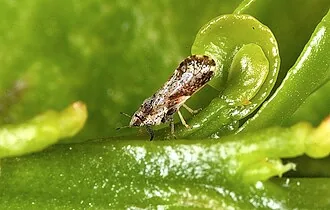
1. Citrus Psyllid — Diaphorina citri (Psyllidae: Hemiptera)
IMPORTANT
The citrus psyllid is the vector of citrus greening disease (Huanglongbing/HLB), caused by Candidatus Liberibacter asiaticus. This is one of the most devastating diseases of citrus worldwide, and the vector-disease relationship is extremely frequently tested.
Real-world impact: Citrus greening has destroyed millions of hectares of citrus in Florida, Brazil, and China. In India, it is a growing threat in the Vidarbha and North-East regions. There is no cure — infected trees must be removed.
Host range: Citrus and other Rutaceae family plants
Damage Symptoms
- Both nymphs and adults suck cell sap from leaves, which curl up, dry, and fall off
- Direct feeding damage is minor; the primary harm is through transmission of greening disease
- Infected trees produce small, lopsided, poorly coloured fruits with aborted seeds
- Blotchy yellow mottle on leaves is characteristic of greening
- Eggs are commonly recalled as almond-shaped in exam-oriented citrus pest tables
Pest-Disease Relationship
| Aspect | Detail |
|---|---|
| Vector | Diaphorina citri (Psyllidae) |
| Pathogen | Candidatus Liberibacter asiaticus (bacterium) |
| Disease | Citrus Greening / Huanglongbing (HLB) |
| Transmission | Persistent (circulative) |
| Cure | None — remove and destroy infected trees |
Management
- Remove and destroy greening-infected trees
- Use disease-free nursery stock (budded on certified rootstocks)
- Spray imidacloprid or thiamethoxam during flush periods when psyllids are active
- Biological control: parasitoid Tamarixia radiata
TIP
Exam mnemonic: "Diaphorina causes Greening — DG pair." Also remember: Candidatus Liberibacter is a bacterium (not virus), which makes HLB unique among vector-transmitted citrus diseases.
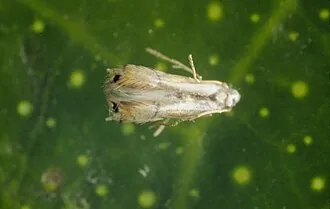
2. Citrus Leaf Miner — Phyllocnistis citrella (Gracillaridae: Lepidoptera)
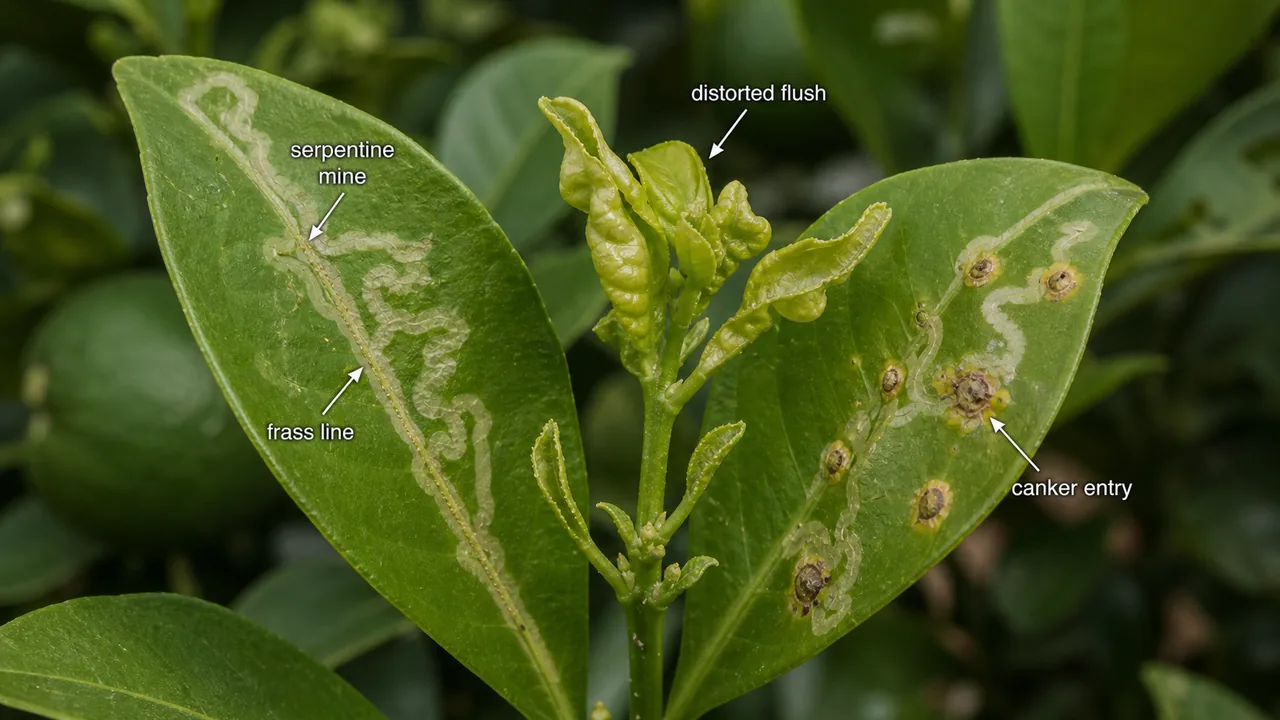
Agricultural context: In citrus nurseries across Andhra Pradesh, nearly every flush leaf shows characteristic winding, silvery trails. These serpentine mines weaken the leaf surface, and the wounds become entry points for the bacterium Xanthomonas citri — making leaf miner damage a precursor to citrus canker outbreaks.
Host range: Citrus, pummelo (Citrus maxima), willow, cinnamon, Loranthus spp.
Damage Symptoms
- Larva mines into tender leaves, forming zig-zag (serpentine) galleries while feeding on epidermal cells, leaving the remaining leaf tissues intact
- Infested leaves turn pale, get distorted, and dry up
- Larval damage leads to secondary infection by fungi and bacteria, especially citrus canker (Xanthomonas citri)
Pest-Disease Interaction
| Pest | Disease Facilitated | Pathogen | Mechanism |
|---|---|---|---|
| Citrus Leaf Miner | Citrus Canker | Xanthomonas citri | Mining wounds provide entry points for bacterium |
Management
- Spray NSKE 5% (50 g/L) or neem cake extract 5% or neem oil 3%
- Alternatively, apply imidacloprid 17.8 SL @ 125 ml per ha
- Time sprays to coincide with new flush emergence
- Avoid excessive pruning that stimulates too many flushes
IMPORTANT
The leaf miner-canker interaction is a key exam concept. Leaf miner damage predisposes leaves to citrus canker infection. Managing the leaf miner indirectly helps control canker.
3. Citrus Blackfly — Aleurocanthus woglumi (Aleyrodidae: Hemiptera)
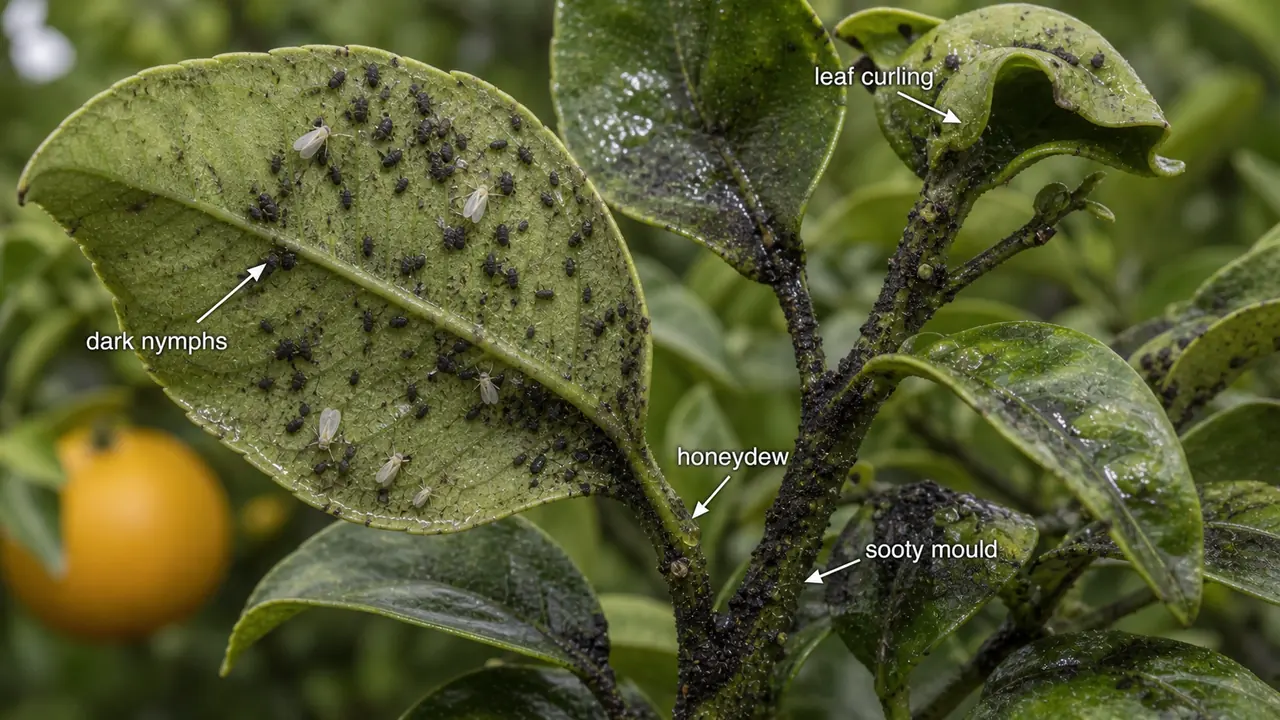
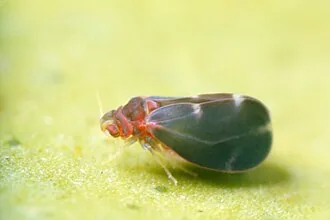
Host range: Citrus, sweet orange, avocado, grape vine, mango, guava, pear, plum
Damage Symptoms
- Nymphs and adults suck plant sap, causing curling of leaves and premature fall of flower buds and developing fruits
- Heavy honeydew secretion leads to sooty mould development
- Nymphs are dark-coloured (unlike typical white nymphs of whiteflies)
Management
- Spray fish oil rosin soap or neem oil
- Conserve natural enemies — several parasitoids attack blackfly nymphs
- Avoid broad-spectrum insecticides that destroy parasitoid populations
4. Citrus Whitefly — Dialeurodes citri (Aleyrodidae: Hemiptera)
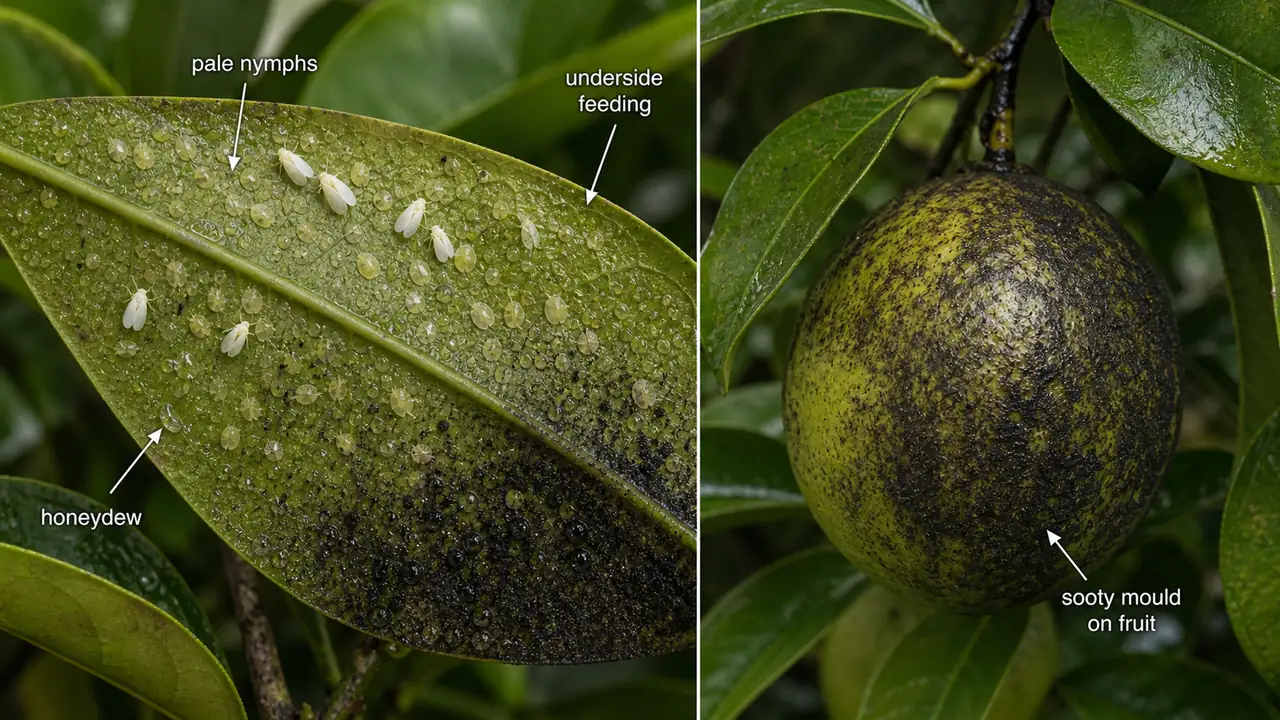
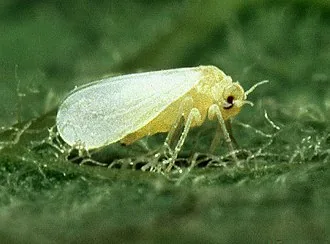
Host range: Citrus, coffee, jasmine, lilac, pear, pomegranate, persimmon, and many ornamentals
Damage Symptoms
- Nymphs and adults suck large quantities of sap
- Further injury from sooty mould fungus growing on copious honeydew excreted by the whitefly
- Heavily infested trees become weak and produce small crops of insipid fruit
- Blackened appearance of leaves and fruits due to sooty mould
Comparison: Blackfly vs. Whitefly of Citrus
| Feature | Citrus Blackfly | Citrus Whitefly |
|---|---|---|
| Scientific name | Aleurocanthus woglumi | Dialeurodes citri |
| Nymph colour | Dark/black | Pale/white |
| Primary damage | Leaf curling + bud drop | Sooty mould on honeydew |
| Key predator | Parasitoid wasps | Cryptognatha flavescens, Verania cardoni |
Management
- Regularly prune to improve air circulation and reduce whitefly buildup
- Conserve predators like coccinellids: Cryptognatha flavescens, Verania cardoni
- Spray neem oil or imidacloprid during peak infestation
5. Bark Caterpillar — Indarbela tetraonis (Metarbelidae: Lepidoptera)
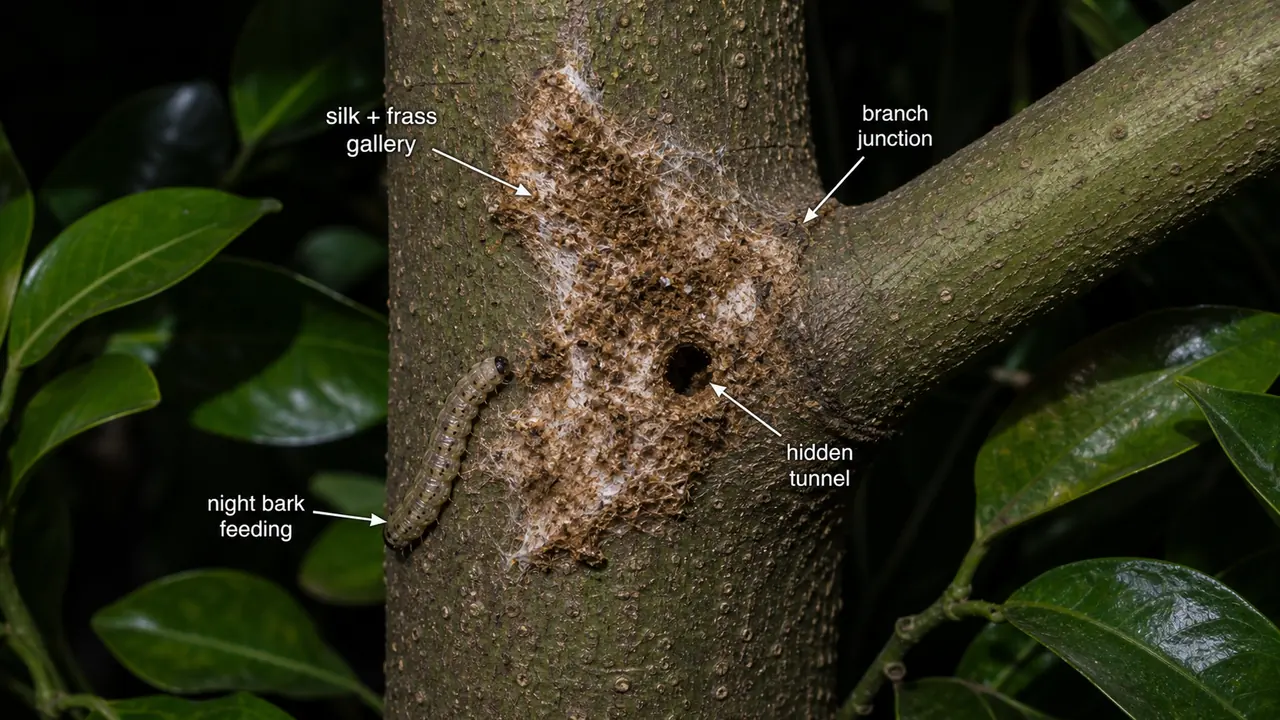
Host range: Mango, guava, litchi, orange, pomegranate, mulberry, moringa, rose, and many other fruit trees
Damage Symptoms
- Young trees are particularly susceptible and may succumb to attack
- Caterpillars bore into the trunk or junction of branches, making zig-zag galleries
- Presence of gallery made of silk and frass is the key diagnostic symptom
- Caterpillars hide in tunnels during the day; come out at night to feed on bark
- Under severe infestation, sap flow is hindered, growth arrested, and fruit formation drops drastically
Management
- Kill caterpillars by inserting an iron spike into the tunnels
- Inject ethylene glycol and kerosene oil (1:3) into the tunnel using a syringe, then seal with mud
- Alternatively, dip cotton in a fumigant (chloroform, petrol, or kerosene), push into tunnel, and seal the opening with clay or mud
NOTE
Cross-crop pest: Indarbela tetraonis attacks mango, citrus, guava, and pomegranate. The management technique (inject fumigant + seal with mud) is the same across all crops and is commonly tested.
6. Citrus Butterfly — Papilio demoleus, P. polytes (Papilionidae: Lepidoptera)
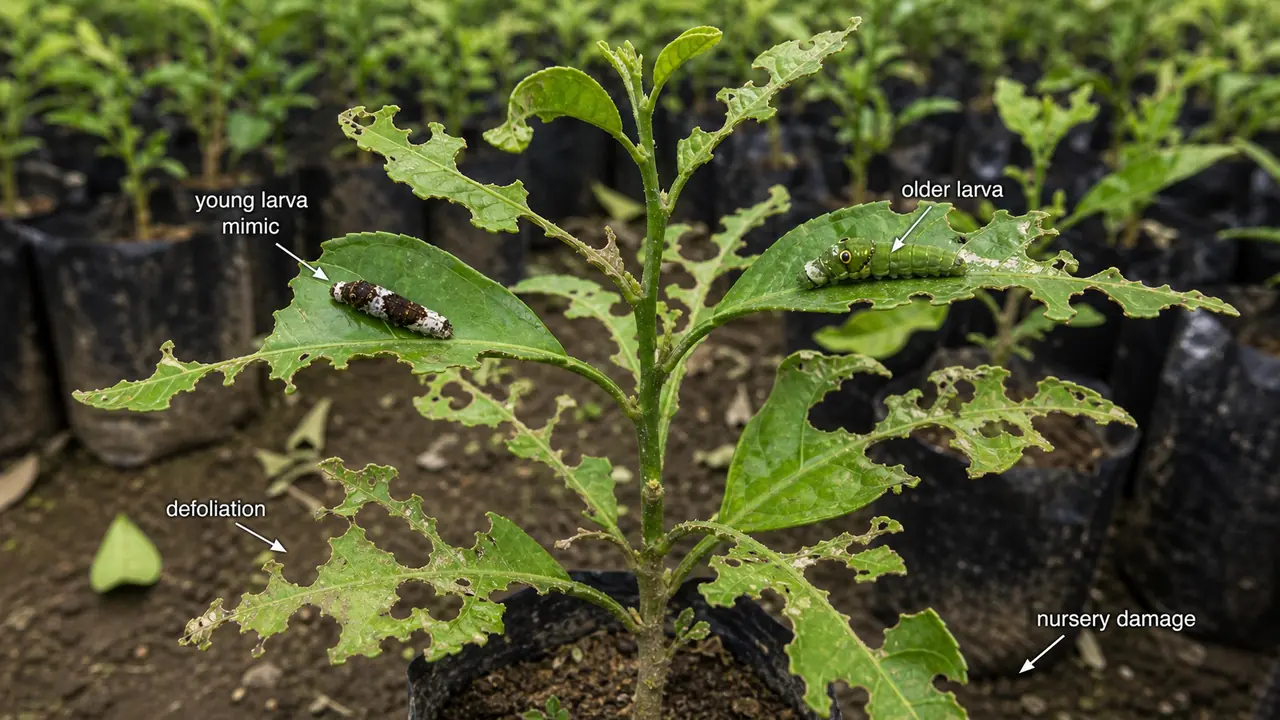
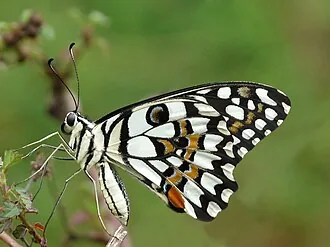
Agricultural context: In citrus nurseries, the large, colourful larvae of the lime butterfly can strip young seedlings completely bare. Papilio demoleus preferentially lays eggs on young flush growth — activity peaks during new flush emergence. Nursery trees are especially vulnerable. The caterpillars, which have distinctive eye-spot markings to deter birds, feed voraciously on both young and mature leaves.
Host range: Citrus and other Rutaceae plants, including Aegle marmelos (bael)
Damage Symptoms
- Young larvae feed on the upper surface of leaves, eating the lamina from margin to midrib
- Grown-up larvae feed on mature leaves and cause severe defoliation of the entire plant
- Particularly damaging in nurseries where plants are small
Identification
| Feature | Detail |
|---|---|
| Common names | Lime butterfly, lemon butterfly |
| Family | Papilionidae (swallowtail butterflies) |
| Larval feature | Distinctive eye-spot markings; green/brown |
| Pupa | Attached to twig by a silk girdle |
Management
- Spray Bacillus thuringiensis (Bt) @ 1 g/L
- Apply nematode DD-136 strain for biological control
- Neem seed extract 3%
- Hand-pick caterpillars in nurseries
TIP
Exam fact: Papilio demoleus belongs to Papilionidae (swallowtail family). It is also called lime butterfly or lemon butterfly. Bt spray is the standard biocontrol recommendation.
7. Fruit Sucking Moth — Othreis fullonica
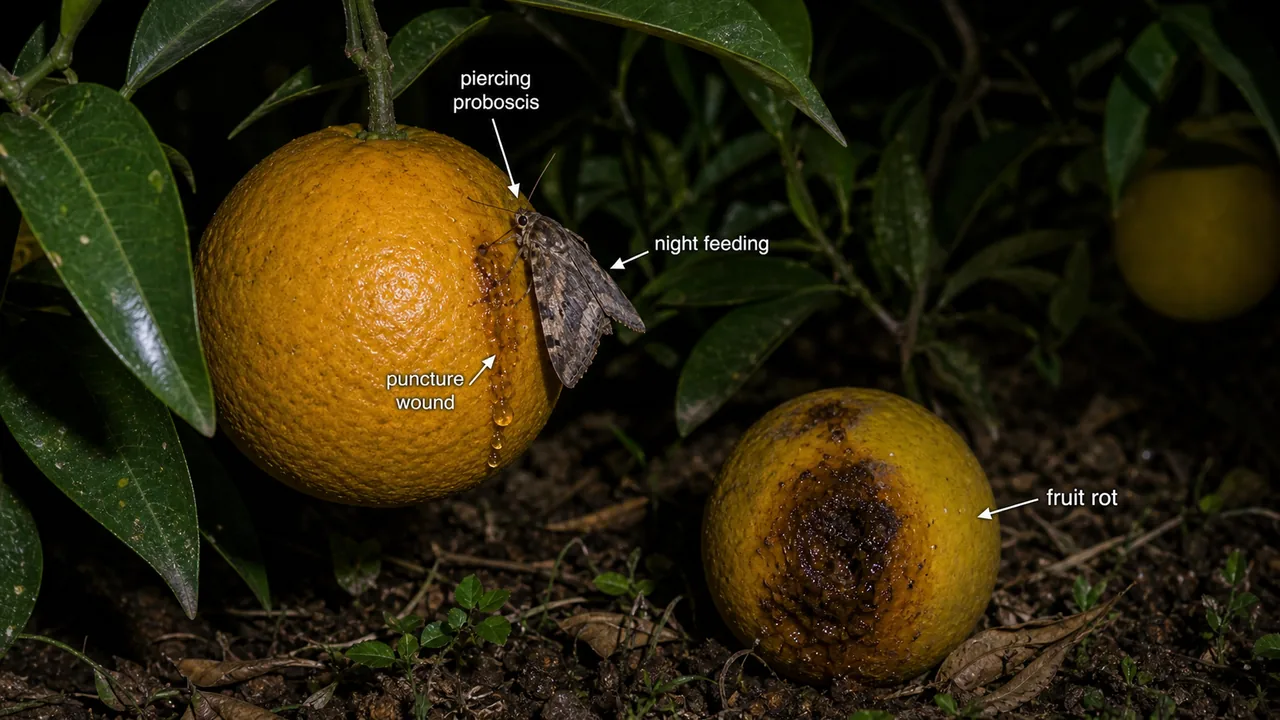
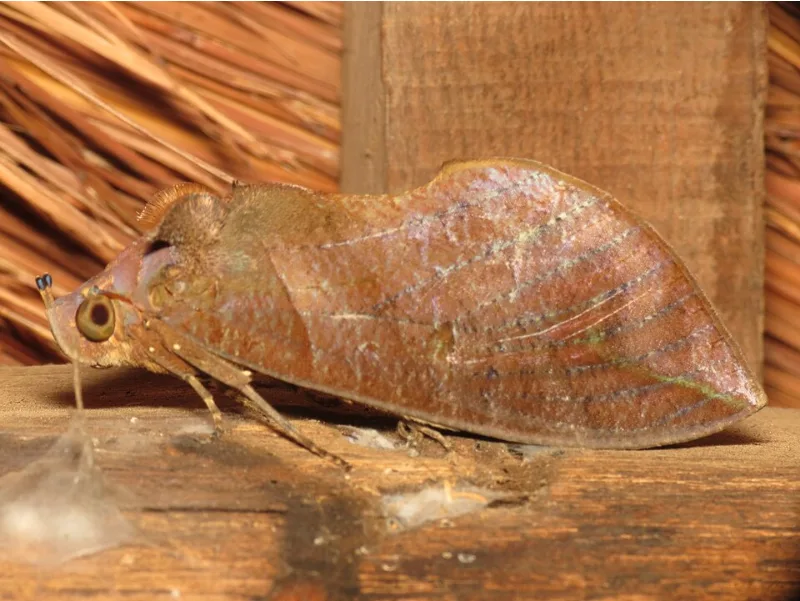
Damage Symptoms
- Adults pierce ripe fruits with their strong, sclerotised proboscis and suck the juice
- Puncture wounds lead to fruit rot and drop
- Strictly nocturnal — damage is noticed only the next morning
- The larvae feed on plants of the family Menispermaceae (moonseed) — not on citrus
Management
- Harvest fruits at colour-break stage, before they fully ripen
- Destroy wild Menispermaceae plants near orchards (larval hosts)
- Use light traps and bait traps at night
- Older orchard-protection advice also includes smoking and bagging fruits with polythene or paper to reduce nocturnal feeding punctures on ripening fruits
Minor Pests of Citrus
8. Leaf Roller — Psorostichya zizyphi (Oecophoridae: Lepidoptera)
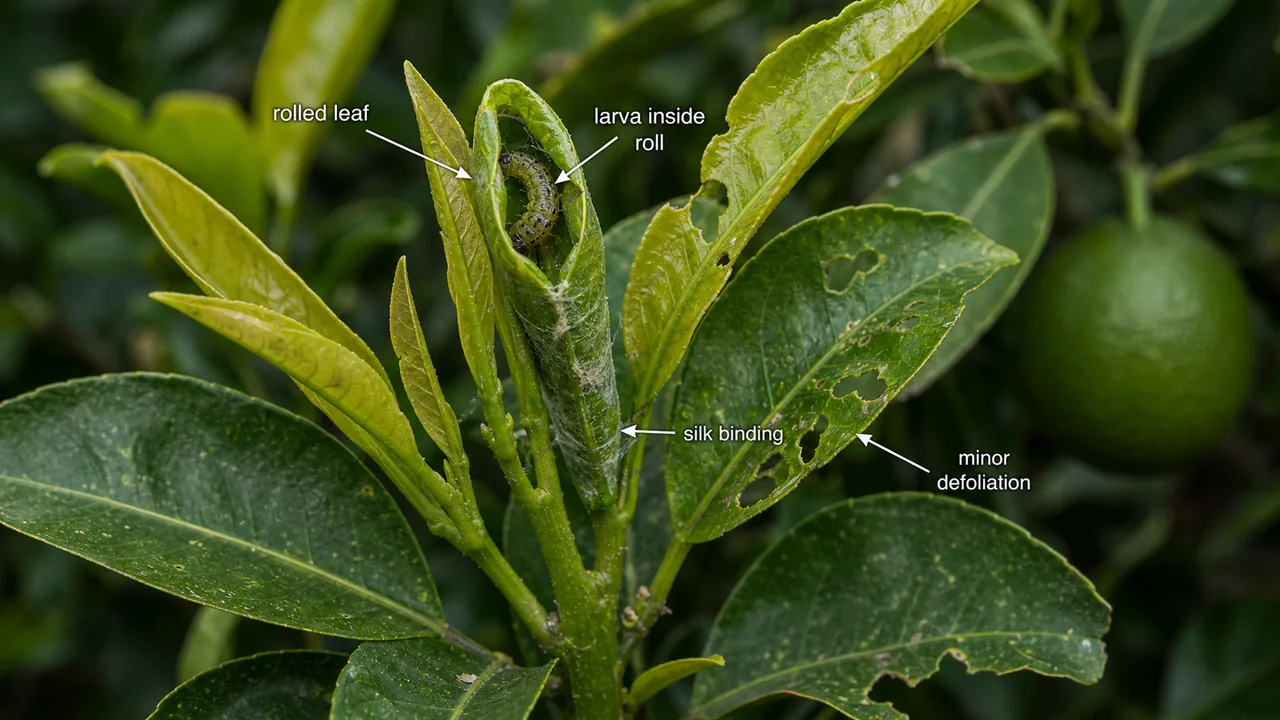
9. Citrus Aphid — Toxoptera citricidus, T. aurantii (Aphididae: Hemiptera)
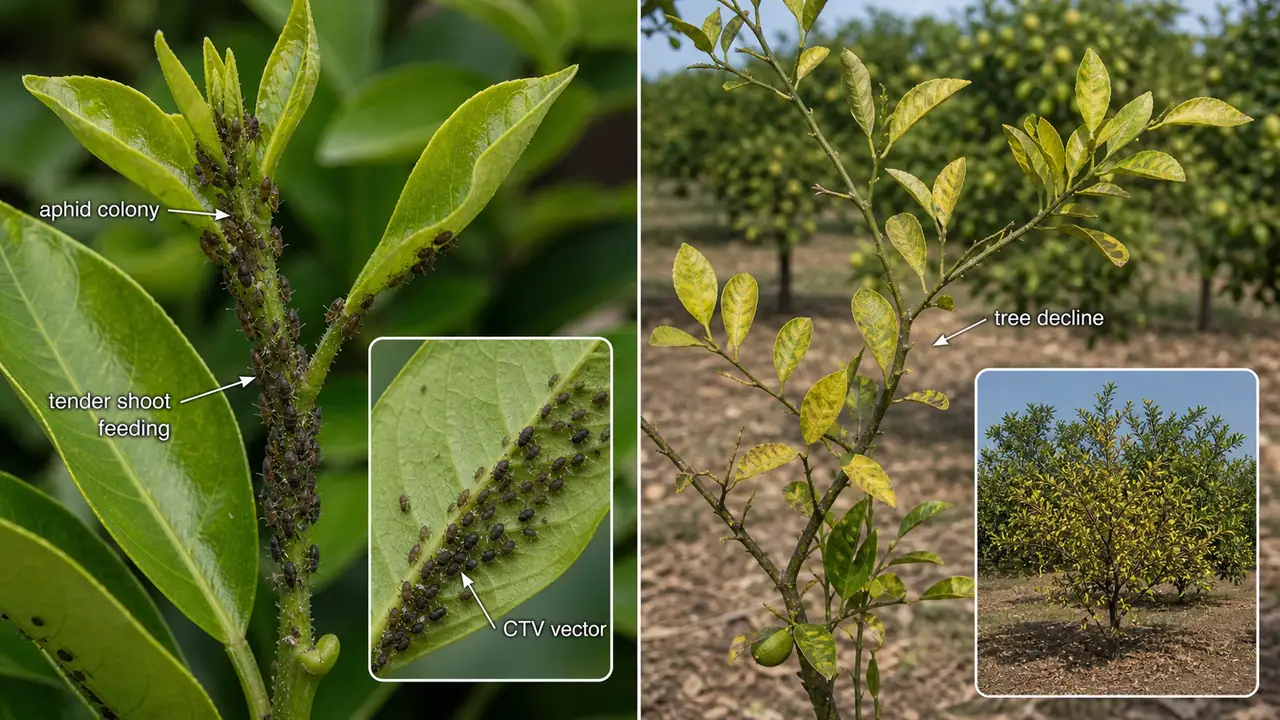
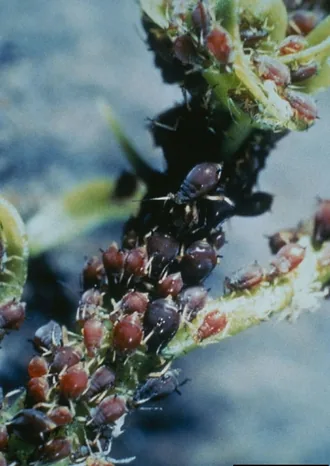
- Suck sap from tender shoots and leaves
- Important as vectors of Citrus Tristeza Virus (CTV) — the most destructive viral disease of citrus worldwide
- CTV causes rapid decline and death of trees on sour orange rootstock
IMPORTANT
Toxoptera citricidus is the most efficient vector of Citrus Tristeza Virus (CTV). This vector-disease pair is as important as the psyllid-greening pair for exams.
10. Thrips — Thrips nilgiriensis (Thripidae: Thysanoptera)
Comparison: Pest-Disease Interactions in Citrus
| Pest | Disease Caused/Facilitated | Pathogen Type | Mechanism |
|---|---|---|---|
| Diaphorina citri (Psyllid) | Citrus Greening (HLB) | Bacterium (Ca. Liberibacter) | Direct vector transmission |
| Phyllocnistis citrella (Leaf Miner) | Citrus Canker | Bacterium (Xanthomonas citri) | Wounds provide entry points |
| Toxoptera citricidus (Aphid) | Citrus Tristeza (CTV) | Virus | Direct vector transmission |
TIP
Exam mnemonic — "PCTx" for citrus diseases: Psyllid transmits Greening, Canker is facilitated by leaf miner, Tristeza is transmitted by aphid (Toxoptera). Three pests, three diseases, three different mechanisms.
Comparison: Pest Families Attacking Citrus
| Family | Order | Pest | Feeding Type |
|---|---|---|---|
| Psyllidae | Hemiptera | Citrus Psyllid | Sap sucking |
| Gracillaridae | Lepidoptera | Leaf Miner | Leaf mining |
| Aleyrodidae | Hemiptera | Blackfly, Whitefly | Sap sucking |
| Metarbelidae | Lepidoptera | Bark Caterpillar | Bark boring |
| Papilionidae | Lepidoptera | Citrus Butterfly | Leaf chewing |
| Aphididae | Hemiptera | Citrus Aphid | Sap sucking |
Field Diagnosis: Citrus Orchard — Which Pest?
Step 1: Check the damaged part
Leaf damage:
- Silvery serpentine mines on tender leaves? → Leaf Miner (P. citrella) — also creates entry points for citrus canker bacteria
- Leaves with black sooty coating + tiny dark insects on undersurface? → Citrus Blackfly (A. woglumi) — sooty mold on honeydew
- Yellowing/mottling of leaves, new growth stunted? → Citrus Psyllid (D. citri) — vector of Greening disease (HLB, incurable)
- Large irregular bites on tender leaves? → Citrus Butterfly (P. demoleus) — look for distinctive caterpillar (bird-dropping mimic)
Fruit damage:
- Puncture marks on ripe fruits, juice oozing? → Fruit Sucking Moth (O. fullonica) — nocturnal; larvae feed on moonseed (Tinospora), not citrus
Trunk/bark damage:
- Frass and silk webbing at branch junctions? → Bark Caterpillar (Indarbela) — inject fumigant into tunnel + seal with mud
Colony on new shoots:
- Small dark aphids on flush growth? → Citrus Aphid (T. citricidus) — vector of Tristeza virus (CTV, incurable)
Key exam fact: Citrus has TWO incurable vector-transmitted diseases — Greening (psyllid vector) and Tristeza (aphid vector). Control the vector, not the disease.
Exam Tips and Mnemonics
- Two vector-transmitted diseases of citrus: Greening (by psyllid) and Tristeza (by aphid) — both are incurable
- Leaf miner-canker link: Leaf miner does not transmit canker but creates entry wounds — this is a pest-disease interaction, not vector transmission
- Bark caterpillar management is the same across mango, citrus, guava: inject fumigant into tunnel + seal with mud
- Fruit sucking moth larvae feed on Menispermaceae (moonseed), not on citrus — destroying these wild plants controls the pest
- Blackfly vs. whitefly: Despite both being Aleyrodidae, blackfly nymphs are dark while whitefly nymphs are pale
Summary Cheat Sheet
| No. | Pest | Scientific Name | Family: Order | Key Exam Fact |
|---|---|---|---|---|
| 1 | Citrus Psyllid | Diaphorina citri | Psyllidae: Hemiptera | Vector of Citrus Greening (HLB); pathogen: Ca. Liberibacter (bacterium); no cure |
| 2 | Citrus Leaf Miner | Phyllocnistis citrella | Gracillaridae: Lepidoptera | Zig-zag mines; predisposes to citrus canker; spray NSKE 5% |
| 3 | Citrus Blackfly | Aleurocanthus woglumi | Aleyrodidae: Hemiptera | Dark nymphs (unlike typical whitefly); leaf curling; flower bud drop |
| 4 | Citrus Whitefly | Dialeurodes citri | Aleyrodidae: Hemiptera | Sooty mould on honeydew; predator: Cryptognatha flavescens |
| 5 | Bark Caterpillar | Indarbela tetraonis | Metarbelidae: Lepidoptera | Silk + frass galleries; inject fumigant + seal with mud |
| 6 | Citrus Butterfly | Papilio demoleus | Papilionidae: Lepidoptera | Lime/lemon butterfly; severe defoliation; Bt spray; DD-136 nematode |
| 7 | Fruit Sucking Moth | Othreis fullonica | — | Adult pierces ripe fruit; nocturnal; larvae on Menispermaceae |
| 8 | Citrus Aphid | Toxoptera citricidus | Aphididae: Hemiptera | Vector of Citrus Tristeza Virus (CTV) |
| 9 | Thrips | Thrips nilgiriensis | Thripidae: Thysanoptera | Fruit scarring; sap laceration |