🥥 Coconut Pests: Rhinoceros Beetle, Red Palm Weevil, Eriophyid Mite & More
Complete guide to 11 major and minor pests of coconut — rhinoceros beetle, red palm weevil (hidden enemy), black headed caterpillar, eriophyid mite, white grub, and slug caterpillar. With comparison tables, IPM, and exam mnemonics for exams, NABARD & ICAR.
Field scenario: A coconut farmer in Tiptur (Karnataka) notices that the central spindle of one of his palms has been cut and toppled. When he examines the opened fronds, they display a distinctive diamond-shaped cutting pattern — the signature of the rhinoceros beetle. A few rows away, another palm shows brown ooze dripping from holes in its trunk. By the time these external symptoms appeared, up to 50 grubs of the red palm weevil were already hollowing out the trunk from within. The red palm weevil is rightly called the "hidden enemy" of coconut.
Coconut (Cocos nucifera) is one of India's most important plantation crops, vital for the economies of Kerala, Karnataka, Tamil Nadu, and Andhra Pradesh. Over 100 insect and mite species attack coconut, but 6 major pests and 5 minor pests are of economic importance. Two relationships are especially critical for exams: the rhinoceros beetle creates wounds that the red palm weevil enters through, and the eriophyid mite — though microscopic — causes enormous economic damage to nut quality.
Pro Content Locked
Upgrade to Pro to access this lesson and all other premium content.
Charged once for one year · ₹1188 total
Save ₹100/month vs ₹2388/year launch price
- All Agriculture & Banking Courses
- AI Lesson Questions (100/day)
- AI Doubt Solver (50/day)
- Glows & Grows Feedback (30/day)
- AI Section Quiz (20/day)
- 22-Language Translation (100/day)
- Recall Questions (20/day)
- AI Quiz (15/day)
- AI Quiz Paper Analysis (100/day)
- AI Step-by-Step Explanations (100/day)
- Spaced Repetition Recall (FSRS)
- AI Tutor
- Immersive Text Questions
- Audio Lessons — Hindi & English
- Mock Tests & Previous Year Papers
- Summary & Mind Maps
- XP, Levels, Leaderboard & Badges
- Generate New Classrooms
- Voice AI Teacher (AgriDots Live)
- AI Revision Assistant
- Knowledge Gap Analysis
- Interactive Revision (LangGraph)
🔒 Secure one-time yearly payment via Razorpay · No hidden fees
Field scenario: A coconut farmer in Tiptur (Karnataka) notices that the central spindle of one of his palms has been cut and toppled. When he examines the opened fronds, they display a distinctive diamond-shaped cutting pattern — the signature of the rhinoceros beetle. A few rows away, another palm shows brown ooze dripping from holes in its trunk. By the time these external symptoms appeared, up to 50 grubs of the red palm weevil were already hollowing out the trunk from within. The red palm weevil is rightly called the "hidden enemy" of coconut.
Coconut (Cocos nucifera) is one of India's most important plantation crops, vital for the economies of Kerala, Karnataka, Tamil Nadu, and Andhra Pradesh. Over 100 insect and mite species attack coconut, but 6 major pests and 5 minor pests are of economic importance. Two relationships are especially critical for exams: the rhinoceros beetle creates wounds that the red palm weevil enters through, and the eriophyid mite — though microscopic — causes enormous economic damage to nut quality.
How This Lesson Is Organised
We move from the crown downward: first the pests that attack from the top (rhinoceros beetle, black headed caterpillar), then those that bore into the trunk (red palm weevil), then the nut-infesting mite, root feeders (white grub), leaf feeders (slug caterpillar), and finally the minor pests. This top-to-bottom organisation mirrors how a farmer inspects a palm.
Pest Classification Table — Coconut
Major Pests
| No. | Common Name | Scientific Name | Family | Order | Part Attacked |
|---|---|---|---|---|---|
| 1 | Rhinoceros Beetle | Oryctes rhinoceros | Scarabaeidae | Coleoptera | Crown, unopened fronds |
| 2 | Red Palm Weevil | Rhynchophorus ferrugineus | Curculionidae | Coleoptera | Trunk (internal) |
| 3 | Black Headed Caterpillar | Opisina arenosella | Cryptophasidae | Lepidoptera | Leaflets (lower surface) |
| 4 | Coconut Eriophyid Mite | Aceria guerreronis | Eriophyidae | Acari | Developing nuts |
| 5 | White Grub | Leucopholis coneophora | Melolonthidae | Coleoptera | Roots |
| 6 | Slug Caterpillar | Parasa lepida, Contheyla rotunda | Cochlidiidae | Lepidoptera | Leaflets |
Minor Pests
| No. | Common Name | Scientific Name | Family | Order | Part Attacked |
|---|---|---|---|---|---|
| 7 | Mealy Bug | Pseudococcus longispinus | Pseudococcidae | Hemiptera | Leaves, nuts |
| 8 | Scale Insect | Aspidiotus destructor | Diaspididae | Hemiptera | Leaflet undersurface |
| 9 | Lacewing Bug | Stephanitis typicus | Tingidae | Hemiptera | Leaflet undersurface |
| 10 | Termite | Odontotermes obesus | Termitidae | Isoptera | Roots, trunk base |
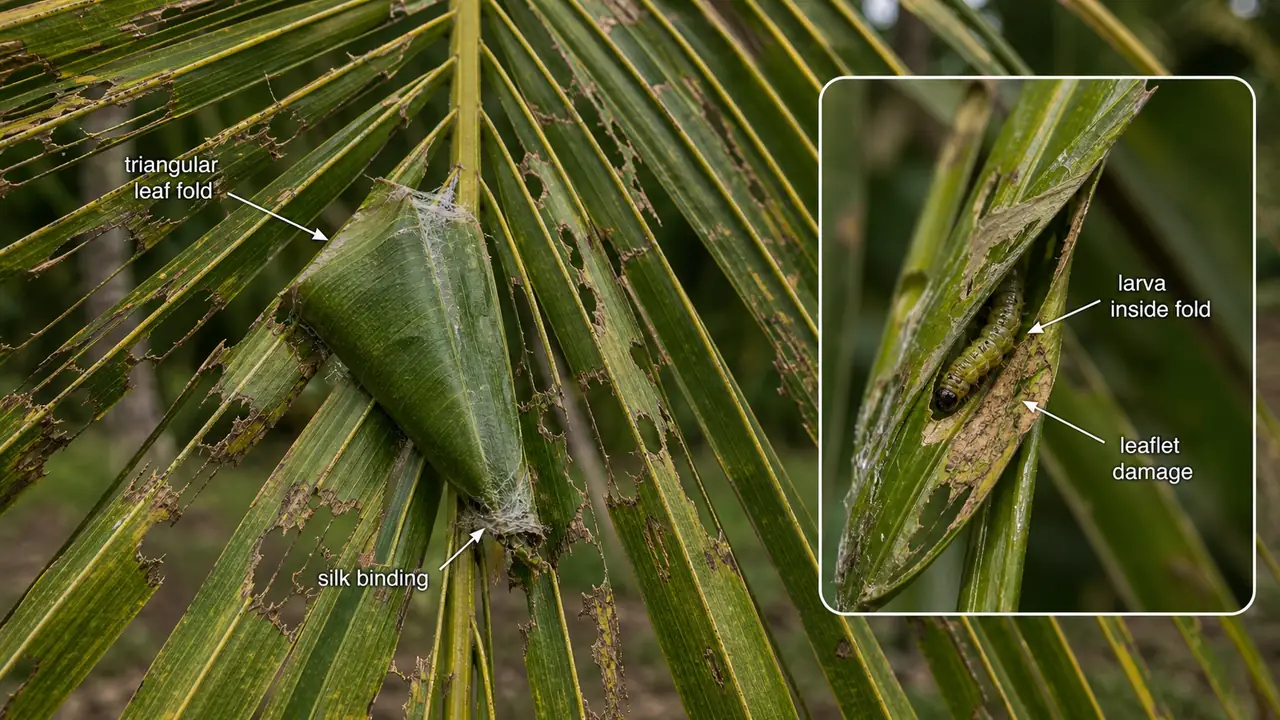
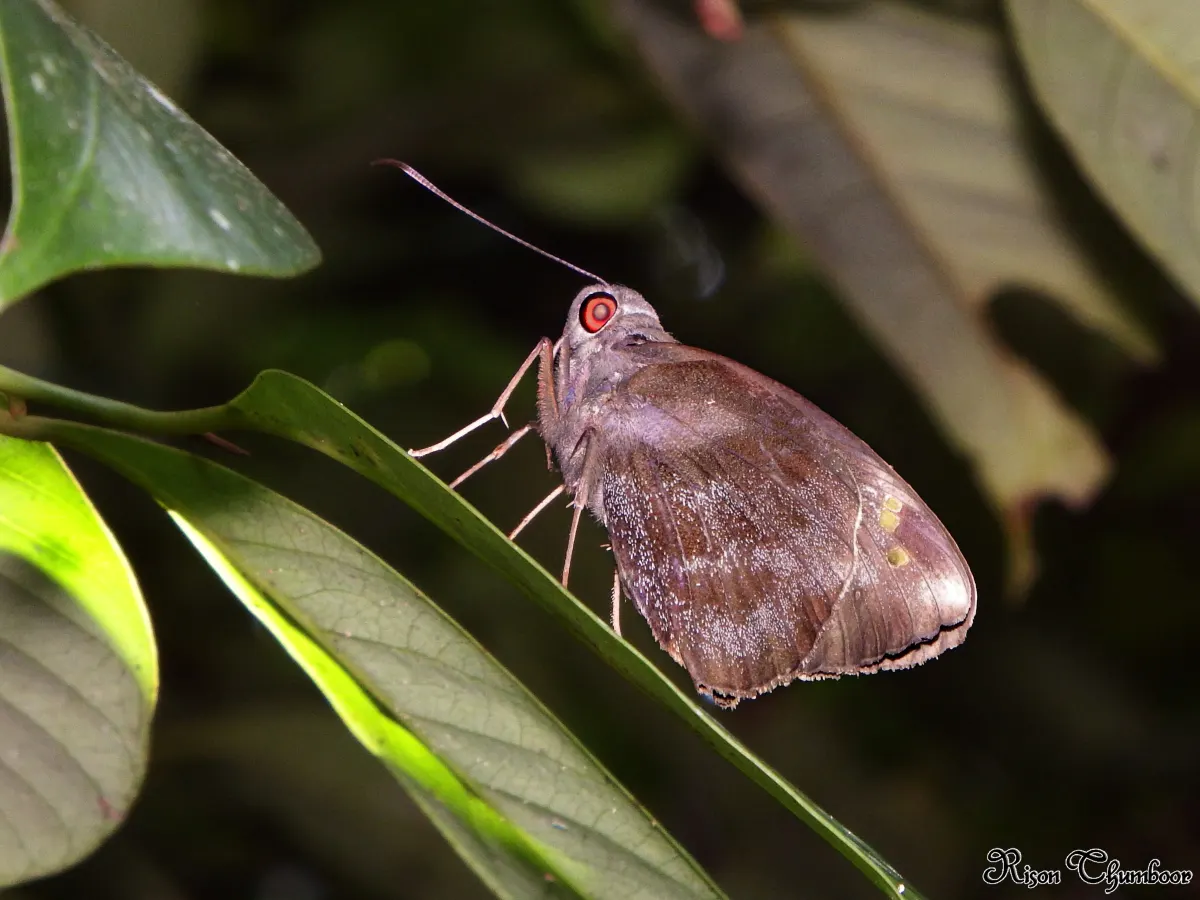
| 11 | Coconut Skippers | Gangara thyrsis, Saustus gremius | Hesperiidae | Lepidoptera | Leaflets |
1. Rhinoceros Beetle — Oryctes rhinoceros (Scarabaeidae: Coleoptera)
IMPORTANT
Rhinoceros beetle is a regular pest of coconut and one of the most destructive pests of palms worldwide. Uniquely, it is the adult beetle (not the grub) that causes damage.
Why this matters: In most Coleoptera pests, the larva/grub is the damaging stage. The rhinoceros beetle is an important exception — the adult bores into the crown.
Host range: Coconut, arecanut, oil palm, palmyra, date palm, sago palm, pineapple, sugarcane, and wild dates
Damage Symptoms
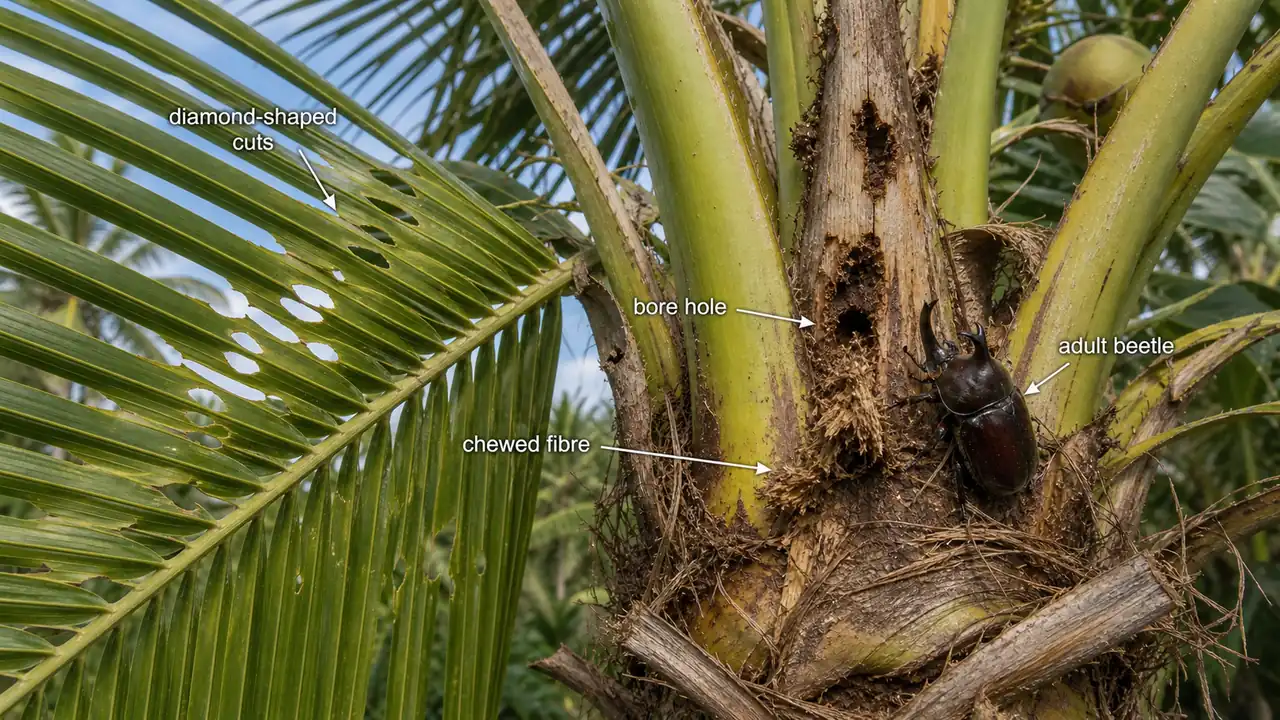
- Central spindle appears cut or toppled
- Fully opened fronds show characteristic diamond-shaped cuttings (the single most diagnostic sign)
- Holes with chewed fibre sticking at the base of the central spindle
- Adult beetles bore into the crown and feed on unopened fronds
- Wounds created by rhinoceros beetle serve as entry points for the red palm weevil
Field Identification
| Feature | What to Look For |
|---|---|
| Diagnostic sign | Diamond-shaped cuts on opened fronds |
| Bore holes | At base of spindle with chewed fibre |
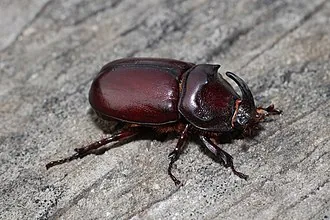
| Adult beetle | Large (35-45 mm), dark brown/black, horn on head |
| Sexual dimorphism | Horn is long in male, short in female |
| Grub habitat | Decaying organic matter (manure pits, compost heaps) |
| Manual extraction | Insert an iron hook in the crown region to extract adult beetles from bore holes |
IPM and Management
- Remove and destroy breeding sites: decaying logs, manure pits, coconut stumps
- Use Oryctes baculovirus (OrV) for biological control — infect adults and release them
- Apply Metarhizium anisopliae (green muscardine fungus) in breeding sites
- Use rhinoceros beetle traps baited with ethyl 4-methyloctanoate (aggregation pheromone)
- Fill leaf axils with a mixture of neem cake + sand (1:2) to repel adults
- Hook out beetles from bore holes using a flexible wire with a hook
TIP
Exam mnemonic: "Diamond cuts = Rhinoceros beetle." The adult causes damage (not grub). Grubs breed in decaying organic matter — field sanitation is the primary control. Metarhizium anisopliae and Oryctes baculovirus are the two biocontrol agents to remember.
2. Red Palm Weevil — Rhynchophorus ferrugineus (Curculionidae: Coleoptera)
IMPORTANT
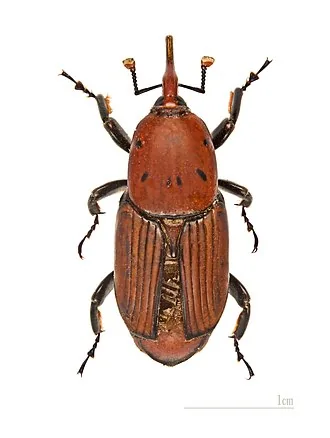
Red palm weevil is called the "hidden enemy" of coconut because the grubs feed inside the trunk, and by the time external symptoms appear, the internal damage is often fatal.
Agricultural context: In many coconut-growing regions, growers learn about red palm weevil infestation only when the palm suddenly collapses. The weevil often enters through wounds created by the rhinoceros beetle, creating a dangerous pest interaction.
Damage Symptoms
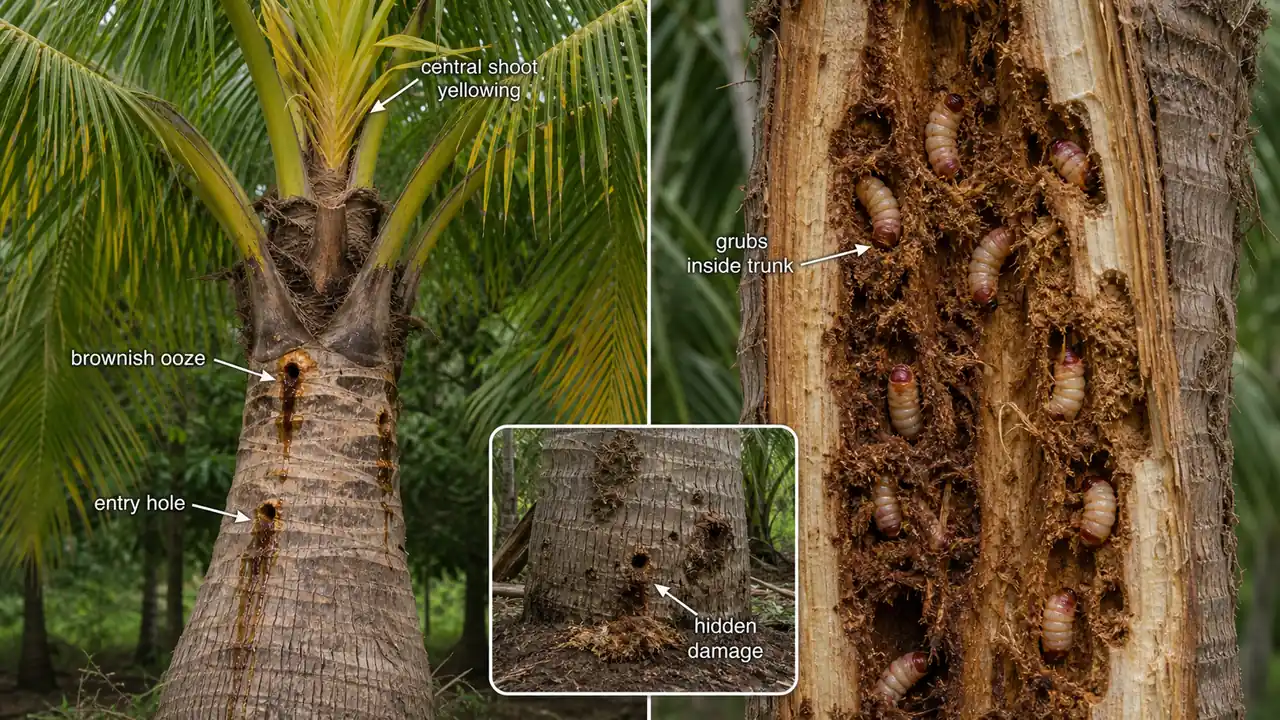
- Holes on the trunk with brownish ooze (fermented sap)
- Older tables often describe this brown ooze as gummosis
- Yellowing of inner leaves and gradual wilting of central shoot in the crown
- Up to 50 grubs can be found feeding on soft tissues inside the trunk
- Chewing sounds can sometimes be heard from infested trunks
- In advanced attack, the weakened crown may finally topple
- By the time external symptoms appear, the internal damage is often beyond recovery
Pest Interaction: Rhinoceros Beetle and Red Palm Weevil
| Aspect | Rhinoceros Beetle | Red Palm Weevil |
|---|---|---|
| Creates wounds | Yes (primary pest) | Enters through wounds |
| Part attacked | Crown (top-down) | Trunk (lateral entry) |
| Damaging stage | Adult beetle | Grub (larva) |
| Detection | Easy (diamond cuts visible) | Difficult (internal damage) |
| Lethality | Rarely kills palm | Often fatal |
Management
- Prevent rhinoceros beetle wounds (primary entry point for weevil)
- Avoid cutting green fronds — wounds attract egg-laying females
- Apply mud + carbaryl paste on cut surfaces
- Inject monocrotophos or chlorpyriphos into infested trunks through bore holes
- Use aggregation pheromone traps (ferruginol) for mass trapping
- Remove and destroy severely infested palms to prevent spread
TIP
Exam connection: Rhinoceros beetle creates entry wounds that allow red palm weevil to enter. Preventing rhinoceros beetle damage indirectly controls red palm weevil. This pest interaction is frequently tested.
3. Black Headed Caterpillar — Opisina arenosella (Cryptophasidae: Lepidoptera)
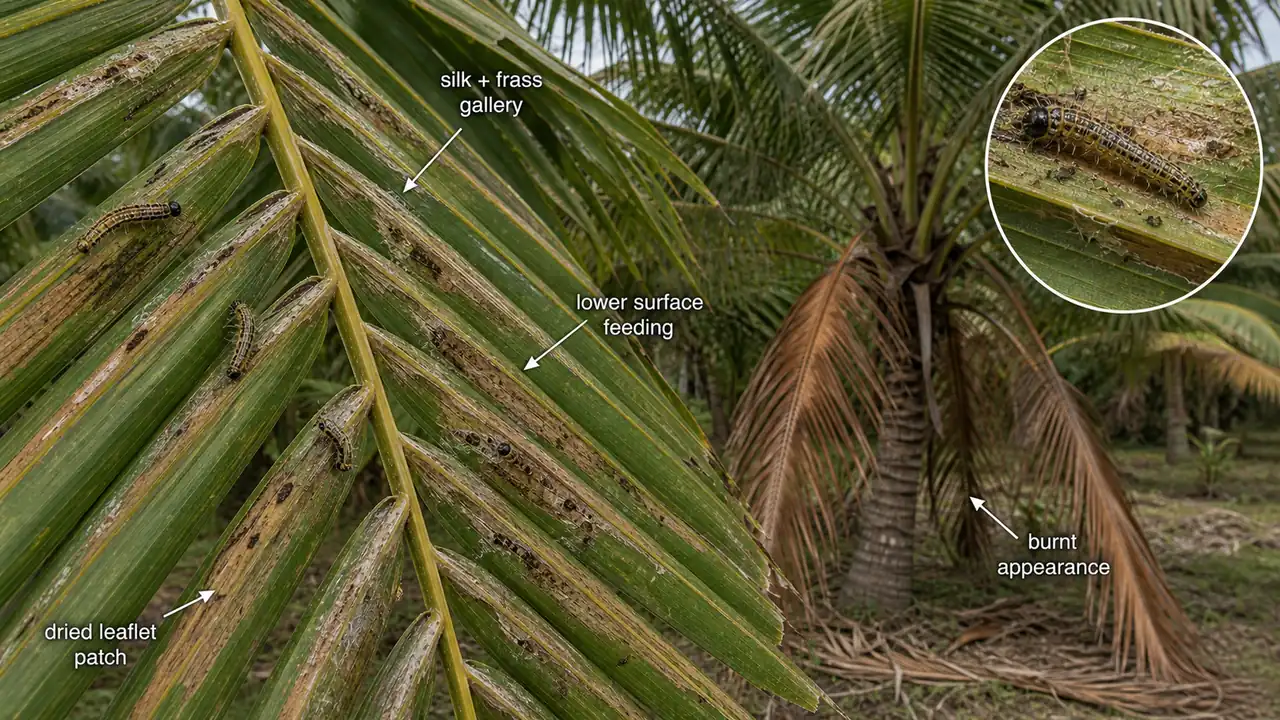
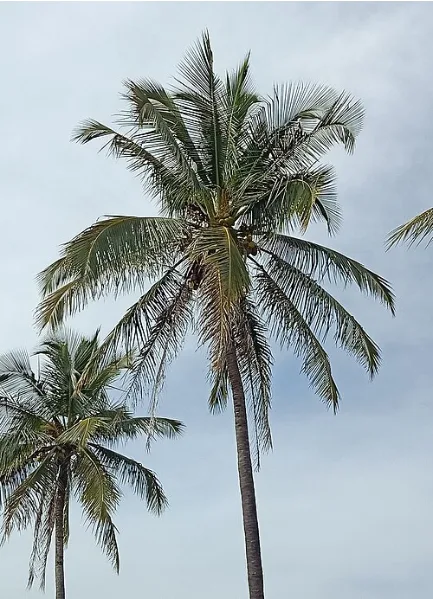
Agricultural context: During outbreaks in Kerala and Tamil Nadu, entire coconut gardens turn brown as the caterpillar strips the green tissue from leaflets.
IMPORTANT
Nephantis serinopa is an older synonym for Black-headed caterpillar of coconut (currently Opisina arenosella). Exam questions may use either name. The characteristic galleries of silk and frass on the leaf undersurface distinguish this pest from all others.
Damage Symptoms
- Dried up patches on leaflets of the lower (older) leaves — damage starts from the bottom of the crown
- Galleries of silk and frass on the undersurface of leaflets
- Larvae feed by scraping green tissue from the lower surface while remaining sheltered under silk galleries
- Older compendiums describe this as larvae making numerous galleries by feeding
- Severe infestation gives the garden a burnt appearance
Management
- Release larval parasitoids: Goniozus nephantidis (Bethylidae) and Bracon brevicornis (Braconidae)
- Older exam tables may also mention Bracon sp. and Spathius / Spoggosia bezziana among released parasitoids
- Cut and burn severely infested fronds
- Avoid burning fronds inside the garden (smoke damages healthy palms)
- Spray contact insecticides on the undersurface of fronds
NOTE
Goniozus nephantidis is the most effective biocontrol agent for black headed caterpillar — this parasitoid name is commonly asked in exams.
4. Coconut Eriophyid Mite — Aceria guerreronis (Eriophyidae: Acari)
IMPORTANT
Eriophyid mites are microscopic (less than 0.25 mm). They are not insects but arachnids (class Arachnida, subclass Acari). This classification distinction is frequently tested.
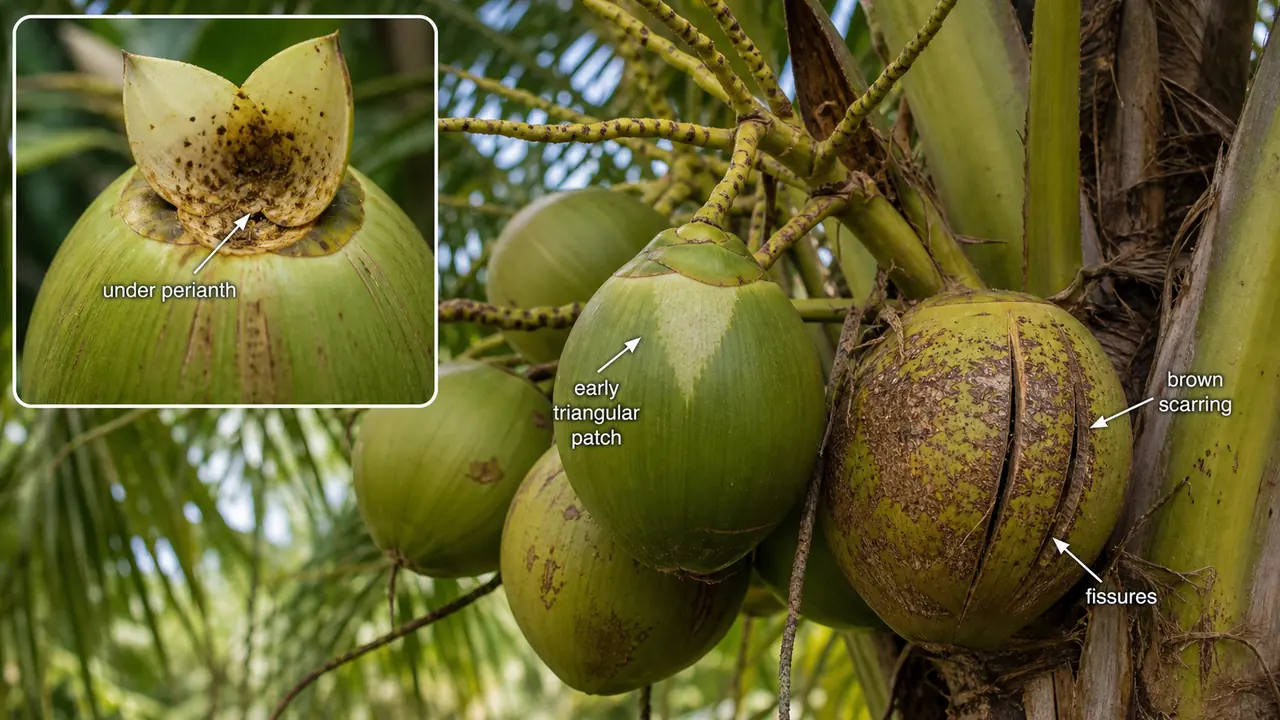
Agricultural context: Since its first report in India in 1998, the coconut eriophyid mite has spread to all major coconut-growing states. It hides under the perianth of developing nuts, making it nearly impossible to reach with contact sprays.
Damage Symptoms
- Mites colonise under the perianth (tepals) of developing nuts
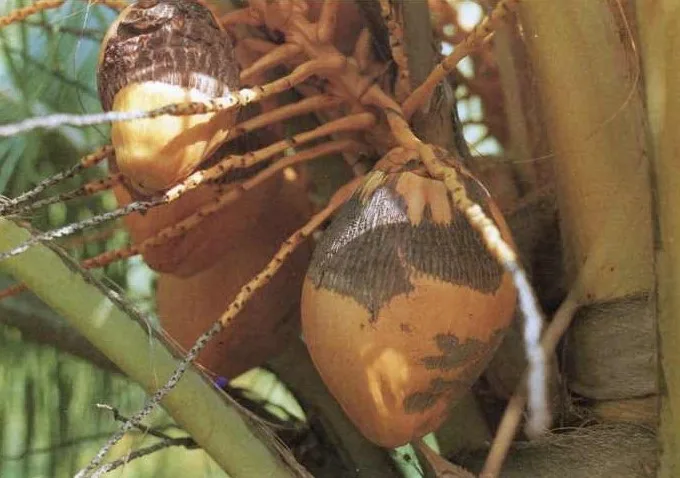
- Feeding causes scarring, distortion, and stunting of nuts
- Affected nuts show brownish necrotic patches on the surface
- Older field tables also emphasize longitudinal fissures and discolouration on the nut surface
- Reduces copra content and oil yield by 10-40%
- Premature nut fall in severe infestations
Classification Distinction
| Feature | Insects (Insecta) | Mites (Acari) |
|---|---|---|
| Body regions | Head, thorax, abdomen | Cephalothorax + abdomen (no distinct head) |
| Legs | 6 (adults) | 8 (adults); eriophyid mites have only 4 |
| Antennae | Present | Absent |
| Wings | Often present | Absent |
Management
- Spray neem oil + garlic emulsion (2%) directed at the perianth region
- Apply azadirachtin-based formulations
- Release predatory mite Neoseiulus baraki
- Root feeding with monocrotophos (systemic approach)
TIP
Exam fact: Eriophyid mites are unique among mites because they have only 4 legs (not 8). They belong to Acari, not Insecta. The hidden location under perianth is why contact sprays are ineffective.
5. White Grub — Leucopholis coneophora (Melolonthidae: Coleoptera)
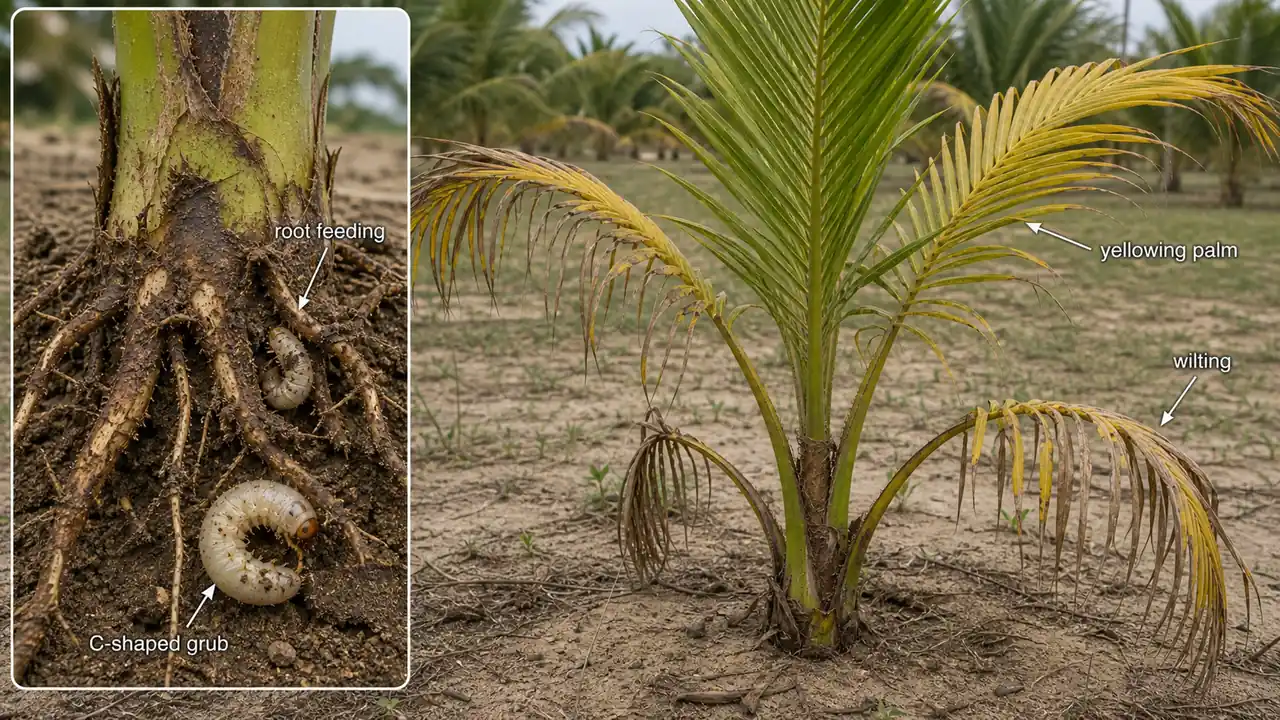
Agricultural context: Young coconut palms in sandy soils of Karnataka and Goa suddenly show yellowing and wilting. When uprooted, the roots are found chewed off by large, C-shaped white grubs.
Damage Symptoms
- Grubs feed on roots of coconut palms
- Young palms are more susceptible than mature palms
- Infested palms show yellowing and wilting of fronds
- In severe cases, palms can be easily pulled out due to root destruction
Comparison with National Pest White Grub
| Feature | Coconut White Grub | National Pest White Grub |
|---|---|---|
| Species | Leucopholis coneophora | Holotrichia consanguinea |
| Primary host | Coconut, arecanut | Groundnut, sugarcane, vegetables |
| Distribution | Western Ghats, coastal | Semi-arid regions |
| Damage pattern | Similar (root feeding) | Similar (root feeding) |
Management
- Apply neem cake @ 2 kg per palm in the basin
- Drench soil with chlorpyriphos around the base
- Collect and destroy adults attracted to light during monsoon emergence
- Biological control: Metarhizium anisopliae application in soil
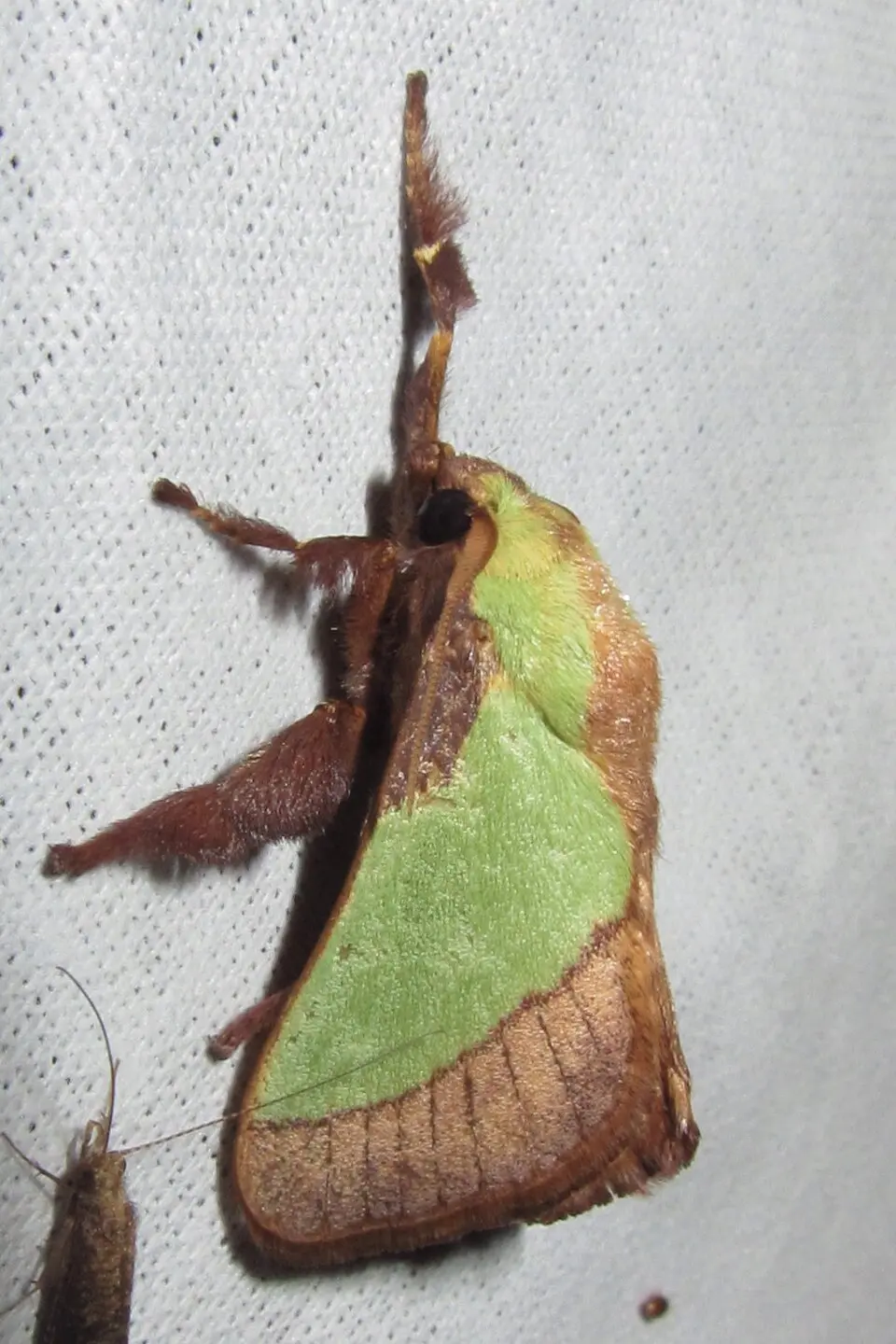
6. Slug Caterpillar — Parasa lepida and Contheyla rotunda (Cochlidiidae: Lepidoptera)
Damage Symptoms
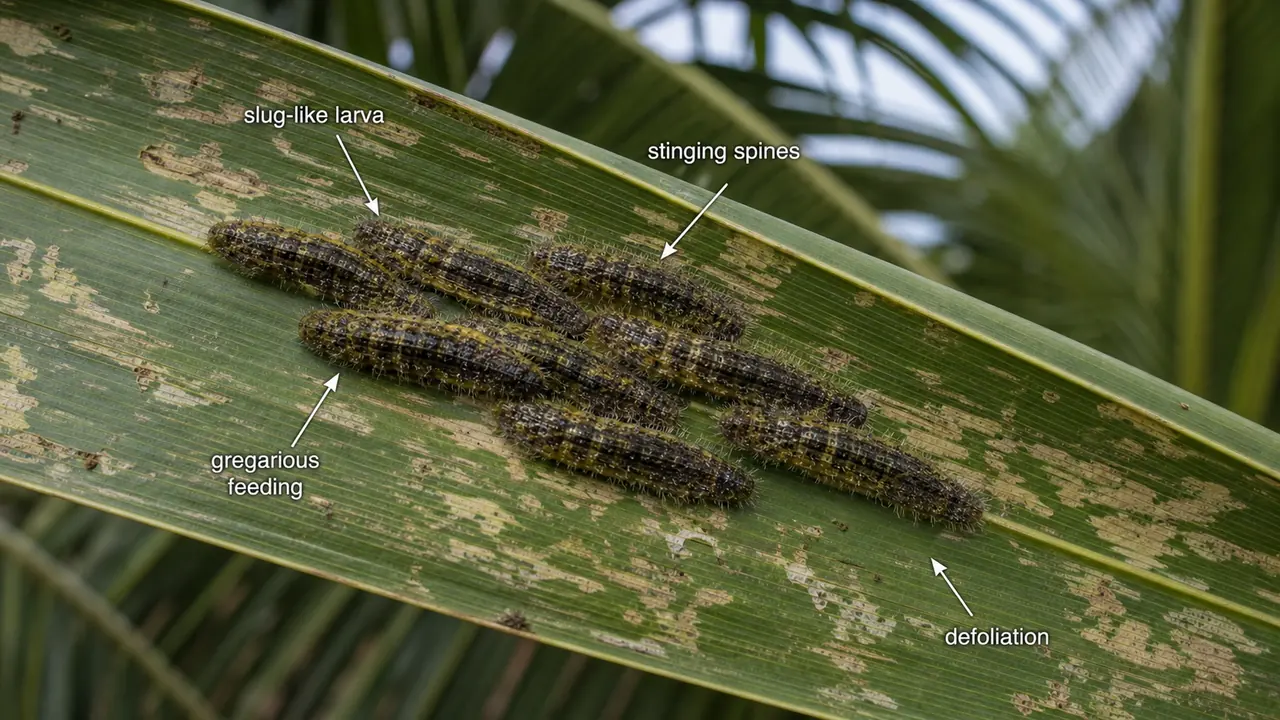
- Larvae are flattened, slug-like, and have stinging spines
- Feed on coconut leaflets, causing defoliation
- Gregarious feeders in early instars — large numbers may cluster on a single frond
- The stinging hairs cause painful irritation to workers during harvesting
Management
- Wear protective clothing during harvesting in infested gardens
- Spray contact insecticides or Bt formulations
- Cut and destroy heavily infested fronds
NOTE
Slug caterpillars belong to family Cochlidiidae (also called Limacodidae). The stinging spines are urticating — they cause skin irritation on contact. This is a minor but commonly asked identification fact.
Minor Pests of Coconut
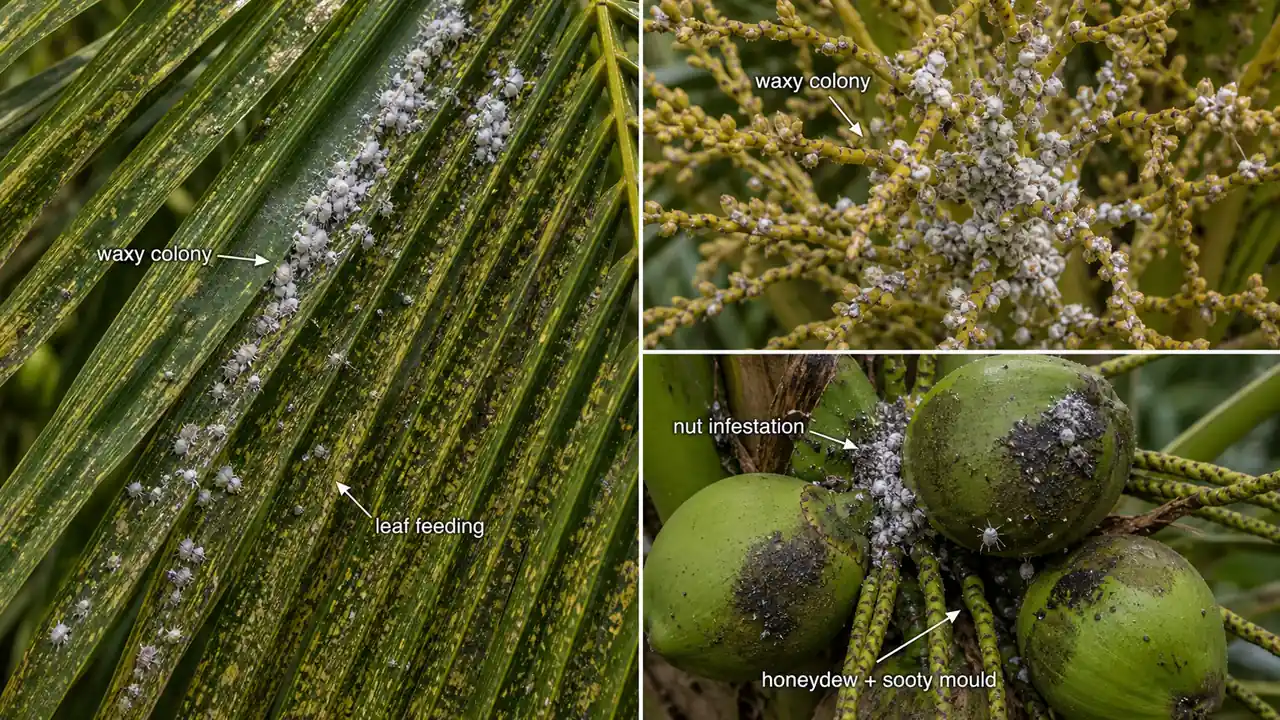
7. Mealy Bug — Pseudococcus longispinus (Pseudococcidae: Hemiptera)
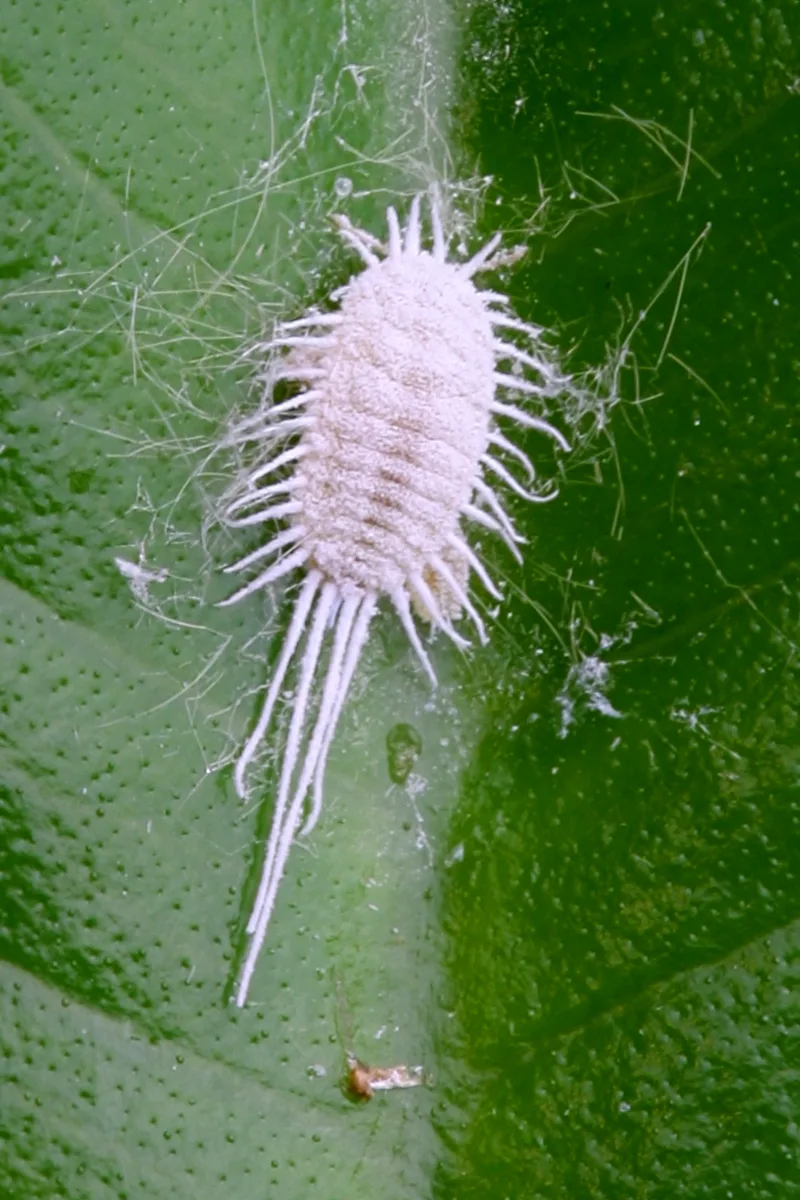
8. Scale Insect — Aspidiotus destructor (Diaspididae: Hemiptera)
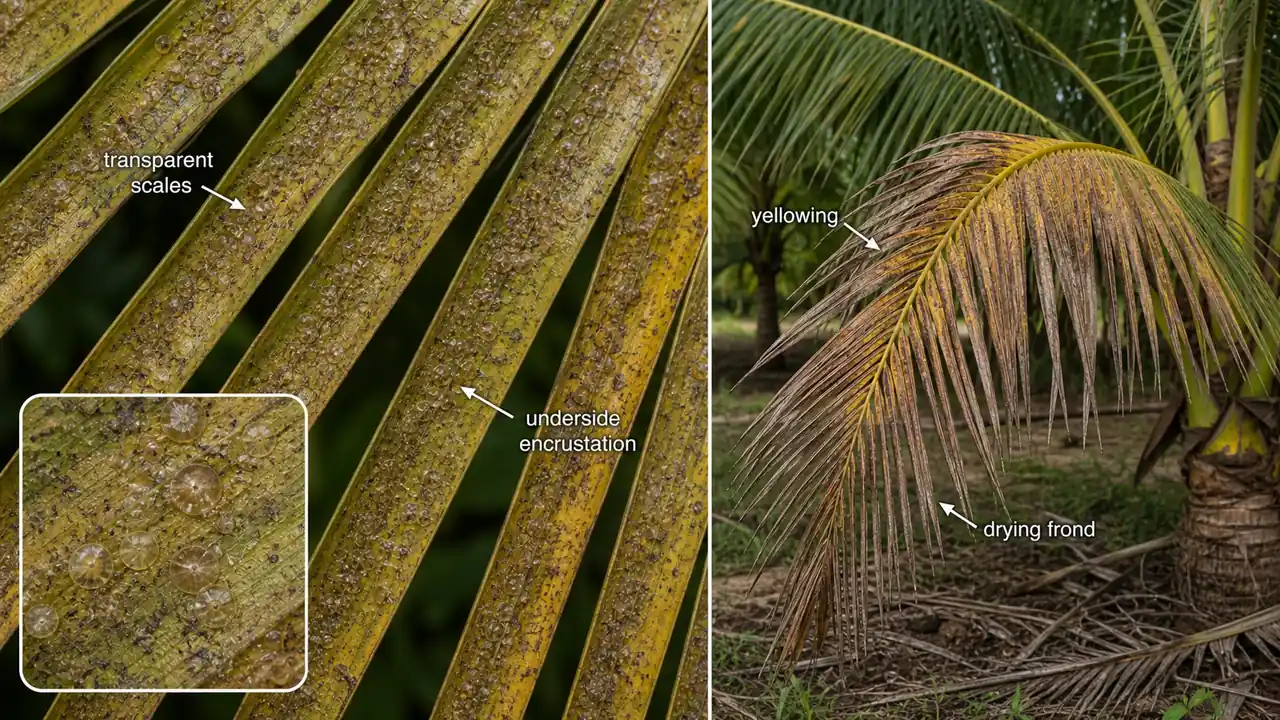
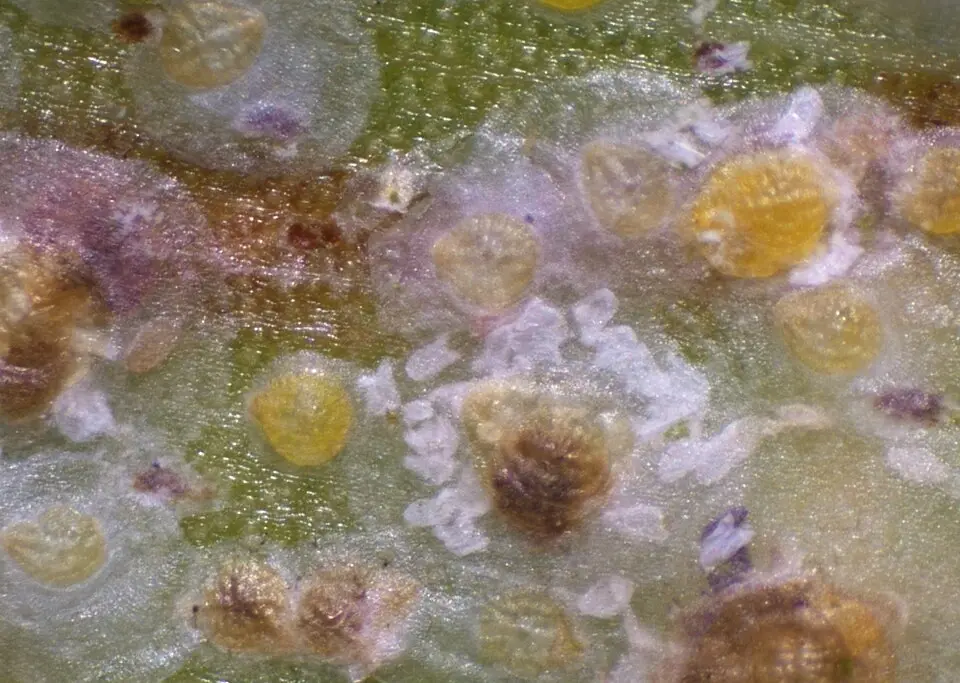
9. Lacewing Bug — Stephanitis typicus (Tingidae: Hemiptera)
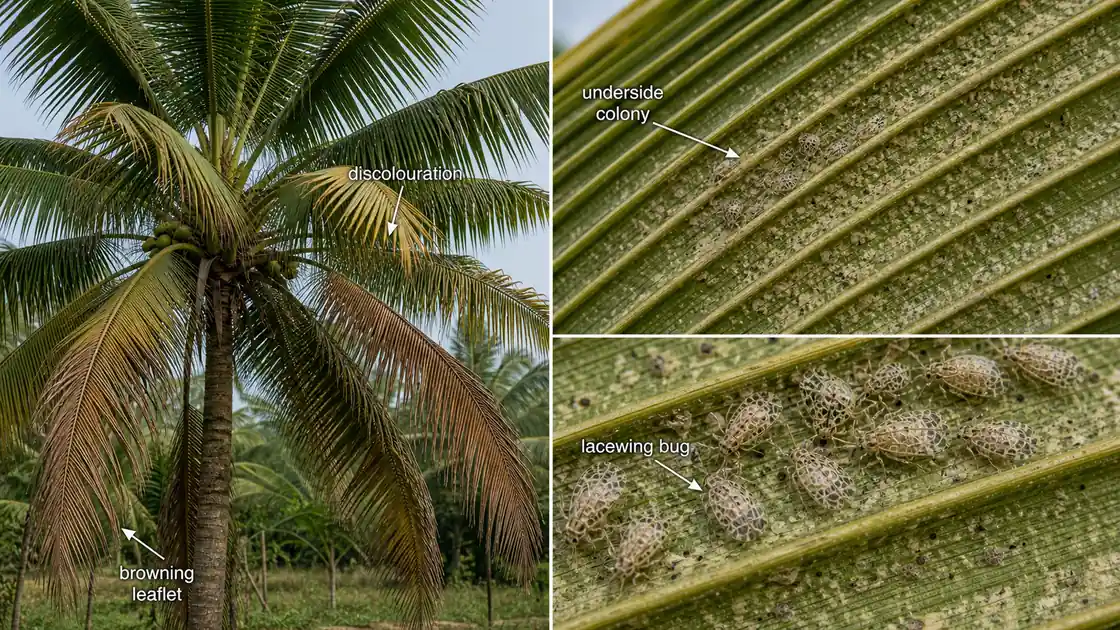
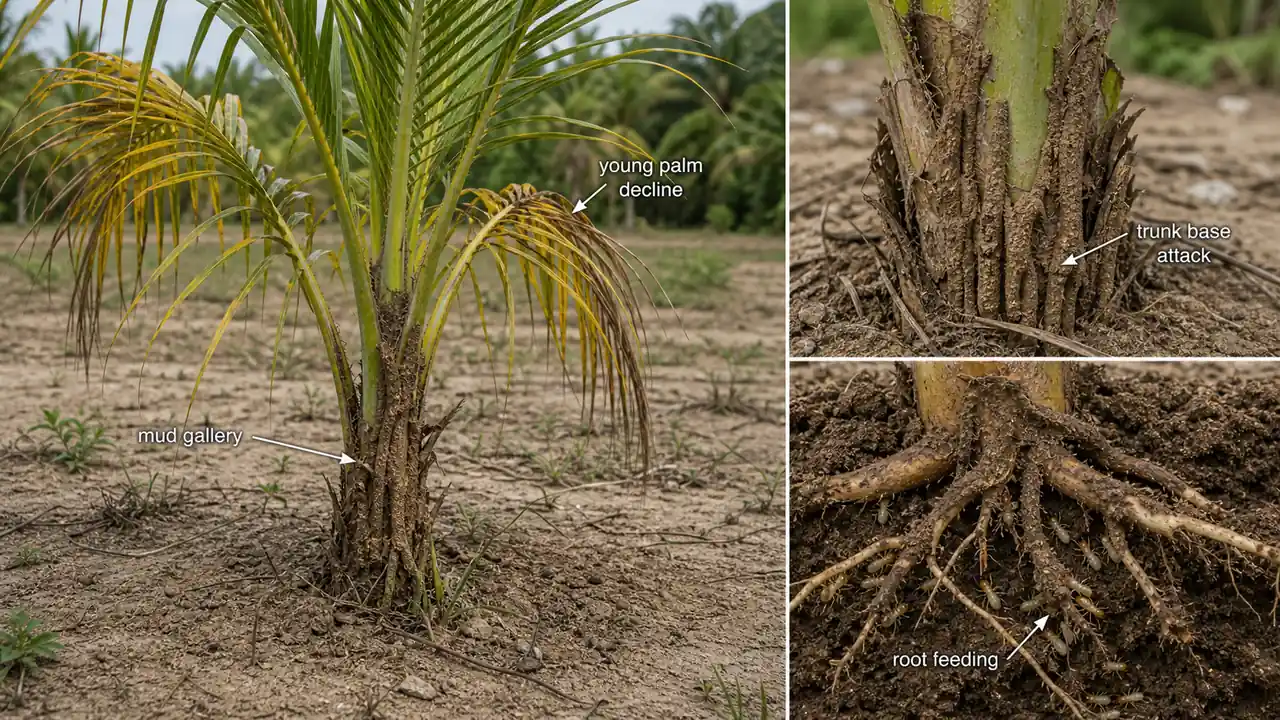
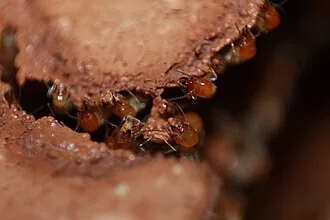
10. Termite — Odontotermes obesus (Termitidae: Isoptera)
11. Coconut Skippers — Gangara thyrsis and Saustus gremius (Hesperiidae: Lepidoptera)
Comparison: Parts of Coconut Palm Attacked by Different Pests
| Plant Part | Pest | Damaging Stage |
|---|---|---|
| Crown / unopened fronds | Rhinoceros Beetle | Adult |
| Trunk (internal) | Red Palm Weevil | Grub |
| Leaflets (lower surface) | Black Headed Caterpillar | Larva |
| Developing nuts (under perianth) | Eriophyid Mite | Nymph + adult |
| Roots | White Grub | Grub |
| Leaflets (surface) | Slug Caterpillar | Larva |
| Trunk base / roots | Termite | Workers |
Field Diagnosis: Coconut Palm — Which Pest?
Look at which part of the palm is damaged:
- Crown/new fronds have diamond-shaped cuts? → Rhinoceros Beetle (O. rhinoceros) — adult beetle, check crown at night
- Trunk oozing brownish fluid, palm declining? → Red Palm Weevil (R. ferrugineus) — grub inside trunk; often enters through rhinoceros beetle wounds. These two pests work together — beetle creates entry, weevil kills the palm.
- Lower leaflets scraped brown, webbing on undersurface? → Black Headed Caterpillar (O. arenosella) — larva scrapes from below
- Developing nuts russet-coloured under perianth? → Eriophyid Mite (A. guerreronis) — NOT an insect (only 4 legs); check under perianth with lens
- Young palms wilting, roots damaged? → White Grub (L. coneophora) — dig near base, find C-shaped grubs
- Leaflets with stinging caterpillars? → Slug Caterpillar (Parasa/Contheyla) — handle with care, urticating hairs
Other Exam-Listed Plantation Crop Pests from Coffee
The shared entomology course does not yet have a dedicated coffee-pests lesson, but a few coffee pests recur often in compact plantation-crop tables and are worth anchoring here for revision continuity.
- White stem borer — Xylotrechus quadripes (Cerambycidae: Coleoptera): grubs and adults tunnel into stems and branches, causing wilting or death of affected shoots
- Shot hole borer — Xylosandrus compactus (Scolytidae: Coleoptera): bores into twigs and small branches, producing wilting above the boring site
- Coffee berry borer — Hypothenemus hampei (Curculionidae: Coleoptera): beetles bore into berries, and infested berries become unfit for marketing
- Green bug — Coccus viridis (Coccidae: Hemiptera): nymphs and adults suck sap from leaves and shoots
Other Exam-Listed Spice and Ornamental Pests
These are compact anchors from the same plantation-crop block in older agriculture manuals. They are included here so the shared notes cover the recurring exam list even before a dedicated spice-pests lesson is built.
Cashew
- Tea mosquito bug — Helopeltis antonii remains the key cashew recall; nymphs and adults suck sap and produce brownish-black patches and cankerous spots on nuts
Cardamom
- Cardamom capsule borer — Conogethes punctiferalis (Pyralidae: Lepidoptera): bores into pseudostems and berries
- Cardamom aphid — Pentalonia nigronervosa (Aphididae: Homoptera): sucks sap and transmits foorky disease
- Cardamom thrips — Sciothrips cardamomi (Thripidae: Thysanoptera): lacerates leaf sheaths and developing capsules, causing malformed capsules and flower or pod shedding
Black Pepper
- Pollu beetle — Longitarsus nigripennis (Chrysomelidae: Coleoptera): grubs bore into berries, while adults feed on tender leaves and create shot-like holes
- Top shoot borer — Laspeyresia hemidoxa (Eucosmidae: Lepidoptera): larvae bore into shoots, causing blackening and decay of the top shoots
Turmeric
- Shoot borer — Conogethes punctiferalis causes yellowing and drying by boring into pseudostems
- Rhizome scale — Aspidiotus destructor is the named sap-sucking scale recall from compact turmeric-pest tables
Ornamentals
- Rose aphid — Macrosiphum rosaeformis causes yellowing and curling of leaves
- Jasmine bud worm — Hendecasis duplifascialis bores into jasmine buds and feeds on the inner content
- Rose leaf cutter bee — Megachile anthracina cuts circular pieces from rose leaves
Exam Tips and Mnemonics
- "RR at the top" — Rhinoceros beetle and Red palm weevil are the two most destructive pests of coconut. Rhinoceros beetle creates wounds; red palm weevil enters through them.
- Diamond-shaped cuts = rhinoceros beetle (always). Brownish ooze from trunk = red palm weevil (always).
- Damaging stage exception: Rhinoceros beetle adult causes damage (not grub). In most other beetle pests, the grub is the damaging stage.
- Eriophyid mite is NOT an insect — it is an arachnid (Acari). It has only 4 legs (unique among mites).
- White grub comparison: Leucopholis coneophora (coconut) vs. Holotrichia consanguinea (National Pest of groundnut/sugarcane) — different species, similar damage.
- Biocontrol agents to remember: Metarhizium anisopliae (rhinoceros beetle), Oryctes baculovirus (rhinoceros beetle), Goniozus nephantidis (black headed caterpillar).
Summary Cheat Sheet
| No. | Pest | Scientific Name | Family: Order | Key Exam Fact |
|---|---|---|---|---|
| 1 | Rhinoceros Beetle | Oryctes rhinoceros | Scarabaeidae: Coleoptera | Diamond-shaped cuttings; adult damages (not grub); biocontrol: Oryctes baculovirus, Metarhizium anisopliae |
| 2 | Red Palm Weevil | Rhynchophorus ferrugineus | Curculionidae: Coleoptera | "Hidden enemy"; brownish ooze; up to 50 grubs; enters through rhinoceros beetle wounds |
| 3 | Black Headed Caterpillar | Opisina arenosella | Cryptophasidae: Lepidoptera | Silk + frass galleries on leaflet undersurface; parasitoid: Goniozus nephantidis |
| 4 | Eriophyid Mite | Aceria guerreronis | Eriophyidae: Acari | Not an insect (arachnid); hides under perianth; nut scarring; only 4 legs |
| 5 | White Grub | Leucopholis coneophora | Melolonthidae: Coleoptera | Root feeder; different from H. consanguinea (National Pest) |
| 6 | Slug Caterpillar | Parasa lepida | Cochlidiidae: Lepidoptera | Stinging spines; slug-like larva; family also called Limacodidae |
| 7 | Scale Insect | Aspidiotus destructor | Diaspididae: Hemiptera | Transparent scale; undersurface of leaflets |
| 8 | Termite | Odontotermes obesus | Termitidae: Isoptera | Mud galleries on trunk; attacks young palms in sandy soils |