🌾 Primary Storage Pests: The Internal Grain Destroyers
Complete guide to primary stored grain pests (internal feeders) — rice weevil, lesser grain borer, angoumois grain moth, pulse beetle, cigarette beetle, drug store beetle, sweet potato weevil, and more with scientific names, damage symptoms, and exam-focused mnemonics
Imagine a farmer in Chhattisgarh who harvested a bumper rice crop in October. He stored the paddy in gunny bags inside a mud kothi. By February, when he opened the bags, he found hollowed-out grains riddled with tiny round holes and a fine powdery dust covering everything. Nearly 15% of his grain was destroyed — not by rats or weather, but by tiny insects that had bored inside each grain and eaten it from within. These are primary storage pests, the most destructive enemies of stored grain, and understanding them is essential for both practical agriculture and competitive exams.
IMPORTANT
In India, post-harvest losses caused by unscientific storage, insects, rodents, and micro-organisms account for about 10 per cent of total food grains. Primary pests are the chief culprits because they can attack sound, undamaged grain.
What Makes a Pest "Primary"?
Primary storage pests are internal feeders — they can infest intact, undamaged grains. The female bores into or lays eggs on sound grain, and the larva completes its entire development inside the grain kernel, emerging as an adult through a characteristic exit hole. This is what makes them far more dangerous than secondary pests, which can only feed on already broken or damaged grain.
Pro Content Locked
Upgrade to Pro to access this lesson and all other premium content.
Charged once for one year · ₹1188 total
Save ₹100/month vs ₹2388/year launch price
- All Agriculture & Banking Courses
- AI Lesson Questions (100/day)
- AI Doubt Solver (50/day)
- Glows & Grows Feedback (30/day)
- AI Section Quiz (20/day)
- 22-Language Translation (100/day)
- Recall Questions (20/day)
- AI Quiz (15/day)
- AI Quiz Paper Analysis (100/day)
- AI Step-by-Step Explanations (100/day)
- Spaced Repetition Recall (FSRS)
- AI Tutor
- Immersive Text Questions
- Audio Lessons — Hindi & English
- Mock Tests & Previous Year Papers
- Summary & Mind Maps
- XP, Levels, Leaderboard & Badges
- Generate New Classrooms
- Voice AI Teacher (AgriDots Live)
- AI Revision Assistant
- Knowledge Gap Analysis
- Interactive Revision (LangGraph)
🔒 Secure one-time yearly payment via Razorpay · No hidden fees
Imagine a farmer in Chhattisgarh who harvested a bumper rice crop in October. He stored the paddy in gunny bags inside a mud kothi. By February, when he opened the bags, he found hollowed-out grains riddled with tiny round holes and a fine powdery dust covering everything. Nearly 15% of his grain was destroyed — not by rats or weather, but by tiny insects that had bored inside each grain and eaten it from within. These are primary storage pests, the most destructive enemies of stored grain, and understanding them is essential for both practical agriculture and competitive exams.
IMPORTANT
In India, post-harvest losses caused by unscientific storage, insects, rodents, and micro-organisms account for about 10 per cent of total food grains. Primary pests are the chief culprits because they can attack sound, undamaged grain.
What Makes a Pest "Primary"?
Primary storage pests are internal feeders — they can infest intact, undamaged grains. The female bores into or lays eggs on sound grain, and the larva completes its entire development inside the grain kernel, emerging as an adult through a characteristic exit hole. This is what makes them far more dangerous than secondary pests, which can only feed on already broken or damaged grain.
Key characteristics of primary pests:
- Can penetrate sound, intact grains without prior damage
- Complete development (egg to adult) inside the grain
- Both larval and adult stages often cause damage
- Create exit holes visible on infested grains
Overview of Primary Storage Pests
| S.No. | Common Name | Scientific Name | Family | Order | Primary Host |
|---|---|---|---|---|---|
| 1 | Rice Weevil | Sitophilus oryzae | Curculionidae | Coleoptera | Rice, wheat |
| 2 | Lesser Grain Borer | Rhyzopertha dominica | Bostrichidae | Coleoptera | Wheat, rice |
| 3 | Angoumois Grain Moth | Sitotroga cerealella | Gelechiidae | Lepidoptera | Rice, maize |
| 4 | Pulse Beetle | Callosobruchus maculatus | Bruchidae | Coleoptera | Pulses |
| 5 | Cigarette Beetle | Lasioderma serricorne | Anobiidae | Coleoptera | Tobacco, spices |
| 6 | Drug Store Beetle | Stegobium paniceum | Anobiidae | Coleoptera | Spices, herbs |
| 7 | Tamarind Beetle | Pachymeres gonagra | Bruchidae | Coleoptera | Tamarind |
| 8 | Sweet Potato Weevil | Cylas formicarius | Brentidae | Coleoptera | Sweet potato |
1. Rice Weevil — The Most Important Pest of Stored Rice
Scientific Name: Sitophilus oryzae
Family: Curculionidae | Order: Coleoptera
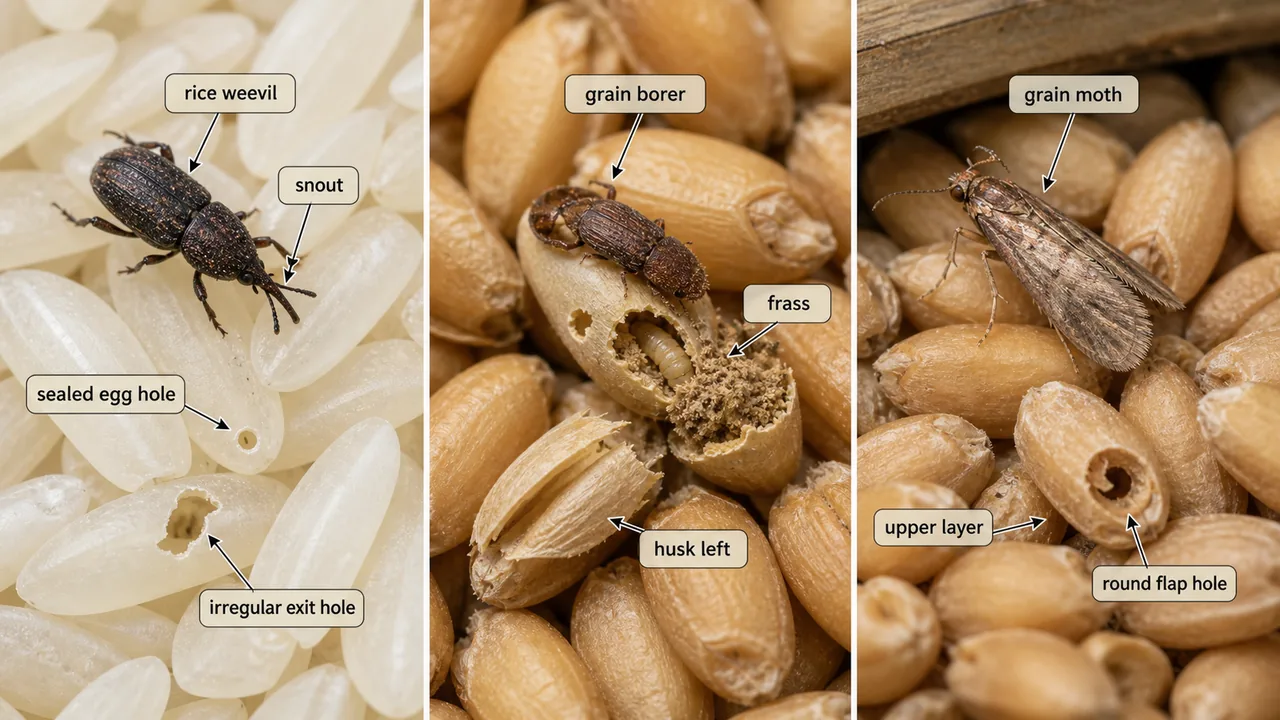
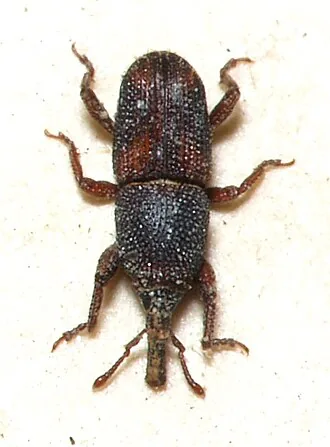
The rice weevil is a small (2-3 mm), dark brown beetle with a characteristic elongated snout. It is the single most economically important pest of stored rice across the tropics. In FCI godowns and farmer-level storage alike, this weevil is the primary cause of grain damage.
Damage Symptoms
- The adult female bores a small hole in the grain using her snout, deposits a single egg, and seals the hole with a gelatinous secretion
- The grub hatches and feeds entirely inside the grain, consuming the endosperm
- Pupation also occurs inside the grain
- The adult emerges by making an irregular hole through the grain wall
- Infested grains become hollow, lightweight, and lose nutritional value
- Both grubs and adults cause damage
IMPORTANT
Sitophilus oryzae (Rice Weevil) is the most important primary pest of stored rice. The entire development — egg, larva, pupa — occurs inside the grain. The adult female bores, deposits an egg, and seals the hole. This is a classic exam question.
Agricultural context: In the warehouses of the Food Corporation of India (FCI), rice weevil infestation is monitored by checking for irregular holes and lightweight grains during routine sampling. A single infested bag can spread the pest to adjacent stocks within weeks.
2. Lesser Grain Borer — The Wheat Destroyer
Scientific Name: Rhyzopertha dominica
Family: Bostrichidae | Order: Coleoptera
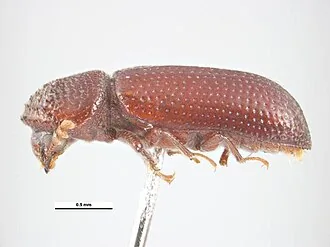
Also called the Auger Beetle because of the way it bores into grain like a drill. This cylindrical, dark brown beetle (2-3 mm) is particularly destructive to stored wheat.
Damage Symptoms
- Grubs feed on the inner content of grains, particularly wheat and rice
- After feeding, they leave only the husk behind — the grain becomes a hollow shell
- Both grubs and adults bore into grains
- Produces large amounts of frass (fine grain dust) — a telltale sign of infestation
- Infested grain has a characteristic musty smell
TIP
Rhyzopertha dominica is also called the Auger Beetle. Mnemonic: "Rhyzopertha Dominates wheat" — it is the most destructive primary pest of stored wheat. Remember "leaves husk behind" as the key damage symptom.
Agricultural example: A wheat farmer in Madhya Pradesh who delays fumigation after harvest often finds his stored wheat reduced to husks and powder within 3-4 months, with the lesser grain borer being the primary culprit.
3. Angoumois Grain Moth — The Surface Layer Attacker
Scientific Name: Sitotroga cerealella
Family: Gelechiidae | Order: Lepidoptera
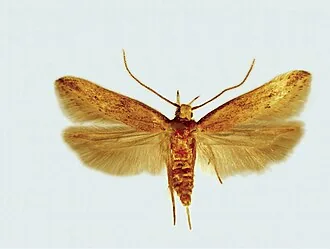
Unlike the beetles above, this is a moth — the only Lepidopteran among major primary storage pests. It is small (about 6 mm wingspan) and buff-coloured.
Damage Symptoms
- Larvae bore and feed inside the grains
- Infested grains give out an unpleasant smell and present an unhealthy appearance
- The upper layer of the grain heap is severely attacked — grains are covered with moth scales and webbing
- Characteristic round emergence holes with a thin flap (like a tiny trapdoor)
- Can infest grain both in the field before harvest and in storage
NOTE
Sitotroga cerealella primarily attacks the upper layer of the grain heap. Unlike weevils and borers that infest throughout, the moth concentrates on the top 15-30 cm. This means surface-layer inspection can catch early infestation.
Agricultural context: In traditional farm storage in Andhra Pradesh and Telangana, farmers often notice moth activity (tiny buff-coloured moths flying near grain bags at dusk) as the first sign of Angoumois grain moth infestation. The top layer of paddy in open bins is most vulnerable.
4. Pulse Beetle — The Pulse Grain Specialist
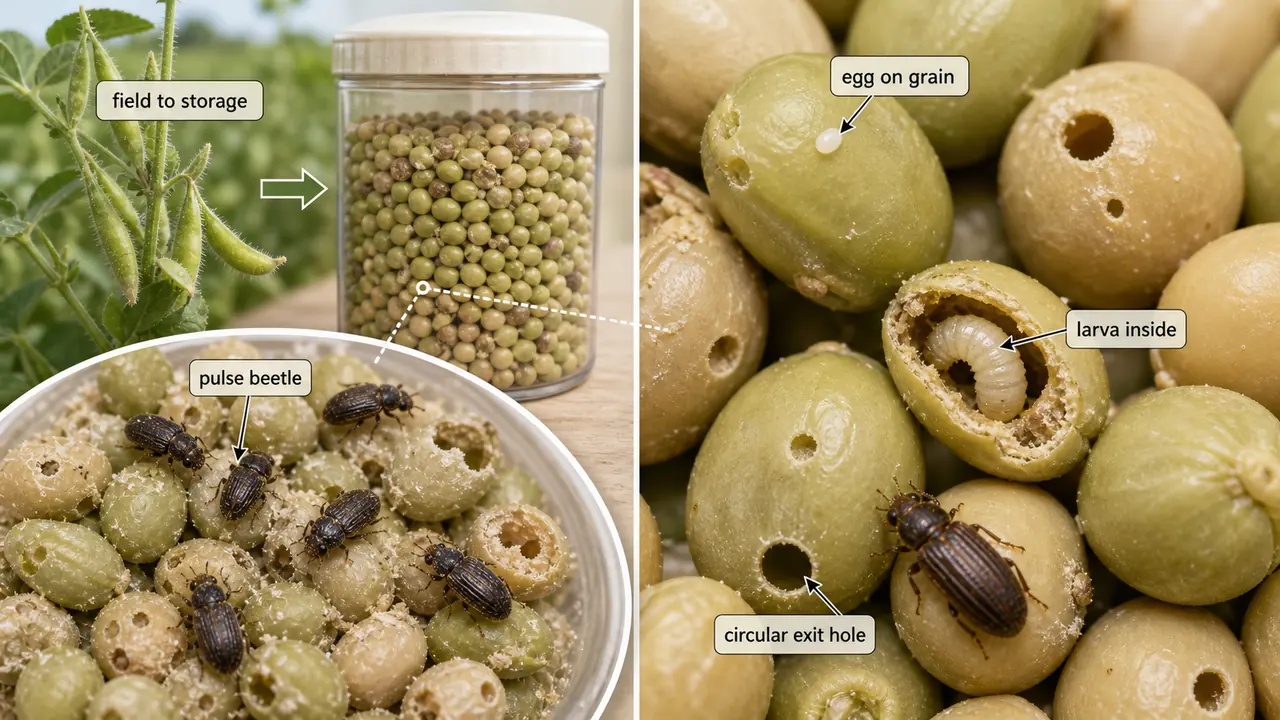
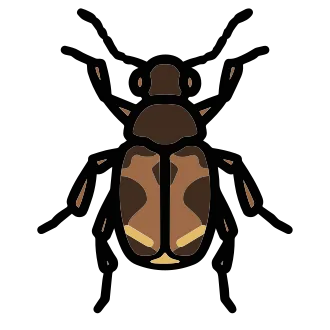
Scientific Name: Callosobruchus maculatus
Family: Bruchidae | Order: Coleoptera
This beetle is the bane of stored pulses — moong, urad, chana, arhar, and cowpea. Unlike cereal pests, it begins its attack even before harvest.
Damage Symptoms
- Adults lay individual eggs directly on the surface of pulse grains
- Grubs emerge and bore into the inner contents of the pulse
- Pupation also occurs inside the pulse
- Characteristic circular exit holes on pulse grains
- The entire life cycle (egg to adult) is completed inside a single pulse grain
- Severe infestation makes pulses unfit for consumption and germination
IMPORTANT
Callosobruchus maculatus can infest pulses in the field before harvest — a fact that distinguishes it from most storage pests. The entire life cycle is completed inside a single pulse grain. This is frequently asked in IBPS AFO, NABARD, and FCI exams.
Agricultural example: Dal millers in Rajasthan and Maharashtra routinely check incoming pulse lots for circular holes — the signature of pulse beetle. Infested lots fetch significantly lower prices because the beetles destroy the cotyledons, making the pulses unfit for splitting into dal.
Older exam books may also list Callosobruchus chinensis alongside or instead of C. maculatus for stored pulses. Treat both as pulse beetles, but remember the stable concept: infestation often starts in the field before harvest and then continues in storage. For small seed lots, coating pulses with thin films of edible oils is a classical preventive measure because it discourages egg laying and reduces successful larval establishment.
5. Cigarette Beetle
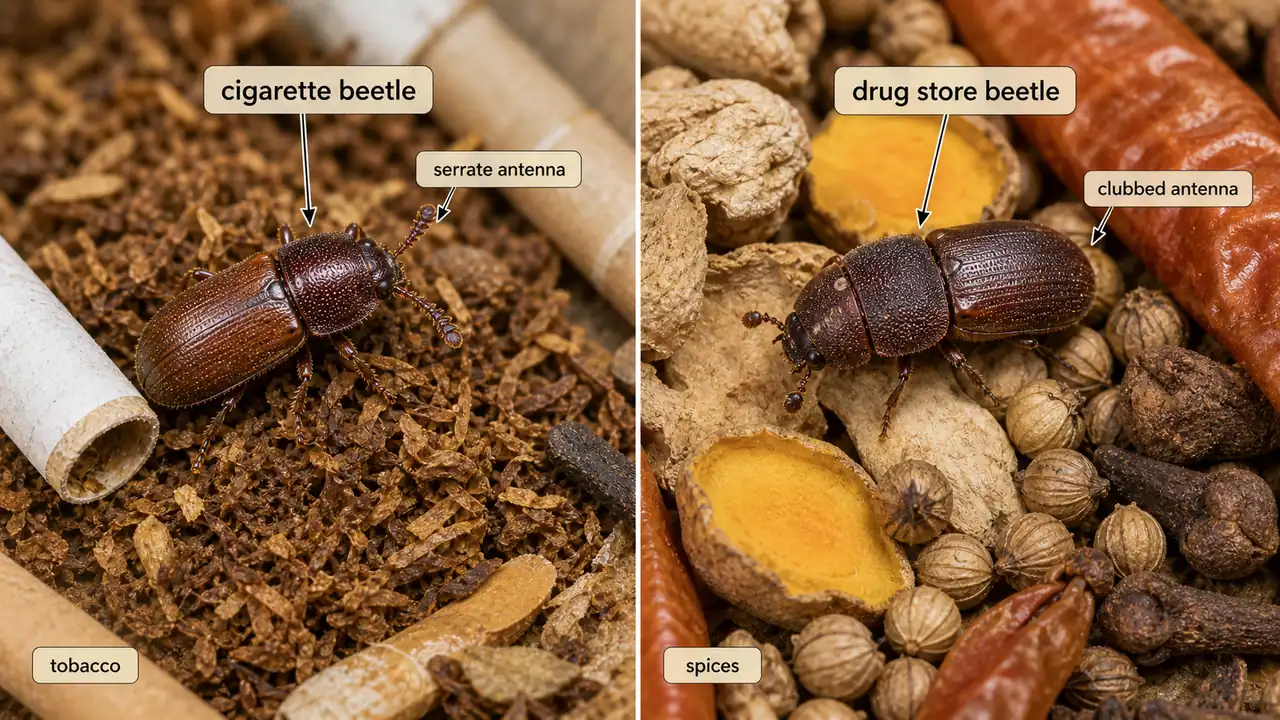
Scientific Name: Lasioderma serricorne
Family: Anobiidae | Order: Coleoptera
Damage Symptoms
- Grubs and adults feed on stored tobacco, turmeric, chillies, and ginger
- Also damages dried fruits, spices, and cereals
- Leaves irregular holes and tunnels in stored products
- Named "cigarette beetle" because of its association with stored tobacco
Agricultural context: In the tobacco curing barns and spice warehouses of Andhra Pradesh and Kerala, this beetle causes significant losses. Turmeric farmers in Erode (Tamil Nadu) must protect their dried turmeric fingers from this pest.
6. Drug Store Beetle
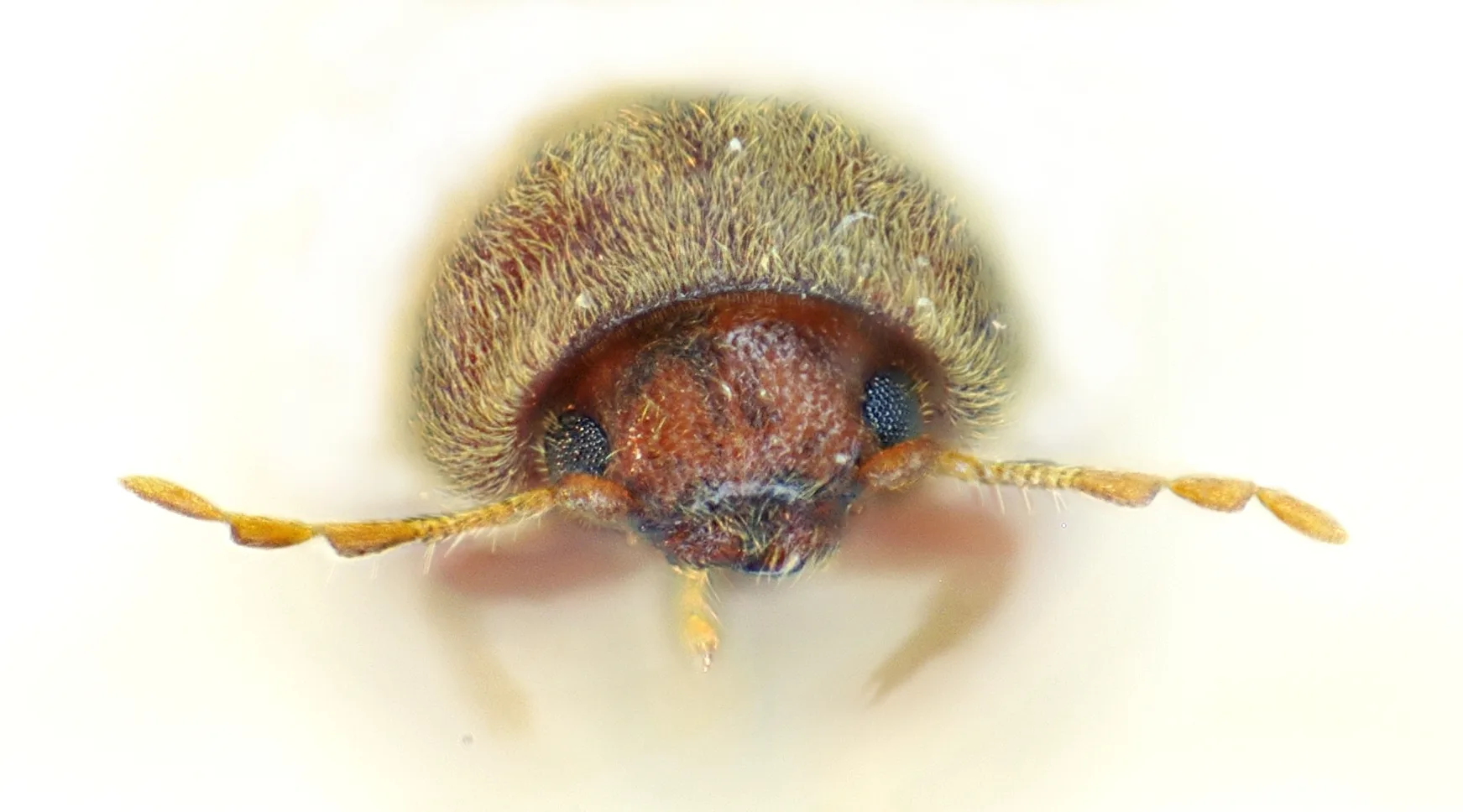
Scientific Name: Stegobium paniceum
Family: Anobiidae | Order: Coleoptera
Damage Symptoms
- Grubs feed on stored turmeric, ginger, and coriander seeds
- Also attacks dried herbs, spices, and pharmaceutical products
- Similar in appearance to cigarette beetle but slightly larger
Cigarette Beetle vs. Drug Store Beetle
| Feature | Cigarette Beetle | Drug Store Beetle |
|---|---|---|
| Scientific name | Lasioderma serricorne | Stegobium paniceum |
| Primary hosts | Tobacco, turmeric, chillies | Turmeric, ginger, coriander |
| Size | Smaller (2-3 mm) | Slightly larger (2.5-3.5 mm) |
| Antennae | Serrate (saw-toothed) | Clubbed (last 3 segments enlarged) |
| Family | Anobiidae | Anobiidae |
TIP
Mnemonic to distinguish them: "Lasioderma Loves tobacco Leaves" (Cigarette beetle). "Stegobium attacks Spices and Store medicines" (Drug Store beetle). Both belong to family Anobiidae.
7. Tamarind Beetle
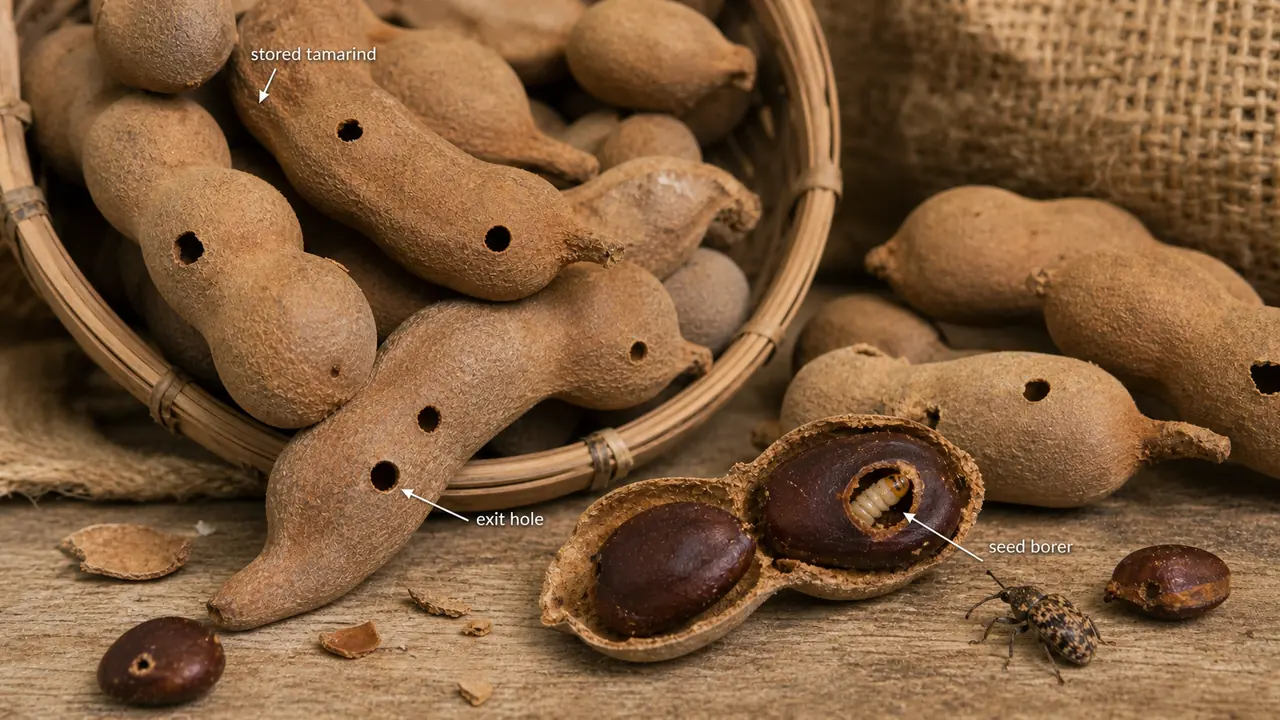
Scientific Name: Pachymeres gonagra
Family: Bruchidae | Order: Coleoptera
- Specific pest of stored tamarind
- Grubs bore into tamarind pods and seeds
- Important in tamarind-producing regions of Tamil Nadu, Andhra Pradesh, and Madhya Pradesh
8. Sweet Potato Weevil
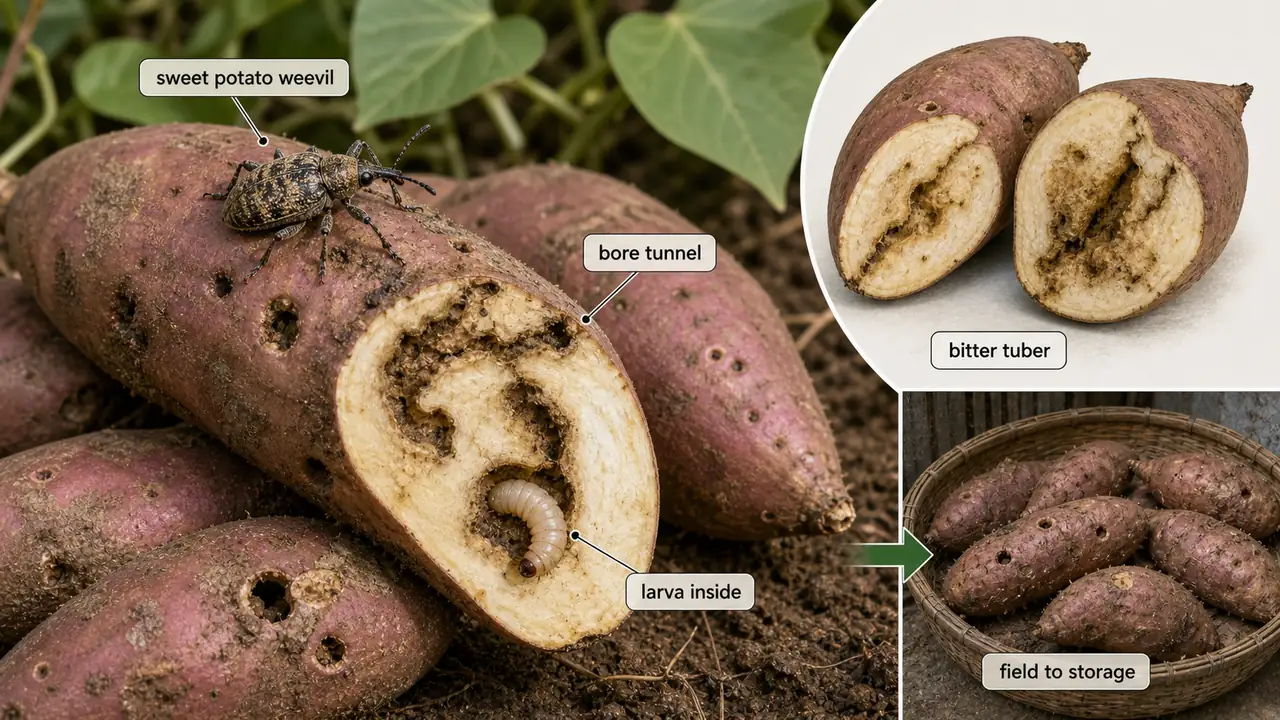
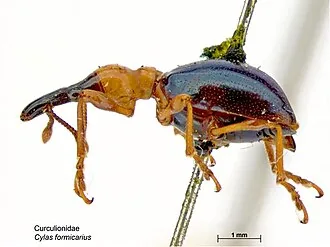
Scientific Name: Cylas formicarius
Family: Brentidae | Order: Coleoptera
Damage Symptoms
- Grubs feed on the tuber by boring into it
- Infested tubers develop a characteristic bitter taste due to the production of toxic terpenes
- Both a field pest and a storage pest — infestation begins in the field and continues in storage
- Cut pieces of sweet potato tuber are also used as simple trap baits to attract and collect weevils in field sanitation programs
Agricultural context: Sweet potato growers in Odisha and Bihar face heavy losses from this weevil. Tubers with even minor weevil damage become completely inedible due to the bitter toxins produced in response to larval feeding.
Khapra Beetle — Trogoderma granarium (Dermestidae: Coleoptera)
IMPORTANT
Khapra beetle is a quarantine pest of stored grain. Uniquely survives in low humidity and high temperature — dangerous in hot, dry warehouse environments where most other pests do not thrive.
| Feature | Khapra Beetle |
|---|---|
| Scientific name | Trogoderma granarium |
| Family: Order | Dermestidae: Coleoptera |
| Thrives in | Low humidity + high temperature |
| Status | Quarantine pest |
| Host | Wheat, barley, stored grain products |
NOTE
Most suitable fumigant for quarantine treatment = Methyl bromide.
Additional Primary Pests
Grain Weevil
Scientific Name: Sitophilus granarius
Family: Curculionidae | Order: Coleoptera
- Often recalled as the classical wheat weevil
- A primary internal feeder of whole cereal grains, closely paralleling rice-weevil biology in storage questions
Potato Tuber Moth
Scientific Name: Phthorimaea operculella
Family: Gelechiidae | Order: Lepidoptera
- Larvae bore into the tuber and feed on the pulp
- Attacked tubers develop bacterial infection, making them unfit for consumption
- Important pest of both field and cold storage potatoes
- Particularly damaging in potato-growing regions of Uttar Pradesh, West Bengal, and Himachal Pradesh
Arecanut Beetle
Scientific Name: Araecerus fasciculatus
Family: Anthribidae | Order: Coleoptera
- Pest of stored arecanut (betel nut)
- Also known as Coffee Bean Weevil
- Important in arecanut-growing regions of Karnataka and Kerala
Groundnut Beetle / Groundnut Bruchid
Scientific Name: Caryedon serratus
Family: Bruchidae | Order: Coleoptera
- Important storage pest of groundnut
- The grub is the main damaging stage, feeding inside kernels like other bruchids
Field Diagnosis: Stored Grain Damage — Which Pest?
When you find damaged grain in a godown, check these signs:
Step 1: Examine the grain
- Single round exit hole per grain, grain hollowed inside? → Rice Weevil (S. oryzae) — snout-bearing beetle; most common storage pest
- Grain completely powdered, only husk remains? → Lesser Grain Borer (R. dominica) — most destructive; causes more flour than weevil
- Small exit hole + white frass on surface layer of grain bag? → Angoumois Grain Moth (S. cerealella) — damages only top 15-20 cm layer of bag
- Round holes in pulses (dal), beetles exit? → Pulse Beetle (C. maculatus) — starts infestation in the field itself before harvest
Step 2: Check the environment
- Fine powdery residue ("frass") between grains? → Internal feeder present — primary pest
- Webbing or silk threads binding grains together? → External feeder — secondary pest (see next lesson)
- Warm humid godown (>27°C, >60% RH)? → Ideal conditions for ALL storage pests — check for cross-infestation
exams practical tip: Primary pests (internal feeders) are more dangerous than secondary pests because they can infest intact, undamaged grain. You cannot detect them until the adult exits. Always check for "hidden infestation" by cutting 100 random grains — if >5% show internal damage, fumigate immediately.
Exam Tips and Mnemonics
TIP
Mnemonic for primary storage pests (internal feeders): "Rice Loving Ants Pick Cigarettes Daily Till Sunset"
- R = Rice Weevil (Sitophilus oryzae)
- L = Lesser Grain Borer (Rhyzopertha dominica)
- A = Angoumois Grain Moth (Sitotroga cerealella)
- P = Pulse Beetle (Callosobruchus maculatus)
- C = Cigarette Beetle (Lasioderma serricorne)
- D = Drug Store Beetle (Stegobium paniceum)
- T = Tamarind Beetle (Pachymeres gonagra)
- S = Sweet Potato Weevil (Cylas formicarius)
Key exam distinctions:
- Only Lepidopteran among common primary storage pests: Angoumois Grain Moth
- Starts infestation in the field: Pulse Beetle, Sweet Potato Weevil, Potato Tuber Moth
- Attacks upper layer only: Angoumois Grain Moth
- Leaves only husk behind: Lesser Grain Borer
Summary Cheat Sheet
| Concept / Topic | Key Details |
|---|---|
| Most important pest of stored rice | Sitophilus oryzae (Rice Weevil); Curculionidae; develops entirely inside grain |
| Most destructive pest of stored wheat | Rhyzopertha dominica (Lesser Grain Borer / Auger Beetle); Bostrichidae; leaves only husk behind |
| Only Lepidopteran primary storage pest | Sitotroga cerealella (Angoumois Grain Moth); Gelechiidae; attacks upper layer of heap |
| Entire life cycle inside pulse grain | Callosobruchus maculatus (Pulse Beetle); Bruchidae; can infest pulses before harvest |
| Feeds on stored tobacco and turmeric | Lasioderma serricorne (Cigarette Beetle); Anobiidae; serrate antennae |
| Feeds on turmeric, ginger, coriander | Stegobium paniceum (Drug Store Beetle); Anobiidae; clubbed antennae |
| Pest of stored tamarind | Pachymeres gonagra (Tamarind Beetle); Bruchidae |
| Causes bitter taste in sweet potato | Cylas formicarius (Sweet Potato Weevil); Brentidae; field + storage pest |
| Causes bacterial infection in potato | Phthorimaea operculella (Potato Tuber Moth); Gelechiidae; field + storage pest |
| Post-harvest losses in India | About 10% of total food grains |
| Safe insecticide for warehouses | Malathion |